Sunday, February 01, 2026

‘We could see shortages’: Experts warn of possible impacts tariffs have on health-care sector

ByTammy Ibrahimpoor
Published: January 29, 2026 

The Canadian Health Coalition’s Steven Staples discusses how tariff-driven disruptions underscore vulnerabilities in Canada’s drug and medical supply chains.


As the United States continues to place tariffs on nations around the world, economists have focused on inflation, markets and trade balances. But researchers warn the fallout could also show up in doctors’ offices, grocery aisles and hospital budgets.

In a new analysis published by The British Medical Journal (BMJ), researchers Courtney McNamara of Newcastle University and Benjamin Hawkins of the University of Cambridge argue that trade policy is a powerful, and often overlooked, driver of public health, impacting access to medicines and food, as well as job security and the financial stability of health systems.

“We tend to hear a lot about economics, about markets, but actually trade shapes everyday lives,” McNamara, a co-author of the study, said in a video interview with CTVNews.ca. “It shapes the price and availability of food, the cost of medicines. It shapes how secure people feel in their jobs.”

Researchers are warning about the impacts of tariffs on access to healthcare. (Pexels)

Medicine access and rising costs


One of the most immediate concerns involves pharmaceuticals and medical supplies, the researchers say. Trade rules influence drug pricing and global supply chains, and even the threat of tariffs can inject uncertainty into systems that rely on predictability.

In Canada, advocates say tariff-driven disruptions underscore vulnerabilities in both drug and medical supply chains.

“We should all be able to supply our own health-care needs, such as medication (and) vaccines, right here in Canada,” said Steven Staples, national director of policy and advocacy with the Canadian Health Coalition, in a video interview with CTVNews.ca.

“It wasn’t too long ago during the (COVID-19) pandemic that what was happening in drug (manufacturing) far around the world was having an impact on Canadians.”

Staples said Ottawa should make plans for medical self-sufficiency, just like it does in other areas like the defence sector.

“Just like the prime minister is looking at national security and trying to build weaponry in Canada, we should all be able to supply our own health-care needs such as medication (and) vaccines … right here in Canada,” he said.

Shelves of medication are seen at a pharmacy.

Justin Bates, CEO of the Ontario Pharmacists Association, said Canada’s deep economic integration with the U.S. makes the health sector particularly sensitive to trade shocks, even when drugs themselves are not directly targeted.

“Pharmaceuticals are not immune to those tariffs and economic pressures,” Bates said in a video interview with CTVNews.ca, noting that while most drugs in Canada are imported, rather than manufactured domestically, hospitals and pharmacies rely heavily on devices and equipment that are tied to cross-border supply chains.

“We could see shortages, we could see an increase in prices and things of that nature,” he said. “It does have a cascade impact across the system.”

As an example, he referred to the tariffs on materials such as steel and aluminum, saying they could cascade into higher prices and shortages for medical devices, including those used to manage chronic conditions like diabetes.

The BMJ analysis notes that brand-name drugs and medicines produced by smaller U.S. manufacturers may be especially vulnerable to price hikes, but similar pressures can spill across borders in highly integrated markets.

“Everybody’s feeling the impact of the tariffs or planning for the impact,” said Paul Sarnese, former president of the International Association for Healthcare Security and Safety, in a video interview with CTVNews.ca. “Pharmaceutical prices are going to increase and ultimately that’s going to get passed to the insurance providers and then ultimately to the patients.”

Sarnese said rising costs could prompt patients to postpone procedures or medications they can no longer afford, only to require more expensive care later.

A customer shops in the produce section at a Metro grocery store in Toronto on Friday, Feb. 2, 2024.

Food prices and nutrition

Tariffs can also shape what people eat. The study notes that higher import duties on fresh produce can push grocery prices upward, while tariffs on metals used in food packaging may raise the cost of staples such as canned beans and soup.

“When we see prices increase on these sorts of goods, then families who are less able to absorb price shocks end up eating sometimes less healthy food,” McNamara said. “This can have domino impacts on people’s nutritional quality and intake.”

Lower-income households are particularly exposed, the researchers argue, because they spend a larger share of their income on food and are more likely to switch to cheaper, ultra-processed options when prices rise.
Jobs, economic stress and health systems

Study authors say employment is central to the political case for tariffs and a critical determinant of health.

“When people feel their job is under threat, (their) health suffers,” McNamara said.

Staples said trade-related layoffs can also have indirect effects on health-care access in Canada, particularly when people lose employer-based drug coverage, increasing pressure on public systems and household budgets.

He also warned against Ottawa’s public-sector job cuts, saying it will weaken health-care oversight.

“Many of those jobs are responsible for making sure that our drugs are safe, that our food is safe, that health care is being provided for in the provinces,” he said. “If we see those jobs cut, that is going to further create an insecurity for Canadians.”

At a broader level, the BMJ study argues that tariffs can fuel inflation and economic volatility, squeezing government revenues needed to fund health and social programs.

Researchers warn about the impacts of tariffs on access to health care. (Pexels)


A call to bring health into trade debates


The authors say the global tariff war should be a wake-up call for the health community and governments to consider the importance of health impacts earlier, not as an afterthought.

“We shouldn’t just be thinking in terms of macroeconomic figures and stock markets and economic growth, but how these things are impacting people’s daily lives,” McNamara said, adding that health professionals should be part of the trade policy making process.

Staples said that emphasis is especially important in Canada.

“We really want to see the federal government paying much more attention to health care … because of the essential role that it provides for Canadians,” he said.

For Bates, the stakes are ultimately measured at the pharmacy counter.

“Where this really hits home is when people can’t access their medications, or they’re so expensive that continuity of care is impacted,” he said. “That’s when these trade decisions stop being abstract and become very real for Canadians.”

Tammy Ibrahimpoor

CTVNews.ca National Digital Producer
OPINION
Eric Ham: Reality check on Trump’s threat of 100% tariffs on Canada

Prime Minister Mark Carney on June 16, 2025, in Kananaskis, Canada, left, and U.S. President Donald Trump on Oct. 7, 2025, in Washington. (AP Photo/Mark Schiefelbein, left, Jacquelyn Martin)


ByEric Ham
Published: January 29, 2026 

Eric Ham is based in Washington, D.C. and is a political analyst for CTV News. He’s a bestselling author and former congressional staffer in the U.S. Congress and writes for CTVNews.ca.


Threatening Canada with 100 per cent tariffs, U.S. President Donald Trump is reverting to an overused policy tool to menace and disrupt one of America’s largest trading partners.

Doubling down on his recent jabs at Canada, he said, “Canada is systematically destroying itself” and called “the China deal” a “disaster.” It’s unclear what precipitated this latest round of criticisms. However, it’s unlikely the threat will carry the same sting this time around.

It’s important to note, 80 per cent of the goods that enter the U.S. through Canada are in fact protected under the Canada-United States-Mexico Agreement (CUSMA). Moreover, many expect a pending U.S. Supreme Court ruling will declare the White House tariff authority unconstitutional.

Such a transformative decision will only further undermine the president’s trade powers, making this latest attack meaningless and impotent.

Trade backbone under constant assault

CUSMA is the largest free trade region in the world. It has helped raise the standard of living for the people of all three member countries. The agreement has been widely described as the backbone of North America’s competitiveness. Yet, the trade pact is under constant assault by the White House.More opinions and expert analyses

Also, time is finally running out on the president’s weaponized trade authority, which has stifled the regional economy since his return to office. Trump’s unhinged tirades aimed squarely at Canada continue to cast a pall over its markets, industries, and workers. These blistering skirmishes are happening even as CUSMA has been a boon for the region over the past five years.

In fact, since CUSMA went into effect, intra-regional trade in goods and services has grown by 37 per cent, driven largely by growth in industrial supplies and the automotive sector. In 2024, for the second consecutive year, Mexico was the top U.S. trading partner, reaching nearly US$930 billion in total trade. Canada followed closely at US$903 billion. Both were well ahead of U.S.-China trade flows.

The agreement also helped spur a 16 per cent rise in foreign direct investment (FDI) across the region, according to data from the United Nations Conference on Trade and Development (UNCTAD). The same data shows the United States remained the top global destination for FDI, attracting US$278 billion in 2024. Canada rose to sixth place at US$64 billion, up from tenth in 2019.

The region has benefited mightily from the trade deal, and its continued and sustained growth only fortified each nation collectively and independently.

However, according to a report from Washington-based think tank Center for Strategic and International Studies, Trump’s decision to enact crippling tariffs have only “weakened investor confidence, jeopardized the region’s hard-won gains, and risk eroding North American competitiveness at a critical moment.”

Leverage ahead of CUSMA negotiations


Throughout 2025, President Trump followed through on many of his threats, issuing import duties on a range of Canadian products including aluminum, steel, and copper.

Refusing to stand idle as its economy was under attack, the prime minister criss-crossed the globe pitching Canada’s stability, enormous energy reserves, critical earth minerals, and geostrategic location as key selling points to would-be partners.

After notching wins including a breakthrough deal with Beijing, Mark Carney and his negotiating team are walking into upcoming CUSMA negotiations with tremendous leverage and clout. Armed with an ample and robust trade agreement, newly established bilateral ties, and a renewed focus internally, Ottawa is prepared to weather the onslaught from Washington.

Still, considering the intensity and rapidity of the latest threats from the president, negotiators are in for a maddening ordeal even if Trump’s only real leverage at this point is the exit.

Threats and barbs losing their sting

In response to hardline rhetoric emanating from the White House, Mexico’s President Claudia Sheinbaum opted for diplomacy over confrontation. Canada, however, has responded with a sharper tone.

Carney declared, “Our old relationship with the United States, a relationship based on steadily increased integration, is over.” Eschewing retaliatory measures, Ottawa is confronting the truculence from the White House with resolute firmness, projecting measured calmness and downplaying the offences as a negotiating ploy. The prime minister is wise to stake out such a position. Just a week ago the president backed down from his efforts to force a takeover of Greenland.

A united effort by Europe countered the threat with its own economic offensive. More hardships were reportedly placed on the table including the shuttering of American military bases and even retreating from future FDI. Once again, TACO Trump reared its head and the American president, fresh off a takeover of Venezuela, ran up against a continent that, with the help of Canada’s PM, found its resolve. Now, where there was once trepidation, there is resolve. Where Trump’s scorn once evoked trembling, there is now ambivalence. Where Trump’s growing belittling sparked alarm, now Canadian leaders express exasperation.

America’s metamorphosis into tyranny might be occurring in real time domestically. However, the strongman threats and barbs have finally lost their sting abroad. Outwitted, outmanoeuvred and outplayed, Canada’s “middle-power” standing has forced Ottawa to deftly end its reliance on its biggest trading partner.

The prime minister parlayed seasoned economic strategy and shrewd diplomacy to sell Canada’s strengths, and is now prepared to leverage newfound gains into a lasting pathway forged under relentless and unyielding pressure.


Eric Ham

CTV News Political Analyst

Trump amps up trade war with Canada by targeting Bombardier

By Lynn Chaya
and
Dorcas Marfo
Updated: January 30, 2026 


U.S. President Donald Trump is threatening to impose steep tariffs on Canadian-made aircraft, escalating a dispute over aviation certification that he claims has unfairly blocked U.S. jet sales in Canada.

Trump made the threat in a social media post Thursday, accusing Canada of “wrongfully” refusing to certify several models of U.S.-made Gulfstream jets and calling the process a barrier to U.S. aircraft sales north of the border.

Trump said his administration would respond by decertifying Canadian-made aircraft in the U.S., including jets produced by Bombardier, unless Canada moves to approve the Gulfstream models.

He also warned that if the issue is not “immediately corrected,” the U.S. will impose a 50 per cent tariff on any aircraft sold from Canada into the U.S. market, a move that could have major implications for the aerospace sector on both sides of the border.

Jet planes are assembled at Bombardier's aircraft assembly centre in Mississauga, Ont., on Monday, Dec. 8, 2025. THE CANADIAN PRESS/Sammy Kogan

Bombardier released a statement late Thursday night, acknowledging that they’ve seen Trump’s post and are in contact with the federal government.

“Our aircraft, facilities and technicians are fully certified to FAA standards and renowned around the world,” the company said, mentioning that they are investing in expanding their U.S. operations.


“We hope this is quickly resolved to avoid a significant impact to air traffic and the flying public,” Bombardier added.

Bombardier and Gulfstream are longtime rivals in the global business jet market, competing directly in the large-cabin, long-range category favoured by corporate and government clients – the same models cited in Trump’s social media post

.
Workers and media take pictures as the new Bombardier Global 8000 high-speed business jet is presented at an event celebrating its entry-into-service at the company's aircraft assembly centre in Mississauga, Ont., on Monday, Dec. 8, 2025. THE CANADIAN PRESS/Sammy Kogan

Among them are the Gulfstream G500 and G600, which entered service earlier and are widely used by corporate and government operators, as well as the newer G700 and G800, the company’s flagship long-range jets.

Bombardier, headquartered in Montreal, manufactures the Global series of business jets and is one of Canada’s largest aerospace employers.

The Gulfstream aircraft compete directly with Bombardier’s jets, including the Global 6500, Global 7500 and Global 8000, which dominate the same long-range category and are already certified for operation in both Canada and the U.S.

Certification determines whether aircraft can be sold, registered and flown in a country. Any delay or refusal can put manufacturers at a competitive disadvantage.

CTV’s aviation specialist Phyl Durdey says Trump does not have the ability to decertify the aircraft them without an investigation.
Trump has no authority to decertify aircraft: expert

CTV News aviation expert Phyl Durdey pushed back on U.S. threats to target Canada’s aviation sector, saying Trump has no authority to “arbitrarily” decertify Canadian aircraft.

In an interview with CTV News Channel on Thursday, Durdey said the U.S. Federal Aviation Administration (FAA) certifies or decertifies all aircraft in the U.S.

He also noted that the U.S. has “lots of operating aircraft that are supplied from Canada,” with thousands of Canadian-built jets flying south of the border, too.

The U.S. military itself relies on Bombardier aircraft, using a fleet of modified Global Express jets known as the BACN aircraft or Air Force E-11A, one of which is currently being deployed to the Middle East.

Durdey warned any move against Bombardier would hurt U.S. economic interests as much as it would Canada’s.

Lynn Chaya
CTVNews.ca Breaking Digital Assignment Editor

Dorcas Marfo

CTVNews.ca Journalist


Experts question U.S. president’s threat to decertify new Canadian planes


ByThe Canadian Press
Updated: January 30, 2026 


MONTREAL — Experts are casting doubt on U.S. President Donald Trump’s ability to ban new Canadian-made aircraft from American skies in a proposed move that would deal a blow to plane makers, airlines and travellers on both sides of the border.

Regulatory authority for plane certification in the U.S. rests with the Federal Aviation Administration, former Canadian Transportation Agency member Jean-Denis Pelletier said.

“The FAA is controlling the certification,” he said. “Mr. Trump has no authority to do that.”

Added John Gradek, who teaches aviation management at McGill University: “The president doesn’t decertify; the FAA decertifies.”

On Thursday, Trump singled out Bombardier Inc. in a threat to decertify and tariff Canadian-made aircraft, marking the latest escalation of trade tensions between the two countries.

The president inaccurately alleged in a Truth Social post that Canada has refused to certify four types of business jets made by Bombardier-rival Gulfstream, based in Savannah, Ga., framing the decision to hold off as illegal. Canada has certified two — the G500 and the G600, but not the G700 or G800.

“We are hereby decertifying their Bombardier Global Expresses, and all Aircraft made in Canada, until such time as Gulfstream, a Great American Company, is fully certified, as it should have been many years ago,” Trump said.

The U.S. administration later tempered that statement, indicating the ban would apply only to new aircraft rather than the more than 5,400 Canadian-built planes and helicopters registered in the United States.

“Subsequent clarifications by administration officials suggest that Canadian-made aircraft in operation already would not be grounded due to a move to decertify,” said National Bank analyst Cameron Doerksen in a report. A White House official confirmed to The Canadian Press that only aircraft that have yet to roll off the assembly line would be affected.

Aircraft constructed in Canada include Bombardier luxury jets and regional planes, A220 single-aisle jets made by French aerospace giant Airbus and helicopters from Texas-based Bell Textron. De Havilland Aircraft of Canada also produces the Dash 8-400 turboprop along with a number of other aircraft.

Historically, plane groundings by regulators have related strictly to safety, such as the Boeing 737 Max 8 being banned from the skies for 20 months during the first Trump administration.

“Threatening action by a safety regulator for political purposes would set a dangerous precedent in the aerospace industry — the FAA may not even have legal authority to ground a plane at the whim of the president,” Doerksen said.

The prospect of decertifying new planes even as identical aircraft already in service retain their airworthiness posed another head-scratcher.

“This is really strange, because certification of aircraft is a very, very long process. It takes years,” said Ross Aimer, CEO of California-based Aero Consulting Experts.

Gradek speculated that Trump’s threat to Canadian aircraft could stem from business interests at Virginia-based General Dynamics, which owns Gulfstream.

“Is there a safety concern with these airplanes? Is there a structural problem with these airplanes? No, you’re doing it for commercial reasons.”


In the lofty world of ultra-long-range business jets, Bombardier and Gulfstream are head-to-head rivals, with the Global series battling for market share against Gulfstream’s latest models.

The G700 and G800, which have not been green-lit in Canada, have been flagged because of possible de-icing concerns.

Canadian regulators typically follow their counterparts in the U.S. and Europe, where the planes have been approved.

But the U.S. certificate is conditional. Gulfstream has until the end of this year to prove that the two plane models function “properly under the probable operating conditions where ice may form in the fuel system,” according to a temporary exemption granted by the FAA in January 2024.

Any blow to Bombardier would be a blow to American companies, too.

Bombardier said it employs 3,000 people across nine sites south of the border and has 2,800 U.S. suppliers. The company’s jets typically boast at least 40 per cent U.S. content.

Meanwhile, the U.S. enjoys a large trade surplus with Canada in aerospace, meaning the general trade imbalance Trump has cited to justify other levies does not apply.

The International Association of Machinists and Aerospace Workers highlighted the tight-woven integration of the sector’s supply chains across the neighbouring countries, and the consequences of a potential tariff.

“It makes you less competitive to the U.S. market. By being less competitive, you sell less aircraft,” said David Chartrand, who heads the union’s Canadian contingent, in a phone interview from Toronto.

“It means job reductions. It means loss of contracts ... There would immediately be casualties on that side of the border also.”

Chartrand, whose union represents some 15,000 aerospace and aviation workers in Canada, stressed that politics should have no influence over safety matters.

“You can’t weaponize the certification process and use it as a threat like that,” he said. “There’s no winner in this.”

Bombardier’s share price dropped about six per cent to close at $232.61 on the Toronto Stock Exchange.

Transport Minister Steven MacKinnon said in a social media post that departmental officials were in touch with their U.S. counterparts. He also said he spoke with Bombardier CEO Éric Martel on Thursday night as well as executives at General Dynamics.

“We are going to continue to support the aerospace industry and to ensure that we are there for Bombardier,” added Foreign Affairs Minister Anita Anand in an address at the Montreal Council on Foreign Relations — a speech that Bombardier executives skipped as they went into crisis mode.

A few kilometres north in the Montreal suburb of Laval, Jean-Denis Pelletier called for calm while warning about the economic risks should the groundings and tariff go ahead.

“I don’t think we have to panic,” said the former transportation agency official. “But this would affect very dangerously our economy in Quebec.”

This report by The Canadian Press was first published Jan. 30, 2026.

— With files from Kelly Geraldine Malone in Washington, D.C., and Dylan Robertson in Ottawa

Christopher Reynolds, The Canadian Press


Hundreds out of work as GM Canada cuts third shift at Oshawa plant

NATIONALISE IT UNDER WORKERS CONTROL


By Codi Wilson
Updated: January 29, 2026 


Automotive Parts Manufacturers’ Association President Flavio Volpe on the Oshawa GM plant cutting their third shift and if there are more layoffs coming.

More than 1,000 workers will be out of a job come Friday morning following news that General Motors (GM) will be cutting the third shift at its Oshawa plant, the union representing employees says.

According to Jeff Gray, president of Unifor Local 222, which represents GM workers in Oshawa, about 500 direct employees will be impacted by the layoffs, along with more than 500 other workers who are employed with companies that are part of the plant’s supply chain.

In a statement, Unifor said the move comes as GM shifts jobs to the United States.

“General Motors has made a clear decision to cave to Donald Trump rather than stand up for its loyal Canadian workforce, making the workers in Oshawa pay for that appeasement with their jobs,” Unifor National President Lana Payne said in a statement on Thursday.

“It is misguided for General Motors to think it can get away with consistently diminishing their production footprint in Canada and still be the number one seller of vehicles in the Canadian marketplace. GM’s decision is not only short sighted but fails to recognize the mood of Canadians and Canadian workers.”

The automotive manufacturing company initially said it would cut the third shift last year but later pushed the timeline, saying it would operate three shifts at the plant until early 2026.

“As announced last year, Oshawa Assembly will return to two shifts of production beginning February 2, while continuing preparations to build the next generation of gas‑powered full‑size pickups, reinforcing Oshawa’s future in GM’s key full‑size truck program," GM said in a statement.


“Approximately 500 employees will be placed on layoff when the plant returns to two-shifts of production and GM has worked closely with Unifor to support impacted employees through this transition with comprehensive separation packages, retirement support, and other benefits. We thank and recognize the employees impacted for their contributions.”

‘Latest blow’

Unifor, meanwhile, said it presented the company with a “viable plan” to retain the third shift, a proposal they said was rejected by the company.

Unifor described the layoffs as the “latest blow” to the auto sector in Ontario, pointing to job losses at both Motors CAMI Assembly Plant in Ingersoll, Ont. and the Stellantis Assembly Plant in Brampton.

“Even in a brutal trade war auto companies can make different decisions,” Payne continued.

“Decisions that respect the contributions and skilled work of Canadian autoworkers. Decisions that show Canadian consumers that these automakers actually care about the market they sell into, by stepping up to protect Canadian jobs and building here.”

Last year, GM announced plans to hire an unspecified number of temporary employees at its Fort Wayne, Ind., assembly plant to increase production amid U.S. tariffs on imported vehicles.

The U.S. facility manufactures the GMC Sierra truck and the light-duty Chevrolet Silverado.

The Oshawa Plant currently only assembles light and heavy-duty Chevrolet Silverado pick-up trucks.

“I think we are all upset. We launched this truck in 2021. We hit every metric GM wanted to with productivity and safety and quality. Our members took these jobs thinking that they had finally a good job with a good collective bargaining agreement,” Gray, of Unifor, said.

“And a few short years later, because of things that are out of our control… we are losing our third shift. And they are sending 50,000 of our units down to Fort Wayne, Ind., and that doesn’t sit well with us.”

Premier Ford calls layoffs ‘very disappointing’

Speaking about the layoffs at an unrelated news conference on Thursday morning, Premier Doug Ford said the province has a plan to provide support to workers.

“We are going to make sure they have opportunities in the defence sector, life sciences sector, other areas, and we will be there for them 24/7,” Ford said, calling GM’s decision “very disappointing.”

“This goes back to our point that we have to move quicker and faster and make sure that the federal government comes in to support not only these workers but the overall auto sector. We have to be more competitive. We have to get rid of the EV mandate to make ourselves more competitive.”

Gray said the union wants to see the federal government secure a trade deal that will protect the country’s auto workers.

Jeff Gray, president of Unifor Local 222, speaks to CP24 about recent layoffs at GM's Oshawa plant.

“It is devastating news. We have a large portion of our membership that won’t have a job come tomorrow morning,” he said.

“We are speaking to members, we are speaking to politicians. We will speak to anybody who will listen to us. We have to continue this fight.”

Codi Wilson

Journalist, CP24.com


CIBC forecasts wider discount for Alberta heavy oil in 2026 as Venezuelan supply looms

ByThe Canadian Press
Updated: January 13, 2026 at 2:00PM EST


The oil tanker named Xanthos Eos steam on Lake Maracaibo, Venezuela, Wednesday, Jan. 7, 2026. (AP Photo/Edgar Frias)

CALGARY — Analysts at CIBC are forecasting a wider discount on Alberta heavy crude this year as U.S. plans to rebuild Venezuela's ailing industry dominate headlines.

The bank estimates the differential between Western Canada Select, the heavy Alberta blend, and West Texas Intermediate, the U.S. light oil benchmark, will average US$14.25 a barrel in 2026.

For 2025, the price gap is estimated to have averaged US$11.30 as Canadian producers benefited from the first full year of operations of the Trans Mountain pipeline expansion to the West Coast, enabling exports to Asia.

Venezuelan and Alberta oilsands crude both have a thick, tarry consistency and require specialized equipment to refine into products like gasoline and diesel. Refineries on the U.S. Gulf Coast are set up to handle that type of oil, so any meaningful increase in Venezuelan supplies on the market would compete with imports from Alberta and could weigh on WCS prices.

The majority of the 4.4 million barrels per day Canada exports to the U.S. winds up in the Midwest, while about one-tenth heads to the Gulf.

"In the near term, we expect news around resuming investment in Venezuela and targeting production restarts will dominate headlines and cause pressure on WCS-WTI basis (as well as heavy oil realizations for Western Canadian producers)," the CIBC analysts wrote.

The U.S. has been working to exert control on Venezuela's oil sector since the capture of that country's leader in a military raid on Jan. 3. President Donald Trump has since said he wants American oil giants to invest US$100 billion to repair Venezuela's crumbling energy infrastructure and tap its vast reserves.

Mike Shaw, portfolio manager at Franklin Templeton's ClearBridge Investments, said in a written commentary that there's little risk of Canada being pushed out of the U.S. market in a meaningful way, given how integrated Midwest refineries are to cross-border pipeline networks.

"Canada’s primary exposure is to sentiment and marginal pricing, not to a sudden loss of U.S. market access. From a macro and fiscal perspective, a softer oil price environment would reduce cash-flow generation across the sector and dampen royalties, taxes, capital investment and employment tied to the energy complex," Shaw wrote.

"That said, the downside is partially mitigated by the fact that Canadian oilsands producers have materially lowered their cost structures and can remain profitable, albeit less so, at meaningfully lower oil prices than in prior cycles."

Meanwhile, the price of WTI was up almost three per cent to US$60.90 per barrel in afternoon trading Tuesday. The CIBC analysts forecast an average 2026 WTI price of US$60 per barrel, down from US$64.92 last year.

That report said Brent crude, the price linked to light oil produced in the North Sea, is expected to average US$63 this year. It fetches a higher price because of its ability to access global markets by sea.

Enverus is expecting Brent to average US$55 in 2026. It was trading above US$65 on Tuesday.

"Our work shows oil prices will reset lower in 2026 without signalling long-term scarcity," said managing director Dane Gregoris.

"Upstream operators will continue to push for efficiency gains while capital stays highly selective.”

Both Enverus and CIBC are expecting weaker prices in the first part of this year, with some recovery in the second half.


This report by The Canadian Press was first published Jan. 13, 2026.

Lauren Krugel, The Canadian Press
SEPARATIST ALBERTA PREMIER
Smith says caucus members can sign any petition they want to, including on separation


By Spencer Van Dyk
Updated: February 01, 2026

Alberta Premier Danielle Smith says members of her caucus can sign whatever petitions they want to, including one pushing for a referendum on the province’s independence from Canada.

“I don’t police the responses of my MLAs, they can sign whatever petition that they want,” Smith told CTV Question Period host, Vassy Kapelos in an interview airing Sunday, adding she doesn’t know whether any of her caucus members have signed such a petition.

“But I would say that my approach, and the approach of our caucus as a united caucus, has been to support a sovereign Alberta within united Canada,” Smith added. “That means the federal government respects our areas of jurisdiction, just as we respect their areas of jurisdiction. I think we’re moving in the right direction on that, but not completely.”

READ MORE: ‘Very high level’: Alberta separatist group won’t say which Trump officials it met with

The push for a referendum on Alberta’s separation from Canada appears to be gaining steam, with petition drives being held across the province in recent weeks. Separatists argue Alberta is not, and has not been treated fairly by Ottawa when it comes to natural resource development and equalization, among other issues.

Jeffrey Rath, legal counsel for the Alberta Prosperity Project and one of the people leading the charge on a push for separation, has said Alberta MLAs in Smith’s caucus have signed the petition endorsing the idea of separating from Canada.

Smith told Kapelos she’s conveyed to Prime Minister Mark Carney that a way to “bring the temperature down” would be to recognize that some Liberal policies are very unpopular in some parts of the country compared to others. She cited the federal firearm buyback program as an example.

Last year, Smith’s government passed legislation to reduce the threshold for a petition to trigger a referendum. The legislation both significantly reduces the number of signatures required, and extends the time period for signatures to be collected.

READ MORE: Alberta separatist says members of Smith’s caucus have signed referendum petition

Alberta Premier Danielle Smith holds a press conference on Parliament Hill in Ottawa on Tuesday, Oct. 7, 2025. THE CANADIAN PRESS/Sean Kilpatrick (Sean Kilpatrick)

In order to move to a referendum on the question, a petition must have just shy of 178,000 signatures by May.

Asked whether she regrets changing the law to make it easier for petition to call for a referendum, given how the situation is unfolding with the push for separation, Smith said: “No.”

She said there are other referenda in the works, on other issues and called the change “a mechanism for citizens to move on issues that the government does not have on their agenda.”

Rath, meanwhile, confirmed to Kapelos — also in an interview on CTV Question Period airing Sunday — that his group has had meetings with U.S. officials over the past year to discuss the possibility of Alberta’s separation from Canada, though he wouldn’t say which members of U.S. President Donald Trump’s administration they have spoken with directly.

B.C. Premier David Eby said this week following a meeting of Canada’s premiers that a separatist group meeting with members of a foreign government amounts to “treason.”

Speaking at the same press conference, Smith said she and her caucus are “supportive of a strong and sovereign Alberta within a united Canada.”

But she added she believes Alberta was “relentlessly attacked” by former prime minister Justin Trudeau, and that governments at both the provincial and federal level need to give Albertans “hope” and show them “not just words, but with actions, that Canada can work.”

Asked again whether she believes it’s okay for members of her caucus to sign a separatist petition, regardless of whether she or her MLAs are empathetic with the sentiment that is underpinning the push for independence, Smith said she doesn’t know any MLAs who have signed a petition.

“I don’t know anyone who has signed it, so I don’t know how to answer that,” Smith said.

READ MORE: Danielle Smith steers clear of separatism as she addresses federal Conservatives in Calgary

“As soon as you tell me which caucus members have signed (the petition), we can have a conversation,” she later said. “I just don’t know that any have signed, so we’re talking about a hypothetical situation I don’t even know exists.”

Pressed again on whether her caucus should make it clear that the party wants the province to remain part of Canada, Smith said: “We need to see some action on the part of the part of the federal government.

“I’m sympathetic to the million Albertans who have lost hope that this isn’t a real change of heart on the federal government’s part, that it was a last-minute deathbed conversion to try to avoid losing an election,” Smith said, in reference to Trudeau’s resignation and his replacement with Carney.

She added it’s important to see the federal government following through on its commitments to Alberta, and pointed to the recently signed memorandum of understanding between the two governments outlining the conditions that need to be met for a new oil pipeline to the Pacific to proceed.

With files from CTV News’ Stephanie Ha
Spencer Van Dyk
Writer & Producer, Ottawa News Bureau, CTV News


BC Premier Eby says reported Alberta separatists meeting with U.S. officials amounts to ‘treason’


ByMike Le Couteur
andAbigail Bimman


Published: January 29, 2026 at 9:51AM EST


B.C.’s premier didn’t mince words when asked what he thought about a meeting between Alberta separatists and White House officials.

B.C. Premier David Eby called meetings between members of an Alberta separatist group and officials in the Trump administration “treason” Thursday morning.

Eby says he planned on bringing up the issue at the First Ministers Meeting with Prime Minister Mark Carney and other premiers in Ottawa today.

Eby refused to describe the people who had the meeting as Albertans, saying that people from that province “overwhelmingly want to stay in Canada.”

B.C. Premier David Eby speaks with reporters before the First Ministers Meeting in Ottawa, Thursday, Jan. 29, 2026. THE CANADIAN PRESS/Adrian Wyld

The B.C. premier said he respects the desire to hold a referendum in Alberta and for people to exercise their right to free speech, but he believes the meeting crosses the line.

“There’s an old-fashioned word for that, and that word is ‘treason,’” said Eby. “It is completely inappropriate to seek to weaken Canada, to seek to go and ask for assistance to break up this country from a foreign power and, with respect, a president who has not been particularly respectful of Canada’s sovereignty.”

Legal counsel for the group Stay Free Alberta, Jeffery Rath, says they met with U.S. officials three times last year, in July, September and December. Rath calls Eby’s comments “ludicrous.”


“We were there on a fact-finding basis, there’s nothing treasonous about it,” Rath told CTV News.

The sovereigntist group confirms it was conducting a feasibility study with Trump officials and other financial institutions about $500 billion in credit facility in the event of a successful referendum on Alberta independence.

“That’s what we’re working on, I mean, to determine whether that that facility would be available on a going-forward-basis,” Rath said. “Whether it’s with U.S. Treasury or Goldman Sachs or JP Morgan through a bond issue, or whatever,” Rath said.

A senior U.S. State Department official wouldn’t confirm any type of request for $500 billion, but told CTV News on background, “The Department regularly meets with civil society types. As is typical in routine meetings such as these, no commitments were made.”

A similar comment from the White House, where another official -- also speaking on background -- said the administration meets with civil society groups and that no commitments were conveyed.

Premier of Alberta Danielle Smith arrives for a Council of the Federation meeting with Canadian premiers in Ottawa, on Wednesday, Jan. 28, 2026. 
THE CANADIAN PRESS/Justin Tang

Eby also called on Alberta Premier Danielle Smith and other premiers to call out the meeting as “unacceptable conduct.”

While reiterating that she supported a “strong and sovereign Alberta within Canada,” Smith did not describe the meetings as treasonous.

“I would expect that the U.S. administration would respect Canadian sovereignty, and that they would confine their discussion about Alberta’s democratic process to Albertans and to Canadians,” Smith told reporters at a news conference with all premiers and the prime minister.

She also noted she’ll raise the issue with her Alberta delegate in Washington, so he can raise it with members of the Trump administration.

That sentiment around sovereignty was echoed by Carney when he was asked to comment on the actions of the separatist group.

“I would expect the U.S. administration to respect Canadian sovereignty. I’m always clear my conversation with President Trump to that effect, and then move on to what we can do together,” said Carney.

Recently, U.S. Treasury Secretary Scott Bessent called Alberta a “natural partner for the U.S.,” adding the western province should be allowed to expand oil shipments through the U.S.

The prime minister would not specifically answer a question as to whether he thought these recent events amounted to foreign interference by the U.S.

Ontario’s Doug Ford described the meeting as “going behind Canada’s back” at a time when he says the country should be sticking together.

“We all know where President Trump stands. He wants Canada, and that’s not going to happen,” Ford told reporters. “I don’t know about treason, it’s unacceptable, it’s unethical.”

“This is an opportunity for Premier Smith to stand up and say enough is enough,” said the premier.

On her radio show earlier this week, Smith pushed back on any notion of Alberta separatists being interested in joining the U.S.

“I would say, when I talk to people (Canadians) who are frustrated with the way we’ve (Albertans) been treated (by Ottawa) for the past 10 years, they don’t say, ‘therefore I want to be an American state.’ That is not what I am hearing.

“They (separatist Albertans) want a new relationship with Canada. And that’s what I’m doing,” she said.

The Alberta independence movement has been collecting signatures, with the goal of initiating a provincial referendum on whether Alberta should separate from Canada.

New Brunswick Premier Susan Holt speaks with reporters before the First Ministers Meeting in Ottawa, Thursday, Jan. 29, 2026. THE CANADIAN PRESS/Adrian Wyld

While supporting the right of people to express themselves in a free and democratic country, New Brunswick Premier Susan Holt believes Albertans will choose to stay in Canada.

“I think you’re talking about a minority of people who are agitating, and I am very optimistic that the majority of Albertans will demonstrate their love for this country and their desire to be a part of it and whatever comes next.”

In a more light-hearted moment, Manitoba Premier Wab Kinew noted that all of the referendum talk makes him want to hold one in his province. “Except in Manitoba, the question is going to be; do you want to stay a part of Canada? And the two choices are going to be ‘yeah’ and ‘Heck yeah!’”

With files from CTV News Calgary’s Stephen Hunt and CTV Calgary’s Tyler Barrow
Senior Political Correspondent, CTV National News

Abigail Bimman

Correspondent, CTV National News


LNG

Owner of B.C. ghost town taking another swing at energy exports

ByThe Canadian Press
February 01, 2026 

Businessman Krishnan Suthanthiran poses for a photo in Calgary, Sunday, Jan. 18, 2026. Suthanthiran, who owns the one-time company town of Kitsault, B.C., is trying to interest government in the site as an energy export terminal. THE CANADIAN PRESS/Larry MacDougal (Larry MacDougal)

Krishnan Suthanthiran is trying to make Kitsault, B.C., happen — again.

The Indian-born, U.S.-based medical technology entrepreneur says he spent about US$7 million two decades ago to purchase the uninhabited one-time mining town at the end of a scenic fiord. Some media reports have cited a lower purchase price.

His early plans for Kitsault included an eco-resort, an arts and science centre and a movie studio. In 2013, Suthanthiran turned his sights to energy, floating a plan for a liquefied natural gas export terminal.

None of those ideas have panned out and the town, about 140 kilometres northeast of Prince Rupert, B.C., remains mostly vacant.

But Suthanthiran believes Kitsault’s time as an energy hub has finally come, as trade and geopolitical upheaval focus political attention on boosting oil and gas exports to non-U.S. markets.


His latest pitch is to build two pipelines connecting Alberta to the coast, one for natural gas and one for crude oil. The oil and natural gas, in the form of liquid butanol, would be exported across the Pacific from a marine terminal near Kitsault.

He came armed with a pile of glossy brochures touting Kitsault’s housing and infrastructure offerings late last month when he visited Calgary, where he said he had meetings with Alberta energy ministry staff.

“I truly believe that this is the right thing for Canada and this is the right thing for the First Nations,” the 78-year-old told The Canadian Press in an interview.
The town

Kitsault’s life as a bustling mining town was brief.

Amax Canada Development Ltd. opened a molybdenum mine nearby in 1981. The town it built for workers once boasted 1,200 residents.

But shortly thereafter, the market tanked for molybdenum, an ore used in steelmaking, and the mine shut down. By the end of 1983, Kitsault was empty. It has remained frozen in a 1980s time warp ever since.

When the town was put on the market in 2004, it came with 92 houses, complete with period decor. It also had a hospital with a never-used X-ray machine, a curling rink, swimming pool, library, theatre, shopping mall and pub. The Kitsault Energy brochure says the town has full B.C. Hydro power service.

Over the years, the town has only housed groundskeepers and a smattering of mining workers. Suthanthiran figures he spends $2 million a year to maintain it.
The businessman

A biography on Kitsault Energy’s website tells the story of Suthanthiran’s humble beginnings in India, where it says he sold candy to classmates so he could afford schoolbooks. The bio says he came to Canada in 1969 with $400 and studied engineering at Carleton University in Ottawa. Three years later, unable to find a suitable job in Canada, he moved to the U.S.


His father’s cancer death inspired his career path and he founded a family of companies under the TeamBest Global umbrella focused on equipment used in cancer diagnosis and treatment, the bio said.

Some have run into legal and labour trouble.

In one case dating back more than a decade, Belgian authorities sought Canada’s help executing search warrants related to a criminal investigation into Best Medical Belgium Inc., one of Suthanthiran’s companies. A 2017 Court of Appeal for Ontario decision says the Belgians were looking into allegations of misuse of company assets, concealing assets in insolvency, making false statements, using false documents and money laundering. Suthanthiran has denied wrongdoing. CBC reported last June that the investigation was ongoing.

Later, workers at another one of Suthanthiran’s companies, Best Theratronics in Ottawa, went on strike for almost 10 months amid a bitter pay dispute until an agreement was finally reached early last year. At the same facility, which made equipment used in radiation therapy, the company ran afoul of the Canadian Nuclear Safety Commission over the financial guarantee for decommissioning required under its licence.

When asked how his expertise figures into his oil and gas ambitions, Suthanthiran replied: “I’m an innovator, I’m an engineer.”
The plan

Suthanthiran wrote in an open letter to Prime Minister Mark Carney and Alberta Premier Danielle Smith last month outlining a vision to “elevate Canada’s role as a global energy leader.”

He is proposing a marine terminal at a deepwater port on Observatory Inlet, about 30 kilometres from the town site, from which tankers of crude would depart for Asia. He says the site would also have a floating facility to manufacture liquid butanol — a chemical with a wide range of uses, including as a fuel — from natural gas. Suthanthiran says it’s a more cost-effective undertaking than LNG, which requires gas to be chilled into a liquid in ultra-cold temperatures.

Along the same inlet, but closer to the Pacific, the Nisga’a Nation and industry partners are planning the floating Ksi Lisims LNG development, which is being expedited as a federal project of national importance.

Barry Prentice, a business professor at the University of Manitoba, said the waters leading to Kitsault are navigable and sheltered.

“From a marine perspective, I don’t see any red lights flashing,” said Prentice, who specializes in transport and supply chains.

The fact that the town is connected to utilities and already has housing available is a bonus, Prentice added.

“If the idea is to move fast on things, I can’t think of any site that would be able to move faster than that,” he said. “Some of the pieces of the puzzle are there.”

Heather Exner-Pirot, senior fellow at the Macdonald Laurier Institute, hadn’t heard of Kitsault as a port option.

“Prince Rupert comes up as a more obvious one, because they have the deep water ports and because they have capacity for the size of the operation that we’d expect,” she said.

Further south and inland, the port of Kitimat already has the LNG Canada terminal in operation and another, Cedar LNG, under construction.

“It is busy and probably constrained,” said Exner-Pirot.

The best bet, she said, is wherever the support from local First Nations is strongest.

“The most welcoming Indigenous nation on that coast would have a very good chance of attracting it.”
The moment

Suthanthiran believes the “stars are lined up” for his latest vision for Kitsault to succeed. The Canada-U.S. trade relationship has been rattled by tariff chaos and annexation threats. That’s honed political attention on boosting exports to markets besides the United States, by far the biggest buyer of Canadian oil and gas.

U.S. plans to boost Venezuelan oil production following the ouster of President Nicolas Maduro in January has intensified calls for Canada to ramp up energy exports to Asia via the West Coast.

The Alberta government is currently leading the charge for a new oilsands pipeline, committing $14 million to early work on a proposal to the federal major projects office, established last year to speed along infrastructure deemed in Canada’s national interest.

Smith has said the aim is for the private sector to eventually take on the project alongside First Nations partners. A sweeping energy agreement Smith and Carney signed late last year envisions a new bitumen pipeline being built in tandem with emissions-reducing measures.

Suthanthiran said Canadian industry remains “gun shy” about taking on such a project.

“Everybody is pointing a finger at somebody else. Who’s going to take the lead? It’s like a dance floor. Nobody wants to go first.”

Suthanthiran said he’s open to selling Kitsault and letting someone else take the reins.

“I don’t have to own the town forever.”

Lauren Krugel, The Canadian Press


PM Carney, Alta. Premier Smith open to alternate oil pipeline routes

By Spencer Van Dyk
January 29, 2026 

Alberta Premier Danielle Smith and Prime Minister Mark Carney both say they’re open to alternate routes for a potential pipeline to get Alberta oil to Asian markets, which does not necessarily need to end at B.C.’s northwest coast.

“Some of the alternatives are already emerging,” Smith told reporters in Ottawa on Thursday, when asked whether the northwest coast route is the only one being considered.

Prime Minister Mark Carney and Alberta Premier Danielle Smith both say they’re open to alternate routes for a potential pipeline to get Alberta oil to Asian markets, which does not necessarily need to end at B.C.’s northwest coast. (The Canadian Press combined photo)

She said several options to boost oil exports are currently being considered, including an expansion of Enbridge’s main line and exploring ways to better utilize old Keystone assets, among other ideas.

“North, south, east, west, we’re willing to go in every direction,” Smith said.

Smith has been at odds with B.C. Premier David Eby over the issue for months. In June, Eby said he wouldn’t support a new pipeline — arguing the Trans Mountain Expansion Project is already in place — to which Smith responded that she would “convince” him.

Prime Minister Mark Carney, right, signs an MOU with Alberta Premier Danielle Smith in Calgary,Thursday, Nov. 27, 2025. THE CANADIAN PRESS/Jeff McIntosh

Then, in November, Carney and Smith signed a historic memorandum of understanding (MOU) outlining the conditions that need to be met for a new oil pipeline to the Pacific to proceed.

In the MOU, Alberta agreed to negotiate an industrial carbon pricing agreement by April 2026, which would implement an industrial carbon price with a floor of $130 per tonne.

In return, the federal government has agreed not to implement the oil and gas emissions cap, to suspend the clean electricity regulations in the province, and if required, make an exemption to the federal tanker ban.

But Eby has been staunchly opposed to lifting the tanker ban, which was enacted in 2019 and prohibits oil tankers carrying more than 12,500 metric tons of crude or persistent oil from docking, loading or unloading at ports on the B.C. north coast.
B.C. Premier David Eby, speaks during an announcement for new funding to support victims of crime, in Surrey, B.C. on Friday, Nov. 28, 2025. THE CANADIAN PRESS/Ethan Cairns

“We are doing our work to put the project together by June, and we are hoping that the federal government can move swiftly on making a decision so we can get down to technical details on that,” Smith said on Thursday.

“I’m very confident that once approved, we will have one or more strong proponents in the private sector willing to work with us to build it.”

Asked to respond, Eby said Smith is “committed to keeping (B.C.) updated on her progress,” and that he looks forward to that.

Canada’s premiers are in Ottawa this week for a meeting of the Council of the Federation. On Thursday, they also collectively sat down with Carney, largely to discuss trade amid the ongoing trade war with the United States.

While they’re in town, a few also met with Carney separately, including Smith and Eby, who said pipelines were a topic of conversation.

The B.C. premier described the sit-down as “very civil,” and “borderline friendly.”

Prime Minister Mark Carney takes his seat at the First Ministers Meeting in Ottawa, Thursday, Jan. 29, 2026. (Adrian Wyld/The Canadian Press)

Speaking to reporters on Thursday, Carney said he wanted to “re-emphasize” that the MOU includes many other provisions, including cooperation on data centres, nuclear power, and inner ties.

“With respect to a route, and under the MOU, ‘a bitumen pipeline to Asian markets,’ is the way it’s described, and therefore the specific routes are not outlined,” Carney said.

“Of course, work is being done to explore the feasibility of various routes, and there are many factors that affect the feasibility, starting with Indigenous support, as well as technical and economic considerations,” he also said.

Alberta is currently acting as a proponent to fund the initial planning stages of a proposed bitumen pipeline to B.C. northwest coast, and Smith re-asserted her desire on Thursday to present a proposal to the Major Projects Office by June.

“We are hoping that the federal government can move swiftly on making a decision so we can get down to technical details on that,” Smith said. “I’m very confident that once approved, we will have one or more strong proponents in the private sector willing to work with us.”

A private proponent for a pipeline has yet to come forward.

With files from CTV News’ Stephanie Ha
Spencer Van Dyk

Writer & Producer, Ottawa News Bureau, CTV News


Shell, Mitsubishi exploring sale options for their stakes in LNG Canada: Reuters exclusive


By Reuters
January 16, 2026 


The Shell Oil logo and the logo of Mitsubishi Motors Corp in a combination photo. (AP Photo / Gene J. Puskar)

Oil company Shell and Japanese conglomerate Mitsubishi are exploring sale options for their respective stakes in the $40-billion LNG Canada project, three sources familiar with the matter told Reuters.

The moves come as owners of the massive liquefied natural gas facility weigh a potential expansion, and after another stakeholder, Petronas, successfully offloaded a piece of the project.

Shell, the largest owner with a 40-per-cent stake in LNG Canada, has been working with investment bankers at Rothschild & Co to sound out interested parties in recent weeks, said two of the sources. Two sources added that Shell could offload as much as three-quarters of its holding, or 30 per cent of the project.

Shell has expressed willingness, however, to consider different options relating to its exposure to the project’s Phase 1, which is operational, and the proposed Phase 2, given their different risks.

One of the sources estimated that any buyer for Shell’s stake could be committing roughly $20.9 billion, inclusive of the equity stake, debt and capital requirements for Phase 2.

Royal Bank of Canada signage is pictured in the financial district in Toronto on September 8, 2023. THE CANADIAN PRESS/Andrew Lahodynskyj

Mitsubishi hires RBC


Mitsubishi, which holds a 15-per-cent stake, has hired RBC Capital Markets as it weighs its options, two of the sources said, cautioning deliberations were early and any sale effort would not kick off until later this year. The sources did not elaborate on how much of its stake Mitsubishi could market.

All the sources said sales involving Shell and Mitsubishi were not guaranteed, and spoke on condition of anonymity to discuss confidential deliberations.

CTV News reached out to LNG Canada, which referred questions to Shell and Mitsubishi. Shell said they would not be commenting on this story, while Mitsubishi has not responded.

MidOcean, backed by investment firm EIG and Saudi Aramco, closed a deal in December to buy a fifth of the Petronas venture that held a 25-per-cent stake in LNG Canada.

PetroChina holds a 15-per-cent stake, while Korea Gas Corporation owns five per cent of LNG Canada.

A tanker being loaded with the first cargo of Canadian liquefied natural gas is shown at the port of Kitimat, B.C. on Saturday June 28, 2025. THE CANADIAN PRESS/Handout — LNG Canada (Mandatory Credit)

LNG Canada’s cost advantage

LNG Canada is the first major LNG facility in North America with direct access to the Pacific Coast. The project in Kitimat, B.C., has a supply cost advantage because prices for Canadian natural gas consistently trade at a discount to the U.S. Henry Hub benchmark.

Even so, existing and potential owners will consider industry fears of global oversupply of the supercooled fuel, as new LNG output comes online. Energy Transfer said in December that it was suspending development of its Lake Charles LNG export facility in Louisiana.


LNG Canada started production in June, but has since run into operational problems. Its second processing unit, known as Train 2, was down in December, nearly a month after its startup, two sources told Reuters

.
The terminus for the Coastal GasLink natural gas pipeline is seen at the LNG Canada export terminal under construction in Kitimat, B.C., on Sept. 28, 2022. THE CANADIAN PRESS/Darryl Dyck

When fully ramped up, Phase 1 will have the capacity to export 14 million metric tons of LNG per year.

Shell told potential bidders it will keep a gas contract with the terminal for 30 years, one source said.

Developers of major infrastructure projects often reduce their stakes once they become operational, allowing them to book profits and recycle cash into new ventures. Large investment firms and infrastructure funds are ready buyers of such stakes, as they like the projects’ steady revenue.

Shell, the world’s biggest LNG trader, said in March it targeted a four-to-five per cent annual increase in LNG sales over the next five years and one-per-cent annual production growth.

Shell and its partners were working toward a final investment decision for Phase 2, as soon as this year, which would double capacity.

By Arathy Somasekhar, David French and Andres Gonzalez, Reuters
How one Quebec company could help boost Canadian self-reliance


By Genevieve Beauchemin
February 01, 2026


Crews work to prepare the proposed site where Nouveau Monde Graphite hopes to open a mine near a small Quebec village.

Saints-Michel-des-Saints is a small village where snowmobiles roam on the edge of Quebec’s vast forests. Its critical mineral deposits could now put it on the map of a new world order the Canadian government is vying to build, one in which Canada is more self-reliant.

One Quebec-based company, coincidentally called Nouveau Monde Graphite, which translates to New World Graphite in English, is planning to open both a mine and plant to produce the mineral used in sectors like battery manufacturing for electric vehicles (EVs), as well as and defence.

“The benefits of our project to Canada, and all the G7 countries, is to have a stable source of this critical mineral, but also at the right price point,” said CEO and founder Eric Desaulniers. “Here in Canada – in Quebec specifically – we can be very competitive in that market.”

Nouveau Monde Graphite CEO and founder Eric Desaulniers says Canada could be very competitive in the critical minerals market.

For now, Asia dominates the market. To go full steam ahead, the mine must finalize its financing, and that is taking up a lot of Desaulniers’ time now.

Antoine Cloutier is a project geologist with Nouveau Monde Graphite. He says the eureka moment for this project came more than a decade ago during exploration.


“That was pretty much the moment when our metal detectors and all the equipment started beeping through a fairly large area,” he said. “That was the moment when we saw there was truly potential for this to be big.”

Cloutier say graphite is a versatile mineral which has a “thousand and one uses.”

“It is used in lithium-ion batteries, as well as in defence, in aerospace and in manufacturing,” he said.

Crews work to process graphite at a test plant in Quebec.

In November 2025, Ottawa recognized the mine as a “Major Project of National Interest.” That nation-building designation is given to high-priority projects and provides accelerated regulatory approval.

Both the federal government and Quebec have invested, but the company faced some setbacks in financing last year, as the growth of EV battery vehicles slowed and some other companies in the supply chain faltered. U.S. tariffs may also be a barrier.

“We have a lot of discussions with other G7 countries in Europe,” said Desaulniers. “Now the world is forcing us to look at other places to sell our production, which is a very good diversification strategy.”

Desaulniers says he is hopeful the company will be set to begin ramping up to commercial production within months.

The graphite deposits lie on ancestral land of the Atikamekw First Nation of Manawan. The community opposed the mine at first, but has since struck an Impact Benefits Agreement with Nouveau Monde Graphite.

Some in the region still oppose the project, fearing environmental fallout. But Mario Venne, the mayor of Saint-Michel-des-Saints, says the mine has worked with the town and answered many of the residents’ concerns.


He is hopeful the project will get off the ground and bring good paying jobs to a region that was hard hit by U.S. tariffs in the forestry sector.

“It could help Saints-Michel-des-Saints bloom,” said Venne, adding that over several years, the town’s population has dwindled, and that it needs about 100 families to settle back in to support the local infrastructure.

The mine’s economic impact could attract some of the young people, who left in search of employment, to return to their roots in the community.

Kevin Ducharme moved to the region several years ago, in large part drawn by its lakes and forests. Now he is the mine’s environmental director.

“It’s normal that some residents have concerns with a project like this,” he said. “We are not in a mining region; people are not used to seeing mines.”

But Ducharme says it was important to explain how the mine would operate, and that it is banking on the best environmental mining practices and the best monitoring systems.

A billboard in Saints-Michel-des-Saints shows the proposed facilities that Nouveau Monde Graphite hopes to build nearby.

Nouveau Monde Graphite did not expropriate any homes near the vast mine land, but offered concerned owners nearby to buy their properties. The company says it paid nearly $4.4 million for nearby real estate. One of the buildings that now belongs to Nouveau Monde Graphite is a cottage, which is now used as an office.

“Having a relationship with the community is key,” he said.

A test mine is up and running, but the target date for commercial extraction is, for now, set for 2028.

Genevieve Beauchemin

CTV National News Quebec Bureau Chief

Robotisation saves 500,000 work hours, says Rosatom


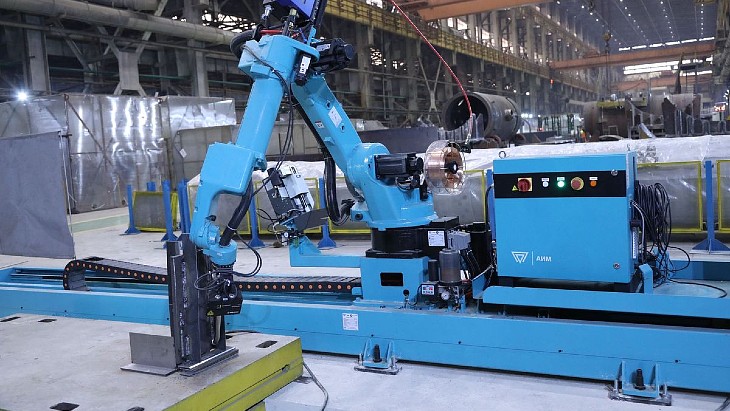
Thirty projects to deploy robots across its machine-building division - including robotisation in transportation, welding and control operations - will save half a million standard hours of work a year,  Russia's state nuclear corporation Rosatom has said.
 
(Image: Rosatom)

ZiO-Podolsk, based in St Petersburg, has begun using a welding robot for supports for nuclear power plant heat transfer equipment. It plans to manufacture 164 supports - each involving about 80 welds - during 2026, and says that work which might have been expected to take 16,000 hours will now take 4,000.

It says that a robot "does not get tired and works without breaks" and works "faster than a human and with higher accuracy", with the additional benefit that specialists can be freed from "monotonous" work and focus on more complex tasks where a creative approach is required.

Anton Lebedev, head of ZiO-Podolsk, said: "Implementation of robotic solutions is not just modernisation, but investments in the future. The robot exceeded all our expectations." He said that not only had it increased welding capacity, but the quality had also reduced the follow-up load on locksmiths and welders.

Among the other 30 projects, JSC CDBMB in the Leningrad region last year launched a robotic welding project for elements of pumping equipment for nuclear power plants, which is said to have allowed a near-doubling of the speed of welding work.

And the Atommash plant in Volgodonsk launched a spider robot for ultrasonic testing of welded connections of reactors and steam generators, which Rosatom says speeds up quality control operations.