Wednesday, February 25, 2026


Student protests spread across Tehran universities for fourth consecutive day in Iran

Student protests spread across Tehran universities for fourth consecutive day in Iran
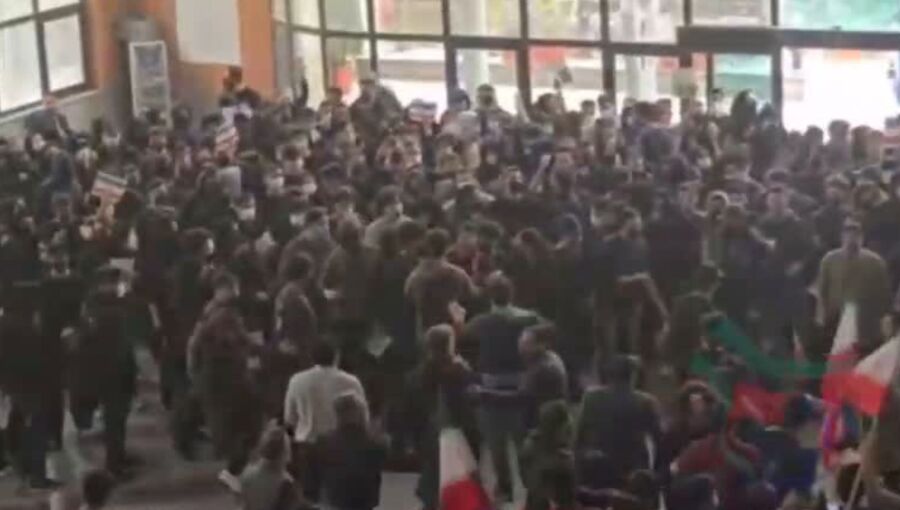
Students are seen fighting those loyal to the clerical system at universities across Tehran. / CC: Social media Telegram
By bnm Tehran bureau February 24, 2026

Student protests continued across Tehran's universities for a fourth consecutive day on February 24, with demonstrations reported at more than ten institutions as Basij militia members deployed on campuses to contain the unrest, according to student Telegram channels.

Al-Zahra University saw a sit-in begin on February 24, with the United Students Telegram channel reporting that "suppressors and Basijis are present to prevent the sit-in."

At Khajeh Nasir University's Vanak campus, Basij forces fired tear gas and pepper spray to disperse students, with protesters chanting slogans against the Revolutionary Guards.

Demonstrations were also reported at Sharif University, Shahid Beheshti University, Iran University of Science and Technology, Soure University, and the faculties of social sciences and arts in Tehran. Chants included "Woman, Life, Freedom," "Death to the dictator," and "Political prisoners must be freed."

Over the preceding three days, major universities in Tehran, Isfahan University of Technology, and Ferdowsi University in Mashhad had all seen large-scale protests directed against Supreme Leader Ayatollah Ali Khamenei.

Amirkabir University of Technology in Tehran has warned it will move swiftly to discipline students involved in recent campus unrest, as protests at Iranian universities entered a fourth consecutive day on February 24.

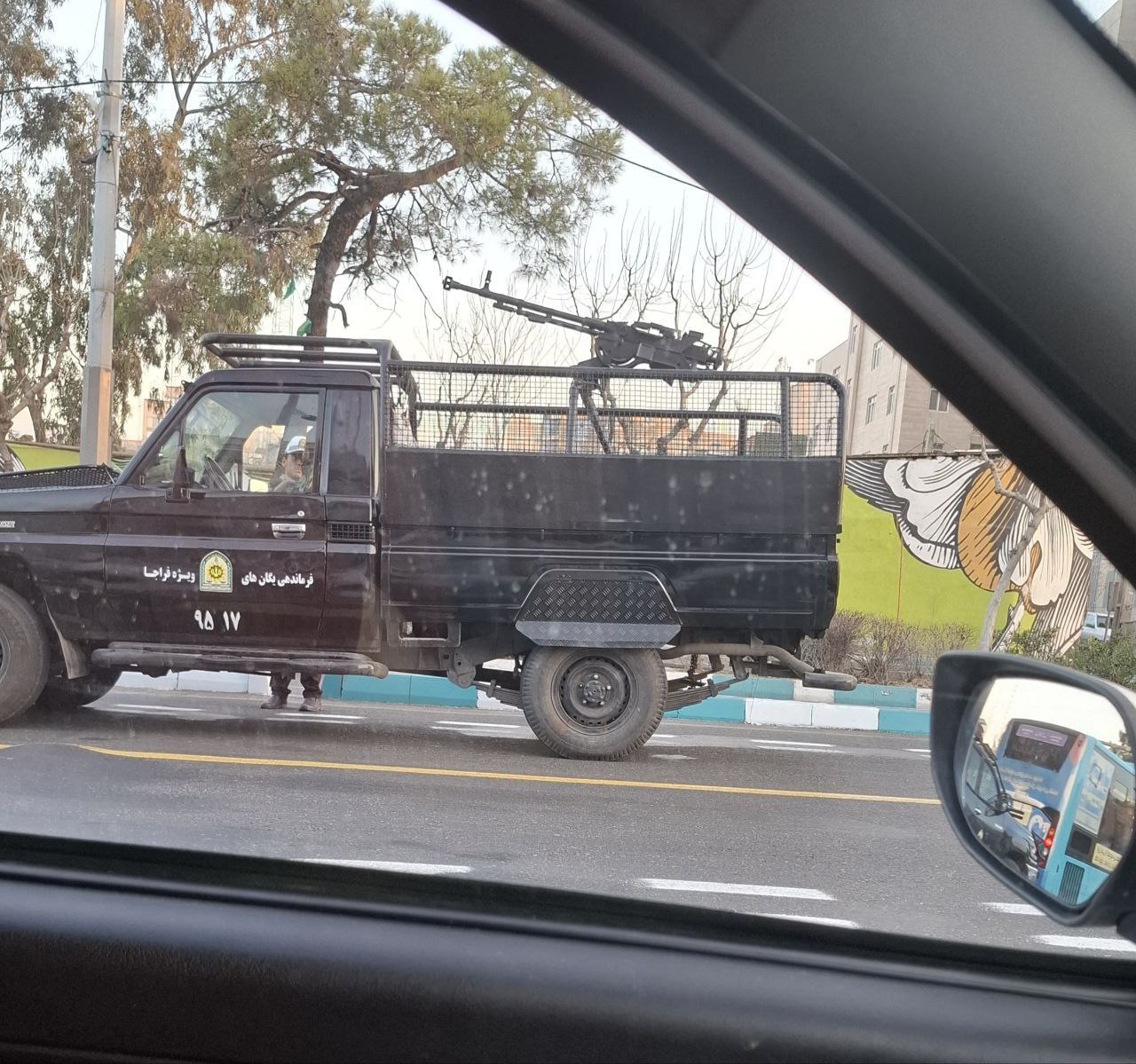
Armed police have also been recorded with machine guns outside university complexes in recent hours, according to social media posts shared with IntelliNews. 
In a statement published by 19 Dey newspaper, the university said cases against students "from all factions" would be reviewed without leniency, condemning what it described as stone-throwing, property destruction, and disrespect for national symbols.

The announcement came as protests spread across at least ten Iranian universities, including the University of Tehran, Sharif University of Technology, Isfahan University of Technology and Ferdowsi University in Mashhad.

Students dressed in black gathered to mourn those killed during a government crackdown in January 2026, which Iran's authorities say left more than 3,000 dead.

Rights groups, including the US-based Human Rights Activists News Agency, put the toll at upwards of 7,000, according to its latest figures on February 24, significantly higher than the government death toll.

At Amirkabir University, clashes broke out between anti-government students and pro-regime Basij members on February 22, with verified social media footage showing scuffles between the two groups.

A student group said on Telegram that protesters had chanted "our target is the entire system," while others were insulting the yellow flags of the Basij and Hezbollah flown by those loyal to the system. 

Updated 11:20 GMT/UTC

Iranian Students Face Down Security Forces On Fourth Day Of Nationwide Campus Protests – OpEd


February 25, 2026 
By Mahmoud Hakamian


On February 24, 2026, the student-led uprising across Iranian universities entered its fourth consecutive day. Despite heavy militarization and violent suppression tactics by the state, major academic institutions in Tehran—including Tehran University, Beheshti (Melli), Sharif, Khajeh Nasir, Iran University of Science and Technology (IUST), and Science and Culture—remained active sites of protest. The demonstrations also expanded beyond the capital, with students at Isfahan University of Technology, as well as Sajjad and Shandiz universities in Mashhad, holding anti-regime rallies.


Direct Confrontation and Student Defiance

The regime’s response to the renewed campus unrest has been marked by physical violence and heightened surveillance, which students have met with direct resistance. At Khajeh Nasir University in Tehran, security forces assaulted students at their dormitories in an attempt to disperse their gathering, but the students fought back and maintained their rally. At Isfahan University of Technology, the state deployed drones over the campus to identify and intimidate protesters.

In Tehran, the confrontations escalated into severe physical clashes. At Beheshti University, intense altercations broke out between students and the regime’s Basij and security agents. During the rally, students torched a photograph of Supreme Leader Ali Khamenei while chanting, “This is the year of blood, Seyyed Ali will be overthrown!” and “Basij, IRGC, to us you are ISIS.” Meanwhile, at Tehran Art University, female students chanted, “Freedom, freedom, freedom!” At IUST, plainclothes campus security were seen noting the names of students wearing black mourning attire, while police forces stationed themselves outside the university gates.

Uncompromising Demands

The chants echoing across the campuses demonstrate a clear rejection of the theocratic state in its entirety. At Sharif University, where students successfully resisted attacks by Basij agents, the crowd chanted, “This is the last message, our target is the entire regime!” At both the University of Science and Culture in Tehran and Shandiz University in Mashhad, students repeated the slogan, “Students will die but won’t give in to disgrace!” Demonstrators at Beheshti University made their stance on the ruling establishment clear, chanting, “We will not have a country as long as the mullahs are in power!”
The State’s Panic and Threats of Escalation

The persistence of the students has prompted public alarm from the regime’s judicial authorities. On February 24, the regime’s Attorney General, Mohammad Movahedi Azad, called for a swift security and law enforcement crackdown on the universities. Blaming the unrest on “enemies” attempting to inflame the domestic atmosphere, he ordered responsible agencies to “swiftly identify the related agents and take decisive and legal action against them,” warning that the authorities “must not allow such actions to continue.”

The current campus strikes are deeply intertwined with the nationwide uprising that erupted on December 28, 2025. Sparked initially by a strike among Tehran bazaar merchants over severe economic crises, the movement quickly evolved into explicit demands for the regime’s overthrow. The state responded with a brutal crackdown, cutting off communications and killing thousands of civilians, including children.

Instead of pacifying the public, this systemic slaughter has fueled the students’ resolve. For four days, students have gathered to commemorate the martyrs of the January protests, explicitly rejecting any form of tyranny. As demonstrated during the earlier days of this campus revolt, students have forcefully expelled monarchist provocateurs from their ranks, declaring they will not accept dictatorships of either “turbans” or “boots” and demanding “Neither Shah nor Mullah.” By returning to the campuses to face down the regime’s security forces, the students are demonstrating that the blood spilled by the regime has only solidified the Iranian people’s demand for a free, democratic, and secular republic.

Mahmoud Hakamian writes for The People’s Mojahedin Organization of Iran (PMOI), also known as Mujahedin-e-Khalgh (MEK)


Iran: Tsunami Of Arbitrary Arrests, Enforced Disappearances, HRW Says

February 25, 2026 
By Eurasia Review


Iran’s authorities have waged a brutal campaign to terrorize the population through mass arbitrary detentions, torture, and enforced disappearances in the aftermath countrywide massacres of protesters and bystanders by security forces on January 8 and 9, 2026, Human Rights Watch said Tuesday.

Evidence examined by Human Rights Watch shows that senior officials, Iran’s security and intelligence agencies including the police, known as FARAJA, the Islamic Revolutionary Guards Corp (IRGC) and its intelligence organization, the Ministry of Intelligence, and prosecutorial and judicial officials have orchestrated a coordinated, brutal mass clampdown to quash further dissent and conceal their atrocities. In addition to mass arrests, they have held detainees in incommunicado detention including in unofficial facilities, broadcast hundreds of coerced “confessions,” including by children, and carried out large-scale enforced disappearances while imposing severe restrictions resembling martial law in many cities.

“As a whole nation remains in shock, horror, and grief, and families still search for their loved ones in the aftermath of the massacres of January 8 and 9, authorities continue to terrorize the population. Arrests continue and detainees face torture, coerced “confessions,” and secret, summary, and arbitrary executions,” said Bahar Saba, senior Iran researcher at Human Rights Watch. “Given the immense dangers those detained and forcibly disappeared face, international monitors should immediately be given unhindered access to all detention facilities and prisons.”

A prisoner whose voice recording was received by Human Rights Watch stressed the importance of maintaining international scrutiny, saying, “Do not forget the detainees… Be our voice, if you do not raise your voice, they will eliminate us all.”

Those forcibly disappeared include individuals arrested and may include cases of people who participated in the protests but never returned home. Some families have received calls informing them that their loved ones had been killed but have not had the bodies of their loved ones returned, or received any information about them despite repeated inquiries.

A January 26 statement by the IRGC’s Intelligence Organization indicated that at least 11,000 people had been summoned by intelligence and security forces as of that date. According to judiciary’s spokesperson, 10,538 individuals had been referred for prosecution and 8,843 indictments were issued by February 17.

Human Rights Watch spoke with 23 people both inside and outside Iran, including detained protesters; relatives of people killed, detained, and/or forcibly disappeared; people participating in protests; lawyers; human rights defenders; medical professionals; and journalists. Sources provided information about the situation in areas across the country, including the provinces of Alborz, Eastern Azerbaijan, Fars, Golestan, Hormozgan, Ilam, Kermanshah, Khouzestan, Kurdistan, Lorestan, Mazandaran, Razavi Khorasan, and Tehran.


Human Rights Watch also analyzed videos of security forces violently arresting protesters and their heavy presence on the streets after the mass killings, including 139 videos of forced “confessions” broadcast by the state broadcaster—Islamic Republic of Iran Broadcasting (IRIB)—and state-affiliated media as of February 6. Human Rights Watch also reviewed official statements, reports, and publications by independent media and human rights organizations.

Authorities have repeatedly vowed “speedy trials” and a “harsh response” without “any leniency,” while labelling protesters “criminals,” “enemies of God,” and “terrorists.” On February 3, a criminal court in Qom sentenced 19-year-old wrestling champion, Saleh Mohammadi, to death for alleged involvement in the death of a member of the security forces. Mohammadi was convicted after summary proceedings that did not even last a month and relied on forced “confessions” that he said were extracted under torture. The court has ruled that Mohammadi’s execution should be carried out in public.

On February 19, Amnesty International reported that children were also among 30 people facing the death penalty whose cases were documented by the organization. In a measure reminiscent of sham trials broadcast in 2022 that resulted in arbitrary executions of several men, IRIB started broadcasting segments of trial proceedings, including against two children, for alleged offences in connection with the protests.

The exact number of those arrested since the start of the protests remains unknown, but human rights groups have reported the figures to be in the tens of thousands. As of February 13, the Volunteer Committee to Follow-Up on the Situation of Detainees, a network of activists outside Iran, had published the names and details of over 2,800 people arrested.

Those interviewed said that prosecutors and prison officials have systematically denied detainees access to their families and lawyers and refuse to provide information about detainees’ fate and whereabouts, thus subjecting them to enforced disappearance. Enforced disappearances are grave crimes under international law and are considered ongoing so long as the authorities refuse to acknowledge the fate or whereabouts of those disappeared.

A human rights defender who has spoken to several detainees’ relatives in the provinces of Ilam and Kermanshah said that officials responded to families’ requests with insults and profanities. Verified videos posted online and verified by Human Rights Watch show scores of concerned families gathering outside prisons, prosecutors’ offices, and police stations in search of their loved ones.

Human Rights Watch has also documented cases of torture and other ill-treatment, including severe beatings with batons; kicks and punches; sexual and gender-based violence; food deprivation; and psychological torture, such as threats of execution, and denial of medical care to those injured. These cases, which can also amount to serious international crimes, are believed to be a fraction of the true scale of gross detention violations given that many people remain in incommunicado detention.

Iran’s authorities have imposed and maintained a heavy military presence applying severe restrictions against the population across numerous cities in the aftermath of the massacres. Several witnesses described measures resembling curfews and martial law, including checkpoints across cities and intra-city roads and armed agents routinely stopping vehicles and searching cars and passengers’ mobile phones. These descriptions were corroborated in videos verified by Human Rights Watch.


Security and intelligence forces have continued to carry out arrests of real and perceived dissidents. Those targeted include protesters, lawyers, medical professionals, human rights defenders, students, schoolchildren, athletes, journalists, political activists, environmentalists, and members of ethnic and religious minorities including Baha’is.

Since the start of the protests, the IRIB and media outlets affiliated with the IRGC have broadcast hundreds of protesters’ coerced “confessions.” They further heighten fears that people whose forced “confessions” have been aired will face the death penalty, and arbitrary executions.

Coerced television “confessions” violate the absolute prohibition of torture and other ill-treatment, the rights to presumption of innocence, and to a fair trial. The Islamic Republic has a long history of using coerced “confessions” to quash dissent and in cases leading to death sentences and arbitrary executions after grossly unfair trials.

Fears of a wave of death sentences and arbitrary, summary, and secret executions are growing in light of official statements and the execution spreeof recent years. Since the start of the protests, officials have vilified protesters, repeatedly referring to them as “criminals”, and mohareb, an individual “waging war against God,” which is a capital offense.

UN member states should demand that Iran’s authorities immediately release all those arbitrarily detained, disclose the fate and whereabouts of people forcibly disappeared, halt any planned executions, and allow independent international bodies, such as the UN Fact-Finding Mission on Iran, unhindered country access, including to prisons and detention facilities, hospitals, morgues, and cemeteries.

Governments with embassies in Iran should send high level observers to all capital trial proceedings and urgently request to visit to all sections of detention facilities.

“Systematic impunity has enabled Iranian authorities to repeatedly commit crimes under international law,” Saba said. “Other countries’ judicial authorities should initiate criminal investigations of international crimes under the principle of universal jurisdiction and in accordance with national laws, with a view to prosecute those suspected of criminal responsibility.”
Mass Arbitrary and Violent Arrests, Unlawful Detentions

Officials and state-affiliated media in Iran have stated that authorities have arrested thousands of people across the country, but independent rights organizations have reported that there have been tens of thousands of arrests.

Several sources who had spoken to people in prisons across the country said that authorities had emptied prison wards to hold detainees together and in isolation from other prisoners, in an apparent attempt to stop the flow of information.


Protest detainees are also held in unofficial detention facilities run by security and intelligence bodies, and other unregistered and secret locations, placing them at heightened risk of torture and arbitrary, summary, and secret executions. Iranian authorities have a track record of using secret, unofficial, and makeshift detention facilities, in particular during protest crackdowns, to hold detainees without registration.

Security forces have continued to arrest protesters on the streets, at checkpoints, and in home raids. A spokesperson for the Volunteer Committee to Follow-Up on the Situation of Detainees told Human Rights Watch that many people were arrested at home, days after they had participated in protests.

In one case, based on credible information received, Revolutionary Guard forces conducted an early morning raid on the house of Milad Ebrahimi, an injured protester in Kamyaran, Kurdistan and arrested him on February 1. The source said Ebrahimi sustained a gunshot wound during the protests but did not seek medical care at a hospital fearing arrest. Security forces also arrested his brother, Hamed Ebrahimi, for objecting to the arrest.

Witness statements and state media reports indicate that security forces have used video footage from CCTV cameras, and drones to identify those participating in protests.

Relatives of detainees and lawyers interviewed said that the authorities prohibited access to lawyers during the investigation phase, consistent with authorities’ decades-long pattern of denying detainees access to legal representation, including independent lawyers of their choice.

Under Note to Article 48 of the Code of Criminal Procedure, individuals charged with certain offenses, including national security offenses, are denied the right to access an independent lawyer of their own choosing. Only lawyers approved by the head of the judiciary can be appointed to defend them. The UN Fact-Finding Mission on Iran and human rights organizations have documented a pattern of complicity by many judiciary-approved lawyers in grave human rights violations. As a result, families and detainees have said they do not trust them.

“Detainees have no access to lawyers,” a lawyer said. “Families do not want to retain Article 48 lawyers. Independent lawyers who go to officials to take on protest detainees’ cases are told by the authorities, ‘Are you an Article 48 lawyer? No? Then leave, you cannot take the case.’”

In practice, even in cases with judiciary-approved lawyers, detainees are denied access to legal counsel during the investigation phase including during interrogations.

Witnesses said that, consistent with their track record, authorities have also harassed families of detainees, warning them not to speak up or publicize the situation of their loved ones.
Incommunicado Detention; Enforced Disappearances

The authorities have held those arrested during and after the protests in incommunicado detention. In many cases those detained are forcibly disappeared, as authorities have refused to provide families with any information about their fate and whereabouts.


In one case, authorities arrested Youresh Mehrali Beiglou, an Azerbaijani Turk activist, on January 4 in or around Tabriz, East Azerbaijan province, after releasing a video in which he spoke about the protests. After the arrest and for a period of over a month, he was allowed to make only one brief phone call to his family, and they were denied information about his whereabouts.

Another Azerbaijani Turk activist, Ali Babai, was arrested on January 14. Other than one brief phone call informing his family that he was in an intelligence ministry detention facility, the authorities have denied his relatives information about his fate and whereabouts.

In Karaj, Alborz province, security forces raided Jahangir Kazemi’s home on January 14 and arrested him. His family received two brief phone calls from Kazemi, who is reportedly held in solitary confinement, but has been denied visits and information about his situation. Kazemi’s wife, Fatemeh Golmohammadi, was arrested on January 27. The couple, who have young children, have been denied access to a lawyer.

A relative of a detainee in a northern province, described the response of prosecution officials to detainees’ families:

“When we ask officials at the prosecutor’s office [about our loved one], they tell us, ‘They are criminals, if they weren’t, we would not have arrested them,’ “When we ask what their crime is, they respond, ‘You yourselves know better.’”

Families have been gathering outside prisons, police stations, and prosecutors and governors’ offices. Human Rights Watch has reviewed four videos showing such gatherings.

Researchers geolocated videos showing these scenes outside the county courthouse in Karaj, Alborz province, Qazvin Central Prison, Qazvin province, and outside the governor’s office in Yasuj, Kohgiluyeh, and Boyer-Ahmad province.

Verified videos analyzed by Human Rights Watch from the provinces of Alborz, Esfahan, Lorestan, and Razavi Khorasan corroborated these accounts. Collectively, the videos show large numbers of armed security forces patrolling cities on foot or in vehicles, including trucks mounted with heavy machine guns, discharging weapons and using megaphones to order people to stay indoors.

In one video published online on January 29, and reported to have been recorded outside a police station in Kerman, concerned families are seen speaking to an official from behind a closed door, repeatedly saying that their loved ones are missing. One man is heard saying, “Why is there no one to answer us… my child has disappeared for 24 hours, but no one answers… is there not a manager, a supervisor, someone to step outside? So many people are here worried for their children.”


 

Report: Maritime Cyberattacks Doubled in 2025

Fanava
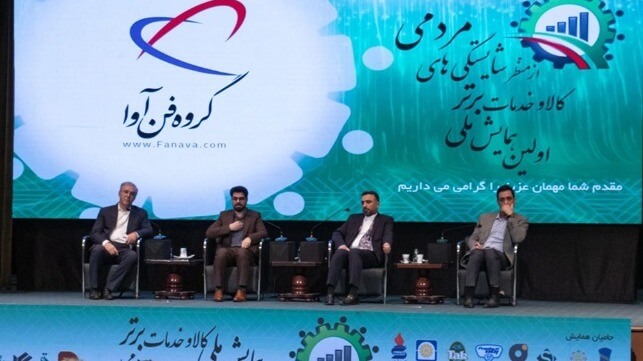
Hacked: Iranian satcom provider Fanava was penetrated by cyber threat group Lab Dookhtegan, which used its access to target dozens of tankers (Fanava file image)

Published Feb 24, 2026 4:15 AM by The Maritime Executive


The prevalence of maritime cyberattacks doubled in 2025, according to Korean security firm Cytur, led by an explosion of malware and distributed denial of service (DDoS) incidents. Some of the most concerning examples involved a high-level penetration of the shoreside supply chain, giving the attackers useful information about systems (or even remote access) at a fleet level. Others extended to worst-case scenarios: destroyed equipment, hacked ECDIS chart systems, and remote control of ballast valves.

Hackers are getting better at targeting shipping, Cytur's report shows, and they have a reason: money. Access is the same as ever - exploiting unwitting crewmembers via phishing emails; breaching unprotected public wifi used by the crew; or sneaking aboard via a hacked USB drive, whether by bribing a crewmember to use the drive or by accident. But Cyber threat actors are finding more ways to monetize vessel information, whether by encrypting it, holding it hostage and demanding a ransom from the operator, or by stealing it and selling it to third parties on the Dark Web. 

Illicit items found for sale online include voyage logs, cargo manifests, ship design schematics and the personal information of the crew, according to Cytur. Often the operator will pay to avoid having their internal records released: one common ransomware attack involves encrypting the ship's Planned Maintenance System (PMS), forcing the operator to pay in order to recover the voyage's logs. Ransomware attacks and data theft are often found in high-traffic regions, like Asian waters and major hub ports, Cytur said.

Another common form of attack is distributed denial of service (DDoS), a brute-force swarm of automated activity that swamps a network and crowds out legitimate traffic. Hackers may hijack vulnerable onboard routers and other IT infrastructure, then use it to send so many requests that it overwhelms the capacity of the ship's satcom connection, temporarily rendering the ship unable to exchange messages with the home office.

More concerning, though, are hacks targeted at disabling or hijacking ship systems. The "Lab Dookhtegan" ("sewn lips") attack on Iranian tonnage last year was a concerning example. The threat group systematically targeted an Iranian satcom provider, Fanava, to carry out an attack high up the digital supply chain for Iran's state-owned fleet of tankers. After penetrating Fanava, Lab Dookhtegan obtained fleetwide control over ship to shore VOIP services, making it harder for the vessels to communicate with the home office or with port officials. 

While in possession of access to the ships' networks, the Lab Dookhtegan group stole corporate documents belonging to Iranian state firms NITC and IRISL, then released them online. When done with its access mission, it destroyed the ships' modems by overwriting partitioned memory; physical replacement of the hardware was required. 

Another advanced supply chain attack occurred in October, when Japanese radar and ECDIS builder Furuno was hit by ransomware. The hacking threat group, known as Rhysida, stole Furuno's internal data and threatened to release it; meanwhile, it encrypted the firm's data, disabled backup servers and demanded payment. The attack temporarily interfered with service, updates and parts shipments for Furuno. 

Most concerning may be hacking attacks on operating technology (OT), like engine control systems and ballast water systems. Cytur warned that the remote access communications protocols baked into equipment electronics - used by OEM troubleshooting teams to remotely diagnose errors and make changes - remain a vulnerability. If a hacker could remotely control engine output, or ballasting, the results could be catastrophic. 

Going forward, Cytur anticipates that AI agent-assisted attacks will become more prevalent, and that this year will be the beginning of an era of "autonomous attacks" with largely or fully AI-directed hacking campaigns. This will de-skill cyber crime, opening up the door to a larger number of would-be hackers, the consultancy predicts.

"The incident data from 2024 and 2025 proves that maritime cybersecurity is no longer an ‘option’ but a matter directly linked to a vessel’s ‘right to operate,'" said Cho Yong Hyun, CEO of Cytur.


From Sea to Sky

Satellite Service Providers Lift the Maritime Industry into the New Space Age

KVH file image
File image courtesy KVH

Published Feb 23, 2026 8:26 PM by Mia Bennett

(Article originally published in Nov/Dec 2025 edition.)


Nestled within the aptly named Post Office Bay on Galapagos' Floreana Island sits a relic of analog communication.

A barrel beckons visitors to pitch in their unstamped postcards in the hopes that a passer-by bound for the addressed location retrieves the epistle and ferries it to its destination. If, say, you were a tourist from Palm Beach, Florida and you found a missive to Miami in the barrel, you might take it with you and hand-deliver it to the addressee upon your return home.

The contrivance harkens back to the eighteenth century when northbound English whalers on their way to Alaska's bountiful seas might drop off mail bound for home and pray that mariners headed for the Atlantic might pick it up – a process that might take weeks or months.

The invention of the telegraph in 1837 dramatically sped up maritime communications, reducing the time it took a message to cross the Atlantic to less than a day. Now, thanks to satellites, communications at sea across nearly the entire planet move at light speed, whether for emergency alerts or daily correspondence.

The number of satellites has increased exponentially in recent years due to the rapid growth of mega-constellations like Starlink and Eutelsat's OneWeb. These networks provide broadband Internet from Low Earth Orbit (LEO), the orbital shell some 100 to 1,200 miles above Earth.

LEO satellites complement traditional connectivity enabled by networks of L-band satellites and VSAT (Very Small Aperture Terminal) antennas. Many L-band satellites sit in geostationary orbit 22,236 miles above Earth. This distant vantage allows satellites to see nearly half the planet at once, making them useful for communications and monitoring. Latency is high, however, challenging real-time interactions. That's where LEO mega-constellations, much closer to Earth, offer an advantage.

HYBRID CONNECTIVITY

Maritime providers around the world are helping shipowners take advantage of both next-generation and legacy satellite services with streamlined, multi-orbit solutions.

While combining them can seem confusing, companies like AST Networks simplify the process. In November, the U.K.-based company launched MODULA, a modular, pay-as-you-grow connectivity approach combining LEO, GEO, cellular, backup and safety services in a single managed solution.

Sally Hubble-Button, Global Corporate Communications Manager, explains, "Operators can choose the capabilities they need today and expand as their requirements evolve. Paired with AST's LinkBox – an intelligent routing device with a lifetime guarantee – MODULA ensures seamless network switching, cost-control and reliable connectivity – no matter where in the world you are."

Together, MODULA and LinkBox deliver a scalable, future-ready solution for shipowners.

Hybrid connectivity also strengthens the reliability and redundancy of communications for shipowners. Denmark-based Cobham Satcom's SAILOR XTR VSAT platform works across multiple frequency bands and satellite orbits including GEO, Medium Earth Orbit (MEO) and LEO, allowing use of high-throughput satellite networks like Inmarsat and THOR 7.

As a result, says Søren Egholm, Senior Vice President of Product Management & Marketing, "Vessels maintain consistent access to critical business and safety systems as well as connectivity for crew welfare, even in congested or remote maritime zones." For their part, satellite service providers have embraced third-party device integration as it helps future-proof shipboard systems and reduce operational downtime.

Intellian, the world's largest manufacturer of VSAT antennas for the maritime industry, is also enhancing safety and connectivity through optimized, integrated solutions. The South Korean company recently commercially launched its Iridium Certus® GMDSS Systems along with its compact and enterprise flat panel antennas including OW10HM and OW11FM.

"Designed to fully leverage the power of Iridium Certus Global Maritime Distress and Safety System (GMDSS)," states Jon Harrison, Vice President & Head of Sales for Europe, the Middle East and Asia (EMEA), "Intellian's complete, state-of-the-art C200 and C700M GMDSS Systems provide truly global coverage for the vessel, even in polar regions."

Both systems have received the Marine Equipment Directive Wheelmark and U.K. Marine Equipment Regulations Red Ensign approval. The C700 GMDSS System is the market's only one designed to harness the Iridium Certus 700 service. In a single terminal, it delivers Iridium GMDSS, Long-Range Identification and Tracking (LRIT) and Ship Security Alert System (SSAS) alongside dependable L-band connectivity for business data and voice services.

Intellian CEO Eric Sung adds, "These two new solutions reflect that deep market knowledge, combining our expertise with the power of Iridium Certus GMDSS to deliver safety systems that the maritime community can trust."

MANAGING CYBERSECURITY RISKS

As reliance on both satellites and digitalization grows across the maritime industry, cybersecurity is gaining urgency.

"With this increased volume of bandwidth comes a heightened cybersecurity risk," says Tore Morten Olsen, President of Maritime at Marlink, "the impact of which continues to grow as more maritime users are connected and higher volumes of data are transferred."

While the resilience, cybersecurity and anti-sabotage capabilities of satellite infrastructure are the operator's responsibility, satellite service providers can build maximum operational resilience for end users through innovations to terminal technology. These make use of a combination of L-Band, VSAT and flat panels across LEO, MEO and GEO orbits to maximize data speeds, efficiency and safety.

With its multi-orbit, multi-band technology, Intellian provides its customers the ability to maintain service continuity even if one specific network is targeted or compromised. The company's XEO Series allows customers to switch between Ku-band and Ka-band services from just one antenna without manually changing the RF feed while the V240MT antenna system enables alternating between MEO and GEO networks and between the C-, Ka-, and Ku-bands.

Intellian's Wideband Global Satcom naval antenna, ARC-M4 Block 1, takes things a step further as the first tri-band antenna to provide simultaneous X and MIL Ka-band service. "This capability is the single most powerful tool a customer has to mitigate a geopolitical or cyber attack," says Jon Harrison.

France-based Marlink provides a complete portfolio of cyber tools to help owners proactively prepare for, manage and respond to problems like jamming, GPS spoofing or geofencing of satellite services due to local regulatory regimes. Olsen explained that as part of upgrades to its Eik Teleport, an early maritime satellite communications receiving facility opened in Norway in 1976 to serve oil platforms in the North Sea, the company created Marlink Lab. The simulation facility lets shipowners sandbox adverse situations and develop strategies to enable their employees and crew to quickly respond to risks.

ROBUST SOLUTIONS

To ensure continuity of service in a threat-prone environment, shipowners are seeking robust solutions, which companies worldwide are developing.

A representative of Rhode Island-based KVH Satcom explains, "We see a growing demand among our customers for assistance in managing network and IT operations aboard vessels, especially as many fleets face resource challenges both in simply managing day-to-day onboard operations and the expanding array of cybersecurity regulations."

KVH's network solutions, like its CommBox Edge Secure Suite's Intrusion Prevention System, block harmful traffic in real-time by leveraging industry-leading cybersecurity and proactive monitoring technologies including Cisco Talos and Cisco Snort. KVH also offers a cybersecurity compliance program, which helps its customers maintain compliance with key industry regulations and training requirements.

As of 2021, in accordance with the IMO's Guidelines on Maritime Cyber Risk Management Resolution MSC.428(98), all shipowners must incorporate addressing cyber risks as part of their overall safety and security practices.

Cobham Satcom is also tackling cybersecurity issues across the maritime satellite communications ecosystem all the way from onboard terminals to ground segments and space. The company is continuously making hardware and software enhancements to SAILOR, its L-band maritime satellite terminal that uses the Iridium Certus network, and Sea Tel, which offers television at sea.

"On the cyber side, our engineering and product teams continuously implement security upgrades that protect against unauthorized access, malware injection and data interception," notes Søren Egholm. "This includes encrypted control channels, secure firmware updates and secure boot processes that help ensure the terminal cannot be manipulated or hijacked."

Spoofing and jamming of Global Navigation Satellite System (GNSS) signals are another set of threats Cobham Satcom is addressing. This kind of disruption can severely impact connectivity by preventing a ship's satellite terminal from locking onto the right satellite. The company is designing antennas and software to maintain tracking accuracy, resist external interference and enable continued operations even under challenging signal environments.

"The goal is not only to protect against deliberate cyberattacks or electronic warfare," Egholm adds, "but also to ensure continuity of service during periods of geopolitical instability, when connectivity becomes a mission-critical asset."

NAME OF THE GAME

As the world becomes more complex and unpredictable, enhancing resilience to both digital and RF (radio frequency)-based threats is crucial to maintaining secure and stable communications.

While the odd Galapagos tourist can live on a prayer and hope that their postcard will serendipitously reach its destination, shipowners cannot afford to leave things to chance. Today, speedy and uninterrupted communications spirited securely between sea and space are the name of the game.

The opinions expressed herein are the author's and not necessarily those of The Maritime Executive.


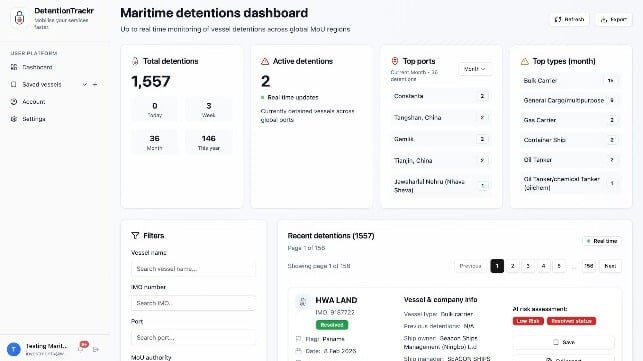
DetentionTrackr Launches AI-Powered Global Detention Intelligence Platform

DetentionTrackr

Published Feb 24, 2026 9:44 PM by The Maritime Executive


[By: DetentionTrackr]

DetentionTrackr has officially launched, as a new maritime intelligence platform centralising global Port State Control (PSC) detention data, into real?time, actionable intelligence to drive greater efficiency and strategic decision-making across the industry.

In February, 72 vessels were detained across global ports, with 164 detentions recorded since the beginning of 2026 globally. Despite consistent enforcement activity, detention information remains fragmented across regional authorities.

“DetentionTrackr delivers a unified AI-driven view of active vessel detentions, enriched with detailed ownership and management intelligence,” said Thomas Cox, Co-Founder of the platform. “It represents a new category of maritime intelligence, transforming how the industry understands and responds to detention events.”

The platform aggregates live detention data and enhances each report with information including:

  • Detailed vessel profiles
  • Inspection and detention history 
  • Ownership structure and beneficial owner mapping
  • Ship owner/manager identification and contact information
  • Structured risk context 

Active detentions are monitored every hour. Resolved cases are archived within the system to support contextual benchmarking and fleet analysis.

The platform is designed for:

  • Ship managers seeking fleet benchmarking visibility and competitor performance insights
  • Charterers assessing detention exposure prior to fixing vessels
  • P&I clubs monitoring operational and compliance risk
  • Technical suppliers responding to machinery, safety and deficiency-related detentions
  • Maritime service providers addressing urgent operational gaps
  • Port agents requiring early awareness of detained vessels within their regions
  • Riding squads mobilising crews to rectify deficiencies and restore compliance

“PSC data is public but operationally fragmented,” said David Holly, Co-Founder at DetentionTrackr. “We built DetentionTrackr to transform dispersed inspection records into structured, actionable intelligence; empowering maritime professionals to make faster, more informed decisions.”

DetentionTrackr is now available for commercial subscription.

The products and services herein described in this press release are not endorsed by The Maritime Executive.


Philippine Divers Release Video of Search for Remains Inside Lost Ferry

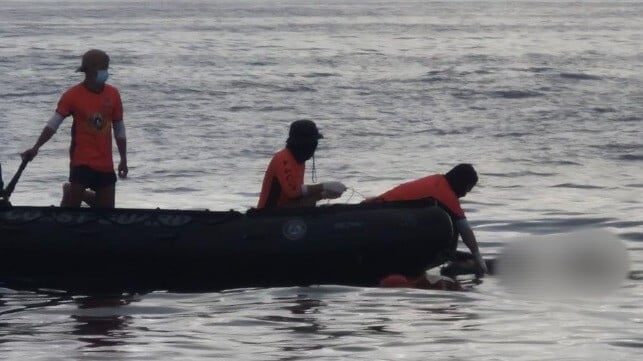
PCG servicemembers recover another body from the water at the wreck site, February 21 (PCG)

Published Feb 23, 2026 8:22 PM by The Maritime Executive


The Philippine Coast Guard's salvage divers continue to conduct dangerous and difficult search-and-recovery work at the wreck site of the Trisha Kerstin 3, the ferry that capsized and sank off Basilan in late January. The confirmed death toll from the sinking has risen to 65, and Philippine leaders have demanded accountability - even prosecution - for those responsible for the vessel's final voyage. 

Over the weekend, divers recovered another body from the wreck - the remains of crewmember Rodolfo Cabilan Jr., a resident of Bohol. Cabilan was found in the interior of the vessel, on the car deck, the PCG said. The victim's father, Rodolfo Cabilan Sr., confirmed the deceased's identity by his belongings, according to Bohol Monitor. (As the weeks have passed since the sinking, deterioration has made identification of victims and disposition of their remains more challenging.)

Initial estimates of the number of personnel on board turned out to be flawed, as the passenger manifest contained inaccuracies. After consolidation and tallying of all available information, the PCG and its interagency partners believe that there were 293 survivors, 65 known victims, and 14 people who remain unaccounted for. Relatives and survivors claim that there may be even more missing. 


The PCG has pledged to continue the search effort through all compartments. Video footage released by the agency's technical diving group shows the difficult, dangerous, and eerie conditions at the site. The rescue divers are tasked with entering and searching passenger berthing compartments filled with debris, with just a few feet between the tops of bunks and the overhead - a risky location to enter while burdened by bulky gas tanks and restricted by a limited supply of air. 

The investigation into the loss of the ferry is well under way, and more than a dozen public officials have been dismissed from their posts for allowing the operator to continue running vessels in allegedly unseaworthy condition. Last week, Philippine Sen. Raffy Tulfo asserted that operator Aleson Shipping Lines and the crew of the Trisha Kerstin 3 should face murder charges for setting sail on the casualty voyage. Survivors have claimed that some of the life vest storage compartments were locked, and many survived by clinging to improvised floatation - even potato chip bags, in one well-publicized story. Some survivors claim that the vessel was already operating with a list at the time of its departure, and was overloaded; initial indications appear to confirm that the ship was carrying more than its rated capacity, according to senior investigators with regulator MARINA.  


China's Maritime Militia Was More Active Than Ever in 2025

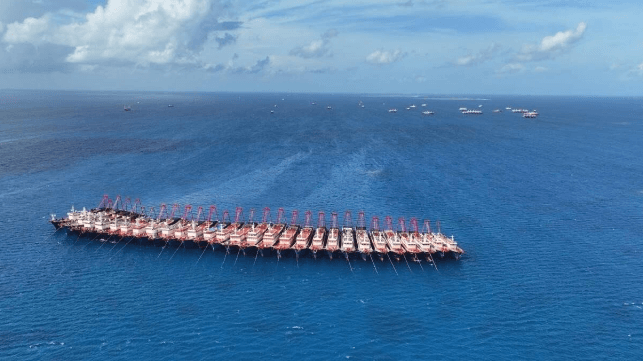
Professional maritime militia units in the South China Sea (file image courtesy Philippine Coast Guard)

Published Feb 24, 2026 5:01 PM by The Maritime Executive


China's militia of military-trained fishing crews spent more time deployed in the South China Sea than ever before last year, according to CSIS' Asia Maritime Transparency Initiative. In a new report based on satellite imaging, AMTI detailed  the movements of identifiable maritime militia vessels near 12 reefs, and found that the sustained Chinese presence in sensitive areas of the region numbers in the hundreds of vessels - every day. 

Nearly half of the activity occurred at Chinese-claimed Mischief Reef and Whitsun Reef. Mischief is occupied by China and has been built up into a massive military installation, used for staging operations throughout the Spratly Islands. Satellite images of the lagoon at Mischief Reef from September 2025 show a remarkably large presence at the anchorage, including flotillas of dozens of vessels rafted together. Four times in 2025, the accumulation of Chinese fishing vessels at this shoal alone exceeded 200 trawlers. In parallel to the buildup at this location, the number of fishing vessels at Fiery Cross Reef - another Chinese mega-base - has virtually vanished.  

Whitsun Reef, just 50 nautical miles to the west of this Chinese base, is undeveloped and claimed by the Philippines; it has been the site of repeated mass gatherings of Chinese maritime militia trawlers over the years.

The deployment patterns in the western Spratlys complemented the movements of the China Coast Guard at other, more hotly-contested features. The CCG showed record activity near Scarborough Shoal in 2025, but was not accompanied by many maritime militia vessels at that location; instead, the fishing fleet focused its efforts elsewhere. 

AMTI divides the maritime militia into two categories: the "Spratly Backbone" fleet of subsidized commercial fishermen, with secondary training as militiamen; and the professional full-time militia vessels, which are fewer in number but have higher capability for paramilitary missions. According to the think tank, the shift of the Spratly Backbone vessels to Mischief Reef - away from the hottest action in the area - is effectively a demotion for the largest component of the militia. 

"[The relocation] likely reflects the diminishing value of the Spratly Backbone fleet to China now that the international community knows they are not legitimate fishers, as well as the overriding focus on sustaining persistent CCG and professional militia operations around Scarborough and Sabina [Shoals]," AMTI concluded. 


China Blocks Exports to 20 Japanese Companies and Puts 20 on Concerns List

Mitsubishi Shipbuilding
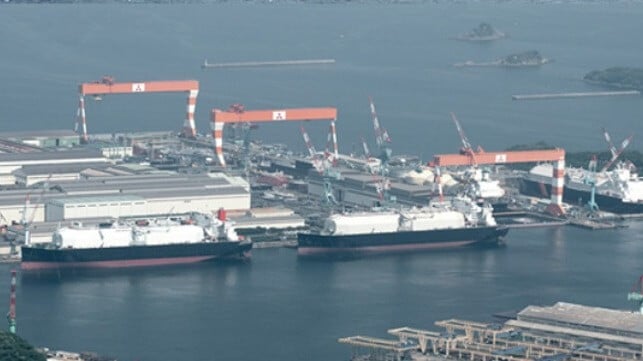
Mitsubishi's shipbuilding along with others including JMU were listed (file photo)

Published Feb 24, 2026 8:22 PM by The Maritime Executive


In the latest sign of rising tensions between China and Japan, China’s Ministry of Commerce announced export bans on 20 leading Japanese companies and placed an additional 20 companies on a “List of Concerns.” Japanese officials quickly responded, demanding a lifting of the restrictions, which it called “intolerable,” as it lodged a “strong protest” with Beijing.

Tensions have been rising as China continues to expand its territorial claims, with spats between the two sides over uninhabited islands used as fishing grounds. China has also objected to the reports that Japan was committed to raising military spending to two percent of gross domestic product in 2026. Many in the Japanese government have said the country must modernize its military in response to Chinese efforts. Last November, Japanese Prime Minister Sanae Takaichi also told parliament that Japan might have to respond if China attacks Taiwan.

In taking today’s steps, Chinese officials cited Japan’s efforts to enhance its military strength. The Chinese Foreign Ministry referenced “national security” and its “international obligation of non-proliferation.” The Commerce Ministry took it further by saying Japan was trying to “remilitarize” and referencing “nuclear ambitions.”

Japan has commercial nuclear power, but its post-World War II Constitution contains provisions long interpreted to block military use of nuclear weapons. It also restricts nuclear ships. Japan’s Defense Ministry, however, in 2025, made remarks about “next-generation power sources” for its submarines and other combatants.

Under the restrictions launched today, Chinese companies or companies dealing with Chinese technology are immediately banned from exporting any items that can be deemed to have “dual-use,” i.e., repurposing from commercial to military purposes. The list is 20 of Japan’s leading industrial companies, including Mitsubishi Heavy Industries Shipbuilding, along with several other divisions, as well as divisions of Kawasaki and IHI involved in aerospace, Japan Marine United Corporation, and others.

The second listing is companies that China said it has concerns that they could repurpose dual-use items, and that the companies could not be verified. Exports or international companies doing business with these 20 companies now have to submit a risk assessment and provide a “written commitment that the dual-use items will not be used for any purpose that would enhance Japan’s military strength.” This includes dealings with Subaru, FUJI Aerospace Technology, ITOCHU Aviation, Sumitomo Heavy Industries, Nissin Electric, and others. 

Experts highlight that China would likely include exports of rare earths and metals that could be used in electric vehicles as well as missiles. They note that China briefly restricted similar exports to Japan 16 years ago.

After filing its official protest, Japanese officials said the country would consider its “necessary responses.”


China and Hutchison Condemn “Illegal Takeover” of Port Terminals

Port of Balboa container terminal Panama
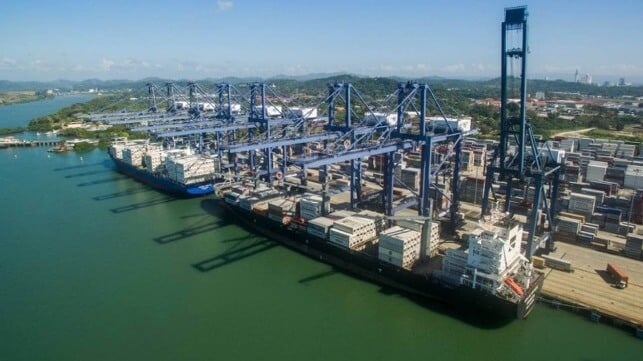
AMP reports it is stabilizing operations at Balboa and will progressive resume container handling (US Embassy file photo)

Published Feb 24, 2026 2:38 PM by The Maritime Executive


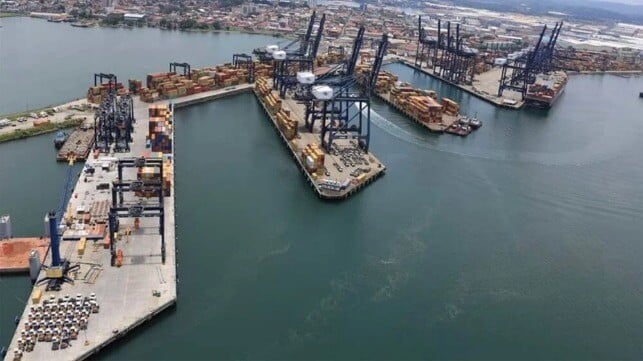
The Hong Kong Government and CK Hutchison condemned the actions of the Government of Panama, saying they would seek legal recourse after Panama took possession of the terminals in Balboa and Cristobal and signed new operating contracts with Maersk and Mediterranean Shipping Company (MSC). Hutchison confirmed that its subsidiary, the Panama Ports Company, has ceased operations.

Hutchison asserts that the representatives of Panama “made direct physical entry into the terminals,” saying they “arrived without invitation.” It further asserts that representatives of the Panama Ports Company were locked out of the terminals. Media reports in Panama said employees were told they could not speak with the Panama Ports Company, or they could be arrested. The government said it would guarantee full employment for the existing workers.

The actions came shortly after the Supreme Court of Panama published its final decision ruling the laws that established the concession and the 2021 extension were unconstitutional. The Government of Panama also signed rules freezing all the movable equipment and giving it and its representative the right to use the equipment to maintain the operations.

Container operations at both the port of Balboa and Cristobal were suspended pending the transition. The Panama Maritime Authority is overseeing the operations and said the suspension was temporary while new systems were implemented. It notes that bulk operations were continuing.

The Comptroller General of Panama moved quickly to sign new contracts with Maersk’s AMP Terminals to operate the Port of Balboa on the Panama side of the Panama Canal. A separate contract was signed with MSC’s Terminal Investments Limited (TIL) for the operations at Cristobal on the Atlantic side of the canal.  The Comptroller said the actions were fundamental to strengthening the national port system, the country’s competitiveness as a regional logistics hub, and the generation of employment and investment.

The decision to separate the operations into two companies lays the groundwork for continued competition with the plan to award two separate long-term concessions. Panama previously stated that the operations would be separated with two operators in the future. They noted the two agreements also provide for two different operating models and that Panama would be following the operations as it works to define the long-term tender for the operations. 

Each company has an 18-month contract, and it includes fixed payments for the management, operation, and maintenance of the terminals. AMP will be paying approximately $25.6 million, while TIL will pay approximately $16 million. The new contracts exclude the land, for which the government expects an additional $20 million annually in concession fees. Panama projects it will receive $100 million for the temporary operation of the terminals. 

The Hong Kong Government issued a statement saying its executive “condemns this blatant act,” lodging a “strong protest” against the forced takeover of the two ports. It asserted that Panama’s actions “ignored the facts and violated contractual good faith.” It says the government's forced takeover “severely damaged the Hong Kong company’s legitimate rights and interests and undermined the spirit of the contracts.”

Hutchison is calling it the “culmination of a campaign by the Pamana State,” and that the actions were unlawful. The company said it would continue to consult its legal advisors regarding the ruling and forceful takeover, as well as the “purported termination.” It said it is reviewing all available recourse, including additional national and international legal proceedings against Panama and “third parties colluding” with Panama.

AMP issued an update on Tuesday, the day after the takeover, saying it had initiated a “stabilization phase” at the Balboa terminal. With the Panama Maritime Authority, it said they would be inventorying the containers in the terminal as well as the equipment, including cranes and technology systems. It said there would be a technical evaluation and a review of the cargo condition, with special attention to perishable goods.

The company said a new terminal operating system was being deployed. AMP reports operations will be “progressively reactivated” with the least possible disruption.


Panama Occupies Hutchison’s Terminals After Court Publishes Decision

Cristobal port terminal Panama
The Government of Panama moved to take over the terminal operations at the Panama Canal from CK Hutchison's subsidiary (US Embassy file photo)

Published Feb 23, 2026 3:00 PM by The Maritime Executive


The Supreme Court of Panama published its decision annuling the concession for the port terminals in Balboa and Cristobal to CK Hutchison, and immediately afterward, the Government of Panama moved to “occupy” both operations and take control of all of the equipment required to run the operations. The Government said in its statement that it will guarantee the operations of the ports until a new tender can be completed.

The publication of the decision in the court’s Official Gazette finalized its ruling that the law establishing the concession to the Panama Ports Company in January 1997 was unconstitutional. The court combined two suits into a single case and also declared the June 2021 25-year extension to be unconstitutional. It annulled the concession in a decision related to the management of national resources.

The government’s decree said the Panama Maritime Authority (AMP) would temporarily occupy the operations due to “urgent social interests.” The decree said AMP would determine the equipment required to maintain the operations, including cranes, vehicles, computers, programs, software, and other property, and take control of the property. It notes that it was not a definitive loss of ownership of the movable property. The government said it would also provide stability for the workers at the two ports.

Hutchison’s Panama Ports Company had predicted that the operations would be halted. It said Panama owned the land, but that all the equipment was its property. It had previously said that the government did not have a plan for the transition.

The government reported that a presidential advisor had met with the Panama Ports Company and notified them of the takeover of the facilities. It said the process would include the steps toward establishing two new concessions, which would take up to 18 months, and that there would e a different operator for each port. 

Previously, it had been reported that Maersk’s AMP Terminals would operate the two port terminals located at each terminus of the Panama Canal, and the company confirmed its willingness to assist the government. Media reports today indicate that AMP will operate one terminal in the interim and that MSC’s Terminal Investments Ltd. (TiL) will operate the other terminal.

Hutchison had previously threatened to sue AMP if it attempted to take over the operations. Separately, it also said it would start arbitration with the International Chamber of Commerce. It did not publicly specify the amount of damages, but media reports in Panama are saying the company is seeking $2 billion. Late last week, a spokesperson for the Panama Ports Company said it had proposed negotiations with the Panama government. 

Maintaining the operations at Balboa and Cristobal is critical to Panama. The two terminals handle nearly 4 million TEU annually, representing more than a third of the containers moved in Panama. The terminals also provide important services to vessels transiting the Panama Canal.