It’s possible that I shall make an ass of myself. But in that case one can always get out of it with a little dialectic. I have, of course, so worded my proposition as to be right either way (K.Marx, Letter to F.Engels on the Indian Mutiny)
Wednesday, February 25, 2026
Trump eyes Pentagon AI program for trade block’s minerals pricing
The Trump administration plans to use a Pentagon-created artificial intelligence program to help set reference prices for critical minerals as it works to build a global metals trading zone, three sources with direct knowledge of the effort told Reuters.
Vice President JD Vance earlier this month proposed that the US and more than 50 other countries impose “reference prices for critical minerals at each stage of production” that would be backed by “adjustable tariffs to uphold pricing integrity.”
Those reference prices will be set by the US Department of Defense’s Open Price Exploration for National Security (OPEN) AI metals program, according to the sources, who were not authorized to speak publicly.
The move sheds light on how the administration aims to shape market pricing, even as the AI technology has faced skepticism for whether it can retool how critical minerals are bought and sold.
The OPEN program was launched in 2023 by the Pentagon’s Defense Advanced Research Projects Agency (DARPA) with the goal of calculating what a metal should be priced at when labor, processing and other costs are factored in and when alleged Chinese market manipulation is factored out.
Trump officials are initially focusing OPEN’s AI pricing model on at least four critical minerals, including germanium, gallium, antimony and tungsten, before expanding to others, with S&P Global and Finnish data firm Rovjok supplying data and other technical assistance, according to the sources.
The White House, Department of Defense, S&P and Rovjok did not respond to requests for comment.
The minerals plan comes as the administration moves to rapidly deploy AI tools elsewhere, including via collaborations with OpenAI, Anthropic and Alphabet’s Google for the use of generative AI in battlefield settings.
Focus on thinly traded metals
China is the world’s largest miner or processor of many of the minerals considered critical by the US government. Beijing has used that advantage in recent years to produce minerals at a loss and dampen market prices, a backdrop that has forced Western rivals to close.
Chinese officials have long said that Beijing manages its exports of minerals in accordance with rules from the World Trade Organization.
The OPEN program, which is being transferred to the control of the non-profit Critical Minerals Forum (CMF) next year, has been focused from its inception on metals that are thinly traded or not traded at all.
The CMF said its focus has been on working with “government-funded partners to conduct stress-testing with AI models,” and on “identifying and supporting commercially viable mining and processing projects, rather than on government policy.”
The AI model is aimed at promoting metals supply deals between Western miners and manufacturers by giving both sides more pricing certainty.
It can be difficult for manufacturers that use germanium, antimony, gallium and other minerals to gauge whether Chinese prices reflect traditional supply-and-demand dynamics.
An antimony price set by the AI program and backed by the trade block could boost profits for companies developing US antimony projects, for example. Yet it could raise prices for automakers who use antimony in adhesives and other products.
It was not immediately clear if the AI-derived prices would oscillate or be fixed, nor if they would be set between the US and individual allies or applied across the trading block.
The timeline for implementation is also unclear as the Trump administration must first convince dozens of allies to join the block to guarantee effectiveness.
Canada’s Ministry of Energy and Natural Resources said in a statement to Reuters it was “working to comprehensively understand and analyze” the minerals trade block proposal.
‘An architecture of reliable investment’
The move comes as the Trump administration is stepping away from guaranteeing price floors for individual companies due to the lack of congressional funding, even as many miners have sought such support.
“The administration is still, in good faith, trying to respond to industry demand signals by creating an architecture of reliable investment, but it doesn’t have the one tool that everybody kind of wanted them to use,” said Eric Robinson, a special counsel with the Baker Botts law firm and former managing director of the Pentagon’s Office of Strategic Capital.
The plan to create a minerals reference price and support it with tariffs has sparked questions about whether the tariff would apply to all products containing critical minerals.
For example, the US has only a small cathode industry and thus has little need for lithium currently, but laptops containing lithium-ion batteries are routinely imported from Taiwan and elsewhere. Manufacturers have long voiced a preference for the cheapest source of minerals possible.
“You can try to set something approximating a price floor, but ultimately the trade barriers aren’t going to guarantee someone on the other side of that tariff wall an actual price floor because multiple producers are still going to compete on price,” said Nathaniel Horadam, a former US Department of Energy staffer who managed critical minerals lending programs during the Biden and Trump administrations.
The OPEN program comes amid private industry efforts to boost transparency. CME Group plans to launch the world’s first rare earths futures contract, Reuters reported earlier this month.
US miners say they are supportive of a reference price-and-tariff plan that could help them offset Chinese dumping, provided it helps them generate a profit.
“I have a good steer on what the price is to produce tungsten in the US,” said Oliver Friesen, CEO of Guardian Metal Resources, which is developing two Nevada mines for the metal used to harden steel. “I would want to make sure any reference price is above that.”
Trump has ordered the Department of Defense to rename itself the Department of War, a change that will require action by Congress.
(By Ernest Scheyder, David Ljunggren and Julia Payne; Editing by Veronica Brown and Nick Zieminski)
Chile’s right-wing pivot puts mining policy under the microscope
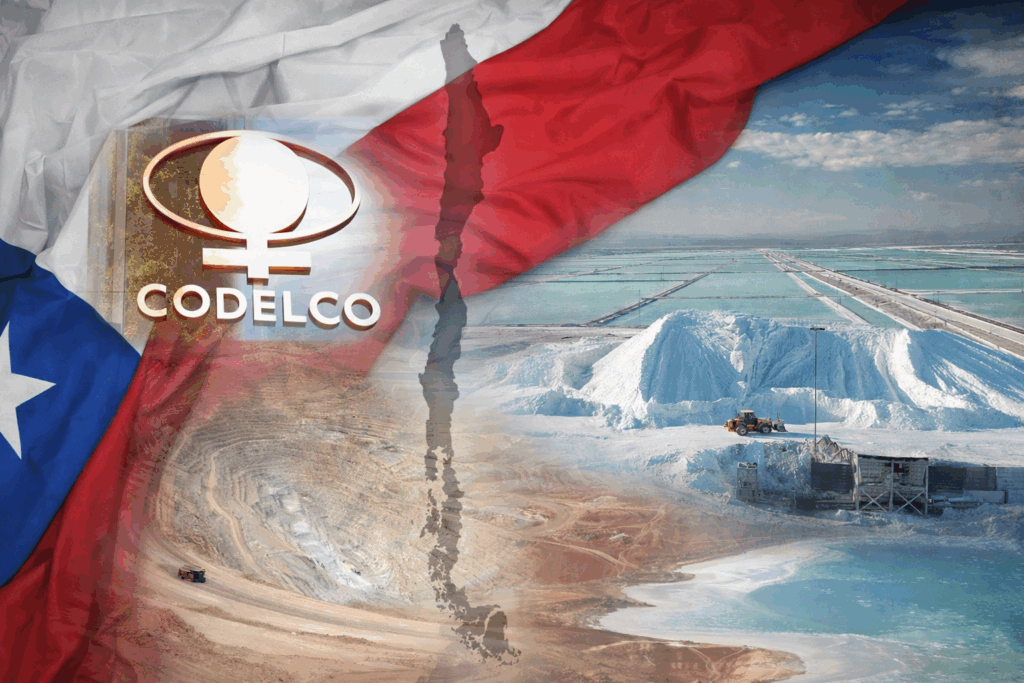
(Illustration by MINING.COM featuring stock and archived images.)
Chile is entering a new political phase as a right-wing government prepares to take office, putting mining policy under renewed scrutiny in the world’s largest copper-producing country.
In recent years, the local politics have also been shaped by rising concern over crime and migration, particularly a surge in Venezuelan migration and highly visible organized crime. While the causes are complex, perceptions linking irregular migration and insecurity became politically potent. President-elect José Antonio Kast, who takes office on March 11, campaigned on stricter border control and tougher law-and-order policies, making security a central issue in Chile’s electoral shift.
Kast has also signalled a change in approach for the mining industry. He merged the ministries of Mining and Economy into a single portfolio and appointed Daniel Mas, an agronomist with no mining background, to lead it. In a country where mining underpins economic growth, labour and export revenue, the move has unsettled parts of the industry.
Carlos Piñeiro, copper analyst at Benchmark Mineral Intelligence, said the fusion could improve coordination but risks diluting mining-specific expertise. “Mining has very particular challenges, especially the non-renewability of resources,” he said. “If this model is going to work, specialists need to be involved in decision-making.”
The Chilean Mining Chamber was more critical. “Mining, despite being our national emblem and the activity that contributes the most resources to the public purse, is treated as second-rate,” chamber president Manuel Viera told MINING.COM.
Viera said the Chamber would have preferred a minister dedicated exclusively to mining, noting that previous experiences placing mining under broader economic portfolios “have not been positive.” While he does not foresee governance risks due to the sector’s maturity, he said mining’s success depends on technically grounded public policy rather than political decisions.
Mas takes charge of a sector that is expected to attract an estimated $105 billion in investments between now and 2034, alongside proposed reforms to permitting and environmental assessment frameworks that companies say have slowed approvals and raised costs.
Eduardo Zamanillo and Marta Rivera, authors of the book Mining is Dead. Long Live Geopolitical Mining, said the merger of the ministries sent an important institutional signal at a time when major economies are placing critical minerals at the centre of industrial and security strategies.
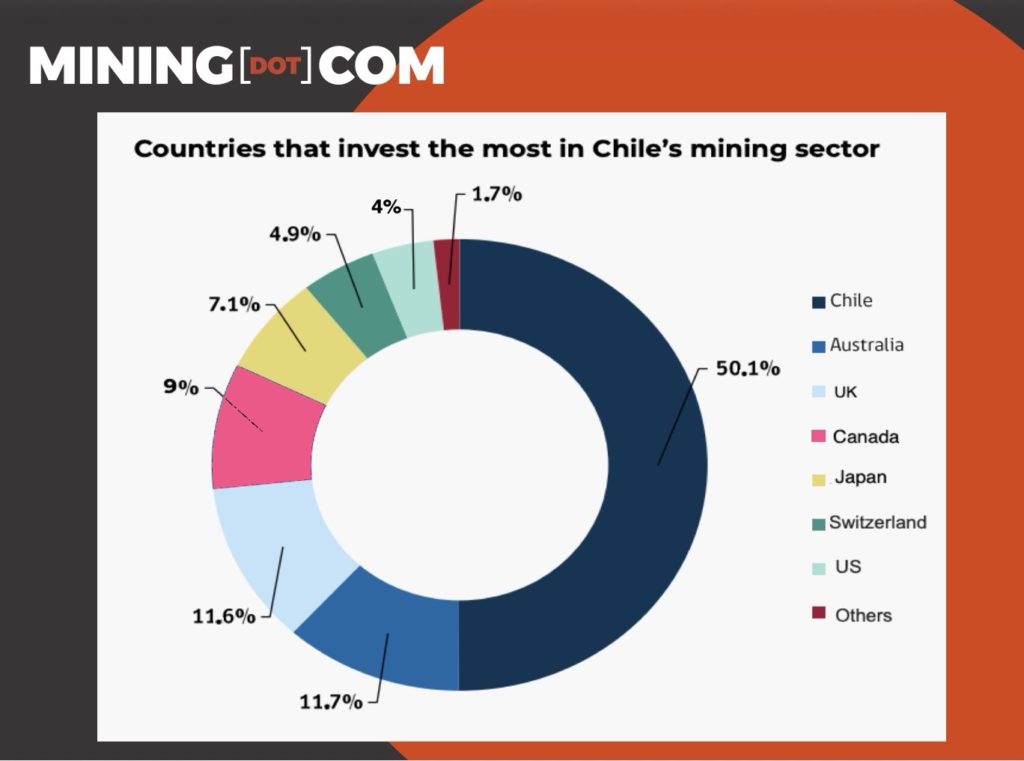
Although Chinese ownership of Chilean copper mines is limited, Beijing maintains influence through trade, financing and equipment supply. At the same time, US trade policy and Inflation Reduction Act-linked investment aim to anchor Chile more firmly within allied supply chains.
From a geopolitical mining perspective, Zamanillo and Rivera argue the move could either integrate mining more deeply into industrial policy, trade and innovation, aligning Chile with US-led reindustrialization efforts, or dilute the sector if it becomes just another file within a broad portfolio.
In their view, Chile’s opportunity lies in treating copper and lithium not merely as extractive revenues, but as platforms for building full value chains tied to allied markets. Whether the merger strengthens or weakens Chile’s position will depend on political will, technical leadership and the clarity of its long-term strategy.
Mineral ambitions meet execution risk
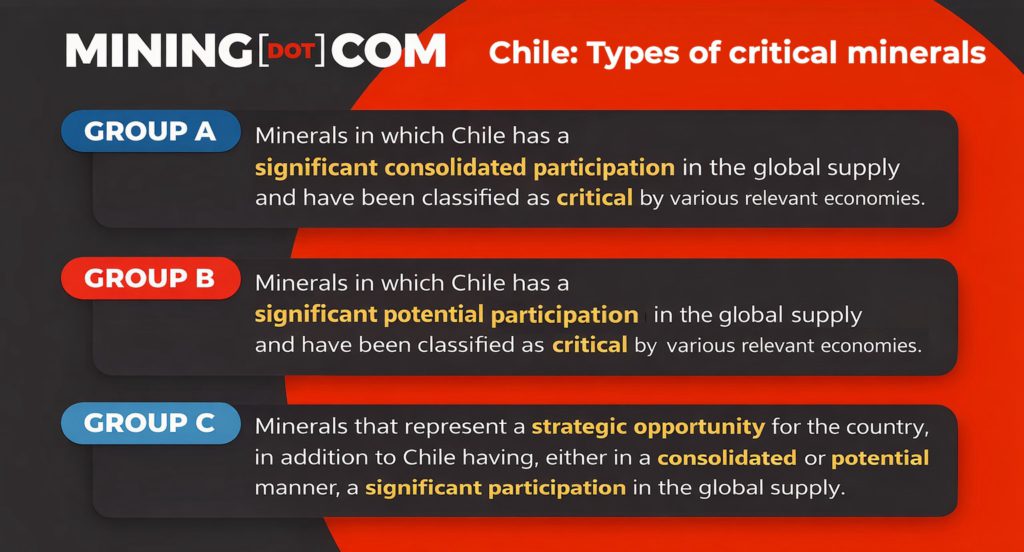
Chile’s policy debate has been further shaped by the release of the country’s first critical minerals strategy in the final weeks of outgoing President Gabriel Boric’s administration. The strategy aims to position Chile as a supplier not only of copper and lithium, but also of 14 other minerals considered essential to the energy transition and resilient supply chains.
Beyond copper and lithium, the list includes molybdenum, cobalt, rare earth elements, antimony, gold, silver, iron ore and boron, to reduce Chile’s historic over-reliance on a single commodity.
Viera said diversification is not optional.
“Depending almost exclusively on copper exposes the country to market cycles and uncertainty,” he said, noting that copper accounts for around 11% to 12% of GDP and more than 20% when considering economic impacts and multiplication effects. While copper will remain the backbone of the economy through at least 2035, he said minerals such as lithium, gold, molybdenum, rhenium and rare earth elements must help reduce long-term risk.
Piñeiro said Chile’s mining base is already broader than often assumed, citing molybdenum, rhenium, lithium, iodine, nitrates and a recovery in gold output. He added that projects such as Salares del Norte could lift national gold production by about 25%.
The strategy groups minerals according to Chile’s current position in global markets, with copper, lithium, molybdenum and rhenium in the top tier, and cobalt, rare earths, selenium and tellurium among longer-term options.
According to Viera, Chile’s challenge is not geology but policy. “The resources exist,” he said. “What is missing is a promotional and development plan that encourages exploration, investment and production.”
Others remain cautious. Daniel Weinstein, partner at Morales & Besa and president of the Mining Ministry’s advisory council, said the strategy provides a framework but does not change investment conditions on its own.
“Cursed” permitting system
José Cabello, director of Mineralium Consulting Group, said the critical minerals plan lacks concrete near-term measures.
“Nothing in the document implies a definitive boost to Chile’s production of these minerals,” he told MINING.COM, pointing to the absence of clear decisions to advance early-stage projects.
Viera echoed those concerns, arguing that without incentives for exploration and faster permitting, Chile risks missing the current price cycle. He described the permitting system as “cursed,” noting that a single project can require more than 500 permits over several years before seeing the light of day.
Zamanillo and Rivera argue that diversification should not be understood only as adding more minerals to a list, but as defining Chile’s position along emerging Western critical mineral value chains.
Trade data show Chile still exports most of its copper as bulk concentrates, heavily tied to China, while a smaller share of refined copper flows to the US and other allied markets.
In their view, the strategic opportunity lies in gradually shifting toward more refined output, midstream processing and higher-value services, using copper and lithium as anchors to attract investment aligned with US and allied industrial policy. Rather than relying predominantly on concentrate exports, Chile could rebalance toward deeper integration with North American value chains.
Copper dominance, rising constraints
Chile remains the world’s largest copper producer by a wide margin, accounting for roughly a quarter of global mined output. But declining ore grades, ageing deposits and rising regulatory complexity are constraining growth.
That strain is showing in production, which fell on a year-on-year basis every month of 2025. Official Cochilco figures peg the decrease in copper production last year at 2%, when compared to 2024 figures.
“Deposits are becoming deeper and lower grade,” Piñeiro said, adding that this makes Chile less competitive than jurisdictions such as the Democratic Republic of Congo, where higher grades support lower costs.
Industry groups are hoping Kast’s government will adopt a more pro-growth stance that would benefit the mining industry, but they warn that meaningful production increases will take time.
They also expect increased government involvement in the northern mining regions, such as Antofagasta and Tarapaca. These areas have seen visible irregular migration flows, heightening security concerns in areas central to copper and lithium production. Business groups have called for stronger border control and protection of logistics corridors. While core mining jobs are specialized, tighter migration rules could affect local labour markets in supporting sectors, analysts say.
Against that backdrop of regional strain, industry leaders are also focused on output and long-term competitiveness. Viera said Chile is “obligated” to exceed six million tonnes of fine copper per year, but stressed that growth must come with greater added value through industrialization. “The future lies in industrializing copper and lithium with a global perspective,” he said.
While Kast’s team has floated boosting mining output by as much as 20% within a year or two, council executive chairman Joaquin Villarino has said Chile’s project pipeline would more realistically lift copper production to around seven million tonnes over the next decade, assuming permitting efficiency and sustained investment.
Mariano Machado, Americas analyst at risk intelligence firm Verisk Maplecroft, said the 20% target is a political signal, not a literal schedule. “It signals urgency, not an immediate step change,” he said, noting Chile’s constraints stem from mature assets and long lead-times.
Machado pointed to Cochilco’s own projections, which show output peaking mid-decade before drifting down toward around 4.4 million tonnes by 2034. “We expect the sector to discount the headlines and watch what Kast can change early, including faster permit decisions and fewer procedural pauses,” he said.
From Zamanillo and Rivera’s perspective, Chile’s fundamentals remain strong in a world where capital is mobile and increasingly shaped by geopolitical considerations. They note that large pools of public and private funding in the United States and allied countries are being directed toward critical mineral supply chains, including reserves, loans and equity instruments. For Chile to compete with both other jurisdictions and high-growth sectors, they argue, it must shorten and clarify permitting timelines.
Long-life copper and lithium projects need predictable rules and sovereign speed, they say, if Chile wants to capture a larger share of the capital now being mobilized under the new critical minerals architecture.
More broadly, the nation’s shift toward a tougher law-and-order agenda shapes perceptions of regulatory certainty and state authority. For foreign copper and lithium investors, that trajectory feeds directly into risk assessments, even if migration itself is not tied to production.
Lithium: cost advantage, policy uncertainty
Chile remains the world’s second-largest lithium producer but has lost market share to faster-growing rivals. A national lithium strategy unveiled in 2023 increased state involvement and reshaped project development pathways.
Piñeiro said Chile’s cost advantage remains significant, citing the Atacama Salt Flat as one of the lowest-cost lithium brine resources globally.
Viera argued the country’s loss of leadership in lithium is political rather than geological. He added that Mining Code restrictions reserving lithium for the state have discouraged private investment despite high-quality reserves.
Machado said investor confidence in lithium hinges less on signed agreements than on operating stability.
“A deal is the easy part — a stable licence to operate is harder,” he said, noting that investors still price in political and social constraints.
While the Supreme Court’s backing of the Codelco and SQM agreement removed a legal challenge, he noted that investors continue to price in political and social constraints.
“Chile’s advantage matters if it can offer a stable operating model that survives social scrutiny and electoral cycles,” he said.
According to Viera, Chile could regain its position as the world’s largest or second-largest lithium producer within the next decade if restrictions are repealed and a pro-investment framework is adopted. He cited projects such as Nova Andino Litio, a joint venture between Codelco and SQM, and Salares Altoandinos as positive steps, but said far greater potential exists across more than 40 salt flats nationwide.
There is also Codelco’s Maricunga lithium partnership with Rio Tinto (ASX: RIO), which is still awaiting antitrust approvals from regulators in Chile and China before the companies can move ahead and sign a shareholders’ agreement.
A credibility test
As Kast’s government prepares to take office, Chile’s mining sector stands at a crossroads. Demand for copper, lithium and other critical minerals continues to rise, but investors are focused on whether political realities, regulatory reform and their execution will align.
For the Chilean Mining Chamber, the central issue is credibility. Viera said Chile must boost exploration incentives, modernize its smelting capacity and position mining as a strategic driver of development, not a fiscal fallback.
He added that the new Minister of Economy and Mining could play a pivotal role. “For more than 15 years, Chile has not launched any new projects to increase copper production. The only initiatives have replaced depleted reserves,” Viera said. “The country needs a nationwide exploration policy… Without new discoveries, we will fall behind.”
For Machado, credibility rests on delivery capacity, not rhetoric. He said the clearest signal would be a delivery framework that promotes productivity and talent, positioning mining as a modern export platform. He pointed to the Critical Minerals Strategy’s call for redesigned curricula, new specializations and stronger integration between industry, academia and the public sector.
That focus aligns with Chile’s broader competitiveness diagnosis, which highlights a persistent mismatch between available skills and labour-market demand. Machado noted that the mining workforce is already structurally tight and increasingly contractor-heavy.
“A robust plan for developing human capital is not an add-on, but a necessity to mitigate capex risk,” he said.
In an increasingly geopolitical minerals market, Chile’s challenge is no longer just the size of its resource base, but whether it can reliably convert that advantage into sustained supply.
———
Brazilian state firm fights Equinox Gold asset sale to CMOC
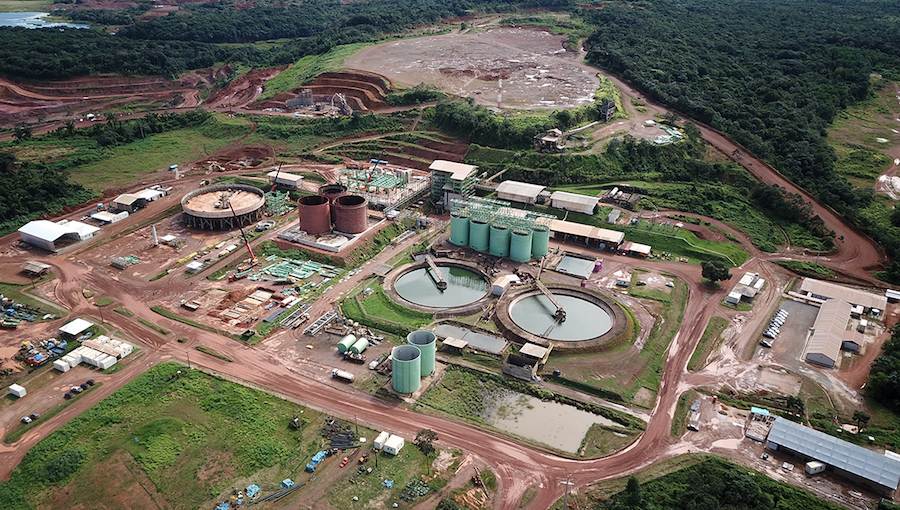
Aerial view of the plant at Aurizona Gold Mine in Brazil (foreground) and Piaba Pit (background). (Image courtesy of Equinox Gold)
A Brazilian state-run company is taking legal action to try to block the sale of a precious metals asset by Equinox Gold Corp. to one of China’s biggest miners.
Companhia Baiana de Produção Mineral, or CBPM, is seeking an emergency injunction for the immediate repossession of a lease area in Bahia, a state in Brazil’s Northeast Region, according to a document seen by Bloomberg News. It argues that Canada-based Equinox was a leaseholder – not the owner – of the concession and therefore was not entitled to sell it.
Equinox agreed to sell its Brazilian operations to CMOC Group, one of China’s biggest mining companies, in a $1 billion deal completed last month. The transaction — announced in December — includes several mines and deposits, in different Brazilian states, under Equinox’s entities in the South American nation.\\
CBPM’s allegations relate to only one of these assets, known as the Bahia Complex. No other properties were listed in the document filed with the court. The company had previously signaled its opposition to the transaction in a statement.
Equinox Gold has not received notice of any lawsuit, Ryan King, the company’s executive vice president for capital markets, said in an emailed response to a request for comment. Equinox “is confident that the sale of its operations in Brazil was fully compliant with Brazilian law and all contractual obligations,” he said on Thursday.
“While Equinox Gold is prepared to defend its position in court if required, the company remains open to engaging in constructive discussions with the State to seek a mutually agreeable resolution,” King said.
CMOC Group, the Chinese company, did not immediately respond to requests for comment. Many Chinese businesses are closed this week for the Lunar New Year holiday.
CBPM alleged that the transaction was agreed without its express consent, which it said was a condition of the agreement governing the mining area. The company has asked the Bahia State Court of Justice to terminate the lease agreement, and is also seeking damages.
“The Canadian company sold a mining right that does not belong to it,” CBPM president Henrique Carballal said by telephone.
(By Mariana Durao)
Austal Finalizes Large Contract to Build Australia’s Landing Craft Heavy
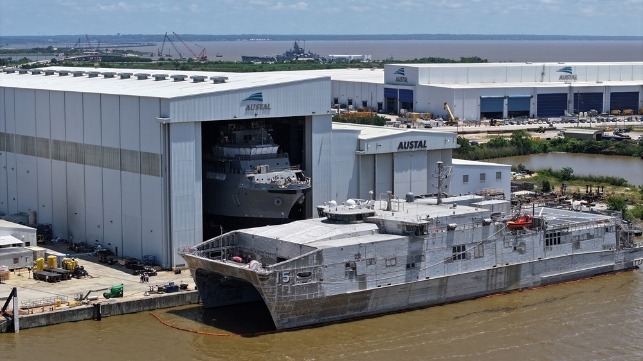
Austal will diversify its military shipbuilding with the Landing Craft Heavy order in Australia balancing its US orderbook (Austal)
Austal Defence Shipbuilding Australia highlighted the announcement by the government’s Deputy Prime Minister and Minister for Defence, Richard Marles, and Minister for Defence Industry, Pat Conroy, as the finalization of a large contract to build the country’s new Landing Craft Heavy (LCH) vessels. It was expecting to sign the contract, valued at approximately A$4 billion (US$2.8 billion), later on Friday while highlighting it was the second major contract for the company under its Strategic Shipbuilding Agreement (SSA) with Australia.
The Australian Government confirmed the selection of Damen’s Landing Ship Transport 100 (LST100) as its preferred design for the Australian Defence Force’s Landing Craft Heavy project in November 2024, with the vessels to be built by Austal. The design calls for an approximately 100-meter (330-foot) long vessel with approximately 3,900 to 4,000 tonnes displacement. It will have a capacity for over 200 soldiers, plus six Abrams tanks or nine Redback Infantry Fighting Vehicles.
Construction of the Landing Craft Heavy vessels will be undertaken using Austal facilities and the Common User Facility at Henderson in Western Australia. Construction is scheduled to commence in 2026, with the eighth and final vessel scheduled for delivery to Australia in 2038.
“Constructing the Landing Craft Heavy vessels at Henderson will create and develop thousands of new, skilled jobs in Western Australia and provide further opportunities for the local defence industry supply chain,” noted Paddy Gregg, Austal Limited CEO.
It is the second major order for the Australian armed forces. Austal also completed in December 2025 a contract for approximately A$1 billion to complete the detailed design and build 18 Landing Craft Medium (LCM) vessels at Austal’s Henderson, Western Australia, shipyard. Construction of the first LCM is scheduled to commence in 2026, with the 18th and final vessel scheduled for delivery in 2032.
Austal has sought to develop its work for the Australian military following its long-standing programs for the United States. It also cited the Strategic Shipbuilding Agreement as a defense when South Korea’s Hanwha Group proposed an acquisition of Austal. Management has questioned whether, because of its role in building for the Australian and U.S. military, a change of control would be permitted. Australia, however, permitted Hanwha to become Austal’s largest shareholder.
“While Austal's U.S. business has traditionally accounted for a large share of our defence order book in recent years, this contract reflects the growing strength and success of Austal’s Australian operations — and Australian industry — within the national shipbuilding and sustainment enterprise. This LCH construction contract balances out the split and provides greater geographic diversity of earnings. It also provides earnings and employment stability for the next 12 years,” said Austal Defence Australia Executive General Manager – Strategic Shipbuilding, Gavin Stewar.
Austal also notes that Austal USA is presently constructing up to 12 smaller Landing Craft Utility vessels for the US Navy at its Mobile, Alabama, shipyard.
Austal USA Appoints its Fourth President in Five Years
Naval shipbuilder Austal USA announced Thursday that president Michelle Kruger has stepped down from running day-to-day operations and assumed an advisory role, to be followed by retirement in June. The company's COO has taken over management as interim president, effective immediately.
"Austal USA is deeply grateful for Michelle Kruger’s vision, commitment, and the lasting impact that she has made on our organization as company president over the last two years," the firm said in a statement. "Congratulations on this momentous milestone and best of luck with the adventures ahead of you as you enjoy your retirement."
Austal is a key partner in multiple Navy shipbuilding initiatives, from the aluminum-hulled LCS and EPF to steel-hull auxiliaries like the T-AGOS program to modules for other defense primes; the company has a wide and deep portfolio, and has been growing rapidly.
Kruger, a USMMA grad and marine engineer by background, worked on LCS sustainment at NASSCO and then transferred over to Austal in 2022, taking a role running Austal's service business, then president in 2023. During her tenure, she oversaw the launch of a major facility expansion for construction of midsize government vessels and submarine modules for the Virginia- and Columbia-class programs. The infrastructure program, upon completion, will give Austal a total of one million square feet of space in seven assembly bays.
Kruger will now serve in an emeritus capacity until June, when she will retire. Her transition was announced one week after Austal Ltd. had to cut profit guidance by 18 percent because of an accounting error at the Austal USA unit. Austal USA's offices had reportedly double-counted incentive payments on its T-ATS fleet tug contract for the U.S. Navy; when the error was found, Austal had to reduce its revenue projections accordingly. Its stock has fallen by 23 percent in the past month.
Austal USA's COO, Gene Miller, has taken over from Kruger as interim president. He is the fourth Austal USA executive to assume the top role in five years, and the third to begin work after a predecessor's sudden departure.
Kruger became interim president in August 2023 after the resignation of Rusty Murdaugh, who departed after Austal lost money on the same fleet tug (T-ATS) contract, its first experience with steel shipbuilding. Losses on the tug order prompted Austal Ltd. to temporarily halt stock trading and make a cut in earnings projections, followed shortly after by Murdaugh's exit.
Murdaugh had started as interim president in 2021 after the ouster of former president Craig Perciavalle, who was later indicted on charges of accounting fraud related to alleged misreporting of construction costs on the LCS program in 2013-16. In 2024, Austal USA pleaded guilty to one count of securities fraud and one count of obstruction of a federal audit in connection with these events; it appointed an independent monitor, paid a $24 million fine and paid $24 million in investor restitution to settle the criminal charges. Court proceedings continue for Perciavalle and two other suspects.
Port Builds on Effort to Strengthen its Safety Culture to Reduce Injuries
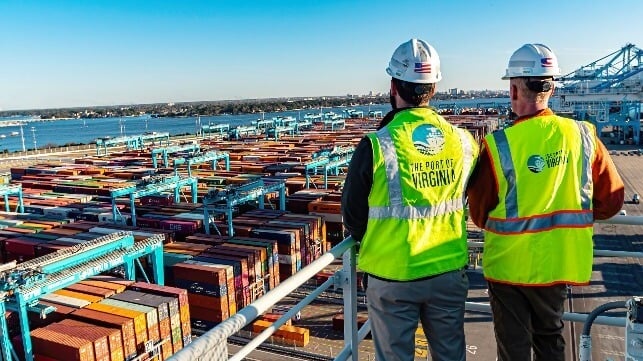
The Port of Virginia® is using a layered approach to strengthen safety throughout its operation by identifying the most common critical risks at its terminals and offices, emphasize safety as a core value and creation of an internal safety brand that serves as a continual reminder for everyone on port property.
The effort was recently recognized by Signal Mutual, the insurance carrier for The Port of Virginia, which presented its Executive Leadership Award to Virginia International Terminals Chief Operating Officer Joseph P. “Joe” Ruddy. The award recognizes the effort underway at the port to emphasize safety and reduce the number of injuries, reportable incidents and lost workdays. (Virginia International Terminals, LLC, is the privately-held terminal operating company for The Port of Virginia.)
“This award is not about an individual, but what The Port of Virginia® is doing, as an organization, to get better and create a culture of safety across the entire operation,” Ruddy said. “It is our goal to eliminate injuries, lost workdays and the like, and become the safest port in North America.”
“Safety is a core value here and as a team we are coming together to ensure that we protect what matters, which are the people that work here, our labor partners, our guests and the contractors coming to and from our facilities and offices. At the end of every day, of every shift, people should be going home in the exact same condition in which they showed up.”
Lost workdays is one of the safety metrics used by the industry and during the last four years, the number of lost workdays at The Port of Virginia, as the result of on-the-job industry, is decreasing. (Lost workdays are measured in the total number of days an employee could not work against every 200,000 hours worked.)
The Port of Virginia, lost workdays by fiscal year, July 1 – June 30:
2022 = 1.82 days
2023 = 1.83 days
2024 = 1.37 days
2025 = 1.04 days
2026 = 1.09 days (as of Feb. 2026)
2026 goal = 0.91
OSHA industry average = 1.4 days
“We are trending in the right direction, in terms of lost workdays, and have been for the last four years, but the goal is zero,” said Sarah J. McCoy, the interim CEO and executive director of the Virginia Port Authority.
Last fall, port leadership announced an organization-wide initiative to ingrain safety even more into the port’s culture. Since then, the port has created a safety brand, We Protect What Matters, and has collaborated with local ILA leadership (International Longshoremen’s Association) and port team members from across the organization to better understand where the highest risks are and how best to mitigate them.
The safety effort includes:
Creation of critical risks and life-saving rules
Recognition for those going above-and-beyond standard safety practices
Identifying and marking potential hazards
Safety audits
Safety briefings for guests
Annual safety training (CPR, first-aid, etc.)
We Protect What Matters messaging campaign
“We had a lot of conversations, grounded in real experience that led to the identification of our Seven Critical Risks and Six Life-Saving Rules,” McCoy, said. “These risks and rules are not about adding complexity or checking a box. They are about clarity, using common language to recognize risk, communicating more effectively and focusing our attention on the situations where the potential for serious harm is greatest.”
“This organizational effort reflects our shared commitment to care, consistency, and accountability. Care for one another, consistency in how we approach safety and accountability to make sure everyone goes home safe at the end of the day.”
Signal’s Executive Leadership Award is an annual award given to an executive who advances employee safety and health through a strong safety culture and a sustainable safety management system.
“The recipient sets high safety standards grounded in personal values, demonstrates a sustained commitment to preventing workplace injuries and illnesses, leads safety efforts in a visible, hands-on manner, and develops effective safety initiatives that are implemented across the organization,” said an award description from Signal.
The products and services herein described in this press release are not endorsed by The Maritime Executive.
Associated British Ports Invests in Young People
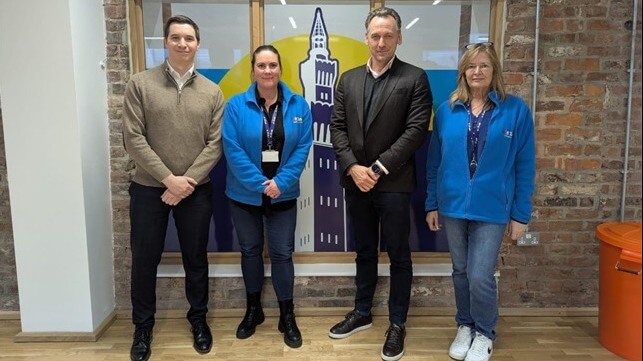
Pictured L to R Max Burnett (ABP), Lucy Ottewell-Key (Horizon), Andrew Dawes (ABP), and Fiona Wright (Horizon)
Associated British Ports (ABP) is delighted to become a founder patron of the Horizon Youth Zone in Grimsby to help support the charity in providing a safe, inspiring place for young people.
As Founder Patrons, ABP will join a growing family of businesses, organisations and philanthropists contributing to the charity’s annual running costs. This enables Horizon to keep offering state-of-the-art facilities, new opportunities, and first-class youth work to thousands of young people in North East Lincolnshire.
Andrew Dawes, Regional Director for ABP in the Humber said: "We’re absolutely delighted to be a Founder Patron of Horizon Onside Youth Zone.
It’s a privilege to support a project that will create opportunities, raise aspirations, and make a lasting difference for young people across North East Lincolnshire. We very much look forward to work alongside them in showcasing opportunities across our port and maritime sector in the Humber."
Horizon CEO, Lucy Ottewell Key said: “We are grateful for the generous support of Associated British Ports. Their belief in Horizon Youth Zone is a powerful message to the young people of North East Lincolnshire that their futures matter. Thanks to this support, more young people will have a safe place to grow, connect, discover their strengths, and build the confidence they need to thrive.”
Since Horizon’s grand opening last weekend, young members are now able to access an indoor climbing wall, four court sports hall, training kitchen, music room with a recording studio, fully equipped gym, sensory room, dance and drama studio, 3G kick pitch, arts and crafts room, and enterprise and employability suite. In addition to these incredible facilities, trained youth workers and dedicated volunteers are available seven days a week to offer guidance and holistic support to help the area’s young people to thrive. The Youth Zone is creating permanent full and part-time jobs, as well as numerous volunteering opportunities.
Horizon Youth Zone is an independent charity with a private sector-led board and part of the OnSide Network of 18 Youth Zones nationwide, supporting more than 55,000 young people annually. Youth Zones are open to young people aged between eight and 19 (up to 25 for those with additional needs), seven days a week, for just £5 membership per year and 50p a visit.
The products and services herein described in this press release are not endorsed by The Maritime Executive.
APM Terminals Expands in Middle East with Jeddah Terminal Investment
APM made a strategic investment in Saudi Arabia's key port and its first on the Red Sea (APM)
Maersk’s terminal operator, APM Terminals, is positioning itself to benefit from the growing status of Jeddah Islamic Port as it announced the acquisition of a stake in a terminal operated by DP World. It represents APM’s first Red Sea presence and further expands its Middle East presence.
As part of measures to deepen its presence in Saudi Arabia, APM Terminals entered into an agreement with DP World to acquire a 37.5 percent stake in the Southern Container Terminal (SCT) at Jeddah Islamic Port. The two companies did not disclose the value of the investment.
APM Terminals is making the strategic investment owing to Jeddah’s role as a vital gateway not only to the local market but also to global networks. DP World, which secured a 30-year build-operate-transfer concession to operate the terminal in 2019, will retain a 62.5 percent majority shareholding and continue to lead the operations at the facility.
Critically, APM Terminals is acquiring a stake in the facility exactly a year after DP World completed a massive $800 million modernization and expansion of SCT. In March last year, DP World completed a three-year project that transformed the terminal into one of the region’s most advanced and sustainable container facilities, the hallmark of which was doubling its capacity from 1.8 million TEU to 4 million TEUs. The expansion also paved the way for a future capacity of 5 million TEU, with additional ship-to-shore equipment to be deployed as demand grows.
The project also involved expanding the terminal’s capacity for refrigerated containers (reefers) from 1,200 to 2,340, something that now ensures optimal conditions for temperature-sensitive shipments. Spanning a total quay length of 2,150 meters, including a deep-water quay with an 18-metre depth, SCT is today capable of accommodating up to five ultra-large container vessels simultaneously.
Mid-this year, DP World expects to complete the construction of the 415,000-square-meter Jeddah Logistics Park that is being touted as the largest integrated facility of its kind in the Kingdom and which is adjacent to SCT. Maersk is also pumping investments into the park that is expected to offer state-of-the-art warehousing, distribution and freight forwarding services, further strengthening Jeddah’s position as a key hub connecting trade routes across Asia, Africa, and Europe.
“Jeddah Islamic port is one of the region's most important trade corridors. This investment secures long-term access to quality infrastructure and strengthens our ability to support customers with reliable, scalable capacity in the Kingdom,” said Keith Svendsen, APM Terminals CEO.
Jeddah Islamic port is located along busy global shipping lines connecting three continents making it the Red Sea's top port for transit trade and transshipment of container and cargo. With four terminals and 62 berths, the port has been witnessing growth in the number of ships calling at the port. Last year, about 4,000 vessels docked at the port.
“Since securing the concession in 2019, we have transformed the Southern Container Terminal into a modern, high-capacity gateway, further strengthening Jeddah’s position as a leading Red Sea hub in support of Saudi Arabia’s Vision 2030,” said Yuvraj Narayan, DP World Group CEO.
He added the partnership with APM Terminals reflects the confidence global industry leaders place in the port operator’s capabilities.
Port of Los Angeles Expects Continued Weakness After January Decline
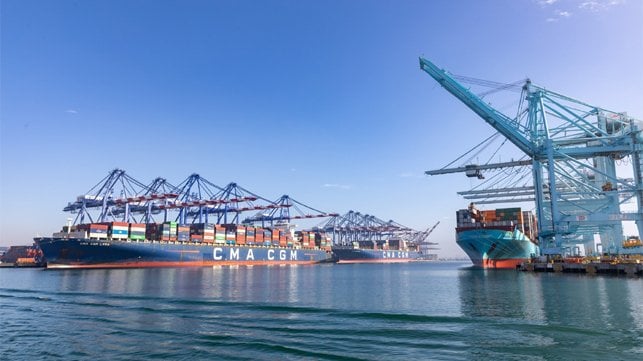
The Port of Los Angeles expects continued declines in volumes due to higher inventories, uncertainties in trade policies, and last year's frontloading by importers (Port of Los Angeles file photo)
The Port of Los Angeles foresees continued weakness in container volumes for the first quarter of 2026 after a 12 percent decline in January. However, while highlighting that it does not expect increased certainty for U.S. trade policies, it believes the rate of decline is stabilizing and is not expected to “drop off a cliff” as the U.S. moves forward in 2026.
As the largest container port in the Americas, the Port of Los Angeles is viewed as a key measure of U.S. trade, especially with China and Asia. Despite the uncertainties and changes in trade policies in 2025, the port recorded its third busiest year, handling more than 10 million containers. While it represented a marginal decline versus 2024, it marked the 26th year the Port of Los Angeles was the busiest port in the Western Hemisphere.
While saying “January held no surprises,” Port of Los Angeles Executive Director Gene Seroka told reporters at a media briefing on February 17 that he expects a decline of “less than 10 percent” for volume in the first quarter. After that, he said, “I don’t see the economy or cargo volume dropping off a cliff…. I don’t see a dire situation.”
Seroka notes that in addition to continuing uncertainties in U.S. trade policy, they are facing a headwind after “importers scrambled to get cargo in ahead of the tariffs” in 2025. He believes that impacted January volumes and will continue to have an impact into 2026.
All measures of volume were off during January, with imports down 13 percent while exports were down 8 percent to the lowest levels in nearly three years. Critically, imports were 3 percent below the port’s five-year running average.
Similarly, the indicators are also weak. Seroka pointed to the consumer confidence index, which is at its lowest level in 11 years. He reported in January that empties leaving the port, an indicator of shippers preparing for export cargo, were down 12 percent. He said this reflects softer demand ahead. During the conversation, it was noted that the U.S. is not exporting much to China currently.
Halfway through February, the forecast for the month was that arrivals looked “relatively flat” compared to last year. However, the Lunar New Year holiday began this week and will have an impact going forward. Seroka said the primary impact would be felt in March at the port of Los Angeles.
Seroka also believes that importers are in a “cautious restocking phase.” He notes that inventories are higher at the beginning of the year, meaning they expect it will impact volumes going forward. He also notes that the frontloading that took place in 2025 means they will continue to face challenging year-over-year comparisons as they go forward this year.
Despite a cautious outlook, Seroka noted that order levels appear to be fairly stable, contributing to the outlook of a leveling off for volumes as they move into 2026. He also notes the American consumer has “shown remarkable resilience.”
The Port of Los Angeles’ forecasts follow similar broader outlooks from the National Retail Federation, which expects retail imports to remain at lower levels moving into 2026. The spending frenzy during and after the pandemic has cooled, with analysts noting that consumers remain concerned.