Monday, March 02, 2026

Source: Waging Nonviolence

As a senior, I’m trying to do my part to push back against the daily dismantling of the nation by the Trump administration. And I’m not alone.

Around 25 percent of adults in the United States are seniors. We are a powerful demographic for reclaiming and restoring democracy in this country. We want to build upon the 250 years of its existence and support its return to a position of international leadership.

In my 85 years as a citizen of the U.S., I’ve done my best to be a good one. Never shy to engage with worthwhile causes, I have been involved with disability rights, vocational rehabilitation, special education, domestic violence prevention and rehabbing offenders, senior services, youth services, food and water security, and immigrant and minority rights. I have tried to advance justice in the U.S., and some 16 plus other nations in which I have worked. Yet, since 2016, my pride in my own government has waned precipitously.

I now live in a senior independent living facility with some 50 other seniors. We are often willing to overlook our increasing infirmities and dwindling resources to engage with passion and determination. We take great pride in having a positive influence on our children — both biological and otherwise — by teaching them our values and how to uphold them.

I have scores of senior friends and family members — some are more physically capable, but many have limited mobility or are even homebound. However, all of them are engaging in civil resistance in meaningful ways. I’ve learned from them that there are many opportunities for peaceful engagement in the resistance.

Those with limited mobility are posting and commenting on social media. Those with economic means are donating to progressive candidates. Many are phone banking and writing postcards to voters and potential voters with groups like Seniors Taking Action. Others boycott businesses that support the current administration, write letters to the editor and call in to radio talk shows.

I’ve seen many seniors (and non-seniors) with canes, walkers and wheelchairs at all of the protest events I have attended. At one demonstration, an elderly, disabled fellow showed up in a wheelchair equipped with hydraulic lifts that put him at eye level with the other protesters. He was not only able to see what others saw, but others saw him, his sign and his strength as a demonstrator with the same passion and potency.

I have a friend who turns 100 later this year and uses a walker to travel any distance from our communal residence. She is one of my role models, and has taught me how to maximize my presence and impact at large demonstrations. Last summer, she made careful preparations for the No Kings protest, which was planned at the federal building located roughly a mile from our home. Before the event, she made two round-trip trial runs to build stamina and reassure herself it was doable.

When I arrived at the protest, she had already strategically placed herself where her homemade sign could be seen and she could see, hear and engage fully with the activities. At a subsequent event, with yet another sign, she was one of several League of Women Voters who sported a banner extolling their values. My friend is a firebrand who never misses an opportunity to participate.

Another friend in her mid-70s has been totally blind since early childhood. She marches in most if not all demonstrations in her area. She religiously contacts her elected officials at both the federal and state levels, expressing her appreciation for deeds well done, dismay for bad moves, and suggestions or demands for more effective action. As a Latina woman who grew up in a poor neighborhood in El Paso, the child of a single mother and sister to four younger siblings, her life experience and upbringing has taught her the importance of advocating for herself and for others. With ICE violating the rights of so many minority folks right now, she is standing up in both English and Spanish, and making sure she is heard loud and clear.

My spouse, Stan Coleman, a director, actor, vocalist and pianist, directed a local theater production of the 1936 play “It Can’t Happen Here,” based on the novel by Nobel Prize-winning author, Sinclair Lewis. The performances opened the audience’s eyes to the existential threat Trump and his followers pose to our way of life.

Other seniors have engaged in the boycotts of Target, Disney and ABC, as well as Tesla Takedown. Other elders are leaning on their alma maters to support critical issues like student organizing and protesting, avoiding campus repression, standing up for immigrant student rights, and refusing to buy into the authoritarianism of Trump’s campus compact. Since schools depend on alumni for financial support, especially through legacies, seniors are leveraging their position as potential donors to shore up their colleges’ willingness to defy Trump’s efforts at coercion and control.

As part of our resistance, my spouse and I have chosen to be active founders and members of the local chapter of States Win, formerly known as Sister District Project. This national effort works to support key state-level candidates for office through marches, bar trivia fundraisers and direct donations. Seniors make up more than 50 percent of our chapter. Additionally, our queer, senior walking group (called the “Talkie-Walkies” because we do more talking than walking) frequently sits for hours in front of our main library here in Eugene, Oregon, inviting passersby to register to vote.

Two of the founders of our States Win chapter, both women in their mid-to-late 70s, regularly travel to the home area of the candidates we are supporting and spend days knocking on doors to promote them. They report few negative reactions to their presentations. Could their age or the fact that they are seniors — and have expended considerable effort and expense to do what they are doing — be a factor in this positive reception? SDP’s impact nationally has been formidable: We helped flip both Virginia and Washington State from red to blue trifectas, where all three branches of the state government are now dominated by Democrats.

Making donations is one advocacy activity many seniors can do with little effort. Almost every person I know participates as a donor, in small or large amounts, often as just one way they engage in political activism. My spouse and I have developed a profile for those we support: We look at their platform and what in their history informs it; how they have performed in other political positions, in advocacy groups and in movements; how they have overcome difficulties to be successful; their support for minority rights; and their passion for all of the above.

Phone banking has been shown to be effective in swaying non-voters and regular voters to vote for progressive candidates. It is an activity one can do from home with proven impact. Many, many of my elderly friends participate. Writing postcards can be a solo act from the comfort of one’s kitchen table or a social event with a group of like-minded activists. Seniors might be the largest demographic engaged with postcard writing. One friend, in particular, has handwritten over 1,000 postcards in the past two years.

Signing petitions, joining and supporting advocacy groups such as Southern Poverty Law Center, Amnesty International and the ACLU, door-to-door canvassing, writing letters and emailing, are all methods of civil, peaceful resistance that countless seniors are involved in.

Additionally, with isolation being associated with dementia, the social value of many of these activities can be meaningful. Being with others builds awareness and commitment, both of which foster mental health, along with civil resistance. In Eugene, many of us gather at a store called Materials Exchange Center for Community Arts, or MECCA, where people make signs using both new and used materials, and share ideas with others of similar persuasion. My 84-year-old supper tablemate never fails to show up at a demonstration with a new and clever sign she created at MECCA. Folks often photograph her with her sign.

Importantly, all of these resistance efforts are nonviolent, which has been shown to be the most effective way of waging struggle. Trust us on this. Not only have seniors lived long enough to know what works, the book “Civil Resistance: What Everybody Needs to Know”proves it. Erica Chenoweth demonstrates that nonviolent movements have succeeded twice as often as violent ones over the last century. Along with my fellow senior activists, I often attend Chenoweth’s webinars with the Ash Center at Harvard University.

The activism carried out by our nation’s elders is laudable and extensive. Attend any rally, march, protest and look at the amount of white hair in the rising sea of protesters. Today’s seniors are not sitting at home knitting sweaters for our grandkids or pasting memory photos in albums. Nope, we are out there pushing back and fighting for a far better gift for them: We are assuring a future where we have a fully restored and improved democracy.

Don’t mess with seniors!\\\Email

Bill Winkley has worked as a teacher, rehab counselor, administrator and consultant in non-profit management. He has lived and worked extensively around the world. Today he coordinates the work of One Family International in developing nations from his home in a senior independent lives facility in Eugene, Oregon.


Robert F Kennedy Jr: 1 Year of Failure

Source: The Lancet

In his first speech as Secretary of the US Department of Health and Human Services (HHS), Robert F Kennedy Jr laid out a plan to restore trust. The COVID-19 pandemic saw public faith in Federal health and science plummet—between April, 2020, and September, 2023, the percentage of polling respondents who trusted coronavirus and vaccine information from the Centers for Disease Control and Prevention (CDC) “a great deal” or “a fair amount”, fell from 83% to 63%—and the HHS employees to whom he was speaking were facing devastating mass lay-offs and funding cuts. Although Kennedy did not mince words about the likely fate of staff resistant to his ambitions, he promised open and honest engagement with everyone willing to work towards making the USA healthy again. To the Senate committee who confirmed his nomination, Kennedy promised a receptive and collaborative relationship, and to the public from whom he claims his mandate, he promised a new era of unbiased science without hidden conflicts of interest, secrecy, or profiteering. Radical transparency, gold-standard science, ethics, compassion, competency, and pride would restore to HHS the unimpeachable authority that the USA needs and deserves. Politicians are known to break promises, but Kennedy’s record, 1 year in, has been a failure by most measures, especially his own.

10 days after his speech about trust and openness, HHS rescinded a 54-year-old policy of soliciting public comments for new rules and regulations, silencing the voices of many of the stakeholders he pledged to serve. Kennedy has summarily dismissed advisers and experts, communicated policy changes on pay-walled media, fired a whistleblower, and overseen the revisions of guidelines and recommendations, contradicting decades of established science, often to the benefit of industries he formerly condemned. Under Kennedy’s leadership, the National Institutes of Health (NIH) shuttered programmes studying the health effects of air pollution, HHS withheld a report linking alcohol consumption to cancer, and the Food and Drug Administration (FDA) withdrew warnings of potential harm from consuming products (such as raw milk and chlorine dioxide) falsely marketed as treatments for autism. His changes at CDC have driven 26 states to reject official guidance on vaccine policy, and in December the CDC awarded an unsolicited $1·6 million grant to conduct a vaccine study in Guinea-Bissau that raised so many ethical concerns—the design would have risked exposing thousands of unvaccinated children to hepatitis B—that it has been compared to the infamous Untreated Syphilis Study at Tuskegee.

HHS under Kennedy has made a habit of throwing good money after bad science. Amid the Trump administration’s cuts to research funding and personnel there has been a harmful shift in priorities. Cutting-edge discoveries and clinical investigations—on subjects ranging from mRNA vaccines to diabetes and dementia—are denied crucial resources while junk science and fringe beliefs are elevated without justifiable explanation. Under Kennedy’s leadership, politicisation at the NIH, FDA, and CDC is imperilling the future of US science and innovation and throttling the public health enterprise that keeps the country safe today.

The mechanisms maintained by the Federal Government to monitor and report health concerns such as drug overdoses, maternal mortality, and food security have been as beleaguered as the doctors and scientists who rely on them; thousands of datasets are no longer publicly available, leaving Americans—and the world—unprepared to respond to future crises. And crises are looming: in November, 2025, the first human infection (and death) from the H5N5 strain of avian flu was recorded in Washington state; pertussis, which killed 13 people in the USA in 2025, continues to spread across the country; and the measles outbreak that began in January of last year now threatens the elimination status of the USA and Mexico.

Despite these developments, Kennedy has continued to spread misinformation and push politicised agendas at the expense of the country’s most vulnerable. When called to account for his decisions by Congress, he has been evasive and combative. The destruction that Kennedy has wrought in 1 year might take generations to repair, and there is little hope for US health and science while he remains at the helm. Calls for his resignation now number in the thousands. Congress must exercise its duty of oversight and hold Kennedy accountable for his record, or else accept responsibility for endorsing President Trump’s decision to let him “run wild on health”.


For more on the firing of Jeanne Marrazzo see https://www.theguardian.com/us-news/2025/oct/03/rfk-jr-jeanne-marrazzo-nih-fired

For more on how a key report on alcohol and health was not published see https://www.statnews.com/2025/09/04/federal-alcohol-health-study-not-released-dietary-guidelines/

For more on the withdrawal of warnings see https://www.propublica.org/article/rfk-jr-fda-removes-autism-treatments-warning

For more on concerns regarding the Guinea-Bissau vaccine study see World ReportLancet 2026; 407: 559–60

For more on cancelled studies see https://www.statnews.com/2025/08/30/diabtes-prevention-program-restored-impact/

For more on data collection see https://www.notus.org/trump-white-house/federal-data-is-disappearing


US forces launched a military attack against Venezuela on January 3, reportedly killing over 100 people and kidnapping Venezuelan President Nicolás Maduro and first lady Cilia Flores, who also serves as a National Assembly deputy.

Western corporate media have played an active role in recent years in legitimizing escalated US aggression against the Venezuelan people, from whitewashing economic sanctions that killed tens of thousands (FAIR.org6/4/216/13/22) to outright calling for a military intervention (FAIR.org2/12/2511/19/25). They also exposed themselves once again as the fourth branch of the US national security state, opting not to publish information they had prior to the January 3 operation in order to “avoid endangering US troops” (FAIR.org1/13/26).

The brazen act of war has elicited zero dissent from the Western media establishment, no urge to challenge Trump’s return to early 20th century “gunboat diplomacy.” Worse, with the White House pushing to impose a semi-colonial protectorate and plunder Venezuela’s wealth, corporate outlets continue working overtime to normalize US imperialist predations.

Damage control

In the weeks since the attack, Western media have made a point of referring to Maduro as “arrested” (NBC1/5/26), “captured” (PBS2/10/26) or “ousted” (ABC1/5/26). The choice is far from innocent. By not stating that the Venezuelan leader was “kidnapped” or “abducted,” in a blatant violation of international law, establishment journalists are normalizing the US’s rogue actions, denying Maduro the proper protections of prisoner of war status (FAIR.org1/20/26).

But it is not just through semantic distortion that corporate outlets have quarantined any critique of the administration’s lawlessness. Another common feature has been a certain “damage control” in covering up Trump’s most outlandish statements.

After the January 3 military operation, Trump stated in a press conference that “many Americans, hundreds of thousands over the years…died because of [Maduro].” No corporate outlets reported the outrageously false statement. (A couple of factchecking pieces—CBS1/6/26New York Times1/8/26—addressed his adjacent, essentially unfalsifiable claim that “countless Americans” died due to Maduro.)

The attempts to make Trump’s Venezuela policy claims appear more rational are not new. For instance, in presidential press conferences, he constantly said that Venezuela had “emptied” its mental institutions into the US (X10/15/2511/2/2512/3/251/3/26). But throughout 2025, the New York Times  (11/4/25) mentioned this absurd statement just once, and the Washington Post (10/22/2512/21/25) did so twice.

On the domestic policy front, corporate journalists have had fewer qualms labeling Trump claims as “false,” when it comes to ending wars (CNN1/20/26), immigration (NBC2/4/26) or the 2020 US election (Guardian1/12/26). But they seem happy to carefully conceal or openly parrot false accusations that build the case for wars of aggression, whether in YugoslaviaIraqLibyaSyriaIran and now Venezuela (FAIR.org8/1/05).

The vanishing cartel

In recent years, and especially in the second half of 2025, US officials justified escalating attacks against Venezuela on the grounds that Maduro and associates ran a drug trafficking operation, the so-called Cartel of the Suns. Trump himself, during his January 3 press conference, claimed Maduro “personally oversaw the vicious cartel known as Cartel de los Soles.”

While experts consistently questioned the cartel’s existence, and specialized agencies, including the DEA, found Venezuela to play a marginal role in drug trafficking, media outlets reproduced the warmongering claims without scrutiny, citing only the denials from the Venezuelan president they have systematically demonized for over a decade (e.g., New York Times10/06/25NPR11/12/25CNN11/14/25).

But the biggest rebuff came from the Justice Department itself. When the time came to indict Maduro, US prosecutors dropped the accusation that the Venezuelan leader headed an actual drug cartel, and downgraded the Cartel of the Suns to a “patronage system.” In other words, the Justice Department was aware that the cartel charge had no substance, and instead accused Maduro of a much looser “drug trafficking conspiracy.”

But this remarkable about-face brought no accountability for the media establishment. Having spent years echoing claims that US prosecutors admitted would not hold in court, corporate outlets chose to ignore the new development, rather than exposing their shameful stenography over the years and taking responsibility for its deadly consequences. FAIR used Google to search for reporting on this crucial about-face in outlets including the Washington PostReutersCNNNBC and NPR, and found no results.

The one notable exception in this quasi-state corporate media circus was the New York Times‘ Charlie Savage (1/5/26), reporting on the administration’s quiet dropping of its casus belli. Savage wrote that this “called into greater question the legitimacy” of the administration’s designation of the Cartel of the Suns as a foreign terrorist organization. However, the piece stopped short of challenging the US military operation and illegal kidnapping of Maduro, referring to the Venezuelan leader as “captured” and “removed from power.”

The paper of record was quick to compensate for the vanishing of a flimsy regime-change trope by bringing up another one, focusing on a tried and tested dishonest narrative: Venezuela’s alleged ties with Hezbollah, one of the main opponents of the US and Israel in West Asia (FAIR.org5/24/19). Under the headline, “What to Know about Hezbollah’s Ties to Venezuela,” Times reporter Christina Goldbaum (1/19/26) offered nothing but a laundry list of unsubstantiated claims from anonymous officials.

Media connivance with Washington’s official narratives to justify imperialist attacks only pave the way for new iterations. Recently, in tightening the murderous blockade against Cuba, the Trump administration proffered the totally baseless claim of the Cuban government “providing a safe haven” for Hamas and Hezbollah. While the New York Times (1/30/26) uncharacteristically reminded readers that Trump offered no evidence, other outlets (NBC1/29/26CNN1/30/26) were happy to echo the accusation uncritically.

Holding a country hostage

The media establishment’s support for US foreign policy did not end with the January 3 act of war. Since the attacks and presidential kidnapping, the Trump administration has taken control of Venezuelan oil exports at gunpoint after a month-long naval blockade that involved seizing tankers in the high seas for allegedly transporting Venezuelan crude in violation of unilateral US sanctions.

Under an initial agreement, Venezuela surrendered 30–50 million barrels for White House–picked intermediaries to transport and sell. Proceeds were deposited in bank accounts in Qatar, with a portion being returned to Carácas at the administration’s discretion (Venezuelanalysis1/21/261/29/26). Analysts have argued that this arrangement explicitly violates the Venezuelan constitution.

Some articles have given space for Democrats to oppose the Trump deal, but mostly on the grounds of lack of transparency or opportunities for corruption (CNN1/15/26Politico2/11/26New York Times2/11/26). Readers will find no opposition on principle to the Trump administration’s Mafia-esque extortion of a sovereign nation’s natural resources, from the president himself saying the US will “keep some” of the hijacked Venezuelan oil (CNBC1/22/26) to Secretary of State Marco Rubio announcing that the administration is “prepared to use force to ensure maximum cooperation” (New York Times1/28/26).

It is hard to find double standards, because no other nation on Earth unleashes this kind of gangster imperialism. But concerning Russia, Western media did not hold back from denouncing its “stealing,” “robbing” or “plundering” of Ukrainian minerals or grain, despite these resources being in territory that Russia occupies and claims sovereignty over (Washington Post8/10/22Guardian12/11/23DW8/28/23New York Times6/5/22).

In a nutshell, when Washington imposed deadly sanctions against Venezuela, corporate pundits said these only targeted Maduro and were meant to promote democracy (FAIR.org6/14/196/4/216/13/226/22/23). When the White House ramped up military threats, mainstream journalists parroted drug trafficking allegations (FAIR.org2/12/2511/19/25). When the drug trafficking charges were exposed, Western outlets reheated baseless stories about Hezbollah. And when Trump seized Venezuelan oil at gunpoint, the only mild concern was whether he would use it to enrich himself.

True to its roots in the “yellow journalism” of Joseph Pulitzer and William Randolph Hearst, the liberal media establishment is fully on board with Trump’s “Donroe Doctrine.” They have undoubtedly earned the title, to paraphrase Gen. Smedley Butler, of “gangster journalists for capitalism.”Email

Ricardo Vaz is a journalist and political analyst based in Caracas, Venezuela. He works on the editorial team of the independent media outlet Venezuelanalysis, on the technology team of the Tricontinental Institute for Social Research, and is also a member of the Tatuy TV and Utopix communication collectives.

‘Don’t Support Bootlickers’: ChatGPT Subscribers Vow Mass Cancellations After Pentagon Deal

“We can push OpenAI over the edge,” said one group encouraging a boycott of the AI giant.


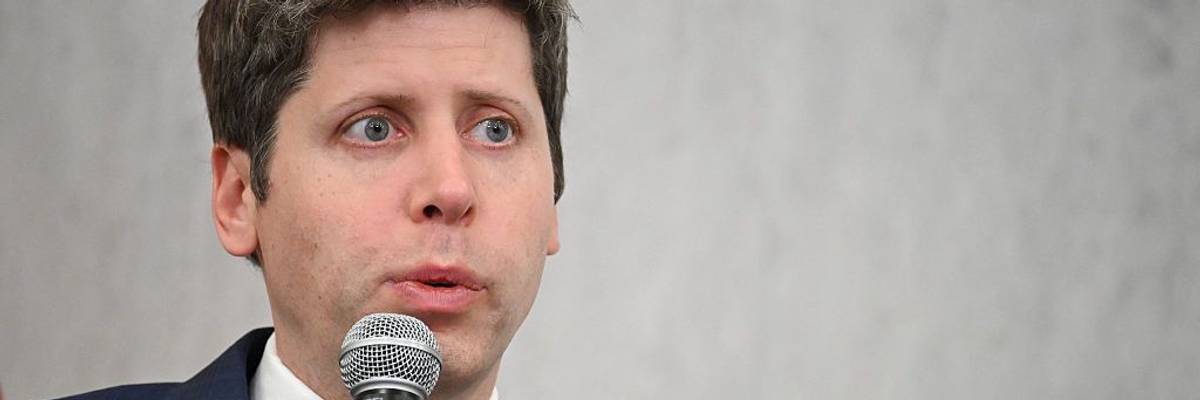
OpenAI CEO Sam Altman speaks at the Federal Reserve in Washington, DC, on July 22, 2025.
(Photo by Mandel Ngan/AFP via Getty Images)


Brad Reed
Mar 02, 2026
COMMON DREAMS

Calls to boycott OpenAI have been growing over the last several days after the artificial intelligence giant reached a deal with the US Department of Defense to use its ChatGPT chatbot across its classified network.

OpenAI CEO Sam Altman on Friday said that the deal reached with the Pentagon would have “prohibitions on domestic mass surveillance” and maintain “human responsibility for the use of force, including for autonomous weapon systems.”

The DOD had previously gotten into a dispute with AI firm Anthropic, which refused to modify its Claude chatbot to allow for its use for domestic spying or to make final decisions on whether to take a human life.

President Donald Trump announced on Friday that he’d ordered the US military to stop using Anthropic’s technology, describing the firm as “A RADICAL LEFT, WOKE COMPANY” in a Truth Social post.

Shortly after Trump’s post, Altman announced that OpenAI had reached a deal with the Pentagon. This led many critics to suspect that, whatever Altman’s denials, the DOD would be allowed to use ChatGPT in ways that it had been forbidden to utilize Claude.

Adam Cochrane, who runs activist venture capital firm Cinneamhain Ventures, said immediately after Altman’s announcement that he was canceling his ChatGPT subscription on the grounds that “I don’t support bootlickers.”

Dr. Simon Goddek, a biotech scientist, also revealed that he was canceling his ChatGPT subscription and encouraged others to do the same.

“Companies understand one language: MONEY,” he wrote. “If they support wars of aggression, they can’t profit from me. I’m out. What’s stopping you?”

AI consultant Mark Gadala-Maria accused Altman of being two-faced with his DOD deal, noting that the OpenAI CEO had expressed solidarity with Anthropic in the face of the Trump administration’s attacks.

“Just a few hours ago he was on TV saying he stood by Anthropic,” wrote Gadala-Maria. “Then he undercuts them and takes the same contract that Anthropic just lost. How can anyone trust this guy?”

An OpenAI boycott group called “QuitGPT” went online shortly after Altman’s announcement, and the organization claims that it has gotten more than 1.5 million people to cancel their ChatGPT subscriptions or stop using it all together.

QuitGPT also outlined why its boycott of OpenAI could be potentially effective given the highly competitive nature of the current consumer AI market.

“ChatGPT is the biggest chatbot in the world, but that advantage is fragile,” QuitGPT explained. “ChatGPT has been losing market share. Their creator, OpenAI, is losing three times more than they earn. ChatGPT users skew young and progressive, and many don’t know about alternatives. We can push OpenAI over the edge.”