Monday, March 02, 2026

Congress, Do Your Job and End This Illegal War of Aggression by the US and Israel

Congress must assert its constitutional authority over matters of war and peace against an out-of-control, rogue president and executive branch, and vote in favor of the Iran War Powers Resolutions
.


Demonstrators gathered outside the White House in Washington DC, to protest US and Israeli strikes on Iran.
(Photo by Celal Gunes/Anadolu via Getty Images)


Kevin Martin
Mar 02, 2026
Common Dreams

Once again, the United States and Israel are illegally attacking Iran, as they did last June. It is already a regional war, which will take a horrible toll on ordinary people in many countries, with reports a girls’ school was bombed, killing at least 85 people.

Unlike the limited strikes in last June’s 12-day war, this is aimed not just at Iran’s nuclear or military facilities, but at regime change in Iran, as President Donald Trump declared, and government targets in Tehran have been hit, with Israel claiming Iran’s Supreme Leader Ayatollah Ali Khamenei was killed. Predictably, Iran is firing back at Israel and at US military bases in the region.

Late last week, the Foreign Minister of Oman, who had been mediating negotiations between the US and Iran, stated prospects were good for a possible agreement. However, according to an Israeli official, the talks were apparently a treacherous ruse, as the US and Israel had planned coordinated attacks on Iran for months.

This crisis lies at the feet of President Trump, who abrogated the Joint Comprehensive Plan of Action (JCPOA) in his first term. That multilateral agreement had effectively capped Iran’s nuclear program well short of acquiring The Bomb. Now, once again, two nuclear-weapon states are bombing a non-nuclear-weapon state. Meanwhile, Trump has preposterously called for Iranians to overthrow their government.

Congress should also impeach, convict, and remove the president from office for this illegal act, as politically unlikely as that appears now.

The timing of this attack, while perhaps planned for months, came as momentum was building in just the last few days for Congressional War Powers Resolution votes in both the House and the Senate. Democratic leadership in both Houses of Congress had coalesced behind the resolutions, Senate Joint Resolution 104, sponsored by US Sens. Tim Kaine (D-Va.) and Rand Paul (R-Ky.), with 12 other co-sponsors, and House Concurrent Resolution 38, sponsored by US Reps. Thomas Massie (R-Ky.) and Ro Khanna (D-Calif.), with over 80 co-sponsors. That resolution may be voted on as soon as Tuesday or Wednesday, according to Khanna.

Sen. Kaine issued a statement asking, “Has President Trump learned nothing from decades of US meddling in Iran and forever wars in the Middle East?” and “Is he too mentally incapacitated to realize that we had a diplomatic agreement with Iran that was keeping its nuclear program in check, until he ripped it up in his first term?,” while calling the war a colossal mistake and “a dangerous, unnecessary, and idiotic action.”

US Rep. Jim Himes (D-Conn.), ranking Democrat on the House Intelligence Committee, stated, “Everything I have heard from the administration before and after these strikes on Iran confirms this is a war of choice with no strategic endgame,” and “It does not appear Donald Trump has learned the lessons of history.”

Congress must assert its constitutional authority over matters of war and peace against an out-of-control, rogue president and executive branch, and vote in favor of the Iran War Powers Resolutions. Congress should also impeach, convict, and remove the president from office for this illegal act, as politically unlikely as that appears now.

Anti-war protest demonstrations are already being held this weekend in many cities, including Washington, Philadelphia, Baltimore, Chicago, Princeton, Norwalk, Greenbelt, Canandaigua and others, reflecting not only the illegality of this war but also its unpopularity, as 70% of Americans oppose war with Iran, according to a recent poll. The world urgently needs more diplomacy, not more war.

While this may prove impractical as the war has already begun, and may metastasize in unpredictable ways, we should recall the recent Don’t Give Up the Ship video by six US senators and representatives, all veterans of the military or intelligence services, reminding members of those services of not only their right, but their obligation, to refuse to obey illegal orders. I don’t know if this illegal attack on Iran was what they had in mind, but it certainly applies.

On Saturday in the Washington, DC area, it was sunny and warm after an unusually cold, snowy winter. I had thought of taking a stroll on Theodore Roosevelt Island to watch the Potomac River flow, as Bob Dylan might recommend, but was deterred by the thought of the smell and filth from the collapse of the major sewage pipe that released over 240 million gallons of poo into our precious, life-sustaining, wild river. One cannot help but reflect on the metaphorical, and literal, consequences of our choices as a nation, to prioritize endless, bottomless spending of our tax dollars on war and weapons of destruction over infrastructure to keep our communities safe and healthy.

May we start making better choices, right now. Let’s end this senseless war and prioritize human and environmental needs over the profits of the war machine.


Democratic Leaders Face Backlash Over ‘Cowardly’ Responses to Trump War on Iran

“As we plunge headlong into another catastrophic war, Sen. Schumer and Rep. Jeffries’ throat-clearing and process critique only serves Trump and the war machine.”
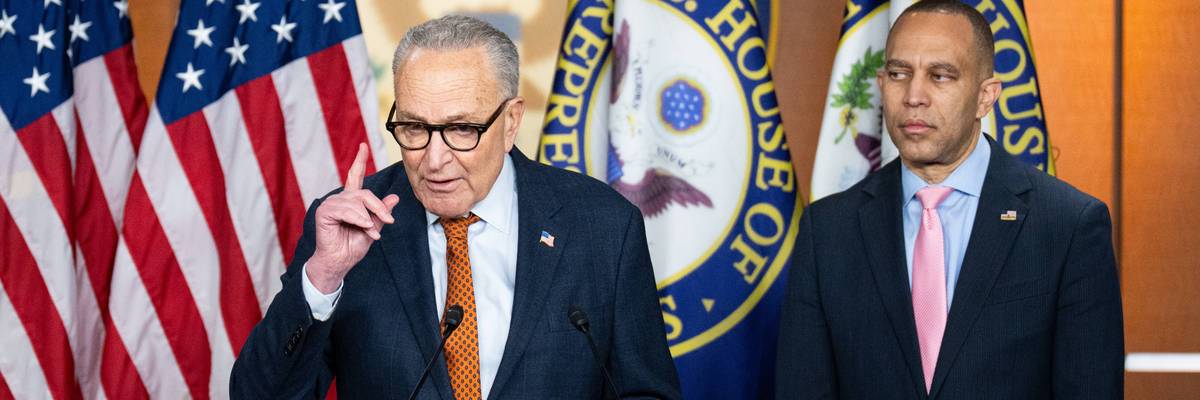


Senate Minority Leader Chuck Schumer (D-NY) and House Minority Leader Hakeem Jeffries (D-NY) held a joint news conference on January 8, 2026.
(Photo by Bill Clark/CQ-Roll Call, Inc. via Getty Images)


Jake Johnson
Mar 01, 2026
COMMON DREAMS

The top Democrats in the US Congress, Senate Minority Leader Chuck Schumer and House Minority Leader Hakeem Jeffries, faced backlash on Saturday over what critics described as tepid, equivocal responses to President Donald Trump’s illegal assault on Iran—and for slowwalking efforts to prevent the war before the bombing began.

While both Democratic leaders chided Trump for failing to seek congressional authorization and not adequately briefing lawmakers on the details of Saturday’s attacks, neither offered a full-throated condemnation of a military assault that has killed hundreds so far, including dozens of children, and hurled the Middle East into chaos.
...
Top Dems Reportedly Working to Sabotage Bill to Stop Trump War With Iran

Schumer (D-NY)—who infamously worked to defeat the 2015 nuclear deal that Trump later abandoned during his first White House term, setting the stage for the current crisis—said he “implored” US Secretary of State Marco Rubio to “be straight with Congress and the American people about the objectives of these strikes and what comes next.”

“Iran must never be allowed to attain a nuclear weapon,” he added, “but the American people do not want another endless and costly war in the Middle East when there are so many problems at home.”

Jeffries (D-NY), a beneficiary of AIPAC campaign cash, said in his response to the massive US-Israeli assault that “Iran is a bad actor and must be aggressively confronted for its human rights violations, nuclear ambitions, support of terrorism, and the threat it poses to our allies like Israel and Jordan in the region.”

“The Trump administration must explain itself to the American people and Congress immediately, provide an ironclad justification for this act of war, clearly define the national security objective, and articulate a plan to avoid another costly, prolonged military quagmire in the Middle East,” said Jeffries.

The Democratic leaders’ responses bolstered the view that their objections to Trump’s attack on Iran are based on procedure, not opposition to war.


Claire Valdez, a New York state assemblymember who is running for Congress, said that “as we plunge headlong into another catastrophic war, Sen. Schumer and Rep. Jeffries’ throat-clearing and process critique only serves Trump and the war machine.”

“Democrats should speak clearly and with one voice: no war,” Valdez added.

Schumer and Jeffries both committed to swiftly forcing votes on War Powers resolutions in their respective chambers. But reporting last week by Aída Chávez of Capital & Empire indicated that top Democrats worked behind the scenes to slow momentum behind the resolutions, helping ensure they did not come to a vote before Trump launched the war.

“The preferred outcome of many AIPAC-aligned Senate Democrats, according to a senior foreign policy aide to Senate Democratic Leader Chuck Schumer, is that Trump acts unilaterally, weakening Iran while absorbing the domestic backlash ahead of the midterms,” Chávez wrote.

Neither Schumer nor Jeffries backed legislation last year aimed at forestalling US military intervention in Iran.

The top Democrats’ responses to Saturday’s US-Israeli attacks on Iran, which Trump said would continue “uninterrupted” even after the killing of the nation’s supreme leader, contrasted sharply with statements of rank-and-file congressional Democrats—and even some members of leadership—who condemned the president for shredding the Constitution and driving the US into another deadly war that the American public opposes.

Rep. Alexandria Ocasio-Cortez (D-NY), who has been floated as a possible 2028 challenger to Schumer, said Saturday that “the American people are once again dragged into a war they did not want by a president who does not care about the long-term consequences of his actions.”

“This war is unlawful. It is unnecessary. And it will be catastrophic,” said Ocasio-Cortez. “This is a deliberate choice of aggression when diplomacy and security were within reach. Stop lying to the American people. Violence begets violence. We learned this lesson in Iraq. We learned this lesson in Afghanistan. And we are about to learn it again in Iran. Bombs have yet to create enduring democracies in the region, and this will be no different.”

Rep. Rashida Tlaib (D-Mich.), a vice chair of the Congressional Progressive Caucus, was more blunt.

“Congress must stop the bloodshed by immediately reconvening to exert its war powers and stop this deranged president,” she said. “But let’s be clear: Warmongering politicians from both parties support this illegal war, and it will take a mass anti-war movement to stop it.”


Call Grows to Impeach Trump, ‘The Most Dangerous Man on the Planet’

“Trump’s illegal war on Iran and the rule of law,” said one pair of campaigners, “establish an intolerable pattern of egregious abuses of power, directly threatening our constitutional order, our safety, and our way of life.”


Protestors stand on an image depicting US President Donald Trump during a gathering to protest against the US and Israel attack of Iran and the killing of the Supreme leader in front of the US Embassy in Ankara on March 1, 2026.
(Photo by Adem Altan/AFP via Getty Images)


Jon Queally
Mar 02, 2026
COMMON DREAMS

After the unprovoked bombing of Iran over the weekend by the United States and Israel—strikes that included the unlawful assassination of Iranian Supreme Leader Ali Hosseini Khamenei—the call for US President Donald Trump to be impeached and removed from office has grown as the straightest path to hold the US leader to account for the attacks which policy and human rights experts have condemned as a serious war crime.

With a regional war in the Middle East that was already boiling from Gaza to Lebanon and from Syria to Yemen now exploding in the wake of the US-Israeli attacks on Iran, Globe and Mail columnist Debra Thompson on Sunday called Trump “the most dangerous man on the planet.”

“Rather than ending wars,” Thompson notes, “Trump has initiated military action eight times, carrying out attacks in seven countries (Syria, Iraq, Iran, Nigeria, Yemen, Somalia, and Venezuela) in 2025.” Such a pattern of violence and warmongering should make clear that failure to restrain Trump has only emboldened him.

“The recurring danger in this latest presidential aggression is that there are no guardrails, no constraints, and no post-hoc justification,” writes Thomson, “other than that Mr. Trump is the President of the United States and can do whatever he wants.”

But American presidents cannot simply do whatever they want. According to a Reuters/Ipsos poll out Sunday, less than 25% support the president’s aggression against Iran. In the first wave of the US military attack, an Iranian school for girls was bombed, killing over 108 civilians, mostly children.

While some congressional lawmakers are pushing for a vote this week on a War Powers Resolution to curtail US military operations against Iran, others are demanding more robust action from Congress to bring Trump’s war-making to an end.


“Under Article I, Section 8 of the U.S. Constitution, only Congress has the power to declare war, as well as to raise and support armies, provide and maintain a navy, and fund and regulate the military,” declared novelist and political activists Stephen King on Saturday. “Impeach the SOB.”


Mike Hersh and Alan Minsky, respectively the communications director and executive director of the Progressive Democrats of America, argued in a Sunday op-ed for Common Dreams that “Trump’s illegal, unconstitutional war on Iran is not only a moral and humanitarian disaster, but also a profound constitutional crisis.”

According to Hersh and Minsky:
Trump’s illegal war on Iran and the rule of law establish an intolerable pattern of egregious abuses of power, directly threatening our constitutional order, our safety, and our way of life. These intertwined crises cry out for an immediate, decisive response by the Congress and the US public.

Therefore, PDA demands that all members of Congress, Democrats, Republicans, and Independents alike, uphold their oath of office to defend our constitutional republic. The Constitution offers one and only one remedy when President a repeatedly breaks the law and arrogantly refuses to abide by the limits on the power clearly laid out in the Constitution. That remedy is impeachment, followed by removal from office.

Matt Duss, executive vice president for the Center for International Policy, said that US lawmakers, as well as the American people they represent, “must also be ready to hold the president and his administration accountable for this breach of US and international law.”

“The failure to hold past presidents liable for war crimes and related violations of our own laws has helped lead to this dangerous moment, with a seemingly unrestrained president endangering millions of lives with impunity,” warned Duss. “The forever wars and the imperial presidency must finally come to an end.”
Democrats Don’t Need an Autopsy to Know How Damaging Their Unwavering Support for Israel Has Been

Surely, if it exists, it should be released, but where our attention might better be focused is in supporting candidates who are refusing to accept pro-Israel PAC contributions and running on platforms challenging failed policies of the past.


Uncommitted’ Democratic delegates from several US states, holds a press conference right next to the United Center where the convention is held, in Chicago, United States on AUgust 22, 2024.
(Photo by Fatih Aktas/Anadolu via Getty Images)

James Zogby
Mar 02, 2026
Common Dreams

A mini-brouhaha has erupted over whether or not the Democratic National Committee has buried an “autopsy” report on its party loss in the 2024 presidential election. Some fear that the report isn’t being released because it suggests the defeat was the Harris campaign’s failure to break with the Biden administration’s disastrous policy that enabled Israel’s sustained genocidal assault on Palestinians in Gaza. As a result, some groups are charging the DNC with a coverup and demanding that the autopsy report be released.

I’ve been on the DNC for more than three decades and am no stranger to how the party handles, or avoids handling, issues involving Palestine/Israel. In 1988, I spoke from that year’s convention podium introducing Jesse Jackson’s platform plank calling for “mutual recognition, territorial compromise, and self-determination” for both Israelis and Palestinians. For my efforts, I was asked to withdraw from the DNC—because “party leaders” were concerned that Republicans would use my membership as an issue in the campaign. (I was reinstated in 1993). I served 16 years on the party’s Executive Committee and 11 as co-chair of its Resolutions Committee. On eight occasions, I presented testimony arguing that the party needed to acknowledge Palestinian rights. And in 2016 I was appointed to serve on the Convention Platform Drafting Committee. Having argued and lost this many times, I am well aware of the party establishment’s fear of addressing Palestinian rights. Finally, this past year, I was appointed by Chair Ken Martin to serve on a Middle East Working Group, which he created to sort out how our party deals with America’s policies in the Middle East.

And yet, I believe that for those of us who support Palestinian rights and are concerned that leading Democrats have been on the wrong side of this issue for too long, the fight over whether an autopsy report exists and, if it exists, what it might say, is not where we need to be focusing our energy.

I say this because we already have all the evidence we need to write our own autopsy report that demonstrates conclusively that voters, especially Democrats and Independents, are fed up with blind support for Israeli policies. This is a fact. And while we have hard polling data to prove it, establishment Democrats and political consultants reject this reality and continue to operate from an outdated playbook.

But the changes are real and can’t be ignored. A wide range of polls have established just how extensive they are. A recent Gallup poll shows that for the first time more Americans sympathize with Palestinians (41%) than with Israelis (35%). This is especially pronounced among Democrats where sympathy for Palestinians is three times greater than it is for Israelis. And a John Zogby Strategies poll from February shows that a plurality of Americans now view the US relationship with Israel as more of a liability (45%) than an asset (34%). Again, among Democrats the margin is three to one (57% to 19%).

This growing antipathy toward Israel translates in shifting attitudes toward policy. In August of 2025, The Economist found:

• 43% of voters favor decreasing military aid to Israel, with only 13% wanting to see an increase in such aid. Among Democrats the decrease/increase ratio is 58% to 4%. Among Independents, it’s almost the same.

• Is Israel committing genocide? Among all voters, 44% say “yes” and 28% say “no.” Among Democrats, the ratio is 68% “yes” and just 8% “no.” And among Independents, it’s 45% to 19%.

Other polls show voters affirming that they’re more likely to support candidates who advance such positions and less likely to vote for those who defend Israeli policies and want to maintain current levels of military aid to Israel.

For further evidence of this shift, with just months before the midterm elections, it’s striking to note that more than three dozen congressional candidates have already declared their intent to reject PAC contributions from AIPAC and other pro-Israel groups. This includes a number of sitting members of Congress, all of whom have previously been strong supporters of Israel and have, in previous elections, been the recipients of millions of dollars from pro-Israel sources, including PACs and dark money independent expenditures. One of these members of Congress recently spoke at the US Holocaust Memorial Museum in which she termed Israel’s actions in Gaza as genocide and announced her support for cutting US military arms to Israel.

While these changes in attitudes toward Israel have been brewing for several years now, they were dramatically accelerated by Israel’s more than two-year assault on Palestinians in Gaza. While the horrors accompanying Hamas’ October 7th attack generated an initial flush of support for Israel, as the toll of Palestinian civilian casualties grew and the extent of Israel’s gratuitous mass devastation of Gaza became clear, support for Israel collapsed.

This was clearly in evidence in the 2024 presidential contest. Post-election analyses showed that Vice President Kamala Harris lost the backing of a wide range of Democratic and Independent voters because she refused to make a decisive break with President Biden’s support for Israel. Instead of listening to her own instincts and being more critical of Israeli practices and more vocal in support of Palestinian rights, she listened to the establishment political consultants who cautioned against “rocking the boat” on this “sensitive issue.”

The consultants, campaign operatives, and media analysts didn’t get the changes that were afoot then, and they still don’t get it now. They are caught in a time warp that views the US politics of the Middle East as if the last two years of Israel’s genocidal war hadn’t occurred. But they did happen and they have been transformative.

It used to be said that criticism of Israel was akin to touching the “third rail” in American politics—avoid it or get burned. In a way, it still is but in reverse. Support for Israel was once the issue sine qua non for candidates for Congress. Polls now show that voters are less likely to vote for candidates who refuse to criticize Israel or who take money from pro-Israel PACs.

As we get closer to the 2026 midterm elections, we can expect more candidates to publicly distance themselves from Israeli policies. We can also expect that pro-Israel groups will panic and up the ante by pouring tens of millions into defeating candidates who are critical of Israel. My sense is that this may backfire, as it did with the recent special House election in New Jersey, because in 2026 what will be controversial are Israeli policies and pro-Israel campaign contributions, not the opposite. The sooner the analysts, consultants, and media figure that out, the better our politics will be.

Given this background, fighting for the party to release an autopsy, is less important. Surely, if it exists, it should be released, but where our attention might better be focused is in supporting candidates who are refusing to accept pro-Israel PAC contributions and running on platforms challenging failed policies of the past. We should also join the growing number of Democratic National Committee members who are calling on the party to ban dark money in elections. This is an instance where looking forward, not backward, will help to bring the change we need—and to be where Democratic voters are already.


Our work is licensed under Creative Commons (CC BY-NC-ND 3.0). Feel free to republish and share widely.


James Zogby
Dr. James J. Zogby is the author of Arab Voices (2010) and the founder and president of the Arab American Institute (AAI), a Washington, D.C.-based organization which serves as the political and policy research arm of the Arab American community. Since 1985, Dr. Zogby and AAI have led Arab American efforts to secure political empowerment in the U.S. Through voter registration, education and mobilization, AAI has moved Arab Americans into the political mainstream. Dr. Zogby has also been personally active in U.S. politics for many years; in 1984 and 1988 he served as Deputy Campaign manager and Senior Advisor to the Jesse Jackson Presidential campaign. In 1988, he led the first ever debate on Palestinian statehood at that year's Democratic convention in Atlanta, GA. In 2000, 2008, and 2016 he served as an advisor to the Gore, Obama, and Sanders presidential campaigns.
Full Bio >
Israel Exploits Attack on Iran to Reinstate Gaza ‘Starvation Policy’

“All the NGOs in Gaza need more food, medicine, medical equipment, fuel, tents, personal care every day. We cannot wait,” said chef José Andrés, founder of World Central Kitchen.


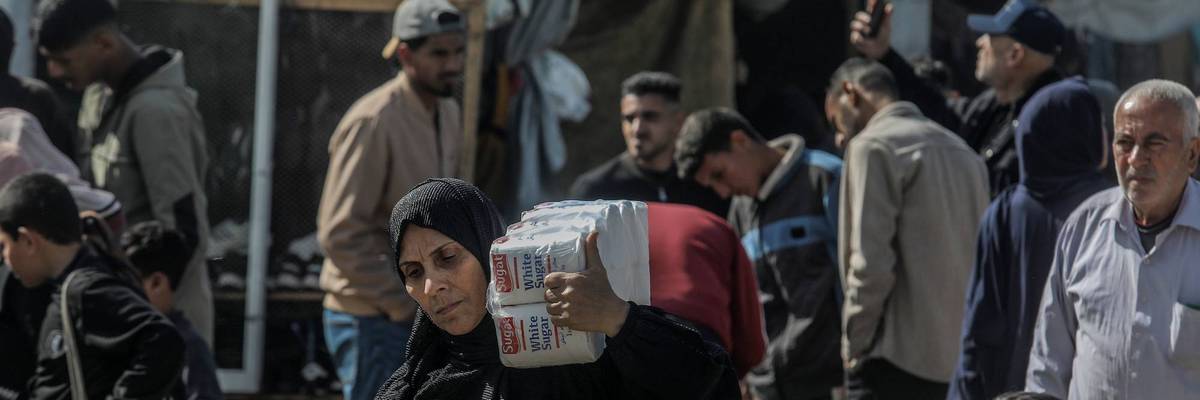
Palestinians gather in the market following the targeting of Iran by the US and Israel and the subsequent retaliatory strikes in Khan Younis, Gaza on February 28, 2026.

(Photo by Abed Rahim Khatib/Anadolu via Getty Images)

Jessica Corbett
Mar 02, 2026
COMMON DREAMS

After Israeli and US forces launched an illegal war aimed at forcing regime change in Iran this past weekend, Israel also announced “the closure of the crossings into the Gaza Strip,” which it has bombed and starved for nearly 29 months, killing at least tens of thousands of Palestinians.

Israel’s Coordinator of Government Activities in the Territories (COGAT)—which oversees civilian policy in Gaza and the West Bank—announced on social media Saturday that “several necessary security adjustments have been implemented” because of the operation against Iran, including the closure of Gaza crossings “until further notice.

COGAT also claimed that “the closure of the crossings will have no impact on the humanitarian situation” in Gaza, adding that “the substantial quantities of food that have entered since the beginning of the ceasefire amount to four times the nutritional needs of the population,” so “the existing stock is expected to suffice for an extended period.”

However, reports from human rights groups, journalists, and the United Nations have highlighted how Israel’s restrictions have continued to impede evacuations of the sick and severely wounded, and nongovernmental groups’ deliveries of humanitarian aid, despite the October ceasefire deal. Palestinians in Gaza also remain at risk of Israeli forces’ airstrikes, gunfire, and shelling.

“A new chokehold on Gaza,” Philippe Lazzarini, commissioner-general of the United Nations Relief and Works Agency for Palestine Refugees in the Near East, said Monday. “Once again, Israel is renewing its ban on supplies entering Gaza. After more than two years of unspeakable suffering and a spreading man-made famine, people still lack the most basic supplies, despite increases in aid since the ceasefire. UNRWA personnel in Gaza keep providing healthcare, learning, and clean water—but we must be allowed to do much more and certainly not less.”

Even before Israel closed the borders on Saturday, the US-Israel attack on Iran led to Palestinians in Gaza “buying whatever food supplies and goods they could manage,” Al Jazeera reported Monday. “People everywhere rushed to the market to buy sugar, flour, cooking oil, and yeast. Shelves began to empty, and the price of essential goods increased.”

Things got even worse after COGAT’s announcement. Asmaa Abu Al-Khair, a 38-year-old mother of eight, told Al Jazeera at a Gaza City market on Sunday that “I feel great anxiety. Everyone is talking about it—about Iran’s strike and the closure of the crossings—and I cannot afford to buy what I need, while at the same time, I am afraid of famine returning. I have young children.”

Many displaced families living in nearby tents also “do not have the money to buy supplies, nor the space to store them inside the tents,” she said. “We endured so much hardship during the war, and it barely ended with the announcement of a ceasefire. So why close the crossing now? What do we have to do with what is happening? Is what we witnessed not enough? Why play with people’s nerves?”

Since Saturday, critics around the world have also warned about the impacts of Israel shutting off the Palestinian exclave indefinitely, again. Arab Center Washington DC fellow Assal Rad declared on social media that “under the cover of its illegal war on Iran, Israel is continuing genocide in Gaza.”

Mass shooting survivor and former congressional candidate Cameron Kasky similarly said that “the siege on Gaza returns in its fullest force. Illegal wars to advance Israel’s goals are being used for expanding the genocide plans.”


Israel faces a South Africa-led genocide case at the International Court of Justice (ICJ) over the US-backed war on Gaza that it launched after Hamas’ October 7, 2023 attack. The International Criminal Court (ICC) has also issued related arrest warrants for Israeli Prime Minister Benjamin Netanyahu and former Defense Minister Yoav Gallant.

Chef José Andrés said on social media Sunday that World Central Kitchen—which he founded—is cooking 1 million hot meals every day, and if Gaza’s borders stay closed, the group “will run out of food this week.”

“We need food deliveries every single day to feed hungry families who are not part of this war,” he said. “All the NGOs in Gaza need more food, medicine, medical equipment, fuel, tents, personal care every day. We cannot wait... let the humanitarian trucks go through today!”

Responding to Andrés, US Congressman Mark Pocan (D-Wis.) said that “Israel must reopen access to aid groups. If not, Netanyahu must be arrested immediately. He continues war crimes.”


The Hague Group—a coalition of countries that came together last year, led by Colombia and South Africa, with the goal of upholding the ICC and ICJ rulings on Israel and Palestine—responded to COGAT by scheduling an emergency meeting that at least 30 nations are set to attend in the Dutch city for which the organization is named.

The focus of Wednesday’s meeting “is simple,” Varsha Gandikota-Nellutla, the group’s executive secretary, said in a Monday statement. “How do we give international law teeth? Several states have begun enforcing their legal obligations, turning rhetoric into concrete action through The Hague Group’s measures: cutting arms flows, closing ports, and pursuing accountability.”

Ronald Lamola, South Africa’s minister of international relations and cooperation, said that “the application of international law can no longer be selective: punitive for some and totally disregarded by others. The Hague Group exists to translate obligations that arise out of international law into coordinated state action. We invite governments of conscience—those prepared to uphold law in deed as well as word—to join us.”


Francesca Albanese, the UN special rapporteur focused on the occupied Palestinian territories and a target of Trump administration sanctions, said that “I am honored to attend the upcoming emergency meeting of the The Hague Group.”

“Time has come for decolonized multilateralism, grounded in universal rights and obligations, applied with integrity and free from double standards,” Albanese added. “May European and Arab states join this necessary effort.”
'Next question, please': Israeli spokesperson blows off Iranian schoolgirls deaths

David Edwards
March 1, 2026 
RAW STORY


Sky News/screen grab

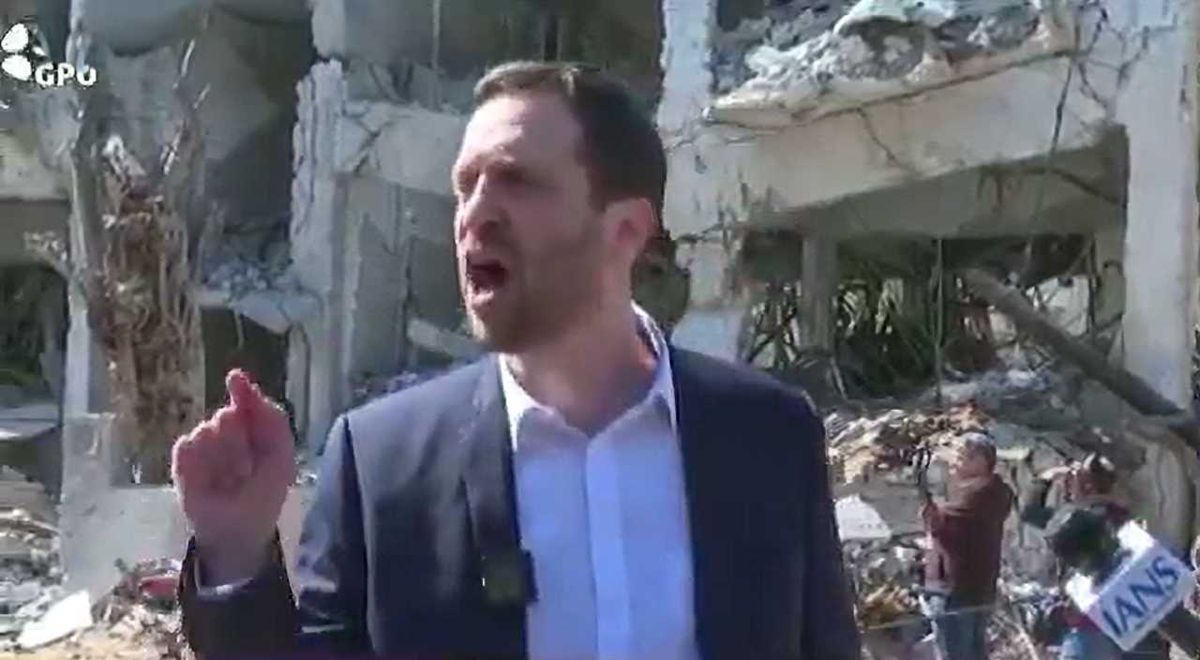
An Israeli spokesperson dismissed the alleged deaths of Iranian schoolgirls and the claim that Prime Minister Benjamin Netanyahu was a war criminal.


During a press conference near rubble in Tel Aviv on Sunday, reporter Secunder Kermani of Britain's Channel 4 News acknowledged that "Khomeini, the Iranian regime, have clearly done terrible things, particularly to their own people."

"But your Prime Minister is a wanted war criminal. You don't have the moral high ground here at all," he said.

"This is a war crime!" the Israeli spokesperson shouted. "This is a war crime! Targeting civilians, targeting elderly women, killing, murdering her caregiver from the Philippines."

"What about the hundred or so schoolgirls in Iran that are being killed in a strike at that?" Kermani asked.

"Yes, next question, please," the spokesperson replied. "Let's allow others."


‘More Horrific Death and Destruction Will Come,’ Warns Tlaib as Israeli Strike Kills Dozens of Iranian Kids

“These acts of war threaten to ignite a catastrophic regional war that will make no one safer while unleashing unconscionable suffering,” said US Rep. Rashida Tlaib.


A screenshot of video footage from Iranian state media shows an elementary school that was reportedly hit by an Israeli missile on February 28, 2026 in Minab, Iran.
(Photo: Abbas Araghchi/X.com)


Jake Johnson
Feb 28, 2026
COMMON DREAMS

More than 50 young children were reportedly killed Saturday by an Israeli airstrike on southern Iran as the US and Israel carried out joint attacks across the country. A local official told Iranian state media that “an Israeli missile attack” hit a girls’ elementary school in Minab.

Saturday is a school day in Iran. A school staff member told Middle East Eye that “you could hear the sound of children crying and screaming” following the strike.

“We still don’t know how many are under the rubble,” said the unnamed staffer. “Some are even saying more than 100. Some of these small children are severely injured. Their parents have come to the school, and this place has turned into a house of mourning.”

Iranian Foreign Minister Abbas Araghchi wrote on social media that the school “was bombed in broad daylight, when packed with young pupils.”

“Dozens of innocent children have been murdered at this site alone,” he added. “These crimes against the Iranian people will not go unanswered.”

Al Jazeera noted that “separately, Iran’s Mehr news agency reported that at least two students were killed by another Israeli attack that hit a school east of the capital, Tehran.”

“Every war is a war on children,” said Inger Ashing, CEO of the global humanitarian group Save the Children. “All children have the right to access a safe education, and schools should always be a haven for children—not a battlefield.”

In a statement, US Rep. Rashida Tlaib (D-Mich.) alluded to the Minab school bombing as she condemned President Donald Trump for “acting on the violent fantasies of the American political elite and the Israeli apartheid government, ignoring the vast majority of Americans who say loud and clear: No More Wars.”

“The Trump administration and Israeli regime’s illegal war of aggression on Iran has already killed dozens of children, and more horrific death and destruction will come,” Tlaib warned. “These acts of war threaten to ignite a catastrophic regional war that will make no one safer while unleashing unconscionable suffering.”


“President Trump will pretend this is about democracy and the rights of the Iranian people,” she continued. “Don’t be fooled, Trump does not care about the Iranian people. The Iranian people are not pawns for the interests of foreign powers. Our government has imposed brutal sanctions that have destroyed the Iranian economy and the lives and livelihoods of millions of people. You cannot ‘free’ people by killing them and destroying their country.”

Tlaib issued her statement shortly after Trump declared in a Washington Post interview that he decided to wage war on Iran to secure “freedom for the people.” As of this writing, the White House has not responded to the Minab school massacre. (Update: A spokesperson for the US Central Command said in a statement that “we are aware of reports concerning civilian harm resulting from ongoing military operations. We take these reports seriously and are looking into them. The protection of civilians is of utmost importance, and we will continue to take all precautions available to minimize the risk of unintended harm.”)

“I want a safe nation, and that’s what we’re going to have,” Trump said as the US-Israeli onslaught hurled the Middle East into chaos.

Tlaib said in her statement that the US Congress “must stop the bloodshed by immediately reconvening to exert its war powers and stop this deranged president.”

“But let’s be clear: Warmongering politicians from both parties support this illegal war, and it will take a mass anti-war movement to stop it,” she added.
'Disgusting and evil.' Trump faces MAGA backlash on Iran.

Zac Anderson, USA TODAY
Sun, March 1, 2026 at 4:41 PM MST

After unleashing operation "Epic Fury" in Iran, President Donald Trump is facing MAGA skepticism at home as the military campaign threatens to strain his political coalition heading into the midterm election.

Trump campaigned as a staunch critic of U.S. wars in the Middle East, and his aggressive foreign policy moves since returning to office have sparked backlash within the MAGA movement, including accusations he has betrayed those who subscribed to his anti-interventionist, “America First” pledges.

Polling indicates many Republicans are wary of military involvement in Iran, presenting a challenge as the president works to keep them motivated in a crucial election year. That skepticism has been aired publicly by prominent voices on the right since the U.S. and Israel launched a military campaign targeting Iran’s leadership, missile sites and nuclear program.


More: Do Americans support Iran strikes? Here's what new poll says


U.S. Vice President JD Vance speaks to Cabinet Secretaries during military operations in Iran, in the Situation Room at the White House in Washington, D.C., U.S. February 28, 2026. The United States launched military strikes and "major combat operations" against Iran on Saturday, President Donald Trump said, targeting the country's missile capabilities.

Supreme Leader Ayatollah Ali Khamenei was killed in the joint strikes with Israel on Iran, an Israeli source confirmed to USA TODAY.

This image was provided by The White House.


U.S. President Donald Trump speaks with CIA Director John Ratcliffe, accompanied by White House Chief of Staff Susie Wiles and Secretary of State Marco Rubio, during military operations in Iran, at Trump's Mar-a-Lago resort in Palm Beach, Florida, U.S. February 28, 2026. This image was provided by The White House.

A satellite image shows black smoke rising and heavy damage at Iranian Supreme Leader Ayatollah Ali Khamenei's compound, following strikes by the United States and Israel against Iran, in Tehran, Iran February 28, 2026.

U.S. Vice President JD Vance speaks to Cabinet Secretaries during military operations in Iran, in the Situation Room at the White House in Washington, D.C., U.S. February 28, 2026. The United States launched military strikes and "major combat operations" against Iran on Saturday, President Donald Trump said, targeting the country's missile capabilities.

Supreme Leader Ayatollah Ali Khamenei was killed in the joint strikes with Israel on Iran, an Israeli source confirmed to USA TODAY.

This image was provided by The White House.More

Tucker Carlson, a long-time Trump backer and former FOX News host who recently attended a White House event, was scathing in an ABC News interview, describing the Iran operation that was launch on Feb. 28 as "absolutely disgusting and evil."

Others in the MAGA sphere questioned how the operation squares with the spirit of the president’s political movement, which over three White House campaigns centered around a more populist approach that eschewed years of GOP foreign policy orthodoxy on utilizing American military might.

“I don’t see how this is in keeping with the president’s MAGA commitment. I’m disappointed,” Trump ally Erik Prince, a private military contractor, said March. 1 on a podcast hosted by Steven Bannon, who served as White House chief strategist during Trump’s first term.

Former GOP Rep. Marjorie Taylor Greene, who has become a fervent Trump critic after years as one of his top supporters in Congress, accused the president and his team in a flurry of social media posts after the initial attack on Iran of betraying their promises.

Greene called the Trump administration “sick (expletive) liars” in a Feb. 27 post declaring, “We voted for America First and ZERO wars.”
Regime change war

The Trump administration’s focus on regime change in Iran is adding to the backlash. The president announced that Iran's Supreme Leader Ayatollah Ali Khamenei had been killed along with other top leaders, and has called on the Iranian people to rise up and replace the regime, even as he has warned against regime change efforts in the past.

“We must abandon the failed policies of nation building and regime change,” Trump said at the 2016 Republican National Convention.

The deaths of three U.S. troops in the operation also has heightened tensions.


Former U.S. Rep. Marjorie Taylor Greene, Republican from Georgia, speaks to reporters as she arrives for a closed-door meeting with House Republicans, at the Republican National Committee office on Capitol Hill on March 25, 2025, in Washington, DC.More

“This was absolutely unnecessary and is unacceptable,” Greene said in a March 1 social media post. “Trump, Vance, Tulsi (Gabbard), and all of us campaigned on no more foreign wars and regime change. Now, America soldiers are dead.”

Many GOP lawmakers and other conservatives are rallying around Trump as the military operation unfolds, with some dismissing the idea that the president is out of synch with MAGA.

Let Trump 'cook'

Longtime Trump adviser Jason Miller said MAGA’s priorities are the same as the president’s, “Full stop.”

“We voted for President Trump because we believe in HIS decision-making & HIS judgment to keep us safe,” Miller said Feb. 28 on social media.


Plumes of smoke rise following reported explosions in Tehran on March 1, 2026, after Iran's supreme leader, Ayatollah Ali Khamenei, was killed a day earlier in a large U.S. and Israeli attack, prompting a new wave of retaliatory missile strikes from Iran.More

FOX News host Laura Ingraham asked conservative podcaster and former Trump FBI Deputy Director Dan Bongino what his message is to “some of our friends on the right” who point out that Trump campaigned against regime change and is now pursuing that goal.

Pete Hegseth Finally Comments on Iranian Strikes After Being MIA on Social Media

Blackwater Founder Fumes to Steve Bannon About Iran Strikes: ‘I Don’t Think This Was in America’s Interests’

“Can you give the man a chance to cook a little bit?” Bongino responded Feb. 28, adding: “Maybe give the guy five minutes before you’re already crapping on everything he did.”

Sen. Lindsay Graham, R-South Carolina, said on NBC’s Meet the Press that the Iran military operation is fully aligned with Trump’s America First agenda.

“America First is not isolationism, America First is not head in the sand,” said Graham, one of the most outspoken GOP hawks. “America First is not to get entangled. We’re not going to have any boots on the ground in Iran.”
Election questions

Trump also faced MAGA criticism after his decision to bomb Iran’s nuclear sites last year. It quickly quieted down, though. That attack was a single event that didn’t spiral into a broader conflict and there were no U.S. deaths. Polls since then have shown overwhelming support for the president among Republicans.

The latest conflict already has resulted in American casualties, though, and is more open ended, with the U.S. and Israel already launching multiple strikes and the president offering an uncertain timeline for how long it could last.


U.S. Navy sailors prepare to stage ordnance on the flight deck of the Nimitz-class aircraft carrier USS Abraham Lincoln during the U.S. attack on Iran at an undisclosed location, Feb. 28, 2026.

A University of Maryland survey conducted two weeks before Trump struck Iran again found that just 21% of U.S. adults favored launching an attack, including just 40% of Republicans. After the operation began, a Reuters/Ipsos poll found 27% of Americans approved, including 55% of Republicans.


With a sizeable portion of his party opposed or unsure of his use of force in Iran, Trump could be treading into politically perilous ground as he seeks to rally the GOP ahead of the midterms and maintain enthusiasm.

Mercedes Schlapp, a Trump ally who served in his first administration and in the administration of former Republican President George W. Bush, said in a CSPAN interview shortly before Trump struck Iran that it’s not something his MAGA base wants and that the midterms will be fought on the economy.

“I think that if the administration moves towards… more military tactics, a more aggressive posture into Iran, I think that that could be detrimental for Republicans going into the midterm elections,” Schlapp said, noting she worked for Bush during the Iraq War and “it became a very unpopular war quickly.”

This sweeping Trump assault has us headed for a hellscape of unimaginable dimensions


John Casey
March 1, 2026 
RAW STORY


A banner depicting Donald Trump hangs outside the Department of Justice. REUTERS/Kylie Cooper

The first days of a bombing campaign almost always look successful. Targets are hit. Explosions dominate headlines. Leaders declare strength. But wars are judged by what follows: retaliation, escalation, unintended consequences that unfold in days, weeks, months, and years.

For example, Israeli sources said on Saturday that Iran’s Supreme Leader Ayatollah Ali Khamenei was killed in the initial bombings. But if he is dead, who comes next? His death after 35 years in power would likely trigger a prolonged, ugly and tumultuous struggle.

Further back, remember George W. Bush and his rush to declare “Mission Accomplished," shortly after the attack on Iraq in 2003?

That pattern of not thinking and planning ahead for what comes next mirrors Donald Trump’s life of losing. His deals and grand ideas often look triumphant at the start. Later, collapse, chaos, and damage become clear.

Trump’s decision to join Israel in bombing Iran is shocking the world. It feels reckless and ego-driven — both for Trump and Benjamin Netanyahu — undertaken without fully reckoning with the grave consequences such action could unleash.

Yes, Iran is dangerous. Yes, it should never have nuclear weapons. Yes, the regime’s mass killing of protesters is abominable. But behind the curtain of cruelty is an entrenched military and ruthless theocratic leadership capable of spreading unimaginable horror throughout the Middle East.

It’s already begun.

But let’s start in the U.S., with a president who campaigned in 2024 on ending wars through dealmaking.

Trump has ended nothing. He has built nothing. He has stabilized nothing. That assessment isn’t limited to what’s happening now. It reflects how he has carried himself throughout his life. He is not a winner. He is a loser. He does not create peace. He creates chaos.


Now he has detonated that chaos in the most volatile region on Earth. Why now? For what purpose? For how long?

Trump repeatedly claimed that last year’s U.S. strikes on Iranian nuclear facilities “obliterated” them. Obliterated. He has insisted on that word, dismissing experts who said otherwise.

So why are American bombs once again falling on Iranian soil? You don’t obliterate something and then have to obliterate it again.


There has been no publicly presented evidence that bombing Iran is in America’s best interest. None. No imminent attack disclosed. No ticking-clock intelligence, laid before Congress.

And what of Congress? Article I of the Constitution is clear: Congress has the power to declare war. Trump didn’t seek it. He didn’t secure it. He didn’t build bipartisan consensus. He simply acted. Congress represents the voice of the American people. We, and our elected officials, should decide whether to put American troops in harm’s way.

Trump failed to rally NATO. After years of threatening to weaken the alliance, flirting with abandoning European partners, even floating the absurd notion of invading Greenland, he has left the United States diplomatically diminished.


Rather than assembling a coalition, he has tethered America’s fate to another leader who thrives on confrontation: Israeli Prime Minister Benjamin Netanyahu.

Netanyahu has long viewed Iran as Israel’s existential enemy. Iran harbors deep hostility toward Israel and Netanyahu. Netanyahu is polarizing in the Middle East, controversial at home. Trump is viewed globally as erratic, incapable of restraint.

Two unpredictable leaders do not create stability. They do not project peace. And if these two have rid Iran of the equally unpredictable Khamenei, God knows what lies ahead.


This is a sweeping assault with no clearly articulated endgame against an adversary as hardened as it is brutal. If Khamenei is dead, his revolutionary forces will surely retaliate to an extreme.

There has been no serious explanation of what victory looks like, only assurances that bombing will continue. Escalation feels inevitable. Regional war is plausible.

Experts have warned for weeks that a full-scale attack on Iran could ignite the Middle East.


Iran is not isolated. It has a network of proxies: Hezbollah in Lebanon, militias in Iraq, the Houthis in Yemen. They are all capable of striking American assets and allies. Retaliation could be relentless, U.S. troops potential targets.

Shipping lanes could be disrupted. The Strait of Hormuz, through which flows a significant share of the world’s oil, could become a choke point. Energy markets would convulse. Inflation would spike. A fragile global economy, rattled by Trump’s erratic tariff obsession, could tip toward crisis.

And then there’s Russia, which was blunt in response to the bombing, saying it was an “unprovoked act of armed aggression.”

Moscow has deepened ties with Tehran. Iran has supplied Russia with drones. Russia has offered diplomatic cover. By attacking Iran in a sustained way, Trump risks entangling the U.S. in a broader dynamic that could spiral beyond control.


When military powers circle the same battlefield, miscalculation is a real probability.

Even within U.S. military leadership, alarm bells have been ringing. Joint Chiefs Chairman Dan Caine has warned that a full-scale confrontation with Iran would come with “acute risks,” along with being extraordinarily costly and unpredictable.

This is not Venezuela. Iran is no pushover. It is one of the most volatile regimes in the world, rivaling North Korea.


And now we have added another unpredictable actor — the habitual liar that is the President of the United States.

This is the man who has failed at virtually every major endeavor he has led, too many to list. He is not a steady leader. He is a coddled billionaire who has never faced meaningful consequences for his mistakes.

Trump, who thrives on confusion, lies, and chaos, has not clearly articulated objectives, sought congressional authorization, or built a multinational framework. And we are supposed to trust him?

We are headed for a hellscape of unimaginable dimensions.

What unfolds next could reshape the global order: regional war, confrontation with major powers, economic shockwaves hitting American families, gas stations and grocery stores, terror retaliation, cyberattacks … the “acute risks” falling like dominos.

Trump falsely bills himself as the man who would keep America out of endless wars. He foams at the mouth for a Nobel. He launched a farcical “Board of Peace.” Yet he has now lit the fuse in one of the world’s most combustible regions.

Unlike his past failures, his latest bomb is far worse than a bankruptcy. Far, far worse.


John Casey was most recently Senior Editor, The Advocate, and is a freelance opinion and feature story writer. Previously, he was a Capitol Hill press secretary, and spent 25 years in media and public relations in NYC. He is the co-author of LOVE: The Heroic Stories of Marriage Equality (Rizzoli, 2025), named by Oprah in her "Best 25 of 2025.”


Trump Guns for Peace Prize

It’s obvious that Trump loves the feel of power. It no doubt gives him a rush more intoxicating than any drug.


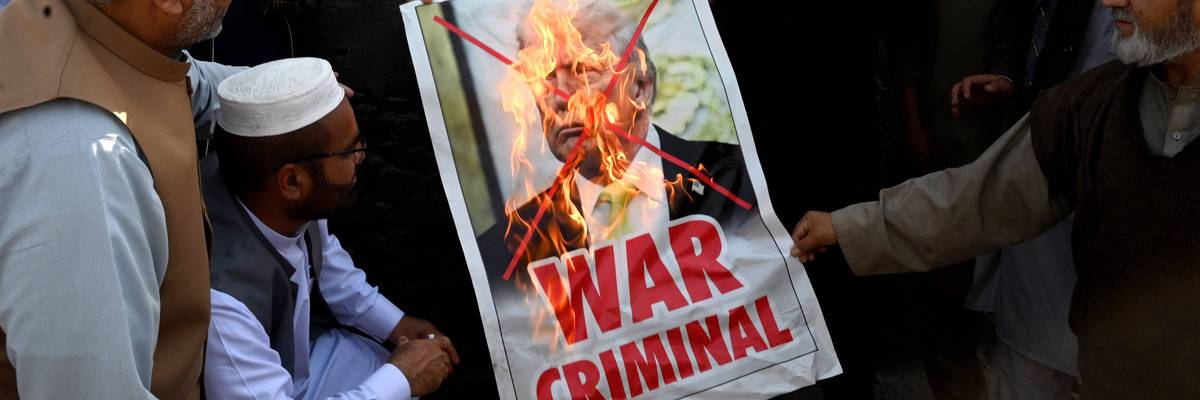
Demonstrators burn a poster of US President Donald Trump during an anti-US and Israel protest in Peshawar on March 2, 2026 after the death of Iran’s supreme leader Ayatollah Ali Khamenei amid US-Israel strikes.

(Photo by Abdul Majeed / AFP via Getty Images)

Les Leopold
Mar 02, 2026
Common Dreams

Since resuming power 13 months ago, President Trump has declared he should be awarded the Nobel Peace Prize. At the same time, he has attacked civilian boats in the Caribbean, abducted the head of Venezuela, blockaded Cuba, conducted air strikes in NigeriaSomaliaYemen, and Syria, and even threatened to invade Greenland. He bombed Iran’s nuclear facilities last June, and now is waging war to achieve regime change, not an easy task in a country of 90 million people.

What is common to all these strikes is that the target was weak. Note that Trump is not trying to topple North Korea, or force Russia out of Ukraine, or threaten China’s economic domination. His targets can’t do much harm to the US, at least in the short run, which makes it easy to score what he calls “victories.”

It’s obvious that Trump loves the feel of power. It no doubt gives him a rush more intoxicating than any drug. He is the ruler of the strongest nation in the history of the world, but he doesn’t have the freedom to unilaterally act on domestic affairs, although he constantly tries. The courts are in the way, as is popular dissent. Judges and citizens are preventing him from exerting his will, even making him change course by removing troops and immigration forces. And it will, he surely knows, get even worse if the Democrats gain control of either house of Congress.

But he has a free hand in foreign affairs. The Supreme Court won’t stop him and there is no international court that the US recognizes, nor does he believe he is morally bound by international law. He couldn’t care less about the United Nations, and he hopes that military engagement against the weak makes him look strong to the American public. Also, in Iran’s case, a war with a quick victory has the added benefit of possibly improving his paltry approval ratings by diverting public attention away from “affordability” and the Epstein files. Already the joke is that they should have called the Iran adventure, “Operation Epic Epstein.”

Just think what the total freedom to attack means for Trump. For starters he gets to deploy his toys—the trillion-dollar arsenal of US warships and fighter planes. It’s the ultimate video game for power-hungry adults. And no one can stop him abroad, and while the Republicans in Congress could, they certainly won’t.

Trump seems to believe that these military attacks will secure his place in history as the greatest president of all time. He and only he had the guts to get rid of the Iranian theocracy that has bedeviled the US since the 1979 hostage crisis. And only he will end communism in Cuba, that pesky island of resistance only 90 miles from shore. Most importantly, he is remaking the Middle East into a US-Israeli safe zone. He is showing the world that the US means business and that whatever it wants, it should get—of course in the name of protecting the US and securing world peace.

As Trump’s deputy chief of staff, Steven Miller, put it, “We live in a world , in the real world…that is governed by strength, this governed by force, that is governed by power. These are the iron laws of the world.”

Before claiming all this aggression demonstrates Trump truly is a Hitler-like dictator, we should recall that he is not the first Commander-in-Chief to follow these “iron laws of the world.” Truman sent troops to fight in Korea (1950), Eisenhower sent them to Lebanon (1958), Kennedy to the Bay of Pigs in Cuba (1961), Johnson to Vietnam (1964), Nixon bombed Cambodia (1969), Reagan invaded Grenada (1983), George H. Bush invaded Panama (1989), Clinton bombed Kosovo (1999), Obama bombed Libya (2011), Trump sent missiles to Syria (2017,2018), and Biden ordered airstrikes in Syria (2021), and Yemen (2024)—all without a declaration of war by Congress.

This is what US presidents do because they can. But no president has been quite as overtly aggressive as Trump. Even when he tries, he can’t hide his desire to dominate. He doesn’t spend time building alliances or forming a consensus at home. He just acts as if the weaker countries of the world are his playthings. He can push them around at will, first with tariffs then with bombs, and his sycophantic enablers will cheer him on. From Trump’s perspective, what’s not to like?

Nothing, unless it doesn’t end well. And there are dozens of ways his current path in Iran could lead to his own destruction. The American public is not likely to approve of these adventures, especially if prices rise because global trade is severely disrupted. More ominously, it’s possible that a war with Iran could spiral out of control, sucking the US in with ground troops and leading to yet another forever war and American casualties. That’s why MAGA isolationists also are having trouble with Trump’s foreign interventions.

And there is a question of whether the Iranians who want regime change will trust the Americans. They are certainly aware that the Afghans who assisted US forces and the CIA in their (failed) war of liberation were awkwardly abandoned during our troop withdrawal, and those who were given safe haven have in many cases been unceremoniously kicked back to their dangerous homeland by Trump.

The upshot of all this adventurism is that we may again witness a moment in history when the universe actually bends towards justice. Debilitating hubris has a way of striking down the mighty: LBJ was driven from office by his Vietnam debacle and Nixon had to resign because of his secret dictatorial actions. Will Trump blow himself up as well?

Maybe, but let’s pray, with the nuclear button close at hand, he doesn’t take all the rest of us with him.