Thursday, March 05, 2026

‘It's too warm’: Greenland’s traditional fishers pushed towards polluting practices as ice melts
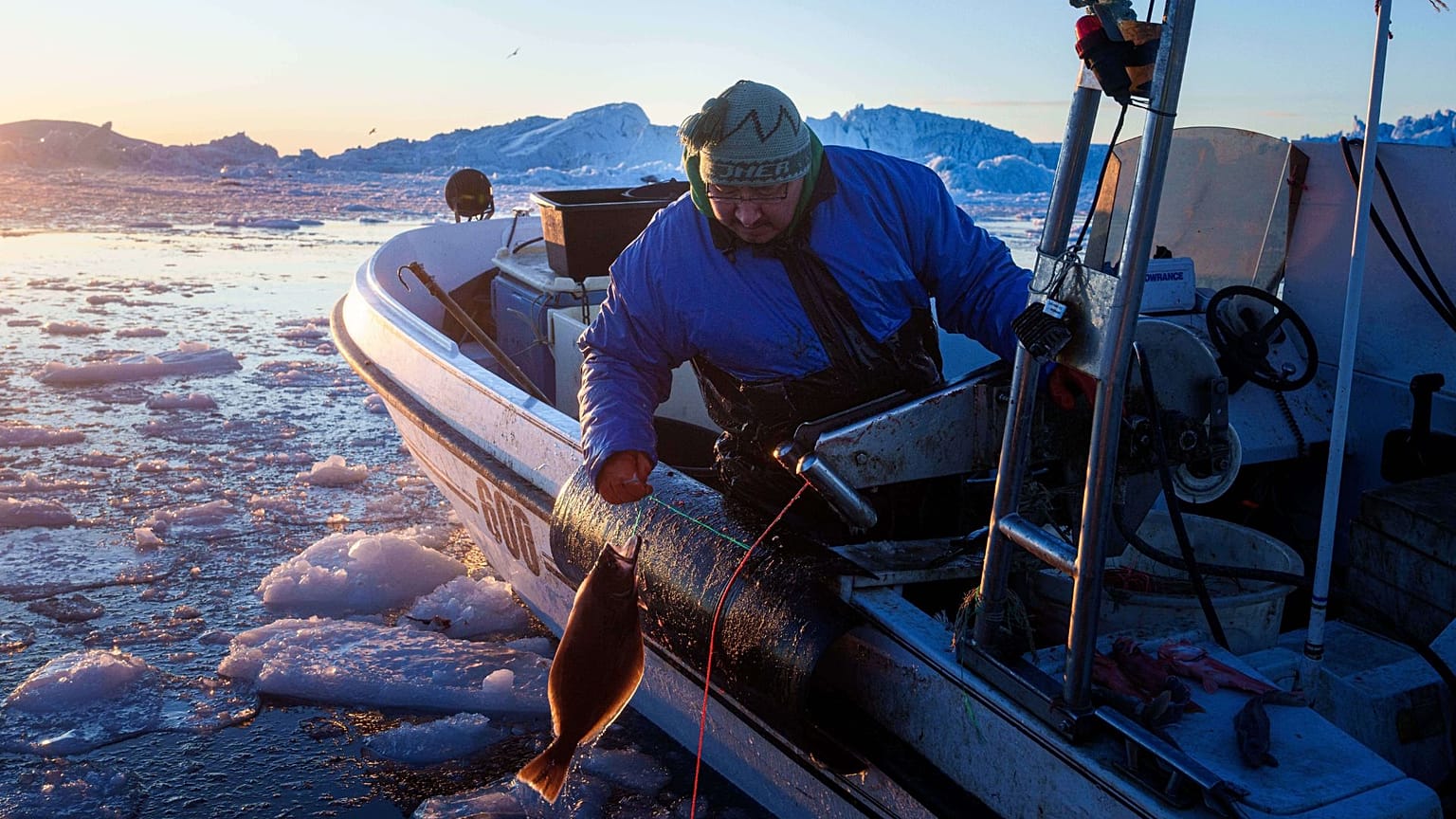
A fisherman catches halibut at Disko Bay near Ilulissat, Greenland, on Wednesday, Jan. 28, 2026.
Copyright AP Photo/Evgeniy Maloletka


By Emma Burrows, Kwiyeon Ha and Evgeniy Maloletka with AP
Published on 

Diminishing sea ice could push traditional ice fishers to use boats or into the ranks of commercial fishing.

Fisherman Helgi Áargil no longer knows what to expect on Greenland's fjords, where he spends up to five days at a time on his boat with his dog, Molly, and the ever-changing Northern Lights in the sky as company.

Last year, his boat got stuck in ice that broke off the nearby glacier. This year, it's been very wet instead. His income is just as unpredictable. An outing could bring him around 100,000 Danish kroner (about €13,400), or nothing at all.

The Arctic's rapidly changing climate is bringing more questions for Greenland, the semiautonomous territory of Denmark that's been shaken by US President Donald Trump's interest in owning it.

While Trump's approach to Greenland has shifted, the world has been unable to slow the effects of climate change. The Arctic is warming faster than any other region in the world, driven by the burning of oil, gas and coal.

What that means for the fishing industry that largely drives Greenland's economy is unknown. Fishing accounts for up to 95 per cent of exports, many to the territory's biggest market, China, along with the United States, Japan and Europe.
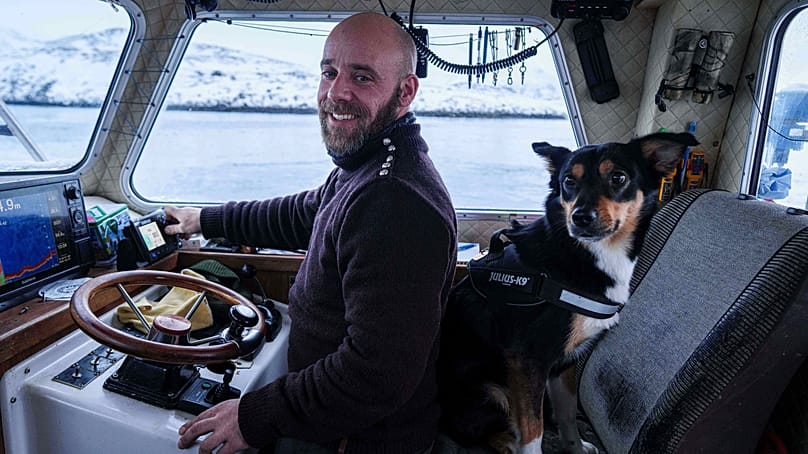
Helgi Aargil, fisherman, with his dog Molly, sails on his boat near Nuuk, Greenland, on Wednesday, Jan. 21, 2026. AP Photo/Evgeniy Maloletka

Disappearing Arctic sea ice

Wrapped in a wool sweater against the freezing wind, Áargil explains how he fishes for halibut and cod. Other top catches are shrimp and snow crab, which including legs can reach more than a metre in length.

Traditional ice fishermen who make up half the local industry are seeing the most dramatic changes to the way they fish.

“My father was fishing from the sea ice" one and a half metres thick, recalls Karl Sandgreen, head of the Icefjord Center that documents climate change in the region and is based in the town of Ilulissat.

That sea ice started disappearing around 1997, Sandgreen says, and fishermen who drilled through the ice to fish increasingly started to fish by boat instead. The use of boats allows fishermen to reach larger areas, but that can come with extra costs and pollution that that accelerates warming.
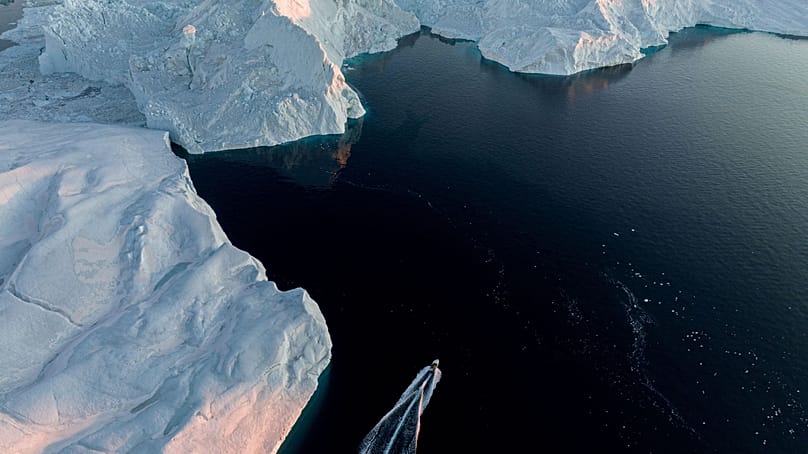
A fishing boat rides in front of an iceberg at Disko Bay near Ilulissat, Greenland, on Wednesday, Jan. 28, 2026. AP Photo/Evgeniy Maloletka

Traditional fishers could be pushed to go commercial

Fishing has shaped Greenland's communities. The harbour where fishermen return to sell their catch is at the heart of every town or village. Before heading out, some fishermen pick up boxes from the island's fishing companies to pack their catch which, in the capital of Nuuk, is winched from the boat to the fish factory.

Toke Binzer, the chief executive of the island’s single biggest employer, Royal Greenland, says he is increasingly worried about a future with greatly diminished sea ice. That could push traditional fishermen toward larger communities and into the ranks of commercial fishing.

The challenge now is how to support traditional fishermen when there is sometimes “too much ice to sail, too little to go out on", Binzer says. Already, that unpredictability has caused a “huge” problem.

Royal Greenland already loans fishermen money to buy a boat, which they repay from selling their catch, Binzer says.
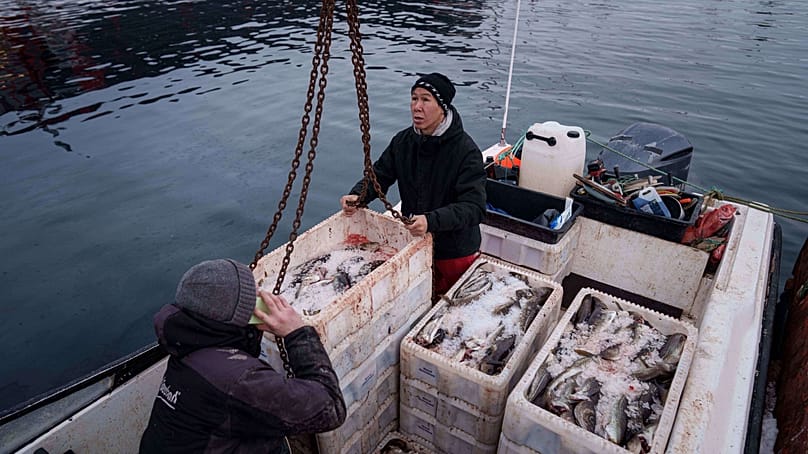
Fishermen unload boxes with fish from a boat at the harbor of Nuuk, Greenland, on Thursday, Jan. 22, 2026. AP Photo/Evgeniy Maloletka

If everyone turns to fishing from boats, that could help economically but lead to overfishing, says Boris Worm, an expert in marine biodiversity at Dalhousie University in Canada.

In Greenland, there are already signs of too much fishing close to shore as halibut are getting smaller, Binzer says. Worm agrees, calling it a classic sign of overfishing as the bigger fish are caught and the smaller, younger ones are left.

That problem could worsen as the retreating ice makes fish more accessible. Fish stocks could rise as the warmer weather causes increased rain and melting ice to bring more nutrients for plankton, which the fish feed on, Worm says.

He warns, however, that the fish may not behave as “predictably”, as in the past, perhaps by seeking new food sources if they can no longer feed on the algae which grows under the sea ice.

Few options beyond fishing

On his boat near Nuuk, Áargil considers another challenge: warm weather is making some fish harder to catch as they go deeper in search of colder waters.

“It’s too warm,” he says, looking at the hills around the fjord. “I don’t know where the fish is going, but there’s not so much.”

Options beyond fishing remain few in Greenland. Tourism is increasing but far from making up a significant part of the economy.

Tradition, too, is at the heart of worries about climate change. Already, dog sledders have been confined to land when there is no sea ice.

“It’s really important for many Greenlanders to have the ability to go out and sail,” says Ken Jakobsen, the manager at Royal Greenland’s factory in Nuuk. Fishing is the “most important” thing.

In the capital alone, he says, there are more than 1,000 boats in the harbour during summer – in a territory where the total population is little over 50,000.


 

Berlinale crisis: Tricia Tuttle to stay as film festival boss after Gaza row

Berlinale crisis: Tricia Tuttle to stay as film festival boss after Gaza row
Copyright AP Photo

By David Mouriquand
Published on 

Tricia Tuttle has agreed to remain in post following the latest meeting of the festival’s organising committee KBB. The festival received "recommendations" from its supervisory board but refuted false claims that the Berlinale will be required to impose a new code of conduct for future events.

The Berlin Film Festival will keep its director after all.

Berlinale boss Tricia Tuttle will remain as the film festival’s director, the Berlinale confirmed, following a supervisory meeting on Wednesday with the board of the state-owned KBB – the company which oversees the Berlinale.

In a statement, the festival said the board confirmed “the importance of the independence of our work,” refuting false claims peddled by conservative German tabloid Bild that a condition of Tuttle’s continued employment would require the Berlinale and its guests signing off on a new “code of conduct”.

The Berlinale said the supervisory board gave “recommendations rather than conditions related to Tuttle’s continued employment."

These government recommendations include the creation of a code of conduct, training for staff dealing with politically sensitive content, and the launch of an independent advisory forum representing diverse social groups, including Jewish voices.

The festival added: "Their consideration and any implementation now rests with the Berlinale, and we will review them.”

Tuttle’s leadership came under threat after this year’s edition of the festival was overshadowed at first by criticism of silence regarding political debate and then by several filmmakers using their acceptance speeches during the awards ceremony to make pro-Palestinian statements and speak out about Gaza.

German Federal Environment Minister Carsten Schneider reportedly walked out of the ceremony after Palestinian director Abdallah Al-Khatib, whose film Chronicles From The Siege won the top prize in the Perspectives section, accused the German government of “being partners in the genocide in Gaza by Israel” - referring in part to Germany maintaining a staunchly pro-Israel stance, rooted in the weight of historical guilt.

Bild, which is openly pro-Israel, suggested that Tuttle was facing the axe. A column by right-wing journalist Gunnar Schupelius accused Tuttle of having “posed for Gaza propaganda,” citing a photo of Tuttle with Al-Khatib and the Chronicles From The Siege crew at the film’s Berlinale world premiere. He accused Tuttle of allowing the Berlinale to be used as a tool by “antisemitic” activists.

These accusations were countered by a groundswell of support for Tuttle – not only from the Berlinale but also from more than 3,000 film professionals, who signed an open letter stating that the Berlinale’s strength “lies in its ability to hold divergent perspectives and to give visibility to a plurality of voices.”

Additionally, 32 global film festival directors, including Cannes head Thierry Frémaux, Toronto Film Festival CEO Cameron Bailey and Locarno director Giona A. Nazzaro, signed an open letter saying they “stand in support of Tricia Tuttle’s wish to continue as Berlinale Festival Director in full trust and with institutional independenc

The festival directors added: “We need to maintain spaces where discomfort is embraced, where debates can be expansive, where new ideas can propagate and where unexpected – and sometimes conflicting – perspectives are made visible.”

Tuttle has three years left on her five-year contract as director of the Berlinale.

Mayor of Marseille opposes Kanye West concert over 'unapologetic Nazism'

Mayor of Marseille opposes Kanye West concert over 'unapologetic Nazism'
Copyright AP Photo - Canva


By David Mouriquand
Published on 

Benoît Payan said the rapper is “not welcome” to perform at his scheduled concert at the Velodrome stadium on 11 June.

The mayor of the southern city of Marseille, France's second-biggest city, does not want American rapper Kanye “Ye” West anywhere near his city.

Mayor Benoît Payan has opposed West's visit, after the controversial singer announced a concert at the Vélodrome stadium on 11 June - West's only scheduled French gig.

In a message posted on X, Payan said: “I refuse to let Marseille become a showcase for those who promote hatred and unapologetic Nazism. Kanye West is not welcome at the Vélodrome, our temple of living together and of all Marseillais.”

Payan is not alone in wanting West to stay away. The CRIF (Representative Council of Jewish Institutions in France) believes that welcoming “someone who has professed his admiration for Hitler raises a real moral question”.

Previously, West had his Australian visa cancelled and was threatened with immediate arrest in Brazil.

In recent years, West has made numerous racist and anti-Semitic comments, going so far as he posting a picture of KKK robesrescinding his previous apology to the Jewish communitydeclaring himself “a Nazi” and asserting that he has “dominion over his wife”. West also started selling swastika t-shirts, and released a song titled ‘Heil Hitler’, in which he praised the Nazi leader.

In January 2026, the singer apologised in a letter published by the Wall Street Journal, in which he stated that he “lost touch with reality” and that his behaviour was due to his bipolar disorder – a condition he previously dismissed.


'The workforce needs to embrace AI': Why humans are critical to the future of AI-integrated work


By Amber Louise Bryce
Published on 

Training, regulation, and employee collaboration are essential for successfully scaling businesses using AI, EY's Jad Shimaly told Euronews Next at Mobile World Congress.

Artificial intelligence (AI) is redefining the future of work at a rapid pace, leaving many business owners struggling to integrate the technology mindfully - while keeping up with high-pressure industry demands.

For Jad Shimaly, the Global Managing Partner at EY, it's essential that CEOs navigate this transitional period with agility, accountability, and an open-minded collaborative approach.

"The workforce needs to be ready to embrace AI," Shimaly told Euronews Next at Mobile World Congress in Barcelona.

"Training, making sure that the workforce is well-equipped to leverage the benefits of AI, and embarking on the change process that AI brings forward, is a big part of what companies that are getting the most out of their AI initiatives are tackling head-on - and very early on into the process."

EY, one of the Big Four accounting firms, has been leading the charge when it comes to developing AI-integration solutions for business leaders, announcing an alliance with Boomi, an AI-driven automation system, in 2025.

Utilising such tools is part of developing an "AI ecosystem," which Shumaly argues is integral for quelling employee overwhelm and ensuring smoother, more efficient AI deployment.

"Companies are realising that they cannot tackle AI initiatives on their own. Bringing in partners, bringing in alliance partners, and doing joint ventures - that new set of workforce is critical for them to land on the true benefits of AI."

Maintaining human advantage

One of the biggest hurdles CEOs face when integrating AI is the tensions it can create with human employees.

Alongside people's fears around the technology taking jobs, the threat of burnout also looms large, as workers struggle to manage new AI-driven responsibilities on top of their existing roles.

This has led to organisations losing up to 40 percent of AI's productivity upside, according to EY data, calling into question how CEOs can encourage innovation without detriment to employee motivation and wellbeing.

The solutions are multifaceted, but at their core reside training, collaboration, and clear frameworks, according to Shimaly.

"If you want innovation and [employee] wellbeing to be complementary to each other, and to be improving in tandem, then we need to have the right change management programmes to make sure that employees are better understanding the positive impact," Shimaly explained.

"Employees cannot just be given a set of innovations or a technology. They need to be part of the solution as well. And when they become part of a solution, by default, they embrace the solution better," he said.

"By default, they understand how the solution is going to impact their daily lives. So, they get readier and they create better things, more creative things, and it improves well-being in general."

Shimaly added that in areas where workforces are augmented by AI, creativity is tripling, reinforcing the importance of framing AI as a tool for complementing workers.

"In many cases, when AI is left on its own, it becomes very structured, very redundant, without driving up the level of creativity in the organisation. And when the workforce is left without AI, we're also seeing that creativity is getting stifled, because the human brain is not getting closer to reaching its capacity."

Responsible AI

Another major and ongoing challenge for business owners is the ethics surrounding AI integration.

As regulatory frameworks struggle to keep pace with AI's surging innovations, it's up to CEOs to devise strong accountability frameworks for leveraging AI's benefits responsibly.

"Responsible AI, the way I see it, is ensuring that you have the right governance, the right ethical standards, the right accountability framework for the AI lifecycle from beginning to end," Shimaly said.

Companies are introducing it through a few steps, he said. The first is defining what responsible AI standards are. The second is communicating what these standards are and how they're going to be embraced and driven through an organisation. The last step is ongoing oversight — making sure responsible AI practices stay current and remain central to how organisations manage AI throughout their entire lifecycle.

Shimaly also noted that companies that embrace the right governance frameworks are seeing more benefits, as it allows them to more accurately measure success.

"It's enabling them to start cutting and start progressing, versus the ones who do not have the right standards in place and are taking two steps forward and then, in many cases, two or three backwards," he said.

"Because AI will inevitably surprise you if you don't govern it the right way."

Alcohol Abstinence Enables Regeneration Even In Advanced Liver Cirrhosis


By 

Consistent and permanent abstinence from alcohol can lead to the regression of existing liver-related complications, even in cases of advanced alcohol-related cirrhosis. This is shown by an international multicentre study led by MedUni Vienna, which was recently published in the renowned Journal of Hepatology.

Up to one third of patients with already decompensated alcohol-related cirrhosis were able to achieve so-called “re-compensation” through consistent abstinence from alcohol – i.e., the complete resolution of liver-related complications with simultaneous recovery of liver function. In addition, the study identifies the factors that are crucial for this recovery of liver function.

Cirrhosis is characterised by progressive scarring of the liver. In Western countries, it is often caused by excessive alcohol consumption and leads to serious complications in many affected individuals, such as abdominal fluid accumulation (ascites), altered mental states (encephalopathy) and bleeding from varicose veins in the oesophagus (variceal bleeding). Traditionally, the occurrence of such complications, known as decompensation events, was considered a sign that cirrhosis had become irreversible. The results now published challenge this dogma. 

The study by the research team led by Benedikt Hofer and Thomas Reiberger (Division of Gastroenterology and Hepatology at the Department of Medicine III at MedUni Vienna and University Hospital Vienna) included 633 patients with alcohol-related cirrhosis from 17 specialist centres in Europe and Asia. All patients had begun abstaining from alcohol after experiencing decompensation events.

The course of the disease is reversible

Within five years, around one third of patients achieved a complete resolution of all liver-related complications with simultaneous improvement in liver function – a condition known as “re-compensation”. “Our data clearly show that even after the onset of severe complications, the course of cirrhosis is not necessarily irreversible,” explains lead author Benedikt Hofer.

In addition to the initial severity of the liver disease, the decisive factor in achieving recompensation was, above all, complete and early abstinence from alcohol. Study leader Thomas Reiberger emphasises: “Abstaining from alcohol can not only halt the progression of liver disease, but in many patients can even lead to an improvement in cirrhosis. However, it is crucial that abstinence from alcohol is maintained immediately after the occurrence of complications – this can more than double the chance of recompensation.”

Dramatic survival advantage through recompensation

The clinical impact of recompensation on the survival of the patients in the study was impressive: none of the recompensated patients who remained abstinent from alcohol died of liver-related causes. The risk of developing liver cancer was also significantly reduced in this group, and overall mortality was significantly lower – clinically relevant results that were additionally highlighted as “Research Highlights” in the journal Nature Reviews Gastroenterology and Hepatology. Thomas Reiberger continues: “Recompensation is no longer a purely theoretical concept, but a clinically increasingly relevant condition that can fundamentally improve the prognosis of patients despite advanced cirrhosis.”

Abstinence from alcohol at the centre of therapy

The study underscores the central role of complete and permanent abstinence from alcohol as the most effective therapeutic intervention for alcohol-related liver disease. At the same time, the results also highlight health policy aspects: structured support to achieve and maintain alcohol abstinence is crucial for the prognosis of these patients – especially against the backdrop of current budget cuts in the area of addiction support and abstinence programmes.

“A relapse into alcohol abuse significantly worsens the prognosis,” says Benedikt Hofer, adding: “So if savings are made in abstinence support, not only are preventable deaths risked, but also high costs for the medical treatment of advanced liver disease and its complications.”

Make Year-Long Standard Time The Nationwide Standard Again – OpEd


March 5, 2026 

By William F. Shughart II


I’m one of the many Americans who hate being forced to time-shift twice a year. After only four months on standard time, daylight saving time returns with a vengeance on Sunday, March 8, when 2 a.m. abruptly becomes 3 a.m.

Only residents of Arizona (with the exception of those living on the land reserved for the Navajo Nation, which is compelled to follow Washington’s timekeeping edicts), Hawaii, Guam, Puerto Rico, and other outlying U.S. territories will not have their body clocks jolted by time suddenly “springing forward” one hour.

Public opinion has been slowly turning against the twice-yearly ritual of moving the clock hands forward and backward. The main question nowadays is, what is to be done, policy-wise?

Most people don’t realize that standard time, as its name implies, was the year-round custom in the United States (and most of the world) until 1918, when—during World War I—the practice of springing forward was introduced as an alleged energy-saving measure. That ended shortly after the war but was temporarily reinstated during World War II and then codified as an annual ritual when Congress passed the Uniform Time Act of 1966.

The false belief in DST-related energy savings has led some state and federal lawmakers to propose making DST permanent. That would be a serious blunder, experience shows.


More than five decades ago, on January 6, 1974, Washington launched what was meant to be a two-year-long experiment with permanent DST. While the change initially was favored by 79 percent of the public, it quickly lost favor after predawn accidents killed or injured several schoolchildren.

Many started calling it daylight disaster time, permanent DST’s popularity tumbled to 42%, and the experiment ended for good in October 1974, after just 10 months.

Fans of permanent DST are relentless, however. The latest effort is called the Sunshine Protection Act, introduced last year by Florida Republicans Vern Buchanan in the House and Rick Scott in the Senate. Political memories are short: It was Florida schoolchildren who became DST’s casualties in 1974.

The reason clock settings are a hotly debated political issue is that the Uniform Time Act allows states and U.S. territories to lock in standard time for 12 months, but it doesn’t allow them to adopt DST permanently. For that to happen, the 1966 statute would have to be amended or repealed.

A “compromise” introduced by another Florida politician would “split the baby” by setting clocks ahead by 30 minutes for good. Although plausibly less troublesome, “half-DST” would put U.S. time zones out of sync with the rest of the world. And it would still misalign our human body clocks with morning sunlight, thereby disrupting circadian rhythms and causing the spikes in heart attacks, strokes, depression and other health problems observed in the days following the one-hour spring and fall time shifts.

Changing clocks twice every year is disruptive and costly. On-the-job productivity sinks until employees adjust physiologically to springing forward and falling back. Retailers are major supporters of DST because they think that sales rise when more people can shop after work. The owners of golf courses, tennis courts and other outdoor sports venues likewise plausibly benefit from DST.

DST’s supporters may be confusing seasonal changes in day lengths with clock changes. Shifting between daylight saving time and standard time has no effect on the rising and setting of the sun at any location on the planet. They are determined by latitude (distance from the equator) and changes in the Earth’s polar tilt as it revolves around the sun.


During a radio interview several years ago, I was amused by the host’s remark that he likes DST because losing an hour of sleep in March signals that winter is ending and spring is on the way. Guess what? Except at the equator, days lengthen and shorten over the calendar year, no matter where the hands of clocks are pointing.

Stop the stupid ritual. Standard time now runs for just four months (early November through early March). It’s time to make it the year-round nationwide standard again.


This article was also published in The Miami Herald

William F. Shughart II


William F. Shughart II is Research Director and Senior Fellow at The Independent Institute, the J. Fish Smith Professor in Public Choice in the Jon M. Huntsman School of Business at Utah State University, and past President of the Southern Economic Association. A former economist at the Federal Trade Commission, Professor Shughart received his Ph.D. in economics from Texas A & M University, and he has taught at George Mason University, Clemson University, University of Mississippi, and the University of Arizona.


Major Data Leak Forum Dismantled In Global Action Against Cybercrime Forum


Credit: Europol


March 5, 2026 
By Eurasia Review


A major online forum for stolen data has been dismantled following an international operation coordinated by Europol.

The forum, known as LeakBase, had established itself as a central hub in the cybercrime ecosystem, specialising in the trade of leaked databases and so-called “stealer logs” – archives of stolen credentials harvested through infostealer malware. Accessible on the open web and operating in English, the platform combined elements of a forum and discussion board, enabling cybercriminals to buy, sell and exchange compromised data.

Between 3 and 4 March, coordinated actions across multiple jurisdictions severely disrupted the forum’s operations and targeted its most active users.
A hub for stolen credentials

Active since 2021, LeakBase maintained a vast and continuously updated archive of breached databases, ranging from historical leaks to newly compromised data. The forum featured large volumes of credential pairs – including email and password combinations – and other access credentials used to facilitate account takeover, fraud and further cyber intrusions.

A credit-based economy and reputation-driven user system helped build trust among offenders and sustain a thriving underground forum. One of the forum’s notable internal rules prohibited the sale or publication of any data related to Russia.


By December 2025, LeakBase counted more than 142 000 registered users, approximately 32 000 posts and over 215 000 private messages, underlining its scale and global reach.
Global operational phase

On 3 March, law enforcement authorities carried out coordinated enforcement actions across multiple jurisdictions, including arrests, house searches and “knock-and-talk” interventions. Around 100 enforcement actions were conducted worldwide, including measures against 37 of the most active users of the platforms.

On 4 March, authorities moved to the technical disruption phase, seizing the forum’s domain and replacing it with a law enforcement splash page.

The operation now enters a prevention phase aimed at deterring further criminal activity and raising awareness of the consequences of engaging in cybercrime.
Europol’s support

Europol’s analysts mapped the forum’s infrastructure and user activity, cross-matching data with ongoing investigations across Europe and beyond. Sensitive information was exchanged securely via Europol, enabling investigators to connect suspects, victims and digital evidence across borders.

An operational data sprint at Europol’s headquarters in The Hague brought together specialists to rapidly analyse seized data and identify high-value targets. A dedicated data scientist supported the case, extracting and structuring millions of data points to generate actionable leads.

The partners have been working closely together within the framework of the Joint Cybercrime Action Taskforce (J-CAT) hosted at Europol to prepare for the final phase of the investigation.


On the action day, Europol set up and coordinated a Joint Command Post, allowing participating countries to share live updates and intelligence in real time as enforcement measures unfolded worldwide.


Eurasia Review

Eurasia Review is an independent Journal that provides a venue for analysts and experts to publish content on a wide-range of subjects that are often overlooked or under-represented by Western dominated media.


JWSTelescope Reveals Surprising Secrets In Jupiter’s Northern Lights


Katie Knowles of Northumbria University, UK.
 (Credit Northumbria University/Barry Pells)

March 5, 2026 
By Eurasia Review


An international team of scientists, led by a PhD researcher from Northumbria University, has made groundbreaking discoveries about a spectacular feature of Jupiter’s northern lights, revealing a never-before-seen temperature structure and dramatic density changes within the top of the giant planet’s atmosphere.

The research, published in Geophysical Research Letters, provides the first detailed spectral measurements of the infrared auroral footprints of Io and Europa – brilliant glowing patterns in Jupiter’s aurora caused by its Galilean moons interacting with Jupiter’s powerful magnetic field.

The images were captured using the James Webb Space Telescope (JWST), an international partnership between NASA, the European Space Agency, and Canadian Space Agency, which uses infrared radiation to look deep into space.

Speaking about the findings, lead author Katie Knowles, a PhD Researcher in Planetary Physics at Northumbria University, explains: “These emissions have been measured before at ultraviolet and infrared wavelengths, but only how brightly they shine. For the first time, we’ve now been able to describe the physical properties of the auroral footprints – the temperature of the upper atmosphere and the ion density, which has never been reported on before.”

Unlike Earth’s northern lights, which are primarily driven by the solar wind, Jupiter’s aurora includes the impact of its four large Galilean moons – Io, Europa, Ganymede, and Callisto – which create their own ‘mini aurora’ on the planet.

Jupiter’s powerful magnetic field rotates approximately once every 10 hours along with the planet itself, carrying charged particles with it. But its moons orbit much more slowly – Io, the innermost moon, takes around 42.5 hours to complete one orbit.

As Katie explains: “The moons constantly interact with the magnetic field and plasma surrounding the planet, and that interaction leads to highly energetic particles travelling down magnetic field lines and then crashing into the planet’s atmosphere, creating the auroral footprints that map to where the moons orbit around Jupiter. Jupiter’s aurora is the most powerful and constant of any aurora in the Solar System. What we’re seeing with the JWST gives us an unprecedented window into how Jupiter’s moons directly affect the top of the planet’s atmosphere.”

The images captured by JWST were taken during time awarded to Dr Henrik Melin and Professor Tom Stallard (Professor of Planetary Astronomy at Northumbria and Katie’s PhD Supervisor). During a 22-hour window of observation time which took place in September 2023, the research team carried out a scan around the edge of Jupiter, chasing the northern lights as they rotated into view. It was during this observation that they also happened to capture the auroral footprints.

However, the footprints created by Io and Europa, did not have the characteristics expected from Jupiter’s main aurora, which is relatively hot and contains a lot of material. Instead, in one snapshot, they discovered a cold spot within Io’s auroral footprint that registered temperatures much lower than expected with extraordinarily high densities (higher than they have ever measured before).

Jupiter’s moon Io is the most volcanically active body in our solar system, with its volcanoes ejecting about 1,000 kilograms of material into space every second, feeding the dense plasma surrounding Jupiter. This material becomes ionized and forms a doughnut-shaped cloud around Jupiter called the Io plasma torus. As Io moves through this environment, it generates powerful electrical currents that create the brightest spots in Jupiter’s aurora.

The research team found that these auroral footprints contain trihydrogen cation (H₃⁺) densities three times higher than those found in Jupiter’s main aurora, with some regions showing density variations of up to 45 times within the same small area.

“We found extreme variability in both temperature and density within Io’s auroral footprint that happened on the timescale of minutes,” said Katie. “This tells us that the flow of high-energy electrons crashing into Jupiter’s atmosphere is changing incredibly rapidly.

“The cold spot registered temperatures of just 538 Kelvin, or 265°C, compared to 766 Kelvin, or 493°C in the rest of Jupiter’s aurora. The cold spot also contained material three times denser than Jupiter’s main aurora.”

The findings could extend far beyond Jupiter and open questions about other planetary systems. Saturn’s moon, Enceladus, also creates an auroral footprint on the planet, and scientists wonder whether similar phenomena occur there.

“This work opens up entirely new ways of studying not just Jupiter and its other Galilean moons, but potentially other giant planets and their moon systems,” said Katie, who is about to complete her PhD at Northumbria University. “We’re seeing Jupiter’s atmosphere respond to its moons in real-time, which gives us insights into processes that occur throughout our solar system and perhaps further afar.

“We only saw this phenomenon in one of our five snapshots which leave us with questions. How often does this occur? Does it switch on and off? How does it change with different conditions?”

To answer these questions, Katie was awarded over 32 hours of observation time with NASA’s Infrared Telescope Facility (IRTF) in Hawaii across six nights in January 2026. This allowed her to watch as the auroral footprint rotated with the planet. She hopes analysis of this data will allow her to determine whether this extreme variability is common or rare.

Katie has presented her findings to international scientists from across the world at the EPSC-DPS Joint Meeting 2025 in Helsinki (Finland) and was also invited to be a Young Scientist Team Member for an International Space Science Institute team meeting in Bern (Switzerland) to further discuss her work.
NORWAY

Salmonids Reveal The Cold Truth About Human Impacts On Fennoscandian Lakes


Lake Tovatna in central Norway was one of the research areas. 

CREDIT: Antti Eloranta, University of Jyväskylä

March 5, 2026 
By Eurasia Review

A large-scale study led by the University of Jyväskylä revealed that human activity is consistently changing the ecosystems of Northern European lakes. The study shows that hydropower and human activity in catchment areas are altering the food webs of lakes. The study challenges the belief that subarctic and alpine lakes located far away are relatively safe from human impacts.

Using brown trout and Arctic charr as sentinels of over 100 lake food webs, the researchers showed that both salmonid fishes respond similarly to the impacts of hydropower and the degree of human modification in the lakes’ catchments. In contrast, the two salmonids responded differently to other, non-human mediated changes in lake environments. This study, published in Limnology and Oceanographyon 23 February 2026, highlights how the large-scale effects of humans extend even into what are typically considered less impacted, more pristine areas.
Extensive data showed how different environmental factors shape lake ecosystems

To understand how lake food webs change with the environment, leader of the ColdWebs research group Dr. Antti Eloranta brought together various scientists that have been studying salmonid fishes in Finland, Norway, and Sweden for over the past 20 years. This combined approach meant that the researchers could examine data taken from thousands of fish collected from 120 lakes to tease apart the many different environmental factors that affect these cold-water lake food webs simultaneously.

“It is really the scale of this study that allowed us to separate all these different effects”, explains Postdoctoral Researcher Matthew Cobain from University of Jyväskylä who led the data analysis. “There have been many small-scale studies examining different environmental factors one at a time in these systems, but environmental factors do not act in isolation. By bringing all this data together, we could really examine the impacts of different factors like temperature, lake size, and hydropower activity all together.”, he continues.

Salmonids tell about lake food webs

The research used stable isotope data, biotracers, that indicate the diet of brown trout and charr, to see how the food webs changed between different lakes.

“These two fish species are the top predators in these systems and therefore they reflect changes in the whole food web”, says Academy Research Fellow Antti Eloranta from the University of Jyväskylä. “The stable isotopes of nitrogen and carbon can tell us whether the fish are moving up or down the food chain, and how much they rely on food from the littoral zone near the shore or from the open water area of the lake, the pelagic zone. Therefore, isotopes in salmonids can be used as tracers of food web structure and function in subarctic and alpine lakes across Fennoscandia.”
New environmental changes are impacting salmonids in a similar way

The researchers found that hydropower resulted in both species shifting towards the pelagic zone, as water-level regulation damages the shallow littoral habitats. They also found that increasing human modifications in the lakes’ catchments led to fish moving higher up the food chain, likely due to increasing nutrients entering the lakes.

“The surprising thing is how consistent these responses to human impacts were between trout and charr” expands Cobain. “Other factors we examined such as lake size, climate, or greenness of the landscape all gave either contrasting or limited responses.”

He suggests that because the two species are adapted in different ways, we would expect them to respond differently to environmental change that they have been naturally exposed to over their species’ range. However, human impacts are novel environmental changes that neither species are adapted to and therefore respond in a similar way.