It’s possible that I shall make an ass of myself. But in that case one can always get out of it with a little dialectic. I have, of course, so worded my proposition as to be right either way (K.Marx, Letter to F.Engels on the Indian Mutiny)
EU Commissioner Stéphane Séjourné on Wednesday presented a strategy shutting Beijing out of EU public funding by introducing a European preference in strategic sectors. Countries which limit access to their own markets through local content rules would also be cut off.
The European Commission on Wednesday unveiled its long-awaited industrial plan, rolling out a “European Preference” that shuts China out of European public funding and tightens the screws on Beijing’s future investments in the European Union.
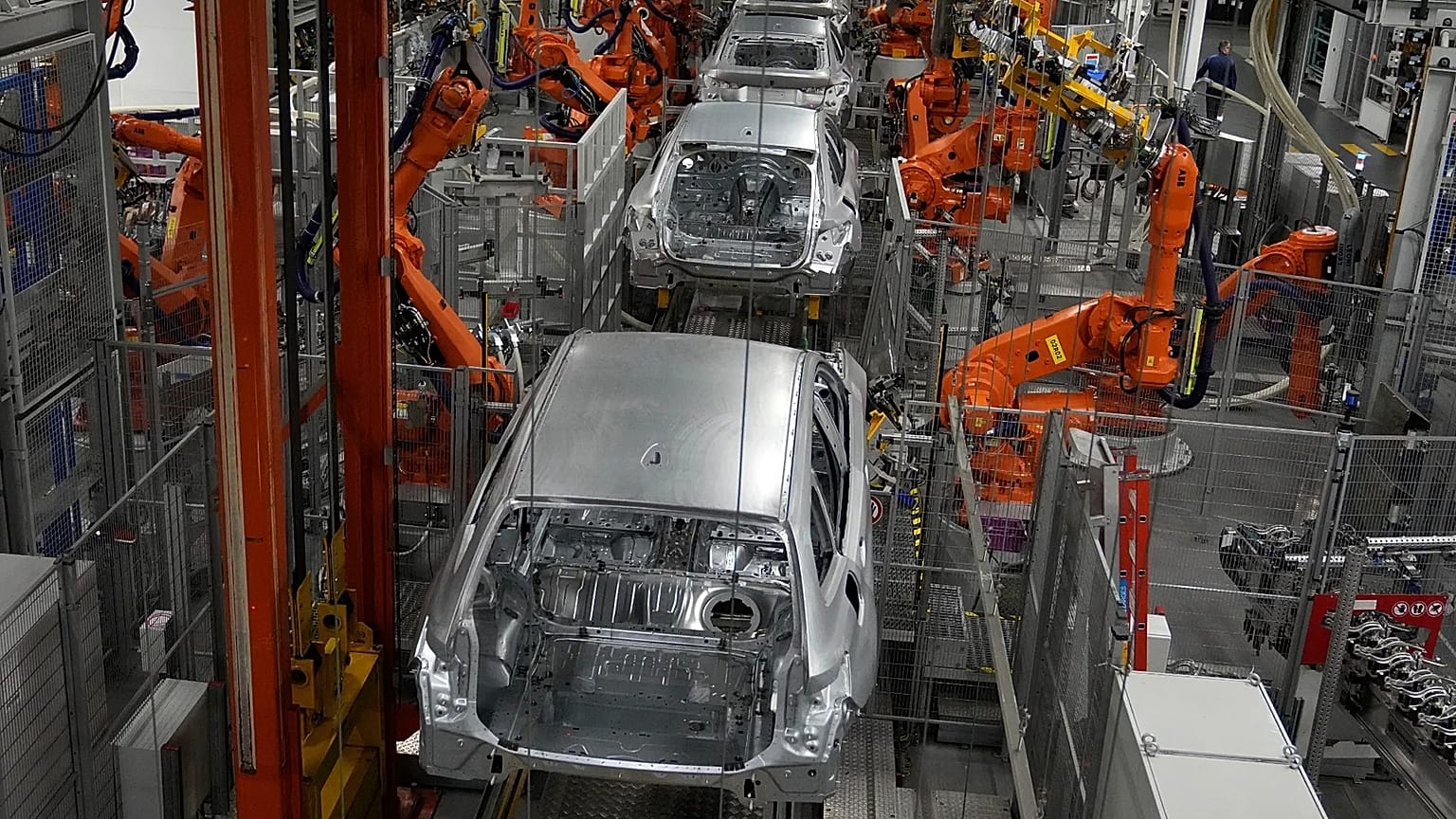
The move comes after 200,000 European jobs were wiped out in energy-intensive industries and the automotive sector since 2024, with 600,000 losses projected this decade in carmaking alone, as China floods Europe with exports while building plants that create scant local employment.
"Facing unprecedented global uncertainty and unfair competition, European industry can count on the provisions of this act to boost demand and guarantee resilient supply chains in strategic sectors," EU Industry Commissioner Stéphane Séjourné said, presenting the EU executive's much-anticipated Industrial Accelerator Act (IAA).
The strategy targets three strategic sectors: clean technologies, car manufacturers, and energy-intensive industries such as aluminium, steel and cement.
It introduces “Made in Europe” thresholds, including a 70% EU-content requirement for electric vehicles –with notable exceptions for most battery components – 25% for aluminium and 25% for cement.
"It will create jobs by directing taxpayers’ money to European production, decreasing our dependencies and enhancing our economic security and sovereignty," Séjourné added.
China targeted by tougher investment rules
The IAA's creation has seen fierce infighting between member states and Commission departments.
A bloc of Nordic and Baltic countries warned the new rules could undermine investment and limit EU countries' access to foreign technologies, while Germany has pushed to open the “Made in Europe” label to include goods and components from like-minded partners. Meanwhile, France has taken a more protectionist line.
In the end, the Commission has proposed extending EU-origin status to products coming from trading partners with free trade agreements that apply reciprocity, notably in public procurement contracts.
“We will consider union-origin products that are manufactured in third countries with which we have an international commitment,” a Commission official said.
That excludes China and the US, which do not enjoy any such agreements with the bloc, but it might also exclude more like-minded partners such as Canada, where a Buy Canadian policy might apply soon to EU companies.
“The proposal also says that we will check later if these countries are not open to us on the same list of categories of technologies even when they were supposed to,” the EU official added.
New conditions will also apply to foreign direct investment over €100 millions in batteries, electric vehicles, solar panels and critical raw materials – again, with China in focus.
“They basically come on a piece of a European land, build their factories, come with thousands of Chinese workers and run the factory on their own with little local added value,” another EU official said, explaining the Commission’s decision to restrict access to its market.
From now on, if an investor comes from a country holding 40% of the global market share in a given sector, 50% will have to be attributed to EU workers. Some other conditions will also apply, such as foreign ownership remaining below 49%, joint ventures with European entities, technology transfers, 1% of the company's global revenue channelled into EU R&D, and 30% of production carried out in the bloc.
“Europe is not a supermarket,” the same EU official said, “it has to be a factory.”
The proposal must now be approved by the EU’s co-legislators – the European Parliament and the Council of the EU, which represents member states.
Why Europe needs a payment system independent of Mastercard and Visa
Europe spends trillions of euros every year on card payments, yet almost none of them run through a European system. Now the EU wants to change that, but can it? Watch the video.
Most card or online purchases in Europe go through Visa or Mastercard, two American companies that lead global payments. EU leaders now see this as a risk Europe can't ignore, and they're acting.
Wero is a digital wallet created by European banks and payment companies to avoid using card networks. It uses instant bank transfers, which remove middlemen, lower fees, and keep data within Europe. Wero already has tens of millions of users in Germany, France, and Belgium, and it's growing quickly.
Two main reasons drive this effort: control and cost. The European Central Bank warns that relying on foreign payment systems leaves Europe open to political pressure or sudden disruptions. After Russia invaded Ukraine in 2022, Visa and Mastercard quickly cut off Russia, blocking it from the global payment system almost immediately.
ECB President Christine Lagarde has made it clear that most digital payments in Europe now use US or Chinese systems. She says this is a weakness Europe needs to address.
Cost is another issue. Retailers report that card network fees have risen sharply in recent years. Direct bank payments could increase competition and help both businesses and consumers save money.
For EU leaders, the stakes are bigger than a digital wallet. Payments, they argue, are infrastructure, and infrastructure is power.
Gender equality is improving in the EU, but the pension gap persists
There's a gap between men's and women's pensions across the EU, both in the average and median amounts received.
Despite significant progress in women’s representation in leadership roles and a narrowing gender pay gap, full gender equality in the EU is said to still be at least 50 years away, according to the European Institute for Gender Inequality Index.
One area that still needs improvement is pensions: new figures from Eurostat show that the average pension for women aged 65 or above in the EU was 24.5% lower than that for men in 2024.
When broken down by country, Malta had the largest pension gender gap, with women receiving around 40% less than men on average. It was followed by the Netherlands (36.3%) and Austria (35.6%).
On the flip side, the smallest gaps were seen in Estonia (5.6%), Slovakia (8.4%), the Czech Republic and Hungary (both 9.6%).
These rates are significantly better than the other end of the table, but the overall trend across the EU shows that there's still much progress to be made.
A similar trend emerges even when looking at median pensions: here, women in the EU received 24.9% less than men.
Luxembourg had the highest gap (43.3%), then Spain (41.1%) and the Netherlands (39.6%).
Down at the other end, Estonia actually registered a -0.3% gap, showing that women's median pension was actually a little bit higher than men’s. It’s followed by Hungary (0.4%) and Denmark (2.7%) with near parity.
Women at a higher risk of poverty than men
Nevertheless, women aged 65 or older faced a higher risk of poverty than men in 22 EU countries, according to Eurostat.
The agency found that at the EU level in 2024, the difference in the at-risk-of-poverty (AROP) rate between men and women aged 65 years or over was -5.6%, showing that women were at a greater disadvantage.
This was especially true in Malta (-18.6%), Lithuania (-13.3%), Austria (-13%) and Portugal (-12.5%).
Only five countries showed the opposite trend, where men faced a greater risk than women: Luxembourg (1.9%), Sweden (1.3%), Denmark (0.7%), Belgium (0.48%) and Slovenia (0.39%).
Gender differences in how at-risk-of-poverty people are were wider among people aged 65 or older than those under 65, Eurostat said. However, this wasn't true of all countries.
At the EU level, the gender difference in the AROP rate was -1.9% for women under 65 years and -5.6% for those aged 65 years or over.
The difference was particularly noticeable in Portugal (8.4% for women younger than 65 years and -12.5% for women aged 65 years or over, resulting in a -20.9% difference), Lithuania (a -20.0% difference), Ireland (-18.7%) and Bulgaria (-17.2%).
While older women generally faced a higher risk of poverty (in relation to men of the same age) than younger women, in some countries, the opposite was true.
Luxembourg registered a 9.2% difference, followed by Slovenia (4.1%), Denmark (2.5%), Germany (1.3%) and France (0.7%) — these positive differences indicate that younger women faced a greater relative disadvantage compared to men than older women did.
‘Stark global inequality’: Calls for taxes on private jets grow louder as uber-wealthy flee Dubai
Copyright Copyright 2026 The Associated Press. All rights reserved.
Private jets are up to 14 times more polluting than commercial planes – and are now being used to escape escalating conflict in the Middle East.
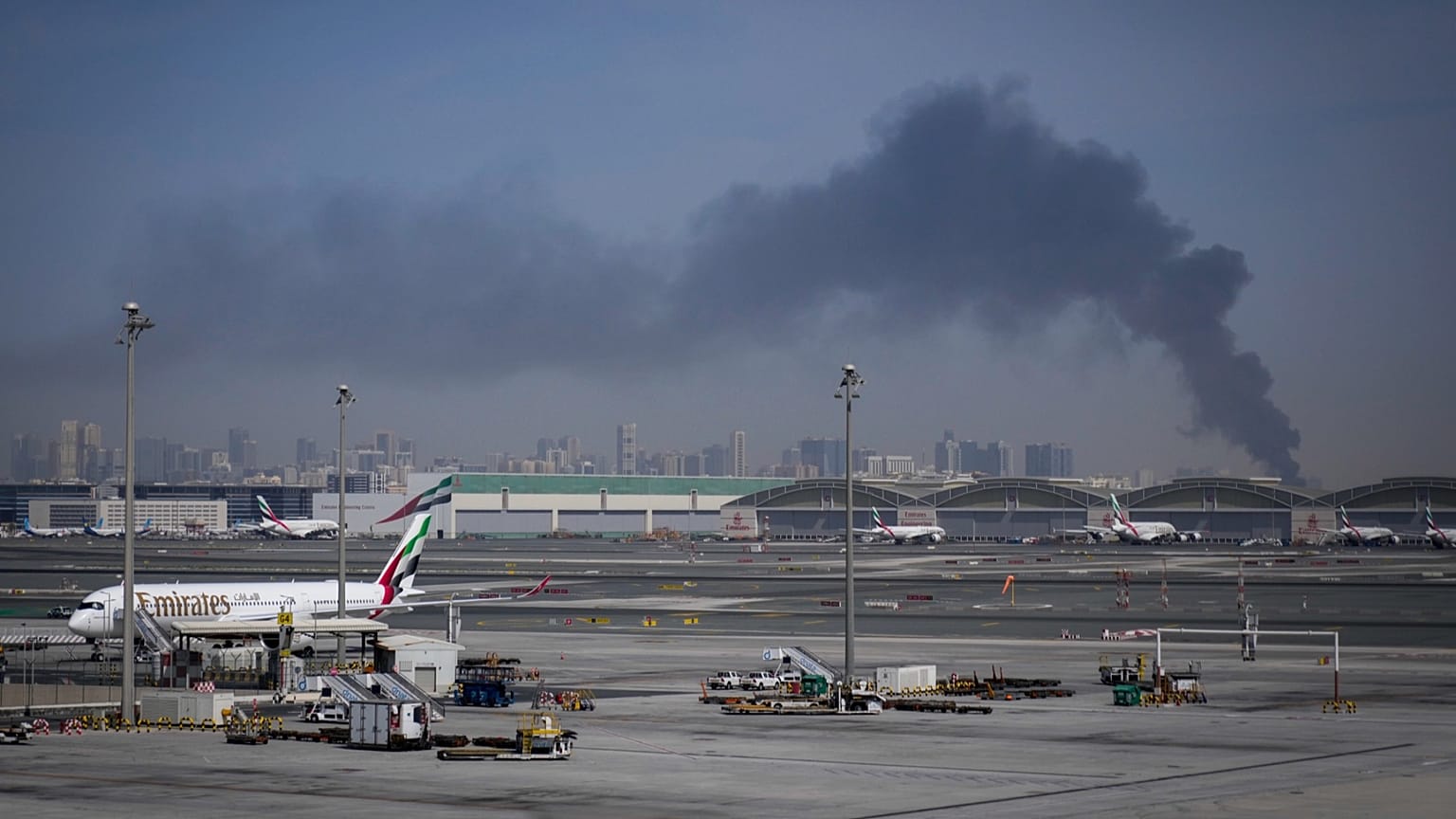
Price-gouging private jet firms have been inundated with demand, as the uber-wealthy scramble to flee Dubai amid the war on Iran.
After strikes targeted luxury hotels and Dubai International Airport – the UAE’s main aviation hub – officials confirmed that all flights had been grounded over the weekend. Following the 48-hour shutdown, Dubai International resumed a limited service, with airlines such as Emirates stating priority was being given to passengers with earlier bookings.
With thousands stranded and fearing for their safety, many attempted to escape Dubai and drive four hours to Muscat in Oman. Some even attempted a 10-hour journey over to Riyadh, the capital of Saudi Arabia.
However, the majority of commercial flights from Muscat to Europe were fully booked until later this w
Due to skyrocketing demand, the price of chartered flights has reportedly spiked – with the mega-rich forking out a staggering €200,000 to get out of the city or nearby regions.
Football superstar Cristiano Ronaldo’s private jet left Saudi Arabia on Monday night, while Italy’s defence minister Guido Crosetto and his family returned home on a military aircraft last weekend.
‘Flying above the chaos’ in Dubai
Tyrone Scott of War on Want, a UK-based charity that works to fight poverty and defend human rights, tells Euronews Green that the influx of private jet use exposes a “stark global inequality”.
“When crises hit, the world’s wealthiest can quite literally fly above the chaos, while millions of others are left trapped in conflict zones or facing closed and heavily secured borders,” he says.
Dubai has long been a playground for the rich, attracting wealthy individuals due to its glitz and glamour, and lack of income tax. But its appeal – amplified by social media influencers – has been built on the backs of migrant workers, who human rights organisations say have faced systematic exploitation.
In 2023, non-profit FairSquare found that migrant construction workers on Dubai’s COP28 site were put to work outdoors in extreme heat that “posed serious threats to their health and could be fatal”.
A 2024 investigation also warned that low-income migrant workers in the UAE were being disproportionately affected by a prolonged dengue outbreak following devastating spring flooding.
“As cases of dengue have rampaged through the community, the toll on migrant workers, who live in marginalised neighbourhoods and struggle to access quality healthcare, has been particularly harsh,” James Lynch, FairSquare’s co-director, said at the time.
For these workers, who are the backbone of Dubai’s impressive skyline and vast shopping centres, escaping the conflict isn’t an option.
“The inequality at the heart of this story is also the root of the climate crisis,” says Hannah Lawrence, a Stay Grounded spokesperson.
“While the super-rich are able to pay tens of thousands of Euros to flee on private jets, those most impacted by war and the climate crisis cannot.”
Lawrence argues that safety should not depend on one’s ability to afford a private jet. “Everyone deserves safety and a future in which they can thrive,” she adds.
“We must end the skyrocketing inequality of private jets, luxury tourism and the privileges of the ultra-rich.”
‘Escalating climate breakdown’
Private jets are also notorious for their environmental impact, which studies show is a huge contributor to climate change.
Analysis from Transport & Environment found that private flights are five to 14 times more polluting than commercial planes per passenger, and 50 times more polluting than trains. Despite this, private jet emissions have increased by 46 per cent between 2019 and 2023.
“At a time of escalating climate breakdown and global instability, it’s indefensible that this level of carbon-intensive luxury remains largely untaxed and unregulated,” Scott says.
“Governments should be looking seriously at measures like strong wealth taxes and levies on private jet use to curb excessive emissions and ensure the richest contribute their fair share to addressing the crises their lifestyles help fuel.”
Can a wealth tax help fight the climate crisis?
Calls for more aggressive taxes on carbon-intensive luxury items and fossil fuel profits have gotten louder in recent years, as the super-rich continue to flout what Oxfam describes as “gross carbon recklessness”.
A report from the NGO group published in January found that the richest one per cent exhausted their annual carbon budget just 10 days into 2026. This is where CO2 emissions exceed limits to keep the world within 1.5℃ of warming, as set out in the Paris Agreement.
The analysis also found that the richest 0.01 per cent exceeded their carbon limit in the first 72 hours of the New Year (3 January). Experts argue the uber-wealthy must slash their emissions by 97 per cent by 2030 to meet legally-binding climate targets.
Oxfam is now calling on governments to introduce a ‘Rich Polluter Profits Tax’. It says implementing such a policy on 585 oil, gas and coal companies – which many wealthy individuals invest in – could generate more than €340 billion in the first year.
It is also urging a ban or punitive tax on “carbon-intensive luxury items” such as super-yachts and private jets. The carbon footprint of a super-rich European, accumulated from nearly a week of using these fuel-guzzling modes of transport, matches the lifetime carbon footprint of someone in the world’s poorest one per cent.
How climate change disproportionately affects the poor
Scientists have repeatedly warned that poorer nations will be most impacted by climate change, despite often having the smallest contribution to rising temperatures.
A 2025 report from World Weather Attribution analysed 22 climate-fuelled disasters from last year, and found that globally, women carry an ‘unequal burden’ that often increases their risk from dangerously high temperatures.
However, the inequality goes much further, and can actually be seen in scientific evidence itself. Many of WWA’s studies in 2025 focused on heavy rainfall events in the Global South, a collective term for countries in Africa, Asia, Latin America and Oceania (but not Australia and New Zealand) which are commonly referred to as “developing” or “less developed” nations.
In general, these countries are poorer than nations in North America and Europe, have higher levels of income inequality and suffer lower life expectancy.
But scientists repeatedly found gaps in observational data, arguing that reliance on climate models developed mainly for the Global North prevented them from drawing confident conclusions.
“This unequal foundation in climate science mirrors the broader injustices of the climate crisis,” the report adds.
Pedro Sánchez defies Trump in biggest gamble yet as Madrid says no to war
Copyright Copyright 2020 The Associated Press. All rights reserved
As audacious as opportunistic, the Spanish PM in clash with Trump as Madrid revives 'no to war' movement. Sánchez bets on a Villepin moment that can energize his progressive base and crown him leader of the left. But his strategy comes with risks attached from security to business.
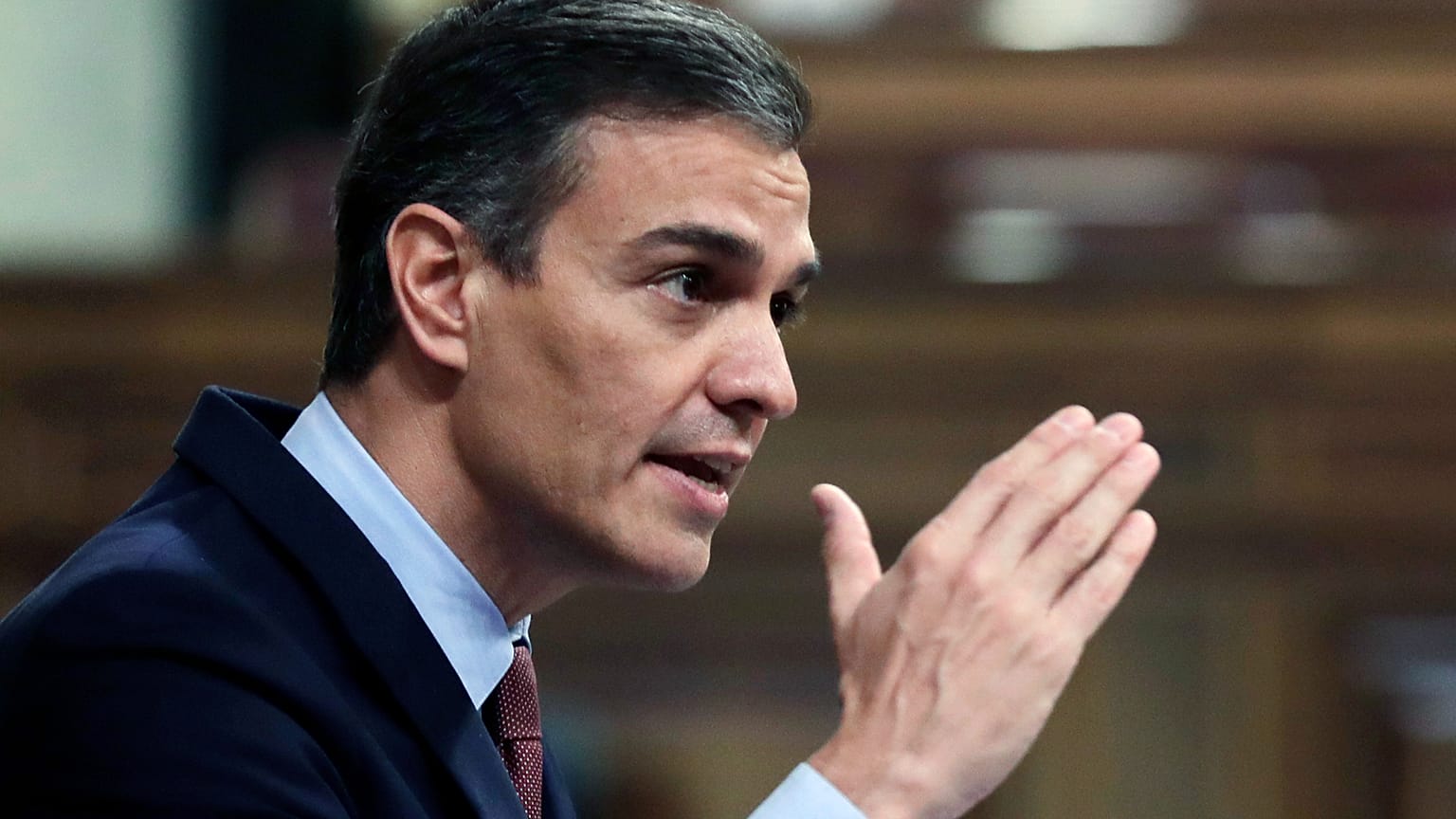
Pedro Sánchez knows exactly what he is doing.
By defying Donald Trump and doubling down on his bras de fer with the US president, the Spanish prime minister consolidates a two-fold strategy.
On the one hand, he seeks to mobilize his progressive electorate domestically, resuscitating a "no to war" movement which resonated strongly with Spanish voters during the US-led war against Iraq in 2003.
Sánchez is also hoping for a moment akin to that of Dominique de Villepin: a Cassandra warning against an unjustified war that will bring disastrous consequences.
Only now it's Iran.
In doing so, he aims to consolidate his image as one of the last strongly progressive, socialist leaders in a global political environment shifting rightward under the influence of MAGA-aligned politics, at a time when left-wing parties across Europe are losing electoral ground and struggling to project a unified international voice.
His strategy, while bold, is also risky as it could leave Spain diplomatically isolated from the European consensus and trigger a trade war that could impact Spanish companies in the US. It also risks inflaming tensions within NATO where Madrid has pursued a somewhat independent strategic line. Intelligence-sharing is also crucial and may be compromised with national security ramifications if the US decides to weaponise it.
Still, far from looking for a ramp-off, Sánchez is doubling down on his bet.
"In 2003, a few irresponsible leaders dragged us into an illegal war into an illegal war in the Middle East that brought nothing but insecurity and pain," Sánchez said Wednesday.
"No to violations of international law. No to the illusion that we can solve the world's problems with bombs. No to repeating the mistakes of the past. No to war."
A clash choreographed to perfection
His campaign against the US-Israeli intervention in Iran comes after Trump threatened to impose a trade embargo on Spain in response to Madrid's refusal to allow Washington to use its military bases to strike Iran from its territory.
Spain insisted any operation handled from the two bases it hosts in Rota and Moron should be limited to humanitarian assistance rather than offensive strikes, and that all activities must comply with international law. The move led to the withdrawal of U.S. aircraft from the bases according to radar information.
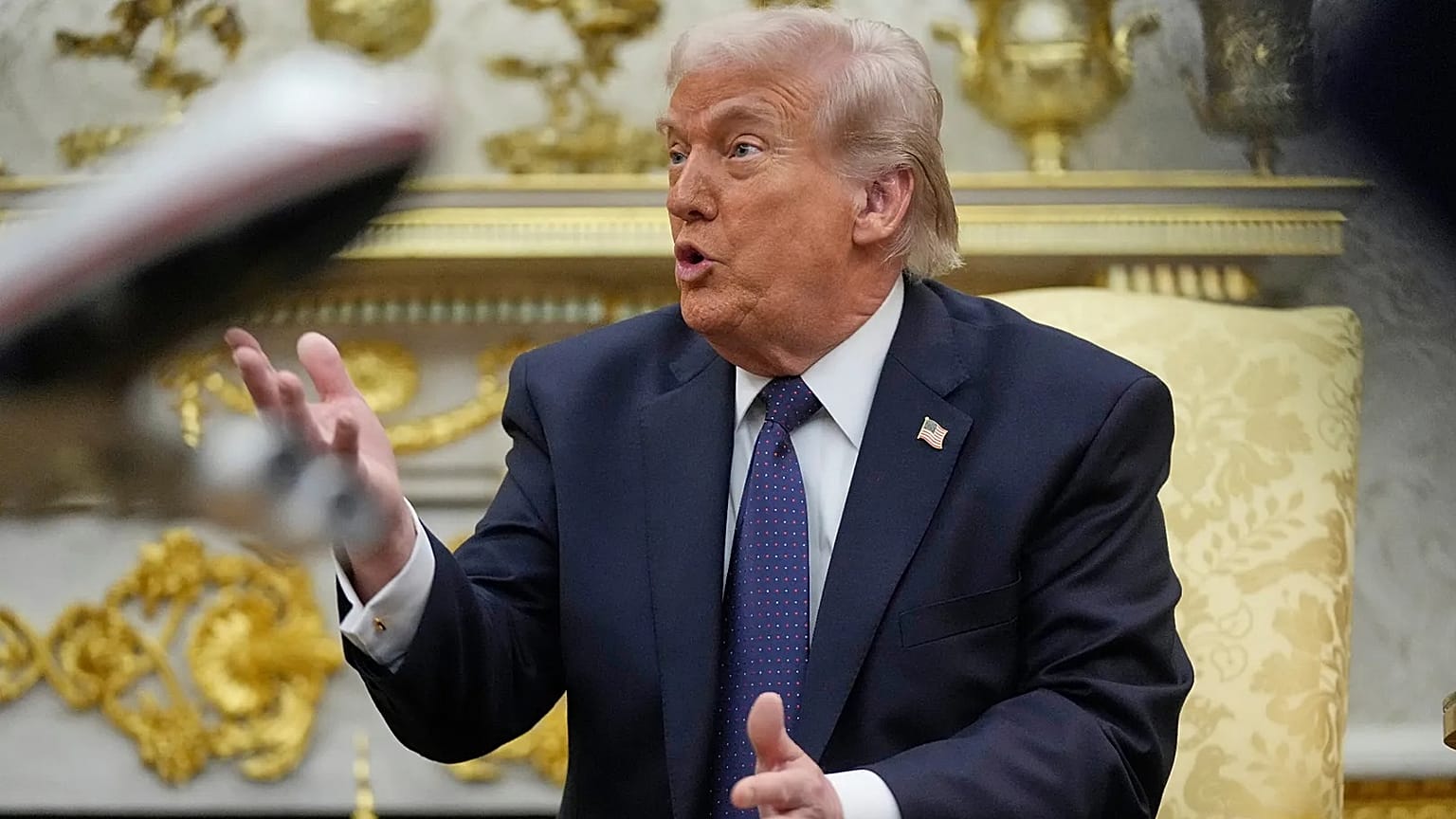
From the Oval office on Tuesday, Trump referred to Spain as an "unfriendly" and "terrible" ally. As he threatened a trade embargo in response, while German Chancellor Friedrich Merz—who was visiting the White House—remained silent, Spain judged that the time had come to confront the world's most powerful man and began preparing its response.
Sources close to the Spanish government late afternoon began to brief that, if Washington were to unilaterally terminate trade ties, it would have to do "in compliance with international law, EU-USA terms of trade and respecting private companies."
By 8 p.m. Madrid time, the Prime Minister’s office informed journalists that Sánchez would deliver a “declaración institucional”—a statement typically reserved for solemn occasions—at 9 a.m. the following day. The announcement was made just ahead of the evening news broadcasts.
Little was left to chance, reflecting Sánchez's carefully managed communications strategy, which is often viewed as both highly effective but also opportunistic.
According to people familiar with the Moncloa palace, as the 17th-century inspired office of the prime minister is known, backtracking was never an option.
Instead, Madrid was clear it needed to respond forcefully, emphasizing Spain's sovereignty, the consistency of its foreign policy from Ukraine to Gaza and Sánchez's position as the only European leader standing up to Trump.
The Spanish Prime Minister delivered just that.
'Our position is best resumed in four words: no to the war," he said, adding that "23 years ago, another US administration dragged us into war in the Middle East."
"We were told it would destroy weapons of mass destruction, export democracy and guarantee global security. In hindsight, it was the opposite. It led to a drastic increase of terrorism, a grave migration crisis in the Mediterranean and more expensive energy."
The political assessment of the Spanish government is that Europeans are tired of appeasing Trump, whether in tariff disputes or defence commitments such as imposing a 5% spending goal with a large chunk dedicated to buying US weapons.
As a result, a candidate who is seen as willing to defend European interests and confront Trump could gain a strong electoral advantage. The Spanish government has not been shy about its policy positions, at the risk of antagonising the real estate magnate since he returned to the White House last year.
Last summer, Madrid refused to adhere to the 5% target suggesting that it would lead to chaotic off-the-shelf purchases of weapons, rather than common European buying, and suggested that NATO performance should be measured on capabilities.
The message is simple: Spain is an ally, but it's also sovereign.
Echoes of Villepin and the ghost of the Azores
For his latest move, Sánchez took inspiration from two defining moments after the launch of the US operation against Iraq in 2003 under President George W. Bush.
The first was a powerful speech delivered in February that year by former French foreign minister Dominique de Villepin who warned before the UN Security Council—of which France is a permanent member—against what he described as a potentially disastrous invasion.
De Villepin passionately pushed back against the US, disputed military actions and suggested intelligence report did not support American claims of a linkage between al-Qaeda, the Saddam Hussein regime and the existence of weapons of mass destruction.
Time proved Villepin right.
The Iraqi war is particularly relevant for the Spanish public opinion because, at the time, former Spanish Prime Minister José María Aznar alongside former UK Prime Minister Tony Blair threw their support behind the Bush administration in its operation.
In the Spanish press, the three leaders were dubbed the “Trío de las Azores,” a name inspired by a photograph taken of them on the Portuguese Atlantic archipelago of the Azores. Spain’s backing of the war sparked a massive protest movement across the country under the slogan “No a la guerra.”
More than 20 years later, Sánchez is reviving it, hoping it will energize his base, increase his international profile and — just as it did for Dominique de Villepin —vindicate his choices.
The Spanish prime minister is facing a difficult re-election campaign, with the next vote scheduled to take place in 2027. Still, Madrid is rife with speculation that he could call for a snap election if he sees a favourable opening and succeeds in rallying his progressive coalition.
But to move up a planned election date, he needs a compelling justification or risk being seen as too cynical to be palatable. Sánchez is perceived by a large part of the Spanish electorate as lacking a moral compass.
The war in the Middle East — and his hard line toward Donald Trump, which the opposition claims risks isolating Spain within the EU, NATO and the broader Western alliance — could provide such a rationale.
The Spanish Prime Minister played that card back in 2023: when he framed a snap election as a referendum on his policies. Although the conservatives secured the largest share of the vote, Spain’s parliamentary system enabled Sánchez to assemble a majority coalition and remain in power.
A clash a long time in the making
In many ways, the rocky relation between the US under Trump and the Spanish government is hardly surprising. The two have clashed on everything from migration policies to societal values, each embracing their role as the other’s political opposite.
For Sánchez — a deeply polarizing figure who denies any wrongdoing in multiple court cases involving members of his family — the international stage offers a political shelter, as is often the case for embattled leaders at home. And he is intentional in cultivating a global profile.
An international conference of left-leaning voices expected to take place in Barcelona next April debating topics from democracy, tech oligarchs and reactionary movements, according to a person familiar with the organizer. The goal is to present a forum that can rival the CPAC, the largest gathering for conversatives, only this time for progressives.
In the meantime, the Spaniards have grown increasingly convinced that more European voices will join them as the war drags on. "Many are afraid of confrontation with the US, but our words reflect what a large camp thinks in Europe," said a Spanish diplomat.
On Wednesday, French President Emmanuel Macron called Sánchez to express his solidarity in the face of Trump's trade threats. European Council President Antonio Costa and Commission President Ursula von der Leyen did the same.
Still, his power moves have not gone unnoticed by critics, who argue that Madrid is treading a very fine line by antagonizing the United States for political gain, even as the EU seeks to secure a fair peace deal for Ukraine.
With an American security guarantee necessary to ensure Kyiv is not attacked again by Russia, and US input in NATO remaining crucial for European security, such tensions carry significant risks.
"He does this for national politics, and he knows the EU will back him up because solidarity always prevails. But is this really necessary?" asked a diplomat from another EU country.
For Madrid, it's not just necessary, it's imperative.
EU Commission backs Spain after Trump’s trade threats
The EU executive said it will defend the EU’s trade interests as US President Donald Trump threatens to cut off trade relations with Spain after it refused to let the US use its military bases for strikes on Iran.
The European Commission said on Wednesday it would make sure the European Union’s interests are fully safeguarded after the the White House threatened to cut off trade relations with Spain.
The Commission offered its support after United States President Donald Trump lashed out at Madrid for its refusal to allow the US military to use its bases to support its operations in and around Iran.
Speaking at the White House on Tuesday, Trump called the Spanish government "terrible".
“We're going to cut off all trade. We don't want anything to do with Spain,” he said.
In response, EU Commission deputy chief spokesperson Olof Gill said: “We stand in full solidarity with all member states and all its citizens and, through our common trade policy, stand ready to act if necessary to safeguard EU interests.”
Later, Commission Vice President Stéphane Séjourné said that when it comes to trade policy, “Any threat against a member state is by definition a threat against the EU.”
Paris has also aligned with Brussels, with President Emmanuel Macron speaking to Spanish Prime Minister Pedro Sánchez on Wednesday “to express France’s European solidarity in response to the recent threats of economic coercion,” according to an Élysée source.
Trump made his remarks in Washington in the presence of German Chancellor Friedrich Merz, who remained silent at the time but later said he wanted to avoid escalating tensions.
The relations between Trump and Madrid were already tense, as Spain has pushed back against the US president's demands for NATO allies to increase their defence spending.
Sánchez said on X that he had also spoken with Commission President Ursula von der Leyen and European Council President Antonio Costa, who expressed their support.
"NO TO WAR. Yes to trade, cooperation, and prosperity," he wrote.
The Commission’s response underscores that trade is a top EU competence, one where tensions with Washington have been high since Trump returned to power in 2025.
“Trade between the European Union and the United States is deeply integrated and mutually beneficial,” Gill added. “Safeguarding this relationship, particularly at a time of global disruption, is more important than ever and clearly in the interest of both sides.”
The EU-US trade deal clinched last summer remains frozen after MEPs halted its implementation following a US Supreme Court ruling last February declaring 2025 tariffs illegal.
Despite the uneven terms – 15% US tariffs on EU goods versus 0% EU duties on US industrial products – the Commission still sees the agreement as beneficial.
‘It's too warm’: Greenland’s traditional fishers pushed towards polluting practices as ice melts
Copyright AP Photo/Evgeniy Maloletka
By Emma Burrows, Kwiyeon Ha and Evgeniy Maloletka with AP
Published on
Diminishing sea ice could push traditional ice fishers to use boats or into the ranks of commercial fishing.
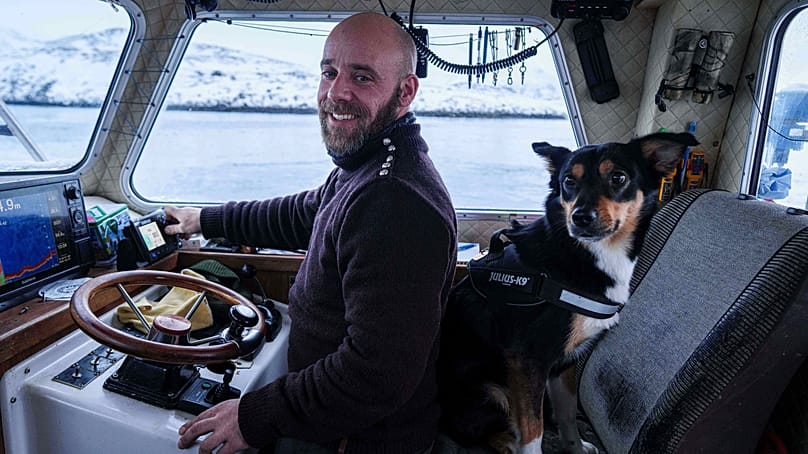
Fisherman Helgi Áargil no longer knows what to expect on Greenland's fjords, where he spends up to five days at a time on his boat with his dog, Molly, and the ever-changing Northern Lights in the sky as company.
Last year, his boat got stuck in ice that broke off the nearby glacier. This year, it's been very wet instead. His income is just as unpredictable. An outing could bring him around 100,000 Danish kroner (about €13,400), or nothing at all.
While Trump's approach to Greenland has shifted, the world has been unable to slow the effects of climate change. The Arctic is warming faster than any other region in the world, driven by the burning of oil, gas and coal.
What that means for the fishing industry that largely drives Greenland's economy is unknown. Fishing accounts for up to 95 per cent of exports, many to the territory's biggest market, China, along with the United States, Japan and Europe.
Helgi Aargil, fisherman, with his dog Molly, sails on his boat near Nuuk, Greenland, on Wednesday, Jan. 21, 2026. AP Photo/Evgeniy Maloletka
Disappearing Arctic sea ice
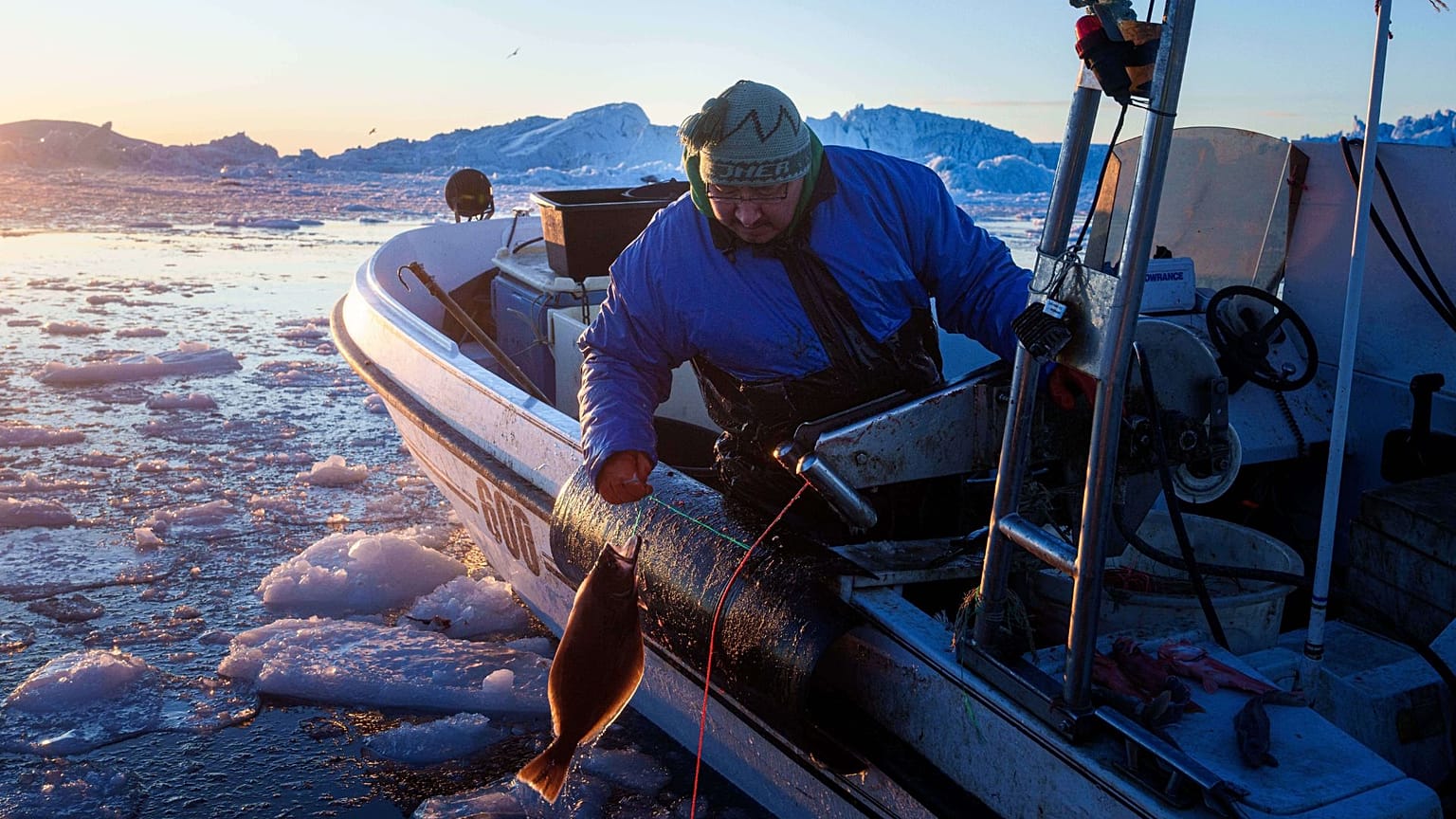
Wrapped in a wool sweater against the freezing wind, Áargil explains how he fishes for halibut and cod. Other top catches are shrimp and snow crab, which including legs can reach more than a metre in length.
Traditional ice fishermen who make up half the local industry are seeing the most dramatic changes to the way they fish.
“My father was fishing from the sea ice" one and a half metres thick, recalls Karl Sandgreen, head of the Icefjord Center that documents climate change in the region and is based in the town of Ilulissat.
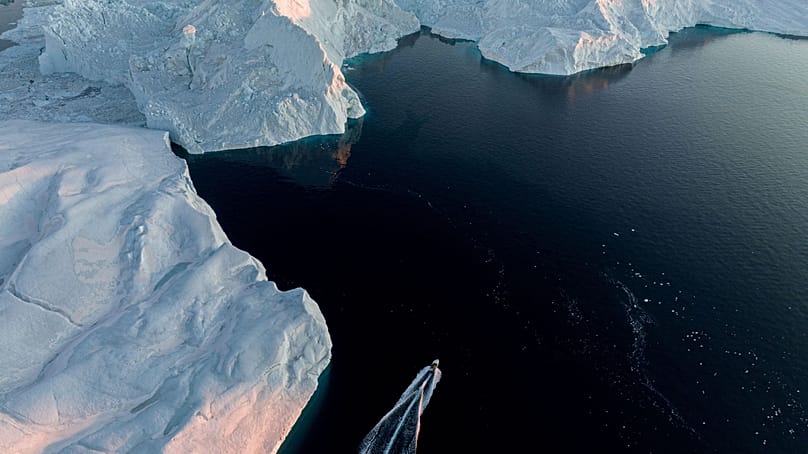
That sea ice started disappearing around 1997, Sandgreen says, and fishermen who drilled through the ice to fish increasingly started to fish by boat instead. The use of boats allows fishermen to reach larger areas, but that can come with extra costs and pollution that that accelerates warming.
A fishing boat rides in front of an iceberg at Disko Bay near Ilulissat, Greenland, on Wednesday, Jan. 28, 2026. AP Photo/Evgeniy Maloletka
Traditional fishers could be pushed to go commercial
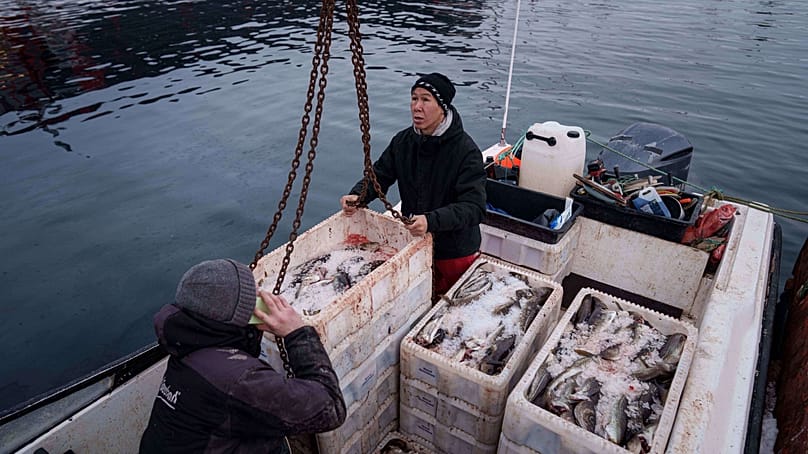
Fishing has shaped Greenland's communities. The harbour where fishermen return to sell their catch is at the heart of every town or village. Before heading out, some fishermen pick up boxes from the island's fishing companies to pack their catch which, in the capital of Nuuk, is winched from the boat to the fish factory.
Toke Binzer, the chief executive of the island’s single biggest employer, Royal Greenland, says he is increasingly worried about a future with greatly diminished sea ice. That could push traditional fishermen toward larger communities and into the ranks of commercial fishing.
The challenge now is how to support traditional fishermen when there is sometimes “too much ice to sail, too little to go out on", Binzer says. Already, that unpredictability has caused a “huge” problem.
Royal Greenland already loans fishermen money to buy a boat, which they repay from selling their catch, Binzer says.
Fishermen unload boxes with fish from a boat at the harbor of Nuuk, Greenland, on Thursday, Jan. 22, 2026. AP Photo/Evgeniy Maloletka
If everyone turns to fishing from boats, that could help economically but lead to overfishing, says Boris Worm, an expert in marine biodiversity at Dalhousie University in Canada.
In Greenland, there are already signs of too much fishing close to shore as halibut are getting smaller, Binzer says. Worm agrees, calling it a classic sign of overfishing as the bigger fish are caught and the smaller, younger ones are left.
That problem could worsen as the retreating ice makes fish more accessible. Fish stocks could rise as the warmer weather causes increased rain and melting ice to bring more nutrients for plankton, which the fish feed on, Worm says.
He warns, however, that the fish may not behave as “predictably”, as in the past, perhaps by seeking new food sources if they can no longer feed on the algae which grows under the sea ice.
On his boat near Nuuk, Áargil considers another challenge: warm weather is making some fish harder to catch as they go deeper in search of colder waters.
“It’s too warm,” he says, looking at the hills around the fjord. “I don’t know where the fish is going, but there’s not so much.”
Options beyond fishing remain few in Greenland. Tourism is increasing but far from making up a significant part of the economy.
Tradition, too, is at the heart of worries about climate change. Already, dog sledders have been confined to land when there is no sea ice.
“It’s really important for many Greenlanders to have the ability to go out and sail,” says Ken Jakobsen, the manager at Royal Greenland’s factory in Nuuk. Fishing is the “most important” thing.
In the capital alone, he says, there are more than 1,000 boats in the harbour during summer – in a territory where the total population is little over 50,000.