It’s possible that I shall make an ass of myself. But in that case one can always get out of it with a little dialectic. I have, of course, so worded my proposition as to be right either way (K.Marx, Letter to F.Engels on the Indian Mutiny)
Friday, March 06, 2026
Less than half of Ukrainian refugees plan to return home - poll
Fewer than half of Ukrainian refugees now say they intend to return home, according to a new survey, highlighting the deepening demographic crisis facing the country as the war with Russia drags on. / bne IntelliNews
Fewer than half of Ukrainian refugees now say they plan to return home after the war with Russia, according to new survey data, as the country’s demographic crisis continues to escalate.
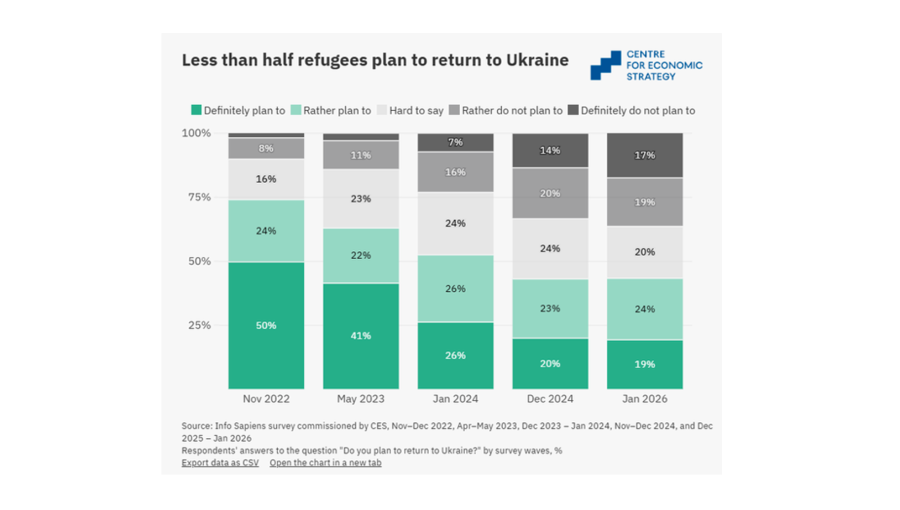
A poll conducted by Info Sapiens for the Kyiv-based Centre for Economic Strategy (CES) shows a steady decline in the share of refugees intending to go back to Ukraine since the early stages of the full-scale invasion in 2022.
The most recent survey, conducted between December 2025 and January 2026, found that only 43% of respondents said they either “definitely plan to return” or “rather plan to return”.
That compares with 74% in November 2022, when half of refugees surveyed said they “definitely plan to return” and a further 24% said they “rather plan to return”. The proportion has fallen consistently in subsequent surveys, reaching 63% in May 2023 and 52% in January 2024.
By early 2026, only 19% of respondents said they “definitely plan to return”, while 24% said they “rather plan to return”. At the same time, the share of refugees indicating they were unlikely to go back has risen markedly: 20% said they “rather do not plan to return” and 17% said they “definitely do not plan to return”. A further 20% said it was “hard to say”.
The findings underline Ukraine’s long-term demographic collapse as the war enters its fifth year. Ukraine is now suffering from the worst demographics in the world with mortality running at three times higher than fertility. The World Bank estimates the population will fall from 35mn pre-war to as low as 16mn by 2030, due to the higher death rates and lack of babies.
An estimate 5.6mn Ukrainians — many of them women and children — remain abroad, primarily in EU countries that granted temporary protection after Russia’s full-scale invasion in February 2022 and few intend to return should the war halt.
Researchers at the Centre for Economic Strategy warned that prolonged displacement risks turning temporary migration into permanent settlement, particularly as refugees establish employment, education and social ties in host countries.
The survey asked respondents: “Do you plan to return to Ukraine?” and tracked responses across multiple waves between November 2022 and January 2026. Analysts say the gradual shift in attitudes reflects both the duration of the conflict and uncertainty over Ukraine’s economic recovery and security environment once the war ends.
Ukrainian refugees face uncertain future as Poland scraps special status
Poland is ending the special status that gave Ukrainian refugees equal access to the labour market, social benefits and healthcare. The system expires on Thursday, meaning many will now face stricter rules to work or receive support.
Four years after Russia’s large-scale invasion of Ukraine began, support from European neighbours along its border is weakening.
In Poland, the wave of solidarity seen in February 2022 has given way to a new policy towards Ukrainians.
From Thursday, their special refugee status will end, placing them on the same footing as other foreigners. Political shift
Nationalist leader Karol Nawrocki campaigned for the presidency last August with the slogan: “Poland first, Poles first”, describing Ukrainians as “ungrateful” and “a burden on society”.
Amid growing anti-Ukrainian sentiment in Poland, he said the country needed to end “a completely incomprehensible and unacceptable situation” that allowed “foreigners to benefit from aid at taxpayers’ expense without contributing themselves”.
In September, Nawrocki vetoed a law that would have extended the special status, preventing parliament from renewing it.
Under the revised rules, Ukrainians must obtain work permits for employers who want to hire them. They will also lose access to social benefits and healthcare if they cannot prove they have a job.
The government of Prime Minister Donald Tusk defended the change.
“Most of those who reside in Poland work; their children go to school. We can therefore now gradually eliminate these extraordinary measures and move from temporary solutions to systemic ones,” the government said.
Marija Jakubowicz, who handles administrative formalities for refugees, said the change is bad news for both employers and Ukrainians.
“Employers no longer needed additional resources to hire Ukrainians. And Ukrainians were no longer forced to accept poor jobs or work for unscrupulous employers,” she told RFI’s correspondent.
Ukrainians make up 66 percent of the immigrant workforce in Poland. Employers’ associations say the new conditions will make it harder to hire workers they need.
Nadia lives in Poland with her two children and relies on the disability allowance received by her 16-year-old daughter, who has cerebral palsy. She says the support is not enough to cover medical treatment, including an operation on her daughter’s leg in January.
“After paying my rent, I have barely €200 left to live on. Of course, the assistance has to stop at some point. But I have nowhere else to go,” she said.
Unable to work, Nadia has considered leaving Poland for what she called a more “generous” country. If she stays, she has one year to apply for a residence permit, something Ukrainians were previously exempt from.
Kajetan Wroblewski volunteers with an organisation helping refugees who continue to arrive in Poland.
Some newcomers hope similarities between Polish and Ukrainian will make integration easier. But Wroblewski says he often discourages them.
“It’s better to understand nothing in Finland but have a bed and food to eat than to sleep under a bridge in Poland,” he told RFI, criticising what he described as the state’s disengagement and public apathy.
According to a CBOS poll released in early January 2026, 46 percent of Poles now oppose accepting Ukrainian refugees, compared with 3 percent at the start of the war.
The survey’s authors say this is the worst result recorded since the poll began in 2014, after Russia annexed Crimea.
This article was partially adapted from the original version in French
Record number of dangerous products intercepted by the EU in 2025, safety report finds
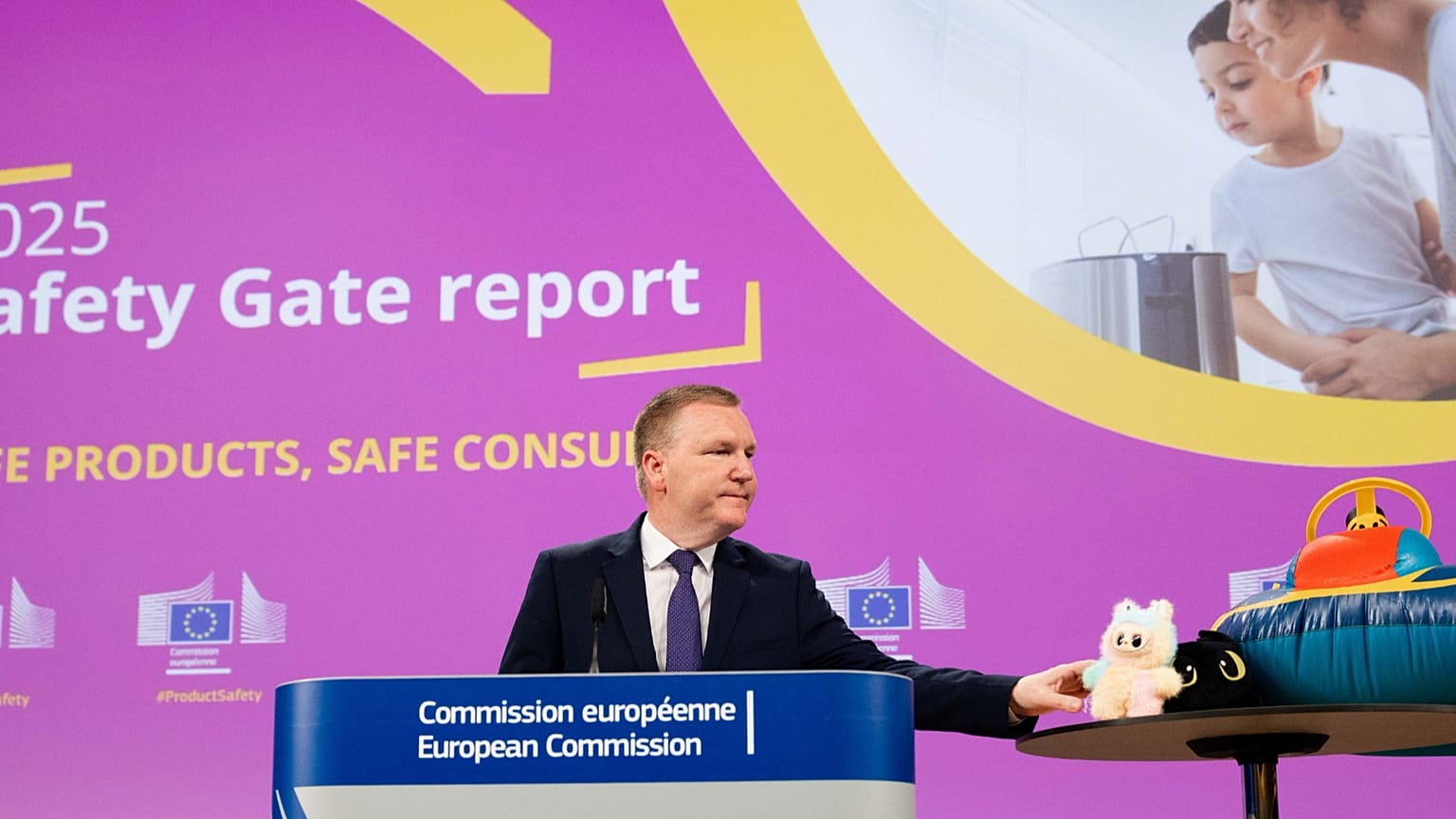
Copyright EC - Audiovisual Service/Photographer : Jennifer Jacquemart
The European Union intercepted a record number of dangerous products in 2025, with cosmetics, toys, and electric appliances leading the list.
Creams, toys, and phone chargers coming to Europe have never been more dangerous, according to a new EU report that logged a record number of safety alerts in 2025 for the third year running.
Last year, 4,671 alerts were notified in the Safety Gate system, the European Union’s tool to monitor dangerous products entering the market, according to a new report.
The 2025 numbers are the highest recorded since the system was launched in 2003, a 14 percent increase compared to 2024 and more than double those in 2022.
“Consumer goods are an important part of our daily lives. Wherever they come from and whatever their purpose, they must be safe for our health and for the wider environment,” said Michael McGrath, European Commissioner of Consumer Protection, during the presentation of the 2025 Safety Gate Report.
He explained that with the rapid growth of e-commerce and the volume of parcels entering the European Union from third countries, the safety framework has become increasingly essential.
The EU introduced the Rapid Alert System in 2003 to identify dangerous non-food products. It covers risks to human health, such as choking, strangulation, and damage to hearing or sight, as well as risks to the environment, energy resources, and property.
What are the most intercepted products?
Cosmetics, toys, and electrical appliances and equipment lead the list of most frequently identified dangerous products.
The most commonly reported risk was from dangerous chemicals, accounting for 53 percent of all notifications, followed by risk of injuries with 14 percent and choking with 9 percent.
Almost eight in ten alerts are concerning cosmetics related to the presence of butylphenyl methylpropional (BMCHA), a synthetic fragrance that has been banned in the EU since 2022. It was commonly used in perfumes, lotions, and household products before it was found that it can have harmful effects on the reproductive system and cause skin irritation.
The report also noted that for the first time, national authorities notified cases of nail polish containing trimethylbenzoyl diphenylphosphine Oxide (TPO), a chemical used in UV/LED-cured gel nail products. Its use was banned in the EU in 2025 over concerns about risks to prenatal health and allergic reactions.
What countries detected the most dangerous products and where are they coming from?
Italy reported the largest number of dangerous products, with 1193 notifications in 2025, followed by Germany with 465 and France with 455. Greece had zero notifications, Romania two, and Iceland five.
The Safety Gate also registers the origin of the products. Commissioner McGrath noted that nearly three-quarters originated from outside the European Union.
The largest source was China, accounting for 2,006 of the 4,671 notifications. Inside Europe, the country of origin of most notifications was Italy, with 614, followed by Germany at 288.
“Toys that children can choke on, cosmetics causing rashes, or chargers catching fire keep entering Europe, often through Chinese online marketplaces, leaving no responsible person in the supply chain in practice,” said Agustín Reyna, director general of the European consumer organisation BEUC
He added that, to genuinely protect consumers, online marketplaces must be held accountable and ultimately become liable when no one else ensures consumer safety.
The Safety Gate Rapid Alert System receives reports from national authorities that identify dangerous products in their market. Information can come from businesses or from citizens through the Consumer Safety Gateway.
The European Commission verifies the information and shares it with other member states, who then search for the product in their own national markets.
Once the information is validated, it is published on the Safety Gate Portal and available to all citizens.
However, BEUC cautioned that the registered notifications represent the tip of the iceberg since authorities are unable to control all products entering the EU market.
“The statistics do not allow conclusions about whether the level of safety declines or, on the contrary, the higher number of notifications means Member States have stepped up their control intensity or that control systems become more efficient,” the consumer organisation noted.
Is Europe losing the robotics race to China, and does it matter?
Chinese firms like nitree and Agibot are dominating the global robotics market.
Germany’s Chancellor Friedrich Merz was treated to a live display of humanoid robots dancing, doing backflips and boxing in Hangzhou in western China in February.
On his return, Merz said Germany was “simply no longer productive enough.”
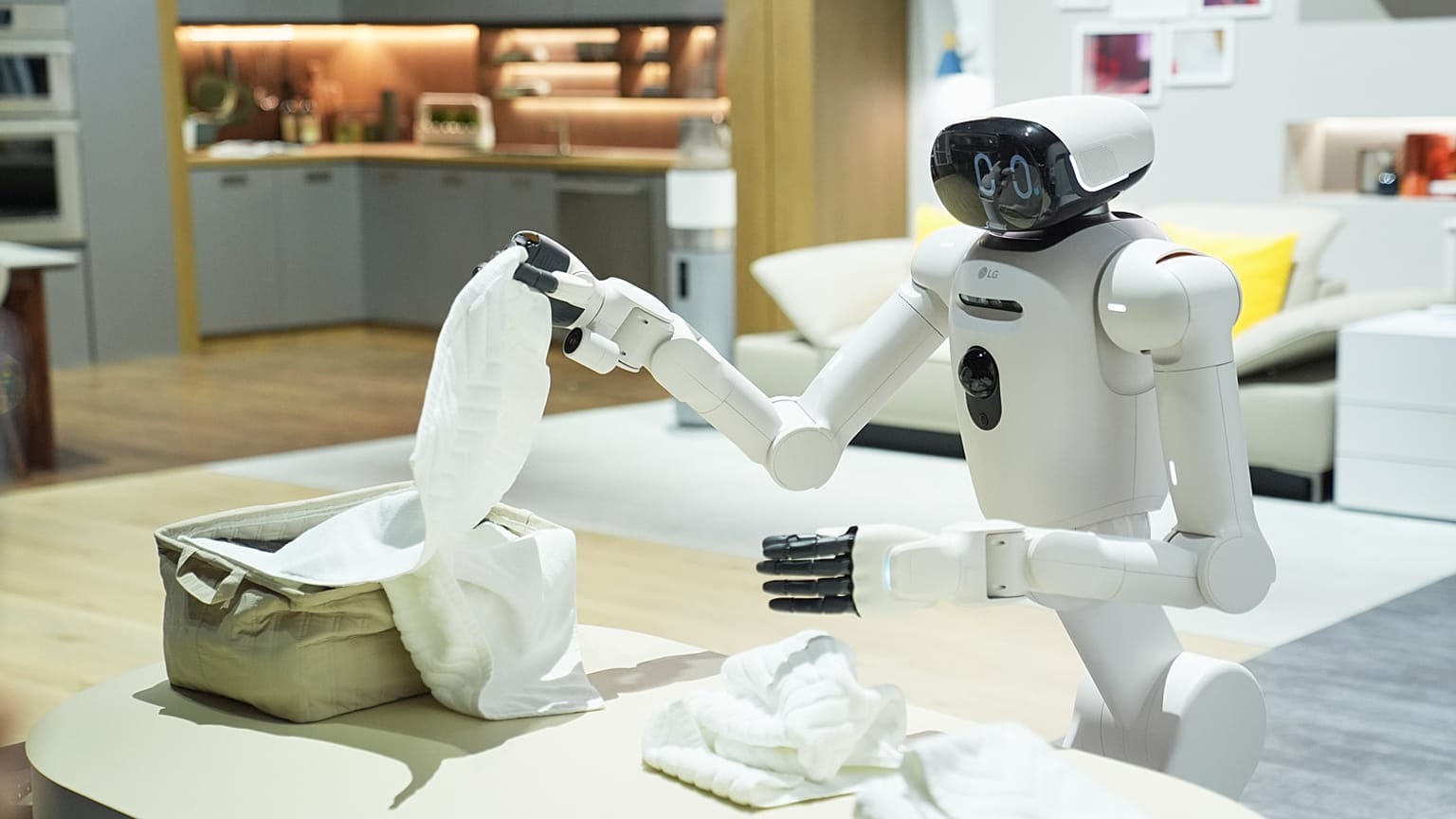
The fact that humanoid robots took centre stage at the Chinese New Year celebrations showcased China’s dominance of the market at the beginning of 2026, with Hangzhou-based Unitree dominating innovation in the sector. Some 87 percent of all humanoid robots that were delivered in 2025 were made in China.
But while Unitree’s humanoid robots have attracted a lot of column inches, and eyeballs, the actual amount of robots shipped by global manufacturers is relatively modest: just over 13,000 were sold last year. Unitree is in second place,with more than 4,000 below Agibot with over 5,000. (5,168), Forbes reported.
That has not stopped investors pouring money into the sector: Barclays research in January 2026 found that the global humanoid robotics market, currently worth $2-3 billion, could reach $200 billion by 2035. It is suggested that Europe may hold a competitive edge in the supply chain due to its historical strength in engineering and automotive manufacturing.
Europe’s fight
Those in the sector aren’t so sure: Rodion Shishkov, founder of London-based construction technology company All3, told Euronews Next that the amount of capital available to robotics startups in Europe is a fraction of that available in the United States and China. As a result, his startup is fighting for fuel while his Chinese and American rivals have plenty in the tank.
“Here in Europe I have to fight - and I mean, literally, fight - for tens of millions of euros of investment while a similarly-positioned, similarly-developed company in the United States can obtain billions of dollars with the same effort,” Shishkov told Euronews Next.
The shortfall is even more acute, Shishkov said, because the kind of functional non-humanoid robots that All3 is developing for use on European construction projects right now are playing second fiddle - funding-wise - to much-hyped humanoid startups. This despite the fact that in many use cases- humanoid startups are far less efficient.
“You need to think of function first. If there is a huge hole to be dug, we don’t need a humanoid robot with a spade, we need an excavator. If there is a self-driving car, do we need a humanoid robot driving it, no. We need to stop starting with the shape and start with the function,” he said.
Andrei Danescu, CEO of autonomous robot and AI logistics startup Dexory, said that Merz’s trip to China “risks framing a very serious technology race as a beauty contest. The question is not whether a robot walks on two legs, it's whether it solves a real problem.
He cited collaborative arms on factory floors, autonomous logistics vehicles in warehouses, or surgical assistants in operating theatres as examples of robots that were already reshaping industries in Europe. but Danescu warned that Europe should not be complacent about Chinese investment in robotics.
The robot supply chain
“China is making serious, sustained investments across the full robotics stack, hardware, software, manufacturing integration, and other regions are moving with real urgency too. This is not a moment for complacency, for bureaucratic stillness,” he said.
Europe's robotics ecosystem is small but strong, in precision engineering, in industrial automation, in some critical applications. But strength is not the same as momentum.”
Danescu called for European regulators to provide speed-enablement and clarity on standards, on liability frameworks for autonomous systems and on public investment that matches the strategic ambition of other global players.
“The AI Act is a start, but robotics needs its own focused attention - policy, funding, strategy. We cannot regulate our way to competitiveness, but we can certainly regulate our way out of it,” he said.
Sam Baker spent a decade working with robots in industrial manufacturing settings before joining venture capital firm Planet A as an investor. He said one of the major challenges he encountered - and which is still ongoing today - is integrating robots into established workflows in industries like construction, where they need to operate alongside human employees.
In that, he said, the biggest bottleneck is safety.
“Not a lot of people are talking about itboth from a regulatory perspective and a standards perspective. How do you deploy this kind of automation - whether that is humanoids or bipedals or co-bots - that have industrial levels of strength amongst humans,” he told Euronews Next.
“There's nothing written right now that tells you exactly how you need to do it and what your safety concept needs to look like.”
Some companies are already trialling non-humanoid robots in factory settings: BMW recently announced that it will trial humanoid robots at one of its factories in Leipzig in Germany. In a press release, the automaker said the robots would be integrated into existing production lines and could also be utilised to develop batteries and components.
The move has raised eyebrows in robotics circles, but Baker believes it is likely the right approach.
“They're not going in and saying: ‘We've definitely got this use case where we can generate this much ROI and speed up this process by X.’ They're saying: ‘OK, here's something that seems like it could work with this kind of form factor. Let's give it a shot and see what happens,” he said.
As for competition with China, Baker thinks that in terms of hardware, that ship has sailed.
“We would be naive to think that we can really achieve sovereignty and independence from Chinese hardware supply chains in robotics,” Baker said.
“I think it is an excellent time to build a robotics business in Europe. There's just a lot of white space to be filled on the intelligence and data side. And there's a lot of room for experimentation, which doesn't have to be very expensive.”
COMMENT: China’s AI-driven industrial surge is redrawing the balance of power
A decisive shift in global economic power is under way, driven by China’s industrial strategy focused on robots and AI. China’s accelerating technological self-sufficiency is a game changer, according to George Noble, former fund manager at Fidelity Overseas Fund.
“We’re watching the biggest shift in global economic power unfold in real time,” Noble said, arguing that while the US remains preoccupied with domestic political disputes and expansive fiscal programmes, Beijing has embarked on “the most AGGRESSIVE industrial strategy since the Marshall Plan”.
Artificial intelligence has become the most visible battleground.
“[In the week of the Chinese New Year] five Chinese AI companies — Zhipu, ByteDance, Alibaba, Moonshot, and DeepSeek — released or announced major model upgrades simultaneously during Spring Festival,” Noble said.
Citing a RAND report published last month, he noted that “Chinese AI models now run at one-sixth to one-fourth the cost of comparable American systems. One-sixth the cost.”
By contrast, surveys of US corporate adopters suggest limited near-term productivity gains.
“The vast majority of US companies investing in AI report ‘no change’ in productivity, decision-making, or customer satisfaction,” Noble said. “America is burning cash. China is building products.”
Semiconductors form a parallel front. The so-called “Four Dragons” — Moore Threads, MetaX, Biren and Enflame — have either gone public or filed for IPOs in recent months. Huawei, he said, is doubling output of its Ascend chip to 600,000 units this year and has set out a three-year roadmap to overtake Nvidia. Bernstein estimates that Nvidia’s China market share could fall from 40% to 8% under current export restrictions, while Huawei’s could rise to 50%.
“They’re not competing with our tech stack. They’re REPLACING IT,” Noble said, pointing to Beijing’s mobilisation of $70bn in chip incentives and plans to require state telecoms groups to replace AMD and Intel products by 2027.
Energy policy underpins the strategy. China invested $1 trillion in clean energy in 2025 — four times its spending on fossil fuels — with the sector accounting for more than one-third of GDP growth, Noble said. The country now produces a terawatt of solar panel capacity annually, accounts for over 70% of global EV production and sells nearly half of its new cars as electric. “They can power their AI data centres with cheap renewable energy they built themselves,” he added.
Monetary signals reinforce the shift. China’s central bank has purchased gold for 15 consecutive months, with January reserves reaching $369.6bn, up $51bn in a single month.
“They’re not just accumulating gold. They’re building the infrastructure to challenge how global commodities get priced,” Noble said, noting the expansion of renminbi-priced contracts on the Shanghai Gold Exchange.
The increase in gold reserves is running in parallel with an accelerating selloff of China’s treasury bill holdings. China’s holding of US treasuries has halved since its peak of $1.3 trillion in 2012 to around $600bn now. And the pace has accelerated since the US weaponised the dollar by barring Russia from using the greenback in the 2022 SWIFT sanctions imposed after the invasion of Ukraine four years ago.
Trade flows have also been redirected as part of the remake of the global economy underway at the moment, driven by rising geopolitical global tensions. China’s total exports reached a record $3.77 trillion last year, producing a $1.19 trillion surplus, but within that the share of exports to the US fell 28.6%, shipments to Africa rose 27.5% and to ASEAN 8.2%. Goldman Sachs has raised its 2026 China growth forecast to 4.8%.
Add the components together — low-cost AI, a parallel chip ecosystem, $1tn a year in clean energy, sustained gold purchases and a trade surplus pivoted towards the Global South — and the trajectory is clear, Noble argued. “China is building the future. America is unfortunately just talking about it.”
Honor’s new ‘robot phone’ wants to be your best AI friend and dance with you
Honor unveils a phone with a robotic arm — and a humanoid robot to match at MWC 2026.
One of the most talked about and looked at new tech on show at the Mobile World Congress was Honor’s “Robot Phone,” a concept device that the company says turns your smartphone into an AI companion.
After showing the front and back of your hand, the gimbal system pulls out and cleverly unfolds. A pair of eyes then comes up on the phone screen, which will track your eyes to allow the gimbal to follow you around, which Honor calls “embodied AI”.
The AI can speak to you and answer your questions, such as does my outfit look good. To which it responds with text on the phone, telling you you look “stylish” and “professional”. While it will pick up on various aspects of your outfit, it will never tell you it looks bad, an Honor representative said.
As well as complementing you, the gimbal can track subjects in real time, follow users during video calls by adjusting its own angle, and even respond to music with movement.
“The robot phone is the first phone that can see, hear, and interact with the world physically because we have this robotic arm built in the phone, now you can use it as a true companion.” Thomas Bai, AI product expert at Honor told Euronews Next.
If you went hiking, for example, it could be your tour guide and travel companion, as it could tell you about the landscapes, “I think that's a real world magic,” he said.
As well as being your companion, it can also help content creators with filming and taking photos.
The device has a 200-megapixel camera, a three-axis gimbal stabilisation, an AI object-tracking mode, and a feature called AI SpinShot that enables smooth 90- and 180-degree rotational transitions for cinematic-style video, which could all be used one-handed.
But with any foldable device, durability is a key question. Bai said he is “confident” about how robust the phone is because the same materials used in the company’s foldable devices, steel and titanium alloy.
Another smartphone on display was Honor’s Magic V6, its latest flagship foldable and the first device of its kind powered by Qualcomm's Snapdragon 8 Elite Gen 5 chip. It is one of the slimmest foldables on the market at 8.75mm when closed, but with a massive 6,660mAh battery.
The robot phone is a concept which aims to be released in the market later this year. The price has not yet been revealed.
But Honor did not just preview its smartphones. One of its biggest announcements was its entry into the humanoid robot market.
The company said the robot was not an industrial tool but a consumer-grade device.
“There are many things we imagine that a robot can do. First of all, it can be your companion,” Bai said.
“It can talk to you, and it can help you to do tasks. For example, like some house cleaning things, maybe help you wash dishes, something like that. We hope it could happen in the future.”
Honor said its robots will target three scenarios: retail assistance, workplace inspections, and personal companionship.
The company said its deep base of user data and experience from smartphones gives it an edge over traditional robotics firms in building machines that can recognise individuals and adapt to their needs from the very first interaction.
Honor's MWC 2026 announcements show how the Chinese company is actively repositioning itself from smartphone manufacturer to broad AI hardware platform.
“The humanoid robot is part of our Alpha plan. Yes, we transformed from a smartphone company into an AI ecosystem device company,” Bai said
“That's a new category of our products and we're very excited to bring it to our customers.”
Is China training an army of robots? Nope, it’s an AI-generated video
Some media users have been sharing videos that they claim are proof that China has started training humanoid robot soldiers. It turns out, however, that these videos were – surprise surprise – created by AI.
Have Chinese dancing robots been turned into killing machines? People were amazed when Chinese television broadcast Lunar New Year celebrations featuring a dance routine carried out by a bunch of G1 humanoid robots, the flagship humanoid robots created by Chinese robotics firm Unitree Robotics. However, two videos that have been circulating on social media since February 19 show a much less peaceful use for G1 robots. The videos show the robots taking part in what appears to be military training, armed with assault rifles. It turns out, however, that these videos are fake.
Robots at a shooting range where magazines appear out of thin air
The first video, which garnered more than 1.9 million views on X (check it out here and here), was said to show "Terminator" robots (as a social media user dubbed them) carrying out military manoeuvres at a shooting range. The video shows G1 robots – easy to identify because of the neon blue on their face – carrying out an operation using assault rifles.
This video of robots carrying out military exercises at a shooting range, which was posted online on February 19, 2026, was actually generated by artificial intelligence. Source: X
However, as Tal Hagin, a researcher who studies disinformation, points out, there are a number of anomalies in this video that show it was generated by artificial intelligence.
Eleven seconds in, you can see that the ejection port cover on the robot’s assault rifle remains closed even when the weapon is being fired. This cover, which protects the ejector from humidity and dust, must open when bullets are being fired so that cartridge cases can be ejected. In the video, the cover remains closed or blinks but doesn’t eject any cartridge cases.
An obstacle course… where the obstacles appear by magic
Another robot soldier video, which garnered more than a million views on X, is perhaps even more spectacular. It shows G1 robots participating in a training obstacle course. This video seems particularly realistic and doesn’t have any of the visual anomalies that often pop up in AI-generated videos, like objects or body parts appearing deformed or distorted.
This video of a robot going through training exercises, which was posted on February 19, 2026, was created by AI. Source: X.
However, this video, too, was generated by AI. To detect the anomalies, you need to compare each scene in the video with the one before it. Around 32 seconds in, for example, a robot dog leaps over a wooden panel in front of a pile of sandbags. However, this panel wasn’t anywhere to be seen at 30 seconds, which is a wider lens view of the same pile of sandbags. The AI magicked this object into being.
Videos from an account belonging to a creator of AI-generated images
Where are these videos from? It’s possible to find their creator by looking at the watermark on the training videos. They were made by a user who goes by "oukanghong" on the Chinese online video site Bilibili (here and here). Oukanghong user seems to specialise in creating AI-generated videos of robots.
The video of the robots making their way through an obstacle course has a note on it indicating that the video was made using artificial intelligence.
The average gross earnings of bus, tram and train drivers are below the overall earnings of full-time employees in Germany. Euronews Business takes a closer look at railway salaries.
Strikes hit public transport across Germany in late February. The dispute has since been resolved, as Deutsche Bahn and the GDL train drivers' union reached a deal on pay.
But how much do tram, bus and train drivers actually earn in Germany?
According to the Federal Statistical Office (Destatis), skilled bus and tram drivers earn around €3,638 gross per month on average as of April 2025. Drivers in the railway sector earn notably more — skilled train and locomotive drivers take home an average of up to €4,600 gross monthly.
Gross earnings are pre-tax and before social security deductions.
Bus, tram and train drivers earn less than the overall average
As of April 2025, the average gross earnings of full-time employees in Germany are €4,784.
This shows that both bus and tram drivers, as well as train drivers, earn less or on the very cusp of the overall average in the country.
Special payments may change the comparison, but based on gross earnings alone they earn less.
In addition to drivers, there are several occupations in the public transport sector, particularly in railways.
Among nine other relevant occupations, employees in railroad construction in highly complex positions earn the most, with median monthly gross earnings of €6,229 while this falls to €4,844 for skilled workers.
Inspection and maintenance of railway infrastructure in highly complex positions also pay well, with median monthly gross earnings of €6,074.
This declines to €5,292 for complex positions and to €3,618 for skilled workers.
The median earnings for surveillance and control of railway traffic positions are €5,503 while technical railway operations earn €4,188.
The lowest median earnings in the sector, based on available data, are for service in road and railway traffic positions at €3,568. This is slightly lower than the earnings of bus and tram drivers.
Relate
Complex railway jobs pay better
The data suggest that, on average, highly complex positions in the railway industry are better paid than the overall average for full-time employees.
However, both bus and tram drivers and railway drivers earn below this overall average, along with other non-complex positions.
The official data cover more than 1,300 job titles. The median earnings of skilled drivers of train engines and other railway vehicles rank 667th while skilled bus and tram drivers rank 985th on the list.
Data from the ERI Economic Research Institute’s Salary Expert also provide insights. The average gross base salary for tram drivers in Germany is €3,053, while it is significantly higher for subway train drivers at €5,978.
Best paid: Aviation, healthcare and legal
According to Destatis, aviation is the top-paying sector in Germany, followed by healthcare, legal and judiciary. Pilots have the highest median annual gross earnings in Germany at €27,459.
While it reflects Eurostat estimates for 2021, train drivers in Germany are among the highest paid in the EU.
In nominal terms, Germany ranks fourth, while it ranks second when measured in purchasing power standards (PPS). Although their pay is comparatively high across Europe, their salaries remain below the national average in Germany.
In the UK, employees in the rail and Tube sectors earn significantly more than the national median income.
The median gross annual earnings for full-time employees reached £37,430 (€44,211) in April 2024 according to the UK’s Office for National Statistics (ONS).
Train and tram drivers earned a median salary of £63,958 (€75,545). These rail roles rank among the UK’s top 20 highest-paid occupations.