Saturday, March 07, 2026

AI Boom Siphons Billions From Crucial Energy Innovation Funding

  • Venture capital funding for energy research and development has shrunk for three straight years, with a significant portion of the decline attributed to large non-specialist VC funds shifting their focus to AI startups.

  • Government spending on energy R&D also dropped globally in 2024 and 2025 due to budget cuts and policy pivots, adding to the financial squeeze on energy innovation.

  • Despite the overall decline, seven key areas—including next-generation geothermal, nuclear fusion, and carbon dioxide removal—are seeing continued growth in VC funding, indicating a shift in investment priorities toward energy security and competitiveness.

AI is a double-edged sword for the energy sector. The rapid integration of large language models into everything from your email account to your toothbrush – no, really – has driven the energy demand of data centers through the roof. Public and private interests are scrambling to plan enough energy production additions to keep up with skyrocketing projections, often at the expense of climate goals. But AI could also provide critical solutions to making all kinds of processes and industries more energy efficient, as well as become a cornerstone of next-gen clean energy tech, thereby potentially becoming a net-positive for energy use in the future. 

At the same time, the AI boom has also driven an explosion of interest in advanced and often low-carbon energy technologies like geothermal and nuclear fusion. But a new report from the International Energy Agency (IEA) finds that AI startups may actually be siphoning money away from energy tech startups, at the likely expense of energy innovation, energy security, and both short- and long-term climate goals. 

“After years of growth, energy innovation funding appears to be entering a phase marked by slower growth and shifting priorities,” states the IEA’s The State of Energy Innovation 2026 report. After peaking in 2023, government spending on energy research and development dropped on a global level in 2024 and reduced another 2 percent in 2025 to reach 55 billion worldwide. This is at least partially due to policy pivots and budget cuts, particularly in the European Union and the United States.

Venture capital has also dropped off for energy research and development, shrinking for three years straight according to the IEA. While there is “no single reason for the decline in energy VC funding since 2022,” the report highlights the fact that energy startups had to compete fiercely with AI startups over the course of last year. “The share of VC funding for AI rose to almost 30% in 2025, while the share of energy shrank, and large non-specialist VC funds shifted focus from energy to AI,” the IEA reports. 

This is shockingly bad news in an era when energy innovation is needed more than ever as energy security concerns balloon and the threat of climate change grows ever more urgent. “There's an irony here,” writes Axios. “The AI boom's biggest need — energy — may be getting financially undercut by the boom itself.”

In the fourth quarter of 2025 alone, reported $8 billion in clean energy projects were scrapped in the United States, and just $3 billion worth of new projects announced. “That means the pipeline of new investment is shrinking,” Hannah Hess, associate director of climate and energy at the Rhodium group, told nonpartisan news outlet Semafor last month. “Usually, even when we see quarterly fluctuations, from a zoomed-out view we continue to see sustained momentum. That’s no longer true.”

Related: The U.S. Just Took a Giant Step in The Rare Earth Race With China

This drop in both public and private spending in energy sector R&D is also hugely impacted by the sorry state of the electric vehicles market. The Trump administration’s war on Biden- and Obama-era climate and energy legislation has slashed the electric vehicle market to the bone. Since the countrywide $7,500 federal tax credit was rolled back in September, EV markets have bled out $65 billion on a global scale.

However, the market may already be in the process of correcting itself. Last month, Bloomberg reported that there are early signs of a potential upturn in private equity dealmaking in the clean energy sector after a year of inaction as firms waited out high levels of policy uncertainty. Last year saw a bottoming out of clean energy acquisitions, with a year-on-year contraction of over 50 percent, bringing numbers down to 2013 levels. 

But the landscape for investment is changing, reflecting shifting priorities toward energy security and competitiveness and away from climate efforts. The IEA reports that we can expect continued growth in seven key areas, which may offset some of the decline in EV funding: carbon dioxide removal, critical minerals, next-generation geothermal, low-emissions industrial production, aerospace, nuclear fission and fusion energy. In 2025, these seven areas represented one-third of energy VC funding, a massive surge from 2019, when they represented less than 5 percent. 

By Haley Zaremba for Oilprice.com 

Pipeline Gaps and Refinery Shifts Expose California’s Energy Vulnerability


  • California is functionally an "energy island" because it lacks crude oil pipeline connectivity to major domestic sources like the Permian Basin and must rely heavily on marine imports.

  • A disproportionate share of US imports from the Middle East, which transit the Strait of Hormuz, ends up on the West Coast because California lacks domestic alternatives for its refining system.

  • The combination of declining local production, specialized refinery configurations for heavier imported crude, and the closure of key refineries is increasing California's structural vulnerability to fuel shortages and price spikes.

The United States produces more crude oil than any country in history, pumping more than 13.5 million barrels per day. On paper, that suggests a high level of energy security.

But energy security for different states depends on infrastructure and access. For the 39 million residents of California, independence is largely geographic fiction.

If the Strait of Hormuz remains constrained, attention will focus on Asia’s large crude importers. Yet a close look at U.S. pipeline maps and refinery configurations shows that California is uniquely exposed as well.

This is not a new concern. In my 2019 Forbes column, California’s Oil Hypocrisy Presents a National Security Risk,” I detailed how the state’s declining production and lack of pipeline connectivity left it dependent on crude that transits the Persian Gulf. That structural vulnerability remains.

Infrastructure Defines Dependence

The Gulf Coast is connected to the Permian Basin and Canada by a dense network of crude pipelines. Oil moves efficiently by pipe to refining complexes in Texas and Louisiana, and from there into national product markets.

California has no such connection. There are no crude oil pipelines linking the Permian or midcontinent to the West Coast. Every barrel refined in California must be produced locally, shipped from Alaska, or delivered by tanker.

That isolation makes California functionally an energy island.

Declining Production, Rising Imports

California once ranked among the nation’s leading oil producers. Today, output has fallen sharply from its historical peak. According to the California Energy Commission, the majority of crude processed in the state now arrives via marine imports.

Related:How China’s Rare Earth Ban Backfired into a U.S. Tech Breakthrough

As in-state production declined, waterborne imports filled the gap. When global shipping lanes are stable, this model functions. When chokepoints tighten, the exposure becomes clear.

The 700,000 Barrel Reality

The United States still imports roughly 700,000 barrels per day from Saudi Arabia and Iraq. Over half of that transits the Strait of Hormuz. In a 20 million barrel per day national market, that volume may appear small.

The key issue is distribution.

Because Gulf Coast refiners can access domestic crude through pipelines, Persian Gulf barrels are not evenly spread across the country. A disproportionate share of those Saudi and Iraqi imports ends up in PADD 5, the West Coast refining district, precisely because California lacks pipeline access to Permian supply.

When shipments through Hormuz are disrupted, the shortfall is not felt uniformly. Houston has alternatives. Midwest refiners have alternatives.

California does not.

The missing barrels show up in Long Beach and the Bay Area first, because that is where import dependence is highest and substitution options are limited.

Refinery Configuration Limits Flexibility

Even if domestic crude could be redirected, California’s refining system presents another constraint.

Refineries are engineered around specific crude characteristics such as API gravity and sulfur content. Over decades, California facilities invested heavily to process heavier, higher-sulfur imported crudes from the Middle East and Latin America.

Related: Why Trump Wants Magnets More Than Gold

Light, sweet shale oil from the Permian Basin does not have the same economics when run through hardware optimized for heavier feedstocks. Large-scale substitution can increase costs and reduce gasoline and diesel yields at a time when capacity is already tight.

Capacity Is Shrinking

At the same time, California’s refining base is contracting.

Phillips 66 shut down its Los Angeles-area refinery complex in late 2025. Valero has announced plans to idle its Benicia refinery in 2026.

These closures remove a meaningful portion of statewide refining capacity in a short time frame. The Energy Information Administration has warned that refinery retirements on the West Coast increase the risk of higher gasoline prices in PADD 5.

To compensate, California has increased imports of finished gasoline and blending components from overseas markets, including the Bahamas and Asia.

Importing finished product can stabilize supply in the short term. It does not solve the underlying structural exposure.

Geography Still Governs Energy Markets

National production strength does not eliminate regional vulnerability. Energy independence at the federal level does not automatically translate into resilience at the state level.

California’s combination of declining in-state production, lack of crude pipeline connectivity, refinery configuration constraints, and shrinking capacity leaves it more exposed to disruptions in the Strait of Hormuz than most Americans realize.

When crude flows through that chokepoint tighten, the consequences are not abstract. They are reflected in fuel availability and prices on the West Coast.

In energy markets, infrastructure determines resilience. For California, the absence of connection to domestic supply remains the defining constraint.

By Robert Rapier


Eni Boosts Stake in Algeria’s Touat Gas Field After Engie Exit

Italy’s Eni has strengthened its position in Algeria’s onshore Touat natural gas field following the complete exit of France’s Engie, according to an Algerian presidential decree dated February 17 and published in the Official Journal on February 24.

The decree approves amendments to the long-standing hydrocarbon contract covering the Touat perimeter — blocks 352A and 353 — located in the Adrar wilaya of southwestern Algeria. Under the revised structure, Eni absorbs 8% of Engie’s former stake, raising its indirect participation to 42.9%. Thailand’s PTTEP acquires the remaining 22%, increasing its holding to 34%, while Algeria’s state energy firm Sonatrach retains its 35% stake. All gas production remains allocated to Sonatrach.

The Touat field, operational since 2019, experienced a prolonged shutdown beginning in late 2021 due to mercury contamination in processing facilities. Following significant remediation investments, output has recovered to roughly 13 million cubic meters per day, or about 4.5 billion cubic meters annually. The field is part of Algeria’s Western Sahara gas system and feeds infrastructure supplying domestic markets and exports to Europe.

The reshuffle underscores a broader shift in Algeria’s energy sector, with Italian and Asian players expanding their footprint as some French operators scale back. Algeria remains a strategic pillar for Eni in Africa, ranking second on the continent in total payments to host governments in 2024 at $1.2 billion. Eni and PTTEP are also jointly exploring the nearby Reggane 2 block, awarded in the country’s 2024 bid round, signaling continued investment momentum in the Adrar basin.


How Quickly Can Qatar Restart the World’s Largest LNG Export Hub?

  • QatarEnergy has declared force majeure on LNG exports after shipping through the Strait of Hormuz halted.

  • Restarting LNG production could take weeks or months, as plants must shut down when storage fills and require a slow, sequential restart process to avoid damaging cryogenic equipment.

  • Global gas markets face a significant supply shock, with European and Asian prices surging nearly 50%, while U.S. LNG exports have little spare capacity to replace the lost Qatari supply

QatarEnergy declared force majeure on liquefied natural gas (LNG) exports on Wednesday, following disruptions at its Ras Laffan industrial city facilities caused by the Middle East conflict.  This legal declaration effectively releases the state-owned company from contractual delivery obligations due to extraordinary circumstances beyond its control. The shutdown was triggered by a near-complete halt of shipping in the Strait of Hormuz due to the U.S.-Israeli conflict with Iran. Qatar accounts for 20% of global LNG exports, primarily serving Asian markets including China, Japan, India and South Korea as well as Europe.

Unfortunately for gas customers, it could take months before the giant LNG plant returns to normal production. U.S. President Donald Trump initially projected that Operation Epic Fury would last only four to five weeks, but later announced that the U.S. has the capability to go "far longer". His ally in the war, Israeli Prime Minister Benjamin Netanyahu, has described the campaign as "quick and decisive action" that may "take some time" but will not last for years.Related: No Missiles, No Drones: What Happens When Rare Earths Stop Flowing?

The Trump administration has outlined four core goals: destroying Iran's missile and naval capacities, ensuring it never obtains a nuclear weapon, and stopping it from funding regional militant groups. Last year’s Operation Midnight Hammer only lasted for 12 days, and only elicited a symbolic response from Iran. However, Iran has been much more aggressive this time around, following the death of Supreme Leader Ayatollah Ali Khamenei, launching widespread and intense retaliatory attacks across the Middle East.

Tehran has fired hundreds of Shahed drones and high-speed ballistic missiles targeting Israel and multiple U.S.-allied Gulf nations, including the UAE, Saudi Arabia, Kuwait, Bahrain, Qatar and Oman. The Islamic Revolutionary Guard Corps (IRGC) declared the Strait of Hormuz closed and warned of attacks on vessels, forcing a halt to major oil/gas flows and causing global shipping to seek alternative routes.

The situation is exacerbated by the slow process of re-opening giant LNG plants once shut down.

Qatar’s Ras Laffan Industrial City serves as the primary hub for the country's massive LNG operations, and is home to the world's LNG export complex. The city’s LNG plant features 14 LNG trains with a production capacity of approximately 77 million metric tonnes per year (mtpa). The city’s port has six LNG berths, designed to accommodate the world's largest LNG carriers, including QMax and QFlex vessels. The plant’s storage tanks have a capacity of ~1,880,000 cubic meters, with additional storage tanks and berths currently being built to handle up to 126 million tonnes per year by 2027. The plant’s current storage takes only 4 days to fill up at full production rates, forcing production to rapidly come to a halt whenever export vessels cannot leave. Once the restart process begins, it will take another two weeks for the facility to reach full operational capacity.

Restarting is intentionally slow to avoid "thermal shock" to critical, sub-zero cryogenic equipment. LNG production involves extremely low temperatures (-160 °C or -260 F). Rapidly introducing feed gas into cold, idle equipment can cause severe stress, damaging or rupturing vital, expensive components. Additionally, trains cannot restart simultaneously; they must be brought back online sequentially to ensure stability.

And, all this means that global gas markets will be in a significant deficit for several weeks, at the very least. The halt in Qatari LNG production due to security concerns in the Strait of Hormuz has intensified competition between Atlantic and Pacific basins, sending European (TTF) and Asian gas prices up by nearly 50%.

"Nothing can replace ‌Qatari LNG. If the shutdown is prolonged, it portends a larger gas market shock than in 2022 when Russian turned off pipeline gas to Europe. Gas prices could retest their record highs set in 2022," Saul Kavonic, head of energy research at MST Marquee, told Reuters.

Unfortunately, the United States, the world’s largest LNG producer, has little immediate spare export capacity to offset major supply disruptions, with only ~ 5% of additional volume available. U.S. LNG export plants are currently running near full capacity, with most production locked in long-term contracts. However, several major LNG export plants are under construction in the U.S. Gulf Coast region, targeting significant capacity increases by 2030. Key active projects include the massive Plaquemines LNG (Louisiana), Cheniere’s Corpus Christi Stage 3 (Texas), Golden Pass LNG (Texas), Rio Grande LNG (Texas), Port Arthur LNG (Texas), and the newly initiated Louisiana LNG project. Together, these LNG plants will add over 65 million tonnes per annum (mtpa) of nominal LNG capacity, or roughly 60% of the country’s current capacity.

By Alex Kimani for Oilprice.com


Europe-Bound LNG Cargoes Divert to Asia as War Upends Gas Market

A growing number of LNG cargoes that were initially en route to Europe have sharply diverted in the Atlantic toward Asia via the Cape of Good Hope as Asian buyers are now winning the competition with Europe with about 20% of global LNG supply currently offline. 

So far this week, three LNG tankers, two carrying cargoes from the United States and one from Nigeria, have sharply pivoted toward Asia after signaling initially they would go to Europe, vessel-tracking data reviewed by Reuters showed on Friday.      

Asia is scrambling for supply after Qatar halted LNG production and the Strait of Hormuz is de facto closed to tanker traffic in the escalating war in the Middle East. 

LNG shipments from Qatar and the United Arab Emirates (UAE), which jointly account for about 20% of global LNG supply, are now off the market, after QatarEnergy announced a pause to LNG production at its Ras Laffan hub, the world’s largest LNG complex, issued force majeure notices to buyers, and no tankers pass through the Strait.

As traffic via the Strait of Hormuz is effectively closed, the LNG supply shock to Asia is immediate as it receives a total of 85% of Qatar’s LNG exports.   

Europe is feeling the secondary effects, with spot prices so high in Asia that Asian buyers now attract the flexible-destination cargoes despite soaring LNG tanker rates and the longer voyages through the Atlantic and around the southern tip of Africa toward Asia.   

Other LNG exporters cannot cover the loss from Qatar and the UAE—not at this scale, and not quickly, Kpler’s Laura Page wrote in an analysis on Thursday. 

Of the other LNG exporters, the U.S. and Australia already operate at high utilization rates, while Nigeria, Algeria, and Trinidad face feed gas availability constraints, according to Kpler.
So realistic supplementary supply from all alternative sources totals under 2 million tons, against a 5.8 million ton monthly shortfall, the energy analytics firm noted. 

By Tsvetana Paraskova for Oilprice.com 

U.S. Gasoline Surges to Highest Under Trump as Iran War Roils Oil Market

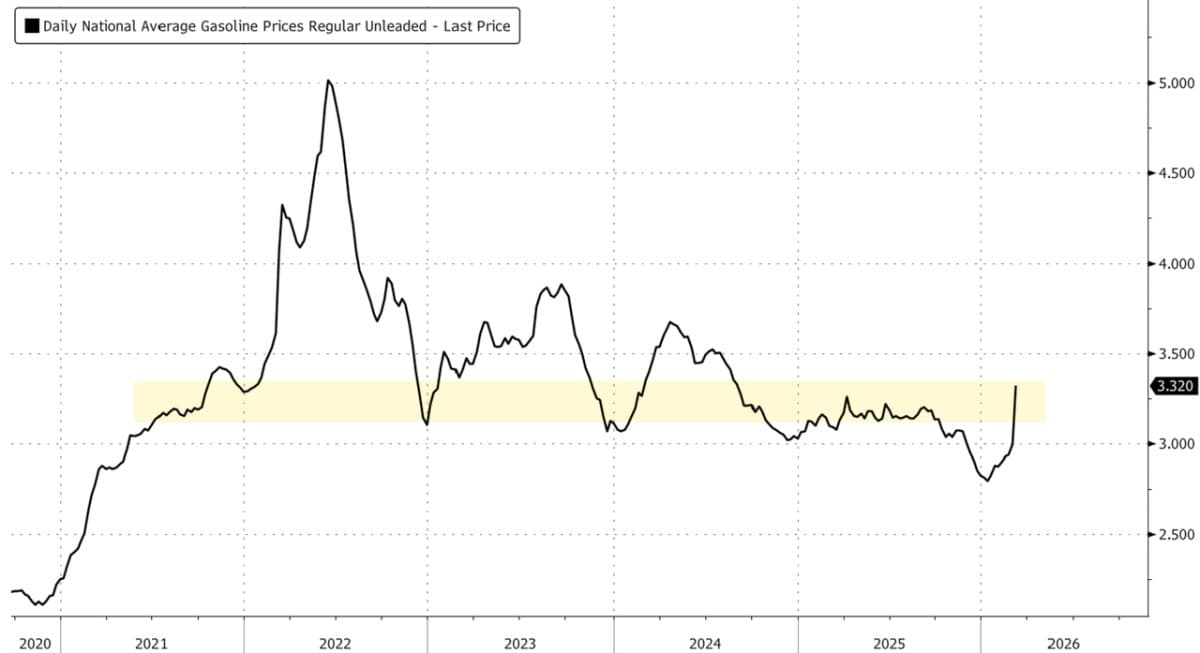
The national average price of gasoline in the United States has jumped to the highest level seen during either of President Donald Trump’s terms in office, per GasBuddy data, as the de facto closure of the Strait of Hormuz is holding back millions of barrels of crude and fuel supplies and leading to price spikes.  

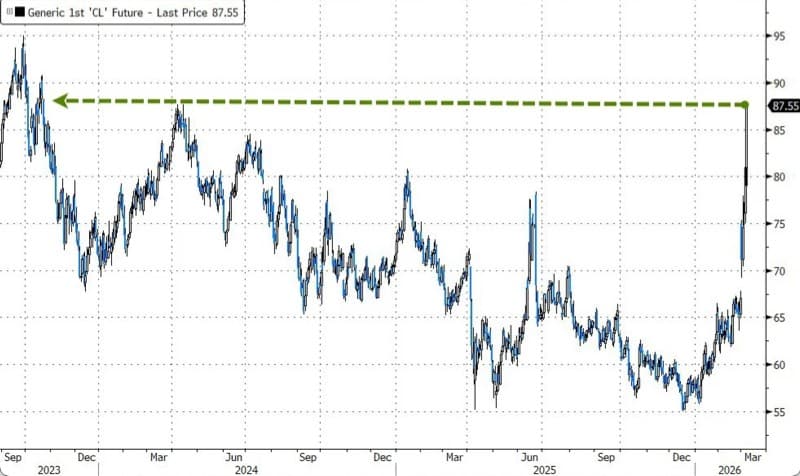
WTI Crude, the U.S. benchmark, jumped from $67 per barrel on February 27, just before the Iran war started, to above $84 per barrel a week later as of early Friday. Oil prices are on track for at least a 16% weekly jump in the biggest one-week rally since the Russian invasion of Ukraine in 2022. 

With crude prices being the main component of gasoline price formation, U.S. prices at the pump have jumped this week, too. The price spike from the Iran war is being compounded by the more expensive summer-grade gasoline that refineries are now producing for the summer driving season. 

Late on Thursday, the national average had surged to $3.262 per gallon— the highest level recorded during either of Trump’s terms in office, according to live GasBuddy data, said Patrick de Haan, head of petroleum analysis at GasBuddy. 

The number of U.S. states with average gas prices over $3 per gallon has jumped from about eight on Sunday to 33 as of late Thursday, with the list likely to grow to 40 in the next few days, de Haan noted

The price of diesel, which globally faces more acute physical disruption and pressure from the Middle East war, has surged more than gasoline.

The U.S. national average price of diesel soared to $4.124 per gallon, the highest level since December 2023, according to GasBuddy data.   

“The diesel market is simply tighter, and with drone attacks on a Saudi refinery, Qatar shutting down natural gas production, boosting heating oil use, and lower U.S. inventories amidst cold weather, diesel has out-rallied gasoline,” GasBuddy’s de Haan said.     

By Michael Kern for Oilprice.com 


Trump Shrugs Off Biggest Gas Price Spike in Years

Americans are experiencing a sharp rise in gas prices this week, with the national average gasoline price posting its largest weekly jump since the early days of the Russia-Ukraine war. If fuel prices continue to climb as the U.S.-Israeli Operation Epic Fury intensifies against Iran, the fallout for consumer sentiment may weigh on the broader economy and affect voting polls in the near term.

The surge in gasoline and diesel prices at pumps nationwide doesn't appear to be a concern for President Trump (at least not yet).

"I don't have any concern about it," the president told Reuters in an interview on Thursday evening when asked about rising prices.

"They'll drop very rapidly when this is over, and if they rise, they rise, but this is far more important than having gasoline prices go up a little bit."

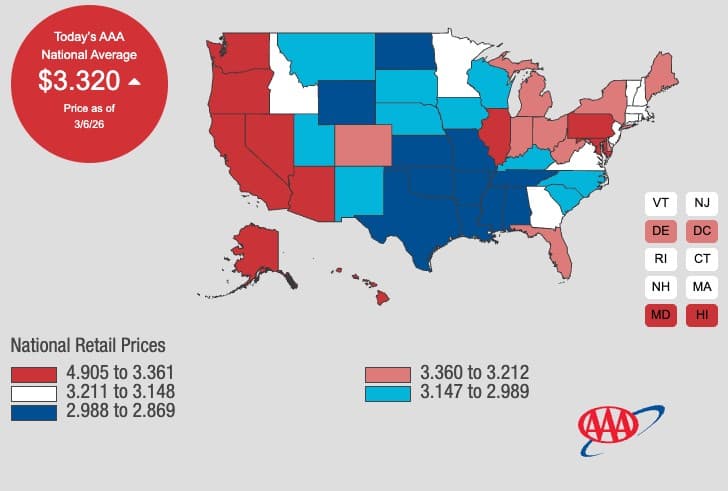
The president's comments come as the national average gas price at the pump has jumped nearly 11% this week to $3.32 per gallon, according to the latest figures from the travel organization AAA.

The nearly 11% surge in the national average is the biggest weekly jump since the week of March 6, 2022, when there was a 12.6% spike due to energy market chaos stemming from the war in Eastern Europe.

Related: Why Trump Wants Magnets More Than Gold

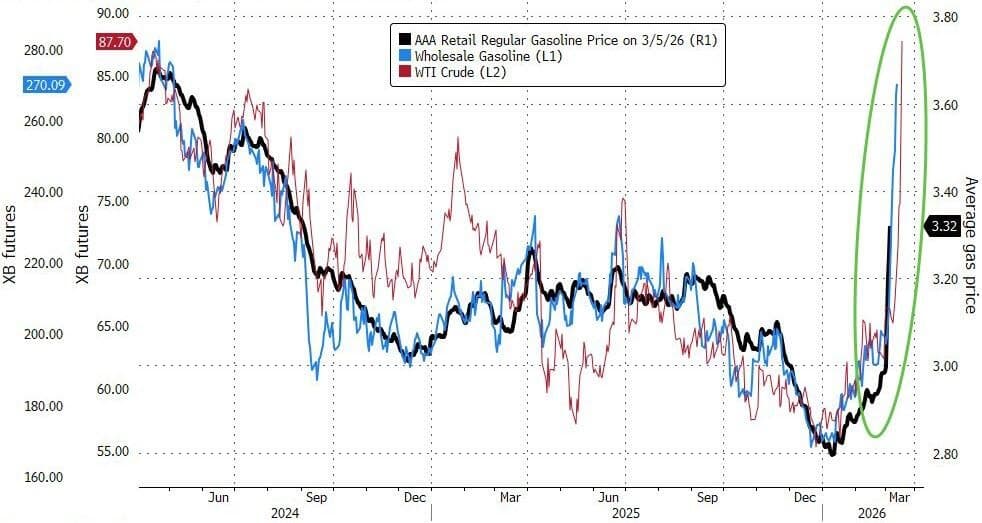
Surging WTI futures on Friday morning, now at $86/bbl (Brent crude futures above $90/bbl), suggest that pump prices could be headed higher into the weekend. This is a very big concern for the Trump administration, despite Trump downplaying the whole price surge.

"We have slightly higher oil prices for a little while, but as soon as this ends, those prices are going to drop, I believe, lower than ever before," Trump told reporters in the Oval Office on Tuesday.

Current WTI futures pricing suggests $3.80-ish for gas at the pump. 

Trump has often touted low pump prices as one of his major accomplishments in making the economy more affordable for Americans after the inflation storm during the four years of the Biden-Harris administration. To be fair, gas prices nationwide are still relatively low compared to those years.

On Wednesday, Energy Secretary Chris Wright told Fox News that any increase in pump prices would be a temporary bump and a "very small price to pay" for accomplishing Trump's goals in the Middle East. The U.S. is more sheltered than ever to withstand a global energy shock, thanks to Trump's 'pump baby pump' pro-energy policies.

To mitigate the incoming energy shock created by the paralyzed Strait of Hormuz, Trump ordered the government to provide risk insurance for tankers transiting the waterway earlier this week. However, as we have already explained, and as Qatar's energy minister warned this morning, the risks of both an energy shock and a financial shock are soaring.

By Zerohedge.com