Trump’s Crusade: Christian Nationalism and the Making of a Holy War
.png)
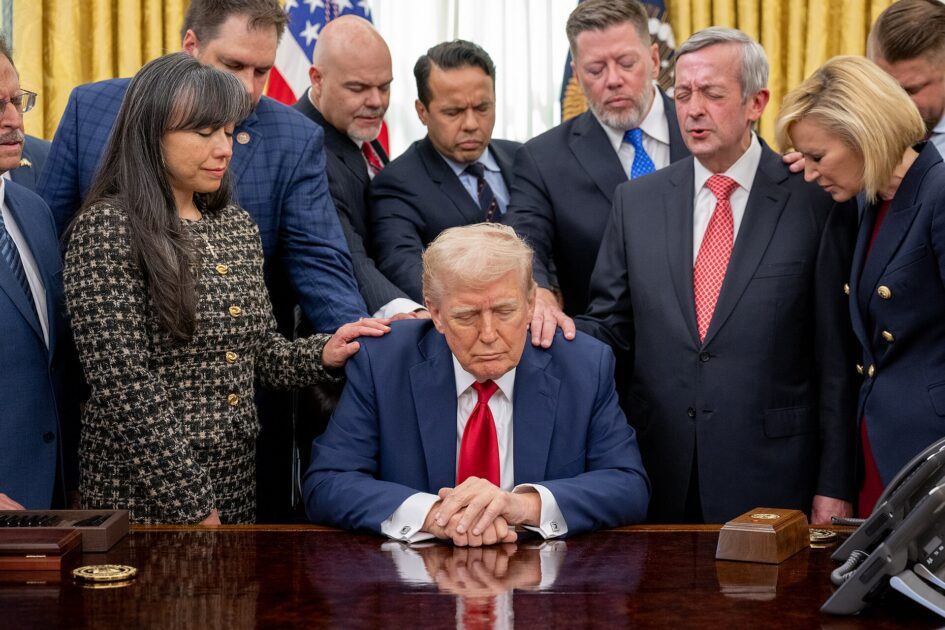
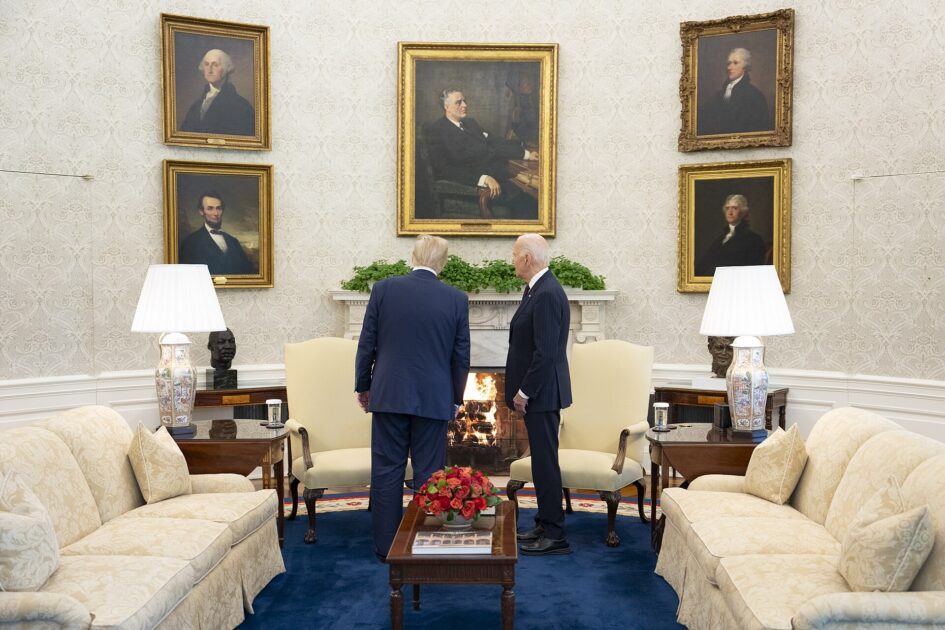
Photograph Source: The White House – Public Domain
“Violence is the last refuge of the incompetent.”
– Isaac Asimov
Israel and the United States are now at war with Iran, a conflict framed by both leaders through a stark and self-serving moral binary. In the words of Benjamin Netanyahu, it is cast as a “necessary fight between good and evil.” For Donald Trump, the illegality of the war is beside the point. It is waged instead in the ideological spirit and cruelty of the Crusades, fueled by religious fervor and animated by what David Smith writing in The Guardian, has called a celebration of the “capacity to inflict violence.” What this religious framing obscures is the political reality that this is, in large part, Netanyahu’s war, one he has long prepared by casting Iran in apocalyptic terms as a successor to Nazism. But as Fintan O’Toole suggests, something even more disturbing is at work: in Trump’s hands, the war is severed from any coherent political or moral rationale, reduced to a hollow spectacle of destruction, a language of power emptied of meaning itself. Yet this emptiness is not benign. It signals at once a profound political weakness and an unrestrained embrace of state violence, a politics of dispossession and a logic of disposability that, if left unchecked, points toward the reemergence of camps as instruments of governance, cloaked in the moral certainties of religious dogmatism.
This fusion of war, spectacle, and religious zeal is not merely a rhetorical flourish. It signals a deeper transformation in how violence is imagined and justified. Trump’s Secretary of Defense, Pete Hegseth, gives this worldview its most chilling expression. Speaking with a zeal that echoes the language of holy war, he declares that the mission of the U.S. military is “to unleash death and destruction from the sky all day long.” In such statements, war is stripped of the language of restraint, law, or even tragic necessity. It becomes an open affirmation of annihilation as virtue.
As Greg Jaffe observes in The New York Times, rhetoric of this kind signals a profound shift in the moral framework guiding American power. Instead of invoking justice or defense, it embraces vengeance. In this worldview, the enemy is not an opponent to be contained or negotiated with but a foe to be obliterated. War thus becomes not only an instrument of policy but a spectacle of righteous fury, a theater of domination in which violence is sanctified and the infliction of blood, suffering, and death is embraced as proof of strength. Yet the significance of this war culture extends far beyond the battlefield. Its logic does not remain confined to foreign policy; it migrates inward, reshaping the language, institutions, and pedagogical practices of domestic life.
War has long been the most brutal expression of state power, but in the political culture surrounding Donald Trump it has taken on an even darker significance. War is no longer simply a strategic instrument of foreign policy. What is emerging instead is a war culture in which violence, white Christian nationalism, and militarized spectacle function as a form of public pedagogy, instructing citizens not to question domination but to admire it.
In this register, Operation Epic Fury becomes barbarism refashioned as spectacle, draped in an aesthetic of impunity and moral annihilation. War is transformed into a form of public pedagogy, a daily lesson in domination delivered through media images, political rhetoric, and state policy, teaching that cruelty signals strength and that enemies, both foreign and domestic, are rendered disposable, unworthy of recognition or justice and instead subjected to humiliation, repression, and violence. Under such conditions, violence no longer hides behind the worn language of necessity or o making the world safe for democracy. It exposes what it has long been in American foreign policy, a ruthless instrument of imperial power.
On the domestic front, this pedagogy operates not only through spectacles of military force but through laws, institutions, and cultural narratives that normalize authoritarian power. It works, as I and Will Paul have observed elsewhere, not simply through “tanks in the streets but through legislation that turns education into an arm of the security state.” Classrooms are redefined as sites of patriotic discipline, history is rewritten as nationalist myth, surveillance becomes a civic duty, and students learn that obedience is virtue while dissent marks them as suspect. In such conditions, education no longer nurtures critical judgment or democratic responsibility; it becomes a machinery for producing subjects who internalize the values of militarism, hierarchy, and unquestioned authority.
This war culture reflects what political theorist Achille Mbembe calls necropolitics, a form of power organized around the capacity to decide who may live and who must die. Within such a framework, violence ceases to be simply an instrument of policy and becomes a defining feature of political identity. What is particularly alarming is that this war is increasingly framed through the language of Christian nationalism. The imagery and rhetoric of the Crusades have reentered public life, symbolized not only by Defense Secretary Pete Hegseth’s crusader-themed tattoo but also by his repeated claims that Trump has been ordained by God to wield military power against alleged infidels.
As David Smith reports, Doug Pagitt, a pastor and executive director of the progressive Christian group Vote Common Good, describes the theological logic shaping this worldview:
It seems to me that Pete Hegseth has a worldview which is contorted toward thinking that this administration has a particular divine calling. He believes, because he said it, that God has uniquely ordained Donald Trump and those that he chooses to accomplish very specific purposes in the world. Pete Hegseth’s own version of Christianity is built around a certain Christian advancement that comes through the domination of the governments of nations. He believes that not only is the military at his disposal to use for his purposes but that it is there to fulfill God’s agenda for the world.
War is celebrated as proof of strength, enemies are stripped of their humanity, and the destruction of entire populations is reframed as the necessary price of restoring national greatness, often invoked through the slogan “America First.” In such a necropolitical order, the state derives legitimacy not from protecting life but from demonstrating its capacity to destroy it. Moreover, we live in an era under a fascist regime in which the annihilation of morality is in full bloom. Almost nothing is reported in the mainstream press regarding the fact that “Between 600,000 and 1 million Iranian households are now temporarily displaced inside Iran as a result of the ongoing conflict [a figure that represents] up to 3.2 million people.
The same moral callousness is on full display about Hegseth’s response to troop deaths in Iran. Trump’s initial response to the death of three troops was “We have three, [and] we expect casualties, but in the end it’s going to be a great deal for the world.” For Trump death makes sense only as part of a cost-benefit analysis. He later said “there will likely be more [deaths] before it ends,” before adding: “That’s the way it is. Likely be more.” Hegseth responded by “criticizing the media for supposedly focusing too much on the dead soldiers in an effort to make Trump ‘look bad.’”
Militarism thus ceases to be an exception to politics and becomes one of its central organizing principles. Under such conditions, even the mass killing of civilians, including children, is absorbed into the brutal language and logic of national power and disappears behind the spectacle of military triumph. The devastation produced by the illegal Israeli-U.S. bombing campaign in Iran is rarely acknowledged with any moral seriousness. Airstrikes have struck targets across the region, including oil depots around Tehran, sending thick black smoke into the sky and spreading toxic fallout across surrounding communities. Yet the human consequences of this destruction are largely erased from official discourse, replaced by triumphant displays of technological power and nationalist rhetoric.
Within the Trump administration, the suffering produced by the war is not merely ignored but openly trivialized. When asked whether Russia’s involvement in the conflict might endanger American personnel, Hegseth dismissed the concern with chilling bluntness, stating that “the only people who should be worried right now are Iranians who think they are going to live.” Such remarks reveal a political culture in which violence is no longer treated as a tragic consequence of war but as a measure of national strength.
The staggering economic cost of the war further exposes the distorted priorities that sustain this militarized order. According to The Atlantic journalist Nancy Youssef, citing a congressional official, the conflict is costing the United States roughly $1 billion per day. Sarah Lazare notes that this sum could instead cover the daily cost of food assistance for the 41 million Americans who rely on food stamps, or help sustain Medicaid coverage for the 16 million people expected to lose healthcare under recent cuts. In this sense, the war does not simply devastate lives abroad; it also drains resources from the social programs that sustain life at home. Yet the consequences of this war extend beyond immediate human and financial costs.
As Chris Hedges has warned, the economic consequences may extend far beyond these immediate costs. With Iran threatening shipping in the Strait of Hormuz, through which a significant portion of the world’s oil supply passes, the conflict risks triggering a global economic shock that could push the world toward recession. That such dangers are barely acknowledged by the Trump administration reveals the extraordinary recklessness with which this war has been launched, a fusion of geopolitical aggression and profound ignorance of the economic forces it has set in motion. Yet the deeper problem is that this war does not emerge in isolation. It reflects the logic of gangster capitalism, in which militarism has become normalized as a permanent feature of national policy.
Nor is this pattern new. The United States has long treated war spending as a permanent feature of national policy. As Eric Morrisette observes, “We know that wars are costly. Having extricated ourselves from protracted Middle East conflicts just three years ago, we have clear reference points which are not reassuring. The Costs of War Project at Brown University’s Watson Institute estimates that from late 2001 through FY2022, the U.S. spent or obligated $8 trillion on post-9/11 wars: $5.8 trillion in direct costs and at least $2.2 trillion in future veterans’ care through 2050. Every dollar in that accounting was a dollar that did not go toward schools, bridges, or health care.”
Seen in this light, the war on Iran reveals how militarism functions simultaneously as spectacle, ideology, policy, and a form of state-sanctioned extortion. It erases the suffering of those beneath the bombs while demanding enormous sacrifices from the public whose resources sustain it. Violence becomes both the language of power and the measure of political legitimacy in a necropolitical order that normalizes destruction while rendering its human costs invisible. As Primo Levi warned, fascism rarely arrives all at once; it advances through small moral accommodations that gradually normalize cruelty and erode the capacity to recognize injustice. What makes such violence politically sustainable, however, is the language that legitimizes it, a language that empties words of their moral weight while transforming brutality into the rhetoric of necessity and destiny.
In the lies, deaths, and destruction unleashed by the illegal Israeli-U.S. war on Iran, we are witnessing what Toni Morrison once called the language of war. In her Nobel Prize lecture, Morrison warned that such language is the language of leaders with blood on their hands, a dead language “content to admire its own paralysis.” It is a language intoxicated with power, seduced by its own narcissism, and emptied of moral accountability. When political speech becomes saturated with this rhetoric, violence no longer requires justification. It is presented instead as destiny, necessity, or even virtue.
Few figures illustrate this necropolitical imagination more starkly than Pete Hegseth. His public rhetoric celebrates unrestrained violence while dismissing the legal and moral limits that once governed modern warfare. In this worldview, war is no longer treated as a tragic necessity but as a form of purification, an arena in which nationalism, hyper-masculinity, and religious destiny converge. The result is a political culture steeped in militarism, misogyny, and a toxic cult of strength, animated by religious fundamentalism and marked by a deep ethical abyss.
Hegseth’s own words make this worldview unmistakably clear. In his book The War on Warriors, he recounts dismissing the advice of a military lawyer who was explaining the rules of engagement to soldiers under his command in Iraq. According to Hegseth, he told the troops: “I will not allow that nonsense to filter into your brains.” Such remarks are revealing not only for their contempt toward the legal restraints governing modern warfare, but also for the ideological worldview they expose.
The religious dimension of this rhetoric has also surfaced directly in official military messaging. During a Pentagon briefing on the Iran conflict, Hegseth concluded his remarks by quoting scripture, invoking biblical language to frame the campaign against Iran.
For critics, such gestures underscore the dangerous erosion of the boundary between church and state in the conduct of American military policy. When military briefings invoke scripture and political leaders frame geopolitical conflict in biblical terms, the line between strategy and religious mission begins to dissolve. War is no longer presented simply as a matter of national security but as part of a larger theological struggle. In such circumstances, political violence risks being sanctified, and the state begins to assume the moral posture of a crusade rather than a democracy bound by law.
Elsewhere in The War on Warriors, Hegseth launched a frontal attack on the laws of war. He wrote: “If our warriors are forced to follow rules arbitrarily and asked to sacrifice more lives so that international tribunals feel better about themselves, aren’t we just better off winning our wars according to our own rules?! Who cares what other countries think.”
These remarks are not merely rhetorical bravado. They signal a profound rejection of the ethical framework that has governed modern warfare since the mid-twentieth century. The laws of armed conflict, codified in the Geneva Conventions after the devastation of World War II, were meant to place limits on the machinery of violence. They rested on a simple but crucial principle: even in war there must be moral boundaries. Civilians cannot be deliberately targeted, prisoners cannot be tortured, and entire communities cannot be treated as disposable. Those principles emerged from the ashes of a century that witnessed mechanized slaughter, genocidal campaigns, and cities reduced to rubble.
When such limits are dismissed as inconveniences or signs of weakness, the consequences are neither abstract nor distant. They are written on the bodies of the dead and the shattered landscapes left behind. The history of modern warfare offers chilling reminders: the massacre at My Lai in Vietnam, where hundreds of unarmed civilians were slaughtered; the torture chambers of Abu Ghraib, where prisoners were humiliated and brutalized; the network of secret detention sites and “black sites” where detainees disappeared into legal voids beyond the reach of law.
In the decades since the so-called war on terror began, the devastation inflicted on civilian populations in Afghanistan, Iraq, Syria, and Gaza has left entire regions shattered. Cities and towns have been reduced to landscapes of rubble, grief, and enduring trauma, while millions have been displaced and whole societies forced into conditions of permanent insecurity. Against this backdrop, Donald Trump’s claim that he was an “anti-war president,” campaigning on the slogan “no new wars,” collapses under the weight of reality. In his second term, that claim quickly unraveled as the machinery of militarized power expanded rather than receded. Trump not only widened the reach of U.S. violence abroad, he also brought the language and tactics of war home, unleashing heavily armed federal forces in American cities where they operated with near impunity. The message was unmistakable: the paramilitary violence long inflicted on distant populations, especially in Latin America, could now be turned inward, dissolving the boundary between foreign battlefields and domestic life.
As journalist Zachary Basu observes, “no president in the modern era has ordered more military strikes against as many different countries as Donald Trump.” With the restraints of international law increasingly cast aside, Trump’s imperial violence expands with few visible limits, reaching even to the brazen abduction of Venezuela’s president. War becomes more than a geopolitical strategy. It emerges as a necropolitical project in which entire populations are rendered disposable and destruction itself is staged as a spectacle of imperial power.
Hegseth’s rhetoric gives this politics of disposability its ideological language. By casting restraint as weakness and humanitarian law as a bureaucratic nuisance imposed by distant elites, he undermines the fragile moral architecture meant to limit the violence of war. In this framework, justice gives way to raw power, and the only measure of success is victory.
This normalization of lawless violence feeds the broader war culture shaping the political imagination of the MAGA movement. Military force is framed not as a tragic last resort but as proof of national vitality. Violence becomes a measure of masculinity and patriotism, while reflection or restraint is dismissed as cowardice. War is imagined as a cleansing force capable of restoring national greatness.
The deeper cultural logic behind this exaltation of force was diagnosed decades ago by Walter Benjamin. Writing in the shadow of European fascism, Benjamin warned that authoritarian movements seek to “aestheticize politics.” Instead of encouraging democratic deliberation, they transform power itself into spectacle. War becomes the ultimate aesthetic experience, a dazzling display of technological force designed to overwhelm moral reflection.
Benjamin’s insight helps illuminate the political culture surrounding Trump, where war is increasingly aestheticized and violence is staged as a spectacle of national power. Government propaganda celebrating bombing raids increasingly resembles the visual language of video games and action films. Explosions appear as cinematic effects, targets disappear in bursts of light, and destruction becomes a performance of technological mastery rather than a human catastrophe.
Behind these carefully crafted images lies a far more brutal reality. During the recent escalation of the war with Iran, a U.S. bombing strike reportedly destroyed an elementary school building, killing more than 135 children. Such atrocities reveal the grotesque distance between the spectacle of military triumph circulating through official media and the devastating human consequences it conceals.
This transformation becomes even clearer through the work of the French theorist Guy Debord, whose analysis of the “society of the spectacle” helps explain how modern warfare is transformed into a visual drama of power rather than a human catastrophe. Debord argued that modern politics increasingly operates through images that detach people from lived reality. Spectacle replaces genuine experience, encouraging citizens to consume representations of power rather than question its consequences.
Bombing campaigns appear as visual events rather than human tragedies. The public is encouraged to identify with the display of national power rather than with the lives destroyed in its wake.
The cultural critic Susan Sontag anticipated this danger in her reflections on war imagery. Sontag argued that repeated exposure to images of violence can produce what she called a form of moral anesthesia. Viewers become fascinated by the visual power of destruction while the suffering those images represent gradually recedes from moral consciousness.
The visual culture surrounding contemporary warfare exemplifies precisely this dynamic. When bombing footage is packaged in the style of entertainment media, the boundary between war and spectacle dissolves. Violence becomes consumable.
Journalist and antiwar scholar Norman Solomon has long argued that modern warfare depends on carefully managing public perception. Governments sanitize war through narratives and images that obscure the suffering inflicted on civilians. War becomes politically sustainable not because it is humane, but because its brutality is hidden from view.
In the present moment, however, violence is not merely concealed. Increasingly, it is praised and nowhere is this glorification more visible than in the religious language surrounding the war.
But spectacle alone cannot sustain this war culture. It must be anchored in a moral narrative that legitimates its violence, shields it from critique, and renders its brutality both righteous and necessary. This role is increasingly played by a powerful strain of religious fundamentalism circulating within parts of the MAGA movement. Several prominent figures in Trump’s orbit, including Hegseth and allied political leaders, have framed conflicts in the Middle East in explicitly biblical terms. Iran is depicted not simply as a geopolitical adversary but as a spiritual enemy within a larger cosmic struggle between good and evil. In some Christian nationalist circles, commentators openly interpret the conflict through end-times prophecy, suggesting that confrontation with Iran could fulfill biblical narratives surrounding Armageddon and the return of Christ.
Several commentators have noted how openly religious this rhetoric has become. Writing in The Nation, critics of the war point out that leading figures in Trump’s political circle have increasingly framed the conflict as a civilizational struggle rooted in religious identity. Senator Lindsey Graham stated bluntly that “this is a religious war,” suggesting that the outcome of the conflict could shape the region “for a thousand years.” Such language marks a dangerous shift in political discourse, one in which geopolitical conflict is reimagined as a sacred confrontation between faiths rather than a political crisis requiring diplomacy.
When militarism fuses with apocalyptic religion, the consequences are deeply troubling. War ceases to be a tragic failure of diplomacy and becomes a sacred drama instead. Violence is sanctified as the instrument through which divine destiny is said to unfold.
Journalists have increasingly warned that the war is being framed in explicitly religious terms. Writing for MSNBC, Ali Velshi cautioned that Christian nationalist narratives are seeping into the Trump administration’s rhetoric on Iran, blurring the line between church and state and casting the conflict through theological imagery rather than political reasoning.
In some cases the rhetoric has gone even further. Military watchdog groups report that certain commanders have described the war to troops as part of “God’s divine plan,” invoking biblical prophecy and the Book of Revelation to suggest that the conflict could usher in the end times.
The philosopher Hannah Arendt warned that ideological systems of this kind erode the human capacity for moral judgment and weaken the ethical restraints that make political life possible. Her analysis of the “banality of evil” revealed how individuals can become complicit in immense violence when ethical reflection is replaced by ideological certainty. When war is framed as destiny or divine mission, the ability to question its human cost becomes dangerously weakened.
The convergence of militarism, spectacle, and religious nationalism therefore produces what might best be understood as a political death drive. It is a sensibility marked by fascination with destruction, contempt for vulnerability, and deep indifference to human suffering. Critics of the war argue that the political culture surrounding it reflects something deeper than aggressive foreign policy. Writing in CounterPunch, Anthony DiMaggio and Dean Caivano describe the Iran war as part of a broader authoritarian transformation in American political life, one in which militarism, religious nationalism, and the politics of spectacle converge to produce what amounts to a new authoritarian moment. Whether one accepts that characterization in full or not, the fusion of war propaganda, religious rhetoric, and the glorification of violence undeniably signals a profound shift in the moral landscape of American politics.
History offers sobering warnings about where such sensibilities can lead. Reflecting on the conditions that made fascism possible in Europe, the writer and Holocaust survivor Primo Levi observed that authoritarianism rarely arrives all at once. It emerges through gradual shifts in moral sensibility, through the normalization of cruelty and indifference. As Levi wrote, “Every age has its own fascism, and we see the warning signs wherever the concentration of power denies citizens the possibility and the means of expressing and acting on their own free will.”
The danger lies precisely in these warning signs. When political leaders mock international law, celebrate lawless violence, and sanctify war through the language of religious destiny, they normalize a culture in which brutality becomes ordinary and cruelty appears as virtue. Under such conditions, the moral foundations of public life begin to erode. As the language of fascism takes hold, it strips ethical principles of their meaning and transforms morality, truth, and “the noble concept of a common humanity into a disdainful sneer.”
The bombing that killed more than a hundred children in Iran should have provoked universal moral outrage. Instead it quickly disappeared beneath the spectacle of geopolitical posturing and the rhetoric of righteous power. That silence reveals how deeply the culture of war has penetrated public life, normalizing the mass killing of civilians while erasing their suffering from public memory. In this process, historical and social amnesia are reproduced through the language of theocratic fundamentalism, which frames violence not as a political crime but as part of a sacred struggle between good and evil. Under such circumstances, the war on children and those branded as infidels becomes more than an atrocity, it becomes a political alibi. Cloaked in the language of divine mission, militarized violence helps shield the brutalities of capitalism itself, allowing a system built on disposability, dispossession, exploitation, and endless war to conceal its cruelty behind the moral camouflage of religious destiny.
The merging of aesthetics and violence in the Trump regime is also evident in its repeated invocation of national decline. This rhetoric functions as a coded language of disposability and racial purification, framing certain populations as signs of degeneration while promising national rebirth through the restoration of authority and force. As Anthony DiMaggio and Dean Caivano observe, such language fuses older eugenic ideas and the fascist rhetoric of “blood and soil” with appeals to social hierarchy and civilizational renewal. In their analysis of Trump’s rhetoric, they write:
Trump’s rhetoric adopts the language of decline and rebirth yet departs from this classical model in a decisive way. In his second inaugural address in January 2025, he declared that “America’s decline is over.” In this week’s State of the Union, he also described the United States as “a dead country” before his return to office. These statements frame the nation in biological terms, casting it as lifeless and degraded while positioning executive authority as the animating force capable of restoring vitality. Legitimacy is measured in terms of life and death rather than institutional continuity.
Seen in this light, Trump’s language of decline and rebirth is not merely rhetorical exaggeration but part of a deeper authoritarian aesthetic in which politics is defined as a drama of national resurrection. Echoing the fascist logic Walter Benjamin warned about, the nation is imagined as a living body that must be purified and revitalized through force, while those marked as disposable are cast outside the boundaries of moral concern. In such a framework, the promise of renewal becomes inseparable from the power to decide whose lives count and whose deaths are deemed acceptable, a necropolitical vision in which sovereignty is measured not by the protection of life but by the capacity to destroy it. The language of purification central to fascist politics, with its insistence that the nation must be cleansed, echoes Zygmunt Bauman’s argument that fascist ideology imagines society as something to be “gardened,” where those deemed undesirable are treated like weeds to be removed.
A society that learns to watch war as spectacle risks losing the capacity to recognize the humanity that disappears behind the screen. When cruelty becomes entertainment and destruction becomes proof of strength, the moral foundations of democracy begin to erode. As Fintan O’Toole notes, under such circumstances, “fascism works by making the extreme appear normal.”
Resisting this trajectory requires more than opposing particular wars or policies. It requires confronting the cultural logic and pedagogical practices that turns violence into spectacle and domination into virtue. Democracies cannot survive when political leaders sanctify cruelty in the language of destiny and divine mission. If this culture of militarized spectacle continues to expand, the danger is not only endless war abroad but the steady corrosion of democracy at home, the devastation of civilian populations and the accelerating destruction of a planet already pushed to the brink by militarism and extractive capitalism.
What is crucial to grasp in the fight against neoliberal theocratic fascism is that people must come to understand their lived experiences as part of a broader system of oppression, and to recognize that making change imaginable is itself the foundation for building mass resistance. This battle extends beyond economic and institutional forms of domination to the modes of hegemony that shape consent, desire, morality, and everyday common sense. At stake is a struggle over consciousness, values, and agency itself. In that sense, any viable resistance movement must place education at the center of politics. The struggle for economic, political, and social rights is inseparable from challenging the conditions that produce and reproduce a culture of domination and exploitation.
Resisting the expansion of neoliberal theocratic fascism demands the emergence of a broad democratic movement led by workers, youth, and all those rendered disposable within this necropolitical order. Such a movement depends upon a formative culture capable of nurturing critical consciousness, civic courage, and a language of possibility. This is not only a battle against war and authoritarianism; it is also a demand for a different future, one in which democracy is no longer synonymous with permanent warfare and gangster capitalism, but is reclaimed as a moral and political project rooted in justice, equality, and critical reason. At its core, this is a struggle to reclaim education as a practice of freedom and to reimagine politics as an ethical, collective commitment to building a more just world, a democratic socialist future in which life, equality, and justice prevail over profit, disposability, and war.