Sunday, April 19, 2026


White House Wants a Nuclear Reactor Orbiting the Moon by 2028

  • The White House issued a directive on April 14 ordering NASA, the Pentagon, and the Department of Energy to develop a nuclear fission reactor capable of orbiting the moon, with a launch-ready target of 2028.

  • Nuclear power is considered the only viable energy source for a permanent lunar presence — solar, wind, and hydropower are all ruled out by the moon's environment, including 14-Earth-day-long lunar nights.

  • The U.S. launched a nuclear reactor into orbit in 1965, but space-based nuclear programs were abandoned after radioactive releases. NASA has since spent billions on space nuclear projects that went nowhere — the White House says this time is different.


The Trump administration has grand plans for “ENSURING AMERICAN SPACE SUPERIORITY.” When NASA sent humans to the moon for the first time this century earlier this month, the organization made it clear that this is just the “opening act” for a new and revitalized era of space exploration. Under the Trump administration, NASA has enormous ambitions, going as far as to plan a permanent base on the moon, which will need never-before-seen energy innovations to maintain a secure source of power. This week, the federal government laid out its plans to achieve it.

The plan is to send a nuclear reactor into space. Last year, Trump issued a plan to install a nuclear reactor on the surface of the moon, but new orders describe a brand new vision. The April 14 plan lays out a mandate for NASA, the Pentagon and the Department of Energy to develop a nuclear system capable of orbiting the moon, and to have it launch-ready as soon as 2028.

To achieve this vision, NASA will partner with various agencies to fast-track mid-power fission reactor designs and surface power variants, which will compete to achieve near-term demonstration of viable models. “The White House’s overall strategy is to conduct parallel and mutually-reinforcing NASA and Department of War (DOW) design competitions to enable near-term demonstration and use of low- to mid-power space reactors in orbit and on the lunar surface, and prepare to deploy high-power reactors in the 2030s,” Interesting Engineering reported this week.

Solving the riddle of generating power in space would be revolutionary for space exploration and expansion, and all of the political and economic power that comes along with it. “With great power competition rising, the ocean floor, Arctic, and lunar surface are becoming the front lines of global security and economic progress — but they remain energy deserts,” says Tyler Bernstein, Chief Executive Officer of a venture-backed nuclear battery startup called Zeno Power.

Nuclear is widely seen as the only feasible solution to bringing energy into space. Lunar days are extremely long, and each lunar night lasts 14 Earth days, meaning solar power is out of the question. There is no wind on the surface of the moon, so wind power is out as well. Nor is there flowing water for hydropower. Fossil fuels are not available on the moon, and bringing them into orbit would be a ludicrous waste of resources. By comparison, nuclear fission powered with high-assay, low-enriched uranium is far and away the best option.

Based on these facts, it should not be surprising that the idea of bringing nuclear power to space is a very old one that has been tried many times before. In fact, the United States launched a nuclear reactor into orbit way back in 1965, and the Soviet Union launched similar projects. However, both the United States and the USSR released radioactive materials into the atmosphere and on Earth as a part of these efforts, and this track of nuclear development was soon abandoned due to growing pushback and a wave of anti-nuclear sentiment.

Of course, nuclear fission technology has changed and advanced considerably since those ill-fated ventures. But NASA has continued to explore space-based nuclear power in the past decades, “spending billions on nuclear power projects that haven’t gone anywhere” according to a recent report from Scientific American.

But a new nuclear era is upon us. Public support for nuclear power is on the rebound, and space-age ambitions have likewise come roaring back in the Oval Office as well as the private sector. And U.S. leadership is outwardly confident that this time around, it will work. “Nuclear power in space will give us the sustained electricity, heating, and propulsion essential to a permanent robotic and eventually human presence on the moon, on Mars, and beyond,” Michael Kratsios, the director of the White House’s science and technology policy office, recently said at the Space Symposium.

By Haley Zaremba for Oilprice.com

The Overlooked War China Is Desperate to Contain

  • China hosted trilateral talks to de-escalate violence between Pakistan and Afghanistan, but continued clashes underscore fragile progress.

  • The core dispute over Taliban ties to militant groups remains unresolved and highly contentious.

  • Beijing’s role highlights both its growing regional ambitions and the limits of its diplomatic leverage.

As US President Donald Trump says the war in Iran could be over "very soon" and Pakistani mediators in Tehran prepare to meet with officials, another nearby conflict has been drawing Beijing's attention.

Since late February, fighting between Afghanistan and Pakistan has intensified, with Islamabad declaring an "open war" with its neighbor. Strikes have killed hundreds and displaced hundreds of thousands, according to the United Nations Office for the Coordination of Humanitarian Affairs in Afghanistan. The conflict has alarmed the international community and perturbed China, which is a partner to both countries and sensitive to violence along its western borders.

Against that backdrop, Beijing has stepped in to play a diplomatic role, announcing on April 8 that it hosted weeklong talks in Urumqi in western China in hopes of brokering a cease-fire. At stake is not just tempering hostilities but a broader test of China's ability to manage instability on its periphery, where it has deep economic and political ties.

While all sides have publicly backed dialogue, deep disagreements over militant groups and cross-border attacks threaten to derail any meaningful de-escalation. Delegations from all three sides were quick to tout the value of the talks. China's Foreign Ministry called them "frank and pragmatic," while the Taliban called them "useful" and said they took place "in a constructive atmosphere."

But even as the talks were underway, Afghanistan accused Pakistan of carrying out shelling across its border, raising questions about whether China can end the conflict and how much diplomatic capital it is willing to attach to the discussions as it also navigates the war in Iran.

"The Taliban and Pakistani diplomats know how to come up with word formulas that make China look good and even limited border easement measures," Michael Semple, an Afghanistan expert at Queen's University Belfast, told RFE/RL. "But agreement on the issue of Taliban support for the Tehrik-e Taliban Pakistan (TTP) is likely to prove elusive for now."

Pakistan has long alleged that Taliban-run Afghanistan harbors fighters from the TTP, a militant group that carries out cross-border attacks -- allegations the Afghan Taliban denies.

Testing Beijing's Influence

Analysts believe both Pakistan and the Taliban value China as a strategic partner.

For Islamabad, Beijing is a valuable counterweight to its archrival, India, and a needed source of foreign investment. For the Taliban, China represents a massive nearby market that could help its struggling economy while also presenting a partner to help the government gain full international recognition after the militants seized power in 2021.

But while China has leverage on paper, it's unclear how much pressure it is willing to apply.

Beijing has typically taken a back seat in international mediation, confining its efforts to situations likely to yield quick results, such as a 2023 deal between Iran and Saudi Arabia that re-established diplomatic ties between the two Middle Eastern rivals.

Amid the war in Iran, Beijing has also mostly kept its public distance, welcoming foreign delegations and looking to portray itself as an arbiter of international norms. This is in contrast to the United States, such as when Chinese leader Xi Jinping called the US blockade of Iranian ports a "return to the law of the jungle" as he hosted Sheikh Khaled bin Mohamed bin Zayed Al Nahyan, the crown prince of Abu Dhabi, on April 14.

Still, some reports, including comments from Trump himself, have suggested China has used its position as Iran's top investor and oil buyer to push toward engaging in cease-fire talks with the United States and potentially moving to wind down the fighting.

Tempering hostilities between Islamabad and Kabul will not be straightforward.

Before the Taliban's return to power in August 2021, officials from Afghanistan's ousted government similarly accused Islamabad of supporting the Taliban on Pakistani soil, which Pakistani officials denied at the time.

There have been few official statements regarding the discussions since they wrapped up in Urumqi. Pakistan has also been playing an active diplomatic role as host to US-Iran cease-fire talks.

Chinese Foreign Ministry spokeswoman Mao Ning said during a daily briefing after the talks ended that "the three parties agreed to explore a comprehensive solution to the issues in the relations between Afghanistan and Pakistan, and clarified the core and priority issues that need to be addressed."

Omar Samad, a former Afghan diplomat now based in the United States, says China-backed talks created new momentum, but there is still a large gap between rhetoric and the reality on the ground.

"The talks created a narrow opening, but openings of this kind tend to close quickly when confronted with entrenched mistrust," he told RFE/RL, adding that China and other mediators must sustain a long-term commitment to address structural issues that are "complex but not unsolvable."

From Allies To Adversaries

While the Taliban government was initially expected to maintain Pakistani support after seizing power, ties have frayed between the former allies, mainly over the TTP issue. Tensions peaked in October 2025 during a weeklong official visit by Taliban Foreign Minister Amir Khan Muttaqi to India.

On October 9, the first day of Muttaqi's visit, Islamabad launched air strikes across several Afghan provinces, including the capital, Kabul. Some reports initially indicated the Kabul attack targeted TTP leader Noor Wali Mehsud, though he later purportedly released a video to prove he was alive. In the wake of the strikes, Taliban forces launched counterattacks along the border, claiming to have killed dozens of Pakistani security personnel. Islamabad rejected those claims.

Defense ministers from both sides traveled then to Doha, the Qatari capital, on October 18 for talks mediated by Turkey, leading to a temporary cease-fire. Separate delegations later met in Istanbul that month for a follow-up meeting. That was followed by additional mediation efforts by Saudi Arabia and the United Arab Emirates, but Islamabad and Kabul failed to reach a permanent truce.

Following a renewed escalation in February, a major Pakistani strike on March 16 hit the Omid Drug Rehabilitation Center at the former NATO base, Camp Phoenix, in eastern Kabul.

Taliban officials said more than 400 people were killed, while Islamabad maintained it had struck military installations. The UN later reported a death toll of 143. Human Rights Watch condemned the incident as "an unlawful attack and a possible war crime."

"The Taliban for their part seem ideologically committed to the continuation of jihad and thus unable to distance themselves from the TTP," said Semple. "As long as the TTP campaign continues, there is every reason to expect an intensification of the conflict between the Taliban and Pakistan."

By RFE/RL

Worst U.S. Drought in Decades Puts Spring Crops at Risk


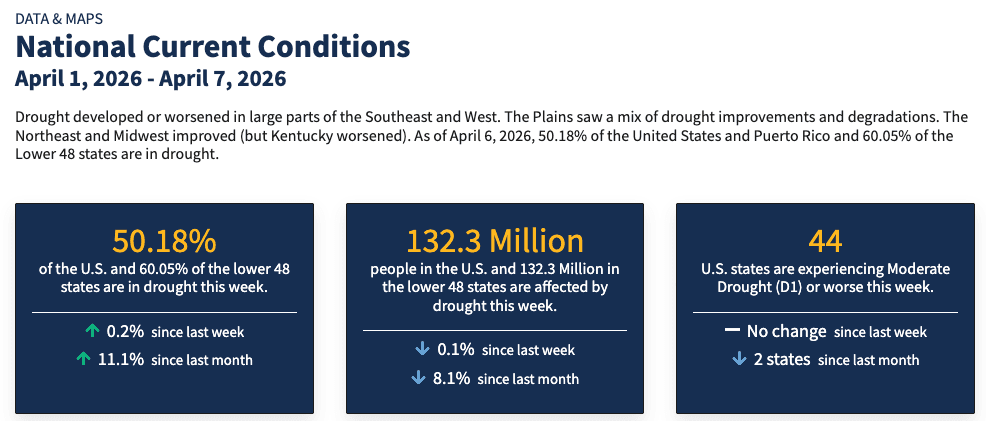
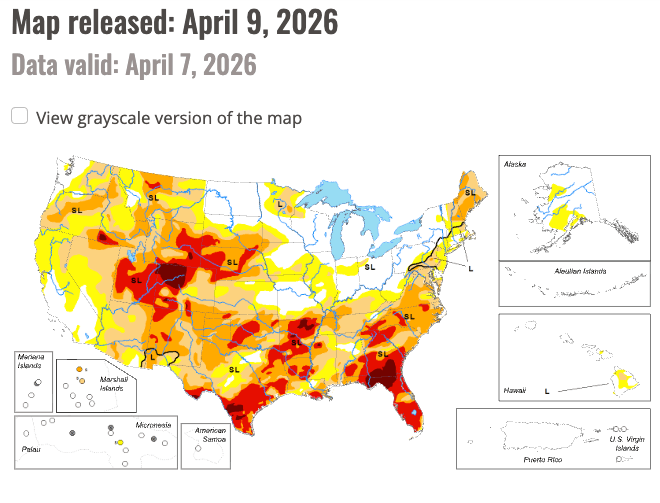
  • 60% of the Lower 48 is currently in drought as spring planting season begins, per NOAA, putting pressure on sugarcane, rice, peanuts, and wheat.

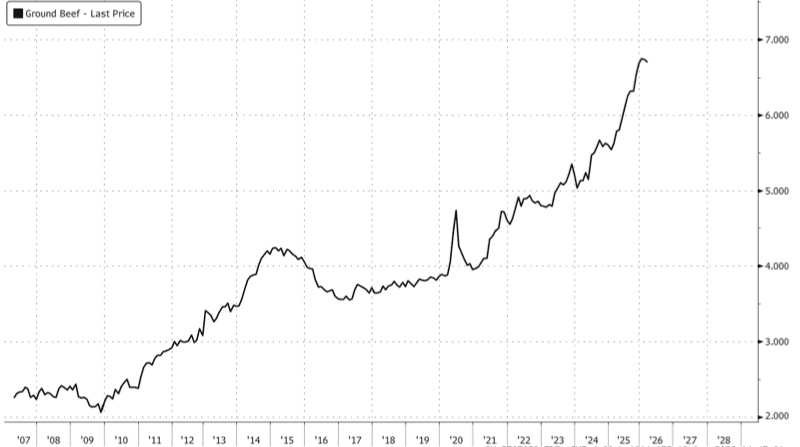
  • The U.S. cattle herd is at its lowest level since the 1950s; further drought-driven herd reductions could push beef prices to new record highs.

  • Shrinking mountain snowpack is threatening irrigation across the western U.S., with water cutbacks already imposed in Washington's Yakima Basin and along the Colorado River.

A massive drought has emerged across large swaths of the US agricultural belt, threatening crops and livestock and eventually affecting food prices, at a time when fertilizer and diesel costs are soaring. As of early April, 60% of the Lower 48 is in drought as the Northern Hemisphere growing season begins and farmers begin plantings, according to NOAA.

The southern US is already experiencing severe, extreme, and even exceptional drought conditions, putting pressure on key crops such as sugarcane, rice, and peanuts, while fruit trees have also been damaged by extreme temperatures.

Across the Great Plains, otherwise known as the nation's breadbasket, winter wheat farmers are being forced to decide whether to keep the struggling crop or cut losses and replant, with dry soil also making germination harder.

The drought also complicates matters for ranchers, as the nation's cattle herd is already at its lowest level since the 1950s. As a result, some ranches may further reduce their herds, which will only push beef prices to new record highs.

In the western US, the problem is not so much rainfall as shrinking mountain snowpack, which threatens irrigation supplies ahead of the growing season. Water-use cutbacks for agricultural purposes are already being discussed or imposed in places such as Washington's Yakima Basin and along the Colorado River.

Related:

Meteorologists Warn About Super El Nino Event

Washington, D.C. Will Feel Like June. Cue MSM Climate Doom Propaganda

X user Tony Heller noted, "The US is facing a drought possibly similar to the drought of 1610, which wiped out the Jamestown Colonists."

All bad news for food prices. Traders are piling into these agri ETFs: "Why The Fertilizer Crisis May Spark Record Inflows Into Agri ETFs."

By Zerohedge

World Bank and IMF See Economic Slowdown Across Central Asia and the Caucasus

  • The World Bank and IMF both forecast slower growth across Central Asia and the Caucasus in the coming years.

  • Azerbaijan is expected to be the only country in the two regions to post slightly stronger growth.

  • Both institutions warn that the conflict involving Iran and broader geopolitical tensions could further damage the outlook.

The World Bank and International Monetary Fund are predicting growth rates to slow in the coming years across Central Asia and the Caucasus. Azerbaijan is projected to be the lone state in the two regions to buck the trend and register moderate growth.

The economic disruption created by the US-Israeli blitz on Iran is a wild-card factor affecting growth projections, according to the two banks’ most recent updates.

The World Bank’s Economic Update for the Europe and Central Asia region also cites geopolitical tensions and trade fragmentation as additional factors hindering economic growth. The longer the present uncertainty in the Gulf region lasts, the greater the pressure on the economies of Central Asian and Caucasian states.

“Heightened uncertainty would likely restrain investment, while weaker global demand would reduce exports,” the update states.

In the World Bank’s view, Kyrgyzstan is projected to experience the greatest dip, declining to a projected 5.8 percent rate in 2027 after achieving 11.1 percent growth last year. The average growth rate for Central Asia was 7 percent in 2025 and is estimated to slow to 5.2 percent this year and 4.7 percent the following. 

The picture is similarly muddled for the Caucasus. Georgia’s economy, long the region’s top economic performer, is losing its luster: after achieving 7.5 percent growth in 2025, the rate is expected to decline to 5.5 percent by 2027. Georgia’s dip continues a downward trend over the past five years: in 2022, Tbilisi registered an 11 percent growth rate. 

The bank predicts that Armenia’s economic performance will mimic Georgia’s, with the growth rate moving down from 7.2 percent last year to 5.1 percent in 2027.

Azerbaijan is the exception to the rule, according to the bank’s update. But that comes with a caveat: Baku at the same time is projected to have the lowest growth rate of any state in the Caucasus and Central Asia over the next two years. Azerbaijan achieved a modest growth rate of 1.4 percent in 2025. The rate is expected to rise to 2 percent in 2026 before settling back to 1.8 percent the following year.

The bank update says states in the ECA region can potentially mitigate factors impeding growth through the liberalization of private-sector business activity.  

“To achieve stronger growth in productivity and jobs, ECA countries would need to prioritize ambitious structural reforms that help modernize the business environment, catalyze entrepreneurship, and improve the quality of education,” the update states.

“Targeted industrial policies can help address some market failures, but they remain secondary to the transformative potential of broader structural reforms,” it adds. 

The IMF’s World Economic Outlook update generally concurs with the World Bank in foreseeing a downward growth trend for the Caucasus and Central Asia over the near term, while presenting a slightly rosier view on growth rates. For example, both banks show Kazakhstan registering 6.5 percent growth last year, but the World Bank predicts Kazakhstan’s rate to be 3.9 percent in 2027, while the IMF projects 4.4 percent growth for the year. Similarly, the IMF fixes Azerbaijan’s growth rate as slightly higher (2.2 percent in 2026; 2.5 percent in 2027) than the World Bank’s projections.

The IMF update, unlike the World Bank, contains projections for Turkmenistan. The country achieved 3.6 percent growth in 2025, and the rates are expected to decline to 2.6 percent this year and 2 percent next year.

The IMF update hedges its projections, emphasizing that lots of uncertainty clouds the global economic picture.

“Downside risks dominate the outlook,” the update states. “A longer or broader conflict [in the Persian Gulf], worsening geopolitical fragmentation, a reassessment of expectations surrounding artificial-intelligence-driven productivity, or renewed trade tensions could significantly weaken growth and destabilize financial markets.”

By Eurasianet

Li

Inside the Race to Control the World’s Lithium Supply

  • Global lithium production has surged nearly tenfold since 2015, driven by booming demand for EVs, energy storage, and digital infrastructure

  • China dominates both lithium production and refining, controlling a significant share of the global supply chain

  • Western countries are accelerating domestic mining and new technologies to reduce dependence and improve sustainability

The world is ramping up its lithium production in a bid to meet the growing global demand for critical minerals, being driven by renewable energy deployment and the higher uptake of electric vehicles (EVs) and other electronics. Lithium production from mining increased from 31,500 metric tonnes in 2015 to 82,500 tonnes in 2020 and 290,000 tonnes in 2025. While China remains the world’s biggest lithium producer, as production expands, several new players are entering the market, which is helping to diversify operations.

The global lithium-battery market exceeded a value of over $150 billion in 2025, marking a 20 percent increase compared to 2024. “Batteries are becoming a cornerstone of the automotive sector, a critical source of flexibility for power systems, and an increasingly important source of back-up power for digital infrastructure, including data centres and artificial intelligence,” according to the International Energy Agency (IEA). Lithium-ion batteries are also used for industrial and strategic applications, such as in defence.

South America is the most well-known region for lithium production and is home to the lithium triangle, an area with vast lithium reserves connecting Bolivia, Argentina, and Chile. The region holds approximately 53 percent of the world’s lithium reserves. The three countries, along with Peru, contain about 67 percent of proven lithium reserves and produce around half of the global supply, according to the U.S. Geological Survey.

China dominates global lithium production, having invested in some of the world’s largest mines, as well as increased its domestic production of the white gold. By 2027, China is expected to contribute around 32 percent of global lithium production from domestic projects and another 18 percent of production from overseas operations, giving Chinese companies control of around half of the global lithium market. However, China holds a much larger control of the lithium refining market and is expected to manage around 81 percent of lithium refining activities by 2027

Western powers are, therefore, highly dependent on China for their lithium supply. Its strong hold of the lithium market has also led China to dominate global lithium-ion battery production, which has bolstered its electronics industry. In January, the United States announced plans to boost self-sufficiency and reduce its reliance on China for its lithium by rapidly expanding domestic mining activities. 

In October, the U.S. Department of Energy took a 5 percent stake in Lithium Americas Corp and a separate 5 percent stake in the company’s Thacker Pass joint venture with General Motors, which is expected to be the largest lithium source in the Western Hemisphere.

At the time, the U.S. Energy Secretary Chris Wright stated, “Despite having some of the largest deposits, the United States produces less than 1% percent of the global supply of lithium. Thanks to President Trump’s bold leadership, American lithium production is going to skyrocket.” Wright added that the move is aimed at reducing U.S. dependence on foreign adversaries for critical minerals by strengthening domestic supply chains.

The United Kingdom is also looking to develop its domestic lithium production through the development of a mine in the south-west county of Cornwall, to be operated by Cornish Lithium. While traditional mining methods will be used to extract the lithium, such as drilling and blasting in a quarry, the project’s operators are adamant that environmental permits are very strict, meaning that the firm will be expected to be sustainable where possible and dispose of waste appropriately

Meanwhile, certain byproducts attained from the extraction process can be useful, such as silica for cement, sulphate of potash for fertiliser, and gypsum for plasterboard. The firm aims to develop more sustainable mining practices where possible, such as in the use of electric trucks. This is particularly important for the project’s success, as several other European lithium projects have faced backlash from locals and environmentalists concerned about the impact of mining on the environment, as seen in both Portugal and Serbia.

Canada also has its sights set on sustainable lithium mining. At present, Canada produces around 6,000 tonnes of lithium a year, compared to Australia’s 88,000. In Western Canada’s Alberta, which is well known for its oil production, researchers are hoping to use a new extraction method to produce lithium more sustainably. The direct lithium extraction (DLE) method does not require solar evaporation – which is used in South American lithium mining – to extract the lithium, instead, it relies on chemicals to extract the lithium directly.

Ngai Yin Yip, a professor of earth and environmental engineering at Columbia University, recently published a study about a solvent that researchers believe can be used to extract lithium from brine. So far, this method has only been practised in the lab, but the promising lab results have encouraged a company called Piepgrass to test the method at scale, in real-world conditions.

As the global lithium market continues to grow, several new players are entering the industry. Although China will likely maintain its market dominance, the United States is expected to make strides in lithium extraction and processing in the coming years, while some European companies develop smaller projects. In addition, a greater emphasis is expected to be placed on sustainable lithium production to help governments achieve decarbonisation aims in line with a green transition.

By Felicity Bradstock for Oilprice.com

Ni

Indonesia nickel smelter group says new ore pricing formula would hurt industry


Nickel pig iron plant in Indonesia. (Image from Nickel Mines Ltd.)

Indonesia’s nickel smelters group, FINI, said on Wednesday that a new formula to calculate nickel ore price will pile more pressure on the sector, which is already struggling to cope with rising production costs.

A new nickel ore pricing formula, which factors in the content of other minerals in the ore, took effect on Wednesday.

The new formula will “significantly” increase production costs for the production of nickel products for both metals and battery components, FINI said in a statement.


FINI estimated that production costs of mixed hydro precipitate, used in battery production, would increase by around $2,400-$2,600 per metric ton of nickel content due to the inclusion of cobalt content in the pricing formula.

Nickel processing costs using rotary kiln-electric furnace (RKEF) would increase by close to $600 per ton of nickel content, it said.

Nickel smelters are already facing higher production costs due to rising energy and sulphur prices, FINI said.

“The nickel processing and refining industry will potentially incur operational losses, especially when other components, particularly industrial fuels and sulphur raw materials, are also significantly increased,” FINI said.

(By Bernadette Christina Munthe and Fransiska Nangoy; Editing by David Stanway)

Mn

Manganese X receives US patent for purification technology


Credit: Manganese X Energy Corp.

Manganese X Energy (TSXV: MN) said on Wednesday it has been granted a US patent for the proprietary purification technology it has developed for processing manganese sulphate.

The US patent expands the company’s global intellectual property portfolio, following its recent patent acceptance in South Africa. Applications for patents in Canada, Mexico and Australia have also been submitted for its technology, the company said.


“This achievement reinforces the strength of our technology and our commitment to building a secure and scalable domestic supply chain,” CEO Martin Kepman said, noting the importance of high-purity manganese sulphate in the rapidly growing lithium-ion battery market.

Manganese sulphate is a cathode material used in the production of lithium-ion batteries for electric vehicles and stationary energy storage systems.

Issuance of the US patent adds further value to the development of its flagship Battery Hill project in New Brunswick, the company said. The project, covering over 12.2 sq. km and five distinct zones, is considered to be one of the largest manganese carbonate deposits in North America. Based on a historical report cited by the company, it has a mineral resource of 194 million tonnes.

A pre-feasibility study is currently underway to evaluate multiple processing pathways to optimize both technical performance and economics, Manganese X said.

Shares of Manganese X surged over 9% to C$0.12 by midday, taking the Canadian junior’s market capitalization to C$25.8 million ($18.9 million).