Sunday, April 19, 2026


Spain to formally ask EU to break Israel association agreement, Sanchez says

Spain to formally ask EU to break Israel association agreement, Sanchez says
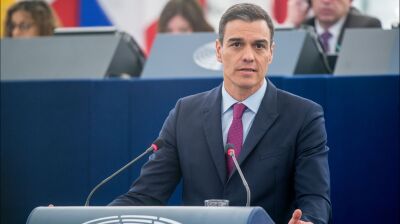
Pedro Sanchez at EU Parliament: file / bne IntelliNewsFacebook
By bnm Gulf bureau April 19, 2026

Spanish Prime Minister Pedro Sanchez said Spain will formally request the European Union suspend its association agreement with Israel at a meeting of EU foreign ministers on April 21 in Luxembourg, El Pais reported on April 19.

"A government that violates international law or the principles of the EU cannot be its partner," Sanchez said at the opening rally of the Andalusian election campaign in Gibraleon, Huelva.

Sanchez made the announcement at the first pre-campaign rally for the regional elections scheduled for May 17, attended by around 2,000 people. The prime minister is backing Socialist candidate Maria Jesus Montero, a former vice prime minister and finance minister, whose party faces a heavy defeat according to polls.

A survey by the Andalusian Studies Centre published earlier in the week gave Montero 21% of the vote and between 26 and 27 seats, below the 30 seats the party won in 2022, which was the Socialists' worst result in the region. The same poll rated Montero as the lowest-scoring leader of all candidates at 3.7 out of 10.

The Spanish government has been among the most vocal European critics of Israel's conduct in Gaza. Madrid recognised Palestine as a state in May 2024 alongside Ireland and Norway and has repeatedly called for the EU-Israel Association Agreement, which provides preferential trade access, to be reviewed on human rights grounds.

Sanchez drew on his anti-war messaging during the rally. "We are friends of the Israeli people, but we do not agree with their government," he said.

The prime minister accused Spain's opposition People's Party (PP) and far-right Vox of blocking measures on housing access, aid for working classes dealing with the impact of the war, minimum wage increases and pension revaluations. He repeated a pledge from summer 2024 to add €25bn ($28.4bn) to Spain's pension reserve fund by 2027.

Montero told the rally that if elected, no patient would wait more than 80 days for a medical test under her administration. She pledged to build 10,000 homes and facilitate access to them. The candidate said recent delays of more than a year in breast cancer screening diagnoses in Andalusia amounted to "the greatest negligence of a health system in this country."

Gibraleon is one of the towns where the Socialists retain an absolute majority in what was historically a party stronghold in southern Spain.

Spain recently reopened its embassy in Tehran as relations between the two continue to grow amid the ongoing fued with Israel and the US which backs Prime Minister Benjamin Netanyahu's campaigns in Gaza, Syria, Lebanon and Iran, IntelliNews previously reported. 


Cuba’s dilemma: Reform and overcome the crisis or collapse


La Joven Cuba graphic

First published in Spanish at La Joven Cuba. Translation by LINKS International Journal of Socialist Renewal.

There is no doubt that Cuba is facing one of the most perilous, if not the most perilous, crossroads in its history. The future of the nation as we know it, with all its virtues and flaws, its strengths and weaknesses, is at stake.

After what happened in Caracas on January 3 and the publication of United States President Donald Trump’s Executive Order on January 19, the traditional enemies of the Cuban nation hope to achieve their goals more forcibly than ever before.

Taking advantage of the current critical situation in Cuba, the US government is trying to wipe the slate clean of the past 67 years of Cuban history.

If that were to happen, we Cubans would lose all possibility of self-determination. The centuries-old emancipatory aspirations of our most eminent heroes would collapse. Cuba would never again be the nation that José Martí, Carlos Manuel de Céspedes, Ignacio Agramonte, Ana Betancourt, Mariana Grajales, Antonio Maceo, Gómez, Marta Abreu, Julio Antonio Mella, Antonio Guiteras, etc dreamed of.

Meanwhile, the country is experiencing a polycrisis resulting from the confluence of two distinct but linked phenomena. On the one hand Cuba has faced 64 years of economic warfare unleashed by the US in 1962, following the logic set out in the Mallory Memorandum of April 1960 that applying economic sanctions against the Cuban people would produce “hunger, desperation, and the overthrow of the government,” On the other hand, over the past eight years the Cuban government’s economic policies have been beset by various deficiencies and shortcomings.

Unfortunately, as in other stages of Cuba’s history, some compatriots support the hostile US policy toward our nation in the mistaken belief that our salvation and well-being lie in accepting subordination to a foreign state.

They forget all of Martí’s warnings and Cuba’s 57 years of submission to the United States. That subordination did not turn us into a prosperous country, notwithstanding the effort to promote visions of a luminous Havana that contrasted with the poverty and inequality in the rest of the country.

Other compatriots are so overwhelmed by the difficulties of recent years that they go so far as to deny the real achievements of the revolutionary project in its first stage. Their reasoning is naive: “The Americans need to come and fix this.”

Every day we hear that fateful phrase more and more often in our cities’ streets.

Finally, as often happens in other countries and contexts, other compatriots cling to a past that is not going to return. They go so far as to oppose an axiom that Fidel Castro himself defended: that we must change everything that needs to be changed.

The convergence of these three trends condemns the country to something Raúl Castro warned us about more than 15 years ago. If we do not fix our own mistakes we will plunge into an abyss. In other words, the inevitable collapse.

In his media address on February 5, President Miguel Díaz-Canel referred to some specific changes, but avoided discussing comprehensive reforms. The representative of the Cuban state used the word “change” four times, referring to issues such as the basic food basket, the import-dependent mentality, the energy matrix, and the way that the party exercises its leadership role. Similarly, the concept of “transformation” was used only five times, also for specific topics: the digital transformation of the country and the development of artificial intelligence (with the country practically without electricity), making the state apparatus more economically sustainable, municipal autonomy, encouraging Cubans living abroad to participate in the country’s development, and the energy transition.

However, at a time when more than ever the country clearly needs far-reaching economic reform and the start of a gradual political reform that makes the system of relations between citizens and the state more efficient and responsive, it is striking that the top leader of the party and the government himself has not addressed the need for reform, an extremely relevant issue in such a critical moment.

This issue has been on the national agenda ever since Fidel Castro himself launched a series of substantive changes in the 1990s by: legalising foreign currency holdings; opening the country to foreign investment; expanding self-employment; and authorising the creation of Basic Units of Agricultural Production.

On the political front, the Revolution’s leader proposed and promoted the 1992 Constitution reform. This included an electoral transformation. Previously, National Assembly of People’s Power representatives had been indirectly selected by Provincial Assembly delegates. The reform set in motion a process whereby Cuban citizens ratified the mandates of those who had been selected.

Subsequently, during his first terms as president, Raúl Castro promoted another wave of reforms, including one that had a political character and was extremely important to Cuban citizens. In 2013, breaking with years of restrictive practices, a new immigration law was adopted.

The struggle between supporters and opponents of reforms that is taking place in Cuba today has been bluntly addressed in these pages by my young colleague Rubén Padrón Garriga. In his video “The Counter-Reform” he points out that to refuse to make necessary changes “is to condemn the people to misery.”

Reforms and the current national and international context

The current national and international context is extremely serious. It demonstrates something about which there can be no confusion — the most serious contradiction that we face, as was the case in other historic stages, is the contradiction between the imperial ambitions of certain circles of power in the US and the Cuban people’s desires to have a homeland that is free and sovereign, prosperous and democratic, and just and equitable.

The Trump administration — in which Marco Rubio, a figure consumed by an innate and perverse hatred, plays a decisive role — is prepared to do anything, even military aggression, to achieve the longed-for dream of “regime change”.

For Rubio, his collaborators and a growing number of Cuban emigrants, “regime change” amounts to an unconditional surrender, not only of the government, but also of the Cuban people living on the island.

If Cuba “collapses,” as is widely believed to be inevitable, we would all be subject to US rule. It would be naive to think otherwise.

Trump himself has hinted at what could be done in Cuba and who he is most interested in supporting: “dismantling” the country to provoke a rupture in the national political process for the benefit of the Cubans who make up the majority of the diaspora in the US.

Of course, any promise from Trump is highly uncertain. Just look at the way Cubans are being treated, even those who voted for him in 2024. There are increasing arrests, deportations, and mistreatment, even of those who are already citizens.

Cubans residing in the neighbouring country to the north who supported Trump and Rubio a year ago should reflect on this before continuing to call for an invasion, a naval blockade of oil imports, or a military action of some other kind.

Trump, Rubio and a growing number of Cuban Americans are also convinced that, because of the shortcomings and errors of the Cuban government, the necessary conditions have been created to bring about the “collapse” of Cuba, its economy, and its government. President Trump’s Executive Order is clearly designed to provoke that collapse through energy strangulation. This constitutes an act of war against an entire people who pose no threat to the US.

Therefore, the challenge for Cuba and for Cubans who live here is obvious. It is impossible to remove the blockade or even to soften it. We must overcome it with effective economic policies that transcend our external dependence.

However, one must add another extremely important contradiction to the contradiction that exists between the Cuban people and the imperialist power circles within the US. That is the contradiction that exists within Cuban society between, on the one hand, those who govern the country, and on the other, the citizens who aspire to well-being and prosperity and do not view their rulers as decision-makers who are capable of making the necessary changes.

Those Cubans inside and outside Cuba who believe the issue can be resolved with a complete break and the removal from power of all those currently in government would do well to reflect on what is happening and what could happen, based on what has occurred in other countries that the US has occupied and dominated. Along with the current government there would be an attempt to erase all the positive aspects of the revolutionary process in its early years (universal access to healthcare and education, easier access to housing, etc).

They would impose a “Made in Miami” government on us, one that would only answer to the interests of the US and the Cuban-American right wing in Miami. The result would not be a “first-world capitalism” but something similar to what has happened in other countries that are subservient to Washington. We would wind up with an extractivist system whose benefits would go to foreign companies exploiting our resources, not the Cuban people. The differences between Washington, DC, and San Juan, Puerto Rico are quite striking.

And what about democracy and human rights? Trump has already shown that he does not care about them. And not just in Cuba or Venezuela. He wants to annex Canada and Greenland without consulting their citizens in the slightest.

Resolving the crisis by intensifying the path of reform

Therefore, the only path forward for us Cubans who live on the island is to do everything that we can to ensure the Cuban economy, which has been declining for several years, recovers and begins to develop so that our citizens can enjoy the decent life they so rightfully deserve. And that depends exclusively on the highest authorities in the country. Not on the provinces, not on the municipalities, and not on the average Cuban.

The demand for reforms, which is primarily economic but also political, is a natural consequence of the times that we are living in. This is especially true when we see on the National Television News that our leaders, with a few exceptions, continue to repeat the old formulas. Not only do they refuse to change, they also refuse to clearly recognise the numerous mistakes that they have made.

The statistics are compelling. The country’s GDP, volume of exports, and productivity continue to decline, while social indicators such as infant mortality and the average age of the population continue to rise due to low fertility and the growing emigration of young people of working age.

Against the backdrop of these two contradictions, Cuba is embroiled in a bitter struggle between those who, as citizens and even as rank-and-file party members, consider that it is essential to deepen the process of reforms, and those in power who are postponing changing everything that needs to be changed, hiding behind the slogan of “we are continuity.” The latter group have held sway and maintained control of power, including the mass media.

In these cases, those who defend the status quo often take advantage of the supremacy of their antiquated speech in state media, particularly television.

They reject and stigmatise anyone who thinks differently and proposes changing everything that needs changing. They defame and vilify them with the most implausible accusations. The tone of these assertions is harsh, sectarian and oppressive.

There is nothing new in these accusations. They have been seen before, such as in 2016 when, for example, a campaign was waged against so-called “centrism”.

But now there is an additional problem. It is the critical nature of the moment. These are not times for division, but for unity and growth. These are not times to plot against patriotic Cubans simply because they hold a different opinion.

The solid arguments of Cuban specialists with the highest national and international prestige on the need for reforms are being met with arguments that are difficult to sustain in serious academic debate.

As on other occasions, regarding the specific issue of reforms, the essay “Reform or Revolution” by the courageous German-Polish leader Rosa Luxemburg is being cited out of context. It is superficial to argue that this debate can be generalised beyond its specific content, as if our current situation were the same as the specific dilemma that was addressed in that text, which resulted from the internal debate within German social democracy in the last decade of the 19th century.

As is well known, that debate concerned the Erfurt Program and the best strategy for overthrowing capitalism and building socialism in Germany. In other words, the discussion centred on the best strategy for a socialist or social-democratic party to take power and on the radical nature of the path that such a party should follow once in power to overcome capitalism.

But Luxemburg’s oft-cited conclusions have nothing to do with our specific situation and debate today, namely whether the current Cuban socialist system needs reforms. The aim is to come up with proposals to change everything that needs to be changed so that Cuban socialism can achieve its intended goal: a prosperous, sustainable, just and equitable society.

It is clear that the current policies have not been successful in this regard.

A better approach to the meaning of reforms within a socialist system may be that of Atilio Borón, an academic who is well known in Cuba. In 2008, referring specifically to the Cuban and Venezuelan experiences within the concept of 21st century socialism, he stated that:

The absurdity of anathematising any reform as a heresy or a betrayal of socialism — understood as an unalterable dogma not only in terms of principles, which is correct, but also in terms of historical projects, which is wrong — is obvious, because it would mean the consecration of a suicidal immobility, the denial of the capacity for self-correction of errors and a renunciation of collective learning, conditions that are essential for the permanent improvement of socialism.

What has damaged the Cuban economy most is not the reform approved 15 years ago, as its opponents argue, but rather the failure to have applied it consistently and deliberately. There are many examples: the inexplicable delay in implementing the “re-ordering”, that is, the monetary and exchange rate unification, which was originally scheduled for 2016 but postponed until 2020, or the current surprising delay in adopting a law governing businesses, to name just two.

Cuban academics from different generations and professions have been active, subjecting the country’s reality to serious and objective analysis. They do so without resorting to slogans or subterfuges that attempt to sugarcoat the multifaceted crisis that we have been experiencing. They have been doing this in institutional spaces, such as the Economic Society of Friends of the Country, the Centre for Studies of the Cuban Economy, and the “Last Thursdays” forums organised by the Temas journal. They have been presenting their analyses publicly, in full view of the citizenry.

Acting in this way, they have been fulfilling an obligation that Julio Carranza explained more than 18 years ago:

Scientists and scientific institutions have a public service responsibility. This consists of communicating specialised information and analysis directly to society; not as a political proposal, but as well-founded interpretations that contribute to raising the cultural level and to general knowledge on different subjects.

Among the opponents of reform, an ossified view of orthodox Marxism prevails. This view predominated in the Soviet Union for more than 60 years and prevented timely reforms. As a result, by the time the proponents of reform finally managed to move in that direction, starting in 1985, it was too late. The economic stagnation resulting from the ossification and sclerosis of Marxist thought had undermined the foundations of socialism in the Soviet Union.

The paths taken by the People’s Republic of China and the Socialist Republic of Vietnam were quite different. In both countries reformist factions within their respective Communist parties succeeded in implementing transformations that opened their economies to the realities of the market. The evidence of the success of their reforms is obvious. In both countries there was no hesitation in undertaking reforms with the utmost seriousness and depth. In both countries the people now enjoy the benefits of prosperous and resilient economies.

Cuba must find the road toward its own reforms. Otherwise, all of us will run the risk of suffering an unacceptable setback that we do not deserve after so much sacrifice.

Carlos Alzugaray Treto is a former senior Cuban diplomat and professor. Now retired, he is a co-coordinator of La Joven Cuba's Advisory Board.


NATO Allies Adopt Evasive Policies on US War in Iran


by  | Apr 17, 2026 

Trump administration officials are discovering that a daunting number of longstanding U.S. allies and security clients are adopting hedging policies or even openly opposing Washington’s decision to wage war against Iran.  That sobering reality has become even clearer over the past week than it was during the earlier stages of the armed conflict.  On April 12, the president called upon NATO members to join U.S. naval forces in blockading Iranian ports. The proposed move was in response to Tehran’s continuing efforts to selectively close the vital Strait of Hormuz to foreign shipping.

However, most of Washington’s alliance partners refused to join the retaliatory blockade. British prime minister Keir Starmer was especially blunt and negative. The U.K. is “not supporting” the U.S. blockade of Iranian ports, Starmer stated, insisting that the country would not get “dragged in” to the Iran war.  Starmer, along with French President Emmanuel Macron, instead proposed intensified international efforts, including a conference, to secure an effective agreement to reopen the strait.

The extensive allied refusal regarding Washington’s blockade plans reflects growing European dissatisfaction with overall U.S. policy toward Iran and, indeed, with Trump’s entire approach to world affairs. Concerned longtime proponents of close transatlantic security cooperation are expressing mounting worries that disagreements between the United States and its principal European allies about Iran policy could lead to a fatal breach in NATO.

European leaders and their publics clearly are getting restless. Serge Schmemann, the Moscow bureau chief for the New York Timesemphasizes the extent of the change.  “Mr. Trump’s war on Iran, about which NATO allies were not consulted and in which they subsequently declined to participate, has made clear that Europeans no longer defer to Mr. Trump as the de facto “‘leader of the free world.’”

At the same time, European leaders have tried to avoid directly antagonizing President Trump.  Achieving such a balance is not easy.  Trump expressed fury at NATO allies who have failed to support Washington’s intervention against Iran. Even before the latest intra-alliance spat over establishing a blockade, the president denounced such allies as “cowards.” Administration officials also are examining ways to punish uncooperative Alliance partners.  Secretary of State Marco Rubio echoed and amplified Trump’s earlier doubts about the continuing value of NATO to America’s security. “Why are we in NATO? You have to ask that question. Why do we send trillions of dollars and have all of these American forces stationed in the region, if in our time of need, we won’t be allowed to use those bases?” Rubio said during an interview with Fox News in early April.  The refusal of most NATO members to authorize U.S. airstrikes and other offensive operations against targets in Iran has especially irritated administration officials.

However, as Wall Street Journal columnists Linas Kojalaand and Vytautas Leškevičius point out, with the notable and ostentatious exception of Spain, the most significant and influential Alliance members, including Britain, France, and Italy, have all quietly assisted the U.S. war effort in other ways.  The outcome has been a bit of a muddle. “Politically, the war with Iran has widened the gap between Washington and many European governments. Operationally, it has underscored how heavily the U.S. still relies on Europe – and how cooperative most European governments are.”

European NATO leaders seem to be trying to have it both ways.  By condemning Washington’s war of aggression against Iran and the widespread economic disruption that the conflict has caused, those countries maximize their ability to win the plaudits of outraged populations and governments around the world.  Yet providing quiet backing for at least some U.S military operations and diplomatic efforts to limit Iran’s power and influence placates other countries–especially those in the Middle East – that worry about both the clerical regime’s current conduct and its long-term strategic ambitions.

It is a very delicate balancing act on several levels, and it remains to be seen if European political elites can carry it off.  Important factions within the U.S. diplomatic, intelligence, and military communities may well sympathize with at least some of the European objections to the Trump administration’s Iran policy.  However, hardliners in those same U.S. institutions are not pleased with the perceived reluctance of other NATO members to support an armed intervention that the administration regards as a high priority. Worse, Trump himself has expressed vitriolic displeasure at what he considers unreliability at best and outright betrayal at worst.  His anger is not a trivial matter.  Even a lame-duck president with low domestic public approval ratings exercises a dominant role in U.S. foreign policy. Policy differences about the Iran war have already exacerbated transatlantic tensions, and if the war does not end quickly, those tensions are almost certain to worsen dramatically.

Dr. Ted Galen Carpenter is a senior fellow at the Randolph Bourne Institute and the Libertarian Institute. He is also a contributing editor to National Security Journal and The American Conservative. He also served in various senior policy positions during a 37-year career at the Cato Institute. Dr. Carpenter is the author of 13 books and more than 1,600 articles on defense, foreign policy and civil liberties issues. His latest book is Unreliable Watchdog: The News Media and U.S. Foreign Policy (2022).


The War Powers Resolution Is Not What You’ve Been Told


by  | Apr 19, 2026 | 

Reprinted From World BEYOND War.

According to The Hill, in an article typical of U.S. media, Trump’s war on Iran is totally legal for 60 days if Congress does nothing, after which it becomes illegal, unless Congress has explicitly OK’d it. This is supposedly because of the War Powers Resolution of 1973. And The Hill is not alone in pushing this idea. Fox News agrees with The Hill. So does Time. So does USA Today. So does The Washington Post. So does Roll Call. So does Politico. So does every AI bot infecting the internet.

However, the War Powers Resolution consists of words that you can read for yourself, and here are some of them:

“The constitutional powers of the President as Commander-in-Chief to introduce United States Armed Forces into hostilities, or into situations where imminent involvement in hostilities is clearly indicated by the circumstances, are exercised only pursuant to (1) a declaration of war, (2) specific statutory authorization, or (3) a national emergency created by attack upon the United States, its territories or possessions, or its armed forces.”

  1. There has been no declaration of war by the U.S. Congress since 1941.
  2. There has been no authorization to attack Iran, nor to continue attacking Iran.
  3. There has been no attack upon the United States or its territories or possessions, and there were no attacks on its armed forces until after said armed forces had begun the war.

The same law says that a president who launches a war in any of those three situations, then has 48 hours to submit his first report explaining himself, and 60 days after that report (62 days total — plus a possible extra 30) to entirely knock it off. But none of those three situations exists. So, the president must immediately knock it off — must, in fact, have never started the war. It is simply not true that the war will become illegal after 60 days; it has been illegal since the instant it was begun. It is factually false that it must be ended after 60 days in order to comply with the law; it must be ended immediately.

If the War Powers Resolution did not exist, one could revert to the actual Constitution that the War Powers Resolution claimed to uphold and which says that the decision to declare and wage a war is up to the Congress.

If that weren’t enough, one could also find in the Constitution that spending money on anything is up to the Congress. At least one Congress Member has been pointing out lately that the Constitution says “No money shall be drawn from the Treasury, but in Consequence of Appropriations made by law.” No law has appropriated a dime for attacking Iran.

If Congress were to appropriate money for the war and/or to declare or authorize the war, there would still remain the problem that the same Constitution makes treaties to which the United States is party “the supreme law of the land” and one of those treaties is the UN Charter, which bans war except in narrow circumstances not met. Various other treaties ban war entirely.

The wars are all illegal from day 1. But don’t we still want the War Powers Resolution used to try to end them, by forcing votes on whether to end them? Sure, we do. The wars are legally allowed to continue for 0 days, but don’t we still want them stopped at 60 or 62 or 90 or 92 or whatever number of days our so-called government is willing to treat as a deadline? Sure, we do. Endless bloody massacres and fits of massive destruction are horrible, but wouldn’t they be less horrible if they could each be held to 60 days or shorter? Maybe.

Better would be to end each war immediately, right now, and to hold all the future wars to 0 days. How does one do that without a handy mechanism that corporate media outlets all pretend is real? Well, one way would be to use handy mechanisms that are real in written law. They include (redundantly) banning the use of any money for a war. They include impeaching and removing from office those waging a war. They include closing distant foreign bases, thereby making it impossible to get them attacked.

Those sound harder, perhaps, than telling a president his time is up. But you’ll have to do them anyway after you’ve told him his time is up and he’s told you to go to hell. Meanwhile all the blood of those 60 days will be on your hands — not to mention the blood of all the other wars to come.

If you let corporate media outlets and random Congress members pretend that laws say totally crazy things — such as that presidents can legally attack anyone they want if they cut it out after 2 months, what else will they decide that laws can say: no warrant is needed to spy on you? being born in the U.S. doesn’t make you a citizen? a corporation has human rights? one human right is the right to use assault rifles? bribery is free speech? a paramilitary force can kidnap people off the street? profiting from public office is acceptable?

And if all your puppet, weapons-buying, sidekick governments around the world obediently immitate the standard that their presidents can legally attack anyone they want if they cut it out after 2 months, how is that likely to work out?

David Swanson is an author, activist, journalist, and radio host. He is executive director of  WorldBeyondWar.org and campaign coordinator for RootsAction.org. Swanson’s books include War Is A Lie and When the World Outlawed War. He blogs at DavidSwanson.org  and  WarIsACrime.org. He hosts Talk Nation Radio.


Hydropower Is Making a Global Comeback

  • Hydropower remains the world’s third-largest electricity source but is often overlooked despite its vast untapped potential.

  • Its flexibility and storage capacity make it critical for balancing intermittent renewables like solar and wind.

  • Rising fossil fuel volatility is pushing governments to reconsider hydropower as a key pillar of energy diversification.

As governments look to diversify their energy mix by expanding renewable energy capacity, many are turning to solar and wind power. Meanwhile, hydropower is often overlooked by countries that do not have a tradition of hydropower production. With the ongoing conflict between the United States, Israel, and Iran, the price of fossil fuels is being pushed ever higher due to severe shortages of oil and gas. This is encouraging governments worldwide to assess their energy security and consider developing various energy sources to support greater diversification and decrease the vulnerabilities of a reliance on any one energy source. 

Hydropower has long played a major role in global energy production, with several countries around the globe relying on the power of water to provide vast amounts of clean energy. The first hydropower projects were developed in the 1800s, and hydro is now the world’s third-largest power generation source after coal and natural gas, contributing around 4,500 terawatt-hours of electricity, or 14 percent of the global total. This equates to around the same electricity production as solar and wind power combined.

China is home to around 29 percent of the world’s installed hydroelectric capacity, followed by Brazil, the United States, and Canada. However, some countries rely much more heavily on hydropower, with Norway, Paraguay, the Democratic Republic of Congo, and Albania depending on hydro for a large proportion of their electricity generation.

However, the IEA’s Executive Director, Fatih Birol, has suggested that hydropower is often overlooked, describing it as“the forgotten giant of electricity”. Birol says that it is often not included in international energy discussions, when it should be, especially with the global electricity demand set to rise at a faster pace than the overall energy demand. In 2021, the IEA published a major report on hydropower, identifying the significant potential of expanding the hydro market.

Around 60 percent of the hydro resources in emerging and developing economies are untapped. Investing in the sector could help boost energy access and power industrialisation, thereby spurring economic growth.

Unlike solar and wind power, hydropower is highly flexible, as plants are developed to rapidly adjust their generation up and down as needed, and can be stopped and restarted with relative ease. This makes them highly efficient in adapting to changes in the power demand, typically at a low cost. For this reason, hydropower could be key to clean energy diversification, filling the gap when the sun is not shining and the wind is not blowing.

Hydro resources can also be used for energy storage. Pumped-storage hydro (PSH) plants can act as giant batteries, using water instead of chemicals. At present, they are the largest form of electricity storage worldwide, with the capacity to hold 30 times more power than batteries. In addition, new technologies can make hydro plants much more efficient, meaning that investing in refurbishing and upgrading ageing plants could help boost electricity output and improve storage capacity.

There is close to 200 GW of PSH capacity worldwide, contributing around 90 percent of long-duration energy storage globally. A further 570 GW of PSH is set to be developed worldwide in the coming years. Conventional hydropower, such as the Three Gorges Dam in China, stores energy by holding water in a reservoir before releasing it to power turbines. However, PSH has the reputation as a “water battery”, as it uses excess energy, mainly from renewables, to pump water from a lower reservoir to a higher one, before allowing gravity to send the water back down pipes to boost power during low-production hours.

Despite often being overlooked, hydropower has garnered greater attention in the United States in recent months, due to President Trump’s crackdown on clean energy. A submersible hydroelectric technology is being used in the Great Lakes, one of the world’s largest freshwater bodies, which border several large North American cities, such as Chicago, Toronto, Montreal, and Detroit.

None of the five Great Lakes has substantial tides or currents to fuel hydropower, but some of the surrounding waterways do. In February, the Ocean Renewable Power Company (ORPC) announced its first urban project on the St Lawrence River in Montreal. ORPC plans to begin operating two hydroelectricity devices later this year, with 60-90 MW of resource potential in the area. The devices use carbon fibre turbines, which are turned by the flow of water. This technology has become increasingly popular in recent years, with similar projects being developed in Korea and the United Kingdom.

Despite long being used as an energy source, the potential for hydropower as part of energy diversification efforts has been greatly overlooked. As governments worldwide look for ways to strengthen their energy security and reduce reliance on volatile energy sources – such as oil and gas – hydropower could offer a major clean alternative power source, as well as provide enhanced stability through the use of hydro plants as giant batteries. 

By Felicity Bradstock for Oilprice.com