Sunday, April 19, 2026

AI Job Cuts, Plastic Pollution, and Experimental Nuclear: Why I Oppose Dow

We are building a new and sustainable economy on our terms. This is what Dow wants to take away from us; I refuse.
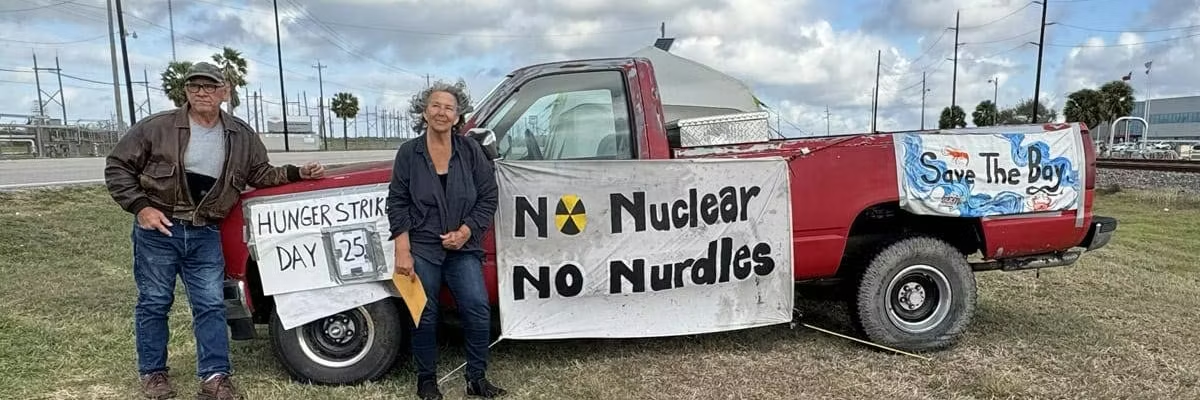


Diane Wilson poses on day 25 of a hunger strike against Dow Chemical.

(Photo via Texas Campaign for the Environment)

Diane Wilson
Apr 19, 2026
Common Dreams

I’m a 77-year-old shrimper from the Texas Gulf Coast, and the AI revolution has reached my town. Early this year, Dow Chemical announced global cuts to 4,500 jobs as it moves toward artificial intelligence. News of the layoffs tore through our rural community of Seadrift–where some of the thousand people work at the local Dow facility–with the devastation of a hurricane. Replacing workers with robots might be Dow’s latest blow, but this toxic industry has wronged my hometown of Seadrift for 70 years.

I recently completed a 30-day hunger strike on the public property (ditch) outside of Dow Chemical, during which time the sheriff actually arrested me while I was attempting to deliver my letter of demands to a company representative here in my hometown.

For decades, Dow has illegally dumped plastic and chemical waste into the local bays and waterways, which have sustained this fishing community for more than 170 years. Now, the company wants government approval for a new permit that would legalize plastic pollution at the Seadrift plant, and allow the construction of experimental nuclear reactors to power it.

As a native Seadrifter, I say: No.

Industry promised us prosperity, but we lost our economy and our heritage.

Dow is planning massive job cuts right now, despite collecting $177 million in bank finance since 2019—which is more funding than any other petrochemical company currently expanding in the US, according to a new report, “Toxic Finance.”

What lasting good have these toxic pollution factories ever done for this community?

My family made a living on the water for four generations, and I’ve been a shrimper all my life. I remember when Union Carbide (now Dow) and Formosa Plastics came to our communities with glossy pamphlets and slick presentations. Our elected officials made a devil’s bargain, and “a little pollution” turned into billions of plastic pellets and tons of chemicals in our water.

When the local bays got sick, the communities started dying with it. First, as in Formosa Plastic’s case, industry bought out the ranchers; then an elementary school; and finally, through a class action suit, bought out citizens and now own their homes. Local businesses have been boarded up throughout the county. As a young woman, I worked at Froggy’s fish house; now, it’s a concrete slab. Four more were bulldozed. A hundred boats used to launch from our docks at the start of shrimp season; today, we’re lucky if we have five. Industry promised us prosperity, but we lost our economy and our heritage. As the old saying goes, our downtown died by a thousand cuts.

I always knew it was a raw deal, but at least some of us got steady jobs… at least for a little while. Now, Dow can’t even deliver on that meager promise. Instead, Dow joins the likes of Amazon, UPS, and dozens of other multinational corporations looking to replace American workers with artificial intelligence.

Nobody from Dow has even responded to me after 30 days of fasting and living in a tent outside of their facility, despite acknowledging receipt of my demand letter to Dow’s CEO. To be clear, I will not rest until this company:Commits to zero discharge of plastic pellets, powder, and flakes from its Seadrift facility and incorporates that commitment into its operating permit; and
Cancels all plans to build nuclear reactors at the site and withdraws its construction permit application from the US Nuclear Regulatory Commission.

On a bright note, the Texas Commission on Environmental Quality (TCEQ) has confirmed that a public meeting about Dow’s proposed changes to the water discharge permit will be held at some unspecified time in the future… and so, the fight continues!

Believe me, dear folks, people still have power. I sued Formosa Plastics and won the largest citizen lawsuit settlement under the Clean Water Act in US history—$50 million plus additional fines because the company can’t stop polluting the bay—all of which has gone into a public trust designed to restore the fishing communities, the bays, and the local environment.

Our trust funded a cooperative of 250 fisherfolk working together to revitalize our seafood industry, which now has its own office, a processing plant, and a 60-acre oyster farm that will grow to become the largest in the Gulf. We are building a new and sustainable economy on our terms.

This is what Dow wants to take away from us. I refuse.

Will you join me in fighting back against corporate greed?


Our work is licensed under Creative Commons (CC BY-NC-ND 3.0). Feel free to republish and share widely.


Diane Wilson
Diane Wilson is a fourth-generation shrimper and environmental activist from Seadrift, Texas. She is the executive director of San Antonio Bay Estuarine Waterkeeper and a proud funder of the Matagorda Bay Fishing Cooperative. She recently concluded her 15th hunger strike to protect the bay upon which her community depends.
Full Bio >
Louisiana Advances One of the Country’s ‘Cruelest’ Anti-Homeless Bills

One homeless advocacy group said the bill, which would require homeless people to perform unpaid labor to pay for involuntary treatment, “evokes debtor’s prisons, convict leasing, and the ugliest day of Jim Crow.”


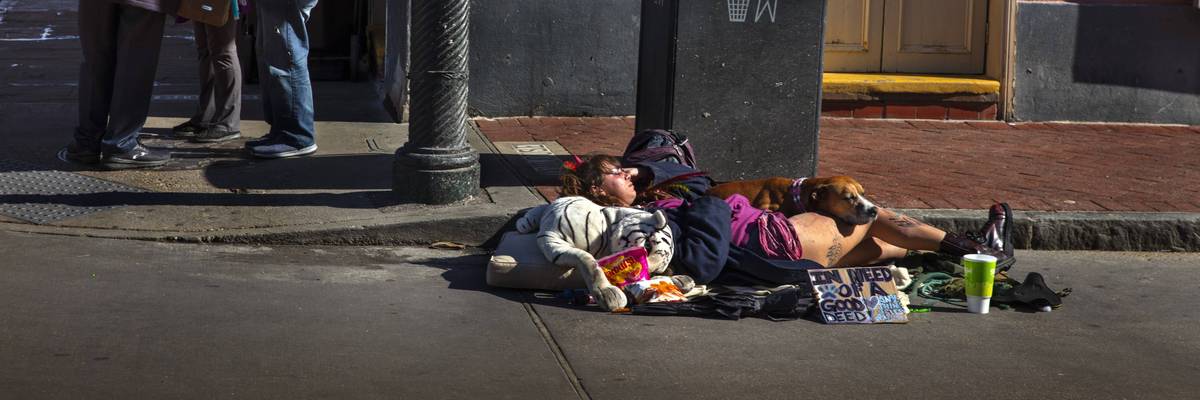
A homeless woman sleeping with a dog on the street on February 26, 2020, in New Orleans, Louisiana.
(photo by Barry Lewis/InPictures via Getty Images)


Stephen Prager
Apr 18, 2026
COMMON DREAMS

The Louisiana House of Representatives voted this week to pass what the National Homelessness Law Center says is “one of the cruelest anti-homeless bills in the country.”

Like many other anti-homeless bills being advanced around the country following a 2024 Supreme Court decision allowing states and cities to criminalize homelessness, House Bill 211, which passed by a vote of 70-28, makes unauthorized sleeping in public spaces a crime.

It is punishable by a fine of up to $500, imprisonment for up to six months, or both. Repeat offenders could face one to two years in prison with hard labor and a $1,000 fine.

The bill, which will now advance to the GOP-controlled state Senate, has been nicknamed the “Streets to Success Act” because, according to its sponsor, state Rep. Debbie Villio (R-79), the goal is not to jail homeless people but to “connect them to service providers.”


Those who are convicted of sleeping outdoors could be given the option to avoid jail time by instead entering into a mandatory treatment program for at least 12 months. The bill authorizes local governments to set up semi-permanent camps in remote areas, where defendants would be required to stay and receive treatment.

The bill requires homeless defendants to pay “all or part of the cost of the treatment program to which he is assigned,” a steep cost for many, as the average cost for residential drug and alcohol rehab treatment in Louisiana is more than $4,400 per week, according to the addiction referral service directory Addicted.org.

According to the bill, those who cannot afford this steep cost would be required to perform unpaid labor for the state or a local community center in lieu of payment.

Bill Quigley, director of the Gillis Long Poverty Law Center at Loyola University New Orleans, called the bill’s entire premise “a farce.”

“If people had the resources to pay for housing and physical and/or mental health services, they would not be on the street,” he told Common Dreams.

He described it as a “cruel theater of the absurd” based on “the lie that people choose to be homeless.” The law, he said, “assumes our communities have plenty of affordable apartments and lots of mental and physical health services available.”

In reality, he said, these services are chronically underfunded, and the city would need to build about 55,000 more affordable rental units to provide enough housing for its rent-burdened population.

Though it is not uncommon for homeless people to struggle with mental health or substance use issues, increases in the cost of housing have been shown to have a direct relationship with increasing homelessness.

Homelessness in New Orleans dropped considerably in the years following the Covid-19 pandemic, when Congress provided permanent housing subsidies for those in need. But after those funds have dried up, homelessness in the city shot up higher than before the pandemic, a study by the homelessness nonprofit UNITY of Greater New Orleans found in 2024.

New Orleans City Councilmember Lesli Harris (D), who has opposed the bill, pointed to the success of the city’s Home for Good program, which took a “Housing First” approach to homelessness, providing rental subsidies and allowing people to move straight from encampments into housing without requirements that they obtain treatment.

According to a May 2025 report, the program had moved 1,133 people off the streets and into supportive housing and allowed eight homeless encampments to close.

“Through our Home for Good program, we house an individual for roughly $21,844 per year. By comparison, jailing that same person costs an average of $51,000—and failing to act at all can cost up to $55,000 in emergency room visits and crisis rehousing,” Harris said. “HB 211 would steer Louisiana toward the most expensive option while producing no lasting housing, no services, and no real path forward for the people involved.”

Harris has also decried the bill’s creation of what she called “internment camps” for treatment. The bill’s text requires these facilities to be far away from downtown and other high-value neighborhoods, which she said separates those trying to rebuild their lives from work, public transit, and other critical services, and further isolates them from society.

Since the Supreme Court’s 2024 decision in Grants Pass v. Johnson, which allowed cities to enforce public-camping bans against unhoused people even when shelter is unavailable, around two dozen states and hundreds of municipalities have passed various measures criminalizing poverty.

The homeless advocacy group Housing Not Handcuffs points out that many of the bills were written by the Cicero Institute, a far-right think tank with heavy backing from billionaire tech investors that now has deep influence over the housing policy of President Donald Trump, who has taken a hacksaw to funding for public housing programs under the Department of Housing and Urban Development.

Housing Not Handcuffs said Louisiana’s bill, which would almost certainly be signed by Republican Gov. Jeff Landry if passed by the state Senate, “is an extreme take on the already extreme copy-paste legislation” peddled by Cicero.

“This bill forces homeless people charged with a crime to make the false choice between jail or at least one year of forced treatment,” the group said. “Louisiana has a long history—and present—of chain gangs, prison labor, and entrenched white supremacy. This bill clearly evokes debtor’s prisons, convict leasing, and the ugliest day of Jim Crow.”
Israel Continues ‘Gaza Tactics’ in Lebanon, Leveling Villages and Homes in Violation of Ceasefire

UN experts have said Israel’s “destruction of urban and village housing that displaced persons would have returned to, is consistent with the pattern of domicide that was initiated during the genocide in Gaza.”


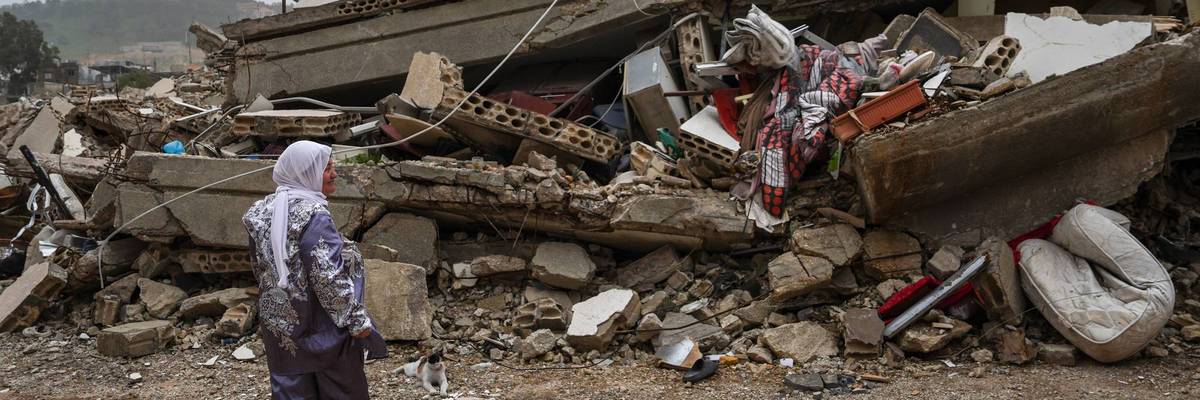
A woman surveys the damage to her home that was destroyed by an Israeli air-strike that killed seven of her neighbors in Nabatieh on the second day of a cease-fire between Israel and Lebanon, on April 18, 2026, in Nabatieh, Lebanon.

(Photo by Ryan Murphy/Getty Images)

Stephen Prager
Apr 18, 2026
COMMON DREAMS

Despite a ceasefire announced Friday, after US President Donald Trump said Israel was “PROHIBITED” from continuing to strike Lebanon, Israel continued to level villages and homes across southern Lebanon from Friday into Saturday in what has been described as a continuation of its “Gaza tactics.”

Just as it did in Gaza, Israeli Army Radio announced Friday night that Israel had established a “yellow line” in southern Lebanon about 10 kilometers north of the Israeli border, effectively allowing Israel to occupy about 10% of Lebanese territory and maintain control of 55 towns and villages.


Israel Defense Minister Deploys ‘Gaza Model’ in Lebanon, Ordering Destruction of Villages


Despite Ceasefire With Iran, Israel Pummels Lebanon With ‘Apocalyptic’ Strikes

According to a report by Lebanon’s National Council for Scientific Research, Israeli forces have been destroying more than 1,000 homes per day since March 2, sometimes wiping out entire villages across southern Lebanon.

The campaign escalated later in the month after Israeli Defense Minister Israel Katz ordered the military to “accelerate the destruction of Lebanese homes” near the Israeli border based on the “model in Gaza,” where Israel has destroyed around 90% of all infrastructure and left most of the population sheltering in tents.


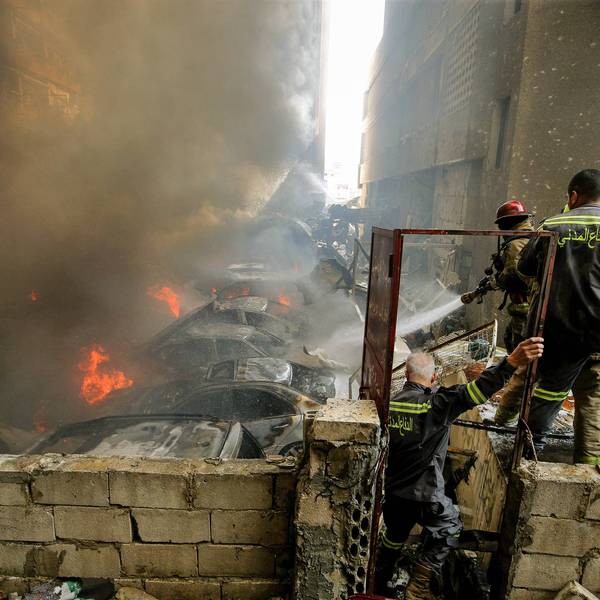
Israel has described this as an effort to destroy Hezbollah infrastructure. But the razing of entire villages has often appeared indiscriminate, and numerous attacks have targeted or damaged schools, hospitals, and other nonmilitary infrastructure. More than 40,000 homes have reportedly been destroyed or damaged.

Demolitions and land-clearing operations have continued after Friday’s ceasefire, according to reporters on the ground in Lebanon for Al Jazeera. Israeli artillery also reportedly shelled areas around Beit Lif, al-Qantara, and Toul.

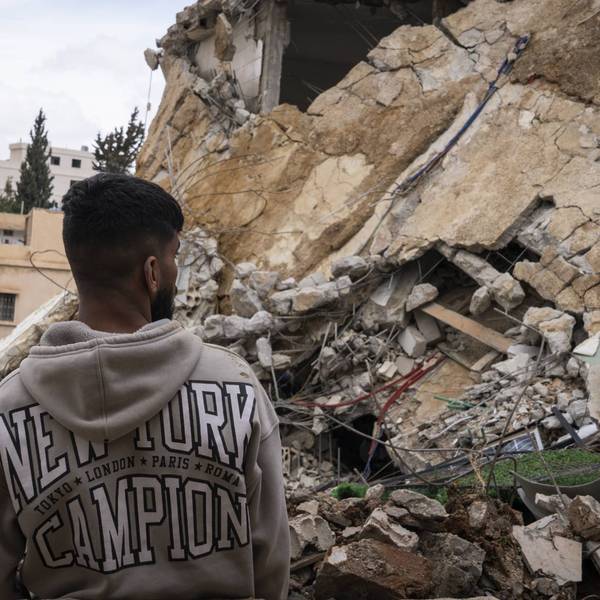
On Friday, Israel warned tens of thousands of displaced Lebanese civilians in southern Lebanon not to return to their homes despite the ceasefire, although some have begun to make the trek anyway. Many have found their former homes reduced to rubble.

“There’s destruction, and it’s unlivable,” said one resident who was displaced from his home in Nabatieh. “We’re taking our things and leaving again.”


Israel said Saturday that it had also carried out new airstrikes in southern Lebanon against people who approached the newly established yellow line. The Israeli military claimed that individuals crossed from north of the line toward Israeli troops, prompting “precise strikes” by air and ground forces against them.

An Israeli military statement described those approaching as “terrorists” who violated the ceasefire and said it carried out the strikes in “self-defense against threats.” However, it did not specify what threat those approaching the line posed.

Previous attacks that Israel has said were directed at Hezbollah fighters have devastated civilian areas in southern Lebanon, as well as Beirut and its surrounding suburbs.

According to Lebanon’s Health Ministry, which does not distinguish between military and civilian casualties, more than 2,167 people have been killed since Israel renewed its attacks in Lebanon on March 2.

In Gaza, despite a ceasefire, nearly 100 Palestinians have been killed near the yellow line since it was established in October 2025. Those killed have included at least 36 women, children, and elderly people, according to TRT World.


On Wednesday, a group of United Nations experts denounced what they called Israel’s “illegal aggression and indiscriminate bombing campaign” aimed at occupying land in violation of the UN Charter.

“The issuance of blanket evacuation orders, combined with the destruction of urban and village housing that displaced persons would have returned to, is consistent with the pattern of domicide that was initiated during the genocide in Gaza,” they warned.

On Saturday, a group of peacekeepers with the United Nations Interim Force in Lebanon also came under attack, resulting in the death of a French soldier. Lebanon’s Foreign Ministry condemned the attack and pledged to identify the “perpetrators.”

UN peacekeepers and French officials have said the attack was most likely carried out by Hezbollah, but Hezbollah has denied responsibility.

Israel’s continued attacks on Lebanon also threaten to derail not only its ceasefire with Lebanon but also the US ceasefire with Iran.

After the announcement of a ceasefire between Israel and Lebanon on Friday, Iran briefly reopened the Strait of Hormuz to unrestricted travel. But on Saturday, following reports of Israel’s violations of the ceasefire, it was once again closed.

While Iranian officials said the proximate reason for the closure was the continuation of US President Donald Trump’s blockade of the strait, they have also indicated that they want Israel to stop attacking Lebanon as part of the ceasefire.
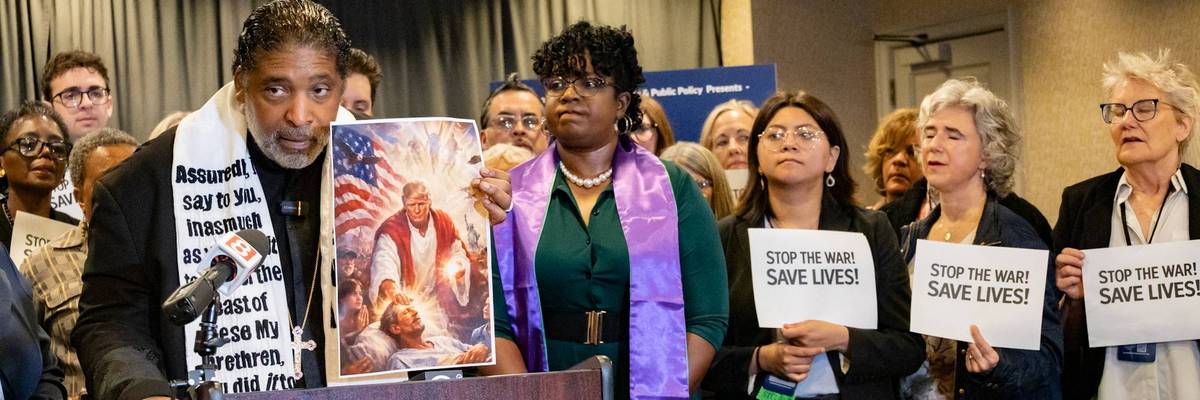
An Unholy War and the Blasphemy of Donald J. Trump

This must be a moment of entering the public square with the truths of the gospel, with love, the truth of the prophets, and the courage to say we are not afraid of this administration or any, and we won’t be silent any more.


Rev. Dr. William J. Barber II holds an AI-generated picture of President Donald Trump depicted as a version of Jesus Christ during a press conference on April 14, 2026 at the Yale Public Theology & Public Policy Conference in New Haven, Connecticut.
(Photo: Corey Fletcher / YALE Public Theology & Public Policy Conference)
Common Dreams

Editor’s note: The following remarks were delivered during an emergency press conference in New Haven, Connecticut on Tuesday, April 14, 2026 in response to recent comments and actions by President Donald J. Trump.

“You shall have no other gods before me.” —Exodus 20:3

“All who make idols are nothing, and the things they treasure are worthless.” —Isaiah 44:9

“Therefore, since we are God’s offspring, we should not think that the divine being is like gold or silver or stone—an image made by human design and skill.” —Acts 17:29

“God is spirit, and his worshipers must worship him in Spirit and in truth.” —John 4:24

There are times that compel people of faith to speak, servants of Jesus to speak, proclaimers of the gospel to speak and engage in truth-telling and forms public exorcism rooted in deep radical love with the hope of repentance and a commitment to faithful witness—without fear of what any man or woman administration can do to us.

Two weeks ago the Moral Monday movement held Moral Monday gatherings in Washington, DC, 16 states, and Canada to denounce this war and the President’s declaration that if another country didn’t do what he said, he would “reign” down Hell on them and wipe out their entire civilization.

Why has he been talking about “reigning” down hell? Why does he write “reign,” not “rain”? What authority is he claiming to serve?

Why was he so threatened by Easter that he had to try to make it about him?

Why is the Pope teaching what Jesus and the church have always taught getting under his skin? The religious nationalist movement for so long has been saying he is an imperfect instrument being “used by God.” But he’s not satisfied with that. He wants to be God.

The AI image of him as Jesus is so bad that some of his own people have called it blasphemy. So now he’s trying to walk it back and say he thought it was a portrayal of him as a doctor.

This is exposing the madness that we’ve seen in policy. He wants to be some kind of God like messianic figure—to decide who lives and who dies; who gets citizenship and who doesn’t; which parts of the Constitution still matter and whose rights have to be respected.

Just 10 days ago, on the anniversary of the assassination of Dr. King, Trump told Russell Vought, the director of the federal Office of Management and Budget, “Don’t send any money for day care, because the United States can’t take care of day care. That has to be up to a state. We can’t take care of day care. We’re a big country. We have 50 states. We have all these other people. We’re fighting wars.”

And then during Holy Week, he went to the Supreme Court to seemingly intimidate them to support undoing birthright citizenship for babies.

Not only is war unholy, but when any human or president acts in word and deed as though they can determine who lives and who dies—who has citizenship and who can “reign” down hell and wipe out an entire civilization—assuming God-like authority, represents a war on divinity.

We live in a nation that has declared some things are inalienable, endowed by our Creator. And for people of faith, even if the nation didn’t say it, we believe and know that some things are only God’s authority, and to violate them is sin because the gospel of Jesus says so.

This AI pic represents idolatry—a false image offered for us to bow down to, and it is blasphemy and heresy and an affront to Jesus Christ. To do it represents a kind of demonic madness, no matter who would do it—Democrat or Republican. To equate Jesus with a person, a flag, bombs and war planes—and to say that’s what heals us and saves us: this is sin and attempts to exalt a person above God. It is a dangerous war on divinity that is a turn from the God of the gospels, the truths of the gospel.

This is why Pope Leo said: “I have no fear, neither of the Trump administration nor of speaking out loudly about the message of the gospel.”

And he said this even after the reports of the Trump administration calling the ambassador of the Vatican to the Pentagon earlier this year.

I’m not Catholic, but as a bishop in the Lord’s church, in this moment, Pope Leo is my pope.

As much as Pope Francis was, as I had the opportunity to respond to his encyclical on the environment and address the Pontifical Academy for Social Sciences as addressed the moral issue of poverty and people’s movements around the world.

But we must be careful in this moment to act as though this is the first moral and spiritual violation by Trump and religious nationalism. His embrace of a Messianic-type role has been pushed by the delusion of Franklin Graham and others.

When he allows people in his administration to say empathy is the cause of the decline of Western civilization.

These are deep, sinful contradictions of the gospel which says a nation will be judged by how it treats the least of these.

His constant demeaning of other nations and cultures and his constant claim that no one ever did anything as great and wonderful as him before him—the constant self-congratulation and adoration—is idolatry that, when unchecked, has led to where we are now.

Some of the church must repent of far too much silence in the public square confronting these thing public sins and idolatries and other policies with the truths of the gospel and our response to this image and his ridiculous attacks on the Pope cannot be one off.

This must be a moment of entering the public square with the truths of the gospel, with love, the truth of the prophets, and the courage to say we are not afraid of this administration or any, and we won’t be silent any more. We must lift a clear call that this nation and any nation in its words, deeds, and policies must work to have good news for the poor, healing of the broken hearted, deliverance to the captive, recovery of sight to the blind, and a declaration of acceptance to all who have been marginalized if we even hope to be pleasing to God.

“The tendency to claim God as an ally for our partisan value and ends is the source of all religious fanaticism,” Reinhold Niebuhr wrote. This is why when we as people of faith enter into the public space, we do so not with partisan facts and focus, but with the truths of the gospel.

This is why we have been here in New Haven. More than 400 public theologians are returning to their communities later today with a renewed sense that we have a responsibility to help the nation make this choice and build a movement that can take back our government and insist that it serve all the people.

Our work is licensed under Creative Commons (CC BY-NC-ND 3.0). Feel free to republish and share widely.


Rev. Dr. William J. Barber II
Rev. Dr. William J. Barber II, is a Professor in the Practice of Public Theology and Public Policy and Founding Director of the Center for Public Theology and Public Policy at Yale Divinity School. He serves as President and Senior Lecturer of Repairers of the Breach, Co-Chair of the Poor People’s Campaign: A National Call For Moral Revival, Bishop with The Fellowship of Affirming Ministries, and has been Pastor of Greenleaf Christian Church (Disciples of Christ), Goldsboro, NC, for the past 29 years.
Full Bio >

Trump admin dealing 'incalculable damage' to GOP with religious statements: analyst

Ewan Gleadow
April 19, 2026 
RAW STORY


Pete Hegseth (Reuters)

Religious statements made by members of Donald Trump's administration are harming the Republican Party, a political analyst has warned.

Defense Secretary Pete Hegseth delivered a Pentagon prayer service featuring a fabricated Bible verse directly from Quentin Tarantino's 1994 film Pulp Fiction. Hegseth introduced the prayer as CSAR 2517, which is actually Ezekiel 25:17—the fictional passage recited by Samuel L. Jackson's character Jules Winnfield.

The prayer included Hegseth's modifications, replacing movie dialogue with military references. The incident sparked widespread ridicule from legal experts and lawmakers, with critics questioning Hegseth's fitness to lead the military while weaponizing Christianity to justify warfare.

Vice President JD Vance also sparked controversy by publicly lecturing Pope Leo XIV on theology during a Turning Point conference. Vance stated the pope must be "careful" when discussing theological matters and ensure statements are "anchored in the truth." Pope Leo XIV directly rebuked Vance, declaring, "JD Vance is wrong: Jesus doesn't ask us to rank our love for others."

The confrontation highlighted tensions between Vance's Christian nationalist ideology and papal teachings emphasizing universal compassion over national interest prioritization.

David Wippman and Glenn C. Altschuler, writing in The Hill, suggest these moments from Hegseth and Vance highlight a dangerous precedent set by Trump's team.

They wrote, "The Trump administration’s threats to attack Iran’s energy infrastructure and destroy its civilization in the name of Jesus have prompted sharp rebukes from religious leaders, including Pope Leo, who quoted the Prophet Isaiah as saying God 'does not listen' to leaders with 'hands full of blood.'

"Trump’s profanity and endorsements of a Christian crusade are doing incalculable damage. In a nation in which only 62 percent of citizens identify as Christians, the president’s justification for his war of choice is eroding trust, intensifying political polarization, and contributing to an environment in which almost half of Americans think members of the other party are 'downright evil.'

"As Trump divides Americans while claiming God anointed him to lead the country, his rhetoric and his actions make clear that America and its leaders are no longer what they once were — the linchpin of an international order resting on shared values, laws and respect for national sovereignty."


Iran Says It Won’t Negotiate With ‘Erratic’ Trump After Genocidal Threat to ‘Blow Up’ Whole Country

“Our assessment is that Trump effectively lacks both a coherent plan and the capacity to secure even a temporary agreement,” an Iranian official said.


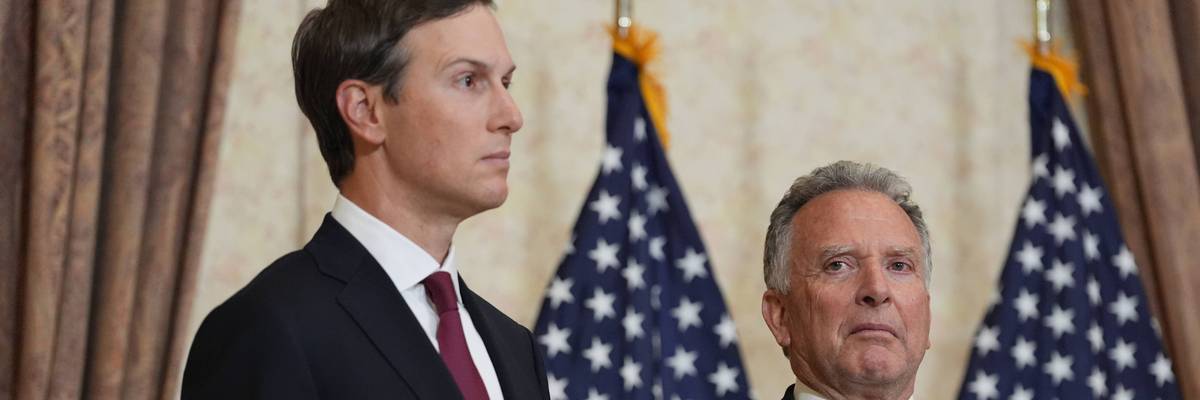
Jared Kushner and Special Envoy for Peace Missions Steve Witkoff listen as Vice President JD Vance speaks during a news conference after meeting with representatives from Pakistan and Iran, April 12, 2026, in Islamabad, Pakistan.
(Photo by Jacquelyn Martin/Pool/Getty Images)

Stephen Prager
Apr 19, 2026
COMMON DREAMS

Iran says it has no plans to negotiate with the US after President Donald Trump said Sunday that “the whole country is going to get blown up” if Iran refuses to make a deal.

Trump claimed that Iranian officials were heading to Islamabad for another round of talks Monday with Vice President JD Vance, his son-in-law Jared Kushner, and Middle East envoy Steve Witkoff.

But Iran’s official IRNA news agency later reported that claims Iran was coming to negotiate were “not true” and described the announcement as “a media game and part of the blame game to pressure Iran.”


The Tasnim News Agency, which is linked to Iran’s Islamic Revolutionary Guard Corps, reiterated the government’s previous position that it would not negotiate unless Trump lifts his blockade of Iranian ports, which Tehran considers a violation of the ceasefire between the US and Iran.

After Trump said the blockade would continue, Iran again shut down travel through the Strait of Hormuz on Saturday, following a brief reopening Friday following the announcement of a ceasefire between Lebanon and Israel.

IRNA added that negotiators decided not to return because of “Washington’s excessive demands, unrealistic expectations, constant shifts in stance, repeated contradictions, and the ongoing naval blockade.”

An unnamed Iranian official familiar with Tehran’s internal deliberations told Drop Site News on Sunday that Tehran is prepared for a long war.

He said negotiators would prefer to make a deal with the US that would give Iran the right to enrich uranium, provide sanctions relief, and establish a long-term non-aggression framework.

But the official said Trump’s erratic behavior and maximalist demands—including that Iran surrender all its enriched uranium—are causing Iranian officials to sour on the idea that he could ever be a trustworthy negotiating partner.

“Our assessment is that Trump effectively lacks both a coherent plan and the capacity to secure even a temporary agreement,” the official said. “His decision-making appears to be grounded in Israeli political and security assessments, conveyed to him on a daily basis.”


Trump has expressed a desire to find an off-ramp from the war, which has caused economic upheaval and further tanked his already grim approval rating.

But he has also stood by Israel as it has repeatedly undermined negotiations by continuing its attacks on Lebanon, including after a 10-day ceasefire that began Friday. Iran has portrayed ending these attacks as key to a durable ceasefire agreement with the US.

The official said that during the previous round of talks in Islamabad, which resulted in a two-week ceasefire earlier this month, Iran “clearly stated” to Vance that “public threats” like the one Trump issued to wipe out all of “Iranian civilization” would not be tolerated again.

Even before Trump made more such threats Sunday morning, Iran had not yet agreed to another round of talks. The official said that Iranian negotiators are still open to further discussions, but added that they “need to be meaningful, and their framework should be defined in advance.”

“The Islamabad negotiations provided President Trump with an appropriate opportunity to exit the war,” the official added. “Should [Trump] nevertheless choose to continue the conflict, Iran will, for a prolonged period, suspend diplomatic channels and will seek, within the context of the conflict, to impose significantly greater costs on United States interests.”

Mohammed Sani, a political analyst based in Tehran, told Drop Site News that Iran appears prepared to inflict more pain on the US should Trump choose violence.

“We see that the Americans have been bringing in more troops and equipment to prepare to attack, but the Iranians have also not been resting during these two weeks of ceasefire,” he said. “They have been preparing, repairing the underground missile cities, bringing in new air defenses, missiles, and drones. Iran is at a high standard of readiness right now. If there is another round of negotiations sometime later in the future, after another round of American attacks against Iran fail, the Iranian conditions for peace will be much tougher.”


Trita Parsi, executive vice president of the Quincy Institute for Responsible Statecraft, said Sunday that Trump’s apparent belief that he can use threats of mass violence to bully Iran into a favorable deal is pushing Tehran further from the negotiating table.

“Due to poor discipline, Trump ends up prioritizing the optics of victory over actually getting a deal,” Parsi said. “Instead of using deescalatory signals from Iran to get closer to a deal, he declares victory and seeks Iran’s humiliation, and by that, he undermines his own diplomacy.”


‘The Whole Country’s Going to Get Blown Up’: Trump Renews Genocidal Threats to Iran as Ceasefire Collapses


“Whether he means it or not, his saying it is an indelible moral stain on our country,” said one law professor.


Stephen Prager
Apr 19, 2026
COMMON DREAMS


President Donald Trump on Sunday renewed his threat to carry out a genocidal attack on Iran, pledging to “blow up” the “whole country” of over 90 million people and to demolish critical civilian infrastructure if it does not sign a peace deal by Wednesday.

“If they don’t sign the deal, then the whole country is going to get blown up,” Trump said, according to Fox News correspondent Trey Yingst, who relayed the comments on air Sunday morning.


Trump also reportedly said that the US was “preparing to hit [Iran] harder than any country has ever been hit before because you cannot let them have a nuclear weapon.”


The comments came after Iran once again closed the Strait of Hormuz on Saturday in response to the continued US blockade of Iranian ports, which Iranian officials said violated the terms of the agreement reached between the two countries.

After renewing the blockade, Iranian gunboats fired upon a pair of Indian-flagged ships attempting to travel through the strait Saturday.

In response, Trump issued a furious post on Truth Social Sunday morning, saying that he would send a team of negotiators—Vice President JD Vance, his son-in-law Jared Kushner, and special envoy to the Middle East Steve Witkoff—to Islamabad on Monday for another round of negotiations.

“We’re offering a very fair and reasonable DEAL, and I hope they take it because, if they don’t, the United States is going to knock out every single Power Plant, and every single Bridge, in Iran,” Trump wrote. “NO MORE MR. NICE GUY!”

“They’ll come down fast, they’ll come down easy and, if they don’t take the DEAL, it will be my Honor to do what has to be done, which should have been done to Iran, by other Presidents, for the last 47 years,” he continued.

It echoed the similarly genocidal threat made by Trump earlier in April that “a whole civilization will die... never to be brought back again,” if Iran did not agree to a deal, which drew worldwide condemnation and sparked efforts by some members of Congress to pursue impeachment or push for Trump’s cabinet to remove him via the 25th Amendment.


Trump has appeared eager to end the war with Iran after it caused economic upheaval and pushed his already dire approval rating even lower. But he has also backed Israel when it sought to undermine key points of the agreement, prompting retaliation from Iran.

The ceasefire announced earlier this month between the US and Iran initially included a halt to the hostilities between Israel and Lebanon. But within hours, Israel unleashed its most punishing set of attacks against Lebanon since the war began in March. Trump then backed Israeli Prime Minister Benjamin Netanyahu when he claimed that Lebanon was never part of the deal.

Iran only agreed to open the Strait of Hormuz on Friday after Israel and Lebanon appeared to agree to a 10-day ceasefire. But Israel has already violated that agreement several times, continuing to raze Lebanese villages and fire upon people approaching its newly imposed “yellow line.”

In addition to calling for the reopening of the Strait of Hormuz, which was open before he launched the war in late February, Trump has demanded that Iran make a deal to hand over all of its enriched uranium, which he refers to as “nuclear dust.”

A spokesperson for Iran’s Islamic Revolutionary Guard Corps (IRGC) has said such a proposal would violate Iran’s sovereignty: “Iran’s uranium is Iran’s asset. It is our responsibility, our energy, our sovereign right.”

An end to the attacks against Lebanon has been described as another central demand from Iran, although officials said the decision to close the strait again on Saturday was in response to Trump’s continued blockade of Iranian ports.


International law strictly prohibits indiscriminate attacks on civilian infrastructure with no military objective, including bridges and power plants that are critical to human life.

Trump’s previous threats to bomb Iran “back to the Stone Ages” suggest that the latest threats are less about accomplishing a specific military objective than about inflicting suffering on Iranian society as leverage.

Last time Trump made such a threat, a coalition of more than 200 groups, including Amnesty InternationalHuman Rights Watch, Refugees International, and Oxfam America, wrote in an urgent letter stating that if carried out, such attacks would constitute “a grave atrocity” and that “a threat to wipe out ‘a whole civilization’ may amount to a threat of genocide.”

Human Rights Watch said that, if acted upon, “the statement could be indicative of criminal intent if Trump were ever prosecuted by the International Criminal Court.

The last time Trump threatened to unleash an apocalyptic attack on Iran, the threat preceded a deal that, at least in principle, involved the US agreeing to negotiate based on a set of terms laid out by the Iranians. This led many observers to characterize the threats as bluster meant to save face before capitulation rather than a sincere pledge to annihilate Iran.

However, Adil Haque, a law professor at Rutgers and the executive editor at Just Security, said that, “Whether he means it or not, his saying it is an indelible moral stain on our country.”
Trump 'incapable' of accepting US has lost the war with Iran: Nobel laureate

Ewan Gleadow
April 18, 2026 
RAW STORY


President Donald Trump looks on after disembarking Air Force One as he arrives at Joint Base Andrews in Maryland, on April 12, 2026. REUTERS/Kevin Lamarque

President Donald Trump has lost the war with Iran but is refusing to accept it, according to a Nobel Prize winner.

Paul Krugman believes that Trump is flat out unable to deal with the fallout of the war in Iran, and that it has not yet set in that the United States' intervention in the Middle East has failed. Writing in his Substack earlier Saturday, Krugman claimed, "It’s been clear for a while that the United States has basically lost this war.

"The goal was to achieve regime change, possibly to take Iran’s uranium. Neither of those is going to happen. The Iranian regime is a harder line than it was before. Iran has ended up strengthened because it’s demonstrated its ability to shut off traffic through the Strait of Hormuz.

"Well, as best I can tell, and this is all speculation now, I don’t think that Trump has taken on board, maybe he’s emotionally incapable of taking on board the reality that he screwed up, that he took us to war and lost, that he, in his mind, still thinks that America has the upper hand and that the Iranians are cowering in fear over the might of the U.S. military, and that he doesn’t need to make any concessions."

The Strait of Hormuz had briefly been opened by Iran but was again closed over a US blockade. A new closure of the Strait of Hormuz was confirmed by Iranian military operational command, Khatam Al Anbiya, with a statement accusing the US of "maritime piracy and theft".

The statement reads, "For this reason, control of the Strait of Hormuz has reverted to its previous state, and this strategic waterway is under the strict management and control of the armed forces."

"Until the US restores the complete freedom of navigation for vessels from an Iranian origin to a destination, and from a destination back to Iran, the situation in the Strait of Hormuz will remain strictly controlled and in its previous state."

President Trump previously imposed a naval blockade of the Strait of Hormuz as part of his escalating Iran war strategy, declaring he would "immediately eliminate" Iranian Navy vessels attempting to breach it.


The dirty secret Europe's far right doesn't want Trump to know


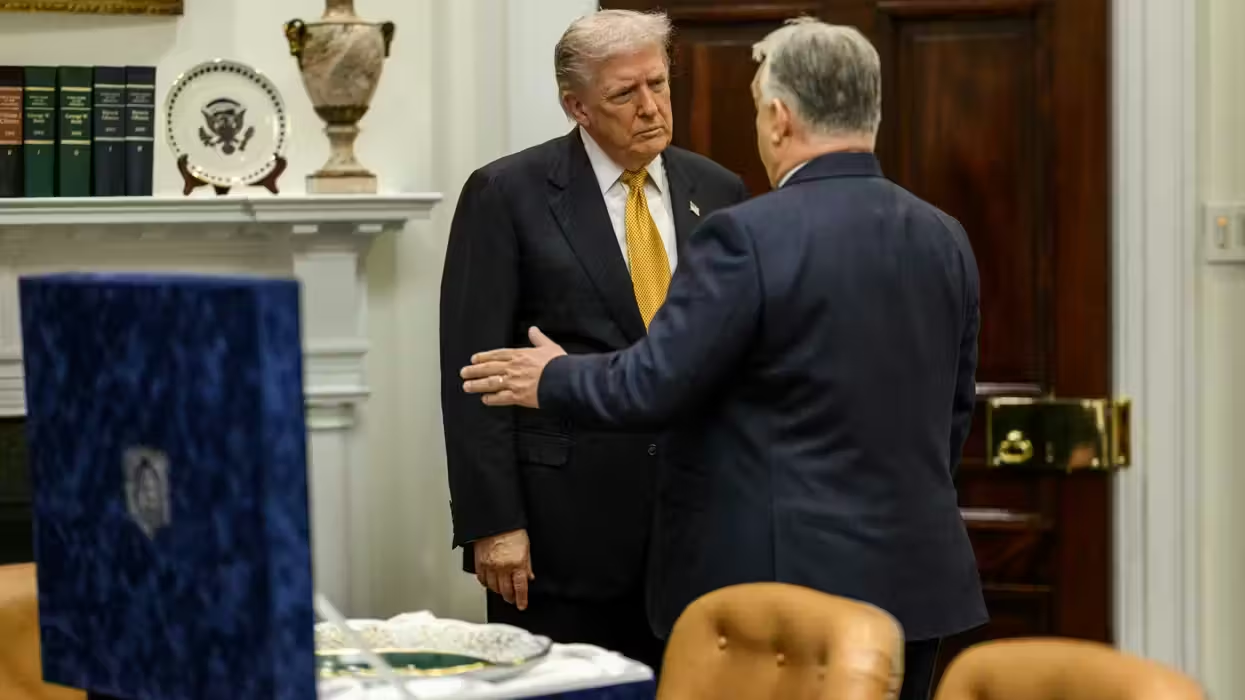
U.S. President Donald Trump with Hungarian Prime Minister Viktor Orbán in the White House on November 7, 2025 (Official White House Photo by Daniel Torok/Flickr)

April 19, 2026 
ALTERNET


President Donald Trump has done his best to curry the favor of Europe’s far right, but after seeing Hungarian Prime Minister Viktor Orbán go down to humiliating defeat despite Trump’s support, the far right now wants to put daylight between itself and America’s leader.

“President Donald Trump’s offensive behavior toward Christians and his unnecessary and unpopular war in Iran isn’t just splitting his political base at home — it’s also alienating his allies abroad,” wrote MS NOW’s Zeeshan Aleem on Sunday. “Right-wing nationalists in Europe are becoming more and more wary of association with Trump and growing inclined to keep him at a distance to protect their own political projects. The trend marks a blow to Trump’s aspirations of creating an international bloc of right-wing nationalist states that work in concert to quash the left.”

Aleem ticked off a number of prominent Italian conservatives who are denouncing Trump including Italian Prime Minister Giorgia Meloni, a number of German lawmakers from the far-right Alternative for Germany party, Romania’s European Parliament member Diana Sosoaca and French far-right leader Marine Le Pen. Their criticisms have ranged from his meddling in European domestic politics, his invasion of Iran and his attacks on Pope Leo XIV.


“Those bold criticisms speak to how incredibly damaging Trump’s war on Iran has been for his standing within his movement,” Aleem observed. “The surge in global oil prices is politically radioactive; far-right leaders and parties in Europe affiliated with Trump risk becoming associated with the energy crisis unless they take steps to create distance from him.”

Indeed, as recently as last week, the United Kingdom’s Brexit champion Nigel Farage downplayed his relationship with Trump, who he once said was ushering in “the beginning of a golden age,” by instead saying “I happen to know him, but that’s by the by.”


Overall, this pattern speaks to how Trump’s brash approach to governance has alienated America’s European allies.

“Trump, for so many people, epitomizes the ugly American — somebody who is bumptious and vulgar and ignorant about foreign cultures,” former Time Magazine editor Rick Stengel said in a recent podcast appearance on The Bulwark with former Daily Beast editor-in-chief John Avlon on Sunday. “So I think people sort of have come to the end of their patience with America.”

Ironically, Trump has aggressively courted the European far right as his natural ideological allies. Trump appointee Susan B. Rogers was selected as Under Secretary of State for Public Diplomacy and Public Affairs in large part to ingratiate herself to the far right, such as by describing German migrants as “barbarian rapist hordes,” falsely claiming Sweden’s immigration policy has caused sexual violence (“If your government cared about ‘women’s safety,’ it would have a different migration policy”) and incorrectly stating that “advocates of unlimited third world immigration have long controlled a disproportionate share of official knowledge production.”

Rogers even met with members of the Alternative für Deutschland (AfD) Party, which espouses an ideology widely perceived as neo-Nazi.

MAGA's 'self-appointed crusade' in Europe falls flat as Vance left reeling: analysis

Ewan Gleadow
April 19, 2026 
RAW STORY


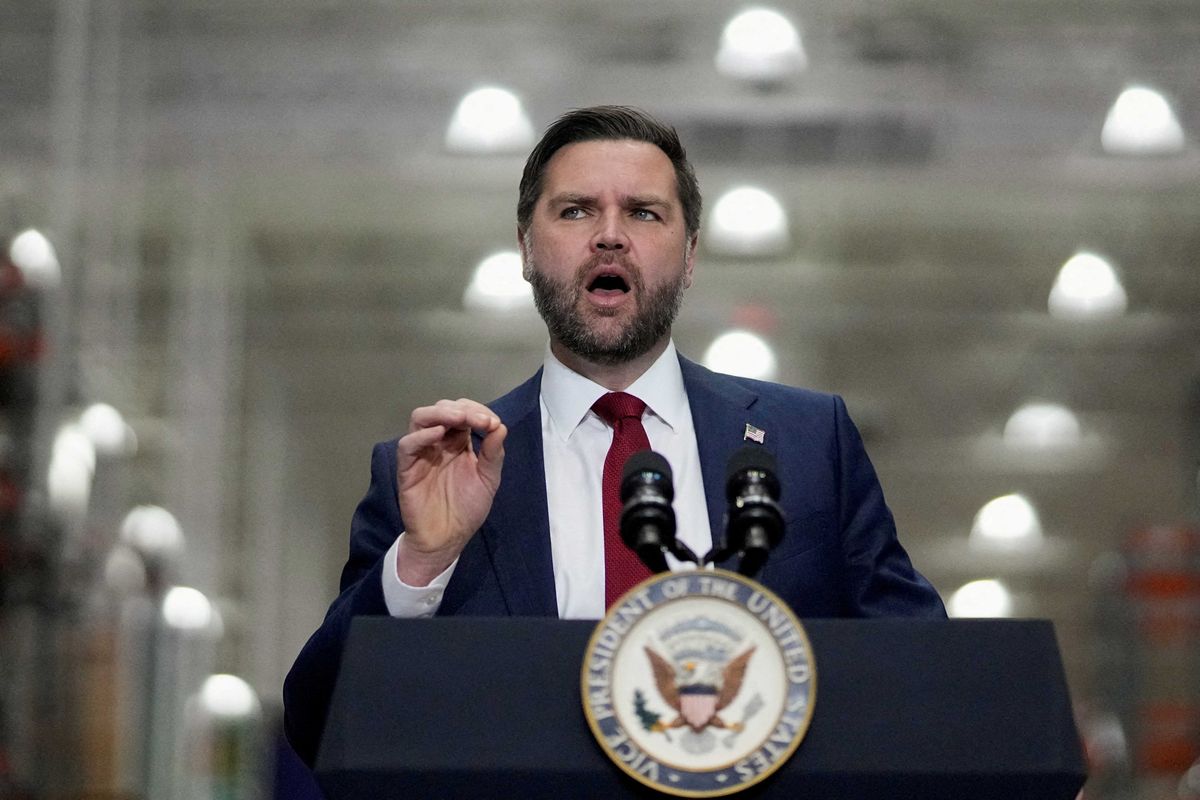
Vice President JD Vance delivers remarks at Uline Inc., in Alburtis, Pennsylvania on Dec. 16, 2025. REUTERS/Eduardo Munoz

MAGA supporters were dealt a devastating blow earlier this week and will struggle to recover from it, a political analyst has claimed.

Hungarian Prime Minister Viktor Orban, a far-right autocrat who has led the country for 16 years, conceded defeat in April 2026 to opposition leader Peter Magyar, marking a stunning rebuke to Trump-backed authoritarianism in Europe. Endorsement from Vice President JD Vance was not enough to win Orban the election, marking an embarrassing moment for Donald Trump's administration and the MAGA movement.

Salon columnist Andrew O'Hehir believes Orban's election loss will set the MAGA movement back, but not stop them from attempting to pool their resources in Europe. He wrote, "It wasn't a great week for the far right’s self-appointed crusade to reconquer Europe as a fairytale paradise of whiteness and Christianity.

"Maybe that’s because that whole idea is vaporware, rooted in a nonsensical social and historical vision and devoted to a losing battle against economic and demographic reality. But that quality of noble, doomed struggle toward impossible goals is both the far-right movement’s fundamental weakness and the source of its power and danger."

O'Hehir went on to suggest that MAGA's backing of Orban and the subsequent election loss highlighted an undermining of Trump's own support during his second term in the Oval Office.

He wrote, "Viktor Orbán, the pudgy poster boy for 'illiberal democracy' and object of a mysterious man-crush by legions of American conservatives, suffered a catastrophic electoral defeat in Hungary that felt, at least for a day or two, like the global MAGA movement’s Waterloo moment.

"As for Donald Trump, what is there to say? The entire world is over him, big time, and it’s the unique curse of America’s narcissistic self-regard that we’re still stuck with him, dominating the headlines day after day with his empty, contradictory and randomly-punctuated blather.

"Trump heads into the latter stages of his presidency as a damaged and toxic figure, a human AI-meme desperately trying to spin his way past the massive humiliation of the Iran war he chose to fight and the global energy crisis he single-handedly created.

"As for the ambitious schemes to reshape Europe’s political map variously proposed by JD Vance, Stephen Miller, Steve Bannon and Elon Musk, among others, to this point none have amounted to more than flatulent rhetoric."

Trump handed 'historic indictment' as economy in worst shape since Eisenhower: analyst

Ewan Gleadow
April 19, 2026
RAW STORY


President Donald Trump has been handed a grim reality check with a poll suggesting his administration's economy is the worst in 74 years.

Political analyst Pat Ford, during an appearance on the David Pakman Show, highlighted how the economy had sunk to its lowest point in decades under Trump's watch. A 74-year low puts the Trump economy on the same footing as Dwight D. Eisenhower's economic forecast in the early 1950s.

Ford said, "American consumers have delivered their verdict. They feel this economy under Trump is the worst in 74 years. The results are a historic indictment of the current administration."

The University of Michigan’s Consumer Sentiment Index fell to 47.6 in preliminary April 2026, a drop of 10.7% from March 2026. It is also the lowest reading in the history of the Consumer Sentiment poll. The prior record low came under Joe Biden's administration in 2022, which Ford explained was during a time when the United States had only just begun to recover from the Coronavirus pandemic.

Ford added, "There was also the start of the Russia-Ukraine war. This is immeasurably tied to Trump's decision to attack Iran because last month Trump was at 53.3, several points higher, now it's dropped 10.7%."

The results, Ford argues, put the US economy in a "more desperate light than even the 2008 financial crisis," but noted it does not mean the economy is "inherently worse" than 2008.

"It does mean that consumers feel the most dejected, that they feel the least confident this time since 1952. I think it is important to point out, especially because this has to do with how the public is feeling and we're only seven or so months away from the 2026 midterms, and people are going to be voting with their wallets.

"They're going to be voting based on how the economy is doing. And if Americans are saying that the economy is worse at this point than it has been at any point over the last 74 years, that's not going to be good for Trump, and that's not going to be good for Republicans. So you better believe that this economic sentiment is going to show up in the midterm elections."


Trump considered awarding self Medal of
Honor amid Iran war chaos: insiders

Alexander Willis
April 19, 2026
RAW STORY

Amid the ongoing U.S. war against Iran, President Donald Trump considered awarding himself the Medal of Honor, the most prestigious military award issued by the U.S. government, White House insiders claimed in a report published Saturday evening in the Wall Street Journal.

Citing a “senior administration official” and people who have “spoken” with the president, the Journal’s report revealed that Trump had privately panicked in early April after learning of the downed U.S. fighter jet over Iran.

“Trump screamed at aides for hours. The Europeans aren’t helping, he said repeatedly. Gas prices averaged $4.09,” the Journal’s report reads. “Images of the 1979 Iranian hostage crisis – one of the biggest international policy failures of a presidency in recent times – had been looming large in his mind, people who have spoken to him said.”

According to a senior administration official, Trump had demanded that the pilots of the downed fighter jet be rescued immediately, though discussions grew adversarial due to the president’s “impatience.”

“Aides kept the president out of the room as they got minute-by-minute updates because they believed his impatience wouldn’t be helpful, instead updating him at meaningful moments, a senior administration official said,” the Journal’s report reads.

Amid the chaos, which according to the insiders also involved Trump “sometimes” losing focus and attempting to pivot to topics unrelated to the U.S. war against Iran such as his White House ballroom, the president also actively considered awarding himself the highest military decoration in the United States’ history.

“He has made risky pronouncements without input from his national security team – including his post about plans to destroy the Iranian civilization – saying seeming unstable could help spur the Iranians to negotiate,” the Journal’s report reads.

“At one point he even mused he should award himself the nation’s highest military honor, the Medal of Honor.”
Trump's cognitive decline just dragged US into a 'really dangerous' situation: analyst


Robert Davis
April 19, 2026 
RAW STORY

President Donald Trump has dragged the U.S. into a "really dangerous" situation that he can't get out of, according to one analyst.

David Pakman, a liberal YouTuber and host of "The David Pakman Show," argued in a recent reaction video that Trump's efforts to reinstate the terms of the Obama administration's Iran Nuclear Deal, which Trump tore up in 2018, have put the U.S. in a bad situation. On the one hand, it has given Iran some leverage in the negotiations to end the war. On the other hand, it has also soured the relationship between the U.S. and its European allies, Pakman argued.

"We are now getting a president saying out loud, 'I'm trying to get us back to where we were,'" Pakman said. "He can barely speak now, in comparison, with fragmented sentences and all of it. And the reason I'm referring to the cognitive stuff is that Trump wasn't even coherent enough to realize in 2018 that this deal was not bad."

"Now with another seven and a half to eight years of decline behind us, it is even less likely that he is going to be able to put something together," he added.

"So, as Trump tries to dissolve the problems that he created and solve issues that are of his own doing, allies around the world are saying, 'That is not something we want to be a part of.' And that's a really dangerous thing," he continued.