Thursday, April 23, 2026

Why Spain Chooses Engagement With China – Analysis


Pedro Sánchez, Prime Minister of Spain, and Li Qiang, Premier of the People’s Republic of China, preside over the signing of agreements between Spain and China in Beijing (04/14/2026).
 Photo: Pool Moncloa/Borja Puig (CC BY SA 2.0).


April 22, 2026 0 Comments

Elcano Royal Institute
By Miguel Otero Iglesias and Mario Esteban


The fourth visit to Beijing in four years by Pedro Sánchez, Spain’s Prime Minister, has again raised eyebrows across Europe and the Atlantic. In an era marked by growing tensions between China and the US and by the EU’s emphasis on ‘de-risking’, Spain’s sustained high-level engagement with China is often interpreted as strategic divergence.

That reading, however, misinterprets both Spain’s intentions and its strategic logic.

Spain’s approach is not about challenging the transatlantic relationship or aligning with China against the US. Rather, it reflects a pragmatic assessment of what Europe must do to better protect the prosperity and security of its population. From Madrid’s perspective, that requires more than defensive de-risking. It requires building greater European capacity and engaging China in ways that expand Europe’s room for manoeuvre rather than narrow it.

China is not a marginal actor that Europe can afford to sideline. It is a central pillar of global industrial production, a key player in green technologies, and an indispensable partner in addressing global challenges. For Spain, therefore, the question is not whether to engage with China, but how to do so in a way that strengthens economic resilience and contributes to Europe’s broader strategic autonomy.


This pragmatism is rooted in Spain’s historical experience. Periods of closedness have coincided with stagnation, while openness to trade, investment and ideas has driven modernisation and growth. This legacy informs a clear preference: protectionism is not seen as a viable long-term strategy, but as a source of weakening.

At the same time, Spain is above all a committed European actor. The government fully supports the EU’s framework that defines China as partner, competitor and systemic rival, and participates in efforts to strengthen economic security. Spain does not seek to break ranks with Brussels; it aims to shape the EU’s China policy from within.

What Spain does question is the tendency to reduce Europe’s China debate to risk reduction alone. If the objective is to better protect prosperity and security, focusing only on reducing dependencies on China is too narrow and ultimately myopic. Strategic autonomy is not autarky. Europe will remain interdependent with the outside world, and its task is to manage those interdependencies in ways that reduce vulnerability while also creating leverage, resilience and opportunity.

In this context, Spain’s engagement with China is an attempt to recalibrate the current focus on ‘de-risking’ to a more effective approach that combines reactive and proactive initiatives: protecting critical sectors where necessary, but also investing, negotiating and cooperating where engagement can help Europe upgrade its capabilities.

Spain’s alternative is therefore not naïve openness, but structured and conditioned engagement. While it welcomes Chinese investment, especially in renewable energies and electric vehicles, to upgrade industrial capacity, it also recognises the risks associated with asymmetries, dependencies and industrial competition.

Yet the answer cannot be limited to retreat. Europe also needs to seize the opportunities that China offers, especially in sectors where Spain and the EU can gain scale, technology, market access or greater relevance in global value chains. If Europe wants to protect its prosperity and security over the long term, it must become more capable and more strategically indispensable, not simply less exposed.

It is precisely because of these concerns and opportunities that engagement must be accompanied by clear expectations.

Sánchez’s dialogue with Chinese leadership places him in a good position not only to convey European concerns directly, but also to explore openings that could make the relationship more balanced and productive. His message in Beijing was not of unconditional cooperation. Rather, it stressed the need for a relationship with China that enhances reciprocity, strengthens resilience and reduces the appeal of more protectionist approaches inside the EU.

In the future, there are several areas where such progress could take shape, and it is very likely that they have been discussed by Sánchez and Xi.

First, ensuring stable access to critical inputs is essential. Avoiding export restrictions on rare earths and magnets for European partners would reduce supply-chain uncertainty and build trust.

Secondly, Beijing needs to address the concerns raised by the European business community. This would send a strong signal. Issues related to market access, regulatory transparency and level playing field conditions remain central. Improvements here would demonstrate China’s commitment to reciprocity.


Third, opening the services sector to European companies represents a major opportunity. Europe, and Spain in particular, holds competitive advantages in areas such as insurance, health, tourism, engineering and logistics.

Finally, the broader geopolitical context cannot be ignored. Europe’s security environment is shaped by Russia’s war in Ukraine, and China’s position is closely watched. Greater Chinese engagement to help end the conflict in a way acceptable to the invaded party would have a significant positive impact in Europe.

Spain’s frequent visits to China reflect an effort to preserve room for manoeuvre, diversify partnerships, and contribute to a more balanced and autonomous European position. For the Spanish Government and regions, engaging with China is not an alternative to protecting Europe’s security and prosperity; it is part of how that protection should be pursued, provided it is guided by the principles of reciprocity, realism and clear European interests.

Whether this approach becomes a broader European paradigm will depend on the evolution of China’s own policies as much as on Madrid’s capacity to persuade other capitals. Productive engagement must ultimately be built on a two-way street.


About the authors:

Miguel Otero-Iglesias is Senior Fellow at the Elcano Royal Institute, Professor at the IE School of Global and Public Affairs, and Research Director at the Center for the Governance of Change at IE University. He is the co-founder and coordinator of the European Think Tank Network on China (ETNC) and is also a Research Associate at the EU-Asia Institute at ESSCA School of Management in France.

Mario Esteban is Senior Fellow at the Elcano Royal Institute and Full Professor at the Autonomous University of Madrid, where he is the Director of the Centre for East Asian Studies. He has been senior researcher of projects funded by the Spanish Ministry of Economy, Industry and Competitiveness, the Spanish Ministry of Foreign Affairs, and the Korea Foundation. He has served as external expert for the European Commission, the European Parliament and the Spanish Ministry of Defence.


Source: This article was published by Elcano Royal Institute

The Elcano Royal Institute (Real Instituto Elcano) is a private entity, independent of both the Public Administration and the companies that provide most of its funding. It was established, under the honorary presidency of HRH the Prince of Asturias, on 2 December 2001 as a forum for analysis and debate on international affairs and particularly on Spain’s international relations. Its output aims to be of use to Spain’s decision-makers, both public and private, active on the international scene. Its work should similarly promote the knowledge of Spain in the strategic scenarios in which the country’s interests are at stake.


Correlating US Aggression On Cuba, Venezuela And Iran: The Oil Factor – Analysis


April 22, 2026
Manohar Parrikar Institute for Defence Studies and Analyses (MP-IDSA)
By Dr. Saurabh Mishra

Venezuela and Iran, the two countries that President Trump has targeted for military operations to date, along with the US, account for about one-third of global oil reserves. The endgames of the US aggression against Venezuela, Iran, and possibly Cuba in the near future may focus on long-term deals that include oil benefits. The Trumpian economic strategy hinges on access to cheap oil.

At the beginning of 2026, United States (US) forces abducted President Nicolás Maduro of Venezuela with the intention of regime change, although the stated goals were different. We also witness the US facing extreme difficulty in breaking Iran’s will to fight, and Tehran is resisting regime change despite immense losses to its top leadership, military and civilian infrastructure. Cuba, too, has a standing threat issued by President Trump, who had been projecting himself as the ‘President of Peace’ until a few months ago.

Trump threatened Cuba with a “friendly takeover”[1] in “some form”,[2] along with choking the country by blockading its oil imports and threatening its suppliers. The country has been under duress with chronic blackouts due to a fuel shortage. Cuban authorities confirmed that there was no oil shipment from January 2026 until the end of March, when a Russian oil tanker arrived with a consignment of 730,000 barrels.[3] President Trump has repeatedly indicated that he would be focusing on his next target, Cuba, once the conflict with Iran is over.[4]

Venezuela and Iran are very different in terms of their political composition, power and identity, and neither of them is/was an imminent military threat to the US. Although Trump’s military actions have been framed as preemptive responses to the threat to US citizens, its core security interests and safety of assets, one factor that Trump has downplayed or not mentioned while stating his objectives is the presence and potential of oil reserves in the two countries.


President Trump’s actions against Cuba are perplexing as to why he would threaten a tiny island nation that cannot pose any real military or economic threat in the context of contemporary global geopolitics. The return of Cuba, which has gradually been phased out of high-level geopolitical discussions since the end of the Cold War, into US grand-strategic calculations, needs explanation. This brief examines President Trump’s desire to “take over” Cuba and highlights the oil variable correlating his rhetoric and actions on Cuba with operations in Venezuela and Iran.

The Façade and the Truth in Venezuela Operation

On 3 January 2026, US forces abducted President Nicolás Maduro of Venezuela, along with his wife, in Operation Absolute Resolve. The couple was accused of heading a drug network impacting the youth and families in the US. President Trump, who previously had reduced US foreign military commitments, expressing a desire for peace and economic prosperity of the US, has ironically been successful in putting military pressure on Venezuela to open up for ‘reforms’ and make structural changes to its economy, especially in the oil sector, so that it could facilitate foreign (US) investments. Venezuela has the largest proven oil reserves, constituting approximately 17 per cent of the global total.[5] The stated objective of eliminating the drug and refugee problems emanating from Venezuela was soon overshadowed by the real calculations and strategies of developing oil fields in the country by US companies with a planned investment of US$ 100 billion over time.[6] The military threat over Venezuela, however, lingers to the degree of the Venezuelan regime’s non-cooperation with the US.[7]

The Bogeyman of Imminent Threat in Iran


Within a couple of months of the Venezuela action, the US, along with Israel, attacked Iran on 28 February 2026 and decapitated its leadership by killing Ayatollah Ali Khamenei, along with other high-ranking politicians and military officers, in Operation Epic Fury. The stated objectives were “eliminating imminent threats from the Iranian regime” and to “ensure that Iran does not obtain a nuclear weapon”.[8] Obliterating the Iranian missile industry, annihilating their navy and disabling their regional proxies were a few other stated objectives.[9]

It must be noted that the claims of both the US and Israel after the 12-day war in June 2025 had ranged between “obliteration” of Iran’s nuclear bomb building capability and a “setback” in “Iran’s ability to develop nuclear weapons by many years”. The assessments claimed that it might take Iran many years to reconstitute the lost capability of enriching Uranium and build a weapon out of it.[10] The Israeli Prime Minister’s Office had also claimed, “The achievement can continue indefinitely if Iran does not get access to nuclear material”.[11] Moreover, Joe Kent, Director, National Counterterrorism Centre in the US, resigned, saying, “Iran posed no imminent threat to our nation, and it is clear that we started this war due to pressure from Israel and its powerful American lobby”.[12]


Therefore, a surprise attack on Iran only within a year, against assessments of the country not posing an immediate threat to the US, along with the targeted assassination of its highest leadership and administrators, reveals a calculated intention for regime change with strikes for which no immediate provocation by Iran was visible. President Trump called on the people of Iran to take over the regime, as this might be their chance that they have had in generations.

The range and nature of the targets selected at the beginning of the US–Israeli joint strikes were beyond what was required to eliminate Iran’s nuclear capability, which was allegedly achieved in June 2025 itself. Therefore, the US’s emphasis on the nuclear dimension as justification for the attacks seemed more like a bogeyman. At the same time, the real objectives were different and linked to the long-term Trumpian grand strategy to be achieved through regime change in Iran. President Trump, known for his transactionalism, is spending billions of dollars on military adventures in Iran. Hence, the question is what motivated him to go to this war.

Did Israel Pull Trump into the War?

It is speculated that President Trump was led into the war by Israel. Israel’s objectives and motivations for the strikes can be understood in light of its antagonistic relationship with the country. Israel had been looking for an opportunity to bring the US on board with its designs to eliminate the Iranian regime, and Prime Minister Netanyahu of Israel succeeded with President Trump this time. But the question again is why Israel could convince Trump.

Given his inclinations and transactional temperament, President Trump should not join a war without concrete business incentives. His real motivations in this war, however, are less understood and quite obfuscated. Differences of opinion have also appeared within the Make America Great Again (MAGA) leadership about the ways of the movement that thrusted him to power. There is a divide within, and Trump, with his adventures in Venezuela and Iran, stands for his own faction. His war on Iran has received credible backing by the Republican Party supporters,[13] anointing his actions as the legitimate MAGA approach. Therefore, to understand his motivations and adventures, we must look into his policy and strategic outlook.

President Trump, in his address after the strikes, mentioned every long-term threat posed by Iran to the US interests in the region, but left out one aspect, i.e. oil. The US has historically had an interest in Iranian oil, but the aspirations to get hold of the source were jeopardised by the Iranian Islamist Revolution in 1979.[14] The Israeli objective of regime change or weakening Iran to a point of no return was deemed as a chance that converged with President Trump’s long-term strategic goals, hinged on an oil vision.

Trump’s approach, discernible in the National Security Strategy 2025, introduces oil as a correlating variable to be discussed in relation to his global strategic adventures, leading to military actions that began in Venezuela.[15] In 2023, Iran accounted for 12 per cent of the global oil reserves and 24 per cent of the Middle East.[16] The two countries that President Trump has targeted for military operations to date, along with the US, account for about one-third of global oil reserves. President Trump’s eagerness to end the war and expression of desire to control Kharg Island and the Iranian oil amidst the conflict alludes towards the original motive of controlling the Iranian oil with a brief blitzkrieg of air power, eliminating its leadership. No other economic factor explains President Trump’s allowing himself to be led into this expensive war.


As there was no immediate provocation by Iran, the US stated objectives appeared to align with Israeli objectives at the outset. However, as the conflict unfolded and the US (especially Trump) considered ending it even without the Strait of Hormuz reopening to normal operations, this revealed the US’s eagerness to get out of the expensive quagmire it had fallen into.[17] This also exposed the difference in goals between the two partners, despite their shared means of regime change. Israel’s motivation for the attack was a shift in the regional strategic balance and long-term security through regime change and weakening of Iran, and this could provide President Trump access to Iranian oil. A Venezuela-like cooperation from the Iranian leadership post the initial strikes appears to have been expected, but the dynamics of the conflict have set back US expectations.
The Centrality of Crude Oil in Trump’s Domestic and Global Strategy

President Trump started his second term with the slogan “drill baby drill”.[18] He concluded that producing more oil would help grow the US economy faster and secure its future hegemony.[19] His pursuit of foreign oil resources is also important to study, as President Trump himself has highlighted that the US is a net energy exporter and does not need foreign oil as it did in the past.[20] It is noteworthy that within a month of the inauguration of his second stint, President Trump signed an executive order stating his administration’s policy of “making America energy dominant”.[21] To this end, the order established the National Energy Dominance Council (NEDC) under the Executive Office of the President.[22]

Now, the question is: why does the US need this Council to dominate energy if the country has a surplus, and who is supposed to be dominated? The executive order, however, did not explicitly mention any other country or region to be dominated; and instead focused on planning from a “long-term” energy perspective towards increasing production of “reliable energy”. For this, the Trump administration prioritises oil drilling over green policies favouring renewables as he has reversed policies that supported and promoted electric vehicles.[23] The Endangered Species Committee in the US has also recently cleared oil and gas drilling in the Gulf of Mexico, exempting it from environmental rules, a move that could threaten a rare whale species and other marine life.[24] The Trumpian economic strategy clearly hinges on access to cheap oil.

Why the Threat to ‘Take Over’ Cuba?


After Venezuela and Iran, which are oil-rich countries, Cuba is a curious case that has not been in global news for its oil reserves. The island, home to around 10.9 million people, located only 90 miles off the southern US state of Florida, is associated with President Fidel Castro, its communist revolution, and its very close relationship with the Soviet Union (USSR) despite being a ‘non-aligned’ country during the Cold War. Cuba was governed by the Castro family under the banner of the Communist Party of Cuba, with single-party rule from 1959 to 2018. And, since then, it has been ruled by President Miguel Díaz-Canel under the same system.


Cuba is known for its famous cigars, sugar production (once among the highest globally but currently at record-low levels and negligible on a global scale), world-class rum, and pristine beaches, but not for oil. It is also recorded in modern history and international relations for the infamous Cuban Missile Crisis, which took the world to the brink of nuclear war in October 1962. The US had blockaded the country during the Crisis, and it has been under a strict US sanctions regime since then. The end of the Cold War, with the disintegration of the Soviet Union and the weakening and reinvention of Russia as a successor state and polity, reduced Cuba’s strategic importance in global geopolitics. The state, however, remains a communist-run system with currently declining industrial and well-being indicators. It has ideological opposition to US policies, but cannot pose any military or political threat in the post-Cold War scenario.

Due to the historical baggage, Cuba keeps good relations with countries that oppose US hegemonic policies and its ambitions of unipolarity. Therefore, in the executive order signed on 29 January 2026, President Trump found Cuba’s “policies, practices and actions” as constituting “an unusual and extraordinary threat” to the “national security and foreign policy of the United States”. The allegations are that Cuba has relations with “numerous hostile countries”, “terrorist groups”, and “malign actors hostile to the United States” that include Russia, China, Iran, Hamas and Hezbollah. Citing Cuba’s relations with these actors and blaming it for having “Russia’s largest overseas signals intelligence facility” and “deep intelligence and defence cooperation” with the People’s Republic of China (PRC), the executive order links it with the US’s notion of Western Hemisphere security and dominance.[25] The country, in fact, has been doing this for decades, but still cannot pose any real threat to the US.

A situation that was considered non-threatening and manageable with sanctions has now been categorised as a “national emergency”. The reasons for this shift are President Trump’s ideological perspective and the resulting threat perception, which makes him sensitive to anything linked to China in the American neighbourhood. Trump has concluded that he needs to push back against the increasing Chinese reach and penetration into the economic and strategic sectors in Latin America, especially in countries ruled by left-leaning leaders. Venezuela and Cuba, from the US perspective, are seen as classic autocratic ideological opponents in the region. Brazil, Mexico and Colombia, too, have left-leaning leadership. Still, they are viewed as functional democracies and may be more difficult to handle due to their size, resources, political culture and international relations. Colombia is a case in which there is a left-leaning government for the first time in modern history, and the upcoming presidential elections may alter the current government. Power in these countries may change hands between the right and left, but Cuba is different. President Trump’s military threat to the country is not justified by any explicit economic reason. The reasons cited are strategic, and Cuba has also been designated as a “state sponsor of terrorism” for sheltering members of US-designated terror organisations.[26] It may be noted that Trump had similar allegations against Venezuela and Iran, which also have the common mineral resource factor of substantial oil reserves that could be turned into long-term energy and economic benefits for the US. Given the absence of a large oil industry, Cuba, at the surface, seems to be a different case altogether. But, with a further inquiry into the country’s crude oil potential, the perception changes.

Cuba as a Potential Petro Power in the Western Hemisphere


Cuba currently has only 124 billion barrels of proven oil reserves, ranking it the 67th largest reserve holder.[27] The US and Cuban geological surveys estimate recoverable oil reserves between 4.6 and 20 billion barrels, respectively.[28] Various geological assessments of Cuba, especially its northern offshore Exclusive Economic Zone (EEZ) blocks, identify and acknowledge its potential to catapult itself among the top 20 largest proven oil reservoirs in the world and become a significant player in the oil economy of the Latin American Region. Even if the mean potential of the reserves is realised, only Venezuela and Canada would be able to surpass Cuba in terms of per capita oil reserves in the Western Hemisphere.[29] The estimates for the Cuban offshore fields are at least half the size of the US’s Alaskan oil reserves.[30]

Since the discovery of Cuba’s oil potential in the early 21st century, the country has sought to reduce its energy dependence on Venezuela and Mexico amid the post-Cold War geopolitical landscape. Oil companies from Canada, China, Russia, Spain, Norway and India had shown interest and invested in Cuba’s offshore exploration blocks, but nothing productive has come of it. Almost 80 per cent of the exploration area lies in deep or ultra-deep waters, and oil cannot be easily extracted with old technology.[31] The state-of-the-art exploration technology is owned and controlled by the US, which has imposed sanctions and a blockade against Cuba, making it difficult to drill due to technology and investment denial, and practically choking the country from becoming energy self-reliant.[32] The development of offshore oilfields over time could boost the Cuban economy and national prosperity, making Cuba a significant player in the region’s petroindustry, although possibly at the cost of economic diversification.[33]

US companies in the agricultural and pharmaceutical sectors have been pressing, sometimes successfully, for relaxations or normalisation of relations with Cuba to gain better access to its lucrative business opportunities.[34] Similarly, US oil companies have also been, though unsuccessfully, lobbying the US Congress to permit them to bid for oil and gas exploration in Cuban Waters. With only a small fraction of the world’s proven oil reserves open to foreign involvement,[35] they do not want to be left out of the race.[36] Former US President Barack Obama took steps to ease sanctions and build a normal relationship with the country. But, his efforts were thwarted by President Trump’s reversal of his policy towards Cuba. President Trump not only reinstated stringent sanctions on Cuba but also choked its essential crude supplies responsible for more than 80 per cent of its electricity generation.[37]

Amidst the downplayed oil dimension in Venezuela and Iran adventures, President Trump’s attention on Cuba as well as the US companies’ interest in exploration of its oilfields converge at a point where the country needs to be opened up for exploration. President Obama took a few steps towards engagement, but President Trump has a different way of achieving his goals. The oil potential of Cuba fits into his long-term scheme of Making America Great Again (MAGA), for which dominating the global energy market, along with the geopolitics of the Western Hemisphere, is an important condition.

The Political Dimensions of a Cuban Energy Self-Reliance


Industry experts do not expect any global disruption due to the availability of Cuban oil in future, and the realisation of the estimated potential may not impact the global prices in general. But, Cuba shall be energy self-reliant with the realisation of even the lower end of the estimates.[38] Further, the country’s transition to being a net oil exporter will have a positive impact on its economy, leading to the failure of the long-term US sanctions policy against Cuba.[39] Hence, it is imperative from the US perspective to keep Cuba energy-starved until the geopolitical and economic positions of the two countries are aligned. The alignment is possible either with regime change in Cuba or a paradigm shift in the US policy to engage the country with its political system intact. President Obama’s efforts to engage and relax sanctions on Cuba faced tough resistance, especially by migrant Cubans who have a grudge against the Communist regime.

President Trump, however, in the new geopolitical context of increasing influence of China and Russia in the Latin American Region, wants to decisively change the long-maintained status quo to benefit the US through regime change. His rhetoric on Cuba is explained by the convergence of his strategic visions of securing the Western Hemisphere for the US by driving China and Russia out, and of dominating the global energy market. As President Trump’s actions in Cuba are being analysed more from strategic and high-level geopolitical perspectives rather than economic ones, the correlation with oil has received little attention from analysts, who focus only on the country’s current proven reserves and production capacity.[40]

Trumpian Actions Have a Long-Term Economic Perspective on Oil

The US military actions and objectives on Venezuela and Iran are being shaped from a long-term Trumpian economic and strategic perspective, and Cuba is no exception. The exploration and development of oil fields in these countries may take around a decade or more and require heavy investment. Cuba, with its oil potential, is also among the top global producers of Cobalt and Nickel (critical metals for electric vehicle battery production) that may be important to a futuristic US foreign policy. But, President Trump has already ‘debunked’ US policy supporting and promoting electric vehicles by prioritising oil and gas over green and renewable energy sources.[41] Hence, oil has emerged as a clear priority in his calculations for engaging or targeting countries to achieve his strategic and foreign policy goals. In the context of Cuba, too, potential oil fields have to be given greater weight than renewables and critical minerals to understand the Trumpian economic and strategic calculus.

Conclusion


The oil potential of Cuba would be an unsaid benefit for the US if the stated strategic objectives are achieved through regime change. US involvement in oil exploration and production in Cuba could be a viable option for the communist Cuban government as well, but it cannot happen without the US securing guarantees to protect its stated strategic interests in the country. President Trump had already indicated the possibility of a deal between the two countries without an invasion, referring to a takeover in “some form”. Any deal, however, would depend on the Cuban government’s willingness to shed its ideological opposition to the US government. Apart from the US desire to detach Cuba from China, Russia and other unfriendly states in the region, oil exploration could be another lucrative potential benefit for the Trump Administration.

President Trump’s conflict with countries that posed no immediate or imminent military threat to the US should at least be explained by economic logic and motivation. Any conflict initiated for any reason ultimately has its economic endgame. And, as we examine here, oil fits in as the variable correlating to Trump’s aggression and military threat against Venezuela, Iran and Cuba. The presence of the correlation is further highlighted by President Trump’s statements and executive order regarding his energy policy. The US–Israel–Iran war has not yet concluded, and the outcomes may not be as the US expected, but oil could be a benefit in all the three. The endgames of the US aggression against Venezuela, Iran and Cuba may focus on long-term deals that include oil benefits.

The focus on the nuclear material issue might be more useful for legitimising the catastrophe unleashed. But, from the perspective of Trumpian MAGA priorities, the success, rationale, wisdom and the economics of these military adventures would remain highly questionable in the absence of any energy/oil deals.


Endnotes:

Will Grant, “Russian Oil Tanker Docks in Cuba Ending Near-Total Blockade”, BBC News, 31 March 2026.

Cuba War Next? Trump Drops ‘Wait for Two Weeks’ Bombshell as Iran Conflict Explodes”, The Times of India Channel on YouTube, YouTube, 6 March 2026.

Country Analysis Brief: Venezuela”, Energy Information Administration, United States of America, p. 5.

Michael Scherer, “Trump Threatens Venezuela’s New Leader with A Fate Worse than Maduro’s”, The Atlantic, 4 January 2026.

Statement of Policy by the National Security Council (NSC 5402)”, Office of the Historian, Washington, USA, 2 January 1954.

National Security Strategy 2025, pp. 5, 14, and 28.

Alexander Ward and Meridith McGraw, “Trump Tells Aides He’s Willing to End War without Reopening Hormuz”, The Wall Street Journal, 31 March 2026.

President Donald Trump’s Inaugural Address”, The White House, 25 January 2026.
National Security Strategy 2025, p. 14.

Establishing the National Energy Dominance Council”, The White House, 14 February 2025.
Ibid.

State Sponsors of Terrorism”, U.S. Department of State.

Cuba Oil Summary Table”, Worldometer, 15 April 2025
.
H. Michael Erisman, “Cuba as a Hemispheric Petropower: Prospects and Consequences”, International Journal of Cuban Studies, Vol. 11, No. 1, 2019, pp. 43–44.
Ibid.

Jonathan Benjamin-Alvarado, “The Current Status and Future Prospects for Oil Exploration in Cuba: A Special Report for the Cuban Research Institute”, Florida International University, November 2006, p. 6.

H. Michael Erisman, “Cuba as a Hemispheric Petropower: Prospects and Consequences”, no. 28, p. 48.

Jonathan Benjamin-Alvarado, “The Current Status and Future Prospects for Oil Exploration in Cuba: A Special Report for the Cuban Research Institute”, no. 30, p. 4.
H. Michael Erisman, “Cuba as a Hemispheric Petropower: Prospects and Consequences”, no. 28, p. 50.
Ibid., pp. 54–55.

Jonathan Benjamin-Alvarado, “The Current Status and Future Prospects for Oil Exploration in Cuba: A Special Report for the Cuban Research Institute”, no. 30, p. 2.
H. Michael Erisman, “Cuba as a Hemispheric Petropower: Prospects and Consequences”, no. 28, p. 55.

Where Does Cuba Get Its Electricity?”, International Energy Agency, 7 April 2026.
Robert Sandels, “An Oil-Rich Cuba?”, Monthly Review, Vol. 63, No. 4, 2011, pp. 40–45.
Ibid.

Arnab Chakrabarty, “Cuba – Cracks in the Red Citadel, and the US’ Unfinished Geostrategic Dream”, Indian Council of World Affairs, 7 April 2026.

Jeremy M. Michalek, “Trump Reversed Policies Supporting Electric Vehicles − It Will Affect The Road To Clean Electricity, Too”, no. 23.


Views expressed are of the author and do not necessarily reflect the views of the Manohar Parrikar IDSA or of the Government of India.

About the author: Dr. Saurabh Mishra is a Research Fellow at the Manohar Parrikar Institute for Defence Studies and Analyses (MP-IDSA), New Delhi. Prior to MP-IDSA he was an Associate Professor at the Amity Institute for Defence & Strategic Studies (AIDSS), Noida, preceded by his assignments as Research Fellow at the Indian Council of World Affairs (ICWA), an autonomous think-tank of the Ministry of External Affairs, India and Research Assistant at the Institute for Defence Studies and Analyses.

The Manohar Parrikar Institute for Defence Studies and Analyses (MP-IDSA), is a non-partisan, autonomous body dedicated to objective research and policy relevant studies on all aspects of defence and security. Its mission is to promote national and international security through the generation and dissemination of knowledge on defence and security-related issues. The Manohar Parrikar Institute for Defence Studies and Analyses (MP-IDSA) was formerly named The Institute for Defence Studies and Analyses (IDSA).

Wednesday, April 22, 2026

Pan-African Activist Kemi Seba Detained in Pretoria as Rights Groups Fight Benin Extradition

Last updated: April 20, 2026 


Prominent Beninese pan-African activist Kemi Seba remains in custody in South Africa following his arrest earlier this week, as extradition proceedings to Benin get underway. Human rights activists and his legal team are mobilizing to block the extradition, arguing that he would not receive a fair trial in Benin due to political persecution.

Seba (real name Stellio Gilles Robert Capo Chichi) was arrested on Monday in a sting operation at a Pretoria shopping centre alongside his 18-year-old son and a facilitator. Authorities say the group was attempting to cross illegally into Zimbabwe en route to Europe, paying around 250,000 rand for assistance. South African police acted on a Benin-issued international arrest warrant from December 2025.

Benin accuses Seba of “inciting rebellion,” “advocating crimes against state security,” and supporting a failed coup attempt in December 2025. He appeared in court and has been remanded in custody until April 20, 2026, with local charges of conspiracy and immigration violations also filed.

Human Rights Concerns and Opposition to Extradition

A growing number of activists, pan-African voices, and legal supporters — including prominent French lawyer Juan Branco — are campaigning against Seba’s extradition. They describe the case as politically motivated persecution by Benin’s government under President Patrice Talon, claiming the country’s judicial system, particularly the special court (CRIET), lacks independence and is used to silence dissent.


Critics argue Seba faces a high risk of an unfair trial, prolonged detention without due process, and harsh treatment as a high-profile government opponent. His legal team is also leveraging his Nigerien diplomatic passport, asserting immunity and political refugee status. Supporters highlight recent arrests of Seba’s family members in Benin as further evidence of targeted harassment.

International and regional human rights observers are watching the case closely, with calls for South Africa — which has a history of protecting political refugees — to carefully review any extradition request under principles of non-refoulement (not returning individuals to places where they risk persecution or unfair trials).

Background on Kemi Seba

The 45-year-old activist is known for his strong anti-colonial, anti-Western rhetoric, promotion of pan-Africanism, and large social media following. He has previously staged symbolic protests, such as burning French currency.


Benin authorities maintain the charges are legitimate national security matters following the foiled coup, which resulted in multiple arrests.

Seba’s next court appearance is scheduled for April 20, 2026, where extradition arguments, including human rights objections, are expected to be central.


Europeans fear Washington more than Beijing for the first time, Politico reports

Europeans fear Washington more than Beijing for the first time, Politico reports
Donald Trump is the leading reason of Europe going cold on the US, new data reveals. / CC: White HouseFacebook
By bne IntelliNews April 21, 2026

For the first time in the history of transatlantic polling, more Europeans view the United States as a threat to their continent than view China in the same light, a seismic shift in public sentiment.

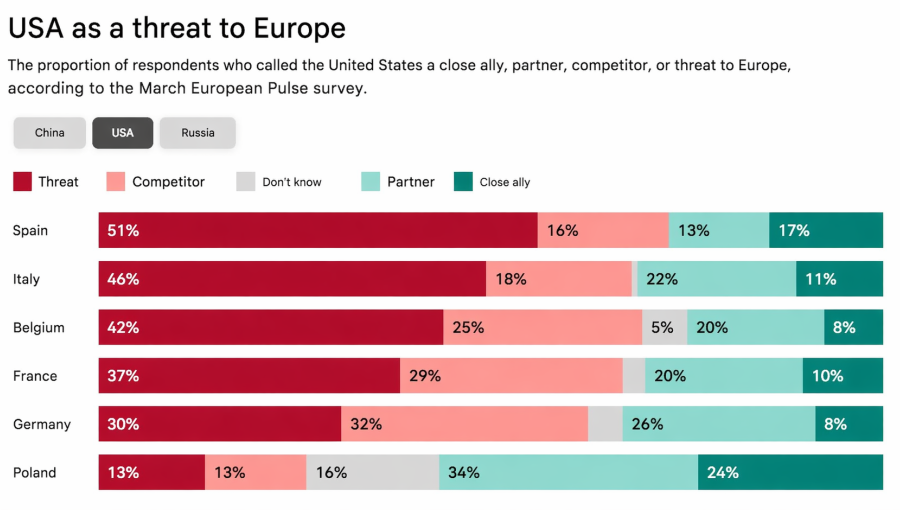
Politico European Pulse survey conducted between March 13 and 21 across Belgium, France, Germany, Italy, Poland and Spain, with at least 1,000 adults surveyed in each country, found that an average of 36% of respondents considered the US a threat to Europe.

In contrast, only 29% expressed equivalent concerns about Beijing. One thing remains unchanged: Russia retains its position as the number one perceived enemy, cited by 70% of respondents across the six countries.

The headline figures mask stark national variations, revealing the fractured geography of European opinion. In Spain, 51% of respondents described the US as a threat, while only 17% considered it a close ally.

Italy followed at 46%, Belgium at 42%, and France at 37%. The biggest shift recorded was in France, where in 2021 only 21% considered the United States a threat.

Only 12% of respondents across the six countries now see the US as a close ally. Among young Europeans aged 18 to 34, the figure describing the US as a threat reaches 55%, and 63% of Europeans consider the United States an unreliable ally.

Poland stands as the clear outlier. Only 13% of Polish respondents viewed America as a threat, with an equal share labelling it a competitor. A significant 34% considered the US a partner, and 24% a close ally, figures that reflect Warsaw's deep dependence on the US security umbrella and its positioning on Nato's eastern flank facing Russia.

Politico, which commissioned the survey, said these perceptions are linked to US President Donald Trump's policies. Since taking office just over a year ago, Trump has imposed tariffs on European allies, pushed for the annexation of Greenland from Denmark, and started a war with Iran, jeopardising global energy stability.

The Iran conflict has proved particularly damaging to European perceptions of Washington. The closure of the Strait of Hormuz since late February has triggered a severe energy crisis across the continent, with European officials largely excluded from decision-making over a war that has driven gas prices up by 60 to 70% and petrol by as much as 34% in some markets. The crisis has exposed Europe's limited influence over major security events, now driven and commanded primarily by the United States.

Trump's repeated public questioning of the value of Nato, and his description of Ukraine as "not our war", has added a security dimension to the economic grievances generated by his tariff agenda.

The transatlantic relationship is under exceptional strain, with Europe's security environment described by the EU Institute for Security Studies as "bleak and uncertain," and a US withdrawal of security guarantees now listed among the most acute risks facing the bloc.

The finding that Europeans fear the US more than China does not reflect any warming toward Beijing. Rather, it captures the speed and scale of Washington's reputational collapse. In France and Belgium, more respondents identified China as a threat, 43% and 38%, respectively, than said the same about the US, 37% and 42%, respectively, suggesting the US-as-threat finding is driven primarily by southern European sentiment rather than a uniform continental shift.

The data also points to a European public that is anxious but not mobilised. Only 19% of respondents said they would be willing to take up arms and fight in the event of an attack.

On Ukraine, opinion is sharply divided along national lines: in Germany, 45% said Europe is "not doing enough," while in Italy, 42% called the aid "too much."

The survey lands at a moment when European governments are racing to construct defence architectures less dependent on Washington, with the EU's rearmament programme accelerating and Article 42.7 receiving more serious attention than at any point since it was written into the Lisbon Treaty. Whether the political will exists to build genuine European strategic autonomy, however, remains deeply uncertain.

What is not uncertain is the scale of the reputational damage. Trust in the United States is at a record low across Europe's largest economies, with Washington now regarded as a greater threat than North Korea by a measurable share of the European public.

EU Ukraine fatigue growing - Kallas

EU Ukraine fatigue growing - Kallas
EU foreign policy chief acknowledges waning allied support and mounting internal pressures even as Hungary's electoral shift raises hopes of unblocking long-stalled financial lifeline. / bne IntelliNews
\


By Ben Aris in Berlin April 22, 2026

The EU's foreign policy chief Kaja Kallas has warned that the bloc is bearing an increasingly heavy and lonely burden in sustaining support for Ukraine, even as Brussels moves urgently to unlock a €90bn EU loan that Kyiv's government desperately needs to stave off a macroeconomic collapse in the coming months if no fresh funding is found.

Speaking on the margins of an EU Foreign Affairs Council meeting in Luxembourg on April 21, Kallas acknowledged that Europe's position as Ukraine's principal backer was becoming harder to sustain.

"We have a problem, namely Ukraine: we are there largely on our own, and we are the biggest supporters there. Not completely alone, that would not be true, but we also have our own concerns," she told reporters.

Kallas has been among Ukraine's most vocal and unwavering defenders in Brussels, but  as IntelliNews has reported, disunity in the EU has been growing as the strains of the cost of the war and the pain of the boomerang effect of sanctions on Russia increasingly take their toll.

At the same meeting, EU foreign ministers could not agree to suspend a free trade agreement with Israel for the mounting atrocities the IDF is committing in Gaza and now Lebanon, championed by Spanish Prime Minister Pedro Sanchez who is calling for the arrest of Israeli Prime Minister Benjamin Netanyahu on war crime charges. Despite the extreme sanctions imposed on Russia in the first week of the war in Ukraine, the motion to condemn Israel, which has committed many of the same offenses, was shot down by Germany and Italy.

Kallas, a former Estonian prime minister who took office as the EU's high representative for foreign affairs in late 2024, has consistently argued that Russian aggression poses an existential threat to European security and that Europe must do more, not less, to ensure Ukraine prevails. However, both Kallas and her boss, European Commission President Ursula von der Leyen, have offered only muted criticism of Israel.

Her Luxembourg remarks reflect the reality confronting Brussels as the US has pulled back from support of the Ukrainian cause and the Iran war consumes Washington's strategic bandwidth. Ukraine fatigue  has been growing slowly as the war entered a stalemate following the failure of the 2023 summer offensive, but is now gathering momentum.

In general, the EU project is facing increasing problems as recession looms across the whole region that is fuelling the “rise of the right”. Hungarian Prime Minister Viktor Orban loss of last weekend’s election was welcomed in Brussels as the most pro-Russia and illiberal government in the EU, but his replacement, Hungarian Prime Minister Peter Magyar, is not as pro-EU as billed. A similar election in Bulgaria also returned a pro-Russia populist and now Romania faces a political crisis. The leaders coming as a result of these election upsets are generally not so much illiberal pro-Kremlin politicians, but, as IntelliNews reported, euroscepticism-lite governments, many of which would like to end the support of Ukraine.

The €90bn loan: a window opens

Against that backdrop, the meeting in Luxembourg was dominated by efforts to unblock the €90bn loan package originally agreed by all 27 EU member states in December but subsequently stalled by Hungary's veto.

"We expect some positive decisions tomorrow on the €90bn loan," Kallas told reporters, as EU foreign ministers gathered. Orban has been the sticking point for the release of the loan, but Magyar has promised to drop Budapest’s objections provided Russian oil deliveries via the Druzhba pipeline resume – which is due to happen on April 22. A European Commission delegation has been in Budapest to discuss implementation with Magyar's incoming team, which formally takes office on May 9.

On April 21, Ukrainian President Volodymyr Zelenskiy confirmed that Ukraine had completed repairs to the pipeline. Slovak opposition to the twentieth sanctions package against Russia has also been caught up in the diplomatic spat and follows a similar logic.

Sanctions, accession and weapons

Kallas also told ministers that the EU "must continue to give Ukraine what it needs to hold its own until Putin understands that this war leads nowhere," and called for a rapid advance on multiple fronts simultaneously.

She urged foreign ministers to "rapidly move forward with the twentieth sanctions package" against Russia and called for a revisiting of "long-blocked decisions, including opening negotiation clusters with Ukraine" on EU accession. In December as part of the 27-point peace plan (27PPP) the Trump administration proposed to accelerate Ukraine’s accession to the EU, joining in 2027. However, the EU member states have shot that idea down and Ukraine is unlikely to become a member for a decade.

On April 22, Zelenskiy compromised and suggested that Ukraine might accept a temporary diminished “observer” status that would allow it to participate in EU meetings, but would not have access to EU funds that come with full membership – in particular, it would have no access to the Common Agricultural Policy (CAP) funding that makes up a third of the EU budget spending. In theory, as a full member, Ukraine would be entitled to massive €186bn a year of subsidies.

The European Peace Facility weapons fund — another vehicle for channelling military assistance to Kyiv — was also flagged as requiring renewed momentum by Kallas, who remains one of Europe’s most prominent Russia hawks.

Kallas presented the fourth pillar of the EU's evolving security guarantee framework for Ukraine to ministers at the same meeting, as discussions continue on what binding commitments the bloc can offer Kyiv in the absence of the full Nato membership that Ukraine has long sought and Washington has not endorsed.

The burden question

Kallas’ frank admission that the EU is "largely on its own" reflects a change of tone in Europe where leaders appear to have largely given up on keeping the “special transatlantic relation” alive that has dominated international politics since the end of WWII. For much of Trump’s first year in office the tactics have been to flatter the US president and attempt to manipulate his ego. Those efforts appear to have stopped now as various EU leaders have become more openly critical of the White House. The issue of condemning Israel’s actions in its military campaign in the Middle East is the most obvious break with US foreign policy and Europe’s. To add injury to insult, the Trump administration announced on April 21 that it was diverting more weapons originally intended for Ukraine to the Middle East.


Kallas acknowledged as recently as September 2025 that "Europe cannot support Kyiv on its own without Washington's involvement," telling Politico that Trump "was the one who promised to stop the killing — so it can't be on us." Her remarks this week suggest her calculus has also shifted since then and she has also given up on new US support. Brussels is now faced with managing a situation it had hoped to avoid: acting as Ukraine's primary backer not by choice but by default.

Ukraine needs more money

The unlocking of the €90bn loan — expected to receive formal approval from ambassadors on April 23 — would provide Kyiv with critical budget support across 2026 and 2027, covering military salaries, social payments and weapons procurement. However, it is insufficient to completely fund Ukraine until the end of 2027 as Ukraine needs a total of some €140bn over the coming two years. Additional money will have to be raised from other G7 partners like Japan and Canada to reach that goal. During the meeting in Luxembourg, Kallas admitted there are no guarantees of financing for the final third of Ukraine's needs in 2027.

The European Union plans to cover two-thirds of Ukraine's external financing needs in 2026-2027 with the €90bn loan, but Ukraine's other international partners have only confirmed the availability of funds to cover the remainder of Kyiv's needs for 2026, said European Commissioner for Economic Affairs Valdis Dombrovskis at the meeting. Ukraine's other international partners have not yet confirmed plans for its 2027 financing.

"I would say that now [in 2026] we are more than provided [with funds to finance Ukraine]. This year, the financing deficit for 2027 is a much more acute issue," Dombrovskis said.

Dombrovskis outlined that in 2026 and 2027, the EU will provide Ukraine with €45bn, covering two-thirds of Ukraine's budgetary and military requirements for those years.

Kyiv has warned that without additional funding, it faces a cash shortage within months that would threaten its ability to sustain the war effort.

Hungary’s new leader unlikely to shift EU stance on Russia and Ukraine dramatically

Hungary’s new leader unlikely to shift EU stance on Russia and Ukraine dramaticallyFacebook
By bne IntelliNews April 22, 2026

Hungary’s political landscape has been reshaped by the electoral defeat of longtime Prime Minister Viktor Orbán, but expectations that the country will now pivot sharply away from Russia and toward a more assertive European Union policy on Ukraine may prove misplaced, says a commentary by Carnegie Politika.

The opposition Tisza party, led by Péter Magyar, swept to victory in parliamentary elections on April 12, ending Orbán’s two-decade dominance. While Magyar is widely expected to soften Hungary’s combative tone within the EU, analysts say structural constraints will limit how far he can go.

Orbán had cultivated a reputation as the EU’s chief spoiler on Ukraine policy, positioning himself as a lone dissenter. However, this image was somewhat misleading. “Orbán created an image for himself as virtually the only opponent of aid to Ukraine in the entire EU,” writes Maksim Samorukov, fellow at the Carnegie Russia Eurasia Center. However, he adds, “in reality, he was simply willing to use his veto to absorb all the backlash, allowing other opponents to remain in the shadows.”

Hungary’s deep-rooted ties with Russia, particularly in the energy sector, predate Orbán and will continue to shape policy under his successor, according to Samorukov. Even during the Cold War, Budapest relied heavily on Soviet energy supplies, and diversification efforts since the 1990s have only partially reduced that dependence.

Today, Russian involvement remains embedded in key sectors of the Hungarian economy. Multibillion-dollar loans tied to the expansion of the Paks nuclear power plant, gas imports routed through the TurkStream pipeline, and oil supplies via the Druzhba pipeline all underpin economic stability. “No leader could afford to sacrifice all that overnight,” Samorukov said.

Magyar has acknowledged these realities. During the campaign, he avoided bold pledges on Russia, offering instead cautious proposals to review existing agreements for corruption and “gradually reduce dependence on Russian supplies by the mid-2030s”, as pointed out by Samorukov. Such timelines fall well short of EU targets to eliminate Russian energy imports by 2027.

Domestic political constraints further complicate any rapid shift. Although Tisza has taken power, much of the state apparatus remains staffed by Orbán-era appointees, including senior judicial figures and prosecutors. Efforts to overhaul these institutions quickly would risk destabilising governance and provoking resistance from entrenched interests.

As a result, Magyar faces a difficult choice: pursue incremental reforms within the existing system or engage in a prolonged struggle against the old guard, Samorukov writes. He suggests the former is more likely, pointing to the risk of political and economic disruption.

Orbán’s downfall itself had little to do with foreign policy. Instead, it stemmed from domestic concerns, particularly economic stagnation and perceptions that the prime minister had grown detached from everyday governance. After years in power, critics said he was “far more interested in meeting with global leaders and facilitating ultra-right parties around Europe than in attempting an economic recovery at home,” the commentary said. 

Magyar’s Tisza movement capitalised on this fatigue, presenting itself as a generational alternative rather than an ideological break. Many of its leaders, including Magyar, emerged from the same political elite as Orbán’s Fidesz party, highlighting the continuity underlying Hungary’s political transition.

The new government is expected to repair relations with Brussels, particularly to unlock billions of euros in frozen EU funds withheld over rule-of-law concerns, says Samorukov. There is growing speculation that the EU may release a substantial portion of these funds without demanding sweeping concessions, partly as a reward for Orbán’s removal.

“Reducing the share of Russian energy supplies in the Hungarian economy can take a back seat for now,” Samorukov suggests, as Brussels prioritises political normalisation over immediate structural change.

Relations with Ukraine are also likely to improve in tone but not necessarily in substance, Samorukov forecasts. Magyar is expected to adopt a less confrontational approach than Orbán, whose disputes with Kyiv often spilled into EU forums. However, policy differences remain significant.

Magyar has indicated that Ukraine’s potential EU membership should be subject to a referendum in Hungary, opposes arms deliveries, and has raised concerns about the treatment of ethnic Hungarians in western Ukraine. Public opinion reflects this ambivalence: even among Tisza supporters, more respondents view Ukraine as a threat than as a partner.

These attitudes are not unique to Hungary. Across Central and Eastern Europe, enthusiasm for Ukraine’s integration into the EU has waned, driven by concerns over competition for subsidies, labor markets, and agricultural exports.

In this broader context, Hungary’s leadership change is unlikely to transform EU policy. While Orbán’s departure removes a consistent veto player, it does not eliminate underlying divisions within the bloc.

“In his absence, someone else is likely to step up and call for second thoughts on providing extra help to Kyiv or imposing new sanctions on Moscow,” Samorukov noted, highlighting the persistence of dissenting voices.

For Russia, the loss of a reliable ally in Budapest presents challenges. The Kremlin had cultivated close ties with Orbán, relying on his support to blunt EU initiatives. Establishing a similar relationship with Magyar will be more difficult, particularly given the current geopolitical climate.

Nevertheless, expectations of a dramatic shift may be overstated. Hungary’s economic ties to Russia, combined with broader European uncertainties, will continue to constrain policy.

The EU itself faces mounting pressures, including internal political divisions, strained relations with the United States, and the economic impact of global conflicts and high energy prices. These factors complicate efforts to maintain a unified and robust stance on Russia.

For now, Hungary appears set to adopt a more cooperative tone within the EU while maintaining many of the underlying policies shaped by geography, economics, and public opinion—suggesting continuity rather than transformation in Europe’s approach to Russia and Ukraine.