Thursday, April 23, 2026


Renewables overtake coal in global electricity mix – Statista

Renewables overtake coal in global electricity mix – Statista
Renewables have overtaken coal as a fuel for producing electricity. / bne IntelliNews
By Tristan Gaudiaut for Statista April 23, 2026

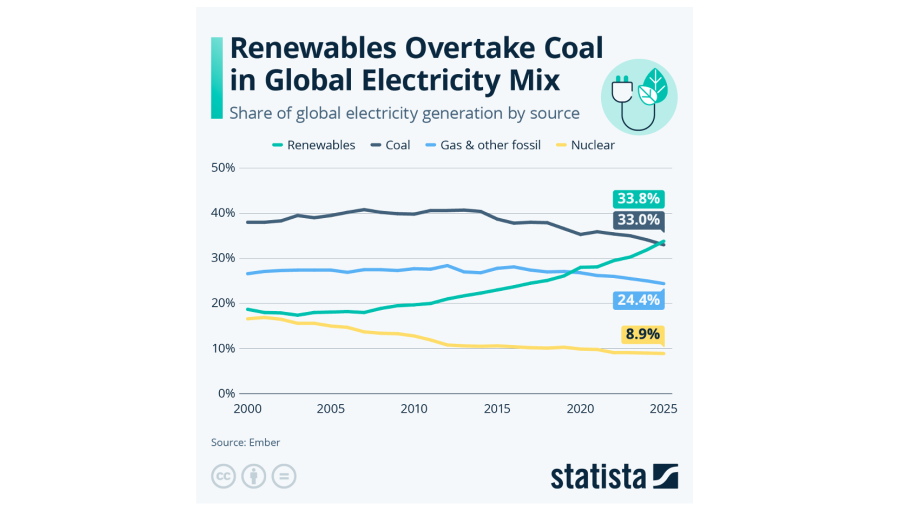
Ten years after the Paris Agreement was opened for signature by member states at the UN Headquarters in New York on April 22, 2016, the global energy transition is beginning to reshape the electricity mix, Statista reports.

As data from Ember's Global Electricity Review 2026 shows, renewables have now overtaken coal as the world’s largest source of electricity generation. In 2025, renewables accounted for 33.8 percent of global power output, slightly ahead of coal at 33.0 percent — a symbolic milestone in the shift toward low‑carbon energy.

The trend reflects a steady but uneven rise of renewables over the past twenty‑five years, from less than 19 percent in 2000 to nearly 34 percent in 2025. Growth was relatively modest in the early 2000s, with the share hovering below 20 percent until 2010, then accelerating markedly over the past decade as wind and especially solar power expanded rapidly. In 2025, this momentum strengthened further, with the entire increase in global electricity demand met by clean energy sources. Solar power alone accounted for 75 percent of the net increase, adding 636 TWh of generation during the year.

Over the same period, the role of fossil fuels in electricity generation has followed a two-phase trajectory. Between 2000 and the mid-2010s, their combined share initially edged up, peaking at around 69 percent in 2012, as growing global demand was largely met by coal and gas. Since then, however, the trend has reversed. Coal’s share has seen the most pronounced decline, falling from about 41 percent at its peak to 33 percent in 2025, while gas and other fossil fuels have decreased more gradually from roughly 28 percent to 24.4 percent. Despite this progress, fossil fuels still account for a majority of global electricity generation (around 57 percent in 2025), highlighting the scale of the challenge ahead in meeting climate targets.

Nuclear energy, for its part, has seen a long-term decline in its share of global electricity generation, falling from around 16.6 percent in 2000 to 8.9 percent in 2025. Most of this drop occurred in the early 2000s and 2010s, as aging reactor fleets were retired and new construction lagged, particularly in Europe and Japan following the Fukushima disaster in 2011. Since then, the decline has been more gradual. Looking ahead, nuclear power is regaining attention as one of the few scalable, firm low‑carbon complements to renewables available today, with expansion plans in countries such as France, the United Kingdom and China, alongside U.S. support for plant lifetime extensions and next‑generation technologies.
India’s renewable surge hits critical mass as solar drives structural shift

India’s renewable surge hits critical mass as solar drives structural shift
/ Antonio Garcia - UnsplashFacebook
By IntelliNews April 21, 2026

In part because of the ongoing limited flow of LNG and oil coming out of the Strait of Hormuz, but more as a result of solid policy implementation India’s renewable energy sector has entered a phase of striking acceleration.

Much of this has been underpinned by falling technology costs and a hard fought push for energy security in which the pace of expansion over the past 12–18 months has been particularly notable. As a result, record capacity additions have appeared as has a broadening of activity across the solar and wind sectors in particular and associated emerging segments such as storage. In turn this has led to a structural shift in how the country generates electricity.

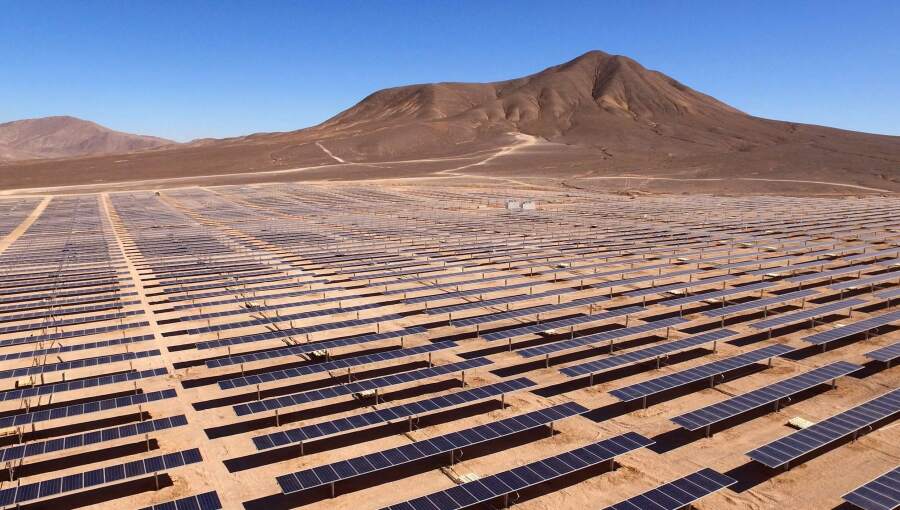
The headline numbers are at times jaw dropping when compared to other countries. India added in excess of 55GW of non-fossil fuel capacity in the recently finished 2025–26 financial year alone. This is the largest annual increase on record for India, taking total non-fossil capacity to an estimated 283GW. This comes on top of 44.5GW added in 2025, with solar accounting for the overwhelming majority of new installations. As such, the scale of green energy deployment has pushed renewables to more than half of all installed electricity capacity.

What distinguishes the current expansion, however, is the speed at which renewable output is now outpacing demand growth across the subcontinent. In 2025 alone, renewable energy generation in India rose by roughly 98 terawatt hours, more than double the increase in electricity consumption. This subsequently led to a decline in coal-fired output, in the process marking a significant turning point given that for the first time ever in the country, clean energy is not simply supplementing fossil fuels but is beginning to displace them at scale.

Across India, solar power is the undisputed engine of this transformation. A record 38GW of solar capacity was installed in 2025, a 54% increase on the previous year. This was followed by an even larger 44.6GW of additional capacity in FY2026. At present, total installed solar capacity has now exceeded 150GW, making India the world’s third-largest solar market.

Several factors explain solar’s dominance in India. Utility-scale projects continue to benefit from some of the lowest tariffs globally—roughly $29–$31 per megawatt hour—The Times of India reports, while government-backed auction schemes have ensured a steady pipeline of projects.

At the same time, distributed solar is expanding rapidly nationwide. Rooftop installations added nearly 9GW in FY2026 alone and this has been supported by subsidy programmes aimed at millions of households and small businesses.

Crucially though, India’s solar expansion is increasingly tied to industrial policy as New Delhi has made wide-ranging efforts to reduce its dependence on Chinese imports across the PV supply chain.

Yet, while China still leads globally in polysilicon, wafers and modules production, India has introduced numerous production-linked incentives and tariff barriers to encourage domestic manufacturing and use.

This has in turn seen a gradual localisation of module assembly and, increasingly, upstream components brought to bear in a move as much about energy security as economics.

Wind power too, long overshadowed by solar, is also experiencing a much needed revival. India added just over 6GW of wind capacity in FY2026, which while significantly lower than the numbers seen in solar added, is its strongest performance in several years. As a result, wind output rose by around 28% in 2025. Policy reforms and implementation, particularly around hybrid auctions combining solar and wind at the same site, have seen a rise in investor confidence in a sector that had fallen behind in recent years.

Similarly, hydropower, though more mature in its exploitation, has also contributed to the recent surge thanks to favourable monsoon conditions which has seen generation rise by about 14% as recently as 2025. And while large hydro projects remain limited by environmental and social considerations, the sector can play a balancing role given the intermittent solar and wind output.

Beyond the typical core generation technologies, two adjacent sectors are gaining momentum and are increasingly coming to the fore in India. The first, battery storage, although constrained in its existence, has seen storage capacity expanding rapidly, supported in large part by falling costs and policy incentives aimed at stabilising the country’s grid. Globally, battery deployment rose sharply in 2025, and India was no different as renewables penetration increases and storage facilities are needed to avoid power loss.

The second is grid infrastructure and transmission – another sector affected by the rapid addition of renewable capacity as bottlenecks in India’s power network have been exposed. This has led to increased investment at the state and national level on transmission corridors and digital grid management.

Taken together, these developments suggest that India’s energy transition is entering a more mature phase.

Because of this, the country has moved beyond the headline-making capacity targets and is now facing a more complex challenge in which integrating large volumes of variable renewable energy into a still coal-heavy system must be seen to work given that coal remains dominant, accounting for around 70% of generation, but its share is beginning to edge downwards as renewables scale up.

To this end, the broader economic implications are significant in that renewable energy is no longer just an environmental policy tool but is a central pillar of industrial strategy, investment and job creation. With nearly 100GW of capacity added in just two years and hundreds more gigawatts in the pipeline, India is leading South Asia as both a major market and an emerging manufacturing hub for clean energy technologies.

 

ISTANBUL BLOG: Message for the CHP. The number of jailed opposition mayors in Turkey has reached 24

ISTANBUL BLOG: Message for the CHP. The number of jailed opposition mayors in Turkey has reached 24
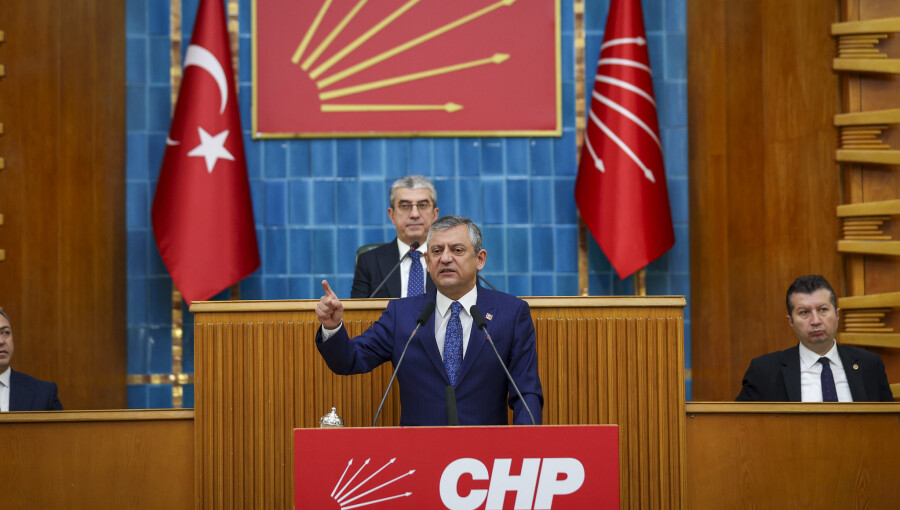
At this week's routine CHP parliamentary group meeting, the audience rose to their feet in applause for more demonstrative drivel from party chair Ozgur Ozel. / CHP.org.trFacebook
By Akin Nazli in Belgrade April 21, 2026

The number of jailed main opposition party mayors in Turkey reached 24 as of April 18, according to data compiled by Intellinews.

Official statistics covering the wide-scope operations are not available. (See statistics and lists compiled by this publication here).

It is not possible to follow up all developments as there are dozens of separate prosecutions and ongoing trials. Each day, more Republican People’s Party (CHP) members are detained, arrested, released or put on trial.

The sorely lacking CHP

The CHP itself does not provide statistics on the operations. As per usual with Turkey’s less-than-compelling biggest opposition party, it has no consistent policy response. A riposte that you might expect to be maintained against the entirety of the ruling regime’s operations is sorely lacking. Many mayors are detained without a squeak from CHP headquarters.

From time to time, Ozgur Ozel, head of the CHP, holds a press conference and yells before the assembled cameras to protest against the arrest of a mayor or the seizure of a municipality.

Unfortunately, he’s renowned for demonstrative drivel. No one takes what he says seriously. On April 18, Ozel declared US Ambassador to Ankara and Special Envoy to Syria Tom Barrack persona non grata for questioning whether democracy was the right fit for countries in the Middle East. As of April 21, there were no reports of Barrack bothering to reply or pondering whether he should vacate his post.

A serious opposition party that outlines achievable targets, focuses on realising those targets, insists on sticking to those targets and eventually achieves results has been missing in Turkey since 2002, the year in which the CHP was relegated to the status of main opposition party.

Ozel talks, Ozel forgets. He is a bankrupted former pharmacy shopkeeper. He does not project much potential. That’s actually the reason why Ozel is not in jail. The powers that be are only too pleased to let him perform the role of main opposition leader. He is pleasingly tolerable.

There again, the government does keep the possibility of a court trial hanging over his head. Should Ozel suddenly find his mojo and cause a sensation by becoming an actual threat to the government, his time at the helm of the CHP could be ended in a flash.

Real deal, real target Imamoglu

In October 2024, the judicial operations targeted at the CHP began with the arrest of Esenyurt mayor Ahmet Ozer, who was accused of terrorism. In November 2025, he was released.

Ekrem Imamoglu, the deposed mayor of Istanbul, Turkey’s largest city, has been in jail since March 19, 2025. He remains the presidential candidate of the CHP and Turkish President Recep Tayyip Erdogan’s chief political rival. He is entirely intolerable as in anything even resembling a fair fight he would very likely wipe the floor with Erdogan.

So far, Erdogan’s ruling Justice and Development Party (AKP) have taken over 19 municipalities held by the CHP.

When lead state prosecutor Akin Gurlek took over the justice minister post in February, operations with the CHP in their cross-hairs were boosted.

Criminal case hearings, in which state prosecutors allege that Imamoglu is the leader of an “octopus-like” gang that has spread its tentacles into corrupt activities in Istanbul Municipality and some other CHP municipalities, are currently being held at Silivri Prison.

On March 9, the first hearing of the Imamoglu trial was held. Court officials wrote in the trial papers that the target is to complete the trial within 4,600 days (13 years).

Ankara mayor Mansur Yavas, another CHP member, is, like Ozel, not in jail, though he is a subject of many investigations. Observers say he remains outside the prison system because he has kept a public distance from suggestions that he run for the presidential candidacy. As if!


Trump's blockade of Hormuz fails as dozens of tankers pass through - FT

Trump's blockade of Hormuz fails as dozens of tankers pass through - FT
Cargo tracking data contradicts Trump's claim of "tremendous success" as shadow fleet exploits enforcement gaps; USS Spruance fires on and seizes Iranian vessel in escalating standoff. / bne IntelliNewsFacebook
By Ben Aris in Berlin April 23, 2026

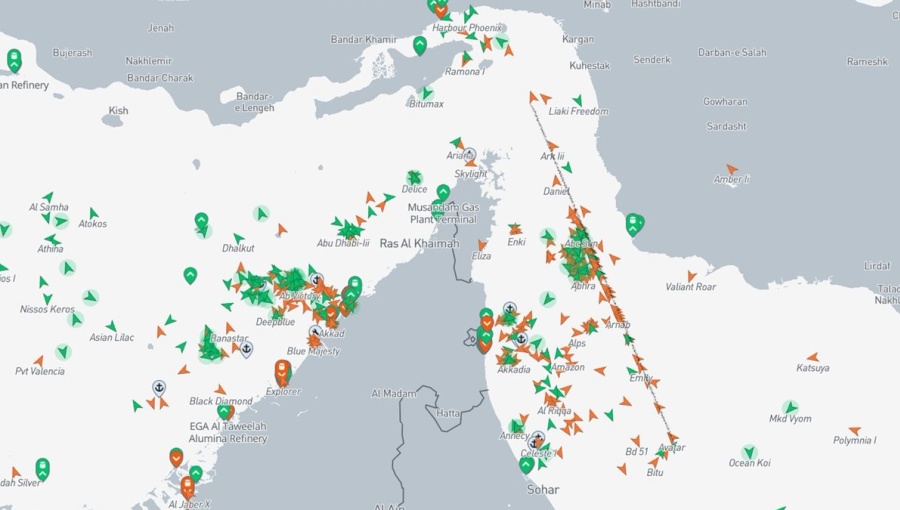
The Trump administration naval blockade of the Strait of Hormuz failed after at least 34 tankers with links to Iran passed through the narrow waterway and exited the Persian Gulf in defiance of the US warships attempts to halt Iran’s oil exports.

US President Donald Trump imposed a naval blockade on any ship leaving the Gulf carrying Iranian oil last week, but has been unable to enforce the order. The two-week ceasefire was supposed to end on April 21, but at the eleventh hour the White House extended it indefinitely as the US failed to impose its will on Iran, which remains firmly in control of the strategic chokepoint.

According to cargo tracking group Vortexa, the vessels departing were confirmed to be carrying Iranian crude oil, the Financial Times reports — a finding that sits awkwardly alongside Donald Trump's assertion that the blockade has been a "tremendous success."

The data, which covers the period since the blockade came into force at 10am Eastern time on April 13, reveals the scale of the enforcement failure.

At least 19 tankers with links to Iran have passed through the blockade to exit the Gulf, while at least 15 have entered, heading toward Iran from the Arabian Sea. Six of those that departed were confirmed as carrying Iranian crude, in the volume of 10.7mn barrels. Assuming a $10 discount to Brent crude — typical for sanctioned Iranian oil — that volume represents revenues of approximately $910mn flowing to Tehran despite the blockade, the FT estimated.

"The blockade has been a tremendous success," Trump told CNBC on April 21, adding that he would not lift the US embargo on the Strait of Hormuz until Washington reached a "final deal" with Iran.

A fresh round of talks was slated to take place on April 22, led by US Vice President JD Vance and Special Envoy Steve Witkoff, however, the plane due to ferry them to Islamabad failed to leave and no talks are scheduled.

The FT report contradicts White House claims that US forces ordered 28 vessels to turn back to Iranian ports since the embargo began — a figure US Central Command appeared to present as evidence of effectiveness of the blockade, though the Vortexa data suggests the overall picture is considerably more mixed.

Ships under fire

Not all ships headed towards the strait are leaving. In a separate report, one tanker headed to India was reportedly duped by cryptocurrency scammers who were paid the $2mn transit fee imposed by Tehran. However, the Iranian Revolutionary Guard Corps (IRGC) fired on the ship as it entered the straits. Recording of the conversation between the capital and the IRGC administration in charge of the strait detail pleas to halt the attacks on the ship as the IRGC explained it had not received the required funds. The tanker eventually turned back.

On April 18, Iranian troops fired on a French container ship and an Indian tanker attempting to cross the waterway, Al Jazeera reports. No tankers passed through the strait on April 19, according to tracking data.

Most of the approximately 30 vessels that attempted to pass on April 17 have since reversed course and are now at anchor at the southern end of the Gulf, awaiting clarity that maritime officials say may not come soon.

The shadow fleet in action

Some of the ships are sneaking past the US warships posted in the Indian Ocean at the exit of the straits. The Dorena, an Iranian-flagged supertanker, snuck past the US forces with its Automatic Identification System (AIS) transponder switched off. Satellite imagery analysed by the FT shows the Dorena off the coast of Malaysia engaged in a ship-to-ship transfer — a common dodge to avoid sanctions on arrival at its destination to mask the origin of cargo.

Oil export figures for Malaysia have soared since the conflict began, despite the fact that Malaysia has no oil fields of its own. The Dorena last signalled its position off the southern coast of India on April 18, and according to Indian and Iranian media reports, arrived carrying approximately 2mn barrels of crude as part of a broader 6mn barrel Iranian delivery to Indian refiners completed under the final days of a 30-day sanctions waiver.

The US also temporarily suspended sanctions on the purchase of Russian oil trapped on tankers at sea. Those sanctions were initially reimposed last week, almost immediately to be removed again on April 17 by the US Treasury Secretary Scott Bessent in an effort to push oil prices down.

US gas prices reached a national average of $4.05 a gallon on April 19. Energy Secretary Chris Wright told CNN they may not return to under $3 a gallon until "next year," while not ruling out the possibility of reaching that level "later this year." High prices of petrol at the pump are a political problem for Trump and his Republican party that face midterm elections in November.

The Treasury Department's waiver lets countries purchase Russian oil and petroleum products loaded on vessels as of April 17 through May 16. It replaces a 30-day waiver that expired on April 11 and excludes transactions involving Iran, Cuba and North Korea.

"As negotiations (with Iran) accelerate, Treasury wants to ensure oil is available to those ⁠who need it," a Treasury Department spokesperson said at the time of the announcement, Reuters reported.

Global prices for Brent have fallen from recent highs to around $100 a barrel as of the time of writing after Iran temporarily reopened the Strait ​of Hormuz at the weekend, before almost immediately closing it again due to the US naval blockade.

As of April 17, there were 177 tankers carrying Iranian cargo on the water globally, according to Windward Maritime AI the FT reported, with maritime traffic mostly headed toward Asia and the Middle East — China, the UAE, Oman, India and Singapore among the primary destinations. A further 163 of those vessels were operating under what analysts describe as fraudulent flags.

Alongside the Dorena, several other sanctioned tankers have re-entered the Gulf, including the Murlikishan and the Alicia — both sanctioned by the US Treasury last year — which transited the strait on the night of April 14 before sailing north toward Iran.

The Touska seizure

The limits of enforcement were demonstrated on April 19 when the US escalated its blockade operations dramatically. The guided-missile destroyer USS Spruance intercepted the Iranian-flagged cargo ship Touska in the Gulf of Oman as it transited the north Arabian Sea at 17 knots en route to Bandar Abbas, Iran's main commercial port.

After the Touska's crew failed to comply with repeated warnings over a six-hour period, Spruance directed the vessel to evacuate its engine room and fired several rounds from its 5-inch MK 45 gun, disabling the ship's propulsion, NS Energy reports. US Marines from the 31st Marine Expeditionary Unit, flying from the amphibious assault ship USS Tripoli, then rappelled onto the vessel and took control.

Trump announced the seizure on Truth Social in characteristically blunt terms. "The US Navy Guided Missile Destroyer USS Spruance intercepted the Touska in the Gulf of Oman and gave them fair warning to stop. The Iranian crew refused to listen, so our Navy ship stopped them right in their tracks by blowing a hole in the engine room. Right now, US Marines have custody of the vessel," he wrote.

The Touska had last docked in Port Klang, Malaysia, on April 12 and was under US Treasury sanctions due to its prior history of illegal activity, according to a US official. Iran's military described the operation as "maritime highway robbery" and an act of piracy, vowing retaliation.

The upshot of the seizure was Tehran suspended its participation in the second round of peace talks due on April 21 in Islamabad.

Iran's parliamentary speaker Mohammad-Bagher Ghalibaf was unequivocal in response: "It is impossible for others to pass through the Strait of Hormuz," he said on state television Al Jazeera reported.

The double blockade

The result of the competing claims of authority over the waterway has created what the shipping industry has taken to calling a "double blockade" — a situation with no modern precedent.

On one side, Washington is attempting to prevent vessels from calling at Iranian ports or carrying goods that could assist Iran in the conflict. On the other hand, Tehran insists all transits of the Strait of Hormuz must follow routes prescribed by the IRGC and receive prior permission from Tehran, in effect also blocking passage through the strait.

Far from forcing Tehran to reopen the Strait of Hormuz, the US naval blockade has double locked it closed. After briefly declaring the strait "completely open" on April 17, Iran clarified that it was only open to vessels with prior permission from Tehran.

The combination of a shadow fleet that has already moved nearly 11mn barrels of Iranian crude past the blockade, an Iranian military with its finger on the trigger in the strait's chokepoint, and a diplomatic process now in renewed jeopardy following the Touska seizure presents Washington with a problem that brute naval force alone is unable to resolve.

Rumours are circulating that the US has used the brief ceasefire to ferry fresh equipment and supplies to the Middle East in a convoy of planes visible on aviation flight tracking sites. At the same time the IRGC has been digging out mountainous caches of drones and missiles that have been targeted by the US-Israeli coalition, significantly increasing the amount of weaponry available to the IRGC should hostilities resume.

Most worryingly, Tehran issued an official warning for the Gulf states to evacuate immediately over the weekend, in an implicit threat of widespread drone and missile attacks on neighbouring cities should the US launch a mooted major ground and bombing assault on Iran.

Strait of Hormuz tensions escalate as US seizes another Iranian oil tanker


By Gavin Blackburn & Malek Fouda
Published on 

The seizure of the Majestic X is at least the fourth Iranian-flagged tanker that has been diverted by US forces and comes after three other vessels were intercepted in waters off India, Malaysia and Sri Lanka.

The US military seized another tanker associated with smuggling Iranian oil, the Pentagon said on Thursday

"We will continue global maritime enforcement to disrupt illicit networks and interdict vessels providing material support to Iran, wherever they operate," the US Department of Defence said, confirming the Majestic X tanker had been boarded in the Indian Ocean.

The Pentagon released footage of the seizure of the vessel, showing US troops on the deck of the vessel.

Ship-tracking data showed the Majestic X in the Indian Ocean between Sri Lanka and Indonesia, roughly the same location as the oil tanker Tifani, earlier seized by US forces. It had been bound for Zhoushan in China.

The seizure of the Majestic X is at least the fourth Iranian-flagged tanker that has been diverted by US forces and comes after three other vessels were intercepted in waters off India, Malaysia and Sri Lanka.

It comes after Iran fired on three ships in the Strait of Hormuz and seized two of them on Wednesday, intensifying its attacks in the strategic waterway which remains closed.

Those attacks came less than a day after US President Donald Trump extended a fragile truce while maintaining a US blockade of Iranian ports.

The standoff between the US and Iran has effectively choked off nearly all exports through the strait, where 20% of the world’s traded oil passes in peacetime.

Iranian media said the paramilitary Revolutionary Guard Corps (IRGC) was bringing the two ships to Iran, marking a further escalation.

Iranian media said the MSC Francesca and the Epaminondas were being escorted to Iran. The US had earlier seized two Iranian vessels as the ceasefire talks were due to take place in Pakistan, prompting Tehran to pull out of the second round of high-stakes negotiations.

The Jordan flagged cargo ship "Baghdad" sails in Persian Gulf towards Strait of Hormuz off the United Arab Emirates, 22 April, 2026
The Jordan flagged cargo ship "Baghdad" sails in Persian Gulf towards Strait of Hormuz off the United Arab Emirates, 22 April, 2026 Anjum Naveed/Copyright 2026 The AP. All rights reserved.

Attacks on vessels in the waterway escalate

Technomar, the management company behind the Liberian-registered Epaminondas vessel, said it was "approached and fired upon by a manned gunboat" off the coast of Oman. It said the ship's bridge was damaged.

A second cargo ship came under fire hours later, with no report of damage, though it was then stopped in the water. No injuries to the crews of either vessel were reported. Panama condemned what it called an "illegal seizure" of its flagged vessel, adding that the attack represented a "serious attack" on maritime security.

The IRGC attacked a third ship, identified as the Euphoria, which had become “stranded” on the Iranian coast, Iranian media reported, without elaborating.

White House Press Secretary Karoline Leavitt said the seizures did not violate the terms of the truce because the vessels "were not US or Israeli."

Iranian Revolutionary Guard cadets march during an annual military parade just outside Tehran, 21 September, 2024
Iranian Revolutionary Guard cadets march during an annual military parade just outside Tehran, 21 September, 2024 Alireza Masoumi/AP

There have been more than 30 attacks on ships in the Middle Ease since the US and Israel launched the war on 28 February with a surprise attack on Iran. Before then, the strait was fully open for all maritime traffic.

The conflict has already sent gas prices skyrocketing far beyond the region and raised the cost of food and a wide array of other products.

The price of Brent crude, the international benchmark, nosed over $100 per barrel, marking a roughly 40% increase from pre-war levels, but stock markets still appear to be shrugging it off.

European Energy Commissioner Dan Jørgensen warned of a lasting impact for consumers and businesses, likening it to other major energy crises over the last half-century. He said the disruption is costing Europe around €500 million euros each day.

Tehran demands end to US blockade for talks to resume

Iran's ability to restrict traffic through the strait, which leads from the Persian Gulf to the open ocean, has proved a major strategic advantage.

While the ceasefire means US and Israeli airstrikes have stopped in Iran and Tehran's missiles and drones no longer target the region, the maritime standoff continues and could escalate.

Without any diplomatic agreement, the attacks will likely deter ships from even attempting to pass through the waterway, further tightening the chokehold on global energy supplies.


EU unlocks €90bn Ukraine loan and toughest Russia sanctions yet — with a crucial caveat

EU unlocks €90bn Ukraine loan and toughest Russia sanctions yet — with a crucial caveat
The twentieth sanctions package targets Greek shipowners, Russia's Arctic LNG fleet and 600-vessel shadow fleet, but the maritime oil ban awaits G7 coordination as Iran war complicates Europe's energy calculus. / bne IntelliNewsFacebook
By Ben Aris in Berlin April 23, 2026

The European Union voted on April 22 to simultaneously unlock its long-delayed €90bn EU loan for Ukraine and adopt the stalled twentieth sanctions package against Russia, in a diplomatic double act that had been blocked for months by Hungary and Slovakia — both of which finally stood aside once the first Russian oil began flowing again through the repaired Druzhba pipeline.

EU ambassadors meeting in Brussels launched a written procedure, giving member states up to 24 hours to register any objections. Cyprus, which holds the rotating presidency of the EU Council, said the procedure was expected to conclude by the afternoon of April 23.

The vote has been long delayed by vetoes from Hungary and Slovakia due to the Druzhba row. Former Hungarian Prime Minister Viktor Orban, who agreed to approve the loan at the EU summit in December, reversed his position after a drone attack on the Soviet-era pipeline cut off oil deliveries to Hungary from Russia. Kyiv dragged its heels on repairs as part of its strategy to starve the Kremlin of oil and gas revenues. “No oil, no money” Orban told Kyiv.

However, everything changed after newly installed Hungarian Prime Minister Peter Magyar landslide victory ousting Orban last weekend. Magyar also insisted that the oil flows resume before approving the loan, which happened on April 22 just before the vote.

Slovak Prime Minister Robert Fico also threatened to continue the veto ahead of the vote but has also climbed down. Slovakia also received assurances from Kyiv that the Druzhba pipeline would be functioning again by the time of the vote. Slovak Foreign Minister Juraj Blanár said his country was also ready to support the twentieth sanctions package once Russian oil was physically delivered.

Diplomats said both Budapest and Bratislava would wait for physical confirmation that Druzhba oil had arrived in their territory before formally clearing the path — meaning final approval was unlikely before the morning of April 23.

The money is desperately needed in Kyiv, which is running out of money and faces a macroeconomic collapse within a month if the fresh funding is not released immediately.

The €90bn loan, originally agreed by all 27 EU member states in December, will provide Ukraine with two tranches of €45bn each in 2026 and 2027, with €28bn per year reserved for military spending and €17bn for general budget needs — covering roughly two-thirds of Ukraine's financing requirements over the period. Hungary, Slovakia and the Czechia secured exemptions from participating in the joint EU borrowing that will fund the package.

The saga highlights the growing disunity in the EU and underscores the emerging Eurosceptic-lite policies emerging amongst more and more EU members, where they put national interests ahead of wider EU policy goals dictated by the European Commission (EC) executive, like sanctioning Russia.

Inside the sanctions package

Embarrassingly, the twentieth sanctions package was supposed to be released on the fifth anniversary of the start of the war on February 24 but was flummoxed by vested interests in the EU – not just Hungary and Slovakia. Greece and Malta were also instrumental in blocking the latest package which targets Russia’s shadow fleet of oil tankers, to which both nations contribute heavily in a lucrative business exploiting loopholes in the sanctions. Greek tankers, flying an EU flag and subject to EU regulations, make up a fifth of Russia’s shadow fleet.

The new package originally banned all EU vessels from working for Russia, but according to reports, that clause has been removed from the latest draft. At the same time, sanctions on buying Russian oil introduced at the end of 2022 have also been eased as a result of the oil shock unfolding as a result of the Iran war.

In parallel, the US has already eased sanctions on buying Russian oil already at sea last month, stored in tankers, by issuing a 30-day waiver to India to alleviate upward price pressure on oil. That waiver expired last week, but was almost immediately renewed by the US Treasury Department after a two-week ceasefire failed to reopen the Strait of Hormuz. On April 22, US President Donald Trump unilaterally extended the ceasefire indefinitely as he struggles to find a way to end the conflict. In the meantime, Tehran remains in complete control of the passage of tankers through the Strait.

Billed as the most ambitious expansion of Russia's sanctions regime since the invasion, the reality is that the twentieth package will have little effect on Russia’s oil exports or revenues, which are expected to enjoy a windfall from the soaring oil prices.

Like most EU sanctions, the key element has been fudged in an effort to please everyone. The centrepiece measure — a complete prohibition on the provision of services related to the maritime transportation of Russian oil and petroleum products — has been agreed in principle but will not take effect until Brussels reaches agreement with the G7.

Brussels concluded that activating an additional squeeze on Russian oil supplies without coordinating with Washington — which has no interest in further oil price rises — would be both economically reckless and politically unworkable.

The measures that do take effect immediately are directed at Russia's Arctic LNG industry, which has so far been the most significant gap in the sanctions architecture. While imports of Russian oil have been banned for three years already, LNG was exempted as there is no viable alternative supply. That shortfall has only been made worse by the halt of Qatari LNG exports by the closure of the Strait of Hormuz.

On paper the EU has vowed to ban the import of Russian LNG completely by the start of 2027. In practice, the volumes of LNG imports continue to rise and the EU remains Russia’s top LNG customer. Europe bought every single shipment of LNG produced by Russia's Yamal LNG plant in February and would have bought more if Russia had produced it as a gas crisis starts to unfold in Europe thanks to the low level of gas storage ahead of the next heating season.

Some LNG restrictions are slated to come into effect before the January 1, 2027 deadline for a complete ban. From April 25, the provision of technical, financial and brokerage services related to Russian icebreakers and gas carriers is prohibited. The EU has also banned Russian LNG imports in January 2026 for short-term contracts effective from the same date. From January 1, 2027, the ban extends to foreign icebreakers and gas carriers operating in Russia's interests that are aimed at the Yamal Arctic LNG-2 project operated by Russia’s Novatek.

Of the 15 Arc7 ice-class LNG carriers built for Novatek and capable of navigating the Arctic Northern Sea Route independently, 11 are owned or managed by European companies. In 2025, these firms facilitated more than 70% of LNG shipments between Yamal and Europe. The Yamal fleet's Arc7 carriers are serviced and repaired in European yards, and the service ban is designed to cut off that maintenance lifeline. However, the phased implementation — and wording that means foreign-operated vessels have until 2027 — gives a significant portion of the fleet time to complete servicing before the door closes.

A separate measure directly targets the Yamal project's corporate structure. The direct and indirect provision of terminal services to LNG projects in which Russian entities own more than 50% is prohibited — a measure that catches Novatek, which holds a 50.1% stake in Yamal LNG. European Commission President Ursula von der Leyen said the new measures would "go beyond previous rounds by targeting the maritime backbone of Russia's LNG trade."

It remains unclear how the EU will supply itself with natural gas if it cuts itself off from Russian LNG imports completely. Russia used to send some 140bn cubic metres (bcm) to Europe a year pre-war. Since the invasion of Ukraine, the piped gas imports have fallen to near zero, but LNG imports soared to a post-war record in 2025 of circa 20bcm, or about 14% of its total gas imports at a cost of €7.2bn. Including the piped gas to Central Europe and Russia still accounts for 12% of the EU’s total gas imports, down from 40% in 2021.

The US has become Europe’s largest LNG supplier, accounting for around 56% of the LNG market, but question mark now hangs over the reliability of US supplies as Europe now finds itself in competition with Asia that is willing to pay higher prices, after the Qatari supplies stopped due to the Gulf war. Several tankers bound to Europe have already been diverted to Asia after Europe was outbid by Asian buyers.

Shadow fleet and financial crackdown

Another element of the twentieth package is a further crackdown on individual vessels: 46 vessels will be added to the EU shadow fleet blacklist, bringing the total to more than 600 — a list that now encompasses a substantial proportion of the tanker fleet Russia relies on to move crude to Asian buyers outside the price cap framework.

The idea of targeting individual ships and shipping companies, rather than relying on a price cap mechanism or restrictions on maritime insurance was pioneered to great effect by the Biden administration with its harshest ever oil sanctions in January 2025.

Crucially, the twentieth package also introduces a ban on direct sales and resale of tankers to Russian companies, with all contracts required to include relevant clauses — an attempt to choke off future fleet expansion at source, as Russia has built up its own fleet by buying end-of-service-life tankers, particularly from Greek shipping companies.

On the financial side, 120 individuals and legal entities will be added to the sanctions list, including 20 banks and financial intermediaries, among them institutions that have been facilitating sanctions evasion in Armenia, Kyrgyzstan, Azerbaijan and Laos. Transaction bans will apply to the ports of Murmansk and Tuapse, seven Russian oil refineries — Ryazan, Komsomolsk, Angarsk, Achinsk, Tuapse, Afipsk and Usinsk — as well as the oil companies Bashneft and Slavneft.

Notably, Gazprombank — which has never appeared on the EU's own sanctions list despite being sanctioned by the US in November 2024 — is again absent from the twentieth package, even as the volume of Russian gas it processes for EU buyers shrinks toward zero ahead of the 2027 import ban.

Kyrgyzstan faces specific punishment for its role in routing sanctioned goods, including through the A7 cryptocurrency platform: the export of metalworking machine tools and telecom equipment to the country will be banned.

The package also expands the EU's legal toolkit against Russian asset expropriation. European companies will now be able to file claims in the EU for damages suffered as a result of third-country court decisions enforcing Russian court rulings — a measure designed to protect Western firms whose assets have been seized in Russia from finding themselves without legal recourse.

What comes next

With Hungary's blockade lifted, Brussels expects to return to a more regular rhythm of sanctions packages. The 21st package of sanctions is already in preparation, according to EU foreign policy chief Kaja Kallas. Officials also note that broader package sanctions do not exclude targeted individual measures — including the prospect of entry bans on participants in the war against Ukraine.

The sequencing of the maritime oil services ban remains the most consequential outstanding question. Its activation depends on whether the G7 — and specifically the United States — judges that global oil market conditions have stabilised sufficiently to absorb a further tightening of Russian supply. As long as Iranian oil exports remain disrupted and the Strait of Hormuz contested, that judgment is unlikely to be made in a hurry.

Fireworks factory blast kills 13 in southern India

In the second such incident in the country in recent days

Fireworks factory blast kills 13 in southern India
/ Suhash Villuri - UnsplashFacebook
By IntelliNews April 23, 2026

In the second such incident in the country in recent days, an explosion at a fireworks factory in the southern Indian state of Kerala, killed at least 13 people and injured more than 40 on April 21, 2026, Deccan Herald reported.

The factory where the blast happened was a temporary production facility and was making firecrackers for the locally important Thrissur Pooram festival.

The blast occurred roughly around 3:30pm local time with a substantial number of the workforce present in the factory during the disaster and thus becoming its casualties.

The fire was not limited to the initial explosion as several secondary ones reportedly kept complicating rescue efforts, as well as the factory's remote location near rural agricultural fields with paddy crops in the way, in conjunction with sparse road connectivity limited the speed with which authorities and local emergency services such as the fire department could respond with specialised equipment.

The recovered bodies of the victims were put through DNA testing as they had become unrecognisable after being severely burned. Several of the injured pulled from the fire were also reportedly in critical condition in local medical facilities.

Purportedly the facility was operated by the Thiruvambady temple committee, one of the two principal participants in the festival's celebrated fireworks displays. However it is unclear to what level the facility was regulated by local authorities and how strict the safety norms and practices were in its day to day operations.

As is often the case with major accidents and disasters, India's central government announced ex-gratia payments of INR200,000 ($2,144) to families of the deceased and INR50,000 to the injured from India's Prime Minister's National Relief Fund. However, away from the pattern for similarly sized incidents, Kerala's state government declared the incident a state disaster and sanctioned INR50mn for immediate relief through the Thrissur District Collectorate, and ordered a judicial probe under a one-member commission.

The Kerala State Police also reportedly constituted a Special Investigation Team(SIT) under the Thrissur City Police Commissioner, with the exact cause of the blast to be determined. The accident followed a fatal explosion at another fireworks manufacturing facility in another southern state of India Tamil Nadu just days earlier, thus making the Kerala blast the second such incident within a week.

Firework manufacturing is regulated by both the central and state governments in India and routinely inspected for safety practices by local law enforcement, however low wages, corruption and the use of informal setups, banned and highly volatile chemicals such as potassium chlorate make it one of the most risky enterprises in the country.