Demonized Iran: A Tale Told By An Idiot
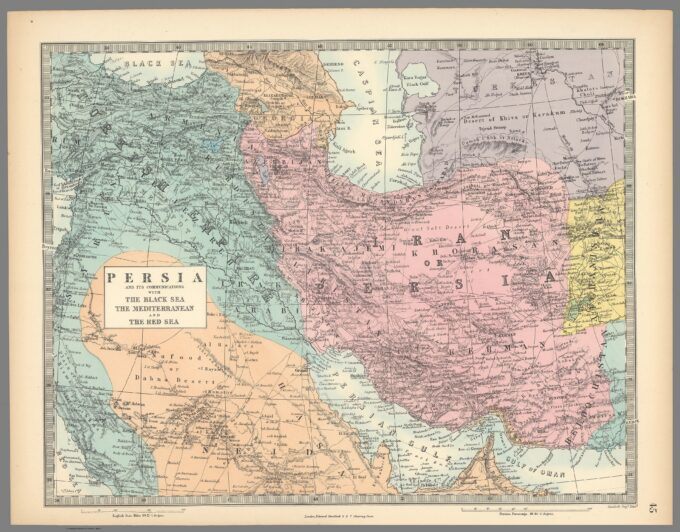
A map of West Asia in 1872, with “Iran or Persia”, ruled by the Qajar dynasty, shaded in pink – Public Domain
The current failing effort to make Iran out to be a major threat to world peace starts the clock at 1979 in its propaganda effort to justify U.S. aggression against Teheran, which deliberately overlooks the events of 1953, when a joint U.S.-British effort overthrew the then secular Iranian government in order to take over the country’s oil industry.
Much like John Foster Dulles and his brother Allen, who successfully plotted the U.S. coup against him, Mohammad Mossadegh (Time’s Man-of-the-Year in 1952) came from an affluent background, welcomed the principles of capitalist democracy, and loathed Marxism. What set the three men on a collision course was not their political values, but the radically unequal world around them.[1]
Mossadegh grew up watching foreigners loot his defenseless country. Nourished by corruption, predatory foreign companies bought up rights to establish Iranian banks and run its post office, telegraph service, railroads, and ferry lines. Other Western firms took over the caviar industry and tobacco trade. When oil was discovered at the beginning of the twentieth century, British officials just bribed a puppet monarch – Mozaffar al-Din Shah – to sign Iran’s rights away to foreign investors. The ocean of oil underfoot became the property of the Anglo-Iranian Oil Company, mostly owned by the British government.
Thus it was that in his short span of years Mossadegh witnessed a stupendous source of national wealth siphoned off to benefit distant foreigners while Iranian peasants lived in hovels and a quarter of the population consisted of nomadic bands. The country suffered a ninety-percent illiteracy rate, an incredible fifty-percent infant mortality rate, and saw seventy percent of its land monopolized by two percent of its population. Iran exported $360 million worth of oil a year, but only received $35 million in royalties from the Anglo-American Oil Company.[2]
Educated Iranians of Mossadegh’s era faced a choice of continuing this humiliating submission to foreign exploitation or launching a rebellion doomed to failure. Mossadegh chose to rebel, demanding full Iranian control of the nation’s resources, which made him a target for Anglo-American imperialism.
Following World War II Mossadegh had emerged as the leader of the nationalists in the Iranian Parliament, with a reputation for being an honest patriot.[3] He not only denounced British control of the oil industry, but also opposed a vast, mega-profit development scheme Allen Dulles had negotiated for Overseas Consultants Inc., a group of eleven American engineering firms with massive construction plans, including hydroelectric plants, rebuilt cities, and industries imported from abroad. Mossadegh denounced it as a sellout to foreign interests, a judgment that found favor in the Iranian Parliament, which killed the project by refusing to appropriate funds for it in December, 1950.
After delivering this heavy blow to foreign capital, Mossadegh was chosen to be prime minister in April 1951. Before accepting, he asked for a vote in favor of nationalizing Iran’s oil industry, and the vote was unanimous. From that moment on he was regarded in Washington and London as the worst sort of enemy, a populist rabble-rouser who stirred the masses with appeals to independent nationalism, which was effectively treason to transnational capital.
In 1953, with the unanimous backing of the Iranian Parliament and overwhelming public support, Mossadegh proceeded with the nationalization, expropriating the Anglo-American Oil Company. In an impassioned address to the nation he warned that Iran was taking control of “a hidden treasure upon which lies a dragon.”[4]
The dragon retaliated by CIA coup, overthrowing Mossadegh in favor of Shah Reza Pahlavi. General Fazollah Zahedi, a Nazi collaborator and staunch partisan of American oil, became the new prime minister. [5] President Eisenhower quickly extended him “sympathetic consideration.”
The CIA’s Kermit Roosevelt emerged as vice-president of Gulf Oil. U.S. Secretary of State John Foster Dulles refused to divulge details of the new arrangements, because “making them public would affect adversely the foreign relations of the United States.”[6]
President Eisenhower told the American people that the Iranian people had “saved the day,” owing to their “revulsion against communism,” and “their profound love for their monarchy.”[7]
The New York Times hailed the destruction of Iranian democracy as “good news indeed,” calling the putsch an “object lesson in the heavy cost that must be paid” by a country that “goes berserk with fanatical nationalism.”[8]
Thousands of Mossadegh supporters were dispatched to jail, torture chambers, and graveyards.[9]
A deeply grateful Shah thanked U.S. Ambassador Loy Henderson and Kermit Roosevelt, telling them the he owed his throne to God, the Iranian people, the army, and to Washington.[10]
Gripped by megalomania, the Shah ruled for the subsequent quarter century in a romantic haze built on a fantasy version of Iran and also of himself. He told Italian journalist Oriana Fallaci that he was guided by visions and messages from God, as well as Imam Ali. “I am accompanied by a force that others can’t see, my mythical force, I get messages, religious messages.”[11]
Instead of seeking psychological help, the Shah went for armaments and the technology of repression, soon becoming the central U.S. military and economic partner in the Middle East. Portrayed in the West as a far-seeing moderate in a land teeming with swarthy medievalists, he remained deeply unpopular at home due to his policies of super-militarization, forced modernization, and systematic torture. Powerful Ayatollahs bitterly objected to his rule, and as they amassed a huge popular following the Shah grew increasingly isolated, clinging to power with an avalanche of weapons sent on by Washington.
By the mid-seventies the Shah’s throne sat atop a veritable powder keg. Two-thirds of the population was under thirty. Cities were hideously unlivable, as urban settlements had quadrupled to twenty million in the previous twenty years. Fifteen percent of the entire country lived around Teheran in shanty dwellings lacking sewage or other water facilities. The nation’s incalculable oil wealth reached few hands, and a restless student generation had no prospects. The bloated bureaucracy was totally corrupt.[12]
Hatred of the military surged as the economy gagged on $18 billion in Western arms imports (mostly from the U.S.) between 1974 and 1978, including air-to-air missiles, smart bombs, and aerial tankers, “everything but the atomic bomb,” according to a State Department official. While Shiite leaders rallied massive popular support, the Shah eliminated civilian courts, held 100,000 political opponents in jail, and carried out more official executions than any other country in the world, in addition to using methods of torture that Amnesty International called “beyond belief.”[13]
Nevertheless, enthroned as he was atop an ocean of oil, the staunchly anti-communist Shah was a greatly admired leader of the “Free World.”[14]
For New Year’s Eve in 1977 Jimmy Carter flew to Teheran to celebrate the 2500th anniversary of the Persian Empire with the Shah. The two heads of state dined in the Niyavaran Palace surrounded by obscene luxury in a city teeming with hideous slums.
In his after dinner speech Carter all but buried his face in the Shah’s lap, displaying a stomach-turning capacity for obsequious flattery. He praised the “great leadership of the Shah,” and proclaimed Iran a “great island of stability” in a “troubled” region of the world, which, he gushed, was a great tribute to “you, Your Majesty,” and to “the respect and admiration and love” which, he alleged, the Iranian people felt for their King, though at that very moment thousands of them were political prisoners suffering Nazi torture techniques in Iranian jails.[15] Continuing in the same vein, Carter declared that “the cause of human rights is one that also is shared deeply by our people and by the leaders of our two nations.” He concluded on a note of utter devotion: “There is no leader with whom I have a deeper sense of personal friendship and gratitude.”
A beaming Shah leaped to his feet in applause, grasping Carter’s right hand in both of his.
On the route to the airport the next morning the mutual admirers failed to notice thousands of young Iranians pelting the army with rocks along the side streets. Soon, nationwide riots would break out.[16]
Nine months later, Carter phoned the Shah during the worst crisis of his entire rule (“Black Friday”), expressing support following his machine-gunning of dozens of demonstrators (thousands according to Iranian dissidents) by troops that had been armed and trained by the United States. The following month Carter received the Shah’s son (who was undergoing training at the United States Air Force Academy at the time) in Washington and told him: “Our friendship and our alliance with Iran is one of our important bases on which our entire foreign policy depends.” Speaking of the Shah’s liberalization policies, he added, “We’re thankful for this move towards democracy. We know it is opposed by some who don’t like democratic principles, but his progressive administration is very valuable, I think, to the entire Western world.”
By that point, of course, nearly the entire Iranian population was fed up with the Shah’s blood-soaked “progressive administration” and its boundless corruption. Graft and bribery were so endemic under his rule that he had amassed a personal fortune worth billions of dollars, still a large sum today, and a gargantuan one in the late 1970s.[17]
There can be little doubt that Carter’s complete lack of concern for democracy, in spite of protestations of the centrality of “human rights” to his administration, was helping provoke an explosion of popular revulsion at the Shah’s misrule.
By January, 1979 the breaking point had been reached. Everyone was cursing the cold, the snow, and the Shah, and strikes paralyzed the country. As power cuts plunged the capital into darkness, food supplies ran out and long lines formed for resupplies of paraffin. Roaming gangs stopped fancy cars to siphon what they needed while oil production stopped and the army went to work the fields. With gas lines backing up for hours, soldiers kept order firing automatic weapons in the air.
The Shah’s henchmen fled like startled cockroaches. Ministers carted away bags stuffed with bank notes; ladies made off with jewelry boxes; masterless butlers wandered around in a daze. Suitcases and crates crammed with paintings, Persian rugs, and precious jewelry, found their way to Europe and America, leaving palaces and elegant homes suddenly eerily empty. Bombarded by money transfers, Central Bank workers went out on strike, refusing to process the deluge.
At Niyavaran palace the Shah sat behind a bank of guards and surveillance equipment wondering what went wrong. Surrounded by gilt, beveled mirrors, chandeliers, gold-plated telephones and jewel-studded gold cigarette boxes, he was plunged into gloom. Anwar Sadat beckoned him to exile in Egypt.
He fled, and Teheran erupted in joy.[18]
Two weeks later the Ayatollah Khomeini returned from fifteen years of exile, greeted by a joyous crowd of three million at the airport.[19] Two months after that, 99% of the adult population voted for an Islamic Republic in an extraordinary 95% turnout.[20] The U.S. client state was no more.
At every stage of its confrontation with the Islamic Revolution, the U.S. response appeared to be tone deaf and inept. A little over eight months after Khomeini’s return to Iran, Carter allowed admission of the ailing ex-Shah to a New York hospital for cancer treatment, and enraged Iranian protesters poured over the U.S. Embassy walls in Teheran, seizing 66 Americans trapped inside. Telling a lurid tale of America-backed torture, murder, and looting, they announced themselves as “followers of the Imam’s line,” and demanded the return of “the criminal Shah.”
Effigies of President Carter and Uncle Sam were set aflame. American flags were spat on, trampled, and burned in the street. Blindfolded Marines, handcuffed behind their backs, were paraded before TV cameras surrounded by vengeful, chanting mobs. “Death to America! Death to Carter! Death to the Shah!”
The Pope, offering to mediate the crisis, was rebuffed by an angry Ayatollah Khomeini: “Where was the Vatican, when the Shah put our youth in frying pans and sawed off their legs?”[21]
Although the U.S. media offered extensive and dramatic coverage of events in Teheran, the non-stop chatter of the pundits did nothing to enlighten the viewing audience. Terms like Mohamedanism, Mecca, purdah, chador, Sunni, Shiite, mullah, imam, Ayatollah Khomeini, militant Islam were packaged up for American viewers in absurd three minute summaries of the meaning of Islam, which only conveyed the mis-impression that Islam was inherently violent, dangerous, and anti-American, a view that persists to this day.
Interviews with Iranian officials alternated with comments from the hostages’ parents, bulletins on the ex-Shah’s failing health, and footage of emotional street demonstrations in Iran. The rituals of the Iranian crowds were cast as though they were sick imitations of Nuremberg, circuses manipulated by mad dictators caught up in religious frenzy, in stark contrast to the level-headed millionaires psychoanalyzing their behavior in American T.V. studios.
Not a single establishment journalist found the U.S. responsible in any way for its Iran predicament. No one offered to make amends for the coup of 1953. The Washington Post dismissed the Shah’s use of systematic torture as inconsequential, since “it can be argued that it was entirely in the tradition of Iranian history.”[22]
In the middle of the hostage crisis another one occurred in neighboring Iraq, where Saddam Hussein overthrew General Ahmed Hassan Bakr and executed all his political rivals. A short time later, president Carter’s national security adviser Zbigniew Brzezinski publicly encouraged him to attack Iran, which he promptly did, invading in September, 1980 with “strong U.S. backing,” according to war correspondent Robert Fisk.
For Saddam the goal was to seize the Shatt al-Arab waterway and Iran’s oil-rich southwestern Khuzestan region; for Iran, it was to survive an existential war and defend the Islamic Revolution.
The war lasted eight long years and featured horrifying trench warfare similar to battles in WWI, with maimings and killings well into the hundreds of thousands on both sides, while the combined population of Iran and Iraq was only fifty-seven million. Iraq repeatedly used nerve and mustard gas thanks to a Department of Commerce license that allowed an American company to ship Saddam a smorgasbord of deadly agents for years, and both sides freely bombed civilian populations.[23]
Washington also provided Hussein with battle plans and satellite data. Over the course of the war, Iraq-U.S. relations became so close that the Reagan administration barely reacted when Iraqi missiles hit the USS Stark in the Gulf, killing several dozen U.S. servicemen. Only when it became convenient following Iraq’s 1990 invasion of Kuwait did Washington criticize Iraq’s appalling human rights record, omitting mention of the U.S.’s starring role in his worst crimes.
One of the most gruesome atrocities of the war period occurred in 1988, when the U.S.S. Vincennes shot down Iran Air Flight 655 in an ascending flight path over civilian airspace in the Persian Gulf, killing 290 people on board. The American commander knew at the time that he was shooting down a civilian plane.
Admiral William J. Crowe, Chairman of the Joint Chiefs of Staff, established the U.S. official line on the horror, accusing the Iranians of having brought the attack on themselves with irresponsible behavior.
The U.S. establishment media suggested that the Airbus might have been on a suicide mission, that the pilot may have been deliberately trying to crash his passenger-packed plane into the American frigate that shot it down. Articles focused on the commander’s anguish in having shot the plane down, reporting the event as a tragic error. President Reagan called it an “understandable accident.” Vice-President Bush declared he would “never apologize for the United States of America. I don’t care what the facts are.”
This was all self-serving nonsense.
In an article in the September 1989 issue of the U.S. Naval Institute’s Proceedings, Edward Herman reported in his 1992 book, “Beyond Hypocrisy,” David R. Carlson, commander of the USS Sides, an escort frigate in the vicinity of the USS Vincennes when it shot the Iranian Airbus down, wrote that he was disgusted with the U.S. excuses for this act, as well as the attempt to blame it on the Iranians. He added that the idea that the Vincennes was attempting to defend itself against Iranian attack was based on a series of lies. “When the decision was made to shoot down the Airbus, the airliner was climbing, not diving; it was showing the proper identification friend or foe – IFF (Mode III); and it was in the correct flight corridor from Bandar Abbas to Dubai. The Vincennes was never under attack by Iranian aircraft. There was no targeting being done by the Iranian P3. The conduct of Iranian military forces in the month preceding the incident was profoundly nonthreatening.” According to Carlson’s account, Herman wrote, for a considerable time before the shootdown the Vincennes’ actions “appeared to be consistently aggressive, and had become a topic of wardroom conversation.” Someone had even jokingly come up with the nickname “Robo Cruiser” for the Vincennes, and it apparently stuck.
Nevertheless, the New York Times continued to support the official story that the Iranians were to blame for the “accidental” shoot-down and never reported on Commander Carlson’s correction.
Adding to the horror, the personnel on the Vincennes were given a hero’s welcome when they returned to the dock in San Diego, and later made it onto national TV and became celebrities. In April, 1990, Herman wrote, the commander of the Vincennes was given the Legion of Merit award for “exceptionally meritorious conduct in the performance of outstanding service” and for “the calm and professional atmosphere” under his command. The destruction of the Airbus and the killing of 290 passengers was not explicitly mentioned in the citation.[24]
Nearly forty years later, Washington is still attacking Iran, based largely on the same highly caricatured image of the country it has held since 1979, and has learned nothing about the reality of its own relations with Teheran. The U.S. continues to be in the Iranians’ back yard – relentlessly – supporting dictatorships, overthrowing regimes, backing genocidal Israel to the hilt, all of which results in a horrifying record of slaughtered civilians that has literally appalled the entire world.
Meanwhile, the Iranian proxy states Washington accuses of terrorism are all products, directly or indirectly, of its own foreign policy. It was Israel and the United States, after all, who took a small, Islamic group offshoot from the Muslim Brotherhood in Egypt called Hamas in the early eighties and built it up and funded it to counteract the secular Palestine Liberation Organization with a religious group. Hizbollah arose because the U.S. backed Israel’s 1982 invasion of Lebanon, killing thousands of Shiites who had no real stake in the Israel-Palestinian conflict. The rise of ISIS a generation later is directly attributable to the Bush-Cheney invasion of Iraq in 2003. And Al Qaeda, which preceded it, grew out of U.S. support for the mujahedeen in Afghanistan after the Soviets invaded that country in 1979.
Aside from the obvious fact that the U.S. is far and away the world leader in committing acts of terrorism, the bungling incompetence at protecting its own declared interests is staggering.
Meanwhile, to this day, a bipartisan consensus reigns in Washington that the U.S. somehow has the moral standing to judge Teheran for its human rights record. But as is so often the case with imperial moralizing, the crimes of the accused pale in comparison to the horrors perpetrated by those who wish to see them self-righteously judged.
Notes
[1]All biographical data on Mossadegh is from “The Brothers – John Foster Dulles, Allen Dulles, And Their Secret World War,” (Holt, 2013), pps.119-24
[2] Lawrence S. Wittner, “Cold War America – From Hiroshima To Watergate,” (Holt, 1978) p. 151
[3] William Blum, “Killing Hope – U.S. Military And CIA Interventions Since World War II,” (Common Courage, 1995) p. 70
[4] Lawrence S. Wittner, “Cold War America – From Hiroshima To Watergate,” (Holt, 1978) p. 151
[5] William Blum, “Killing Hope – U.S. Military And CIA Interventions Since World War II,” (Common Courage, 1995) p. 67
[6] Lawrence S. Wittner, “Cold War America – From Hiroshima To Watergate,” (Holt, 1978) p. 153
[7] Medea Benjamin, “Inside Iran – The Real History And Politics Of The Islamic Republic Of Iran,” (OR Books), p. 27
[8] Noam Chomsky, “Towards A New Cold War,” (Pantheon, 1978) p. 99; William Blum, “Killing Hope – U.S/ Military And CIA Interventions Since World War II, (Common Courage, 1995) p. 71
[9] Cedric Belfrage, “The American Inquisition 1945-1960,” (Monthly Review, 1973) p. 202
[10] Arash Norouzi, “I owe my throne to God, my people, my army, and to you,” www.mohammadmossadegh.com
[11] Medea Benjamin, “Inside Iran – The Real History And Politics Of The Islamic Republic Of Iran,” (OR Books, 2018) p. 30
[12]Walter LaFeber, “The American Age – United States Foreign Policy at Home and Abroad since 1750,”(Norton, 1989) pps. 659-61
[13] Medea Benjamin, “Inside Iran – The Real History And Politics Of The Islamic Republic Of Iran,” (OR Books, 2018) p. 29.
[14] Lawrence S. Wittner, “Cold War America – From Hiroshima To Watergate,” (Holt, 1978) p. 393
15 On CIA torture techniques derived from the Nazis and taught to the Shah’s SAVAK, see Noam Chomsky, “Towards A New Cold War,” (Pantheon, 1979) p. 455-6n
[16] William Shawcross, “The Shah’s Last Ride,” (Simon and Schuster, 1988), p. 130; Pierre Salinger and Eric Laurent, “America Held Hostage,” (Doubleday, 1981) pps. 3-7
[17] Noam Chomsky and Edward S. Herman, “The Washington Connection and Third World Fascism” (South End, 1979) pps. 64, 292-3
[18] William Shawcross, “The Shah’s Last Ride, (Simon and Schuster, 1988) pps. 15-37, 275
[19] Medea Benjamin, “Inside Iran – The Real History And Politics Of The Islamic Republic of Iran,” (OR Books, 2018) p. 37
[20] Medea Benjamin, “Inside Iran – The Real History And Politics Of The Islamic Republic Of Iran,” (OR Books, 2018) p. 39
[21] William Shawcross, “The Shah’s Last Ride,” (Simon and Schuster, 1988) p. 278 Khomeini quoted in Clifton Daniel, ed., “Chronicle of America,” (DK Publishing, 1997) p. 865
[22] Edward Said, “Covering Islam,” (Vintage, 1981) pps. 95-133 passim
[23] Robert Fisk, “The Great War For Civilisation – The Conquest of the Middle East,” (Knopf, 2005) pps. 210-12
[24] Edward S. Herman, “Beyond Hyprocrisy – Decoding The News In An Age of Propaganda,” (Common Courage, 1992) pps, 31-2. See also, Alexander Cockburn, “Corruptions of Empire,” (Verso, 1988) pps. 515-18, and Noam Chomsky, “Class Warfare,” (Common Courage, 1996) pps. 69-90. For a very detailed account, see Robert Fisk, “The Great War For Civilisation – The Conquest of the Middle East,” (Knopf 2005) Chapter 8.