Frederick Douglass’s Words Are More Relevant Than Ever on US’s 250th Birthday
In his powerful speech, “What, to the American slave, is your 4th of July?” Douglass spoke truth to power.
By George Yancy ,
July 2, 2026
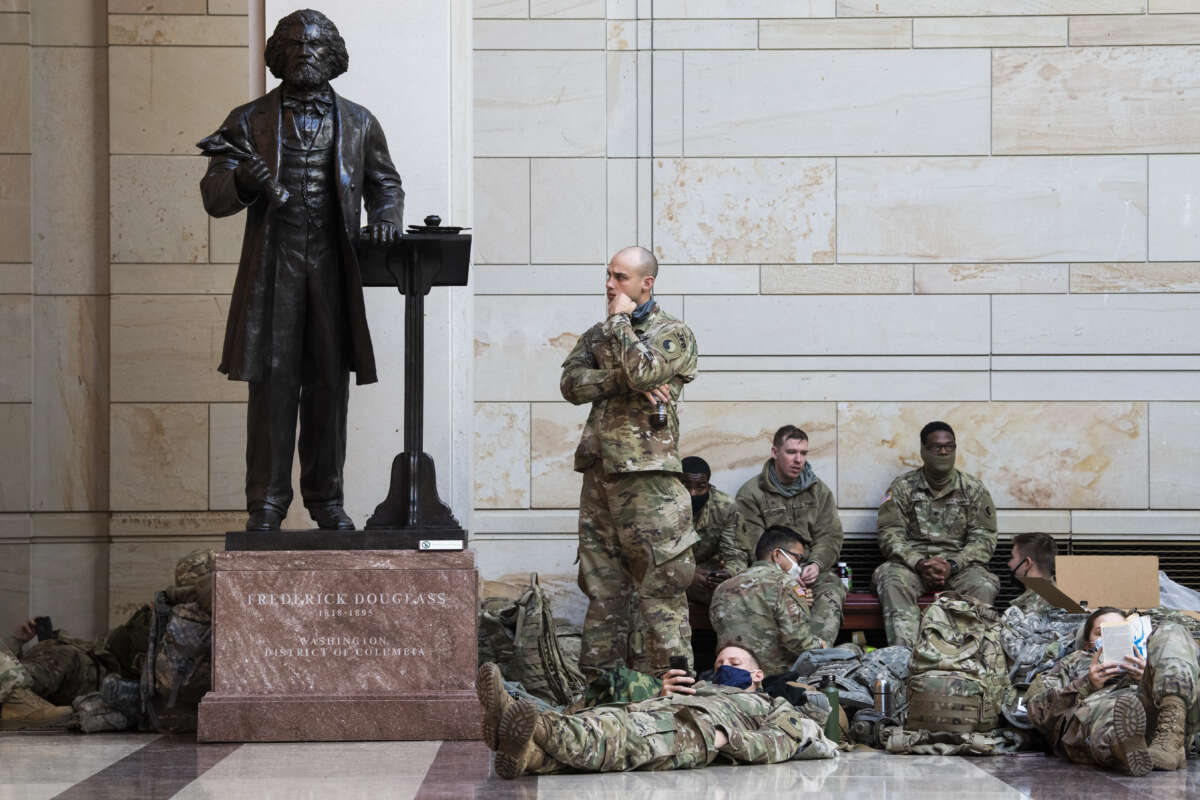
Members of the National Guard are seen near a statue of Frederick Douglass in the Capitol Visitor Center as the House debates an article of impeachment against President Donald Trump on January 13, 2021, in Washington, D.C.Tom Williams / CQ-Roll Call, Inc via Getty Images
Narratives of American “greatness” abound surrounding July 4, but by whom and for whom are they created?
As we observe the U.S.’s 250th birthday, I am reminded of the words of James Baldwin, who wrote that, in the true pursuit of justice, one does not lend an ear to those who are invested in maintaining power, but instead, “one goes to the unprotected — those, precisely, who need the law’s protection most! — and listens to their testimony.”
If we heed Baldwin’s call to listen to the testimonies of those who are unprotected by the law (or dehumanized precisely by the law), it leads us back to the powerful indictment of the U.S. that Frederick Douglass gave on July 5, 1852, when he asked: “What, to the American slave, is your 4th of July?”
Douglass was unafraid to tell the truth about the hypocrisy inherent in the U.S.’s continued deep investment in the brutal enslavement of Black people. Douglass wrote:
The rich inheritance of justice, liberty, prosperity and independence, bequeathed by your fathers, is shared by you, not by me. The sunlight that brought life and healing to you, has brought stripes and death to me. This Fourth July is yours, not mine. You may rejoice, I must mourn. To drag a man in fetters into the grand illuminated temple of liberty, and call upon him to join you in joyous anthems, were inhuman mockery and sacrilegious irony.
Despite the State’s Attempts to Stamp Out Opposition, Our Movements Persevere
Echoes of anti-slavery and civil rights struggles reverberate through the current uprising against ICE. By Austin C. McCoy , Truthout June 19, 2026
On this July 4, I will personally continue to confront the truth that Black people in this country continue to mourn, continue to suffer under anti-Blackness, and continue to experience and resist deep forms of abjection, political threats, and the realities of anti-democratic practices. There is nothing defeatist in facing this reality — the objective is Baldwinian: to refuse illusions, to face human suffering, to tarry with the U.S.’s (largely white) narrative of “justice.” As the country celebrates 250 years of independence, I want to keep Douglass’s courage alive — his refusal to participate in empty political discourse and national pageantry.
To better understand the contemporary implications of Douglass’s powerful critique, I turned to philosopher Tim Golden, who is visiting professor of philosophy at Whitman College in Walla Walla, Washington. He is the editor of Racism and Resistance: Essays on Derrick Bell’s Racial Realism, and his most recent book is entitled, Frederick Douglass and the Philosophy of Religion: An Interpretation of Narrative, Art, and the Political. The interview that follows has been lightly edited for clarity and length.
George Yancy: Could you talk about Douglass’s emphasis on “the slave’s point of view” within the context of the cold existential reality of Black brutality under American slavery?
Tim Golden: When James Baldwin declares the importance of beginning with the testimony of the oppressed, he is working in the long tradition of Black political activism that dates back at least as far as Douglass, and even further. Indeed, the tradition of “the slave’s point of view,” as you put it, is present in the 18th century in the work of Phillis Wheatley, Olaudah Equiano, Jupiter Hammon, and Benjamin Banneker. This tradition continued into the 19th century in the activism of Maria Stewart, Henry Highland Garnet, and, of course, Douglass.
Douglass’s use of “the slave’s point of view” is powerful as it demonstrates the slave’s humanity while destabilizing the white gaze. To demonstrate the former is to destroy the latter, as slavery and humanity are conceptually inconsistent with one another. This conceptual inconsistency means that Black humanity produces a reality that the white gaze cannot comprehend, thus causing the white gaze to turn to a mythology of whiteness as the exclusive site of humanity to maintain its conceptual and ontological coherence. The quoted language from Douglass’s Fourth of July speech in your question refers to Douglass having a “soul,” and being concerned about the nation’s “character and conduct.” Such references indicate a Black humanity inconsistent with the white gaze. Thus, in order to sustain its pseudo-ontology, whiteness turns to a specious but powerful mythology. Indeed, such metaphysical and moral concerns of a Black mind cannot be those of chattel but rather can only be those of a human being. Douglass’s use of “the slave’s point of view” is akin to what Friedrich Nietzsche calls philosophizing “with a hammer.” One side of the hammer (the mallet) builds and the other side of the hammer (the claw) tears down. Such is the work of Douglass from the slave’s point of view: It establishes Black humanity and razes the world of the white gaze, which must then turn to mythology. It is that mythology that the Black body grapples with today.
Understanding how human beings suffer under conditions of racial terror and oppression, Frantz Fanon writes, “I want my voice to be harsh, I don’t want it to be beautiful, I don’t want it to be pure.” Speaking without equivocation, Douglass is also clear, where he writes, “I will use the severest language I can command; and yet not one word shall escape me that any man, whose judgment is not blinded by prejudice, or who is not at heart a slaveholder, shall not confess to be right and just.” Given our contemporary moment in which political dissent and critical discourse against U.S. hypocrisy is framed by many in the “highest offices” of the land as “anti-Americanism,” please explain the importance of using our “severest language” when it comes to speaking truth to power, especially given what is at stake for Black people 250 years after independence.
Using the “severest language” demands some nuance, I think. To be sure, we can think of “severest” in terms of how the language itself sounds. We see this in Black art. For example, this is found in the profanity and harsh language of hip hop and Black poetry and literature. Such language is powerful, but it comes with a profound risk: being tuned out by respectability politics. With a simple invocation of a superficial morality that confuses the effect for the cause, many who most desperately need to hear the hard speech simply do not listen to it and feel justified in ignoring it because of its delivery. Why do I say “confuses effect for the cause”? It is because the profanity complained about that inhabits Black art is not as profane as the conditions that caused the profane expression in the first place. Hence, there is a critique of rap lyrics which advocate criminal, even homicidal behavior without any critique of the systemic racism, unemployment, educational deficits, etc., that lead to perpetual police surveillance and mass incarceration in Black communities. Understood in this way, then, “severest language” comes with a risk and potential of remaining unheard because whiteness is easily masked by superficial moral “outrage” that itself is immoral.
Douglass would say to today’s white Christian nationalism what he said in 1852: Stop hiding behind abstract philosophical debate and start accepting responsibility!
Another way of understanding “severest language” is in terms of its effects rather than its delivery. While the latter runs the risk of deepening alienation, the former, often delivered ironically and thus indirectly, is no less harsh in its intended results, but can be much more effective. Here I am thinking of Douglass’s use of irony in his Fourth of July speech. There, he begins the speech in self-deprecation, claiming that he has “little experience” in public speaking, which is plainly false, as by the time of the 1852 speech, Douglass had years of public speaking experience. Douglass is not trying to be dishonest, rather he is concealing himself in rhetorical irony. Through “self-humiliation,” Douglass disarms his audience, leaving them in a disposition of pity and empathy toward him. It is this irony that the occasion of America’s anniversary demands. Douglass says, “At a time like this, scorching irony, not convincing argument, is needed. O! had I the ability, and could I reach the nation’s ear, I would, to-day, pour out a fiery stream of biting ridicule, blasting reproach, withering sarcasm … The feeling of the nation must be quickened.” Douglass quickened national feeling through the “severest language” he could muster, albeit indirectly, through a rhetorical disarming of his audience that aligned Douglass’s words with the demands of the occasion.
As a philosopher and legal theorist, identify what you see as some of the major contradictions in this country when it comes to the U.S.’s professed ideals and its treatment of Black people. Black people continue to suffer because of the gap between such professed ideals and the hell that they catch because of a country that continues to see them as second-class citizens — indeed, as sub-persons. Do you think that the fury that informed Douglass’s speech back in 1852 remains applicable as the U.S. celebrates 250 years of independence?
Yes. The fury Douglass delivered after his rhetorical self-concealment and repositioning of whites from authority to empathy is badly needed today. The source for this must be through Black forms of speech and Black works of art. Malcolm X once criticized the Black community for having athletes and entertainers as civil rights spokespersons or leaders. Although I often agree with Malcolm X on many points and even understand to an extent his point here, it is nevertheless important to appreciate the role of Black art in the Black community’s liberation struggle. What cannot be said in political debate can often be said in elegy, as with Billie Holiday’s “Strange Fruit,” which is as profoundly moral and political as it is aesthetic. The song’s condemnation of the moral, spiritual, and political abomination of lynching is an act of leadership, not merely entertainment and aesthetics.
We are two Black philosophers informed by and shaped by the radical love embodied within Christianity. Yet, there are those within this country who wield Christianity as an ideological weapon in support of xenophobia, white nationalism, fanaticism, and hatred. Douglass’s critique of Christian hypocrisy under American slavery remains relevant and powerful. Speaking of those white Christian churches and white Christian devotees, he writes, “They strip the love of God of its beauty, and leave the throne of religion a huge, horrible, repulsive form. It is a religion for oppressors, tyrants, man-stealers, and thugs.” For me, Pete Hegseth and other Christians who have religiously bought into MAGA have also stripped the love of God of its beauty. What is Hegseth but a military thug? Please speak to the continuing relevance of Douglass’s insights into the ways in which Christianity is weaponized at this moment.
Cornel West brilliantly captures the distinction between these two sorts of Christianity in his book, Democracy Matters. There, he distinguishes between “prophetic Christianity” and “Constantinian Christianity.” I think that you and I are part of the Black prophetic tradition of Christianity that speaks truth to power. The Constantinian brand of Christianity protects power from truth. West would argue that the Pete Hegseths of the world, like Constantine, appropriate the Gospel of Jesus Christ for political and military conquest, treating Christianity as a means to the end of consolidating and preserving their political influence. Douglass’s critique of Christianity is a critique of Constantine’s Christianity, not of those of the biblical prophets, who took the side of the poor and oppressed. Keeping West’s distinction in mind, we must be ever careful to separate the “sheep from the goats” in American Christianity. Douglass understood this. Hence his disclaimer at the beginning of the appendix to his 1845 narrative that he wanted to distinguish between the religion of Jesus Christ and slaveholding Christianity.
There is always the danger of presentism, but what do you think a contemporary version of Douglass’s famous 1852 speech would say to white America as it celebrates the Fourth of July with so much nationalist pride?
Substitute the conditions of chattel slavery with its legacy today — police surveillance of Black communities, mass incarceration, police killings of unarmed Black people, political polarization, the obfuscation of whiteness protecting itself in political theory, the wealth gap, the education gap, housing discrimination, the religion of whiteness in white Christian nationalism, etc. — and a contemporary iteration of Douglass’s Fourth of July critique would strike a critical, spiritual, and deeply moral tone toward today’s white Christian nationalism remarkably similar to his 1852 rhetorical masterpiece. Why? Because white Christian nationalism is heavily invested in maintaining the legacy of chattel slavery. So, to address the former is to address the latter.
In his Fourth of July speech, Douglass, just prior to his claim that the conscience of the nation needed to be “roused” and the “feeling of the nation” had to be “quickened,” criticized philosophical debate as the means for addressing the problem of chattel slavery in three ways.
First, he says: “Would you have me argue that man is entitled to liberty? that he is the rightful owner of his own body? Must I argue the wrongfulness of slavery … Is it to be settled by the rules of logic and argumentation as a matter beset with great difficulty, involving a doubtful application of the principle of justice, hard to be understood?”
Second, he says: “What, am I to argue that it is wrong to make men brutes … to starve them into obedience and submission to their masters?”
And third, he wonders if he should argue that slavery is not divine. In each of these instances, Douglass is pointing to the moral problem with the deployment of philosophical argumentation under certain situations: it makes that which ought not be debatable the subject of debate.
The freedom of humankind was true as a matter of natural law for Douglass. The very reason that revealed the natural freedom of human beings was the same reason that ought not be indulged to prove such a self-evident truth. For Douglass, to argue for the humanity of the slave or the moral wrongness of slavery would be akin to debating if a bachelor is an unmarried man. Douglass thus advances a “critique of pure reason” all his own. Like Immanuel Kant, Douglass argues that there is no need to argue or debate analytic truth. It must simply be accepted. Persistence in arguing over that which we all know to be true as a matter of natural law — the humanity of Black people — is a waste of time.
So, for Douglass, we must turn from wasting valuable time arguing about the humanity of Black people and toward more subjective matters like “rousing conscience” and “quickening feeling.” And today, Douglass’s words ring through the ages as a rebuke to the deployment of certain uses of philosophical argumentation — a rebuke to rights discourse; a rebuke to the symmetry and reciprocity of neoliberal political arrangements; a rebuke to John Rawls’s original position; a rebuke to arguing abstract ethical and legal doctrine. In short, Douglass would say to today’s white Christian nationalism what he said in 1852: Stop hiding behind abstract philosophical debate and start accepting responsibility! Douglass would quicken the national conscience and rouse the national feeling this Fourth of July by demanding deep phenomenological reflection and real existential change in American race relations and public policy. He would demand that the Constantinian Christianity of white Christian nationalism become a thing of the past. He would remind white Christian nationalists of their profound spiritual and moral failings, calling for a radical responsibility that leads to meaningful institutional change rather than a philosophically abstract obfuscation that maintains the oppressive status quo. “Enough philosophical debate!,” I can hear Douglass saying on an internet live stream. “What we need is acceptance of Black people’s humanity, followed by a plan to eliminate any law, policy, or practice that distorts their humanity, plain and simple!”
Douglass would not only have a message for white Christian nationalism; he would also have a message to rouse the conscience and quicken the feelings of the entire nation, especially Black people. Douglass would tell us that the United States Constitution belongs to everyone. He would wax eloquent about how accepting the logic of Dred Scott as a matter of ontology or being is foolish. Dred Scott, an aberrant, racist logic for some, is not the standard for all. An Afropessimist would disagree, but Douglass would remain undeterred, retorting that the very document that the Afropessimist denies can overcome the category of the slave is the same document that protects their ideas as a matter of First Amendment freedom of speech; the same document decried as irredeemably unfit for justice is the same document that applies to Black and white alike when one is arrested and charged with a crime. Yes, there are problems with the American legal system. But the very classification of circumstances as “problems” implies that things are falling short of a standard of justice, which is the Constitution itself. I can hear Douglass saying to us today, in order to quicken our national feelings and rouse our conscience that there is nothing wrong with the Constitution, while there is everything wrong with how we execute it. Dred Scott may be the way the Constitution has been misinterpreted, but its misinterpretation and distortion by some is not its futility for all.
May Douglass’s would-be Fourth of July speech this Saturday, July 4, 2026, rouse our national conscience and quicken our national feeling. We need both so badly!
This article is licensed under Creative Commons (CC BY-NC-ND 4.0), and you are free to share and republish under the terms of the license.
Narratives of American “greatness” abound surrounding July 4, but by whom and for whom are they created?
As we observe the U.S.’s 250th birthday, I am reminded of the words of James Baldwin, who wrote that, in the true pursuit of justice, one does not lend an ear to those who are invested in maintaining power, but instead, “one goes to the unprotected — those, precisely, who need the law’s protection most! — and listens to their testimony.”
If we heed Baldwin’s call to listen to the testimonies of those who are unprotected by the law (or dehumanized precisely by the law), it leads us back to the powerful indictment of the U.S. that Frederick Douglass gave on July 5, 1852, when he asked: “What, to the American slave, is your 4th of July?”
Douglass was unafraid to tell the truth about the hypocrisy inherent in the U.S.’s continued deep investment in the brutal enslavement of Black people. Douglass wrote:
The rich inheritance of justice, liberty, prosperity and independence, bequeathed by your fathers, is shared by you, not by me. The sunlight that brought life and healing to you, has brought stripes and death to me. This Fourth July is yours, not mine. You may rejoice, I must mourn. To drag a man in fetters into the grand illuminated temple of liberty, and call upon him to join you in joyous anthems, were inhuman mockery and sacrilegious irony.
Despite the State’s Attempts to Stamp Out Opposition, Our Movements Persevere
Echoes of anti-slavery and civil rights struggles reverberate through the current uprising against ICE. By Austin C. McCoy , Truthout June 19, 2026
On this July 4, I will personally continue to confront the truth that Black people in this country continue to mourn, continue to suffer under anti-Blackness, and continue to experience and resist deep forms of abjection, political threats, and the realities of anti-democratic practices. There is nothing defeatist in facing this reality — the objective is Baldwinian: to refuse illusions, to face human suffering, to tarry with the U.S.’s (largely white) narrative of “justice.” As the country celebrates 250 years of independence, I want to keep Douglass’s courage alive — his refusal to participate in empty political discourse and national pageantry.
To better understand the contemporary implications of Douglass’s powerful critique, I turned to philosopher Tim Golden, who is visiting professor of philosophy at Whitman College in Walla Walla, Washington. He is the editor of Racism and Resistance: Essays on Derrick Bell’s Racial Realism, and his most recent book is entitled, Frederick Douglass and the Philosophy of Religion: An Interpretation of Narrative, Art, and the Political. The interview that follows has been lightly edited for clarity and length.
George Yancy: Could you talk about Douglass’s emphasis on “the slave’s point of view” within the context of the cold existential reality of Black brutality under American slavery?
Tim Golden: When James Baldwin declares the importance of beginning with the testimony of the oppressed, he is working in the long tradition of Black political activism that dates back at least as far as Douglass, and even further. Indeed, the tradition of “the slave’s point of view,” as you put it, is present in the 18th century in the work of Phillis Wheatley, Olaudah Equiano, Jupiter Hammon, and Benjamin Banneker. This tradition continued into the 19th century in the activism of Maria Stewart, Henry Highland Garnet, and, of course, Douglass.
Douglass’s use of “the slave’s point of view” is powerful as it demonstrates the slave’s humanity while destabilizing the white gaze. To demonstrate the former is to destroy the latter, as slavery and humanity are conceptually inconsistent with one another. This conceptual inconsistency means that Black humanity produces a reality that the white gaze cannot comprehend, thus causing the white gaze to turn to a mythology of whiteness as the exclusive site of humanity to maintain its conceptual and ontological coherence. The quoted language from Douglass’s Fourth of July speech in your question refers to Douglass having a “soul,” and being concerned about the nation’s “character and conduct.” Such references indicate a Black humanity inconsistent with the white gaze. Thus, in order to sustain its pseudo-ontology, whiteness turns to a specious but powerful mythology. Indeed, such metaphysical and moral concerns of a Black mind cannot be those of chattel but rather can only be those of a human being. Douglass’s use of “the slave’s point of view” is akin to what Friedrich Nietzsche calls philosophizing “with a hammer.” One side of the hammer (the mallet) builds and the other side of the hammer (the claw) tears down. Such is the work of Douglass from the slave’s point of view: It establishes Black humanity and razes the world of the white gaze, which must then turn to mythology. It is that mythology that the Black body grapples with today.
Understanding how human beings suffer under conditions of racial terror and oppression, Frantz Fanon writes, “I want my voice to be harsh, I don’t want it to be beautiful, I don’t want it to be pure.” Speaking without equivocation, Douglass is also clear, where he writes, “I will use the severest language I can command; and yet not one word shall escape me that any man, whose judgment is not blinded by prejudice, or who is not at heart a slaveholder, shall not confess to be right and just.” Given our contemporary moment in which political dissent and critical discourse against U.S. hypocrisy is framed by many in the “highest offices” of the land as “anti-Americanism,” please explain the importance of using our “severest language” when it comes to speaking truth to power, especially given what is at stake for Black people 250 years after independence.
Using the “severest language” demands some nuance, I think. To be sure, we can think of “severest” in terms of how the language itself sounds. We see this in Black art. For example, this is found in the profanity and harsh language of hip hop and Black poetry and literature. Such language is powerful, but it comes with a profound risk: being tuned out by respectability politics. With a simple invocation of a superficial morality that confuses the effect for the cause, many who most desperately need to hear the hard speech simply do not listen to it and feel justified in ignoring it because of its delivery. Why do I say “confuses effect for the cause”? It is because the profanity complained about that inhabits Black art is not as profane as the conditions that caused the profane expression in the first place. Hence, there is a critique of rap lyrics which advocate criminal, even homicidal behavior without any critique of the systemic racism, unemployment, educational deficits, etc., that lead to perpetual police surveillance and mass incarceration in Black communities. Understood in this way, then, “severest language” comes with a risk and potential of remaining unheard because whiteness is easily masked by superficial moral “outrage” that itself is immoral.
Douglass would say to today’s white Christian nationalism what he said in 1852: Stop hiding behind abstract philosophical debate and start accepting responsibility!
Another way of understanding “severest language” is in terms of its effects rather than its delivery. While the latter runs the risk of deepening alienation, the former, often delivered ironically and thus indirectly, is no less harsh in its intended results, but can be much more effective. Here I am thinking of Douglass’s use of irony in his Fourth of July speech. There, he begins the speech in self-deprecation, claiming that he has “little experience” in public speaking, which is plainly false, as by the time of the 1852 speech, Douglass had years of public speaking experience. Douglass is not trying to be dishonest, rather he is concealing himself in rhetorical irony. Through “self-humiliation,” Douglass disarms his audience, leaving them in a disposition of pity and empathy toward him. It is this irony that the occasion of America’s anniversary demands. Douglass says, “At a time like this, scorching irony, not convincing argument, is needed. O! had I the ability, and could I reach the nation’s ear, I would, to-day, pour out a fiery stream of biting ridicule, blasting reproach, withering sarcasm … The feeling of the nation must be quickened.” Douglass quickened national feeling through the “severest language” he could muster, albeit indirectly, through a rhetorical disarming of his audience that aligned Douglass’s words with the demands of the occasion.
As a philosopher and legal theorist, identify what you see as some of the major contradictions in this country when it comes to the U.S.’s professed ideals and its treatment of Black people. Black people continue to suffer because of the gap between such professed ideals and the hell that they catch because of a country that continues to see them as second-class citizens — indeed, as sub-persons. Do you think that the fury that informed Douglass’s speech back in 1852 remains applicable as the U.S. celebrates 250 years of independence?
Yes. The fury Douglass delivered after his rhetorical self-concealment and repositioning of whites from authority to empathy is badly needed today. The source for this must be through Black forms of speech and Black works of art. Malcolm X once criticized the Black community for having athletes and entertainers as civil rights spokespersons or leaders. Although I often agree with Malcolm X on many points and even understand to an extent his point here, it is nevertheless important to appreciate the role of Black art in the Black community’s liberation struggle. What cannot be said in political debate can often be said in elegy, as with Billie Holiday’s “Strange Fruit,” which is as profoundly moral and political as it is aesthetic. The song’s condemnation of the moral, spiritual, and political abomination of lynching is an act of leadership, not merely entertainment and aesthetics.
We are two Black philosophers informed by and shaped by the radical love embodied within Christianity. Yet, there are those within this country who wield Christianity as an ideological weapon in support of xenophobia, white nationalism, fanaticism, and hatred. Douglass’s critique of Christian hypocrisy under American slavery remains relevant and powerful. Speaking of those white Christian churches and white Christian devotees, he writes, “They strip the love of God of its beauty, and leave the throne of religion a huge, horrible, repulsive form. It is a religion for oppressors, tyrants, man-stealers, and thugs.” For me, Pete Hegseth and other Christians who have religiously bought into MAGA have also stripped the love of God of its beauty. What is Hegseth but a military thug? Please speak to the continuing relevance of Douglass’s insights into the ways in which Christianity is weaponized at this moment.
Cornel West brilliantly captures the distinction between these two sorts of Christianity in his book, Democracy Matters. There, he distinguishes between “prophetic Christianity” and “Constantinian Christianity.” I think that you and I are part of the Black prophetic tradition of Christianity that speaks truth to power. The Constantinian brand of Christianity protects power from truth. West would argue that the Pete Hegseths of the world, like Constantine, appropriate the Gospel of Jesus Christ for political and military conquest, treating Christianity as a means to the end of consolidating and preserving their political influence. Douglass’s critique of Christianity is a critique of Constantine’s Christianity, not of those of the biblical prophets, who took the side of the poor and oppressed. Keeping West’s distinction in mind, we must be ever careful to separate the “sheep from the goats” in American Christianity. Douglass understood this. Hence his disclaimer at the beginning of the appendix to his 1845 narrative that he wanted to distinguish between the religion of Jesus Christ and slaveholding Christianity.
There is always the danger of presentism, but what do you think a contemporary version of Douglass’s famous 1852 speech would say to white America as it celebrates the Fourth of July with so much nationalist pride?
Substitute the conditions of chattel slavery with its legacy today — police surveillance of Black communities, mass incarceration, police killings of unarmed Black people, political polarization, the obfuscation of whiteness protecting itself in political theory, the wealth gap, the education gap, housing discrimination, the religion of whiteness in white Christian nationalism, etc. — and a contemporary iteration of Douglass’s Fourth of July critique would strike a critical, spiritual, and deeply moral tone toward today’s white Christian nationalism remarkably similar to his 1852 rhetorical masterpiece. Why? Because white Christian nationalism is heavily invested in maintaining the legacy of chattel slavery. So, to address the former is to address the latter.
In his Fourth of July speech, Douglass, just prior to his claim that the conscience of the nation needed to be “roused” and the “feeling of the nation” had to be “quickened,” criticized philosophical debate as the means for addressing the problem of chattel slavery in three ways.
First, he says: “Would you have me argue that man is entitled to liberty? that he is the rightful owner of his own body? Must I argue the wrongfulness of slavery … Is it to be settled by the rules of logic and argumentation as a matter beset with great difficulty, involving a doubtful application of the principle of justice, hard to be understood?”
Second, he says: “What, am I to argue that it is wrong to make men brutes … to starve them into obedience and submission to their masters?”
And third, he wonders if he should argue that slavery is not divine. In each of these instances, Douglass is pointing to the moral problem with the deployment of philosophical argumentation under certain situations: it makes that which ought not be debatable the subject of debate.
The freedom of humankind was true as a matter of natural law for Douglass. The very reason that revealed the natural freedom of human beings was the same reason that ought not be indulged to prove such a self-evident truth. For Douglass, to argue for the humanity of the slave or the moral wrongness of slavery would be akin to debating if a bachelor is an unmarried man. Douglass thus advances a “critique of pure reason” all his own. Like Immanuel Kant, Douglass argues that there is no need to argue or debate analytic truth. It must simply be accepted. Persistence in arguing over that which we all know to be true as a matter of natural law — the humanity of Black people — is a waste of time.
So, for Douglass, we must turn from wasting valuable time arguing about the humanity of Black people and toward more subjective matters like “rousing conscience” and “quickening feeling.” And today, Douglass’s words ring through the ages as a rebuke to the deployment of certain uses of philosophical argumentation — a rebuke to rights discourse; a rebuke to the symmetry and reciprocity of neoliberal political arrangements; a rebuke to John Rawls’s original position; a rebuke to arguing abstract ethical and legal doctrine. In short, Douglass would say to today’s white Christian nationalism what he said in 1852: Stop hiding behind abstract philosophical debate and start accepting responsibility! Douglass would quicken the national conscience and rouse the national feeling this Fourth of July by demanding deep phenomenological reflection and real existential change in American race relations and public policy. He would demand that the Constantinian Christianity of white Christian nationalism become a thing of the past. He would remind white Christian nationalists of their profound spiritual and moral failings, calling for a radical responsibility that leads to meaningful institutional change rather than a philosophically abstract obfuscation that maintains the oppressive status quo. “Enough philosophical debate!,” I can hear Douglass saying on an internet live stream. “What we need is acceptance of Black people’s humanity, followed by a plan to eliminate any law, policy, or practice that distorts their humanity, plain and simple!”
Douglass would not only have a message for white Christian nationalism; he would also have a message to rouse the conscience and quicken the feelings of the entire nation, especially Black people. Douglass would tell us that the United States Constitution belongs to everyone. He would wax eloquent about how accepting the logic of Dred Scott as a matter of ontology or being is foolish. Dred Scott, an aberrant, racist logic for some, is not the standard for all. An Afropessimist would disagree, but Douglass would remain undeterred, retorting that the very document that the Afropessimist denies can overcome the category of the slave is the same document that protects their ideas as a matter of First Amendment freedom of speech; the same document decried as irredeemably unfit for justice is the same document that applies to Black and white alike when one is arrested and charged with a crime. Yes, there are problems with the American legal system. But the very classification of circumstances as “problems” implies that things are falling short of a standard of justice, which is the Constitution itself. I can hear Douglass saying to us today, in order to quicken our national feelings and rouse our conscience that there is nothing wrong with the Constitution, while there is everything wrong with how we execute it. Dred Scott may be the way the Constitution has been misinterpreted, but its misinterpretation and distortion by some is not its futility for all.
May Douglass’s would-be Fourth of July speech this Saturday, July 4, 2026, rouse our national conscience and quicken our national feeling. We need both so badly!
This article is licensed under Creative Commons (CC BY-NC-ND 4.0), and you are free to share and republish under the terms of the license.

George Yancy
George Yancy is the Samuel Candler Dobbs professor of philosophy at Emory University and a Montgomery fellow at Dartmouth College. He is also the University of Pennsylvania’s inaugural fellow in the Provost’s Distinguished Faculty Fellowship Program (2019-2020 academic year). He is the author, editor and co-editor of over 25 books, including Black Bodies, White Gazes; Look, A White; Backlash: What Happens When We Talk Honestly about Racism in America; and Across Black Spaces: Essays and Interviews from an American Philosopher published by Rowman & Littlefield in 2020. His most recent books include a collection of critical interviews entitled, Until Our Lungs Give Out: Conversations on Race, Justice, and the Future (Rowman & Littlefield, 2023), and a coedited book (with philosopher Bill Bywater) entitled, In Sheep’s Clothing: The Idolatry of White Christian Nationalism (Roman & Littlefield, 2024).

No comments:
Post a Comment