Monday, May 04, 2026


Big funds bet billions on mining supercycle

Stock image by poco_bw.

Major fund managers are heralding a sustained rally in mining and metals as money floods into the sector at the fastest pace in years, driven by robust AI infrastructure, rising ​defence spending and a shift away from expensive tech stocks.

Assets under management in mining exchange-traded funds more than doubled to $87.4 billion by March 31, from $37 billion a year ‌earlier, data compiled by research firm ETFGI for Reuters shows.

Oil & gas and agriculture have also attracted significant inflows, marking one of the sharpest rotations toward hard assets in history.

Investors put $8.24 billion into mining in the first quarter, a $10.8 billion turnaround in sentiment compared with the first three months of 2025 when sweeping US tariffs announced by President Donald Trump triggered outflows of $2.52 billion.

BlackRock portfolio manager Evy Hambro told Reuters capital is starting to rotate into hard assets from high-valuation tech ​stocks, calling it “the early stages of a commodity supercycle”.

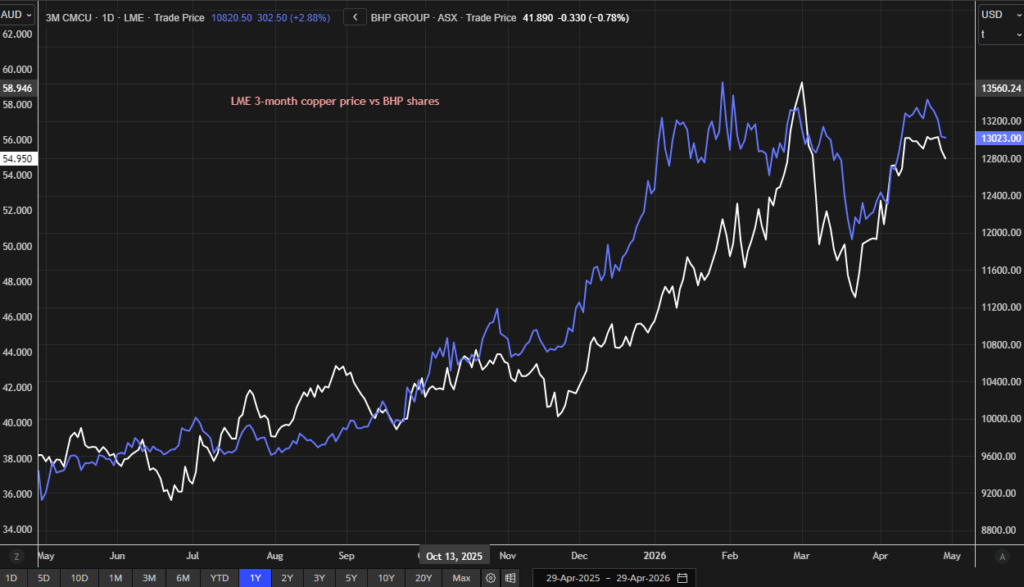
Morningstar’s US Technology Index fell 9% in the first quarter. Shares of BHP (ASX: BHP) and Rio Tinto (LON: RIO), the world’s two largest mining companies, both ​hit record highs this year.

Copper price vs BHP shares

“The material intensity of GDP is rising,” Hambro said, pointing to surging capital investment in grid infrastructure, data centres, electric vehicles ⁠and charging stations.

Unlike China’s urbanization-driven boom in the 2000s, Hambro said demand is “much more robust and resilient” in this cycle because there is global diversification across AI, electrification and defence.

However, the shift heightens risks ​of sharp price swings as metals markets are small relative to global equities and bonds and thus more vulnerable to bottlenecks in mining, refining and transport, analysts and investors said.

Fidelity’s Taosha Wang also said that ​a mining and energy-focused supercycle has already arrived as the Iran war pushes governments to prioritize supply security.

Industrial metals vs gold

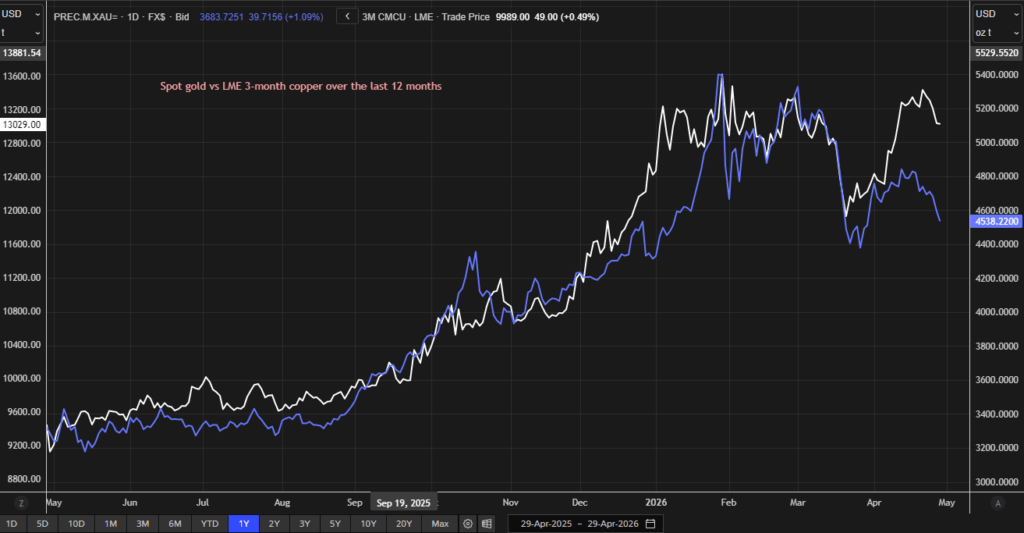
Flows have shown a tilt toward industrial metals. Copper funds attracted $198 million in March, while a searing rally in gold gave way to profit taking. The VanEck Gold Miners (GDX) ETF alone lost $710 million last month, but remains up almost $1 billion year-to-date.

The pullback in gold during an active geopolitical crisis is notable, investors say. Rather than seeking shelter in traditional ​safe havens, markets appear to be betting that the Iran conflict will catalyze a real-economy response, with energy security and infrastructure investment requiring copper, steel and rare earths.
Flows into oil and gas funds – of an ​almost net $6 billion in the first quarter according to ETFGI data – reinforce the thesis that investors are positioning for infrastructure spending, fund managers said.

Some portfolio managers see appeal in diversified miners like BHP and Rio Tinto positioned ‌at the intersection ⁠of multiple demand drivers.

“Copper is very much in demand, aluminum very much in demand, even more so now, as the Iran crisis unfolds,” said Anix Vyas, portfolio manager at Harding Loevner, noting that Rio Tinto with holdings of both metals can benefit from a surge in demand from data centres and industrial applications.

Vyas framed the shift as investors fleeing software companies vulnerable to AI disruption for companies with more durable competitive advantages, like miners with control over critical minerals.

Small markets – big swings

The relatively small size of metals futures markets means heavy inflows can magnify volatility even as a broader uptrend remains intact.

Trading volumes for metals ​futures including copper and aluminum on the London ​Metal Exchange amounted to $21 trillion last year, while ⁠the CME put trading in gold futures at more than $25 trillion, paling against the $85 trillion racked up in Nasdaq-100 futures and more than $135 trillion in S&P 500 futures.

The sharp year-on-year swing in ETF mining flows demonstrates how quickly sentiment can shift and how vulnerable these markets are to reversal.

The sector is also ​only a small slice of the global stock market, with the top five mining companies representing just 0.4% of the MSCI ACWI Index versus ​16.8% for the top five ⁠tech companies. Metals and mining products account for just 0.57% of total equity ETF market share.

Major mining companies’ shares still trade at 7 to 8 times EV/EBITDA, well below the 14 times multiples seen during the 2008-2010 boom, suggesting significant upside if the supercycle plays out.

Discover more
Mining equipment suppliers
Mining news subscription
Rare earth industry

“Copper is at the intersection of everything and critically undersupplied. There is no doubt in my mind that copper prices could double or triple over the next decade ⁠and owning copper ​producers will deliver multiples of the spot price growth,” said Charlie Aitken, group investment director at Australia’s Regal Partners, which ​is overweight mining and metals and held A$21 billion ($15.05 billion) under management at the end of March.

However, while investments in the sector offer an inflation hedge, they could also accelerate price gains, compounding inflation pressures from the Iran war’s impact on energy markets ​and posing risks to global growth, investors said.

($1 = 1.3957 Australian dollars)

(By Clara Denina, Melanie Burton, Pratima Desai and Polina Devitt; Editing by Veronica Brown and Kirsten Donovan)

CU

Billionaire Adani’s copper plant said to be beset by problems

Credit: Adani Metals

Billionaire Gautam Adani’s $1.2 billion copper plant has hit a string of technical setbacks since it was commissioned 10 months ago, raising concerns about the future of an operation vital to adding supply outside China.

Adani Enterprise Ltd.’s Kutch plant has yet to produce meaningful volumes of copper as a result of the engineering trouble, and closed for repair work in late March, according to people familiar with the matter, who asked not to be named due to the sensitivity of the issue. It was not clear if the operation had since restarted.

According to data from India’s Ministry of Mines, the 500,000 tonne-per-year plant produced 94,000 tons of refined copper from April last year to February this year.

A spokesperson for Adani denied Kutch Copper Limited had encountered engineering challenges, and said execution and plant stabilization had been swift.

“KCL has made steady progress in plant ramp up and stabilization towards achieving the full capacity,” the spokesperson said in an email response to Bloomberg. “Within a very short period, KCL’s premium quality products serve hundreds of satisfied customers across product and segment category with long-term contracts in place.”

Earth-i — a company that monitors activity at smelters globally, using satellite data on smoke, stockpiles, vehicle movements and more — said it had seen no clear or significant signs of sustained smelting at the Gujarat site since last June. The agency has detected such markers at other new smelters in Asia and Africa over the last year.

The satellite data did point to other activity, including copper concentrate shipments arriving on site and smoke. Copper concentrate, a form of semi-processed ore, is used to feed the smelter. Four people with direct knowledge of the matter said high levels of impurities in the feedstock — including antimony, arsenic and uranium — had caused operational difficulties.

The presence of other metals can make the primary smelting process unstable, affecting the purity of copper and sulfuric acid produced. Adani’s procurement team is now actively looking for June and July shipments of cleaner copper concentrates, the people said.

To run at full capacity, Adani’s plant needs around 1.6 million tonnes a year of copper concentrate. Kutch Copper Ltd.’s import records show they bought just over a quarter of the feedstock required between February 2024 and February 2026.

Adani’s spokesperson said KCL had long-term concentrate tie-ups with global suppliers for the required “quantity and quality of concentrates, fully meeting operational requirement.”

The facility has an integrated design, where a primary smelter feeds semi-refined copper to the refinery. Even so, the company has imported over 26,400 metric tons of copper anodes, that semi-processed form, in the past two years, according to Bloomberg analysis of trade data.

China currently smelts almost half of the world’s copper, thanks to inexpensive power and technical expertise. An expansion of that capacity, along with mine disruptions and competition from traders, has caused a global raw material squeeze that has already prompted several operations outside China to shut down or turn to government support over the last year.

Trouble at Kutch could also prompt a reassessment of the world’s copper supply. Consultancies CRU, Wood Mackenzie and Benchmark Mineral Intelligence currently expect the Adani plant to be a meaningful contributor, producing between 175,000 tons and 385,000 tons of copper this year.

(By Julian Luk, Preeti Soni and P R Sanjai)


Column: Study group shines some light on Doctor Copper’s confusion

Stock image.

(The opinions expressed here ​are those of Andy Home, a columnist for Reuters.)

Where next for Doctor Copper?

After January’s frenzied rush to record highs, the copper market is now nervously treading water, bobbing to the ever-changing news flow around the Iran crisis.

The closure of the Strait of Hormuz is both bullish and bearish for the copper price.

The Gulf is a major exporter of sulphur and copper miners using leaching technology need a lot of sulphuric acid. Solvent extraction and electrowinning accounts for a quarter of global refined metal output.

But the broader economic fallout from higher energy prices threatens a slowdown in manufacturing activity and therefore copper demand. It’s a risk that grows with each day the Strait remains closed.

The Iran crisis accentuates the confused and confusing play of opposing forces in the copper price.

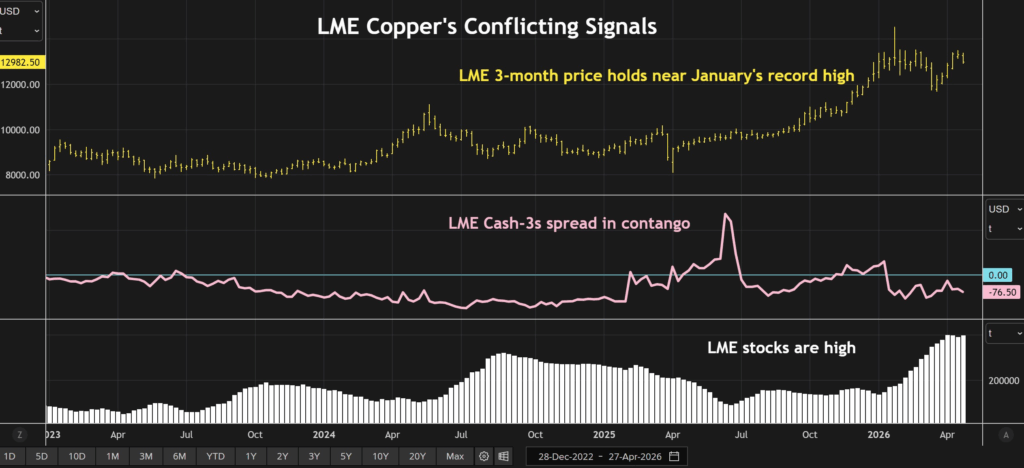
Supply is problematic. So too is demand. At $13,000 per metric ton, London Metal Exchange three-month copper is pricing scarcity. Yet exchange warehouses are full of metal and time-spreads are in deep contango, signalling abundance.

The latest forecasts from the International Copper Study Group (ICSG) shed some welcome statistical light on Doctor Copper’s current dilemma.

LME 3-month copper, cash-3s spread and stocks

Finely balanced

Copper’s fundamental outlook depends on which deteriorates faster – supply or demand.

Global mined production grew by just 0.9% in 2025 relative to 2024 after big production hits in Chile, Indonesia and the Democratic Republic of Congo.

The lingering impact of those incidents has caused the ICSG to revise downwards expected mine production growth this year to 1.6% from 2.3% when it last met in October.

The ongoing squeeze in the copper concentrates segment of the market, reflected in historically low smelter treatment charges, is expected to restrain refined metal production growth to just 0.4% this year.

So far, so bullish.

But the ICSG also cut its copper usage forecast for this year to 1.6% from October’s 2.1%, citing the Iran crisis, which is “likely to weaken the global economic outlook and negatively impact copper demand”.

The Group has flipped its 2026 market balance assessment from October’s anticipated shortfall of 150,000 metric tons to a small 96,000-ton supply surplus.

Relative to the 29 million tons of copper that will be used this year, this is a marginal change but one that captures copper’s fine balancing act between simultaneous risks on both supply and demand sides of the equation.

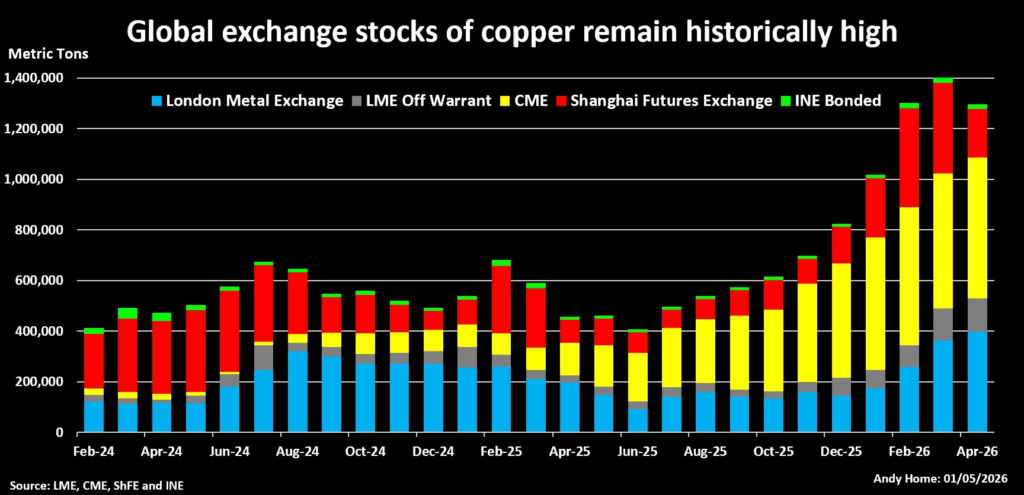
LME, CME and ShFE stocks of copper

Glut in 2025

Last year was a completely different story, which helps explain why exchange inventory is so high.

The ICSG made some interesting revisions to its 2025 market assessments at April’s spring meeting.

The Group now calculates the global copper market recorded a significant supply surplus of 455,000 tons last year, more than double the 178,000-ton excess anticipated in October.

The revision reflects much higher-than-expected smelter production, both primary and secondary.

Global refined copper output grew by 4.5% last year relative to 2024. Back in October the anticipated growth rate was 3.4%. A year ago it was 2.9%.

The aggressive rate of increase has been led by China, which lifted output by 9%, equivalent to an extra million tons, in 2025, according to Macquarie Bank.

Much of last year’s surplus has been drawn to exchange warehouses, particularly those in the United States.

The US premium resulting from the threat of import tariffs on copper has sucked in copper from around the world and led to surging stocks at both CME’s domestic warehouses and LME warehouses in free trade zones.

Global exchange stocks of copper fell in April thanks to China’s post-holiday seasonal restock, but they remain historically high at 1.3 million tons, up by 800,000 tons since the start of last year.

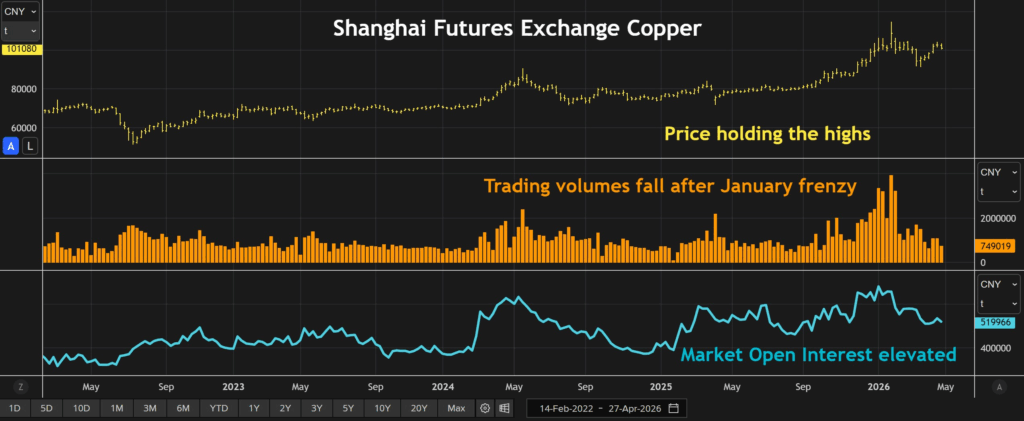
SHFE copper price, volume and MOI

Funds Trump fundamentals

Last year’s big supply surplus helps explain today’s high stocks and loose time-spreads.

On traditional metrics the price should be lower but it’s not because funds are currently trumping fundamentals.

The speculative buying frenzy of January has abated but there are plenty of investors keeping the bull faith in higher prices.

Money managers are net long to the tune of 59,132 contracts on the CME’s flagship contract, the largest bull commitment since the middle of January.

Market open interest on the Shanghai Futures Exchange copper contract, where the speculative fever was most intense, is still elevated at 520,000 contracts.

Copper’s fundamental dynamics are so nuanced right now that both bulls and bears can find plenty of fundamental ammunition to argue their respective cases.

But with investors holding the key, copper has become part of a multi-asset punt on the duration of the Iran war, which leaves both bulls and bears equally beholden to the next headline about the Strait of Hormuz.

(Editing by Kirsten Donovan)