Sunday, May 10, 2026

Australian far-right party wins first lower house seat

Natalie Muller 
DW with Reuters, AFP, ABC
May 9, 2026

The far-right populist One Nation party has won its first seat in Australia's House of Representatives.


https://p.dw.com/p/5DWS1


One Nation candidate David Farley unseated the incumbent Liberal Party
Image: Hilary Wardaugh/AFP


Australia's far-right One Nation party won a key by-election on Saturday in a rural seat that had been held by traditional conservatives for more than half a century.

Preliminary results showed its candidate, David Farley, was on track to win 59.1%, defeating the incumbent center-right Liberal Party by a wide margin.

It marks the first time One Nation has won a lower house seat in the federal parliament.

Farley, a former agribusiness executive, was the clear favorite heading into the contest for Farrer, a large agricultural electorate some 550 ​kilometers (340 miles) south of Sydney.

"We're like a mason with a chisel and a hammer, and we're carving the letters into the Australian democracy," Farley told cheering supporters.

"One Nation is at the end of its beginning — we are going through the ceiling," he said, pledging to bring down the cost of living.


Farley (C) said the election win is the 'biggest achievement' of his career
Image: Hilary Wardaugh/AFP


Why was a by-election held?

The seat was left vacant when former Liberal leader Sussan Ley resigned in February as her party slumped in the polls behind One Nation.

Farley's main rival, popular independent Michelle Milthorpe, was trailing in second place with around 40%, while the Liberal candidate Raissa Butkowski had around 11%, according to the ABC.

The ruling Labor Party did not contest the seat, which is considered unwinnable for a left-leaning candidate.

The One Nation win does not affect the parliamentary majority of Labor, which still holds 94 of 150 seats in the lower house.
What is One Nation?

One Nation was founded nearly 30 years ago by Pauline Hanson, who has long advocated for cuts to immigration. She is one of four senators from One Nation in the upper house.

Hanson was widely condemned after she wore a burqa in parliament last year as part of her push to ban the face coverings
 [FILE: November 2025]Image: Mick Tsikas/IMAGO

Hanson said the result was "a win for Farrer but a bigger win for the nation."

Liberal leader Angus Taylor said the outcome of the by-election brought some "hard lessons" for his party, which has been battling for second place with One Nation in national polls.

The result in Farrer comes amid a surge of support for far-right parties globally. Britain's ruling Labour Party this week suffered a significant loss of seats at council elections.

Meanwhile in Germany, the far-right Alternative for Germany (AfD) is polling at 41% ahead of elections in the eastern state of Saxony-Anhalt that could potentially see it win an absolute majority in a regional parliament for the first time.

Edited by: Karl Sexton
French far-right leaders court Israel, Germany envoys ahead of presidential poll

Paris (AFP) – France's far-right leaders have met the ambassadors of Germany and Israel in recent months as their party, once deemed antisemitic, seeks to court foreign envoys in the run-up to next year's presidential elections.


Issued on: 10/05/2026 - RFI

Either Marine Le Pen, or her lieutenant Jordan Bardella, will run for president next year. © Bertrand GUAY / AFP/File

Marine Le Pen's anti-immigration National Rally (RN) party is eyeing its best chance yet at taking power, with President Emmanuel Macron stepping down after hitting the two-term limit.

Le Pen hopes to run for president for a fourth time in 2027, after twice making it to the runoffs against Macron in the last two votes.

But if an appeals court in July bars the 57-year-old from public office over an alleged fake jobs scam in European Parliament, her lieutenant Jordan Bardella, 30, is expected to run in her place.

France is home to western Europe's largest Jewish population, at around half a million people.

Le Pen has long sought to make the party she inherited from her father Jean-Marie more palatable, including by distancing it from the antisemitic legacy of a man convicted for Holocaust denial.

As polls suggest she or Bardella could well lead in the first round of the election, the strategy seems to have paid off.

Bardella, who is RN party leader after taking over from Le Pen, in February met the German ambassador, his party and a participant said.

The embassy did not confirm the meeting.

But a diplomatic source told AFP it was "the responsibility of a foreign mission to maintain contacts with all the political forces in the host country concerned".

Germany has long been among Israel's staunchest allies, something Berlin has grounded in the country's responsibility for the Holocaust.

"Yes, they met in February," a member of Bardella's team said, seeking to present it as a routine meeting.

He "meets many ambassadors as part of his duties as head of the RN party and as leader of a group in the European Parliament," the person said.

Bardella is head of the Patriots for Europe group, the EU legislature's third-largest bloc that was co-founded in 2024 by former Hungarian prime minister Viktor Orban.


'Areas of convergence'


The participant said the discussion between Bardella and the German ambassador made it possible to identify "areas of convergence" on several issues in France and neighbouring Germany.

They focused in particular on "budgetary discipline" in both leading EU member states.

The episode follows Le Pen last month meeting the Israeli ambassador for the first time.

The embassy confirmed the meeting, with a diplomatic source adding that the ambassador "received all political parties" except from the hard-left France Unbowed (LFI).

LFI has criticised Israel over the war in Gaza, and its leader Jean-Luc Melenchon – also a candidate next year – has been accused of making antisemitic comments.

Before the meeting with the Israeli envoy, Le Pen had the previous day been seen meeting the Lebanese ambassador, who thanked her for her solidarity as his country sought a lasting ceasefire with neighbouring Israel.

Both Le Pen and Bardella also met the US ambassador late last year.

US ambassador Charles Kushner in December on X posted a picture of himself with them, saying he appreciated the chance to learn from them "about the RN's economic and social agenda and their views on what lies ahead for France".


Brazil judge suspends law that reduces Bolsonaro's jail term

Mahima Kapoor 
DW with AFP, Reuters
May 9, 2026

Brazil's top court prohibited the implementation of legislation that would drastically cut former President Jair Bolsonaro's prison term.

The Supreme Court of Brazil on Saturday suspended the implementation of a law that would reduce the prison sentence of former far-right President Jair Bolsonaro, pending the outcome of legal challenges against it.

Bolsonaro is currently serving a 27-year sentence for plotting a coup after losing the 2022 election. The law in question could potentially have freed him in 2028.

Justice Alexandre de Moraes ordered the suspension until the Supreme Court holds a full hearing on appeals challenging the law's constitutionality, the ruling said.
What is the law?

The new law applies to all those convicted of plotting coups, including Bolsonaro. It aims to reduce the waiting period for sentence reductions and significantly cut jail time.

Passed in December, the law was vetoed by leftist President Luiz Inacio Lula da Silva a month later. However, in April, lawmakers led by Bolsonaro's allies overturned the presidential veto, and the bill was enacted on Friday.

The legislation requires defense attorneys to file requests with the Supreme Court to have sentences recalculated on a case-by-case basis.

Moraes' ruling suspends the review of such cases until the full Supreme Court meets to decide on the law's constitutionality.

Two Brazilian political parties and the press association ABI separately challenged the bill this week.

Bolsonaro's lawyers are yet to formally request a recalculation of his sentence. But on Friday, they filed a motion for criminal review with the Supreme Court seeking to overturn the conviction.

Edited by: Roshni Majumdar
Mahima Kapoor Digital journalist based in New Delhi@MahimaKapoor12
Eurovision 2026: Politics collide with a blockbuster show

DW 
May 9, 2026

Controversy over Israel's participation and boycotts unprecedented in scale are already weighing on the Eurovision Song Contest before it even kicks off in Vienna.


The Eurovision Song Contest returns to Vienna for the first time since 2015I
mage: Max Herbst/APA-Images/picture alliance


The 2026 Eurovision Song Contest in Vienna hasn't even started yet — and yet it has been at the center of heated debates for months. At issue isn't so much the spectacular pop shows themselves as the political tensions that, despite the competition's long-standing claim that it is apolitical, are becoming increasingly difficult to ignore.

The last time the Austrian capital hosted the Eurovision Song Contest was in 2015. This year, on the occasion of its 70th anniversary, the contest returns from May 12-16 to a city that stands for culture and diversity. Expectations are high, as the contest aims to bring people together and send a message of openness. The motto is "United By Music – (In) The Heart Of Europe"

But this is precisely what is becoming an increasingly difficult challenge with each passing year, as political crises in some participating countries are also growing.
Israel is the target of protests

As in previous years, Israel is once again the focus of considerable attention. Amid the ongoing conflict in Gaza, activists and some members of the creative community are once again calling for the country to be excluded or boycotted.

Most recently, more than 1,100 artists signed an open letter with a clear message: No Eurovision Song Contest as long as Israel is participating. Supporters of the "No Music for Genocide" initiative include international stars such as Peter Gabriel, Massive Attack, Roger Waters, Macklemore and Brian Eno.

On the other side, an open letter by the pro-Israel initiative "Creative Community for Peace" has also been signed by around 1,100 members of the entertainment industry, including Helen Mirren, Amy Schumer and Gene Simmons. It advocates for Israel's participation: "We are shocked and disappointed that some members of the entertainment industry are calling for Israel to be excluded from the competition due to its response to the largest massacre of Jews since the Holocaust," the letter states.

The Vienna police are expecting disruptive protests and attempts to block the event, especially on the final day. They announced that a demonstration with around 3,000 expected participants from pro-Palestinian groups has been registered for May 16. However, further actions are to be expected. Demonstrators are also likely to arrive from abroad.

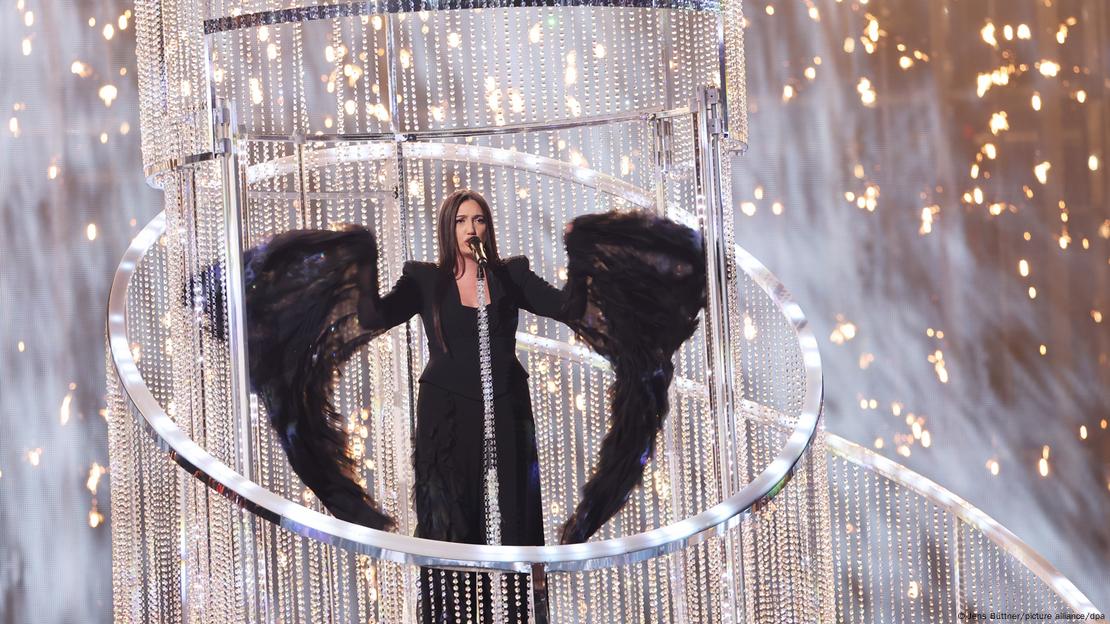
In 2025, Israel's Yuval Raphael came in second
Image: Jens Büttner/picture alliance/dpa

However, Israel, who is sending singer Noam Bettan to Vienna with the seemingly ordinary heartbreak pop song "Michelle," will not be barred from participating, in a decision that aligns with the European Broadcasting Union's (EBU) long-standing position: The competition is an association of broadcasters, not of governments. As a result, Israel remains part of the Eurovision Song Contest.
Even a 'Big Five' country is boycotting the Eurovision Song Contest

This has led some countries to react strongly: Ireland, the Netherlands, Slovenia and Iceland — all Eurovision veterans — are boycotting the contest. Spain has also joined the boycott, meaning that one of the so-called "Big Five" countries (which are the contest's biggest financial backers) will not be participating this year. This has never happened before.

Some countries will not be broadcasting the Eurovision Song Contest on TV. The world's biggest music event, which most recently drew nearly 170 million viewers worldwide, will have a smaller audience this year.

Criticism of Romania's entry


In addition to geopolitical issues, the song submitted by Romania has also sparked debate. One legal professor is quoted in The Guardian as saying that Alexandra Capitanescu's song "Choke Me" demonstrates "an alarming disregard for young women's health and well-being." One of the lines Capitanescu sings is: "All I need is your love, I want it to choke me." Following accusations that the song glorifies violence toward women, the singer explained on Reddit that "Choke Me" is a metaphor — for the pressure and inner fears one imposes on oneself; the title and chorus are not to be taken literally.

The commotion surrounding the song has died down somewhat now — the first rehearsals are over, and the show begins in a few days. But these reactions are a reminder of how delicate the situation has become. What might once have been dismissed as a flamboyant performance is now being scrutinized and interpreted in detail.


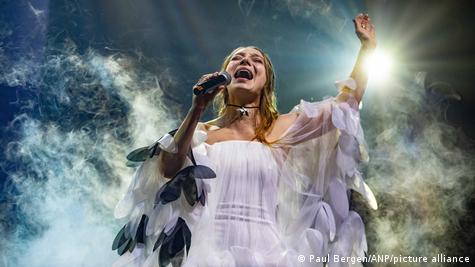
Leleka is competing for Ukraine
Image: Paul Bergen/ANP/picture alliance


Ukraine's German connection

Ukrainian singer Viktoria Leleka is competing with a song written in Berlin, hoping to win over the hearts of Eurovision fans with a blend of ethno-pop and musical theater. In an interview with German broadcaster ARD, she spoke about how much she loves Germany and the language, and how important it is to her to give a voice to her homeland and its diverse culture at a time of Russian aggression against her country.

Ukraine is one of the most successful countries in the contest and is almost always among the finalists. Most recently, the Kalush Orchestra won the 2022 contest with "Stefania."

Amid political tensions, Leleka's entry "Ridnym" is being watched with particular interest. The song describes an inner transformation, coping with fear and the power to find hope even in hopeless situations.

Favorites and trends

Musically, it's shaping up to be a typical ESC year: Big emotions, dramatic stage designs and lots of danceable, upbeat electro-pop.

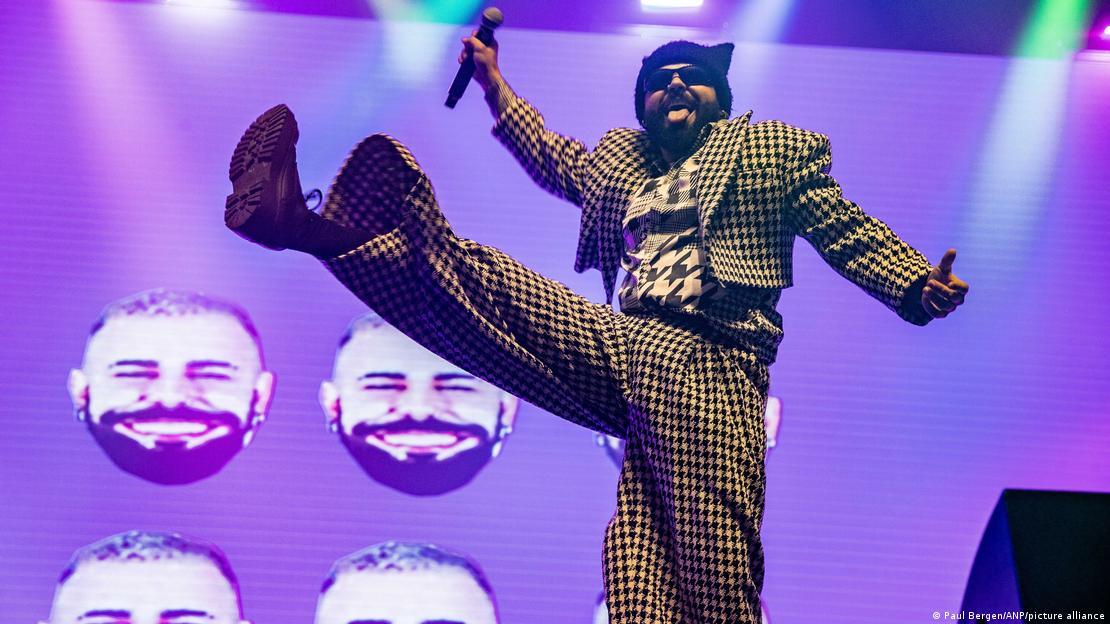
Greece's entry is rapidly climbing the betting odds — whether it can hold its ground will be revealed on Tuesday, May 12, during the first semifinal, when Akylas performs the song live.

Finland will also be competing in the first semifinal with the pop-classical duo Linda Lampenius x Pete Parkkonen, both of whom also have a good chance of winning.

For host country Austria and Big Five member Germany, however, the prospects are not so good — both are traditionally guaranteed a spot in the final and don't have the opportunity to perform in the semifinal shows. For both countries, it's all or nothing in the grand final on Saturday, May 16.


Meme-worthy: Greek singer Akylas
Image: Paul Bergen/ANP/picture alliance

Eurovision Song Contest Asia — a new spin-off


While Europe focuses on Vienna, attention is also turning to the Asian continent. The first Eurovision Song Contest Asia is set to take place on November 14 in the Thai capital, Bangkok. Ten countries, including the Philippines, South Korea and Vietnam, have already confirmed their participation.

An attempt to establish the contest in the US has failed. The American Song Contest 2022 remains a one-time event.

This article was originally written in German.

Silke Wünsch Reporter and editor at DW's culture

Eurovision hopes 70th anniversary celebration outshines Israel controversy


The Eurovision song contest turns 70 this year, but the celebration threatens to be overshadowed by the competition’s biggest ever boycott over the continued inclusion of Israel.

ANALYSIS
Issued on: 08/05/2026 - 
FRANCE24
By: Joanna YORK

A light show at the official opening of the stage at the Wiener Stadthalle prior to the 70th Eurovision Song Contest, in Vienna, Austria on April 28, 2026. © Joe Klamath, AFP


The 2026 edition of the Eurovision Song Contest is celebrating two notable milestones – not only is it the event’s 70th birthday, but it also features the lowest number of competing countries in two decades.

Among the delegations gathered in Vienna for the grand final on Saturday, May 16, five competition regulars will be absent, with Iceland, Ireland, the Netherlands, Slovenia and Spain all boycotting the event over the inclusion of Israel.

Officials from Spain’s national broadcaster RTVE said in April that it would not participate as the contest’s stated mission of neutrality had become “impossible to maintain”.

"No one raised an eyebrow when Russia was required to leave international competitions and not participate in Eurovision after the invasion [of Ukraine],” Prime Minister Pedro Sanchez, an outspoken critic of Israel’s policies in Gaza, added in May.

"We cannot allow double standards, not even in culture."

“It certainly is a rather challenging situation for the organisers of the contest this year,” said Dean Vuletic, historian and author of ‘Postwar Europe and the Eurovision Song Contest’.

“This should really have been a huge party, but in the end, we're seeing fewer participants than ever since 2003.”
‘Under the spotlight’

Eurovision describes itself as a non-political event and performances that contain political messages are not allowed under the competition rules.

But critics say the organisation’s continued inclusion of Israel – which has been accused of committing war crimes including genocide in Gaza – is a political gesture in itself.

“It puts the organisers under the spotlight, and makes people ask what they are doing and how they are thinking,” said Christina Oberg, a professor at Sweden’s Linnaeus University and author of several studies on geopolitical tensions and Eurovision.

Opposition to Israel’s inclusion began in 2024, with the competition falling six months after Prime Minister Benjamin Netanyahu launched extensive ground operations in Gaza in response to the October 7 Hamas attacks in Israel.

By May 2025 – as ground operations and aid blockades in Gaza continued – calls for Israel to be excluded from the competition grew. They have reached a fever pitch this year, amid new Israeli military operations in Iran and Lebanon.

But anger against the Eurovision organisers may be misplaced, said Vuletic. “The European Broadcasting Union (EBU) is not a political organisation. It's a technical association of National Public Service broadcasters, and it doesn't have a political mandate to act.”

The decision to exclude Russia from the Eurovision since 2022 over its full-scale invasion of Ukraine was straightforward, as all members of the EBU had shown a united front in imposing international sanctions on Moscow.

Ukraine's Kalush Orchestra won the Grand Final of the Eurovision Song Contest in Turin, Italy, on May 14, 2022. © Luca Bruno, AP


“But when it comes to Israel, Europe is divided over how it should respond to Israel's military actions,” Vuletic added. “For the European Broadcasting Union to make a decision against Israel, it needs a majority of its members to support such a decision, and we're simply not seeing that.”
‘Playing politics’

This year, Israel will be represented by Noam Bettan with a song called "Michelle" that was co-written by last year's entrant, Yuval Raphael, and features a chorus in French.

In 2025, Austria won the competition overall, but Raphael, who is a survivor of the October 7 Hamas attack, won the public vote for Israel in the grand final, sparking accusations that the competition was rigged.

In response, Eurovision organisers in November announced a series of reforms to the voting system, such as capping the number of votes per voter at 10.

But, regardless of what happens on stage, Oberg expects a similar dynamic this year, with a strong result for Israel in the public vote tempered by a low score from the competition judges. “Which side is playing politics is difficult to say,” she said.

I
sraeli singer Yuval Raphael arrives at the Eurovision opening ceremony as protesters wave Palestinian flags in Basel, Switzerland, on May 11, 2025. © Fabrice Coffrini, AFP


Spain’s boycott of the competition is significant as it is one of the “big five” countries – along with France, Germany, Italy and the UK – whose public broadcasting services make the largest financial contribution to the production of the competition and, as such, are guaranteed a place in the final.

Should more of the big five join the boycott, it could destabilise the competition financially. It could also raise broader questions about “where we are with the initial idea that led to the Eurovision, to bring collaboration and peace to Europe after the Second World War”, Oberg said.

Although she added that some countries may find it easier to quit than others. “It would never happen in Sweden because Eurovision is such a big deal for us.”

In fact, given the competition's politically chequered history, it seems unlikely that this year’s boycotts will dent the competition's reputation too badly.

As far back as 1969, Austria boycotted the Madrid final to show its opposition to dictator Francisco Franco. More recently, Moscow hosted the competition in 2009, in a seeming endorsement of Russian President Vladimir Putin’s regime.

“Eurovision has been through many political crises, and it has weathered them all,” said Vuletic, who believes the politics of Eurovision adds to its overall appeal.

“One of the reasons why the contest is so engaging because we like to see how it reflects political issues,” he added. “It is a contest between countries, so it reflects international relations alongside expressing cultural diversity.”

Fans seem to agree. Tickets for this year’s nine final events in Vienna sold out in record time with spots for the grand final snapped up in just 14 minutes.

“To see every single show sell out so quickly is a powerful reminder of what the Eurovision Song Contest represents - joy, togetherness and shared experience at a time when that feels more important than ever”, said Eurovision’s director, Martin Green.
Venice Biennale opens under shadow of protests over Russia and Israel

Global politics are casting a long shadow at the Venice Biennale, which opens for six months on Saturday. The world's oldest contemporary art event is off to a rocky start amid resignations, boycotts and protests over the inclusion of Russia and Israel.

Issued on: 09/05/2026 - RFI

The newly renovated French pavilion at the Venice Biennale art show in Italy, which opens on 9 May 2026. Artist Yto Barrada is representing France with her installation "Comme Saturne". © Jacopo La Forgia - Institut français

By: Ollia Horton with RFI

As the international art show takes over Italy's canal city for its 61st edition, Russia is returning to the Biennale for the first time since Moscow's invasion of Ukraine in 2022.

Ukrainian feminist collective Femen and Russian punk protest band Pussy Riot joined forces to demonstrate outside the Russian pavilion at the start of press previews on Wednesday.

"We are here to remind that the only Russian culture, the only Russian art today is blood," Femen activist Inna Shevchenko told reporters. "This pavilion stands on Ukrainian mass graves."

Ksenia Malykh, curator of Ukraine's pavilion, said: "They [the Russians] say art is beyond politics but they’re using art as a weapon, in a hybrid war in Europe. So it’s absolutely insane that they’re here. No one progressive could accept that."

A Pussy Riot activist holds an Ukrainian flag during a protest against the participation of Russia in the Venice Biennale art show, in front of the Russian pavilion on 6 May 2026.
 @ AFP - MARCO BERTORELLO

The art fair's international jury resigned last month, saying they would not hand out awards to countries led by figures subject to arrest warrants issued by the International Criminal Court – namely, Russian President Vladimir Putin and Israeli Prime Minister Benjamin Netanyahu.

EU foreign policy chief Kaja Kallas called Russia's participation in the Biennale "morally wrong" and said the European Union was considering cutting €2 million of funding to the festival.

In March, culture and foreign ministers from 22 European countries, including France, asked the organisers to reconsider. "Culture is not separate from the realities societies face," they wrote in a joint letter, arguing that "granting Russia a prestigious international cultural platform sends a deeply troubling signal".

Italy's Culture Minister Alessandro Giuli – who has repeatedly expressed the Italian government's opposition to Russia's inclusion – has said he will not be going to the opening ceremony.


Russia's pavilion will not be open to the public during the Biennale, which runs until 22 November.

Instead, live performances that took place during press previews this week were recorded and will be shown on outdoor screens. The Russian exhibit will be eligible for the art fair's prizes, which this year will be awarded by visitors' votes.

In a statement on Facebook, Russia's ambassador to Italy, Aleksei Paramonov, said there was "truly something painful and unreasonable about the European Union's obsession with targeting Russian culture and art with sanctions and restrictions of all kinds".
Protests over Gaza

Israeli artists are also back at the Biennale, after refusing to open their exhibit at the last edition in 2024 amid the war in Gaza.

Shortly after Wednesday's demonstration outside the Russian exhibit, about a hundred pro-Palestinian demonstrators gathered in front of Israel's pavilion, holding up banners saying "No artwashing genocide" and brandishing the names of Palestinian artists killed in Gaza.

The artist representing France, Yto Barrada, is among more than 200 participants who have signed a letter demanding Israel's exclusion, saying they refuse to allow organisers "to platform the Israeli state as it commits genocide".

The Israeli government has accused protesters of discrimination.

Representing Israel's pavilion, sculptor Belu-Simion Fainaru that the Biennale should be based on "inclusion and dialogue and free expression. A place where you can feel safe, to create and do whatever you believe in."


The president of the Biennale, Pietrangelo Buttafuoco, defended his team's choices and said art should remain neutral.

"If the Biennale were to start selecting not works but affiliations, not visions but passports, it would cease to be what it has always been: the place where the world comes together, and all the more so when the world is torn apart," he told reporters on Wednesday.

"Art has a power far greater than any form of oppression. Art opens the way for the future and gives us the possibility of erasing catastrophes," he said.
Iran absent

"La Biennale seeks to be – and must remain – a place of truce in the name of art, culture, and artistic freedom," organisers said in a statement following the jury's resignation last month.

Days before the opening, Iran announced it would not open a pavilion. No reason was given in the Biennale's official statement, but the country is currently at war with Israel and the United States.

That leaves around 100 countries participating in this year's Biennale.


France has ramped up its presence, with some 20 artists participating in solo and group shows.

Taking on the event's theme, "In Minor Keys", French-Moroccan artist Yto Barrada is presenting an enigmatic installation in the French pavilion inspired by the ambivalent figure of the Roman god Saturn.

Photo of the "La salle des plis" (The Room of Folds), part of the "Comme Saturne" installation by French-Moroccan artist Yto Barrada at the 2026 Venice Biennale. © Jacopo La Forgia - Institut français


Curated by Myriam Ben Salah, Comme Saturne brings together numerous textile techniques to blend references to ritual, myth, labour, agriculture, matter and language. The title also refers to the famous phrase by Pierre Victurnien Vergniaud, a figure of the French Revolution who was guillotined in 1793: "The Revolution, like Saturn, devours its children."

According to a prophecy, Saturn would be overthrown by one of his sons. In response, he ate his sons as soon as they were born. But the mother of his children hid one child, Jupiter, who went on to banish his father and rule supreme.

Barrada plays with this image by using a technique known as "dévoré", in which the surface of a fabric is chemically dissolved to create semi-transparent patterns.


Photo of the "Salle de Travail" (Working Room), part of the "Comme Saturne" installation by French-Moroccan artist Yto Barrada at the 2026 Venice Biennale. 
© Jacopo La Forgia - Institut français


For Eva Nguyen Binh, head of the Institut Français, the French cultural institute responsible for the pavilion, this project sums up "what art can repair and provide: an ability to break down geographical and artistic boundaries, to foster community, draw from history in order to question the present, and to make overlooked narratives visible, especially those of women and minorities".


Political tensions cast shadow over Venice Art Biennale opening

09.05.2026, DPA


Photo: Robert Messer/dpa


The 61st Venice Biennale is due to officially open to visitors on Saturday, a day after thousands of demonstrators gathered in Venice to protest against Israel's participation in the art exhibition.

Alongside the documenta in the German city of Kassel, the art biennial is considered the most important presentation of contemporary art and attracts artists and guests from around the world.

Last week, in a dispute over how to deal with Russia and Israel, the jury resigned en masse - an unprecedented event since the Biennale's founding in 1895. 

The grand opening ceremony has been cancelled, as has the usual presentation of the Golden Lions. 

Prizes will now only be awarded at the end of the Biennale in November – and no longer by a jury, but through a vote by the public. 

The director of the Biennale, Pietrangelo Buttafuoco, rejected criticism of Russia's participation. He accused his critics of narrow-mindedness and defended the event as a bastion of artistic freedom and dialogue.

The festival is set to run until November 22.


Croatia gets Europe's first commercial robotaxi service

07.05.2026, DPA


Photo: Verne/dpa


Robotaxis have taken to the roads of Croatia in what operators say is the first time a commercial driverless taxi service has been made available to the public anywhere in Europe.

Croatian mobility company Verne said it has been operating 11 of the white-painted taxis since April 8.

According to the company, a journey costs €1.99 at the introductory rate. Registered customers can book a ride and unlock the car doors via an app.

The taxis are based on the Chinese Arcfox Alpha T5, made by Chinese automotive giant BAIC and not available to buy in Europe.

Looking ahead, Verne also plans to deploy its own purpose-built autonomous vehicle, a compact two-seat robotaxi specifically designed for driverless ride-hailing. The service is backed by Uber and powered by the Chinese self-driving company pony.ai.

The robotaxi service will initially be available through the Verne app and is set to be soon accessible through the Uber app, following a recently announced strategic partnership between Verne, Pony.ai and Uber.

The service is designed to run completely autonomously but, as with self-driving taxi services in the US in their early days, the car still has a human behind the wheel to intervene if anything goes awry.

The plan is to move over to full robot control over the car in Zagreb by the end of the year. Verne said tens of thousands of kilometres have already been covered by the robotaxis and some 300 passengers carried, with no collisions reported.

Verne said discussions on further rolling out the robotaxis are under way with 11 cities across the EU, UK and Middle East.

Europe-based social networks launch bid to challenge tech giants


New schemes to launch Europe-based social networks face a steep, rocky road to seduce users away from American and Asian giants in the sector. Founders, nevertheless, see opportunity in the disillusionment and distrust of major platforms that have spiked alongside transatlantic tensions under Donald Trump's second presidency.


Issued on: 10/05/2026 - 
By: FRANCE 24


A new crop of European social media apps want to find room in a crowded market dominated by established American and Asian apps 
© Saeed KHAN / AFP/File

A flurry of new schemes to launch Europe-based social networks faces a steep, rocky road to seduce users away from American and Asian giants in the sector.

Founders, nevertheless, see opportunity in the disillusionment and distrust of major platforms that have spiked alongside transatlantic tensions under Donald Trump's second presidency.

"We think the timing is perfect, in a context where relations between Europe and the US are still deteriorating," said Gregoire Vigroux, co-founder of Croatia-based network eYou.

"It's time for Europe to equip itself with its own social networks," he added

Opening to users on Tuesday, eYou is one of a number of efforts on the old continent, including W -- a would-be competitor to X announced in January -- or Eurosky, a platform for accessing independent social networks launched last month.

Bulle (French for "bubble") also launched in January, promising a "healthy social network" while Monnett -- a hybrid of TikTok and Instagram -- is set for full release in July.

"The rejection targeting the (American) platforms is still stronger today" than in the past, said Romain Badouard, a researcher at France's Inria computing institute specialising in social networks.

He suggested that a "conservative turn in Silicon Valley" had proved unpopular with European users seeing the likes of X owner Elon Musk or Meta (Facebook, Instagram, WhatsApp) chief Mark Zuckerberg cosying up to Trump.
'Enormous graveyard'

At W, "the idea is to bring back what was once Twitter in the good old days", said founder Anna Zeiter ahead of the Saturday launch.

Some interest is apparent among investors and users in the new crop of networks.

In a second fundraising round, eYou garnered €300,000 ($353,000) in late 2025 while Monnett claims more than 65,000 users on the beta version of its app.

But such figures would be rounding errors to the giants of the sector, which count in hundreds of millions of users and billions in revenue.

The dominance of incumbent players has left little space for challenge beyond niche offerings like Mastodon or BeReal.

© France 24
09:17


"The world of social networks is an enormous graveyard," eYou's Vigroux acknowledged, adding that "99 percent of European social networks launched in the last 10 years have fallen flat".

Badouard pointed to the "network effect" that powered the snowballing of major platforms' user numbers as a factor now shielding them from competition.

For users on Instagram and TikTok, "all the people they know and the accounts they follow" are on the existing networks.

But the "technological maturity" of the latest wave of challengers could still count in their favour, he said.

"They're answering to a lot of the expectations users have," Badouard said.
Out of the algorithm?

There is a familiar litany of criticisms levelled at the big players, including sorting users into "filter bubbles", unevenly-enforced moderation and addictive design.

European would-be competitors see those as openings to vaunt their own virtues.

W promises to keep all but verified human users from posting, while eYou says it will "promote users sharing content considered trustworthy".

"It's really important for us that it's not an algorithm that determine what's on your screen, but yourself," said Christos Floros of Monnett, which is aiming to hit a million users this year.

Such commitments could steepen the path to profitability for the new arrivals, in a market where financial success is still largely determined by raking in advertising sales.

Zeiter said W would have "no crazy hyper-targeted advertising".

"Right now we are all trying out different business models and different approaches," she said.

"Maybe in one or two years we see what's most successful and then we can team up."

(FRANCE 24 with AFP)
Data centers: Tech boom with downsides
DW


Data centers are energy-intensive engines of growth, the backbone and hub of digitalization. Thousands of them are being built all around the world. The Iran war has shown how vulnerable societies are as a result.


An Amazon Web Services data center in the US: Massive server capacity is needed to fuel increasing internet demand
Image: Noah Berger/REUTERS


Dietzenbach is a small German town with a population of around 35,000. Locally it is best known for its open-air forest swimming pool and an architecturally unusual observation tower from which, on a clear day, you can see Frankfurt, some 12 kilometers away.

Its location is probably one of the main reasons why the US tech giant Google chose to invest several billion dollars in a new, high-performance data center. The greater Frankfurt area is one of the most important data center regions in Europe.

DE-CIX Frankfurt is the world's leading internet exchange. At peak times, it handles more than 17 terabits of data traffic. This equates to the amount of data processed if almost 3.5 million people streamed a high-definition film simultaneously. Seventy-six such data centers are already operating in the greater Frankfurt region. Worldwide, there are about 12,000 of these complexes and many more are being built.


The DE-CIX (Deutsche Commercial Internet Exchange) in Frankfurt is the biggest of its kind in the world
Image: Andreas Arnold/dpa/picture alliance


Growing importance of data centers

The internet is now an indispensable part of modern global society, and becoming ever more so. The rapid expansion of artificial intelligence, in particular, demands greater volumes of data. Massive server capacity is required to process and store this data and enable the smooth operation of cloud services and internet applications. Consequently data centers are the backbone of the modern internet.

They are also fundamentally significant for the national security of modern industrialized countries, whose economies and societies could barely function without them. Essential procedures for the provision of power and health systems, financial management, transport logistics and many other services are processed through these internet exchanges.

This is why data centers in Germany are classified as part of the country's critical infrastructure and afforded special protection. In March 2026, the federal government published a new national Data Center Strategy, illustrating how significant they are. It plans to double Germany's data center capacity by 2030 and will also aim to reduce its dependence on non-European providers.


Vulnerable hubs

The fact that almost everything online now passes through data centers also makes these complexes a prime target. There has been a sharp increase in cyberattacks in recent years. In January 2026, the German Federal Bank reported that it records more than 5,000 cyberattacks every minute on its own IT systems alone. Data centers are usually well protected against attacks like these and also against possible saboteurs.

Data center building complexes are generally secured with video cameras, fences and barbed wire. And with good reason: In Strasbourg in March 2021, a major fire in one of Europe's largest data centers demonstrated that physical damage to the hubs can also have far-reaching consequences. More than 3.6 million websites went down and many customers lost their data forever because their backups had been stored in the same building.

Strategic targets for attack?

Data centers have also become strategic targets in military conflicts. In the war in Ukraine, for example, IT infrastructure has been specifically targeted with the aim of blocking military operations and massively disrupting civilian supply lines.

Data centers in the Persian Gulf have also come under attack. In the US-Israeli war with Iran, Tehran has fired drones and rockets at three complexes in Bahrain and the United Arab Emirates. These belonged to the American cloud service provider Amazon Web Services (AWS) and the attacks caused huge disruption to banking, payment platforms and other systems.

Shortly afterward, the Iranian leadership published a list on Telegram with up to 30 other potential targets that are part of America's IT technology infrastructure in the Gulf. They included data centers, research facilities and the offices of various tech giants such as IBM, Google, Palantir and Oracle. There has been considerable discussion since then about how data centers can be better protected by air defense.

Big investment, big concerns

That's why it is becoming increasingly important to find suitable locations where new data centers can be constructed and reliably secured. However, the people living near these projects are often not at all happy about them.

They are critical of the vast amounts of energy and water data centers require to operate their servers and cool the facilities. Their hardware also wears out very quickly, producing large quantities of electronic waste. Researchers around the world are under pressure to find ways of making the centers more efficient, utilizing the waste heat and powering them with renewable energy.

It is also regarded as problematic that, although investors are often pumping billions of dollars into the construction of the centers, hardly any jobs are created in the region. Data centers often cover tens of thousands of square meters but usually have fewer than 100 people actually working in them. The economic benefit they provide is more likely to be indirect: for example, if other companies that depend on this IT infrastructure decide to locate close by.

Data centers are generally well protected against intruders; they must also be protected against air strikes
Image: Google Handout/dpa/picture-alliance

There have already been protests in various parts of the world. In Chile in 2024, an environmental group successfully demonstrated against the construction of a data center for AI applications. And in April 2026, the legislature in the US state of Maine voted in favor of a moratorium on data centers with a capacity of more than 20 megawatts, citing concerns about the effects on the economy and environment. Janet Mills, the state governor, had to exercise her veto to stop the bill being signed into law.

Germany doesn't always give the go-ahead for new data centers either.

Construction has begun in Dietzenbach but plans for a similar project in Gross-Gerau, around 30 kilometers away, have fallen through. The US investor Vantage Data Centers wanted to spend €2.5 billion ($2.9 billion) building another data center here but a majority of the town council voted against. They argued that the project was too big and the effects on environment and society too unclear.

This article was translated from German.

Thomas Latschan Author and editor with a focus on global politics


Harmful AI datacentres appear to be creating their own microclimates

06.05.2026, DPA


Photo: Sebastian Gollnow/dpa

A new preprint study warns AI data centers can heat up surrounding areas by an average of 2°C. As projects surge in California’s Imperial Valley, will regulators treat the local risks as collateral damage?

By Ariana Bindman, SFGate, San Francisco

As global temperatures rise, datacentres for artificial intelligence are creating "heat islands" that could have significant impacts on communities and their surrounding environments in the years to come, a March 2026 study shows, raising alarm among international researchers.

The preprint of the study, which has not yet been published in a peer-reviewed journal, looked at data from 2004 to 2024.

Researchers from multiple institutions, including the University of Cambridge and Nanyang Technological University, used satellite data from that time to assess rising land surface temperatures at AI datacentres worldwide. After conducting an analysis, they estimated that surrounding surface areas typically increase by an average of 2 degrees Celsius — or 3.6 degrees Fahrenheit — once AI centers start operating, suggesting that the datacentre heat island effect "is real and significant, especially in the context of global warming and climate transformation." Overall, "our results show that the data heat island effect could have a remarkable influence on communities and regional welfare in the future," researchers said in the study.

The implications also suggest that building AI datacentres in heat-stricken areas of California could have dire consequences on local communities.

In Southern California, developers have already invested billions of dollars in constructing AI datacentres in the Imperial Valley, a rural desert community with a poverty rate of 19.5%. The region, which borders Mexico and reaches temperatures of 110 degrees during the summer, is now in another battle to protect natural resources from major corporations.

"We are one of the hottest places on Earth," Anahi Araiza, the head of policy and community research for Imperial Valley Equity and Justice, previously told Californian news website SFGATE. "It's mind-boggling to believe that these projects won't have an impact on our water and energy infrastructure or significantly contribute to air pollution and noise pollution."

Trump's Environmental Protection Agency, however, seems eager to plow ahead on AI development. When SFGATE shared the study with the US Environmental Protection Agency (EPA) press department and asked specific questions about datacentres' potential impacts, a representative said that under Lee Zeldin's leadership, the agency plans to fulfill Trump's goal to make the United States "the AI capital of the world" as part of the "'Powering the Great American Comeback' initiative."

"The Trump EPA understands that we can both protect the environment and grow the economy, fulfilling our core mission and first pillar: ensuring clean air, land, and water for every American," EPA representatives said.

However, just this past week at a congressional hearing, Democrats accused Zeldin's EPA of abandoning its core values to protect humans and the environment, the Guardian reported. Last summer, more than 150 staffers sent a letter to Zeldin expressing concern about his leadership, the New Yorker said, and on April 30, the publication described Zeldin spending his time "gutting the agency he runs."

In February, the EPA revoked a key finding that carbon dioxide and other greenhouse gases threaten public health — a key underpinning for the regulation of greenhouse gas emissions.

Under the Trump administration, Zeldin has made efforts to roll back at least 66 environmental policies, an analysis from the Guardian shows. In April of this year, he proposed cutting the agency's budget in half. Per the outlet, the agency's staffing levels are already the lowest they've been in decades.