Sunday, May 10, 2026


Taiwan's circle of friends has shrunk to 12 thanks to Beijing pressure

Taiwan's circle of friends has shrunk to 12 thanks to Beijing pressure
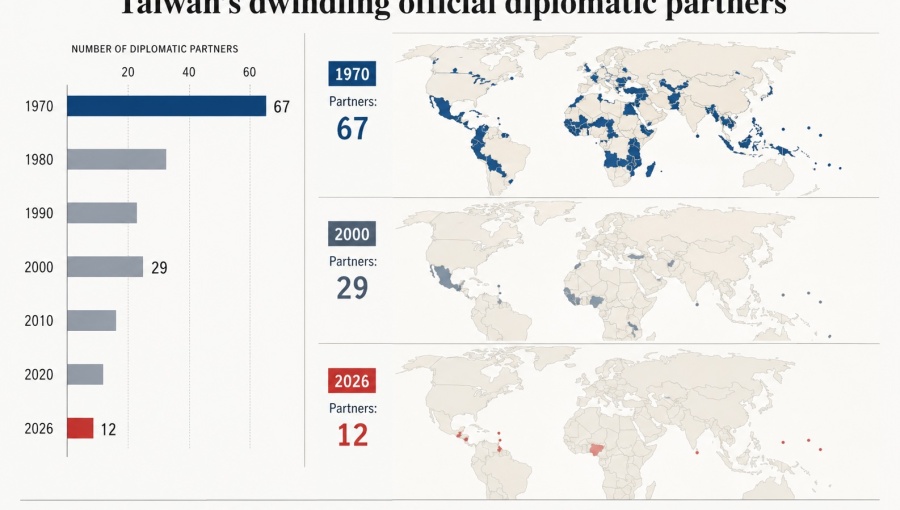
At its peak, Taiwan was recognised by 70 countries fifty years ago. Now that number has fallen to 12, thanks to Beijing's relentless pressure. / bne IntelliNewsFacebook
By Ben Aris in Berlin May 8, 2026

In 1969, Taiwan stood at the peak of its formal diplomatic standing, recognised by approximately 70 countries as the legitimate government of China. Today that number is 12.

Constant pressure by Beijing, which sees the island state as a region of China, has led countries to make a choice between principles and pragmatism. China has grown to become the largest trade partner for the majority of countries in the world.

The trajectory, charted by AFP that maps the collapse of Taiwan's official alliances across five decades, is one of the starkest illustrations of sustained geopolitical attrition in the post-war era.

Since 2016 alone, Taiwan has lost the recognition of ten countries to China. The question, analysts say, is no longer whether that number will fall again, but which country will be next.

The decline accelerated in the 1970s as the People's Republic of China (PRC) consolidated its international standing. The US switched formal diplomatic recognition from Taipei to Beijing in 1979 — a decisive signal that prompted a cascade of defections by other governments.

The shift was sparked by UN Resolution 2758, which expelled the Republic of China's (ROC) representatives from the United Nations in 1971 and seized the People's Republic in their place. Australia, Japan and most of Western Europe followed Washington's lead in recognising Beijing over the subsequent years, leaving Taiwan with formal ties only to countries that had not yet calculated the economic cost of maintaining them.

A similar seat swap followed the collapse of the USSR in 1991, when Russia quickly took over the empty seat, including its place on the United Nations Security Council (UNSC).

The 12 that remain

Taiwan's surviving diplomatic partners are concentrated in the Western Hemisphere and the Pacific: seven in Latin America and the Caribbean, three Pacific island nations, one in Africa — eSwatini — and the Vatican, which maintains ties with Taipei on the basis of its own long-standing dispute with the People's Republic over the status of the Chinese Catholic church.

Haiti's recognition is considered the most precarious. Once Taiwan's strongest foothold in the Caribbean, Haiti is now a failed state in all but name — its government non-functional, its cities controlled by armed gangs, its economy shattered. Haitian officials have engaged openly with Beijing in recent months, hoping that China's permanent seat on the UN Security Council might unlock a multilateral security mission. That engagement already skirts the diplomatic line.

Guatemala is among the most durable remaining allies, with 90 years of diplomatic relations — though even Guatemalan officials have recently faced internal pressure to reconsider the relationship as trade with China grows.

Beijing's toolkit

China's method is consistent: financial inducements, infrastructure investment and the implicit promise of trade access in exchange for switching recognition. Nauru, which switched to Beijing in January 2024 after reportedly requesting NT$2.6bn in aid from Taipei that was not forthcoming, illustrates the economic logic. China is reported to have offered $100mn per year as part of its approach.

If Taiwan were to lose all 12 remaining allies, the practical consequences would be gradual rather than immediate. The US maintains no formal diplomatic relations with Taiwan and yet sells it billions of dollars in arms annually. Japan has no formal relations and remains one of Taiwan's closest economic partners. Practical ties do not depend on the ally count.

But the symbolic and legal implications are significant. Each defection strengthens China's narrative that Taiwan is not a sovereign state but an unresolved question of Chinese internal affairs — an argument that Beijing deploys in every multilateral forum to limit Taiwan's participation in international organisations, from the World Health Assembly to Interpol.

 

Argentina is the IMF biggest debtor followed by Ukraine

Argentina is the IMF biggest debtor followed by Ukraine
Argentina remains by far the biggest IMF debtor, followed by Ukraine. / bne IntelliNewsFacebook
By bne IntelliNews May 8, 2026

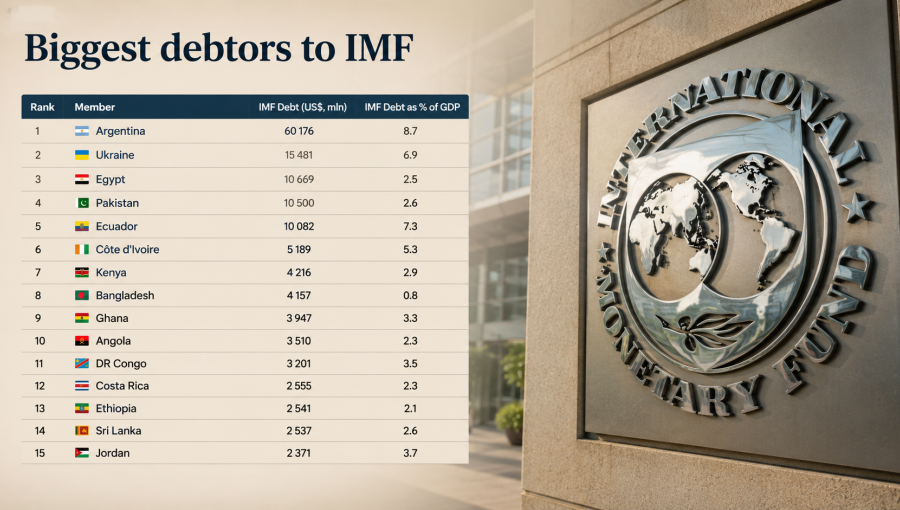
Argentina remains by far the largest debtor to the International Monetary Fund, underscoring the depth of its long-running financial crisis and its dependence on multilateral support. According to the latest data, Buenos Aires owes the IMF $60,176mn, equivalent to 8.7% of GDP — a level that dwarfs other borrowers and reflects the legacy of repeated rescue programmes over the past two decades.

Ukraine ranks second with $15,481mn, or 6.9% of GDP, highlighting the scale of external financing required to sustain the economy during wartime. Egypt, Pakistan and Ecuador follow closely behind, each with IMF exposures of around $10bn, although the relative burden varies significantly when measured against the size of their economies. Ecuador’s IMF debt, for example, stands at 7.3% of GDP, compared with 2.5% for Egypt and 2.6% for Pakistan.

A cluster of emerging and frontier economies rounds out the top 15, including Côte d’Ivoire, Kenya, Bangladesh and Ghana, with liabilities ranging from roughly $4bn to $5bn. While these figures are smaller in absolute terms, they remain significant in relation to domestic output and fiscal capacity. In sub-Saharan Africa, countries such as Angola, the Democratic Republic of Congo and Ethiopia continue to rely on IMF programmes to stabilise public finances and support balance-of-payments needs.

The data also illustrates the diversity of IMF engagement across regions. In Asia, Bangladesh and Sri Lanka have turned to the Fund in response to external shocks and currency pressures, while in Latin America, Costa Rica and Ecuador remain part of a broader pattern of recurrent IMF involvement. Jordan, with $2,371mn in outstanding obligations, reflects the continued reliance of smaller Middle Eastern economies on concessional financing and policy support.

When grandpa goes to prison: The challenge of ageing inmates

27.04.2026, DPA


Photo: Pia Bayer/dpa


As populations age, prison demographics are shifting as well. From accessible cells to tailored exercise programmes, prison authorities must adapt to the needs of a growing number of elderly inmates.

By Iris Leithold and Miriam Widman, dpa

A 75-year-old man was sentenced to five and a half years in prison in the north-eastern German state of Mecklenburg-Vorpommern for stabbing his wife to death at the end of last year.

A month later, the regional court in the state capital Schwerin handed a 74-year-old man a seven year and one-month sentence for the aggravated sexual abuse of his granddaughter.

The two men must now spend a significant part of their final years behind bars, joining 40 inmates as of earlier this year, who are at least 60 years old.

They are not alone. "Of these, seven prisoners were already 70 and older," says Tilo Stolpe, spokesman for the justice ministry in Schwerin.

A global shift behind bars

The trend extends far beyond Germany. Around the world, prison populations are ageing at a notable pace.

According to Penal Reform International, a UK-based non-governmental organization dedicated to criminal justice reform, the proportion of older prisoners continues to rise in many countries.

The group says no global data on the number of older people in prison is available, but says known rates range from 1.8% of the prison population in Indonesia to as high as 20% in Japan.

And "there has been a 311% increase in the daily average number of older persons in prison in the last 20 years," it says.

In some countries with harsh sentencing guidelines, such as in the United States, many older inmates will likely die in prison.

A US Sentencing Commission report from 2022 showed that nearly 40% (38.6%) of offenders who were sentenced at 70 years of age or older were handed prison terms exceeding their life expectancy.

Challenges for prison operations

"Older prisoners more often have chronic illnesses, reduced mobility and increased medical and care needs," Stolpe, the spokesman for the justice system in Mecklenburg-Vorpommern says.

According to the ministry, barrier-free cells are available in the prisons. The newly built preventive detention unit at the Bützow prison alone has 10 rooms with extra-large sanitary facilities intended for older detainees with "typical geriatric symptoms" he says.

In the state that was formerly part of East Germany, the number of older prison inmates is rising.

In 2004, 19 people over 60 were behind bars, which in 2012, the figure was 27, according to the ministry. Over the past 10 years, the numbers have remained stable, it said. But a further growing need to accommodate elderly offenders is expected.

The establishment of a geriatric unit at Bützow, some 50 kilometres south of the Baltic Sea, has already been scheduled, Stolpe says, with plans to address conditions such as dementia, immobility and sleep disorders.

Then money became tight, forcing a postponement until after 2031, the justice ministry says.

For now, care is often provided through external mobile services entering the prison, Stolpe says.

In serious cases - such as terminal illness - prosecutors may suspend a sentence, though such decisions are weighed carefully against public safety concerns.

Prison experts also see the presence of older prisoners in prison as positive. They are far less likely to be involved in conflicts in an institution and can also have a calming and mediating effect on other prisoners, they say.

And they are less likely to re-commit crimes once freed, the US Sentencing Commission report notes, with a recidivism rate of 21.3% compared to 53.4% for those under 50.

Cardio training instead of work

In Germany, prisoners are supposed to work to prepare for life after prison. In practice, available jobs are primarily given to younger inmates.

If the opportunity arises, older prisoners can also work while in custody. According to the ministry, there are no special jobs exclusively for older prisoners.

"However, care is taken to ensure that their work involves physically lighter activities, for example as unit orderlies on the wings or - if they are suitable for relaxed custody conditions - on the prison’s outdoor grounds."

Older inmates can also use the leisure and sports programmes in the prison. If medically indicated, cardio training, meaning exercise to strengthen the cardiovascular system, or extended unlocked time on the wing can also be made possible.

Other German states

Specialized units for prisoners over 60 already operate in parts of Germany, including facilities in Saxony and North Rhine-Westphalia.

At one prison in the western city of Bielefeld, an interdisciplinary care team is tasked wtih creating "spaces for reflecting on age-related changes in the beginning final phase of life" according to an information sheeet.

The facility offers help with pension matters and severe disability issues, water aerobics and the opportunity to move around in the prison’s own park.

Urban coyotes quietly thrive in Chicago but experts say don't panic

WHY DHS TARGETS CHIGAGO

27.04.2026, DPA


Photo: Amy Katz/ZUMA Press Wire/dpa

Coyotes have been spotted across Chicago, from downtown streets to nearby suburbs. Experts say the sightings are a normal seasonal pattern. But you may want to keep your dog on leash or cat indoors during peak times, just to be safe.

By Madeline King, Chicago Tribune

Coyotes have been spotted out and about in central Chicago neighbourhoods and its suburbs, and wildlife experts say there's no cause for alarm.

According to Chris Anchor, a wildlife biologist for the Forest Preserve District of Cook County, people see more of the species when mating season peaks, normally around mid-February.

Experts also say that activities may also increase into the spring and summer months when male coyotes are foraging for pups.

Coyotes, who are instinctually territorial, are therefore patrolling their land more often.

“Everybody in the Chicagoland area lives within the territory of a family group of coyotes,” Anchor said.

Another reason for these omnivores’ more obvious visibility is that prey can becomes scarce in the winter, causing them to travel farther for food, said Seth Magle, senior director of Lincoln Park Zoo’s Urban Wildlife Institute.

He added that coyotes help the environment by eating rabbits, geese and other animals that would otherwise overpopulate the area.

Preschool teacher Kelsey Davies said she has seen one or two coyotes on her street. “What I tell them is, ‘Please eat all the bunnies in my yard. Help yourself,’” she said.

Davies, 50, said the high number of coyote sightings is rare for her neighbourhood. Before the past winter, she hadn’t seen a coyote on her street in years.

She said she now sees them most often at night, when the species is most active, and occasionally hears them howl along to ambulance sirens.

“They don’t bother us. I’m not going to bother them,” Davies said. “I feel like we can live together.”

They look at her and her goldendoodle on their nightly walks, but Davies said the coyotes aren’t aggressive and usually walk away. But Davies said she understands why her neighbours who have small dogs worry.

Despite the fears of some people, experts say the coyote diet does not include humans or pets.

“If coyotes were truly an issue, you would already know about it,” Anchor said. “It would be a huge public service social issue.”

Anchor and Magle stressed that coyotes are almost always peaceful toward and even afraid of humans. Anchor said that it’s far more likely to be bitten by a dog than a coyote — only one person gets bitten by a coyote in North America in an average year.

The two also noted that coyotes are all around people, even those living in densely populated areas. Coyotes look for places to hide where they won’t be disturbed by people.

In cities during the winter, they’ll sleep in cemeteries, on golf courses and in patches of shrubs, Magle said.

Anchor added that there are families living at Navy Pier and the Museum Campus.

“They’re thriving in our cities … but they’re doing it by avoiding us,” Magle said.

Between 2,000 and 4,000 coyotes live in Cook County, according to Stanley Gehrt, a professor of wildlife ecology at Ohio State University and researcher with the Urban Coyote Research Program.

Coyotes returned to the area in the late ’70s and early ’80s after being driven out by human development and population growth for nearly 100 years, according to Anchor. White-tailed deer, beavers and Canada geese also came back to the area, Anchor said.

Gehrt said experts aren’t sure why coyotes returned to urban areas. “What makes it even more of a mystery is that that same pattern occurred in cities across the Midwest and the Eastern US,” he said.

Gehrt said coyote numbers have remained relatively stable for the last decade or so because the species self-regulates its population.

Coyotes can have litters of four pups or as many as 13. Since both parents — who mate for life — remain involved in raising the pups, the litter sizes can increase as long as there’s enough available food.

It’s a common misconception that city coyotes have become dependent on human food, Gehrt said. The species still hunts its natural prey.

Coyotes have the potential to become dangerous to people when they associate humans with food and stop being afraid of them, making it important to keep trash secured and refrain from feeding coyotes, Magle said. In the very rare case that a coyote approaches a person, it’s best to make loud noises to scare it away, he added.

Anchor said while coyote attacks on pets are rare, they are more common than attacks on humans. He recommended keeping dogs on leashes and cats indoors.

Magle said more people are learning to appreciate urban wildlife. When he started working at the Urban Wildlife Institute 16 years ago, he would get calls asking him who would “do something” about the coyote. Now, the calls he gets about coyotes are mostly from people who are enthusiastic and want to share their sightings.

“Maybe your knee-jerk reaction is like, ‘Oh, that doesn’t belong here,’ but then when you think about it, you’re kind of like, ‘Why not? Who decides that?’” Magle said. “‘Maybe a city can be a place for wildlife.’”

Quantum computing is reaching a commercial turning point, study finds

29.04.2026, DPA


Photo: Malin Wunderlich/dp

Quantum computing is becoming an economic driver, as cloud solutions, mega-deals and a race between Europe, the US and China are setting new standards – and opening up opportunities for industry giants and newcomers alike.

The year 2026 is on track to mark a turning point for quantum technology, as global investment in related start-ups surged more than tenfold in a single year to a record $12.6 billion in 2025, according to a new report by consultancy McKinsey & Company.

Global revenues of quantum computing companies also broke the $1 billion threshold for the first time, figures from McKinsey's Quantum Technology Monitor 2026 show.

Quantum computers differ fundamentally from conventional machines. Instead of bits, which are either 0 or 1, they use so-called qubits. Qubits can be not only 0 or 1 but both simultaneously — a property known as superposition.

Qubits can also be linked to one another regardless of the distance between them, a phenomenon known as entanglement. This connection makes quantum computers particularly fast at certain tasks, such as identifying patterns or simulating complex systems.

Transformation in research and AI

As a result, they can solve some problems far more quickly than conventional computers — above all in fields such as cryptography, materials research and artificial intelligence.

The report shows that the topic has reached the boardrooms of global business. "2026 is the year in which quantum computing moves from a technology promise to a strategic management question," said Henning Soller, a partner at McKinsey.

He said the focus was no longer primarily on technical feasibility, but on which companies were now building the capabilities and partnerships needed to secure genuine competitive advantages.

McKinsey's researchers said they had observed a fundamental shift in the sources of funding. Whereas the sector had long depended on public subsidies, private investors and capital markets had now taken the helm.

While around one third of investment still came from public sources in 2024, that share shrank to just 3% in 2025. Almost half of private investment — 44% — came via capital markets in 2025, including through initial public offerings.

Geopolitical race: Europe adopts, the US funds

The report also highlights the geopolitical dimension of the technology. While the US dominates in start-up financing, large transactions and the location of market leaders — with 64% of investment flowing into US start-ups — Europe leads in actual corporate adoption of the technology.

Asia, and China in particular, is rapidly catching up in the background: China leads the world in research publications and patent applications in the field of quantum computing, which McKinsey said pointed to strong state-directed efforts to build intellectual property.

For European business, the report's message is clear: The window for securing a leading position in the quantum economy is closing. Companies that continue to dismiss the technology as a distant prospect risk missing out on the next great industrial revolution.

Dogs' brains shrank by half in course of domestication, study shows

30.04.2026, DPA


Photo: Thomas Warnack/dpa


Dogs’ brains shrank by around half at certain stages during their domestication, a study shows.

Early ancestral dogs still had brains of a similar size to their wolf relatives, say scientists.

But by 5,000 years ago, their brains had shrunk dramatically by almost half (46%), to a size comparable only to that of today’s small terrier and miniature dog breeds, according to the study published in the Royal Society Open Science.

That may also have altered dogs’ temperament, suggests the team led by Thomas Cucchi from the Muséum national d’Histoire naturelle (MNHN) in Paris.

The reduction in brain size may have made the animals more alert and cautious, traits that could have been valuable in ancient human societies.

For their study, the researchers analysed 207 skulls, 185 from modern dogs, dingos and wolves, and 22 prehistoric ones. The oldest specimens were 35,000 years old.

They used CT scans to create virtual impressions of the skull cavities. In fossil skulls, their volume is considered a reliable indicator of brain size.

Challenging coexistence

The findings suggest the Ice Age ancestors of modern dogs show no signs of reduced brain size compared to wolves of that era. In one specimen found in Belgium, the internal skull volume was even slightly larger.

Living in close proximity to humans may have created new cognitive challenges, such as more complex social interactions and the use of new food sources, the scientists suggest.

Some 30,000 years later, we see a different picture, with dogs' brain volume having shrunk significantly. Furthermore, the animals had become smaller, the researchers say.

Dogs reached a shoulder height of 35 to 45 centimetres. Their skulls would have resembled those of modern herding dogs in shape and size, according to the scientists' estimates.

Needing dogs for safety

That change came as humans in Central Europe, who had previously lived as hunter-gatherers, became increasingly sedentary, switching to farming and rearing livestock.

As agriculture spread, settlements emerged and that meant new roles for dogs, the scientists say. The animals may have lived near human settlements as scavengers, been used as guards and may have served as a source of meat.

The team suggests humans may have played a direct role in altering brain size through targeted behavioural selection, breeding for docility. Similar patterns are also evident in other farm animals, though to a lesser extent.

Scientists are still trying to work out how far the shrinking of the brain affected the animals’ intelligence.

Brain size alone is not the decisive factor, but rather, above all, how efficiently the brain is organized.

Trump policy coverage dominates Pulitzer Prize winners

05.05.2026, DPA


The Pulitzer Prizes this year honoured multiple works examining the impact of policies by US President Donald Trump.

Pulitzer administrator Marjorie Miller said during the announcement on Monday that much of the coverage had centred on controversial topics of the year, including immigration policy, sharp cuts to US development aid and reporting on files related to sex offender Jeffrey Epstein.

The Washington Post was awarded for its reporting on the impact of the Trump administration's restructuring of federal agencies. The New York Times won for investigations that uncovered how Trump used his power to financially benefit his family. Journalists at the Chicago Tribune were recognized for their coverage of operations by US immigration authorities in the city.

Awards were also given for reporting on artificial intelligence, a deadly flood in the US state of Texas and destruction in Gaza.

A special citation went to Julie K Brown of the Miami Herald for her 2017–18 investigations into Epstein and the abuse of young women.

Miller said the awards also underscored a commitment to press freedom at a time of growing pressure on media, pointing to restrictions on access to the White House and Pentagon as well as legal action taken by the president against news outlets.

The Pulitzer Prizes are widely regarded as the most prestigious awards in journalism and are also given for achievements in literature, music and theatre.

What to watch out for at the 2026 Cannes Film Festival

A total of 22 films are competing for the Palme d'Or this year as the presitigious Cannes Film Festival begins in the south of France on Tuesday. The nine-person jury this year will be headed by South Korean director Park Chan-Wook but will also feature US celebrity Demi Moore, star of "The Substance".


Issued on: 10/05/2026 
By: FRANCE 24


John Travolta, last seen in Cannes in 2018 for "Solo : A Star Wars Story", will present his directorial debut this year. © Laurent Emmanuel, AFP

The world's most glamorous film festival kicks off in Cannes on Tuesday, promising another action-packed fortnight of world premieres, star-studded red carpets, parties and fashion.

Here are some of the most hotly anticipated moments and appearances:
The main competition

A total of 22 films are competing for the prestigious Palme d'Or for best film which will be handed out on May 23.


Arthouse heavy-hitters such as Spain's Pedro Almodovar, Japan's Hirokazu Kore-eda or Romania's Cristian Mungiu will be up against emerging talent such as Belgian prodigy Lukas Dhont and France's Lea Mysius.

There is industry buzz around "Hope" by South Korean director Na Hong-jin, starring real-life partners Michael Fassbender and Alicia Vikander, as well as AI- and technology-themed "Sheep in the Box" by acclaimed Japanese director Hirokazu Kore-eda.

The nine-person jury this year will be headed by South Korean director Park Chan-Wook but will also feature US celebrity Demi Moore, star of "The Substance".
Hollywood ghosting

Unlike previous editions which have featured Tom Cruise productions "Mission: Impossible" or "Top Gun", no major US studios have chosen Cannes to launch a blockbuster.

Hollywood has traditionally provided some razzle-dazzle and mass-market entertainment alongside the more edgy, independent cinema in the Cannes programme.

Reasons for their absence include cost-cutting, their growing preference for tightly controlled social media-led launches, and the risk that a mauling from the Cannes critics can doom a movie.

Travolta

One man not put off by the prospect of scrutiny from some of the most demanding crowds in the film industry is movie legend John Travolta.

The plane-mad actor will bring some serious stardust when he presents his directorial debut, "Propeller One-Way Night Coach", about a young boy's journey in the "golden age of aviation".

A-listers

Other A-listers from around the world will descend on the Cannes red carpets which will be some of the most celeb-heavy and fashion-rich places on the planet for the next fortnight.

Scarlett Johansson and Adam Driver are set to promote "Paper Tiger", a thriller by American director James Gray, while "Bohemian Rhapsody" star Rami Malek stars in "The Man I Love" by Ira Sachs.

Spanish favourite Javier Bardem, Norwegian star Renate Reinsve, Kristen Stewart and Woody Harrelson are all featuring in films set to screen for the first time on the French Riviera.

Julianne Moore and Cate Blanchett are also set to make appearances, while Barbra Streisand and "Lord of the Rings" director Peter Jackson will pick up lifetime achievement awards.

A Russian returns

The appearance by one of Russia's most decorated independent directors, Andrey Zvyagintsev, will be celebrated for film and personal reasons.

The Oscar-nominated director of "Leviathan" and "Loveless" nearly died due to Covid, spending months in hospital, and fled his homeland after Russia's invasion of Ukraine in 2022.

His first movie since 2017 is called "Minotaur" and tackles the hugely sensitive issue of the Russian bourgeoisie grappling with army conscription at the start of the Ukraine war.
Football

There will be a surprising amount of football at the high temple of cinema, including a British-made documentary "Cantona" about legendary French forward Eric Cantona.


arts24 © FRANCE 24
11:10


An Argentine-made film, "The Match", casts a spotlight on the notorious England-Argentina 1986 World Cup match settled by a goal awarded after a handball by Diego Maradona.


AI-created Lennon

Director Steven Soderbergh will present his documentary "John Lennon: The Last Interview" which features The Beatles songwriter hours before his murder.

Soderbergh has turned the audio-only recording into a film, using archival pictures as illustration and – very controversially – AI-generated images of the late singer.
Best of the rest

With war-hit Iran in the news, "Rehearsals for a Revolution" by Pegah Ahangarani, a film about political repression, appears timely.

After a Nigerian movie screened in a hallowed official slot at Cannes for the first time last year, twin brothers Arie and Chuko Esiri will represent Nollywood again when they show star-packed "Clarissa".

Picked in the Director's Fortnight competition, it features "The Bear" star Ayo Edebiri and "Selma" actor David Oyelowo.

"The Godfather III" and "Ocean's Eleven" actor Andy Garcia presents "Diamond", a "passion project" he has been working on for 15 years.

The first film of a big-budget two-part French production on war-time hero and political colossus Charles de Gaulle will be a major event for the host country.

(FRANCE 24 with AFP)
Thomas and Erika Mann biopic has an oddly twisted premise
DW
May 9, 2026

Premiering at Cannes and starring Sandra Hüller, Pawel Pawlikowski's "Fatherland" is set during the Cold War — a complex period for the prominent anti-Nazi intellectuals.

https://p.dw.com/p/5Cxcx


Sandra Hüller and Hanns Zischler star as Erika and Thomas Mann in 'Fatherland'
Image: Agata Grzybowska/Mubi/AP Photo/picture alliance


Pawel Pawlikowski's "Fatherland" is one of the most anticipated films among the 21 titles vying for the prestigious Palme d'Or this year.

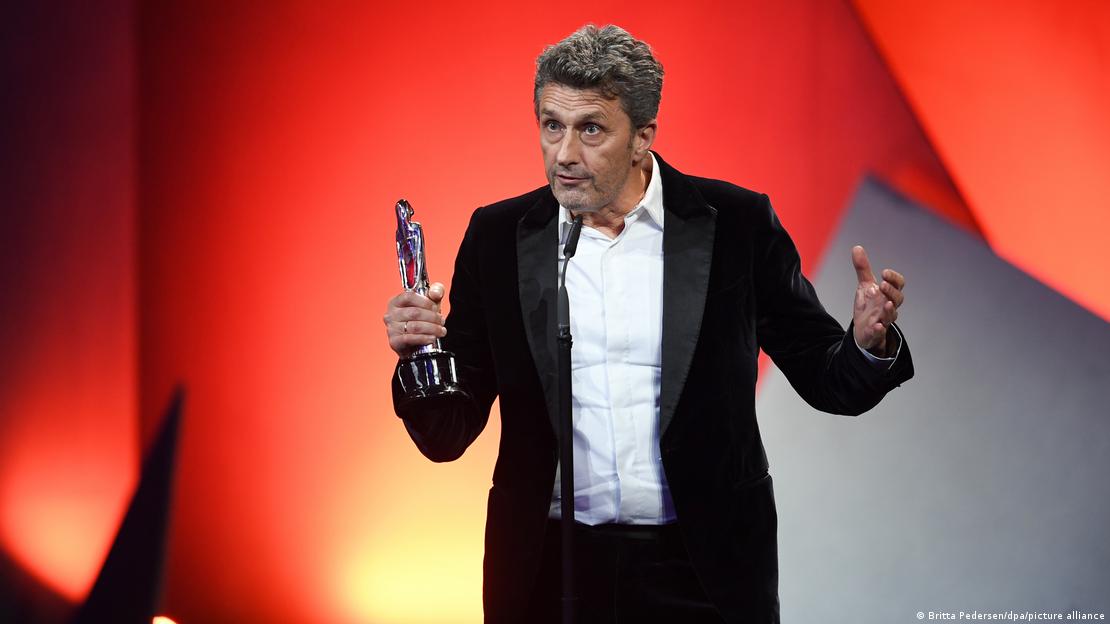
The Polish filmmaker returns to Cannes after winning the festival's best director award in 2018 with "Cold War." The historical romantic drama set between Communist Poland and Paris went on to win the top European Film Awards and earn multiple Oscar nominations.


Pawel Pawlikowski's 'Cold War' also won the People's Choice Award for Best European Film
Image: Britta Pedersen/dpa/picture alliance

Pawlikowski's new film is another exploration of the early Cold War period. It's framed as a road movie undertaken by Thomas Mann (played by Hanns Zischler) and his daughter Erika (Sandra Hüller), as they travel in a Buick from Frankfurt in West Germany to Weimar in East Germany, in 1949.

According to the synopsis of the film, "Fatherland" also explores "themes of identity, guilt, family and love, amid the turmoil and moral confusion of postwar Europe." The biographical work's storyline is already sparking renewed interest in the iconic Mann family.

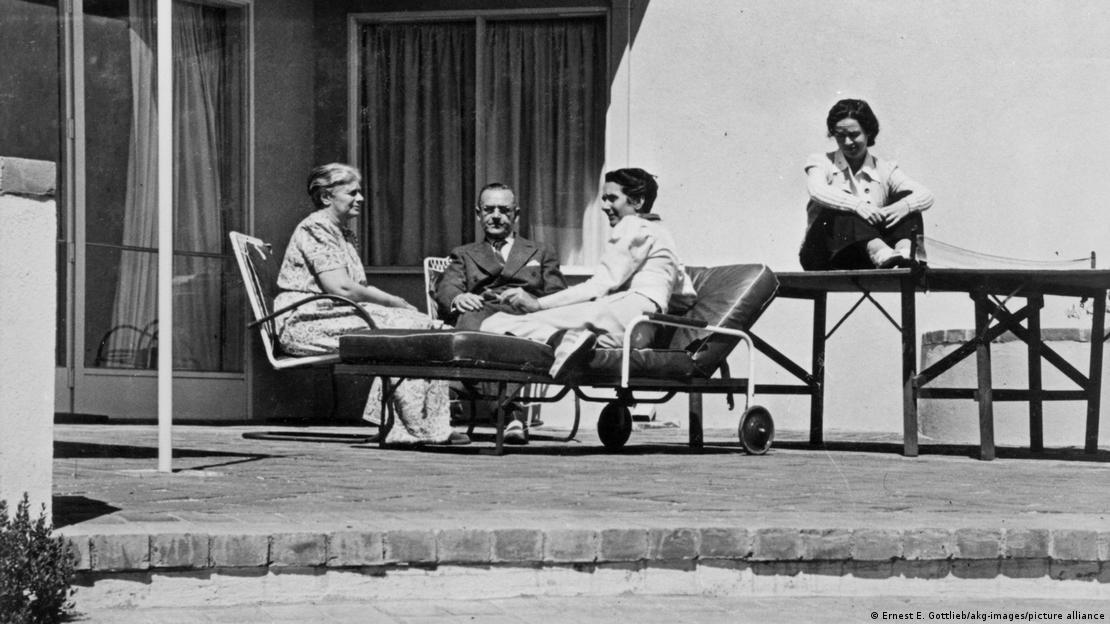
The Mann family, a literary dynasty often referred to as 'Germany's Kennedys' was a prominent, intellectual and wealthy family of writers and artistsImage: Ernest E. Gottlieb/akg-images/picture alliance
What defined the relationship between Thomas Mann and his daughter Erika? How did the prominent exiled family of intellectuals view postwar Germany — and how did the Germans perceive the Manns? And why was the year 1949 particularly important for them?

Thomas Mann's iconic legacy

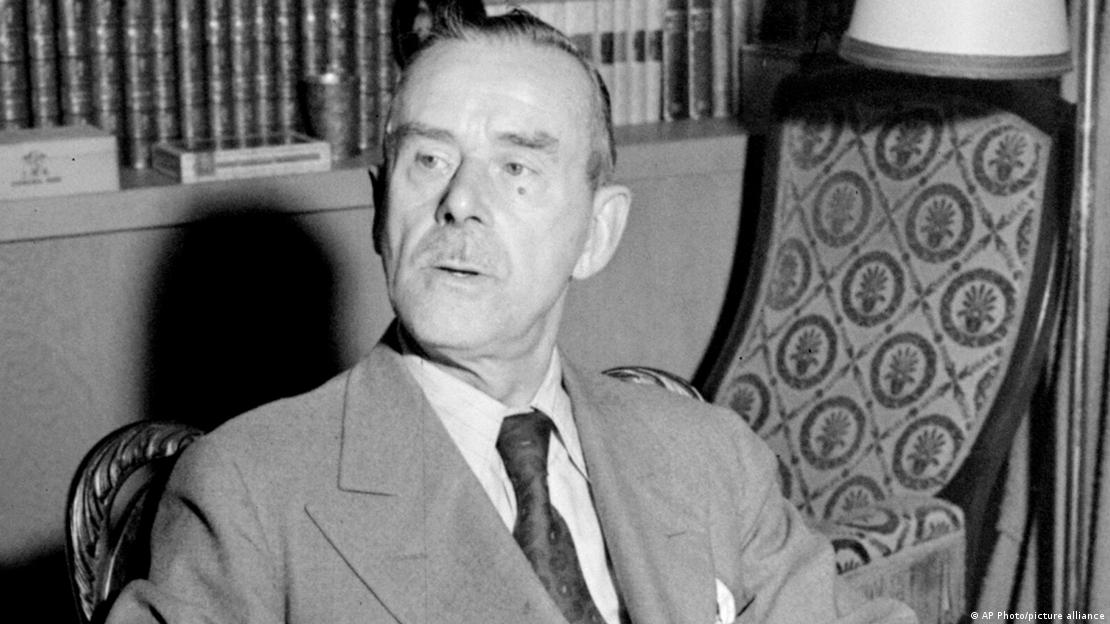
Thomas Mann, 1929 Nobel Prize in Literature laureate, fled Germany in 1933 due to the Nazis' rise to power. During his exile years (1933-1952), which he spent primarily in Switzerland and the United States.

Having established his renown with novels including "Buddenbrooks" (1901) and "The Magic Mountain" (1924), Thomas Mann became a prominent critic of fascism during Hitler's rule, securing his legacy as a key 20th-century democratic intellectual.

Most famously, Mann's "Deutsche Hörer!" (Listen, Germany!) series of speeches, delivered via the BBC between 1940 and 1945 during his exile in the US, document his resistance work.

Thomas Mann's radio speeches were aimed at the German population
Image: AP Photo/picture alliance


A particular bond with his daughter Erika


When Mann's first child was born in 1905, he openly expressed his disappointment that it was a girl. A son would have been "more poetic, more of a continuation, a new beginning of myself," he wrote in a letter to his brother, Heinrich Mann.

"And yet this daughter, among his six children, became the most important one for the father's poetic and political endeavors," says Irmela von der Lühe, author of a biography on Erika Mann.
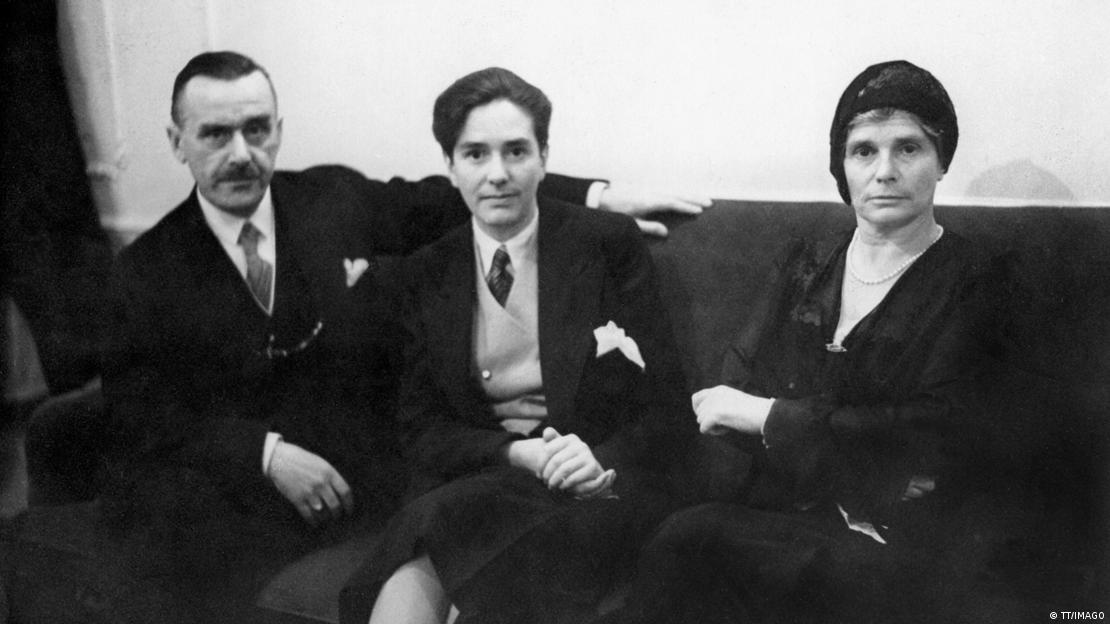
Thomas, Erika and Katia Mann in 1930, when the Nobel laureate held the speech 'An Appeal to Reason,' in which he condemned National Socialism as 'eccentric barbarism'
Image: TT/IMAGO

Indeed, Erika played an influential role in getting her father to actively speak out against the Nazi regime in early 1936. Though he was a known opponent of Nazism as early as 1930, the novelist had remained publicly silent on the topic once Hitler took power. Erika threatened to break ties with her "un-emancipated father" if he didn't drop this cautious approach.

"She had personally clashed with the Nazis very early on," von der Lühe tells DW.

A child of the Roaring Twenties and a talented cultural figure in Berlin, Erika Mann embraced the era's bohemian and experimental lifestyle — until she realized that her generation should have invested more energy in protecting the progressive rights and freedom they enjoyed under the Weimar Republic's democratic constitution.

The year before Hitler seized power in Germany in 1933, Erika was denounced by the Nazis' paramilitary militia for having publicly read a pacifist poem. It affected her acting career and contributed to strengthening her anti-fascist convictions.

In January 1933, Erika Mann co-founded a political cabaret called "Die Pfeffermühle" (The Peppermill) in Munich. She wrote most of its material; the satirical pieces were often anti-fascist. After two months, the Nazis closed the theater company and forced the ensemble into exile.

Through their mother, Katia Mann, who came from a wealthy Jewish industrialist family, the Mann children were also considered Jewish under Nazi racial laws.


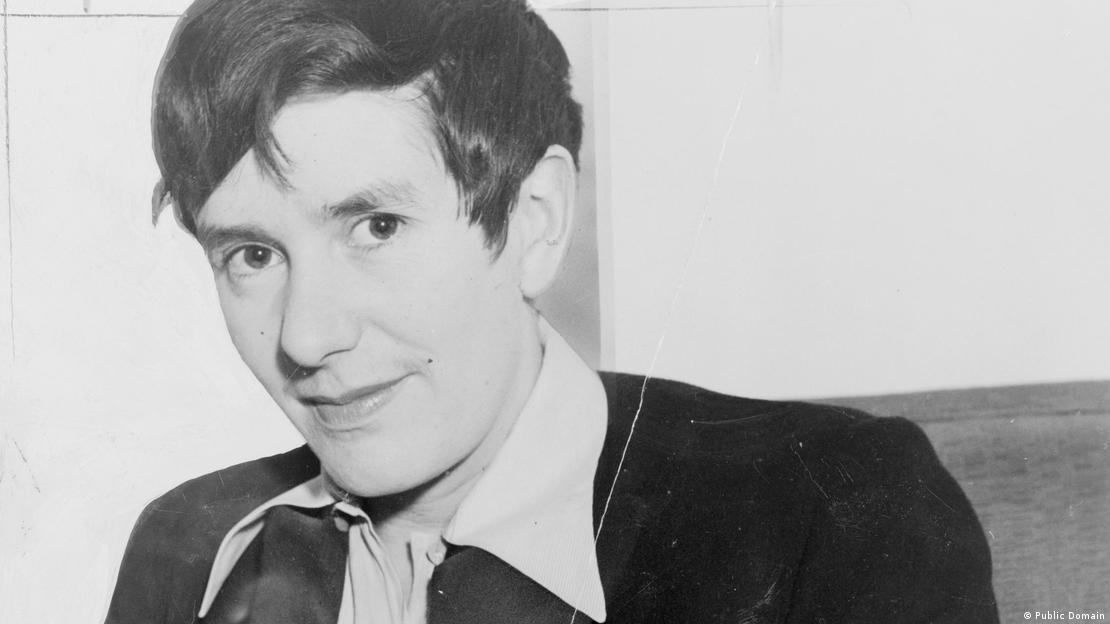
Known for her androgynous style, Erika was also openly bisexual, but this was not a topic she addressed in her activism
Image: Public Domain

In exile, Erika Mann took on a second successful career as a reporter and author, aiming to warn the world about how quickly democracy had broken down under Hitler, despite Germany's renown as being "the land of poets and thinkers."

"That's what I've always found significant about her, and which in my eyes is, unfortunately, very relevant again today," says von der Lühe.
What happened in 1949

Just four years after the end of World War II, Germany was still in ruins, and ideologically divided: October 7, 1949 marked the official establishment of the German Democratic Republic (GDR), a new socialist state based on the postwar Soviet Occupation Zone in East Germany.

After the war, Thomas Mann announced that he would not be returning to live in his home country. He argued in his publications that all Germans shared responsibility for Nazi crimes; this theory of German collective guilt alienated those who had remained in Germany. After all, didn't the Mann family spend all those years living comfortably in exile, while so many others suffered under Hitler?

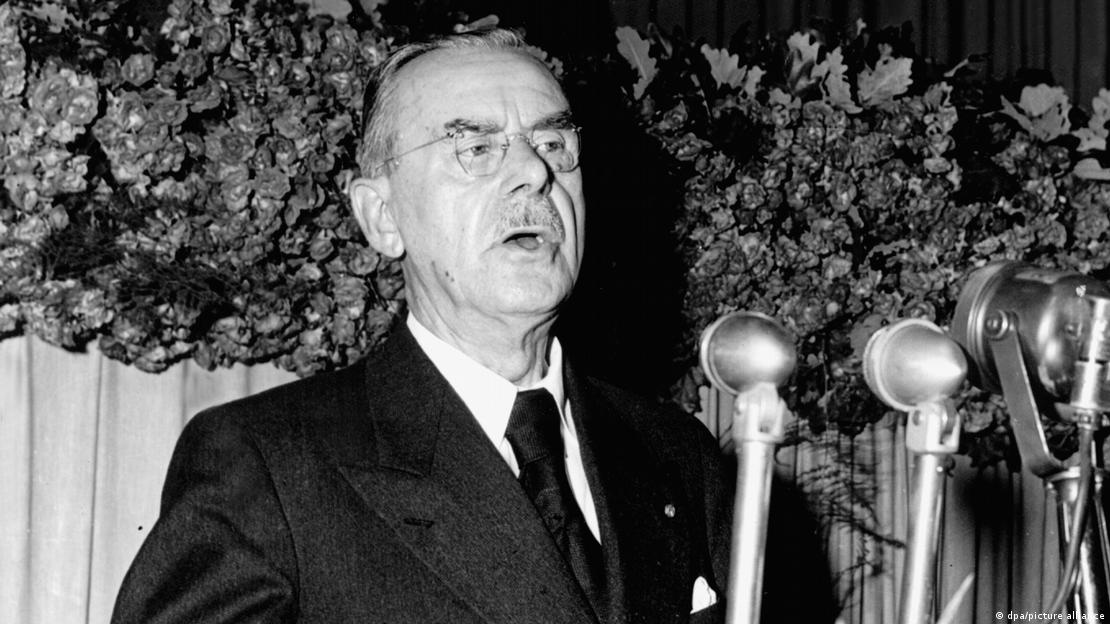
Thomas Mann returned to Germany for the first time since his exile for a visit in 1949, as part of the celebrations marking the 200th birthday of Johann Wolfgang von Goethe. He was invited to receive the Goethe Prize in the West German city of Frankfurt, while the East German city of Weimar offered him an honorary citizenship and the Goethe National Prize .

Thomas Mann giving his speech in Frankfurt in 1949
Image: dpa/picture alliance

In a speech he delivered in both cities, Mann noted that he did not recognize any ideological divisions or occupation zones. "My visit is for Germany itself, for Germany as a whole," he said.

But Erika condemned the project. Von der Lühe notes that the invitation was even at the center of the second major falling-out between Erika and Thomas Mann, after their disagreement about taking a public stance against the Nazis in 1936. Erika felt that her father shouldn't go "to a country where he had been so viciously attacked in the media in recent years," explains the Mann expert.

Those attacks included threatening letters from West Germans; the 1949 Germany visit was under police protection.

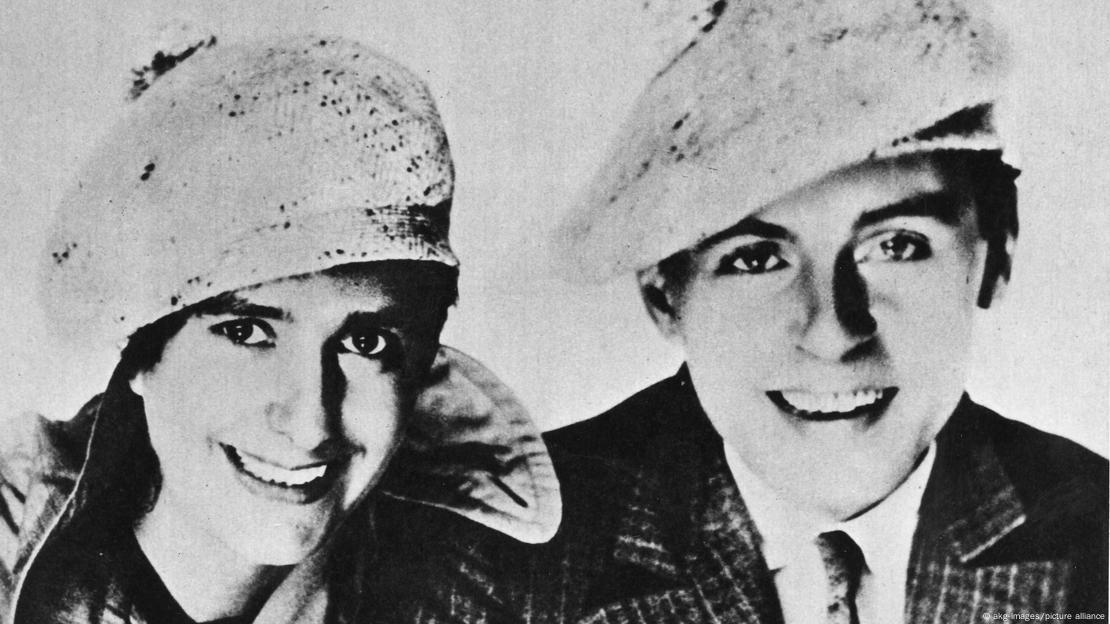
Complicating matters, it was also the year Klaus Mann committed suicide. The second child of Thomas and Katia Mann, Klaus was also a committed anti-fascist author, and Erika had been exceptionally close to him.
Erika and Klaus, Thomas and Katia Mann's two eldest children, were an exceptionally close creative and politically engaged sibling duo
Image: akg-images/picture alliance

Among the many factors that contributed to Klaus' profound disillusionment was the way he had been treated in the US, where the Manns were suspected of being communists. Erika felt Thomas Mann's celebrated stop in Weimar would be perceived as legitimizing communism.

Even though Pawlikowskli's "Fatherland" is based on existing historical figures, its premise is completely fictional. During his well-documented journey from Frankfurt to Weimar, Thomas Mann was accompanied by his wife, Katia. Erika didn't join them — because she had deliberately decided to boycott the tour of their former home country.

Edited by: Sarah Hucal


Elizabeth Grenier Editor and reporter for DW Culture


 Is 'Citizen Kane' really the greatest film of all time?


07.05.2026 DPA


Photo: RKO Radio Pictures/Wisconsin Center for Film and Theater Research/dpa

Orson Welles’ cinema classic would go on to be hailed as the greatest of film all time, but was something of a flop when it was released 85 years ago. What is it that supposedly makes this film so great? And could a feminist film be replacing it on top of rankings?

By Gregor Tholl, dpa

In May 1941, it premiered in a New York cinema, only to become an initial flop. Today, 85 years later, "Citizen Kane" is considered by many to be the greatest film ever made.

The black-and-white film by Hollywood's wonder boy Orson Welles — who was 25 at the time — tells the story of fictional media mogul Charles Foster Kane, in whom contemporaries believed they could easily recognize media mogul William Hearst (1863–1951). The film bombed — at least at first.

So what is it about this work of cinema history that makes it so acclaimed?

The story of the 'greatest film of all time'

In 1952, the team behind the specialist journal Sight and Sound, published by the British Film Institute, had the idea of asking critics to name the "Greatest Films of All Time." This tradition has been repeated every ten years since (and is, of course, just one of many best-of lists).

In 1962, 1972, 1982, 1992 and 2002, "Citizen Kane" topped that prestigious list. In the most recent list (from 2022), "Citizen Kane" ranks third, behind Alfred Hitchcock's "Vertigo" in second place ("Vertigo" was number one in 2012).

Going by the most recent ranking, "Citizen Kane" is no longer the best film of all time.

In a likely surprise to most, first place is now Chantal Akerman's feminist work "Jeanne Dielman" (full original title: "Jeanne Dielman, 23 Quai du Commerce, 1080 Bruxelles", available on Mubi). Meanwhile on the IMDb list of the top 250 films, "Citizen Kane" is only ranked 113th, according to the website's millions of voters. The uplifting prison story "The Shawshank Redemption" (1994) is first.

What 'CitizenKane' is about

In the highly acclaimed "Citizen Kane," a group of reporters tries to explain the last word reportedly spoken by newspaper magnate and politician Charles Kane, who died alone. That word is "Rosebud."

The film opens with a newsreel informing the public about Kane's life. A series of flashbacks then shows various scenes from that life. By the end, the mystery of "Rosebud" is solved.

Audiences watch as Kane inherits a vast fortune as a young boy, builds a media empire as a young adult and ultimately becomes a ruthless man of power.

The sweeping political career that might have crowned his rise is denied him — it collapses because of an affair with singer Susan Alexander, which also destroys his marriage.

Kane marries Susan and becomes obsessed with turning the largely talentless singer into an opera star. The venture fails. Kane dies a bitter old man in his grand castle, Xanadu.

What makes 'CitizenKane' special

Today's viewing habits may make the film seem less remarkable than it once did. But if you try, as best you can, to mentally transport yourself back to 1941, the sheer wealth of innovation becomes apparent.

In visual terms, the film made considerable demands on cinema audiences: extensive use of deep focus, symbolically charged reflections, strong contrasts and sequences shot from extreme high angles (top-down) or low angles (bottom-up).

"Citizen Kane" was also revolutionary for the development of sound in film, then still relatively new. Welles had actors talk over one another and interrupt each other — unheard of at the time.

The film also features an unusual, rather unsympathetic lead character with whom audiences can barely identify. The New York Times once described Kane as an almost Shakespearean figure, somewhere between Hamlet and Lear.

Also striking is the break with linear storytelling. Time jumps occur even within individual scenes. The best example is a breakfast table sequence that shows how Kane's first marriage deteriorates over the years. The setting is always the same room; only the costumes and make-up change. The length of the dining table also grows — effectively conveying the growing distance between the couple.

Welles played Kane at every adult age, spending many hours each day in the make-up chair. His portrayal of Kane is cited as an early example of method acting — a technique in which the actor immerses themselves completely, almost obsessively, in their role.

"Citizen Kane" is regarded as a prototype of the so-called auteur film, because Orson Welles had a hand in almost every artistic aspect, including the screenplay.

Did 'Citizen Kane' win many awards?

After "Citizen Kane" was released, media tycoon Hearst — who believed the film was about him — launched a campaign against lead actor and director Orson Welles, co-writer Herman J. Mankiewicz and the film studio RKO.

Despite its box-office failure, the film was a hit with cinephiles from the start. At the 1942 Oscars, it received nine nominations. However, the film ultimately won only one Academy Award — for best original screenplay, shared between Welles and Mankiewicz.

In late 2020, Netflix released "Mank," starring Gary Oldman in the title role. The film tells the story of alcoholic screenwriter Mankiewicz and his dispute with Welles over the "Citizen Kane" screenplay.

As if the Academy wanted to make up for its failure 80 years earlier, the film by director David Fincher ("Se7en," "Fight Club," "Gone Girl") received ten Oscar nominations in 2021. It won two awards — best cinematography and best production design — surpassing the single Oscar won by "Citizen Kane."