Monday, May 25, 2026

More Tankers Make It Through the Strait of Hormuz

Two liquefied natural gas carriers and a supertanker have traversed the Strait of Hormuz over the past couple of days, with the LNG vessels heading for Pakistan and China, and the tanker, loaded with Iraqi crude, is en route to China.

According to a Reuters report, the vessels used the route that Iran has told all ships to use from now on. The LNG carriers are loaded with Qatari gas, the report said, citing data from LSEG and Kpler. At least one of the vessels was loaded in late March. The supertanker carrying Iraqi Basrah crude loaded its cargo in late February and had been stuck in Hormuz since then.

Bloomberg, meanwhile, reported that ADNOC has been using its own fleet of tankers to ship oil and gas through the Strait of Hormuz in so-called dark mode, where vessels switch off their geolocation indicators to remain unnoticed.

Reports about tankers passing through the Strait of Hormuz have multiplied over the past couple of weeks. Two supertankers exited Hormuz last week and headed for their final destination in China, earlier reports said, and another two LNG carriers also made it through the strait and are en route to India, media reported earlier in May.

Some vessels have been passing through the chokepoint in dark mode, switching off their transponders to avoid detection from the Iranian military. Since early March, hundreds of vessels, including tankers carrying energy commodities, have been stranded in the Persian Gulf west of the Strait of Hormuz amid the de facto closure of the chokepoint, but the past couple of weeks have seen some moving out.

According to data from Bloomberg cited by Zerohedge last week, at least 19 tankers carrying crude oil and liquefied petroleum gas from Gulf states other than Iran had traversed the Strait of Hormuz since March 1. Another 100 tankers, however, remain paralyzed in the strait, the data also showed.

By Irina Slav for Oilprice.com


Deal to Reopen Hormuz Gets Closer, But With Little Agreement in Public
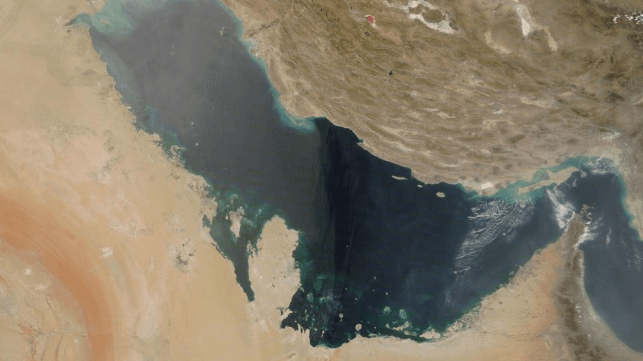
The Strait of Hormuz and the Arabian Gulf from space (NASA)

Published May 24, 2026 2:14 PM by The Maritime Executive


The U.S. and Iran have announced an outline of an agreement to extend their ceasefire and reopen the Strait of Hormuz. The deal has not yet been signed, and as in previous talks, officials on both sides have leaked out conflicting accounts of the details.  

The contents of the deal have not been officially released, and it appears to be structured as a ceasefire extension to allow further time for negotiation, with some of the most difficult decisions deferred for further talks. While definitive confirmation is still pending, a general outline has emerged from participants' background statements. A U.S. official told the Wall Street Journal on Sunday the U.S. has agreed to provide Iran's economy with some "breathing room," but has not yet promised to release frozen Iranian funds or lift sanctions. 

In exchange, the official said, Iran has accepted the idea of exporting its stockpile of enriched uranium to another country, in principle and subject to further negotiation on the details. The deal would also include a time-limited moratorium on further Iranian nuclear enrichment, in exchange for sanctions relief. 

Iran denies that any commitments were made about any matter related to its nuclear program, except for its ongoing pledge to never build nuclear weapons. Iran has always maintained a public commitment not to build a nuclear bomb (though it has quietly pursued the knowledge and physical means to do so).  

Al Jazeera senior correspondent Ali Hashem adds further details reflecting purported benefits to the Iranian side. From the perspective of his sources, the proposed deal looks much different: it reportedly includes a complete end to hostilities, including an end to the ongoing Israeli operation in Lebanon; the release of billions of dollars in blocked Iranian funds; the lifting of the U.S. naval blockade in the Strait of Hormuz, allowing Iran to resume oil exports; and the withdrawal of U.S. forces from the area. 

In accounts published by Iranian state media, the agreement would also leave the strait under Iranian control, in cooperation with authorities in Oman - giving Iran more strategic influence over the waterway than it had at the start of the war. 

U.S. officials have not confirmed any of these claims.  

"The ceasefire and broader de-escalation measures appear intended for near-term implementation, while the main sources of contention were pushed into a separate 30-60 day negotiation track," commented Nicole Grajewski, Assistant Professor at CERI Sciences Po. "That structure is important because it pushes some of the hardest questions (sanctions sequencing, mechanics of Hormuz access, conditions on asset releases) into less visible side documents while still allowing both sides to announce a political breakthrough."

After hopeful comments from the administration on Saturday, President Donald Trump said Sunday that his team would be going slowly. 

"I have informed my representatives not to rush into a deal in that time is on our side. The blockade will remain in full force and effect until an agreement is reached, certified, and signed. Both sides must take their time and get it right. There can be no mistakes!" Trump wrote.  


China Coking Coal Prices Surge After Deadly Shanxi Mine Blast

The price of coking coal in China jumped by 8% after a deadly mine accident in Shanxi province that prompted safety checks that will affect production over the near term. The most actively traded coking coal contract on the Dalian Commodity Exchange hit the equivalent of $186.76 per ton following the accident.

Reuters reports that eighty-two people were killed after a gas explosion in a mine in one of China’s largest coal-producing regions, which makes it the most serious mine accident in the country since 2009 at least.

The government immediately launched an investigation into the causes of the accident, which would inevitably affect production, leading to a jump in prices. The accident itself will also affect coking coal production, with CNN citing Chinese media as reporting that the blast caused walls in the mine to collapse and the site of the accident to fill with water.

There is also a risk of secondary disasters at the mine, with the chief of emergency services of the city where the mine is located, Changzhi, saying that “During the rescue work…toxic and harmful gas has exceeded the limit for a long time.”

Coking coal is used in steelmaking and other heavy industries, with China a major consumer of both local and imported coal. The state has imposed limits on the commodity’s prices, and today, those limits were hit because of the mine accident.

Separately, several other coal mines in Shanxi suspended operations for several days as the authorities conduct safety checks, Reuters also reported, citing consultancy Mysteel. The suspensions would reduce coking coal output by 288,000 tons daily, the report noted, adding that iron ore and steel prices also gained following the explosion in Changzhi.

The Chinese government has been conducting safety checks on coal mines all over the country in a bid to reduce the risk of accidents, but also to put a lid on production growth.

By Irina Slav for Oilprice.com


Coal Is Fueling China’s Next Energy Power Play

  • China is rapidly expanding coal-to-chemicals and coal-to-gas production as high oil and gas prices make coal a cheaper and more strategic domestic feedstock.

  • India now wants to replicate China’s model, investing billions to turn coal into fertilizers, plastics, and chemicals to reduce energy import dependence.

  • The trend highlights how energy security and affordability are overtaking emissions concerns, with coal demand surging despite global net-zero ambitions.

Coal is inarguably one of the big winners from the energy flow disruption in the Middle East. Consumption is up strongly as gas becomes hard to come by and expensive to buy. Power supply security has overtaken any emission concerns. Yet it is not only in power generation that coal has regained popularity. Coal is also increasingly being used as feedstock for chemicals, notably fertilizers.

Recently released data from China showed that coal production in the world’s top consumer had dipped in the first four months of the year. Imports were also down, and power generation from coal declined, extending a trend that began in 2025. The figures would suggest China is reducing its use of coal, but in fact, coal consumption is still going strong in the Asian powerhouse—the commodity is simply being used for more than power generation and metals smelting. China is using coal to make everything from gas to petrochemicals—and now India is planning to do the same.

Earlier this week, Reuters reported that PetroChina was developing a project for the extraction of gas from coal rock, eyeing output of 30 billion cu m by 2035. The extraction technology is very similar to that used in shale formations, the report noted, adding that China is the only country where hydraulic fracturing is being used for so-called rock gas extraction.

In separate news, China’s coal-to-chemicals industry got a major boost from the Middle East war. The sector’s stocks jumped by 30% between the end of February and mid-March, Reuters reported at the time, with investors rewarding the energy industry’s ability to use coal for the production of fertilizers and other petrochemicals without actually using petroleum.

With oil prices surging on the closure of the Strait of Hormuz, coal has become a valuable substitute, not least because even with a price rise—and coal prices have risen—it remains cheaper than the liquid alternative. Indeed, Reuters reported in mid-March that Chinese coal prices had in fact fallen since the start of the war. It is little wonder that India wants to replicate China’s success in coal-to-chemicals.

Dependent on imports for over 80% of its oil consumption, India has found itself in a rather vulnerable position amid the biggest energy crisis in history. Yet India has abundant coal reserves it can use for more than power generation—and that is exactly what it is doing, Bloomberg’s Javier Blas reported this week.

Many net-zero campaigners from political circles like to point out that homegrown energy is a guarantee for energy security. In that, they are correct, even though when they say homegrown energy, they mean energy harvested with equipment imported from, among others, China. And China uses coal to make that equipment. The fact remains, however, that using your own resources to produce energy, fertilizers, and other chemicals is certainly a better choice than importing in and depending on a market over which you have no control with regard to either prices or supply.

China’s coal-to-chemicals industry is a unique one, Bloomberg’s Blas noted in his report, and that means it would be challenging for India to replicate China’s success. One reason for this is that Indian coal is different, the energy columnist reported, and will be harder to convert into chemicals.

The other reason is that China has spent some 20 years improving the extraction technology. India plans to invest $4 billion to jumpstart a coal-to-chemicals industry, but that may not be enough, Blas says, as companies engaged in that activity would need more support to make their products competitive once the war in the Middle East ends and natural gas prices retreat to pre-war levels—whenever that may happen.

Still, the Modi government eyes 75 million tons of coal getting turned into fertilizers and other chemicals, as well as plastics, in 2030, to enhance reliance on locally sourced goods and reduce its passive import bill. It will provide funding for processing facilities and guarantee the local supply of the feedstock—and boost the world’s demand for coal even further than the war already has, further eroding net-zero plans.

Bloomberg’s Blas reported that China’s coal-to-chemicals industry consumes 380 million tons of coal annually. If it were a country, he noted, that industry would be the world’s third-largest coal consumer. And now India wants to build its own gargantuan coal-consuming industry.

Last year, China produced 4.2 billion cubic meters of rock gas. This is just the beginning if production growth plans materialize. The coal-to-chemicals industry is growing and, evidently, inspiring other countries to go local as well, with no concern for the implications of such trends for emission reduction. The coal-to-chemicals industry developments in Asia show quite clearly that the top priorities in energy will always remain reliability and affordability, with emissions a distant third in times of tight supply and high prices.

By Irina Slav for Oilprice.com


Australia’s LNG Industry Warns Policy Uncertainty Is Hurting Investment

  • Australian LNG producers are urging Canberra to speed up project approvals, maintain fiscal stability, and avoid tougher taxes to support new gas supply and investment.

  • The industry sees the Iran war and disrupted Qatari LNG exports as a major opportunity for Australia to strengthen its role as a reliable LNG supplier to Asia.

  • Executives warn that policy uncertainty, export debates, and regulatory delays could undermine Australia’s long-term energy security and global competitiveness.

Australia’s energy producers are calling for state and federal support in faster approvals of new projects and fiscal stability. These could help the world’s third-biggest LNG exporter grow its overseas markets amid the expected years-long turmoil in the global gas market in the wake of the Iran war.

Producers want long-term predictability in taxation, as well as faster permitting processes and environmental reviews from the state and federal governments. As a whole, the industry seeks clarity and certainty that would incentivize producers to invest in new supply to meet growing demand for gas in Australia and the region, which Australia is ideally positioned to serve—Asia’s growing gas and LNG markets.

The current global LNG crisis, created by the loss of Qatar’s LNG supply due to the closed Strait of Hormuz and Iranian missile attacks on Qatari LNG infrastructure, is an opportunity for Australia to bolster its position as a reliable supplier, industry executives said at the Australian Energy Producers’ annual Conference and Exhibition this week.

“For Australia, the crisis has underscored the enormous advantage of having a strong domestic gas and LNG industry,” Cecile Wake, Chair of the Australian Energy Producers association, said in an address to conference attendees.

“Australia’s national interest is best served when we have a well-supplied, affordable and efficient domestic gas market AND a thriving LNG export industry,” Wake said, noting that increasing new supply is the key to achieving both objectives.

While there has been some progress at the state and federal level in advancing projects in recent months, more needs to be done by governments to support investment in new oil and gas supply, the Australian energy executives say.

At the end of April, the state of New South Wales launched the first natural gas exploration tender in ten years amid a supply crunch caused by the war in the Middle East.

The federal government has also just ruled out controls on exports of natural gas during the third quarter of 2026, as industry and experts have assured the government that the most vulnerable East Coast will not see any supply shortages between the winter months of July and September.

Australia’s decision not to implement gas export controls in the third quarter is good news for the global LNG market, which suddenly found itself in a major shortage after the Iran war crippled the Middle East’s LNG exports, with tight markets now expected to last much longer than previously thought.

For the long term, Australian producers need predictability and a strong oil and gas sector to protect energy security at home and help allies with LNG supply abroad, the executives say.

“It should not take a global energy crisis to recognize the significant strategic and economic advantage Australia holds from having a strong oil, gas and LNG sector,” Australian Energy Producers’ Wake said at the annual conference.

The industry will continue to provide reliable energy, but it asks policymakers to “provide the policy stability, internationally competitive settings, and project approval certainty to give our industry confidence to invest,” Wake added.

Kevin Gallagher, chief executive at one of Australia’s biggest oil and gas producers, Santos, warned that debates on the gas conservation policy expected from 2027 and on whether the industry should be taxed more could undermine investments in the Australian energy sector.

“This is a sliding doors moment for Australia, an opportunity to cement and bolster our country’s credibility as a predictable long-term destination for global capital, as a trading partner and as a country that understands prosperity is built over decades, not three-year cycles,” Gallagher said at the conference, as carried by The West Australian.

By Tsvetana Paraskova for Oilprice.com


Heat Pump Sales Surge Across Europe Amid Energy Shortages

  • Heat pump sales across Europe rose sharply in 2025 and early 2026 as households sought alternatives to expensive gas heating.

  • Rising Middle East tensions and high energy import costs are accelerating interest in electrified home heating systems.

  • Policy uncertainty in Germany and Austria could slow momentum despite growing long-term demand for heat pump technology.

Heat pump uptake is on the rise in Europe, as consumers take their energy bills into their own hands. Europe, which already experienced high gas prices and energy shortages after Russia invaded Ukraine in 2022, is now experiencing widespread energy shortages and soaring prices due to the ongoing turmoil in the Middle East, sparked by the February U.S.-Israeli attack on Iran. While governments across the region have been investing in the deployment of more renewable energy capacity in recent years, most consumers still rely heavily on gas for heating and cooking. 

Many countries across Europe continue to depend on fossil fuels for heat. Most countries rely on foreign oil and gas imports rather than domestic production, meaning that they are extremely vulnerable to supply chain disruptions and price volatility. The European Commission president, Ursula von der Leyen, recently said that the European Union spent an additional 24 billion euros on energy imports in less than two months.

Unlike hot water radiators powered by gas, furnaces, or air conditioning units that blast out hot air, heat pumps provide energy-efficient heating, using electricity to transfer heat from a cool space to a warm space. In cold weather, heat pumps move heat from your house to the outdoors, while in warm weather, they move heat from the cool outdoors into your warm house. As they are designed to transfer rather than produce heat, it makes them more significantly energy efficient.

According to data from the United States Department of Energy (DoE), using a heat pump can reduce household electricity use for heating by up to 75 percent compared to electric resistance heating, such as furnaces and baseboard heaters. They can also help dehumidify houses better than air conditioners. While there are several different types of heat pumps, the most common is the air-source heat pump.

For years, heat pumps have been prohibitively expensive, leading many consumers in Europe to stick with regular gas-powered hot water boilers. However, as government incentives provide subsidies for heat pump uptake and gas bills rise to record highs, many consumers across the region are considering investing in an energy-efficient heat pump. This is no surprise considering the price of European natural gas has risen about 40 percent since February.

Heat pump sales in 2025 increased by 10.3 percent across 16 European countries on average, according to preliminary data from the European Heat Pump Association. Approximately 2.62 million residential heat pumps were sold, marking an increase from 2.38 million in those countries in 2024, and bringing the total installed in Europe to around 28 million.

In the first quarter of 2026, approximately 575,000 heat pumps were sold in 11 European markets, marking a 17 percent increase from the same period in 2025, according to the European Heat Pump Association. The increase in uptake was the greatest in France, Germany, and Poland.

Although consumer interest in heat pumps is growing, there is uncertainty over whether this can be sustained. Bureaucracy continues to be a barrier to uptake, as attaining the regulatory approval to install the equipment can take weeks or even months in some countries.

In Germany, the Minister of the Economy, Katherina Reiche, announced in May that the “rigid” requirement stating that new heating systems must be powered by at least 65 percent renewable energy would be scrapped. The government has also ended the ban on “forced heating system replacements or bans”, including the ban on new oil and gas heating systems, which has been phased in since 2024. The move aims to give homeowners greater freedom of choice and create “investment security” for construction companies.

However, critics suggest that the move will undo much of the progress towards transitioning away from gas-powered heaters to energy-efficient options, powered by renewable electricity. Jan Rosenow, a professor of energy and climate policy at Oxford University, explained, “the significant watering down of key provisions… postpones necessary decisions and will ultimately make the transition more expensive and more chaotic."

A similar situation has been seen in Austria, as the government halted heat pump subsidies in the first three months of the year when funds ran out. It is unclear whether consumers in these markets will still invest in new heat pump systems.

While there is still uncertainty around the potential pace of uptake, several companies are coming out with innovative heat pump technology that is expected to support a long-term shift.

In May, Amazon announced that it had signed a deal for a new type of rooftop heat pump that will provide all-electric heating, super-efficient cooling, and cheaper energy bills at several of the firm’s commercial buildings. Meanwhile, Mitsubishi Heavy Industries Air-Conditioning Europe announced plans to launch two new higher-capacity 10 kW and 14 kW water heat pumps, designed for large residential properties and small commercial applications.

By Felicity Bradstock for Oilprice.com


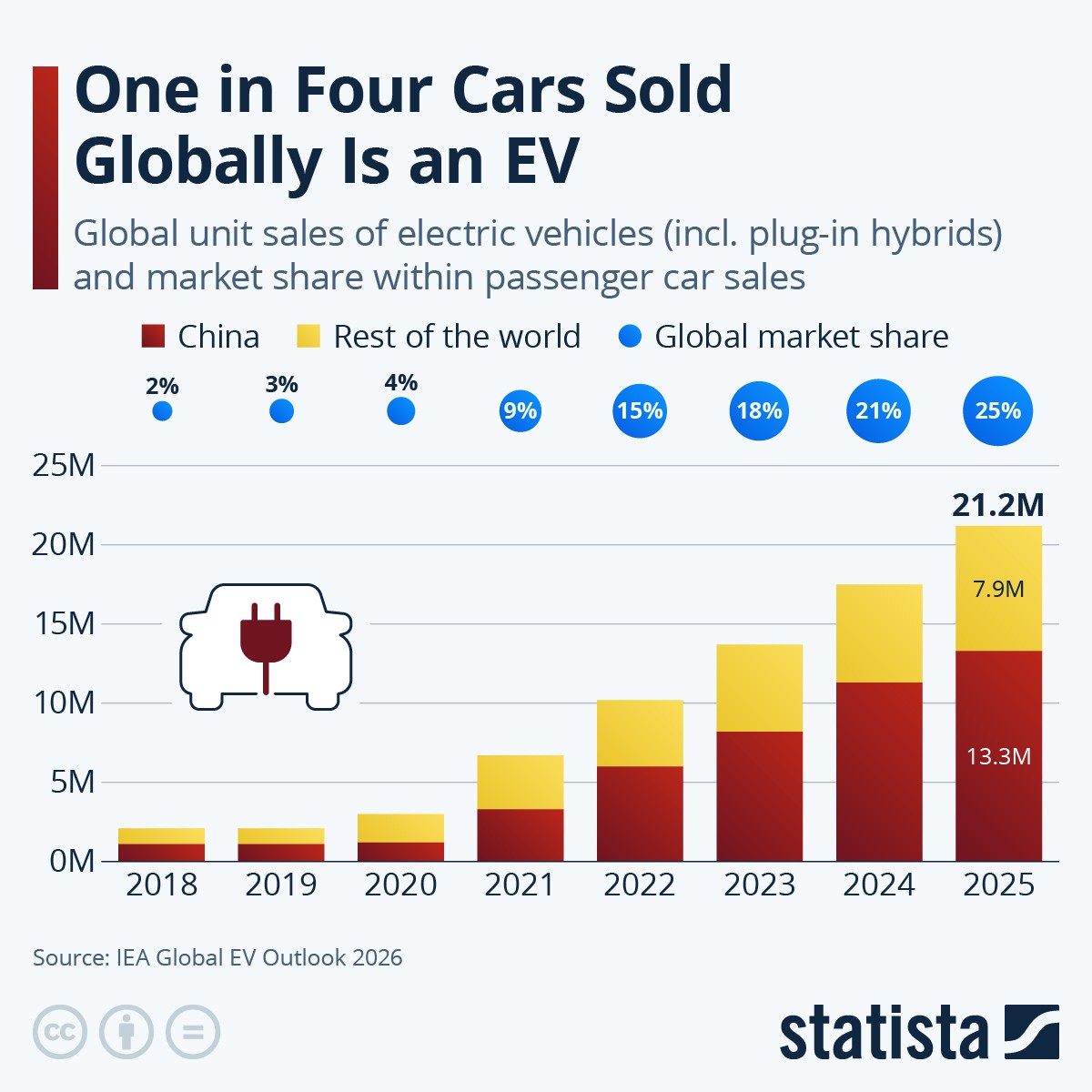
1 In 4 Cars Sold Globally Is An Electric Vehicle

As Statista's Tristan Gaudiaut details below, according to the IEA Global EV Outlook 2026, published on May 20, global sales of electric cars, including plug-in hybrids, surpassed 21 million units last year, more than doubling since 2022, when annual sales first exceeded 10 million.

As the chart shows, EVs now account for roughly one in four passenger car sales globally, meaning their market share climbed to 25 percent in 2025, up from just 2 percent in 2018.

You will find more infographics at Statista

This rapid growth has been driven largely by China, which remains by far the largest market.

With more than 13 million electric vehicles sold in 2025, the country alone accounted for around 60 percent of global sales.

While adoption has also increased steadily in the rest of the world, with nearly 8 million units sold – largely in Europe and the United States – the data highlight China’s dominant role in shaping the global EV market.

By Zerohedge.com


Wind and Solar Overtake Gas Power Generation for the First Time

Wind and solar power generation topped gas-fired power plant output for the first time ever on a monthly basis in April, as the energy crunch limited gas availability and made the fuel more expensive.

Wind and solar installations generated 22% of the world’s electricity last month, climate outlet Ember reported, as cited by Reuters. Gas generation, meanwhile, accounted for 20% of the global total in April.

“The current energy crisis has further strengthened the economic case for renewables compared to imported gas, while also adding greater political urgency to accelerate deployment,” Ember global electricity analyst Kostantsa Rangelova said.

The above statement is arguable. The Strait of Hormuz crisis has affected a fifth of global liquefied natural gas production capacity, leading to surging prices and a switch from gas to coal across Asia, as the solid fuel remains the most affordable baseload generation option. Yet the crisis has also added momentum to wind and solar—especially solar—deployment as a fast alternative to hydrocarbons that are in increasingly short supply.

The parallel growth in wind and solar, on the one hand, and coal, on the other, is an interesting trend that suggests affordability remains the top priority for most. It undermines the argument in favor of a transition to wind and solar as reliable long-term alternatives to hydrocarbons, but it also highlights that they can be used as alternatives in times of tighter supply of gas, especially during peak output season for both wind turbines and solar panels.

What is more, as some observers have noted, the current shift in energy demand patterns will change as soon as the Strait of Hormuz reopens and gas flows return to pre-war levels.

“Some people are saying this oil-price spike will do what the Paris Agreement and EV mandates haven’t,” Bob McNally, founder of Rapidan Energy Group and former White House energy adviser, told Fortune recently, “which is to convince everybody to destroy demand for gasoline. “But busts follow booms,” McNally continued. “When oil prices drop, I think demand for EVs will wane. You’re on this roller coaster of oil prices.”

By Irina Slav for Oilprice.com


TotalEnergies Eyes $100M+ Stake Sales in European Solar and Wind Portfolio

TotalEnergies is considering selling 50% of some of its solar and wind assets in Europe as part of its strategy to partner with other companies in operating and monetizing its clean energy portfolio, Bloomberg reported on Friday, quoting anonymous sources with knowledge of the plans.

The France-based oil and gas supermajor, which has been developing a global renewable energy portfolio for years, is now working with advisers to potentially market 50% in a combined 1.2 gigawatts (GW) of solar and wind power assets in France, Germany, Spain, and Poland, according to Bloomberg’s sources.

A deal could be worth several hundred million U.S. dollars for TotalEnergies, the sources noted.

Unlike other European majors such as BP and Shell, which have outright reduced spending on renewables, TotalEnergies has a strategy to reach a 12% profitability target for its Integrated Power business.

This means that TotalEnergies would typically divest up to 50% of its renewable assets once they reach commercial operation date (COD) and are de-risked, which allows it “to maximize asset value and manage risks.”

In one of its biggest recent stake sales, TotalEnergies last year agreed to sell 50% of its solar projects portfolio in North America to global investment firm KKR for about $1 billion, as part of the French supermajor’s renewables strategy to divest half of its already operational assets.

TotalEnergies has also moved to sign power purchase deals to provide clean energy to major data center developers and hyperscalers.

In November, the French major signed a 15-year Power Purchase Agreement (PPA) to supply Google data centers in Ohio with renewable electricity from a local TotalEnergies solar farm.

Earlier in November, TotalEnergies signed a power purchase agreement with Data4 to supply renewable electricity to the data center developer’s sites in Spain for 10 years, as the French supermajor looks to boost its integrated power business with the key driver of global electricity demand—data centers and AI infrastructure.

By Michael Kern for Oilprice.com 


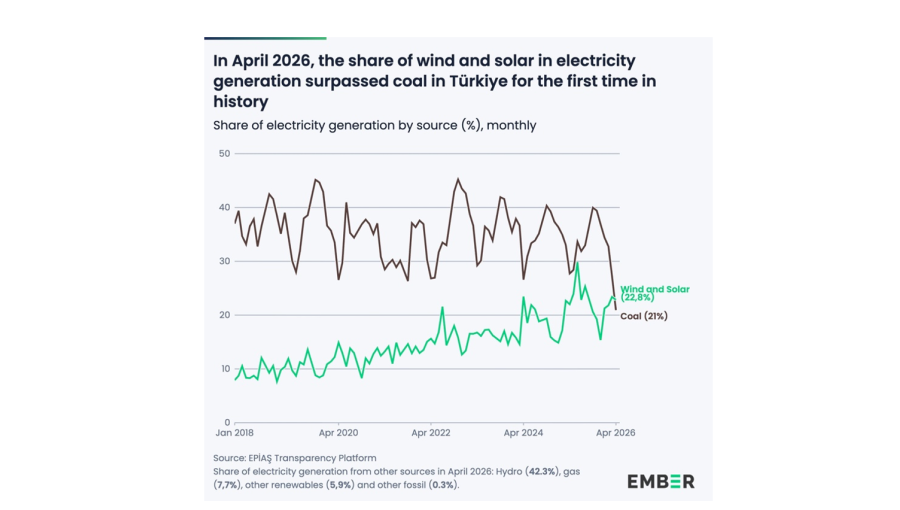
Wind and solar overtake coal in Turkey’s power generation for first time - EMBER

Wind and solar overtake coal in Turkey’s power generation for first time - EMBER
Turkey has been investing heavily into renewables, which now make up 23% of its energy mix, overtaking coal for the first time which now accounts for 21%. / bne IntelliNews


By bne IntelliNews May 21, 2026

Wind and solar energy generated more electricity than coal in Turkey for the first time in April 2026, marking a milestone in the country’s energy transition as strong rainfall also boosted hydroelectric output, according to energy think-tank Ember.

Ember said wind and solar accounted for 22.8% of electricity generation in April, surpassing coal’s 21% share. Total renewable energy generation climbed to 71%, the highest level recorded in the past 26 years, helped by above-seasonal rainfall that lifted hydroelectric production.

Solar power also crossed another symbolic threshold during the month, overtaking imported coal generation for the first time. Solar accounted for 13.1% of electricity production, while imported coal fell to 8.6%, its lowest monthly level in nine years.

Hydroelectric generation rose 60% compared with the same period last year, Ember said. Water inflows to Turkey’s main river basin dams during the first four months of 2026 reached their highest level in eight years.

“April 2026 marked a significant turning point in Turkey’s energy transition,” said ÇaÄŸlar Çeliköz, energy analyst at Ember. “This development was driven both by the momentum achieved in wind and solar energy over the past five years through increases in installed capacity and by the rise in hydroelectric generation due to rainfall above seasonal norms,” he said.

Turkey has accelerated renewable energy investment in recent years as it seeks to reduce dependence on imported fossil fuels, which have historically weighed on the country’s current account balance. The government aims to expand renewable capacity significantly under its long-term energy strategy, with solar installations in particular growing rapidly as equipment costs decline.

Çeliköz cautioned, however, that hydroelectric production remains vulnerable to changing climate conditions and rainfall patterns.

“However, the variable nature of hydroelectric production, which depends on climate conditions and precipitation regimes, creates uncertainty regarding future generation levels from this source,” he said.

“Therefore, in order for this historic achievement to become permanent in the face of changing climate conditions, Turkey needs to increase the momentum it has achieved in wind and solar energy and ensure resource diversity in renewable electricity generation.”