Tuesday, May 26, 2026

Support Our Troops: What It Really Means

by | May 25, 2026Antiwar.com

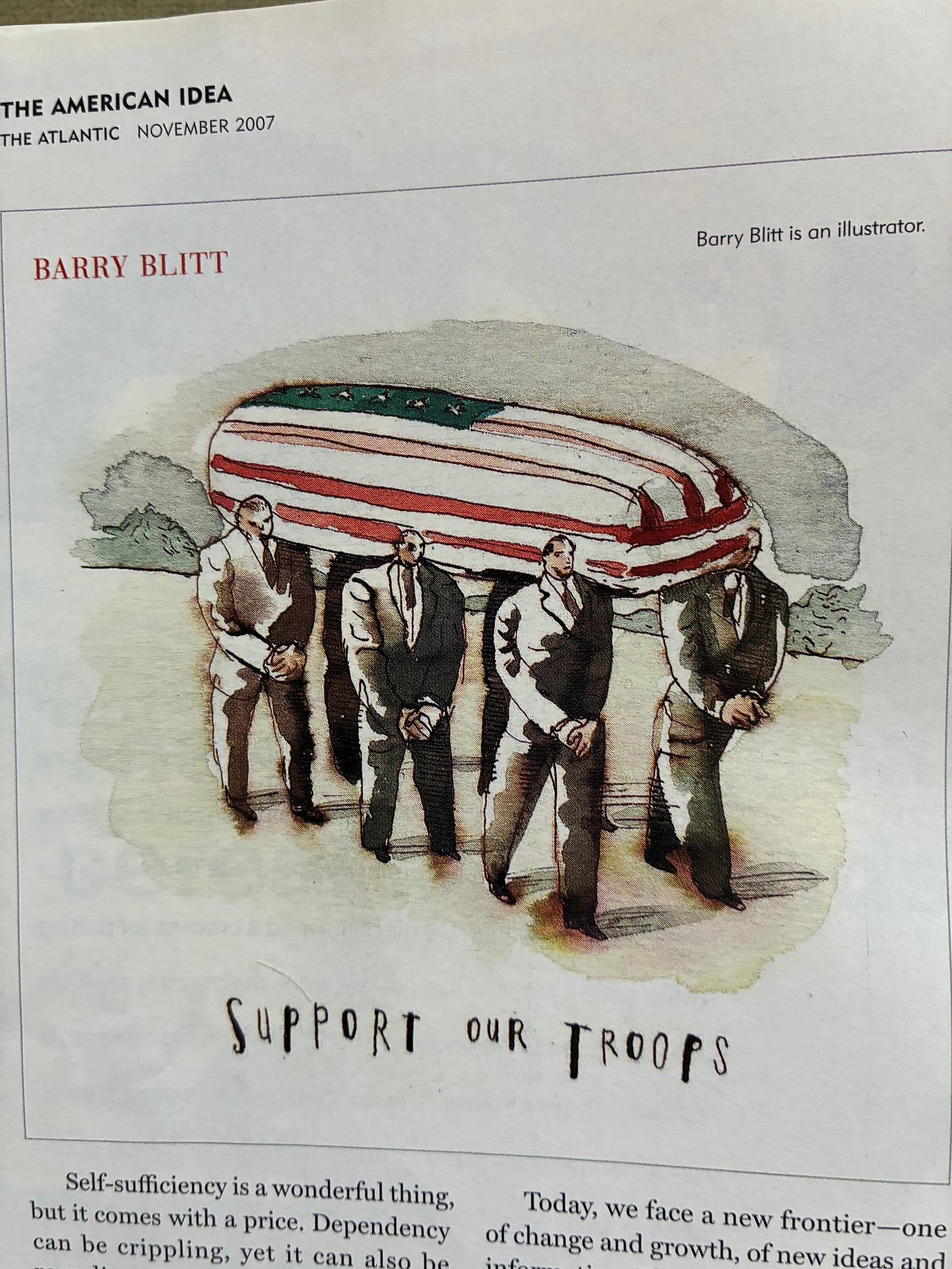
The other day, I was reading an old Atlantic Monthly and came across the following cartoon:

That is one powerful image. I like the tiny heads on the pallbearers. They make me think of the posturing politicians who tell us to “support our troops” while sending them to die in illegal, immoral, and unconstitutional wars.

That cartoon was published near the end of 2007, when America’s disastrous war of choice in Iraq was supposedly improving due to the Petraeus Surge. Of course, General David Petraeus qualified his surge by saying its gains might prove “fragile” and “reversible.” And so they proved.

“Support our troops” is a catchphrase, almost a mantra, often used by cynical politicians to suppress dissent about their disastrous wars of choice. Basically, dissenters are accused of being unpatriotic because their criticism allegedly betrays the troops and weakens national resolve. It’s a BS argument but it’s often compelling and even convincing to some.

Americans have a civic religion defined by the Pledge of Allegiance, the flag, the National Anthem, military parades and pageantry, and U.S. history taught as heritage and as a celebration of American goodness and greatness. When you step outside of that, when you criticize it, dissent from it, you must be prepared to be attacked as a heretic.

Back in 2010, I wrote an article for TomDispatch in which I argued that not every American troop is a hero. I argued instead that real heroes are few and far between, and that the ideal of heroism shouldn’t be associated so closely, even almost exclusively, with military service. These are obvious points (to me, at least), but I took some flak for suggesting that merely donning a military uniform doesn’t and shouldn’t make one a “hero.”

I remain convinced that hyping the troops as universal “heroes” isn’t a form of support. The troops know better. If you truly want to support them, listen to them. Be an informed and knowledgeable citizen. Speak your mind and don’t be afraid to criticize those who seek to use the military for dishonorable or indefensible purposes.

Since this is America, theoretically land of the free, feel free as well to speak out against the military. Our founders were suspicious of large standing armies and were wary of wars as being especially pernicious to democracy.

We Americans celebrate our troops for defending freedom, yet we paradoxically attack those who try to exercise their freedom by denouncing war and militarism. You can’t have it both ways. Unless you want hypocrisy instead of democracy, you can’t celebrate freedom while denying it.

This was, of course, the so-called original sin of the American republic: celebrating freedom while also enshrining the institution of slavery. Rank hypocrisy led inexorably to the U.S. Civil War.

As a retired U.S. military officer, I’ve been thanked for my service more often than I’ve been denounced as a murderous agent of American empire. It’s easy to accept the thanks; slurs and attacks are what they are. People sometimes think to defame or demean others is a way to elevate themselves. So be it.

Another aspect of “support our troops” is communal ritual to mark the passing of local “heroes.” Such rituals take various forms. In my community, one involves a mass motorcycle ride in memory of “fallen” troops killed since 9/11. The language used is that of America’s civic religion, celebrating our “great country” and those “heroes” who’ve made the “ultimate sacrifice.”

It’s easy to acquiesce to that language and sentiment. It’s also easy to attack it and dismiss it as patriotic claptrap.

I see it as something else: a communal rite. A recognition of sacrifice. Even if that sacrifice was not in a worthy cause.

I’m not a fan of these communal rituals and the often cynical uses to which they’re put, but I recognize their potency and the need of some people to participate in them. It’s a collective expression of belonging, of grief, of community. A place to find meaning.

A reader put it very well to me in response to my article on heroes in 2010. I saved the letter and have never quoted from it before but I’d like to do so now:

I think the reason we see the “heroification” of so many is a desperate need of so many to feel a sense of self worth. This is especially true in the working class, who have seen their cultural value, their hopes for the future and the quality of their lives decline so radically in recent decades.

This week here in town we see the massive outpouring for the fallen Marine by those who need so desperately to feel a part of something bigger than themselves, when someone like themselves is honored. I see this as poignant in ways that go far beyond the family’s loss.

This is well and sensitively put. How often in our communal settings are “ordinary” people celebrated for anything? Our culture most often celebrates the rich, the powerful, Hollywood and sports “stars,” while neglecting the everyday heroism (or, if not heroism, acts of generosity) of people from all walks of life.

In sum, “our” troops don’t want to put on pedestals and plinths. They certainly don’t want to be carried in flag-draped caskets. And most don’t want to be celebrated as heroes because they know they haven’t earned it. What they want, I think, is to be understood. What they don’t want is to be wasted, to be betrayed, to be misused.

Who among us would want to see their life as a waste, who would wish to be betrayed, who would seek to be misused?

With Memorial Day approaching, it is good to ponder the wise words of Andy Rooney in the video below. Troops don’t give their lives. Their lives are taken from them. Something so precious shouldn’t be taken so lightly by leaders with neither compassion nor conscience. Even better, as Andy Rooney suggests, is a future where war withers away and peace brings out the very best in us.

Reprinted from Bracing Views with the author’s permission.

William J. Astore, a retired lieutenant colonel (USAF), professor of history, and a senior fellow at the Eisenhower Media Network (EMN), an organization of critical veteran military and national security professionals. His personal substack is Bracing Views.

A Global War on Children

by and | May 25, 2026  Antiwar.com

Originally published on TomDispatch.

Sometimes, Donald Trump just doesn’t get the credit he deserves. In so many ways, he is indeed a record-setting president. Here’s just one example, as reported by Dave DeCamp of Antiwar.com. In early May, the U.S. military bombed Somalia for the 63rd time this year, putting it on course to break last year’s record-setting 124 air attacks on that country.

I’ll bet you didn’t know that the U.S. was bombing Somalia at all, no less so repeatedly (as, in fact, it’s done for years now). How strange! How could you possibly overlook that grim Trumpian reality — except, of course, for the fact that it goes essentially unreported in the mainstream media here? Explain it as you will, but our media doesn’t seem to consider endless war in Somalia a news story or bother to report on this country’s war-making activities in Africa the way it does the destruction it’s wrought in Iran. And perhaps that shouldn’t seem strange, not when the lives of Africans are obviously not as valuable or significant as those elsewhere.

But if you don’t happen to follow DeCamp regularly (and even if you do), take a moment today to read the remarkable TomDispatch regular Nick Turse not just on Donald Trump’s seemingly never-ending killing spree in Somalia, but — yes! — globally. It’s quite a story, all in all, and should be headline news! ~ Tom Engelhardt


In the Trumpian Age, Every Accusation Is Also a Confession

By Nick Turse

“It’s got no anything,” President Donald Trump said of Somalia in a recent xenophobic rant. “All they do is run around shooting each other.”

As is true of so much with this administration, every accusation is also a confession.

U.S. troops have been shooting Somalis since the early 1990s, after lame duck President George H. W. Bush launched an ostensibly humanitarian intervention there that would be embraced by his successor, Bill Clinton. By June 1993, U.S. and U.N. troops had begun attacking various targets in Somalia’s capital, Mogadishu, linked to warlord Mohamed Farrah Aidid, who had helped overthrow dictator Mohamed Siad Barre.

The next month, in a major escalation, U.S. helicopter gunships attacked a house in that city where a group of Somali clan leaders was meeting. The International Committee of the Red Cross said 54 people were killed and 161 wounded. Aidid claimed that 73 Somalis had died, including women and children, and more than 200 had been wounded. U.S. forces suffered no casualties whatsoever.

And it wasn’t long before — in the early 2000s, under Bush’s son, George W., as part of what became known as the Global War on Terror — American troops began slaughtering Somalis again. In addition to major conflicts in Afghanistan and Iraq, Bush, the younger, launched early drone wars from Pakistan to Yemen, including in Somalia. His successor, President Barack Obama, upped the Forever War ante, becoming an assassin-in-chief in Somalia and beyond. Obama’s vice president, Joe Biden, continued the drone war there, too, when he entered the White House.

However, for all those years of slaughter in Somalia, no American president has ever attacked Somalis with the persistence and at the rate of President Donald J. Trump, especially in his second term in office.

The second Bush administration conducted 11 airstrikes in Somalia, killing as many as 144 people — including possibly 55 civilians, according to the think tank New America. Obama presided over 48 strikes during his eight years in office that killed as many as 553 people. Trump’s first term saw a massive escalation in such drone strikes. Over his first four years, Trump carried out 219 attacks, a 271% increase over the 16 years of the George W. Bush and Obama presidencies. But even that spike has paled in comparison to the relentless rate of attacks during Trump’s second term in office. While Biden exceeded Obama’s total in half the time — 51 strikes in four years — Trump is already set to eclipse his own infamous first-term record in less than a year and a half. He has presided over at least 190, if not more, air strikes in Somalia.

Trump’s killing spree in Somalia is just a small part of his wider war on the world. It’s no exaggeration to say that he has the U.S. military “run[ning] around shooting” people on an epic scale. During his two terms in office, Trump has overseen armed interventions and military operations — including air strikes, commando raids, proxy conflicts, so-called 127e programs, and full-scale wars — in Afghanistan, the Central African Republic, Cameroon, Ecuador, Egypt, Iran, Iraq, Kenya, Lebanon, Libya, Mali, Niger, Nigeria, North Korea, Pakistan, the Philippines, Somalia, Syria, Tunisia, Venezuela, Yemen, and an unspecified country in the Indo-Pacific region, as well as attacks on civilians in boats in the Caribbean Sea and the eastern Pacific Ocean. His second term has, in fact been a furious blitz of global war-making, only half-noticed by the American news media. In March, for example, the United States made war on three continents during just three days, conducting attacks in Africa, Asia, and South America. During that span, the U.S. also struck a civilian boat in the eastern Pacific Ocean.

Less than a year and a half into Trump’s second term, the U.S. has already killed more than 2,000 civilians from Latin America to the Middle East and Africa. “This is unprecedented in terms of the sheer number of theaters where harm to civilians has been reported within such a short space of time,” said Megan Karlshoej-Pedersen, a policy specialist with Airwars, a British-based organization that tracks civilian harm globally. She also pointed to attacks in the Caribbean Sea, the eastern Pacific Ocean, Iran, Nigeria, Somalia, Syria, Venezuela, and Yemen.

A War on Children

Since the U.S. began conducting air strikes in Somalia back in 2007, as many as 170 civilians have been killed, according to Airwars. The U.S. military has, however, only admitted to six of those deaths and 11 other injuries — and has never publicly apologized to any families of the victims or those who survived its attacks.

In one April 2018 attack in Somalia during Trump’s first term, a U.S. drone strike killed at least three (and possibly five) civilians. A woman and child were among the dead, according to formerly secret U.S. military investigation documents, but the same report concluded that their identities might never be known. A 2023 investigation I undertook for The Intercept, however, exposed the details of that disastrous attack. The woman and child — 22-year-old Luul Dahir Mohamed and her 4-year-old daughter, Mariam Shilow Muse — survived the initial strike but were killed by a double-tap attack as they fled for their lives. Abdi Dahir Mohamed, one of Luul’s brothers, said of the Americans who killed his sister and niece: “They know innocent people were killed, but they’ve never told us a reason or apologized. No one has been held accountable.”

More recently, President Trump has been responsible for the slaughter of scores, if not hundreds, of children in his war of choice in Iran. “U.S.-Israeli airstrikes have killed at least 2,362 civilians, including 383 children, and injured over 32,314 civilians, according to official figures,” Raha Bahreini, a regional researcher with Amnesty International’s Iran Team, told this reporter and other journalists during a recent press briefing. The deaths include more than 150 children killed in a Tomahawk missile strike on the Shajarah Tayyebeh elementary school in southern Iran. The preliminary findings of a U.S. military investigation into that attack acknowledged that the United States was indeed responsible, contradicting assertions by President Trump that Iran struck the school. Publicly, however, the Pentagon continues to evade responsibility. “This incident is currently under investigation,” Secretary of War Pete Hegseth recently told lawmakers, refusing to answer questions about the attack during testimony on Capitol Hill.

The administration has also been responsible for a steady drumbeat of attacks on civilians in the waters surrounding Latin America. Under Operation Southern Spear, the Trump administration has conducted around 60 attacks on so-called drug boats in the Caribbean Sea and Eastern Pacific Ocean, killing close to 200 civilians since last September. Trump officials have insisted that the victims are members of one of at least 24 or more cartels and criminal gangs with whom it claims to be at war but refuses to name. Experts in the laws of war and members of Congress from both parties insist that the strikes are illegal extrajudicial killings because the military is not permitted to deliberately target civilians — even suspected criminals — who do not pose an imminent threat of violence.

Trump has also killed and wounded many people in Yemen, including dozens of Ethiopian civilians killed in an attack on an immigrant detention center there last year. “The Trump administration’s Yemen campaign, and this attack in particular, should have set off alarm bells for anyone invested in how the U.S. military operates, and the amount of care or disdain it shows for civilian life,” Kristine Beckerle, Amnesty International’s deputy regional director for the Middle East and North Africa, said recently. “One year on, not only has there been no discernible progress towards justice and reparation, but we’re still lacking basic information about what happened in the Yemen attack, why it happened and what steps if any the U.S. military has taken to address it.”

In the spring of 2025, Airwars tracked reports of at least 224 civilians in Yemen killed by U.S. airstrikes during the Trump administration’s campaign of air and naval strikes (codenamed Operation Rough Rider) against that country’s Houthi government. The Yemen Data Project put the death toll at a minimum of 238 civilians, with another 467 civilians injured.

Such deaths are just part of a long butcher’s bill in Yemen stretching back to the very beginning of Trump’s first term. A report by the Yemen-based group Mwatana for Human Rights examined 12 U.S. attacks in Yemen between January 2017 and January 2019, 10 of them “counterterrorism airstrikes.” The authors found that at least 38 Yemeni civilians — 19 men, six women, and 13 children — were killed and seven others injured in the attacks. Among them was a raid by Navy SEALs on a Yemeni village just days after Trump took office for the first time in which women and children died. A year later, the U.S. fired a missile into a sports utility vehicle near the village of Al Uqla. Three of the men inside were killed instantly. Another died days later in a local hospital. The only survivor, Adel Al Manthari, was gravely wounded and forced to turn to a GoFundMe campaign in 2022 to save his life.

“The Attack Was Horrible and Their Response Was Horrible. I Lost a Wife and a Child”

“It’s a horrible place,” Trump said of Somalia during that same racist rant. “Everything is horrible over there.”

Horrible is a word I also recall from my trip to Somalia to meet the family of Luul Dahir Mohamed and Mariam Shilow Muse in 2023.

The U.S. attack that killed the mother and daughter was the product of faulty intelligence as well as rushed, imprecise targeting by a Special Operations strike cell whose members, according to the military investigation conducted later, considered themselves inexperienced. That inquiry led to an admission that civilians were killed and a strong suggestion of confirmation bias (a psychological phenomenon that leads people to cherry-pick information confirming their preexisting beliefs). Despite that, the investigation exonerated the team involved.

“The strike complied with the applicable rules of engagement,” according to that investigation. “[N]othing in the strike procedures caused this inaccurate [redacted] call.” Luul’s husband and Mariam’s father, Shilow Muse Ali, was stunned as he tried to process those words. “The attack was horrible and their response was horrible. I lost a wife and a child,” he told me. “But I cannot understand the explanation in the investigation. How can you admit that you killed two civilians and also say the rules were followed?”

Trump had, in fact, secretly issued loosened rules for counterterrorism “direct action” operations, including for drone strikes in places like Somalia, according to a partially redacted copy of the document. By the end of March 2017, the number of U.S. airstrikes in Somalia had skyrocketed. “The burden of proof as to who could be targeted and for what reason changed dramatically,” retired Brigadier General Donald Bolduc, who led Special Operations Command Africa at the time, recalled. During the Obama administration, by contrast, strikes required high-level approval, according to a drone pilot and strike cell analyst, who served in Somalia the year Luul and Mariam were killed. “Giving strike authority down to a ground commander was a massive difference,” he explained. “It had a big effect.” Attacks in Somalia tripled after Trump once again relaxed targeting principles and (all too predictably) U.S. military and independent estimates of civilian casualties across multiple U.S. war zones spiked.

“They have nothing but crime,” President Trump — himself a convicted felon 34 times over — said of Somalia, as he raged on about that country.

To date, no one has ever been held accountable for the deaths of Luul or Mariam – or any other civilians killed in Trump’s war in Somalia. Nor has anyone been held responsible for those killed in the strike in Yemen that gravely wounded Adel Al Manthari. Or those slain in the raid on a Yemeni village by Navy SEALs. Or the innocents who died in the attack on an immigrant detention center in that country. Or in the strikes on drug boats in the Caribbean Sea. Or for the attack on Shajarah Tayyebeh elementary school in Iran.

Some of those attacks could well have been categorized as crimes of war. Others are certainly extrajudicial killings — or, simply put, outright murders. Those deaths and so many others can be traced back to Donald Trump and his contempt for the lives of people across this planet.

“It’s filthy dirty, disgusting dirty,” Trump said of Somalia, but in truth, that’s a more apt description for the soul of the country that exports slaughter, year after year, and is led by a man who revels in it. “It’s a horrible place,” he continued about Somalia.

And once again, every accusation of his should be considered a confession, too.

Copyright 2026 Nick Turse

Nick Turse is a senior reporter at The Intercept and a fellow at the Type Media Center. He is the author most recently of Next Time They’ll Come to Count the Dead: War and Survival in South Sudan and of the bestselling Kill Anything That Moves.

Follow TomDispatch on Twitter and join us on Facebook. Check out the newest Dispatch Books, John Feffer’s new dystopian novel, Songlands (the final one in his Splinterlands series), Beverly Gologorsky’s novel Every Body Has a Story, and Tom Engelhardt’s A Nation Unmade by War, as well as Alfred McCoy’s In the Shadows of the American Century: The Rise and Decline of U.S. Global Power, John Dower’s The Violent American Century: War and Terror Since World War II, and Ann Jones’s They Were Soldiers: How the Wounded Return from America’s Wars: The Untold Story.
The Rise of China and the Imminent US Exit: What Must the Arabs Do?


by | May 26, 2026Antiwar.com

US President Donald Trum’’s state visit to China will go down in history as the day the United States finally acknowledged Beijing’s ascendancy as a global superpower. That acknowledgment does not need to be articulated in a formal statement; it can be clearly read in the subtext of diplomatic behavior, global perception, and shifting media coverage.

During the summit, Trump’s delegation – accompanied by prominent American corporate leaders – engaged with President Xi Jinping not from a position of absolute global dictation, but through a lens of defensive pragmatism. This transactional approach focused on securing bilateral trade commitments and preventing catastrophic economic friction.

The spectacle of the leader of the Western world navigating Beijing’s terms, while actively managing domestic economic anxieties, signals a profound shift. The traditional American posture of undisputed global hegemon has transformed into that of a major power among equals, seeking stable terms of co-existence with an unignorable rival.

The moment is comparable only to Richard Nixon’s historic 1972 visit to Beijing, though the circumstances are entirely different. Back then, the US’s aim was to exploit the Sino-Soviet split and gain leverage over the Soviet Union in exchange for the normalization of diplomatic ties.

In 1972, China was an economically isolated, agrarian society recovering from internal upheaval. Today, Beijing is a financial giant boasting the world’s largest economy by purchasing power parity, a critical hub of global supply chains, and a leader in next-generation technologies like Artificial Intelligence.

Militarily, the People’s Liberation Army has transformed into a powerful navy and high-tech force capable of denying access to the Western Pacific. This vast economic and military expansion translates into unparalleled global influence, altering the balance of power across Asia, Africa, and Latin America.

All this in mind, Trump’s visit to China appears to be more about a declining empire attempting to manage its own contraction – a move that will likely lead to serious concessions.

Nowhere is the US’s dwindling status more apparent than in the Middle East. Decades of disastrous military campaigns, political alienation, and the unraveling of traditional alliances have eroded Washington’s credibility. Regional powers no longer view the US as an indispensable security guarantor, looking instead toward a multipolar future.

China is already the Middle East’s largest trading partner, with interests ranging from massive crude oil imports to sweeping infrastructure investments under the Belt and Road Initiative, cutting-edge telecommunications networks, and multi-billion-dollar clean energy grids.

Yet Beijing’s approach to the Middle East is fundamentally different from that of the US. The latter inherited the colonial legacy of Britain and France. Though Washington resists seeing itself as a colonial power, it behaves like one: leveraging military might to achieve political dominance and economic privileges.

China is different. Free from the baggage of a regional colonial past – and having historical memory as a survivor of Western imperialism itself – China’s expansion utilizes a completely alternative model: economic integration, development, and trade ties. However, this model could alter should circumstances change. If Beijing finds itself forced to defend its massive interests and energy routes, it may adopt a more muscular posture, similar to its current assertive strategy in the South China Sea.

US influence in the Middle East has been waning for years, and the latest US National Defense Strategy, published in early 2026, is proof of that. The document explicitly anchors American military priorities to a homeland-first posture and the containment of China in the Indo-Pacific. By formally invoking the Monroe Doctrine to focus on the Western Hemisphere and emphasizing conditional support for allies, Washington’s own policy papers reveal a strategic retrenchment and an admission of overstretch.

In this context, the destructive US-Israeli escalations against Iran cannot be seen as an American return to the Middle East, but as a desperate attempt at maintaining relevance. This closely echoes the 1956 tripartite aggression against Egypt by Britain, France, and Israel. Just as that ill-fated campaign was a desperate, violent attempt by dying European empires to demonstrate Western relevance after the devastating toll of WWII, current US-Israeli actions are the volatile spasms of a fading hegemony.

Considering China’s global agenda of expansion and integration, Beijing is likely to find itself the new global player in our region, although such a role can be shaped to mean partnership as opposed to dominance.

Aristotle, warning against the horror vacuii, proposed that every space must be filled with something; if the US exits or its presence continues to dwindle, that political space will not remain empty. For the Arab world, the future carries both a challenge and an immense opportunity. An American exit will create political margins that Arab countries must exploit and fill on their own terms. If they do not, others will.

Arabs nations, like others in the Global South, fully understand the danger of vulnerability during seismic global changes as great powers jockey for influence. They also recognize how US behavior – acting as Israel’s enabler while failing to dictate regional outcomes – only contributes to Washington’s strategic desperation.

This desperation could lead to a sudden, chaotic US exit, leaving an aggressive Israel to expand as a local hegemon, or prompt more unstrategic military campaigns with dire consequences. All of this leaves Middle Eastern nations hostage to a volatile US foreign policy, granting opportunities for an expansionist Israel to reign more chaos.

This moment, therefore, calls for total Arab political clarity and unity, insisting on real sovereignty and the freedom to act based on the interests of the people. This new agenda should prioritize human development and economic prosperity, alongside equality and social justice.

Moreover, Arabs should achieve a new political contract that rejects further foreign meddling or military interventions, holding any government that deviates from this principle accountable.

Finally, a unified Arab position must move past mere rhetoric into concrete action to hold Israel accountable, working ceaselessly toward the freedom of Palestine and ending the illegal occupation of Lebanese and Syrian lands.

Arab political outlooks must leverage these issues in all future integrations with global players, including China, to ensure that the century-long cycle of violence wrought by Western colonialism is over for good.

Dr. Ramzy Baroud is a journalist, author and the Editor of The Palestine Chronicle. He is the author of six books. His forthcoming book,Before the Flood,’ will be published by Seven Stories Press. His other books include ‘Our Vision for Liberation’, ‘My Father was a Freedom Fighter’ and ‘The Last Earth’. Baroud is a Non-resident Senior Research Fellow at the Center for Islam and Global Affairs (CIGA). His website is www.ramzybaroud.net

'This is a disaster': Trump's stated goals from February thrown in his face on MS NOW

Tom Boggioni
May 26, 2026 
RAW STORY


MS NOW screenshot

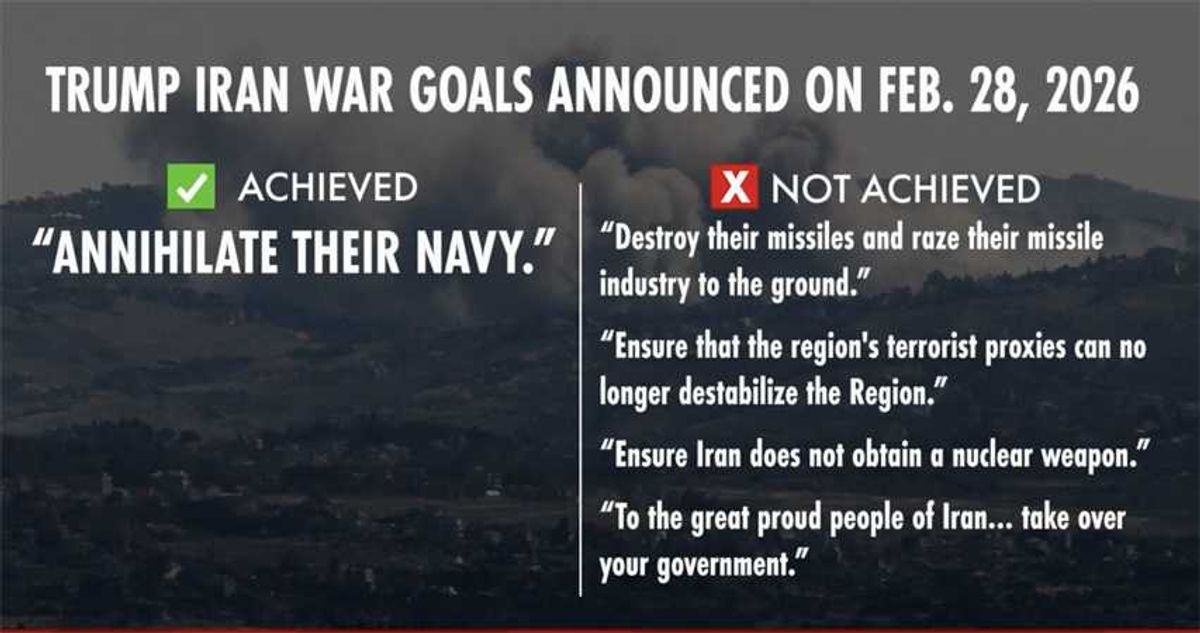
The number of goals Donald Trump set out on Feb. 28 when he launched the unprovoked attack on Iran was held up to the light by MS NOW’s David Rohde on Tuesday morning, who made clear the president's war so far has been a failure.

Well beyond the Strait of Hormuz stalemate that has the Trump administration grasping for an answer, Rohde singled out five claims that the president made when he announced the attack, with only one coming to fruition -- and even that appears doubtful after this weekend's events.

Speaking with “Morning Joe” co-host Jonathan Lemire, Rohde got right to the point as the producers displayed a graphic showing the administration coming up far short of its goals.

“Remind us, please, about the goals that this administration first set out for this conflict and what has actually been achieved,” Lemire prompted his guest.

“Look, I want to give credit to all the service members that are out there in particularly the day after Memorial Day, but this has been a disaster for this administration to have the Secretary of State [Marco Rubio], as we just saw him on his plane, trying to play down, almost trying to placate the Iranians and the American public about how this conflict has gone was extraordinary,” he began.

“I looked up President Trump's speech on February 28th when he announced the war, so achieved: ‘annihilate their navy.‘ Maybe. I mean, I think that's generally true. But this morning, the New York Times has reported that there are hundreds of these speedboats and this — look, I believe the United States Navy, I don't believe the Iranians at all — if they're laying mines with one of these speedboats. That's why it was part of the attack yesterday; that's extraordinary. That shows how emboldened the Iranians are. So that's maybe achieved or partly achieved.”

“And then everything else. 'Destroy their missiles,'” he continued. “The latest assessment is that 70% of Iran's missile capacity remains intact. They have knocked out some of the factories. But again, that is not an achievement. Overall, ensure the region's terrorist proxies no longer destabilize the region — That's not happening at all. That's not even part of these negotiations. And the missiles aren't either.”

“Ensure that Iran does not obtain a nuclear weapon,” he continued. “That's not even part of the current negotiations that will come in this 60-day second round of talks. And then, most tragically, what he said to, as he said to ‘the great people of Iran, take over your government,’ and the regime remains in place.”

“So it's astonishing to me that an American president is in this position,” he concluded. “And they just, you know, this administration … just continues to mismanage this war.”


Trump just went 'all in' while holding 'weak hand' with threat to foreign allies: MS NOW

Tom Boggioni
May 26, 2026 
RAW STORY


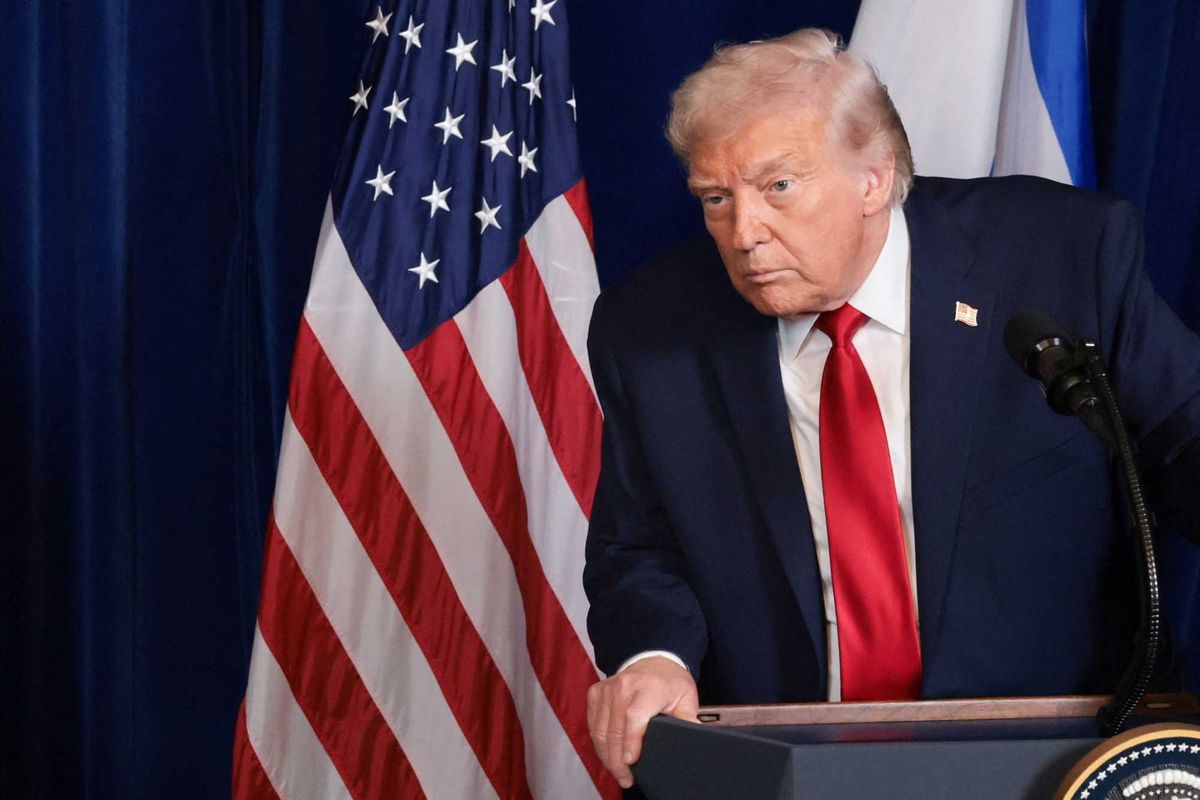
Donald Trump attends a press conference. REUTERS/Jonathan Ernst

Middle Eastern nations that were on the receiving end of a threat from Donald Trump over the holiday weekend called his bluff because he no longer carries the weight he thinks he does.

That was the claim made by MS NOW host Joe Scarborough and Washington Post columnist David Ignatius on Monday morning after the affected nations balked.

Over the weekend, as Trump was boasting that an agreement with Iran was imminent, he then jumped ahead and wrote on Truth Social, “I am mandatorily requesting that all Countries immediately sign the Abraham Accords, and that, if Iran signs its Agreement with me, as President of the United States of America, it would be an Honor to have them also be part of this unparalleled World Coalition.”

As the Washington Post reported, “Analysts, however, expressed doubt that the countries would agree to sign on, especially when tensions are running high amid ongoing conflicts in Iran, Lebanon, and Gaza. Official Iranian policy also calls for the eradication of Israel, and its replacement by a Palestinian state.”

Scarborough jumped into the fray by saying Trump, who has been diminished in the region by the Strait of Hormuz stalemate, doesn’t have the leverage to make such demands.

Stating Trump’s new Iran deal pronouncement is “starting to sound like every other BS peace deal,” Scarborough added, “And I say that I know they're talking, they think they're close, but you have the Iranians saying, no, we're never going to give up our nukes. We're going to continue putting tolls on the strait.”

“And then you have Donald Trump yesterday basically holding a weak hand, actually going all in, saying, okay, Saudi Arabia, okay, Turkey, all right, all these other countries that are never going to join the Abraham Accords, the only way they're going to work is if all of you join the Abraham Accords. And the Saudis have already said, we're not going to do it. We're not going to do it without a Palestinian state. Is there a peace still? Are they really moving forward to one, or is this just more of the same?”

“So, Joe, it is, as your comments suggest, a very confusing and disheartening situation,” Ignatius replied. “It's obvious to me that President Trump badly wants out of this war. He's looking for an exit ramp as hard as he can, he feels that another round of kinetic strikes will be difficult for the U.S. — for the US military it’s unlikely to easily achieve his goals.”

“It will lead, inevitably, to some kind of ground invasion of Iran, which is the last thing that I think he wants. And so he has come up with a peace proposal that is so far short of the war aims that he had when he started,” he added.


Trump officials to send Ebola-exposed Americans to Kenya rather than bring them home: NYT

Bennito L. Kelty
May 26, 2026 
RAW STORY


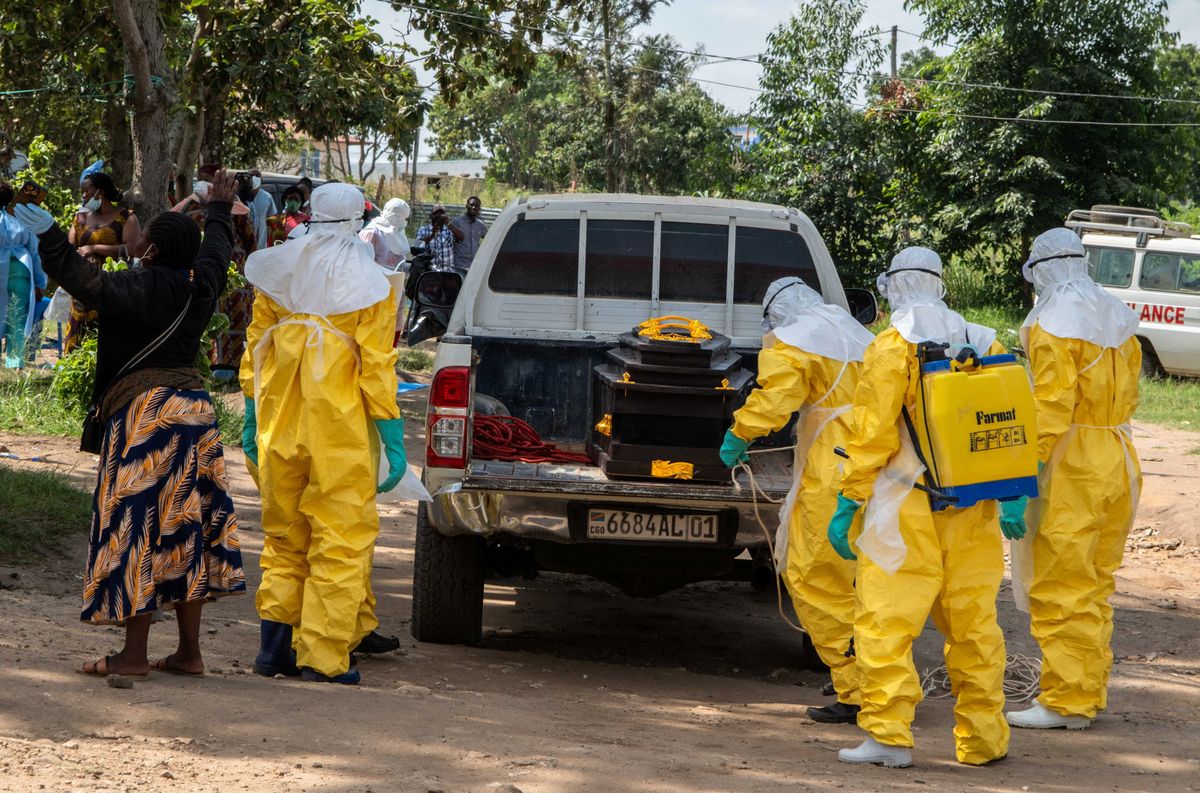
Red Cross workers wearing personal protective equipment (PPE) load on a pickup truck the coffin with the body of Dr Tibenderana Katho Blaise who worked at the Centre Medical Evangelique (CME) in Hoho commune and died of Ebola virus, as aid agencies intensify efforts to contain a new Ebola outbreak caused by the Bundibugyo virus, before his burial in Bunia town, Ituri province, Democratic Republic of Congo, May 26, 2026.
REUTERS/Stringer

The Trump administration wants to send U.S. citizens living abroad who are exposed to the deadly Ebola virus to Kenya rather than bring them home, according to new reporting by the New York Times.

Three people familiar with the Trump administration's plans spoke with the NYT, which noted that previous administrations brought Americans home for observation and treatment.

The outbreak of Ebola is in the Democratic Republic of Congo. The World Health Organization declared it a public health emergency. More than 1,000 cases of Ebola and 200 deaths have been reported during the past 11 days, which makes it the third largest outbreak on record, according to the NYT.

Trump administration insiders told the NYT that the original plan was to send Ebola-exposed Americans to Kenya for monitoring and then to Europe for treatment if they show symptoms.

"But the administration now plans to provide treatment in Kenya as well," insiders told the NYT. Trump officials are already setting up a facility in Kenya where Americans can be quarantined and treated for Ebola, the NYT added.

"Last week, the Trump administration invoked a public health law known as Title 42 to bar immigrants and legal permanent residents who have been in Congo, Uganda, or South Sudan in the previous 21 days from entering the United States," the NYT reported.

"The administration's new plan would also keep U.S. citizens who might have been exposed to Ebola out of the country," two people familiar with the administration's plans told the NYT. "A few dozen Public Health Service officers are now being trained to deploy to Kenya to provide medical care to Americans who are deemed at high risk of developing Ebola."

So far, only a few Americans have been infected, including an American doctor in Germany and six other Americans who were transported to Germany and the Czech Republic for monitoring, according to the NYT.

"Government scientists and physicians who develop symptoms will also be treated in Kenya," the NYT added.