Wednesday, May 27, 2026

Canada to buy Swedish surveillance plane over US models

Jenipher Camino Gonzalez
DW with Reuters, AP
27.05.2026 

Prime Minister Mark Carney said the Canadian Armed Forces need the plane to detect and deter threats across the Arctic.

Carney said the Saab GlobalEye, a UAE version of which is seen here at a French airshow in June 2025, would be a key resource to ⁠deter ⁠threats across the Arctic
Image: Nicolas Economou/NurPhoto/picture alliance

Canadian Prime Minister Mark Carney announced on Wednesday that his government would not purchase early warning radar planes from the United States, opting instead for a European model.

Canada will purchase Swedish Saab's GlobalEye, which is based on the Canadian-manufactured Bombardier Global 6500 jet.

"With a suite of advanced sensors and mission systems, Saab's GlobalEye will be a key resource for the Canadian ‌Armed Forces to detect and ⁠deter ⁠threats across the Arctic," Carney told a defense conference in Ottawa.

The decision comes after Carney linked Canada to a major European Union defense fund last year, and as the Canadian prime minister has made a point of diversifying his country's military spending away from the United States.

Carney has also previously vowed to spend no more than 70 cents of every dollar of Canadian military capital spending to the United States.

The prime minister had pledged earlier this year that Canada would take full responsibility for protecting its vast Arctic territory, after decades of relying on a partnership with the US to monitor over 4.4 million square km (1.7 million square miles) of Canadian land and sea.

"Saab's GlobalEye will be a key resource for the Canadian Armed Forces to detect and deter threats across the Arctic," Carney said.

What is Saab's GlobalEye?

The Saab GlobalEye plane is equipped with a powerful radar. It provides situational awareness of aircraft and missile movements over hundreds of kilometers.

The plane can also detect hostile activity in the air or from ships and can direct fighter jets to their targets. Carney did not elaborate on the size of the fleet or the cost of a potential contract.

Meanwhile, in a statement, Saab said it planned to invest in research and development work in Canada as part of any deal.

Tensions between the US and Canada have been high since US President Donald Trump launched a trade war against the US' northern neighbor and even suggested that Canada should become the 51st US state, which caused widespread outrage in Canada, just as Carney was seeking the post of prime minister and succeeded in getting elected to it.

Since then, the Canadian government has also opted ot review the planned purchase of US F-35 fighter jets to explore other options.


Edited by: Sean Sinico

FIFA to be investigated over ticketing practices for 2026 World Cup


27.05.2026 DPA


Photo: Christian Charisius/dpa


FIFA’s ticketing practices for the 2026 World Cup are to be investigated by chief legal officers in the United States.

The attorneys generals of New York and New Jersey insist FIFA must answer questions after allegations of “artificially inflating prices” and “misleading fans” over the sale of match tickets, with world football’s governing body subpoenaed to provide information.

It has been reported that fans may have been misled about the locations of the seats they were purchasing, and FIFA’s public statements and ticket releases possibly contributing to soaring prices.

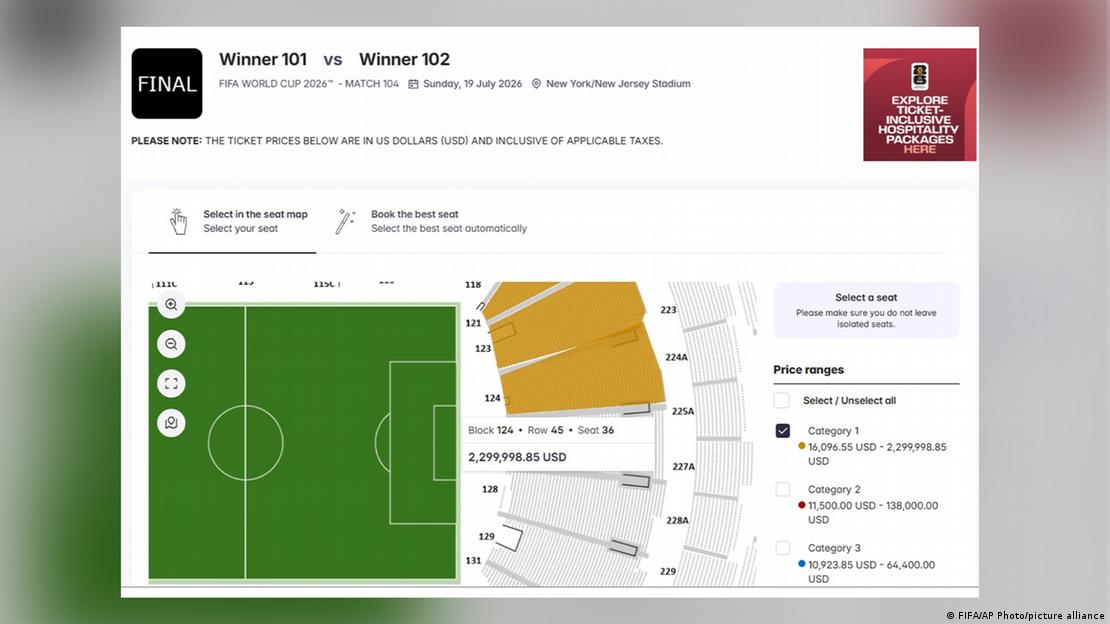
New Jersey Attorney General Jennifer Davenport and her New York counterpart Letitia James have specifically requested details about ticketing practices for eight World Cup matches hosted in New Jersey, including England’s group game with Panama on June 27 and the World Cup final on July 19.

Davenport said: “Being honest about ticket sales is not complicated.

“But FIFA has turned buying a ticket to the World Cup into a gauntlet of confusion, fake scarcity, and impossibly high prices – all at the expense of consumers and hardworking New Jerseyans.

“We are committed to conducting a thorough investigation of FIFA’s conduct, and we are proud to stand together with Attorney General James in protecting our consumers.

“It’s an honour to host the World Cup, but the event is not an invitation to exploit our residents and visitors.”

Supporters have reported they were “misled” about the location of seats, including through the creation of more expensive "front" category tickets released after the initial sales.

It is also alleged variable pricing through various phases and subject to demand had allowed FIFA to raise prices for about 90 of the 104 fixtures by an average of 34%.

The investigation will consider how the ticket release schedule and public statements may have impacted prices.

James said: “New Yorkers have been waiting years for the World Cup to come to their backyard, and they deserve a fair shot at affordable tickets.

“No-one should be manipulated into paying sky-high prices for seats, and fans should be able to trust that the tickets they purchase will be the ones they receive.

“I thank Attorney General Davenport for joining this effort to get answers from FIFA and protect our states’ consumers.”

New Jerseyans who have not received the World Cup tickets they paid for have been encouraged to file a complaint on the Division of Consumer Affairs website.

FIFA declined to comment after being contacted by the Press Association.

'Luxury toaster': Ferrari electric roasted by fans, shun by investors

27.05.2026, DPA


Photo: Ferrari/PA Wire/dpa

Ferrari's 1,000+ hp electric Luce might just be the most ridiculed car of the year. After a rare 6% stock slide, disgust from fans and insults from famous Italian car industry voices, will the numbers silence the backlash once it goes on sale?

By Martin Bensley, dpa

It might be the first of its kind, a striking head-turner and a high-performing electric supercar, but none of that has stopped it from getting a resounding thumbs down from many fans and investors alike.

On Tuesday Ferrari unveiled the Luce, a five-door hatchback with four electric motors and a total output of over 1,000 horsepower ahead of a sales launch later this year.

However, images of the sleek, muscular car triggered exclamations of dismay from many enthusiasts of the Italian luxury manufacturer. It was meanwhile met with anything but enthusiasm on the stock markets.

The model dumps many of the traditional features associated with Ferrari and opts for a futuristic aesthetic, with lines that many users compared to luxury Chinese vehicles.

Fans were particularly upset by the visual design, which is a departure for Ferrari. The shape of the Luce (or "light") comes from studio LoveFrom, headed by Britain's Jony Ive, the famed design specialist who worked on the development of the iPhone.

Ferrari has used design houses such as Pininfarina, Bertone and Zagato before, but it said working with LoveFrom has helped it think radically.

The response of former Ferrari boss Luca di Montezemolo was unequivocal: "If I said what I think, it would harm Ferrari... They are destroying a myth, I’m very sorry. I hope they remove the prancing horse from the car," he said on X.

In another comment on the social media platform, a former Italian Minister for Industry described the Luce as an "aesthetic and technological insult" to all Ferrari fans.

Other commenters likened the Luce to an Apple Store minivan or a Honda Accord, while memes spread on social media depicting the car as a luxury toaster.

"It looks like a child's remote-controlled car you'd buy for $10 from an Aliexpress-ass market stall," wrote news website Aftermath.

According to Ferrari, the car is very much in the tradition of its high-speed road-burners with a top speed of over 310 km/h and a 100 km/h sprint time of 2.5 seconds. The power for all this comes from a 122-kilowatt-hour battery with a range of 530 kilometres. The price is a hefty €550,000.

In terms of sound, the low-noise electric Luce is a departure from the powerful vroom of the V8 and V12 combustion engines in most Ferraris, however.

For the presentation, the company chose an exclusive location: the Vela di Calatrava, a sail-shaped structure by Spanish architect Santiago Calatrava in Rome. Ferrari invited over 200 journalists from around the world to the unveiling, followed by several gala dinners.

Ferrari said it aims to open a new chapter with the Luce. Originally, the plan was for 40% of new Ferraris to be electric by 2030; now the figure is just 20%.

Competitors such as Porsche and Lamborghini have meanwhile scaled back their electric ambitions owing to weak demand and image problems.

Investors also reacted with disappointment. The share price lost more than 6% on the Milan Stock Exchange in a rare slump following the launch of a new model. Shareholders were already irritated in September when Ferrari presented its highly conservative profit targets.

It now remains to be seen how the Luce will fare in the marketplace when it goes on sale later in the year.

Teens and screens: The smartphone trap


Issued on: 26/05/2026 -  FRANCE24
Play (12:08 min)From the show

Smartphones, video games, online homework: screens are everywhere in teenagers' lives. Faced with the risks of addiction and the effects on mental and physical health, some French parents and teachers are pushing back.

Rayan is 13 years old and, like nine out of 10 children his age, he owns a smartphone. Until a few months ago, he would spend several hours a day playing free online games. "I just wanted to stay home in my bedroom all the time, shutters closed, playing Fortnite, Roblox, Minecraft, Brawlstars..." he recalls.

Within weeks, Rayan was hooked. On days off school, he could spend up to 12 hours a day in front of a screen. His concentration suffered, and so did his grades. "He stopped going out, he was always in his room. You had to nag him, and when you took his phone away, he'd storm off to his room and turn the whole place upside down," his mother recalls.

Rayan himself admits he had lost all self-control: "I had this deep anger inside because gaming was supposed to relax me, but in the end it was doing the exact opposite." His parents felt completely out of their depth. "He wasn't my son anymore, it was really hard... We didn't know what to do with him anymore," his mother explains. "We also felt like we were bad parents," his father says. Feeling out of their depth, his parents eventually decided to ask for help.

'The only comparison that holds up is alcohol or hard drugs'

At the Georges Daumézon Hospital near Orléans, psychologist Sabine Duflo sees screen-addicted teenagers once a week. Ninety percent of her patients are boys around the age of fourteen, who play free online multi-player video games. All these games share one thing in common: random rewards. "It's that randomness that creates the addiction," explains Duflo. "The only fair comparison is alcohol or hard drugs," adds the psychologist, who is also the founder of the Collective on Screen Overexposure (COSE). In her view, there is only one solution for overcoming this addiction: withdrawal. "If your child was 13, had a drinking problem, and I prescribed a detox, you'd think that was perfectly reasonable, right? It's the same thing with video games."

The first few days of withdrawal were hard for Rayan, but within a few weeks, he started noticing a difference. "I actually think more about my friends now, about going out with them," he says. His mother says he's become much more of a chatterbox.

Today in France, most children get their first smartphone at the age of nine, and according to the national health authority, spend more than four hours a day on screens outside of school time. Many health professionals are raising the alarm about the risks to children's and teenagers' mental and physical health: deteriorating sleep quality, exposure to violent or pornographic content, stress, anxiety, depression and declining attention spans.
Faced with the dangers of smartphones, parents join forces

In response to these risks, some French parents are banding together. Anne-Laure Bailly coordinates the "Growing Up Better Without a Smartphone" initiative in the Paris region, encouraging families to hold off on giving their child a smartphone for as long as possible and not before the age of 15. "If your child's friends don't have a smartphone, it will be much easier to resist," she says.

Gaëlle de Waru signed up for the initiative to protect her children. "The last thing I want is a child who's hooked on screens," she says. Her daughter Clémentine is nearly 14 and only has a flip phone, just like two of her closest friends. Clémentine says she notices the difference: "We actually spend real time together; we talk so much more."
Contradictory messages

Despite parents' best efforts, it's almost impossible to keep their children off screens because teachers routinely assign homework that requires going online. "I resist, and then the school turns around and asks for the opposite," says de Waru. We asked the French ministry of education what solutions were being considered to avoid forcing parents to equip their children with smartphones. We received no response.

But some schools are taking matters into their own hands. At Collège Alphonse Daudet in Paris, principal Sébastien Blondot has banned students from using the school management platform Pronote and has asked teachers to stop assigning homework that requires a screen.

"The idea is very simple: explaining to students and parents that a child does not need a smartphone to do their schoolwork," he says. That said, technology has not been banned altogether. "We're not banning digital tools, we're managing them," says teacher Yohan Abou. "It also helps put parents back at the centre of their child's education," adds Meriem Guendafa, chair of the school's local parent council.

These initiatives, driven by a handful of teachers and parents, are still few and far between. But they reflect a shared determination: to let teenagers experience their school years without falling into an all-digital world.


Remembering the 'Saxophone Colossus' 
Sonny Rollins


Issued on: 26/05/2026 - 
07:13 min From the show


FRANCE 24's François Picard welcomes Reggie Washington, American jazz bassist and founding member of the Black Lives collective. Sonny Rollins, one of jazz's greats, has passed away aged 95. Often called the "Saxophone Colossus" after his groundbreaking 1965 album, Rollins left a lasting mark on jazz.BY:


Celebrating a century of the magician of jazz, Miles Davis


Issued on: 26/05/2026
Play (11:51 min)

One hundred years after the late Miles Davis was born, the revolutionary trumpet player remains one of the 20th century's most influential artists. We look back at the life and legacy of a complex, visionary figure with one of his collaborators, musician Jason Miles, who recorded the albums "Tutu", "Music for Siesta" and "Amandla" with Davis during his later years. Jason's latest record "100 Miles for Miles Davis" is a reflection on those recording sessions.

We also discuss the keyboard and synth arrangements that pushed Davis's sounds towards the 21st century, and revisit the key moments in his musical journey, from the groundbreaking "Kind of Blue" to his work on French film "Elevator to the Gallows".


Iran partially restores internet access after three-month shutdown

Iranian authorities on Tuesday partially restored internet access after an almost three-month nationwide shutdown imposed during the war with Israel and the United States. While home broadband connections resumed in some areas, mobile internet remained largely blocked, leaving many Iranians still reliant on VPNs to access international websites and social media.

Issued on: 26/05/2026 - 
By:FRANCE 24

The internet has been cut in Iran for almost three months. © Atta Kenare, AFP

Iranian authorities partially restored internet connectivity Tuesday after an almost three-month shutdown imposed against the backdrop of the war against Israel and the US, said a monitor, a senior official and sources inside the country.

The shutdown left Iranians largely cut off from international networks, with only a domestic intranet working for daily tasks like shopping, ride-hailing and education.

"Live metrics show a partial restoration to internet connectivity in Iran on day 88," of the shutdown, monitor Netblocks said on X, saying it was "unclear" if this meant a permanent end to the "longest nationwide internet shutdown in modern history".

Vice President Mohammad Reza Aref said in a post on X that the "first step toward free and regulated access to cyberspace has been taken," adding that the demands of Iranians "will be fulfilled".

State news agency IRNA and Fars news agency said "full international internet connectivity has been restored" for users of fixed broadband services, but this had not been confirmed by internet monitor NetBlocks.

Witnesses inside Iran also told AFP that mobile internet remains cut but home internet with Wi-Fi had been restored, even though VPNs were still needed to access some social media.

"A few minutes ago I could open international websites using my home internet provider," said a 22-year-old woman from the western city of Kermanshah, asking not to be named.

A user in Tehran said the internet service for his company in Tehran has been restored but "mobile connection remained the same" without any access. Others reported that general access remained extremely patchy.
'Long way to go'

The shutdown imposed when war erupted on February 28 followed a similar blackout imposed from January 8 as the country was rocked by mass anti-government protests.

Activists said that the January closure was aimed at masking the scale of a crackdown on the protests, which left thousands dead according to rights groups, as well as preventing more demonstrations.

Doug Madory, head of internet analysis at US network monitoring firm Kentik, said the partial restoration needed to be kept "in perspective".

"Iran has a long way to go to get back to pre-Jan-8 levels of traffic volumes," he wrote on X.

The shutdown had also caused considerable debate inside Iran with the administration of President Masoud Pezeshkian – regarded as a more moderate figure – impatient to end a measure which was also hugely damaging for the economy.

However Pezeshkian by no means has the final say on such issues.

Yaghoub Rezazadeh, member of Iran's national security commission at the parliament, told the Hamshahri daily Monday that the final decision on such issues "rests with the Supreme National Security Council" under hardliner Mohammad Bagher Zolghadr.

Iran's judiciary earlier Tuesday suspended a fledging presidential body that had ordered the restoration of the internet.

The Special Headquarters for Organising and Governing the Country's Cyberspace was formed on May 12 by Pezeshkian.

The body had on Monday reached a decision to "restore the internet" in Iran, according to government spokeswoman Fatemeh Mohajerani, after local media reported that Pezeshkian had decreed the measure.

Supreme leader Mojtaba Khamenei, who has yet to appear in public since his father and predecessor Ali Khamenei was killed at the start of the war, meanwhile is in theory the country's number one figure.

Some Iranians expressed glee on social media over the restoration of a degree of connectivity.

"YouTube without a VPN!!! Oh my God, am I dreaming?" wrote one on X.

"Hello my dear Twitter," said another, using the former name for X.

(FRANCE 24 with AFP)
Duterte's ICC trial to start November 30: judge

The Hague (AFP) – Former Philippines president Rodrigo Duterte will face a crimes against humanity trial at the International Criminal Court from November 30, the presiding judge said on Wednesday.

Issued on: 27/05/2026 - RFI

Duterte will be the first fornmer Asian head of state to face trial at the ICC © Simon Wohlfahrt / AFP

Duterte faces three counts of crimes against humanity, with prosecutors alleging his involvement in at least 76 murders between 2013 and 2018 during his so-called "war on drugs".

The 81-year-old will be the first Asian former head of state to face trial at the ICC, which prosecutes individuals for the world's worst crimes such as war crimes and crimes against humanity.

Prosecutors had sought the November 30 start and they expect to call between 60 and 70 witnesses during the trial.

"I am prepared to accede to the prosecution's request" said presiding judge Joanna Korner. She did however order a further assessment of Duterte's fitness to stand trial before proceedings begin.


The defence, led by British barrister Peter Haynes after a reshuffle, had urged judges not to set a date for trial, arguing that Duterte's health needed to be assessed.

"It would be inappropriate to attempt to set a date... the defence position is that a commencement is contingent upon a determination... of Duterte's fitness to stand trial," the defence said.

Duterte was cleared fit for an earlier hearing that confirmed the charges against him, but he did not appear in person, his defence team saying he was not mentally sharp enough to follow proceedings.

"His condition continues to deteriorate and will need more fully to be reviewed before any trial may commence," argued the defence.

It is unlikely Duterte will ever appear at the court based in The Hague. Judges have granted him leave of absence at every hearing so far.

The only time he has been seen since his arrest was an initial appearance via video, where he seemed confused and tired, his speech barely audible.
'Death squad'

During February "confirmation of charges" hearings, the prosecution alleged Duterte killed thousands of suspected drug pushers and users, first as mayor of Davao City, then as president.

"Decades of murdering his own people, murdering the children of the Philippines, and he claims that he did it all for his country. He doesn't deny it," said Julian Nicholls, summing up for the prosecution after the hearings.

"He ran a death squad in Davao (city) that he created. He ran it for over 20 years before he became president. His promise was to kill thousands and he did."

The true number of killings during his campaign in the Philippines is thought to be in the thousands, and lawyers for the victims have argued that a full trial could encourage more families to come forward.

The case comes with the ICC facing intense political pressure, including two rounds of US sanctions imposed since June 2025.

The Philippines left the ICC in 2019, on Duterte's instructions, but the court has ruled that it still has jurisdiction over alleged crimes committed there between 2011 and 2019.

Duterte "absolutely" maintains his innocence, his former defence lawyer Nicolas Kaufman told the court in February.

Kaufman told ICC judges the evidence against Duterte was "wholly insufficient" and the charges "grievously misplaced and politically motivated".

He argued that while Duterte used "bluster and hyperbole" in his speeches, he also frequently ordered authorities only to shoot in self-defence.

Duterte remains popular in the Philippines, where many favoured his tough approach to crime.

© 2026 AFP
'Trust has been so eroded': Philosopher Miranda Fricker on epistemic injustice today


Issued on: 26/05/2026 - FRANCE24

10:05 min From the show


A world-renowned philosopher has told FRANCE 24 she's still shocked that 20 years after she coined the phrase "epistemic injustice", she is still talking about it. Miranda Fricker is now Julius Silver Professor of Philosophy at New York University and co-director of the New York Institute of Philosophy. She's also a fellow of the British Academy and the American Academy of Arts and Sciences. She's in Paris for a two-day conference at Sciences Po University on discursive practices, that is the way people use language, symbols, stories and the media to influence political events. In Perspective, she spoke to us about the latest theories and how they relate to the fake news environment of today.


DR Congo facing 'catastrophic collision' of Ebola and war, WHO chief warns

The ongoing conflict between armed groups in the eastern Democratic Republic of Congo has made it harder for health workers to contain the worsening Ebola outbreak, World Health Organization Secretary-General Tedros Adhanom Ghebreyesus said Wednesday
.

Issued on: 27/05/2026
By: FRANCE 24

A worshipper has his temperature taken outside a mosque in Bunia, in the eastern Democratic Republic of Congo, on May 27, 2026 the first day of Eid al-Adha, the Feast of Sacrifice. © Glody Murhabazi, AFP

The World Health Organization chief warned Wednesday that conflict raging in eastern Democratic Republic of Congo was dramatically complicating efforts to rein in a deadly Ebola outbreak and urged an immediate ceasefire.

"Eastern DRC now faces a catastrophic collision of disease and conflict with the Ebola outbreak in Ituri province outpacing the response," Tedros Adhanom Ghebreyesus said on X.

The WHO has recorded 10 confirmed Ebola deaths and 220 suspected deaths in DR Congo since mid-May, while also recording a further 900 suspected cases since Kinshasa declared the outbreak on May 15.

The United Nations' health agency said the true spread of the virus was probably much wider. Experts have said it was probably circulating for some time.

The mineral-rich region has been scarred by violence from various armed groups for more than three decades. Since 2021, the Rwanda-backed AFC/M23 insurgent group has seized swathes of territory and fighting has stepped up since the start of 2025.
USAID was shut down 'to soothe ego' of Musk, whistleblower says

TÊTE À TÊTE © FRANCE 24
11:30


It is the 17th Ebola outbreak in DR Congo, one of the poorest countries in the world, and without a vaccine, efforts to contain the spread rely on adhering to preventive measures and quickly detecting cases.

"For good practices and rules on isolation, safe burials and contact tracing to be followed, a great deal of trust in the health authorities is required," said Pierre Boisselet, head of the country's Ebuteli research institute.

"The current situation of conflict and fragmented authority does not, at first glance, seem very favourable," he added.

Tedros stressed that the Bundibugyo strain of Ebola that is spreading in DR Congo had "no approved vaccine nor treatment".

"Stopping this Ebola transmission depends entirely on humanitarian access," he said.

State services in rural areas of Ituri province have been largely absent for decades.

Tedros lamented that clashes were "driving mass displacement, pushing exposed contacts into overcrowded camps and severing critical containment corridors".

"Frontline workers are risking everything, while attacks on health facilities make tracking cases and their contacts nearly impossible," he warned.

Two isolation tents set up by the NGO Alima in the first days of the response were set on fire by an angry crowd demanding the body of one of their friends, who had died of Ebola.

The riot was broken up when soldiers fired warning shots.

WATCH MOREHealth workers struggle with Ebola outbreak as WHO declares highest risk level in DR Congo

Healthcare workers have increasingly been allowing patients' families to visit them under the supervision of medical staff in order to reduce tensions and encourage the sick to go to the hospital.

"From a moral standpoint, it is important to establish this communication between patients and their family members," said Ganou Lamissa, logistics coordinator for the NGO Alima.

"This reassures not only the patients, but also the relatives, who can know under what conditions the patients are being cared for," he added.

The WHO secretary-general called for an immediate cessation of hostilities to allow medical staff to move in to at-risk areas.

"We cannot build community trust or isolate the sick while bombs are falling," he said.

"We urge all warring parties to agree to an immediate ceasefire to contain this outbreak. To allow us safe and sustained access for medical teams.

"We plea to prioritise human survival above everything else."

(FRANCE 24 with AFP)

USAID was shut down 'to soothe ego' of Musk, whistleblower says


Issued on: 27/05/2026 - FRANCE24

Play (11:30 min)From the show


In an interview with FRANCE 24, Nicolas Enrich, a former senior USAID official-turned-whistleblower, said the US agency was dismantled not to cut waste but "to soothe the ego of the world's richest man", then DOGE head Elon Musk. Enrich warned that up to 14 million people could die in the next five years as a result and called the shutdown "illegal".

Enrich, a former director of policy in USAID's Bureau for Global Health who was ousted after publishing an internal memo, said the DOGE team had "no idea" what the agency did. He recalled briefing its newly appointed chief of staff, only to be met with the admission: "Wow, I had no idea that you did all this. I assumed it was just, you know, abortions."

The dismantlement of the agency, he said, served not to "eliminate waste" but "to soothe the ego of the world's richest man."


Enrich dismissed US Secretary of State Marco Rubio's claim that "no one has died" from the shuttering of USAID as "flatly untrue", estimating that "at least 750,000 people have already died unnecessarily due to those cuts".

For our guest, the current Ebola outbreak in DR Congo illustrates what has been lost, as the US State Department is "struggling to improvise" where a USAID team could have deployed within 24 to 48 hours.

Enrich concluded that the "illegal" shutdown of USAID "violated laws, court orders and the intent of Congress".