Wednesday, May 27, 2026


Eight Injured During Cargo Ship Fire in Hamburg

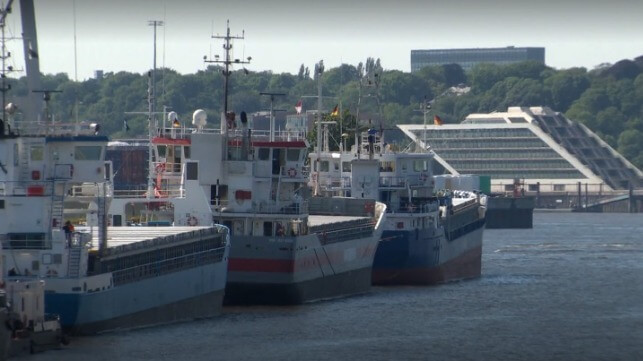
small cargo ship at dock
Jolyn is in the middle in this photo showing her docked in Hamburg (German TV)

Published May 25, 2026 6:15 PM by The Maritime Executive


The fire department in Hamburg, Germany, is reporting it received a callout on Sunday, May 24, for reports of smoke coming from a cargo ship docked at Grevenhofkai in the Kuhwerderhafen section of the port. The reports indicate it was an intense fire.

The ship’s crew had begun to fight the fire, which was in the stern of the vessel. They later determined it was coming from a storage area. The fire department reported an intensive effort involving approximately 80 emergency personnel. 

A total of eight people were seriously injured. One person received medical treatment at the scene, but the other seven were transported to hospitals. Among them was one firefighter and six crewmembers from the ship.

The newspaper Hamburger Abendblatt and broadcaster NDR are identifying the vessel as the Jolyn, a small, 3,600 dwt general cargo ship operated by Royal Wagenborg. Built in 2007, the ship is registered in the Netherlands. It had arrived earlier in the day from Hull in the UK.

The effort involved multiple hose lines, and the firefighters were required to use breathing apparatus. The city fireboat, Branddirektor Westphal, was also dispatched, as were divers. 

The efforts required three hours to extinguish the fire.  The fire department reports it later inspected the area and monitored critical temperatures in the affected area. Once they were convinced the fire was extinguished, they handed the incident over to the police for further investigation.


MSC Settles Out of Court Over 2024 Runaway Ship Incident in Charleston

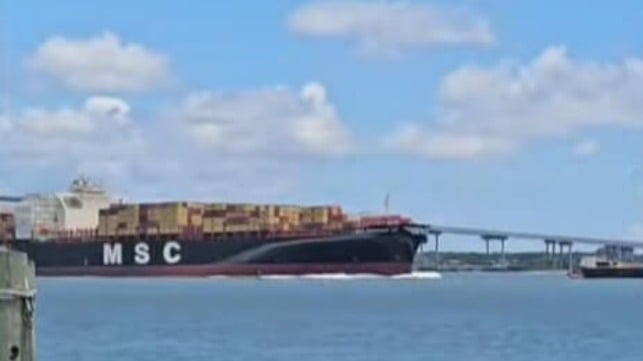
runaway containership speeding through Charleston
The vessel was stuck in full ahead as it was maneuvering out of Charleston harbor in 2024 (YouTube)

Published May 26, 2026 6:09 PM by The Maritime Executive


A filing with the U.S. District Court in South Carolina last week confirmed a settlement has been reached in a suit pending related to the 2024 incident in which an MSC containership lost control and sped out of Charleston harbor. A North Charleston company, Carver Maritime, filed suit alleging the negligence of the ship caused significant damage to the company’s facility on the Cooper River.

Carver Maritime operates a bulk and breakbulk cargo terminal along the river. According to the court filing in 2024, they cited the uncontrolled departure of the MSC vessel MSC Michigan III as causing significant damage to the pier and property. They alleged the containership sped past the terminal at a speed of over 15 knots, far exceeding a safe speed for that section of the river. 

In addition to the wash as the 80,000 dwt containership sped along the river, Carver reported water levels had dropped significantly at its pier. Another vessel, Norwegian Peak, a 45,400 dwt bulker, was sucked away from the pier where it was undergoing cargo operations. Carver said the vessel was pulled away from the pier until its mooring lines became extremely taut, and then forced back into the pier, causing significant damage.

The company asked the court to arrest the vessel, which it agreed with, appointing a custodian. The ship was permitted to leave after about 45 days, and then only with a USCG escort and tugs to ensure it did not make a second wild ride through Charleston’s harbor.

According to an earlier court filing, MSC’s lawyers were contending negligence, asserting that the lines of the Norwegian Pearl were not properly maintained. They said images showed the lines were slack, due “apparently due to her crew’s inattention,” creating a dangerous situation when their ship or others were maneuvering in the river.

The MSC Michigan III’s chief engineer entered into a plea agreement with the U.S. attorney’s office in September 2025. As part of the stipulation in the case, it described multiple maintenance problems on the vessel. Among the issues that were cited was a report that the crew was manually adjusting the length of the linkage rod between the governor and the fuel rack to achieve the desired RPMs with the main engine. They assert the defendant knew the manual adjustments were hazardous because they could cause the linkage rod to fail.

As the ship was departing Charleston on June 5, 2024, the engineers discovered that the linkage rod had disconnected from the governor. The engineers attempted several times to reconnect the linkage rod. While a fitter was working to repair the rod, the ship became a runaway, unable to slow the main engine, and it traveled at more than twice the regulated speed through the harbor. Officials closed the main roadway bridge crossing the harbor, and the ship was finally able to regain control as it reached the outer harbor.

It was alleged that the wild ride caused more than $500,000 of damage along the shoreline. In addition to Carver’s facility, there were pictures of private boats being rocked along the river and a wash on the shoreline. Luckily, the crew was able to steer the containership so that it did not strike anything during the run through Charleston harbor.

The filing did not report the terms of the settlement to the court. It had previously been reported to the court that the shipping company and its insurance companies were working with the insurers for the Norwegian Pearl and Carver to reach a settlement.

The chief engineer was facing up to five years and a $250,000 fine on one count and an additional six years and a further $250,000 on a second count. His sentencing has been postponed and is now scheduled for June 2026. 


Australia's Ichthys LNG Project Dodges Labor Strike

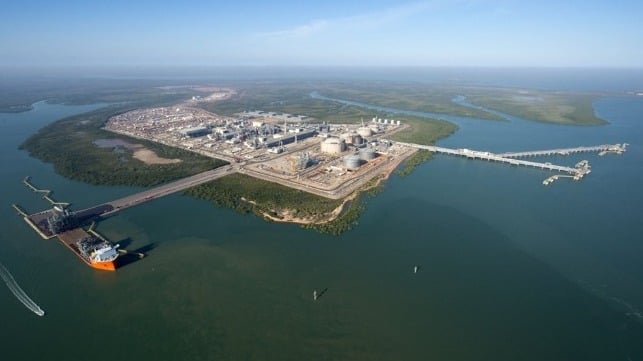
Ichthys
Press handout image courtesy Inpex

Published May 26, 2026 9:12 PM by The Maritime Executive


The labor union for Australia's offshore oil and gas workers has called off plans for a strike at the giant Ichthys LNG terminal in Western Australia. The Offshore Alliance said that negotiations with management were proceeding, and the labor action that its members approved earlier in the month will be deferred. The news will be welcome for Asian utilities, which have been paying elevated prices for LNG since the start of the U.S./Israeli conflict with Iran; any interference with Ichthys' operations could affect about 10 percent of Australian export volume in an already-tight regional supply situation. 

Ichthys is a large offshore gas field located off the north end of Western Australia, a remote region with few inhabitants. Developed by Japanese firm Inpex, it was the largest Japanese overseas investment of any kind at its launch in 2018. Its wellheads are connected by pipeline to a shoreside liquefaction plant located in the nearest community - Darwin, some 430 nautical miles away to the east. The plant can produce about nine million tonnes per annum of LNG.

Last week, the Offshore Alliance - a joint representation body created in 2018 by the Maritime Union of Australia and the Australian Workers Union - called a strike for May 27, saying that talks with Inpex had stalled.

"Our dispute with Inpex's Australian management team will go as long as it takes for Inpex’s senior management . . . to agree to benchmark pay and conditions and secure jobs," the union said in a statement. 

Earlier in the month, the Offshore Alliance called a strike of contract maintenance workers at the Karratha and Pluto LNG export terminals, both operated by Woodside and maintained by contractor UGL. The union accused UGL of "inability to negotiate or accept industrial standards" during talks for a new labor agreement. The union said that the strike would be held indefinitely until a deal was reached. Taken together, Karratha and Pluto LNG have a nameplate capacity of about 19 million tonnes per annum. 


Seafarers Begin Strike Against Three Ships Owned by Iceland’s Eimskip

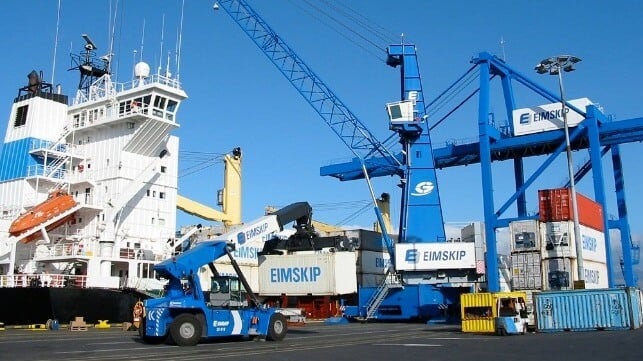
Eimskip container operations on dock
Three Eimskip vessels were hit by the seafarers' strike while a standstill agreement was reached with shoreside employees (Eimskip file photo)

Published May 26, 2026 2:30 PM by The Maritime Executive


The bosuns and able seamen represented by the Icelandic Seamen’s Union (SI) followed through on their earlier threat and began a strike on Monday, May 25, at noon. The three containerships owned by the Icelandic company Eimskip are impacted by the indefinite strike.

The contract with the union, which had provided for wage increases and cost-of-living adjustments, expired at the end of last year. Eimskip reports it has been in talks with the union, including efforts with the state mediator, while denying media reports that it was using lower-cost foreign labor instead of its Icelandic crews.

Last week, the company reported a standstill agreement with the union regarding shoreside employees who had also threatened to strike between May 26 and 28. The strike was called off while a competency analysis of port operations is carried out. Negotiations on the collective wage agreement were deferred until October 31. The company is also implementing a new job classification system and competency-based pay for harbor employees.

Three ships, Bruarfoss, Dettifoss, and Selfoss, owned by the company based in Reykjavik but registered through a subsidiary, Faroe Ship, and operating under the flag of the Faroe Islands, are impacted by the strike. Media reports have said the company was requiring the seafarers to sign on via the Faroe Islands at lower wages or that it could use foreign crews earning wages at one-fifth the scale of Icelandic sailors. 

The company denied these reports, saying the crewmembers working on its three owned ships are employed according to Icelandic collective agreements with the unions. The company asserts the dispute is over demands by the union that Eimskip operate a certain number of owned ships. Management notes its strategy is a mixed fleet of owned and chartered vessels.

Under financial pressure, Eimskip undertook in the second quarter of 2025 “extensive cost-saving measures, including a reduction in the company’s fleet, changes to the shipping system, a reduction in full-time equivalents, and restraints in investments,” it told shareholders. At the beginning of this month, the company reported a 4.5 percent decline in volumes in the first quarter of 2026, with a 1.4 percent decline in shipping revenues, and a total decline in revenues of 4.8 percent driven by its freight forwarding business. EBITDA was down nearly 40 percent year-over-year in the first quarter, and the company reported a bottom line loss of €4.7 million (US$5.5 million), an increase from a loss of €775 thousand in the first quarter last year.

The vessels Bruarfoss and Dettifoss (according to AIS signals) are now idle, while the Selfoss is proceeding to Reykjavik. Eimskip expects that the strike will affect its sailing schedule and services. It said it is working to minimize the disruptions, while media reports indicated no new negotiations were scheduled.


Cuba urges global solidarity amid fears of US aggression
DW with AFP, EFE
27/05/2026 - 

Foreign Minister Bruno Rodriguez warned the UN Security Council that US sanctions were pushing the island toward a "humanitarian catastrophe" as tensions with Washington escalate.


Cuban Foreign Minister Bruno Rodriguez told the UN Security Council that "now should be the time for solidarity" as the Caribbean nation faces a "humanitarian catastrophe."

"I call on the international community to mobilize to prevent a humanitarian catastrophe that could be imposed through arms or the fuel blockade," Rodriguez told the Security Council late on Tuesday.

Ahead of the Security Council session in New York, Rodriguez also posted on X saying, "I requested the UN's contribution to halt a US military aggression against Cuba, which would provoke a bloodbath, and to put an end to the threats of using force."

He reiterated Havana's "willingness to continue bilateral talks with the US," provided there is no interference in Cuban affairs.


US increases pressure on Havana

Rodriguez also met UN Secretary-General Antonio Guterres, in an attempt to shore up UN support to prevent possible US military action against Cuba.

Addressing the UN Security Council, Rodriguez said worsening fuel shortages and sanctions were deepening Cuba's economic crisis and causing widespread blackouts and shortages of food and medicine.

The appeal comes amid heightened tensions after US President Donald Trump increased pressure on Havana, including tighter sanctions and the indictment of 94-year-old former Cuban leader Raul Castro over the 1996 downing of two US-based planes.

The Trump administration continues to step up political pressure on Cuba in an attempt to bring about regime change.

Last week, Trump told reporters that past US presidents had considered intervening in Cuba but "it looks like I'll be the one that does it."

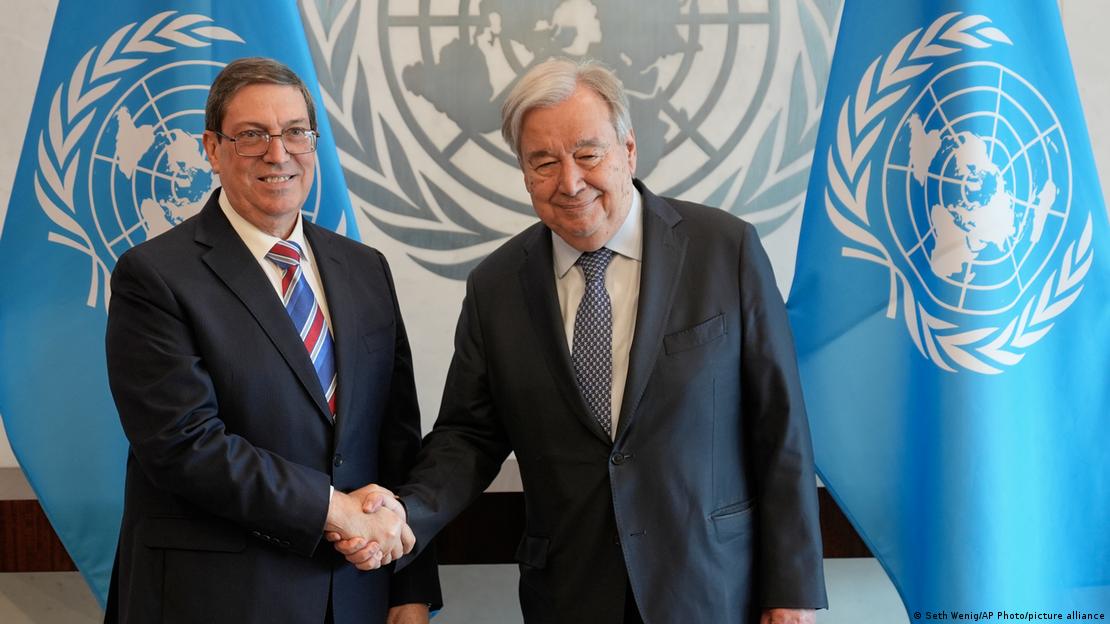
Bruno Rodriguez said had briefed United Nations Secretary-General Antonio Guterres on "the grave humanitarian situation facing the Cuban people"Image: Seth Wenig/AP Photo/picture alliance

'Let Cuba live in peace'

The US has maintained a decadeslong trade embargo on Cuba. However, the Washington's recent US energy blockade has driven the country to the brink as it grapples with blackouts in the capital Havana lasting 22 hours or more.

Rodriguez refuted that Cuba poses a national security threat to the US.

"It is an idea that goes against logic and common sense," he said. "Let Cuba live in peace."


Edited by: Zac Crellin


Bulk Cargo Ship Arrives in Cuba Carrying Aid from China

ship carrying aid to Cuba
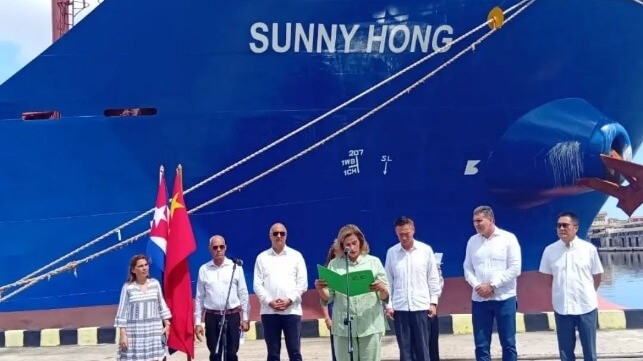
A delegation of Cuban officials greeted the ship carrying the China donation of rice (Ministerio del Comercio Interior de Cuba)

Published May 25, 2026 5:19 PM by The Maritime Executive


Aid shipments are continuing to arrive in Cuba despite the U.S. efforts to apply pressure on the Communist government of the Caribbean island. In the latest development, a Chinese-owned cargo ship arrived in Havana carrying what is reported to be the first of several major aid shipments coming from China.

The bulk cargo ship Sunny Hong (33,847 dwt) was received in Havana by a government delegation on Saturday, May 23, thanking the Chinese for their support. Cuban President Miguel Díaz-Canel called the shipment in a social media posting a “noble gesture of solidarity.”

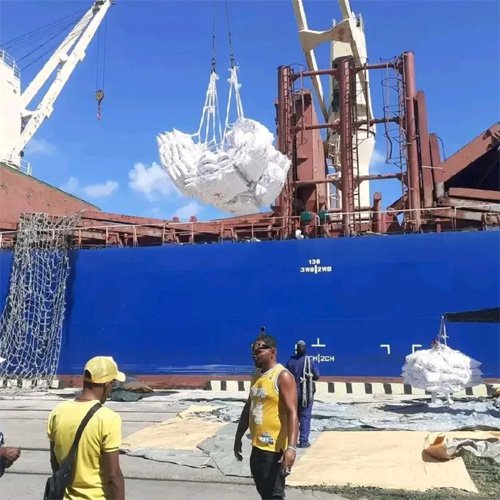
The vessel arrived carrying 15,000 tons of rice from China. The ship had left Qingdao on April 1 and transited the Panama Canal on May 8, but has largely been dark since then despite declaring it was bound for Cuba. 

Cuba’s Minister of Interior Trade, Betsy Diaz Velazquez, said it was greatly needed, and it would be immediately distributed to all the provinces. Media reports have indicated that Cubans are experiencing food shortages as the U.S. blockade and pressure campaign continue. According to Cuban officials, China has committed to sending a total of 60,000 tons of grain to Cuba.


Chinese rice shipment being offloaded in Havana (Ministerio del Comercio Interior de Cuba)


The shipment follows the arrival a week earlier of another aid ship coming from Mexico. Cuban officials said they have received over 3,125 tons of aid from Mexico, including food, medicine, hygiene products, and solar panels, although critics claim little of it is reaching the average Cuban.

At the same time, the Christian charity Saint’Egidio International reported that it had dispatched another container on May 15 from Genoa bound for Cuba. They said it is loaded with medicine, medical supplies, and wheelchairs, valued in total at approximately €700,000 (US$815,000). On May 9, another container from the charity reached Havana carrying 22,000 kg of rice and flour, and the charity said another container with 24,000 kg of food aid is also on its way to Santiago de Cuba. Continuing into June, the charity plans to ship additional containers with oil, flour, vegetables, and sugar. It said it expects to send one container to Havana and a second one to Santiago. 

However, there is no additional word on a second Russian oil shipment that was believed to have left Europe in April. The product tanker Universal’s last reported position was in the middle of the Atlantic, displaying “waiting for orders.” After making its first oil delivery earlier in the month, Russia had said it was preparing a second delivery. 

Despite these efforts, there continue to be reports of widespread outages on the island. The country has used the first Russian oil shipment and can only produce about 40 percent of its oil needs. Blackouts have become common across the island.


US planning to halt immigration at 'sanctuary city' airports
DW with Reuters, AP
27/05/2026 - 

The Trump administration's plans would target cities in Democratic-run states that have not cooperated with its immigration clampdown. Millions of foreign tourists are set to arrive in June for the FIFA World Cup.

The plans could affect millions of travelers set to arrive for the World Cup
 [FILE: March 2026]Image: Matthew Hatcher/Getty Images/AFP

What you need to know about Trump and sanctuary citiesTrump administration considers plans to halt immigration and customs processing at airports in Democratic Party-run cities

Travel and trade could face disruption with the suspension of international passenger and cargo arrivals

Airlines, tourism groups, and even some administration figures warn the move would severely harm the economy


The Trump administration is "drawing up plans" to halt immigration and customs processing at so-called "sanctuary cities," US Homeland Security Secretary Markwayne Mullin has said.

The cities, which are all run by Democrats, have refused to work with the White House in its crackdown on irregular immigration.

The plans would essentially halt all international passenger and cargo arrivals at major airports in Democratic-run states.

Millions of foreign tourists are expected to travel to the US for the FIFA World Cup, which starts in June.

Over 50 million international travelers arrived at the three major New York airports last year [FILE: March 2026]Image: Neil Constantine/NurPhoto/picture alliance


What did Markwayne Mullin say about the plans for 'sanctuary cities'?

In an interview broadcast on Fox News' The Sean Hannity Show on Tuesday, Mullin said "we're currently drawing up plans" but added that no decision had been made about whether to proceed.

The Homeland Security secretary, who took over from Kristi Noem after she was removed from the position in March, insisted that US authorities "shouldn't be processing ​international flights ‌into" so-called sanctuary cities.

Mullin said, "local radical left Democrats aren't allowing us to do our job and enforce federal laws."


What are so-called 'sanctuary cities'?

The Trump administration has sent Immigration and Customs Enforcement (ICE) agents to several Democratic-run cities as part of its clampdown on irregular immigration and mass deportation drive. The White House has also deployed federal National Guard troops to some cities, including Los Angeles and Washington, DC.

While there is no fixed definition of a "sanctuary city," the US Justice Department published a list in August 2025 of cities and states that it claims "impede enforcement of federal immigration laws." The vast majority are run by Democrats.

Some of the largest cities included on the list are Boston, Denver, Philadelphia, Chicago, Los Angeles, New York City, ​Newark, Seattle and San Francisco.

The Trump administration's hard-line immigration crackdown has been met with fierce opposition in many of those cities. In Minnesota, two US citizens were shot dead during altercations with agents from ICE and Customs and Border Protection (CBP).

Democrats in Congress withheld funding for the Department of Homeland Security in protest over ICE and what they saw as excessive immigration enforcement policies. The standoff led to the department's shutdown until President Donald Trump signed a funding bill in late April.

How has the travel industry reacted to the Trump administration's plans?

Mullin's threats to pull immigration officers from certain US international airports, first reported in US media last week, have alarmed the travel industry.

The US Travel Association and major airlines have condemned the plans. In a statement on Friday, the group said it "believes such a move would have devastating consequences for the travel industry and communities that depend on international visitation."

In a separate statement, the Airlines for America trade group said: "Reducing CBP staffing at major airports would have a devastating effect on the airline and tourism industries, causing a significant operational disruption to carriers, travelers and the flow of international cargo."

Opposition to the plans has also come from within the Trump administration. Transport Secretary Sean Duffy told a congressional hearing last week that it would be "a bad idea to start restricting travel based on political views."

"We have people from around the world and around the country that need to be able to fly into all different kinds of places. We shouldn't shut down air travel in a state that doesn't agree with our politics," Duffy said.

Don't let the algorithm hide the news. If you rely on our team for trusted reporting, please take a moment to select us as your Preferred Source on Google by clicking here and hitting the "star" or "preferred" button, so you'll always see our verified news first.

Edited by: Zac Crellin


Study: North American Ports are Getting Fewer Direct Connections

Port of Vancouver
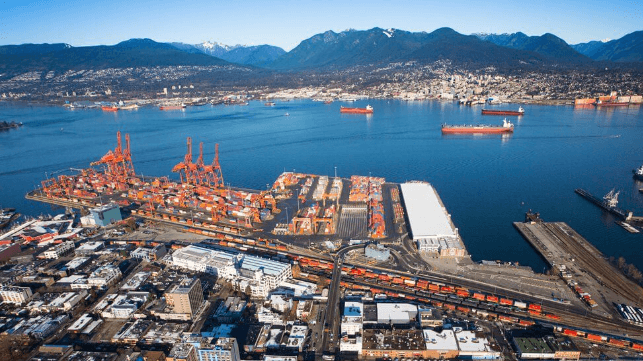
File image courtesy Port of Vancouver

Published May 25, 2026 3:54 PM by The Maritime Executive


Ongoing shifts in global shipping network could be reducing Canadian ports’ connectivity, according to a recent analysis by the Bank of Canada. Based on datasets for ship movements between 2016 and 2023, it is apparent that Canadian ports have become less directly connected to global shipping networks, compared to ports in other countries. This has increased the chances that foreign supply disruptions- especially at distant hubs- impact Canada’s domestic markets and prices.

To map the decline, the central bank analysis calculated the degree centrality, which is an indicator of the number of unique destinations directly connected to a port. Low degree centrality means a port has few dedicated routes. The study found that the degree centrality of Canada’s top five ports declined considerably between 2016 and 2023. For instance, the weighted centrality for Port of Vancouver back in 2016 was 0.75 percent, but this fell to 0.16 percent in 2023. A similar trend is visible for Halifax, Montreal, New Westminster and St. John’s. For context, the degree centrality for Zhoushan in China, the world’s most connected port, was calculated at 2.9 percent in 2023.

The Bank of Canada explained that the decline in relative connectivity is not solely a Canadian issue but a North American phenomenon. In the U.S. as well, major ports saw their degree centrality decline during the period under review. In 2016, three ports in the US were among the top 10 most-connected ports in the world, but none remained in the top 10 by 2023. Meanwhile, eight of the 10 most-connected ports in 2023 were located in East Asia, up from 6 in 2016. These shifts are likely a reflection of growing trade between developing economies.

Further, the study examined changes in total deadweight tonnage, which could act as an indicator of the overall capacity of ships moving through Canadian ports. The deadweight tonnage of all vessels that departed or arrived at Canadian ports fell from 167 million tonnes in 2016 to 119 million tonnes in 2023 - a decline of 28 percent of maritime trade capacity. Just like the decline in relative connectivity, the drop in capacity is also a broader North American issue.

Taking these factors together, the study concluded that there is a substantive shift in the concentration of shipping services and capacity - away from North America and towards Asia and other growing maritime hubs.

Prime Minister Mark Carney also noted falling productivity at Canadian ports at an event in Vancouver last week. “We have fallen way behind in terms of the productivity of our ports and our trade corridors as a whole,” said Carney. “The time it takes from a good showing up just off the coast to landing in central Canada or the U.S is measured in weeks, not days.”

Carney pledged to address these challenges in a comprehensive way as his government rolls out massive investments to the port sector. Early this year, the Canadian government announced $3.6 billion in financing for port authorities to expand trade corridors. In addition, the government is also supporting Port of Montreal with $1.7 billion for expansion, which is expected to increase container handling capacity by 60 percent.


Seaspan Celebrates One Year of Progress on the Heavy Polar Icebreaker

Seaspan
Seaspan Polar Icebreaker steel cutting

Published May 27, 2026 6:34 PM by The Maritime Executive


[By: Seaspan]

It has been one year since the first cut of steel on the heavy polar icebreaker being built at Seaspan’s Vancouver Shipyards. Today, one of Canada’s most complex and capable heavy icebreakers, with year round Arctic access and a full displacement of 26,000 tonnes, is taking shape in North Vancouver, one weld at a time.

In the twelve months since, Seaspan’s Canadian workforce has made significant progress on the built-in-Canada vessel, with block manufacturing and production advancing steadily and to schedule at Vancouver Shipyards in North Vancouver, and significant manufacturing work taking place at Victoria Shipyards and Seaspan’s Ark Road facility on Vancouver Island.

Representing a significant milestone and the start of ship construction, the first Polar grand block at Vancouver Shipyards is now structurally consolidated.

The 330-tonne grand block is comprised of the centreline propulsion motor room, fuel tanks and void spaces. Assembly and outfitting work on the grand block is already ahead of schedule.

The propulsion motor foundations on the first grand block are made of 50 mm thick steel — the first instance of thicker steel plate being used on the ship. This thick steel will help enable the heavy icebreaker to operate self-sufficiently year-round in the high-Arctic, down to -50°C temperatures.

Once complete, the vessel will serve as one of the world’s most powerful conventional icebreakers, ready to protect Canada’s Arctic sovereignty.

Across the shipyard, more than 49 blocks are now under construction, each a testament to Seaspan’s highly skilled workforce that highlights the depth of Seaspan’s shipbuilding expertise.

The workforce in the panel assembly shop is also driving advanced progress, completing pre-outfitting work early in the build schedule, with pipes and small foundations being installed directly off the panel line, allowing our workforce to conduct quality testing and installation while the area is still easily accessible. In the paint shop, the first underwater hull block has been coated with a specialized abrasion-resistant hull coating for icebreakers.

Out in the shipyard, the largest and heaviest polar block, currently weighing 230 tonnes, has already been lifted into place onto a support cradle (where it will remain until delivery) using Seaspan’s 300-tonne gantry crane. When complete, the large block will weigh up to 465 tonnes.

This impressive block is currently back in the block assembly shop, where our team will be welding up to 60 mm thick steel designed to withstand Arctic ice, building on new techniques, including new robotic welding technology, and on experience gained working on other Polar Class vessels, as well as on the structural polar prototype block that the team completed ahead of cutting steel.

As we mark one year of progress on the polar icebreaker, the full scale and complexity of what the team is building at Vancouver Shipyards comes into sharper focus. This is one of the most advanced polar icebreakers ever built: a densely outfitted, multi-mission vessel designed to operate independently year-round in the high Arctic.

This progress would not be possible without the depth of our Canadian supply chain. More than 55 companies, from Delta to Mt. Pearl are contributing to this program. Alongside this ship, Seaspan is building Canadian jobs, Canadian expertise and Canadian capability.

The new polar icebreaker will be the seventh vessel designed and built by Seaspan under the National Shipbuilding Strategy, the fifth Polar Class vessel to be built for the Canadian Coast Guard, and one of up to 21 ice-capable vessels that Seaspan is constructing in Canada, for Canada.

Quotes

  • John McCarthy, CEO Seaspan Shipyards: "A year ago, Vancouver Shipyards marked the first cut of steel. Today we have built up a highly skilled Canadian workforce with the skillset needed to weld steel thick enough to go through Arctic ice. Today the first grand block is structurally consolidated. Over 49 blocks are underway, and Seaspan is building our nation’s future and building up our Arctic sovereignty alongside the future flagship of the Canadian Coast Guard.”
  • Kevin Brosseau, Senior Associate Deputy Minister of National Defence, Commissioner of the Canadian Coast Guard, and Canada’s Fentanyl Czar: “On behalf of the Canadian Coast Guard, I congratulate Seaspan Vancouver Shipyards on one year of progress in building Canada’s future heavy polar icebreaker. This milestone reflects the strength of Canadian expertise and partnership and brings us closer to a vessel that will support year-round Arctic operations and Canada’s sovereignty for decades to come.”

The products and services herein described in this press release are not endorsed by The Maritime Executive.
USMCA to keep tariffs as US opens bilateral talks with Mexico, freezing out Canada

USMCA to keep tariffs as US opens bilateral talks with Mexico, freezing out CanadaFacebook
By bnl editorial staff May 27, 2026

The United States intends to maintain tariffs on imports from both Mexico and Canada even after the USMCA is revamped, US Trade Representative Jamieson Greer confirmed on May 26, as Washington launched the first formal bilateral negotiating rounds with Mexico City this week — pointedly excluding Canada, Reuters and El Economista reported.

"The US is going to have tariffs. Even with somebody like Mexico, or other countries in our own hemisphere, we're going to have tariffs as long as we have a giant trade deficit," Greer said at a Council on Foreign Relations event in Washington.

The declaration strips away any remaining ambiguity about what the revamped agreement will look like. The six-year-old USMCA, first negotiated by President Donald Trump during his first term, will not survive as a tariff-free zone. For Mexico, which has spent months hoping that strong trade cooperation and record market share in US goods trade might earn it relief from Section 232 steel and aluminium duties, Greer's words land as confirmation of what industry has feared.

The steel numbers make the stakes plain. Mexico's steel exports to the US fell 36.6% in 2025 to $2.24bn after tariffs were raised from 25% to 50% in June of that year, knocking Mexico from third to fifth among US steel suppliers and cutting its market share from 11% to 9%. Canada fared no better, with its steel exports to the US falling 36.5% to $45.6bn over the same period, costing it its position as top supplier to the EU. Mexico's steel industry lobby Canacero has argued that Washington should treat Mexico as a USMCA ally rather than grouping it with China and other non-market economies in its trade investigations.

The bilateral talks opening this week in Mexico City will focus on rules of origin and economic security — code for two things Washington wants: more US content in manufactured goods, particularly in the automotive sector, and higher Mexican tariffs on goods from outside North America to tighten the region's external perimeter. "I want to have our supply chain sourced from this hemisphere, from North America," Greer said, while making clear that rules of origin changes are designed to shift more production to the US specifically.

Canada, meanwhile, finds itself in a distinctly different position. Greer said Washington's issues with Ottawa went well beyond trade irritants, drawing a direct parallel with China as one of the few partners to have retaliated rather than accept US tariff rates. "It's hard to see necessarily where that ends," he said, dismissing Canadian automotive production as a product of government mandate rather than natural advantage. "We want to build cars here."

For Mexico, the week's talks represent an opportunity to shape the new framework before positions harden, even as Economy Secretary Marcelo Ebrard acknowledged earlier this month that a clean July 1 closure was unlikely and that negotiations could drag on for years. Meanwhile, the EU-Mexico trade deal signed last week, and the bilateral Canada mission in May reflect the same underlying calculation: that the familiar architecture of North American trade is being rebuilt on different foundations, and Mexico needs more options than it currently has.


Germany signs major Canadian LNG agreement amid Middle East energy fears

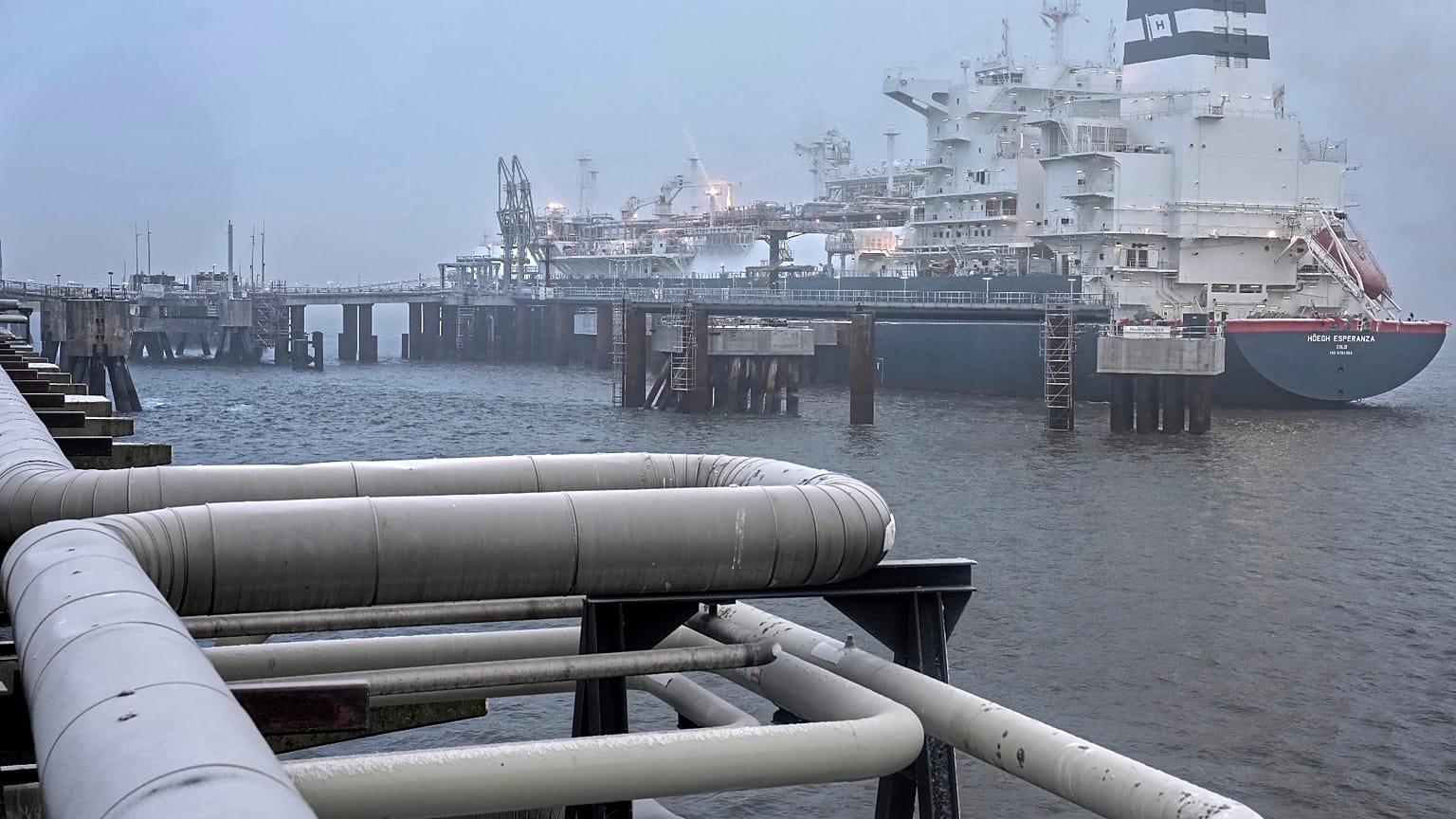
FILE - The 'Hoegh Esperanza' Floating Storage and Regasification Unit (FSRU) is anchored during the opening of the LNG terminal in Wilhelmshaven, Germany. 17 December 2022
Copyright AP Photo/Michael Sohn, pool, File

By Doloresz Katanich with AP
Published on

Canada has reached an agreement to export liquefied natural gas to Germany from a planned Pacific coast terminal, an official familiar with the matter said on Tuesday.

Canada is set to deepen energy ties with Germany as Europe grapples with a prolonged energy crisis linked to the war in Ukraine — and now escalating conflict in the Middle Eas

Canada will sign an agreement with Germany’s SEFE group — Securing Energy for Europe — for supplies from the proposed Ksi Lisims export facility on the coast of British Columbia, AP reported, citing sources familiar with the matter.

The sources spoke on condition of anonymity because they were not authorised to speak ahead of Wednesday’s announcement.

Up to 1 million metric tonnes of liquefied natural gas per year will be exported under the agreement.

The planned exports from Canada would amount to roughly one-eighth of Germany’s LNG imports last year in energy terms. Germany imported 106 terawatt hours of gas through LNG terminals in 2025, according to the Bundesnetzagentur, the country’s federal energy regulator.

SEFE is a major German energy company. It was previously the German subsidiary of Gazprom before Berlin nationalised it in 2022 as Europe struggled with an energy crisis tied to the war in Ukraine.

After European countries backed Ukraine, Russia sharply reduced natural gas supplies, triggering an energy crisis that fuelled inflation and forced some factories to scale back or shut down because of soaring energy prices.

Before the war, Germany was one of the largest importers of Russian gas in Europe.

Germany continues to rely on LNG imports as part of its efforts to replace Russian pipeline gas supplies.

Overall, with the Iran war unfolding, concerns are growing that Europe’s largest economy could face renewed energy shocks.

Germany’s economic outlook has weakened sharply amid the conflict and energy market instability. In April, the German government halved its 2026 growth forecast to 0.5% of GDP, citing the impact of energy shocks linked to the war in Iran.

The latest indicators suggest Germany’s economy remained weak in May, with both manufacturing and services under pressure, pointing to continued contraction in the private sector. However, Germany’s ifo Business Climate Index rose unexpectedly during the same month.

Canada looks beyond US market

Canadian Prime Minister Mark Carney has set a target of doubling non-US trade within a decade. Energy-rich Canada currently exports almost all of its oil and gas to the United States.

British Columbia Premier David Eby said earlier on Tuesday that a deal to supply Canadian LNG to Germany would mark a key step towards the partners behind the Ksi Lisims project taking a final investment decision on the CA$10 billion (€6.6 billion) plant and export terminal.

Ksi Lisims, located on Pearse Island near the border with Alaska, has secured the permits it requires, but the consortium has yet to make a final investment decision that would allow construction to begin.

Eby said securing long-term offtake agreements with buyers is a crucial step before the project can move forward.

The partnership has already signed supply agreements with a subsidiary of Shell and France’s TotalEnergies.


German gas importer SEFE seeks long-term Canadian

 LNG partnership

27.05.2026, DPA


Photo: Oliver Berg/dpa


The German state-owned gas importer, Securing Energy for Europe (SEFE), plans to enter into a long-term liquefied natural gas (LNG) supply agreement with a Canadian company as Berlin seeks to diversify its energy imports.

SEFE and Canadian firm Ksi Lisims LNG signed a memorandum of understanding for the annual delivery of 1 million tons of LNG, the company said on Wednesday. Deliveries are expected to begin in the early 2030s and continue for up to 20 years.

The agreement is aimed at broadening Germany's LNG supply base, which currently relies heavily on imports from the United States. According to Germany's Economy Ministry, the deal would mark SEFE's first long-term LNG partnership with a Canadian supplier.

Economy Minister Katherina Reiche said closer cooperation would help diversify supply routes and strengthen economic resilience against global risks.

SEFE, formerly known as Gazprom Germania, was previously a subsidiary of the Russian state-owned energy giant Gazprom. The company was nationalized by Germany following Russia's full-scale invasion of Ukraine and the resulting energy crisis.