Sunday, June 14, 2026

Source: Africa Is a Country

Empire has never been only a matter of colonial occupation. The United States and Britain remain the most visible architects of widescale death and destruction, but the United Arab Emirates (UAE) represents a different, and in some ways more insidious, model: one that operates through the acquisition of capital, the arming of proxy forces, and the control of infrastructure rather than direct territorial rule.

The alliance between the West and the Gulf operates through military power, financial secrecy, and extractive investment. Its defining feature is the outsourcing of violence—laundered through the language of development, logistics, and humanitarian diplomacy, and hidden behind the architecture of luxury.

The UAE has recently been cast as the unfortunate victim of Iranian retaliation following the regional war started by Israel and the United States, with Donald Trump signaling that he is considering financial assistance to the UAE as a “good ally” that has taken an economic hit. The irony is pointed: The UAE has used its authoritarian apparatus to arrest anyone who publicly documents the extent of Iranian strikes on its territory—a Bellingcat investigation found that at least five people were detained simply for sharing phone recordings of missile strikes. But the victim narrative should not obscure the UAE’s role as a sub-imperial power that has enabled war and war crimes across the region, most consequentially in Sudan.

The UAE’s value to the United States is structural. It was the first Gulf state to normalize relations with Israel, is a major buyer of US weapons, and serves as a hub for intelligence, finance, and military logistics. It has built a network of bases and installations stretching from Yemen to Somalia, around the Red Sea and Gulf of Aden, constructed with US and Israeli involvement. This is the infrastructure of a regional power that seeks influence without accountability.

Sudan is the site of the world’s largest humanitarian crisis. A catastrophic civil war erupted in April 2023 from a violent power struggle between the Sudanese Armed Forces (SAF) and the Rapid Support Forces (RSF), devastating Khartoum, El Fasher, and dozens of other cities. Blood stains in El Fasher could be seen from space.

Since April 2023, roughly 15 million people have been uprooted, while millions more remain in need of life-saving assistance. Women face particular exposure to sexual violence and torture. More than 33.7 million people—out of a population of 50 million—now require urgent humanitarian aid. Acute food insecurity grips more than half the country, essential health services have collapsed, and disease outbreaks compound an already catastrophic situation. The death toll, though difficult to verify, was estimated at up to 400,000 by late last year.

The war in Sudan is one the UAE is directly funding. It does not resemble classical colonial occupation, and so it is rendered peripheral—yet its consequences are among the most catastrophic on earth.

Sudanese writer Husam Mahjoub offers the clearest analytical frame:

The UAE’s role in Sudan is not an anomaly. It is part of a coherent, well-financed, and regionally expansive project: a subimperialist agenda that combines economic extraction, authoritarian alliance-building, and counterrevolutionary politics under the cover of diplomatic sophistication and global partnerships. Sudan, tragically, is one of its central laboratories.

Mahjoub traces how the UAE has positioned itself as a counterrevolutionary force across the region, channeling support to the RSF—a militia implicated in mass atrocities—through weapons transfers and logistical backing. In April 2026, the Sentry revealed that RSF leader Mohamed Hamdan Dagalo (Hemedti) and his brothers have accumulated investments in 20 luxury properties worth US$24 million, all within the same gated estate in Dubai.

The UAE does not operate alone. Egypt and other regional powers work in alignment with the EU, Russia, and the United States, sustaining Sudan’s instability while extracting strategic and economic value: gold reserves, gum arabic, agricultural land, and access to Red Sea trade routes. The UAE has denied the allegations against it. The denials have not been accompanied by transparency, and meaningful accountability remains elusive.

Empire does not always announce itself with colonial decrees. Sometimes it arrives through ports. Over the past 15 years, the UAE has expanded its footprint across Africa through investments in port infrastructure, airports, and logistics networks—and the port is never a neutral site. Palestinian poet and scholar Rafeef Ziadah has written about the UAE’s intervention to control Yemeni ports and trade routes across the Indian Ocean and Red Sea, noting that the same port used for humanitarian aid is also used for military supply. The line between relief and warfare is deliberate blur, not accident.

Gold is the resource that makes the feedback loop legible. A report released in April 2026 by the Center for Environmental and Social Studies details how Sudan’s gold—extracted under violence and coercion—moves through informal networks across borders to Dubai. Supply chains allow materials to be misattributed, relabeled, or blended in ways that obscure their origins; the line between legally and illegally sourced gold dissolves in transit. Gold is exchanged for weapons and financial liquidity, and the war is sustained.

In January 2026, the Will for Peace naval mission brought a convoy of combat vessels from Russia, China, and the UAE to dock at Simon’s Town in South Africa, under the label of a “maritime exercise.” The deliberate blur Ziadah identifies—between humanitarian, military, and commercial logistics—was visible here in its most concentrated form. South Africa is not a bystander in these networks. Open Secrets has exposed Integrated Convoy Protection (ICP), a South African company, and its role in supplying the Emirati war machine, with shipments passing through Durban’s port to Jebel Ali in Dubai. This is what quiet violence looks like: It moves through ordinary infrastructure, hidden in the routine of global trade.

But Durban’s port has also been a site of refusal. In 2021, dockworkers declined to offload cargo from an Israeli ship in an act of solidarity with Palestinians, with labor movements joining in support. Ports are political—they are where wars are sustained, and where workers retain the power to interrupt them.

The UAE’s sub-imperial role is not an aberration. It is the logical expression of a global system in which strategic alignment takes precedence over human life—in Khartoum as in Gaza, in Sudan as in Yemen. Gulf states helped neutralize Palestinian liberation. Sudan is now being abandoned through the same mechanisms. The Western–Gulf alliance is not a relationship between equals pursuing shared values; it is a structure that produces and sustains mass death, and it needs to be named as such.

See Dubai for what it is: an artificial island built on slavery.


This article was originally published by Africa Is a Country; please consider supporting the original publication, and read the original version at the link above.Email

Cheriese Dilrajh is an artist, writer, and investigator at Open Secrets.

The Decline of Saudi Hegemony and the Emergence of a Multipolar Gulf Order

Source: Originally published by Z. Feel free to share widely.

The transformations that have unfolded across the Persian Gulf over the past two decades cannot be adequately explained through the conventional language of interstate rivalry, geopolitical competition, or shifting regional alliances alone. What is taking place is a deeper restructuring of power in one of the world’s most strategic energy regions—a restructuring rooted in changes within global capitalism, evolving patterns of capital accumulation, the crisis of traditional rentier-state models, and the relative decline of the United States’ capacity to sustain a unilateral regional order.

For decades, Saudi Arabia functioned as the dominant power on the Arabian Peninsula. Massive oil revenues, a larger population than its Gulf neighbors, control over Islam’s holiest sites, a strategic partnership with the United States, and a central role in global energy markets gave Riyadh a position from which it could shape regional politics and exert considerable influence over neighboring states.

What is declining today, however, is not Saudi Arabia’s power in an absolute sense. Rather, it is the historical form of Saudi hegemony itself—a hegemony grounded in the relative monopoly of oil wealth, religious legitimacy, and unwavering Western support.

Gulf Capitalism in Transition

Throughout much of the late twentieth century, the Gulf monarchies were organized around a common economic model: the oil-based rentier state. Hydrocarbon revenues enabled governments to maintain political stability and provide extensive welfare benefits without relying heavily on taxation or broad social participation.

The globalization of capital, the expansion of financial markets, and technological transformations have gradually altered this model. Gulf states are no longer merely exporters of oil and gas. Their sovereign wealth funds have become major actors within global capitalism, channeling hundreds of billions of dollars into international banking, logistics, technology, renewable energy, military industries, tourism, and financial markets.

As a result, competition among Gulf states is no longer centered exclusively on hydrocarbons. Increasingly, it revolves around securing advantageous positions within the global circuits of capital accumulation.

Different states have pursued distinct strategies of integration into the world economy. Qatar has relied on its vast natural gas reserves, activist diplomacy, and transnational investments. The United Arab Emirates has established itself as a financial, commercial, and logistical hub linking Asia, Africa, and Europe. Saudi Arabia, meanwhile, seeks to diversify its economy through Vision 2030 and reduce its long-standing dependence on oil revenues.

These divergent pathways of accumulation have gradually weakened the material foundations of Riyadh’s traditional regional dominance.

Qatar and the UAE: New Centers of Capital Accumulation

The rise of Qatar and the United Arab Emirates is not simply the result of ambitious political leadership. It reflects their changing positions within the global economy.

Following the transfer of power in 1995, Qatar used its immense liquefied natural gas resources to become one of the world’s leading energy exporters. Through Al Jazeera, extensive international investments, and a diplomacy centered on mediation and strategic engagement, Doha transformed economic power into political influence. The Saudi-led blockade imposed on Qatar in 2017 ultimately revealed the limits of Riyadh’s ability to dictate regional outcomes as it had done in previous decades.

The UAE pursued a different trajectory. Dubai and Abu Dhabi emerged as major financial, logistical, and commercial centers whose economies are less dependent on direct oil exports than those of many neighboring states. Simultaneously, normalization with Israel through the Abraham Accords expanded the UAE’s access to advanced military, cyber, and security technologies, strengthening its position within the region’s evolving security architecture.

Power in the Gulf is therefore no longer concentrated in a single center. Doha, Abu Dhabi, and Riyadh have each become distinct poles of capital accumulation and political influence.

Iran, Yemen, and the Limits of Saudi Power

If political economy constitutes one dimension of the Gulf’s transformation, the changing regional balance of power constitutes another.

Despite decades of sanctions and international pressure, Iran has succeeded in cultivating networks of influence across Iraq, Syria, Lebanon, and Yemen. Regardless of one’s political assessment of these policies, their cumulative effect has been the emergence of a regional balance that constrains Saudi Arabia’s capacity to exercise unilateral dominance.

The war in Yemen offers perhaps the clearest illustration of this transformation. Saudi Arabia’s military intervention in 2015 was intended to restore a regional order favorable to Riyadh. Instead, the conflict evolved into a prolonged war of attrition that imposed significant financial, political, and strategic costs on the kingdom.

Yemen exposed a fundamental reality: even the wealthiest Arab state in the region could no longer impose its will on neighboring societies through military force alone.

In this sense, Yemen was not merely another regional conflict. It became a critical site where the structural limits of Saudi power were revealed. At the same time, Ansar Allah evolved from a localized insurgent movement into a regional actor capable of influencing the security of the Red Sea and major global trade routes.

The Beijing Agreement and a Relative Post-American Order

The Chinese-mediated rapprochement between Iran and Saudi Arabia in 2023 should be understood within this broader context. Its significance extends beyond the reconciliation of two regional rivals.

For decades, the United States served as the principal security guarantor and diplomatic broker in the Gulf. Today, however, China has become the largest trading partner for many states in the region, while its political influence continues to expand. Russia, meanwhile, has strengthened its role in regional energy and security affairs.

This does not signify the end of American influence. Rather, it suggests that the era of uncontested U.S. primacy is gradually giving way to a more complex configuration of power characterized by multiple centers of influence.

The Gulf monarchies themselves increasingly seek to diversify their strategic relationships rather than remain dependent upon a single external patron.

Contradictions of Gulf Capitalism

Despite remarkable economic achievements, the Gulf development model remains marked by deep structural contradictions.

A substantial share of economic activity depends on migrant labor. Millions of workers contribute to the production of wealth while remaining excluded from many political and social rights. This contradiction lies at the heart of contemporary Gulf capitalism.

Dependence on hydrocarbon revenues also persists. Although governments frequently emphasize diversification, oil and gas continue to constitute the central pillars of state finances. The global transition toward renewable energy and mounting climate pressures introduce significant uncertainties regarding the long-term sustainability of this model.

At the same time, widening inequalities, concentrated wealth, dependence on global financial capital, and vulnerability to fluctuations in the international economy raise fundamental questions about the durability of Gulf development strategies.

These tensions reveal that the region’s challenge is not simply geopolitical competition but the sustainability of a particular model of capitalist development.

Conclusion

The Persian Gulf is undergoing a transition away from an order in which Saudi Arabia functioned as the region’s uncontested hegemonic power. The rise of Qatar and the UAE as autonomous centers of capital accumulation, Iran’s growing influence within the regional balance of power, the consequences of the Yemen war, China’s expanding role, and the relative decline of U.S. unilateral dominance have all contributed to the emergence of a more multipolar regional order.

Yet the central issue is not merely the redistribution of power among states. Beneath these geopolitical shifts lie the deeper contradictions of Gulf capitalism itself—a system built upon the intersection of energy rents, global financial capital, migrant labor, and great-power security guarantees.

From this perspective, the decline of traditional Saudi hegemony should be understood as part of a broader process of regional restructuring driven by transformations in both capital and power. The decisive question facing the Gulf is not which state will ultimately prevail, but whether the region’s development model can adapt to the challenges posed by energy transition, climate change, demographic pressures, and the instability of the global economy.

The answer to that question, more than any geopolitical rivalry, is likely to shape the future of the Gulf in the decades ahead.Email

Majid Maleki Meighani, (sometimes writing under the name Majid Maleki), is an Iranian political analyst, writer, and translator. He was imprisoned for his political activities. His work focuses on critical analysis of Iran’s labor movement, the political left, anti-imperialist critiques of geopolitics, and social movements in West Asia and the Global South. His analysis is grounded in direct fieldwork and interviews within local communities. He has translated into Persian Walter LaFeber’s Inevitable Revolutions: The United States in Central America and the collection Voices of the Arab Spring. He has been a contributor to ZNetwork, Tribune Zamane, and Akhbar-e Rooz. You can access his full body of work on his author page on ZNetwork.

Iran Under Siege


 June 12, 2026

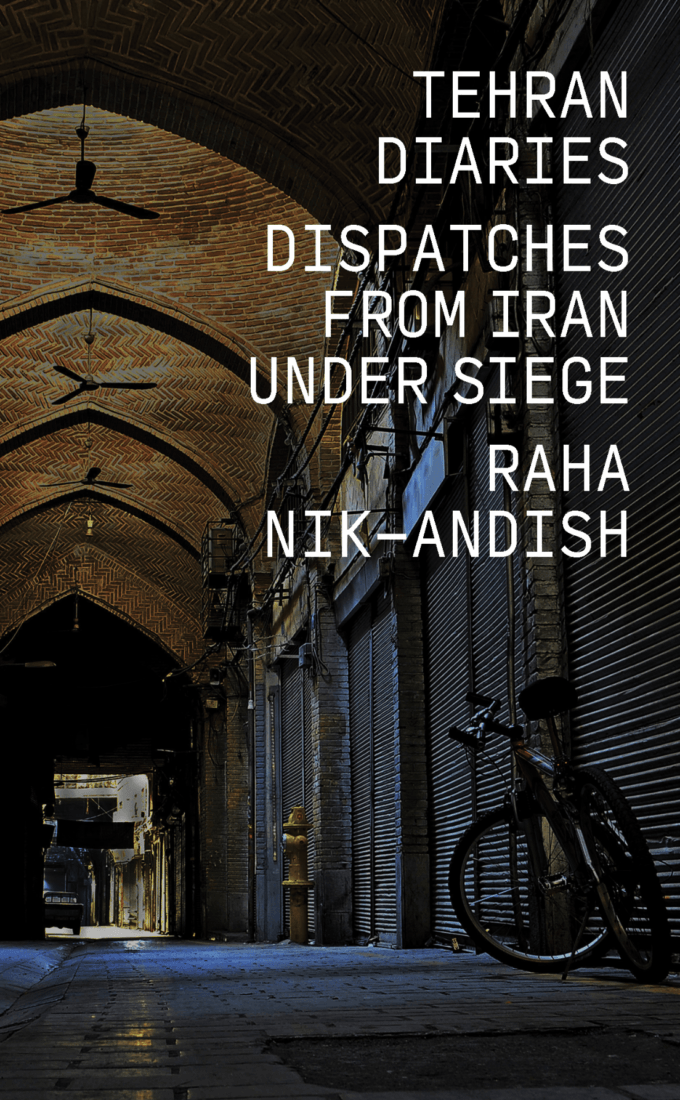
Tehran Diaries: Dispatches from Iran Under Siege. By Raha Nik-Andish. New York: OR Books, 2025, 90pp.

The text of this small volume dates from April, a “yesterday” that seems eternal, because we understand so little of what is happening in Iran in wartime, and what the Iranians themselves are thinking.

The writer, using a pseudonym for obvious reasons, is an art historian and an essayist published in the London Review of Books, among other spots. We hope for his personal security.

We enter at a particularly pregnant moment, elaborated here by a three-page preface by another anonymous writer, comrade or admirer of the author. This small text was composed, as explained, during the longest internet blackout since Gaddafi sliced off service by way of Libya in 2011, when the Hillary Clinton-inspired US coup against Libya was underway. Here we are again, or rather, were when this book was composed.

In an apparently unending irony, as the author writes about the current day, the blackout has eased somewhat, but the Islamic Republic posts messages on Telegram that hardly reach anyone. In a book composed under such difficulties and thus inherently problematic, something possibly decisive can nevertheless be said.

The author struggles to make some sense of things and turns to an intriguing narrative technique. The text moves backward in time, chapter by chapter, through Operation Epic Fury, offering readers an intimate view of where things have been seen and experienced at the ground level. We eventually learn that he has a part-time university teaching job that pays too little to survive, and he also becomes a part-time car-share driver.

Raha begins with the announcement of the Ayatollah’s assassination by the Americans and Israelis. People come out on their balconies, unbelieving, just to look around. The Basij paramilitaries, below them on the streets, immediately begin to bash anyone who is seen or heard to be celebrating. The following morning, the mosque down the street from his apartment blares patriotic songs intermittently from the Iran-Iraq War and the seventh-century conflict in which the Prophet Muhanmmed’s son was murdered and martyred. The heavy official tone is mocked by a mood of quiet happiness.

The ongoing attack from overhead by Israeli and US planes and missiles dramatizes the military failure of the Iranian government but also the emptiness of the long-standing promises offered by Pahlavi, Junior. Washington and Tel Aviv, broadcasting an imminent but never-to-happen arrival of the ever-future Shah, definitely add to the ambiance.

Two weeks later, families huddle in the apartments while bombs land nearby and smash windows. Oddly, it’s the Persian New Year when special treats come as ritual food, symbolizing the rebirth of life. Voices from the mosque plead ritually for God’s mercy while real-life grown-ups try to reassure children and themselves. Soon, they will go out to try and find food that they can afford to buy.

Will the universities, ostensibly still in mid-semester, continue teaching journalism or the arts? This suddenly seems irrelevant. After Trump’s threats to bomb Iran back to the Stone Age (“where they belong”), Iranians ask themselves: Are we doomed? The author comments, “you can’t imagine the effects of knowing that someone wants to kill you, and that everyone is waiting to die.” (p.13)

No one goes to protests anymore. The early, brutal repression ended that. Not even those who supported the war really want to be bombed, now that bombing is underway and shows no sign of ending. It is fine for the exiles, some of them living high in the Gulf States or Los Angeles, to celebrate the moment and to rationalize death from the air as worth the price for ending the current regime any time now. The State media meanwhile blares that Iran is winning. Then the pay-to-view London satellite channels reopen, and every previous version of the truth disappears. Older viewers experience yet another irony: during the Iran-Iraq War, large apartment buildings had been rare, and friends shared bomb shelters. Now that most in the educated, urban classes are trapped in apartments, only a fortunate minority are lucky enough to have a place in the countryside where they can sit out the worst.

We learn by p.22 that our narrator has seized his first opportunity, on returning from abroad (and probably Britain), to resume teaching. Like everyone else, he is seeking somehow to adjust to a new normal. On campus and off, water is stored, but candles and batteries have already grown scarce. Poignantly, he records that on a street corner outside, below his office window, a young woman sings without accompaniment a now-forbidden old favorite: “Year after year, regret is all we have.”( p.24.) Bystanders do not applaud or even film the singing on their phones. They watch and listen, taking back to their apartments what memories they can.

And then we move further back in time to January of this year. Not so long ago! Middle- and upper-middle-class neighborhoods, never given to political protest, leap over customary boundaries, joining the poorer and more discontented. Various obstacles are quickly created against the certain arrival of security forces. Mostly young people demonstrate with chants. And then the soldiers arrive and begin to fire directly into the crowd. By the next day, the official reports of “rioters” have renamed them “terrorists.”

Our narrator, at first searching for bread on foot, instead goes instead to a cinema, where an Iranian comedy plot has an erstwhile liquor salesman falling in love with the daughter of an important family. Even the audience’s laughter is tinged with sadness and horror. He leaves the theater to continue his travel with Iran’s own popular taxi service, known as Snapp! That he has begun to drive them himself to make a little extra money makes him sympathetic with fellow drivers. They report their woes—the inevitable dangers of driving on streets as the bombing continues—and philosophize stoically about the increasingly grim days that seem certain to come.

The strangest and in some ways, the most dramatic media moment in Tehran is the circulation of a documentary about Iranian actress Taraneh Alidoosti, recalling her arrest during the “Woman, Life, Freedom” protests a few years earlier. BBC Persian is, of course, banned, but people find a way to see the documentary, highlighted by the actress’s declaration that she will never again appear on screen in a headscarf. She articulates a personal pain shared by all.

Back, way back in the early Fall of 2025, by Chapter 5, things may be even stranger. In an urgent effort to attract popular support, government-sponsored public programming includes political art offering a vital message, just a few years old: Iranian women artists, famous and unfamous, are enjoying a new era of freedom, including the expression of modernism in the most prestigious museums in Tehran. Some of the notable art pieces have been stored in the museum’s archives for years and now suddenly appear in public, accompanied by the highest levels of prestige.

Thousands of young, educated, and sophisticated, or perfectly working-class, women visitors approach the entrance and don the head scarves they brought with them. Off go those scarves as soon as they get past the museum doors. Thus a paradox of 2025 and some years earlier. The book does not mention a source of some of the protests to come: the outraged response to a secretly revealed video of a lavish wedding, with the bride-to-be in a revealing dress typical of wealthy family events around the world. Pious and secular can join, lashing out at the privileges enjoyed by the Iranian ruling class.

Official art, above all the famous posters created by the government and viewed worldwide, celebrate ancient rulers and make improbable claims of contemporary triumphs improbable even when US and Israeli aims are apparently defeated. Being Persian, for thoughtful millions of citizens and exiles, encompasses both a rich cultural past and a deeply demoralizing present, an internal exile with children of any social class terrified at every loud noise. They are the fearful generation impending.

We are getting close to the end of Tehran Dispatches, and the author is determined to make this point: on the Iranian campuses of a generation ago, women and men had separate staircases, and women never attended classes with men as they do now, talking freely with each other. Likewise, women were forbidden to ride bicycles, but now they ride them freely through the streets, “the wind in their hair” (p.80) on a normal day. Not even the War changes this social detail.

No normal days now, however. Massive, intense security, aka repression. The air is full of poisonous smoke from bombing. The hospitals are unable to accommodate patients in crisis, including the writer’s father. The situation is hopeless and also class-bound in one more way: when his father dies for lack of adequate care, he is buried, with good fortune, in a family plot—new ones have become unaffordable for those outside the upper classes.

Tehran Diaries closes on this note. A close friend tells the author that his mother needs to have an eye replaced. Luckily, very luckily, the cemetery worker who washes the corpses plucks one that can be purchased—quickly, and naturally, for a fee. This, the reader concludes logically, is either death in life or the reverse It is also Iran today.

Paul Buhle is a retired historian, and co-founder, with Scott Molloy, of an oral history project on blue collar Rhode Islanders.