In power for just six months, the government of Bolivia’s centre-right president Rodrigo Paz Pereira hangs in the balance. Five weeks of siege and strikes have effectively paralysed the country. Road blockades, led by millions of mostly indigenous campesinos, surround La Paz and continue to hold across five of Bolivia’s nine departments – Santa Cruz, Oruro, Potosí, Chuquisaca and Cochabamba. Teachers are on strike alongside miners, factory workers, transport workers and the neighbourhood committees (FEJUVE) of La Paz’s sister city, El Alto. Overlooking the capital from the rim of the high plains, El Alto connects La Paz to the rest of Andean Bolivia. With over 900,000 residents – mostly migrant, working-class and indigenous – the city has been the crucible of the protests, uniting with the western highlands and highland valleys, where most of Bolivia’s 11.4 million inhabitants live.
The immediate demand of protesters is the president’s resignation. Since taking office in January, Paz has responded to Bolivia’s acute cost of living crisis and runaway inflation by cutting spending, reducing fuel subsidies and selling off state enterprises, betraying his ‘capitalism for all’ agenda. Restoring relations with the US, he has pivoted toward Trump and prioritized mining, energy, financial and agribusiness interests. Roadblocks and protests began to spread from the beginning of May, with demonstrators calling for a halt to rule by unconstitutional decree and the proposed criminalization of social protest; no privatization of state enterprises such as electricity and water, nor rate hikes; no IMF-backed loans and structural adjustment programmes – a campaign promise that Paz has walked back; the provision of fuel that does not damage vehicles (as opposed to the ‘garbage gas’ the government has supplied to cover shortages) and re-payment for vehicle repairs; fuel and bread subsidies and control of prices for basic foodstuffs; and no new laws that sign away mineral and land rights in backdoor deals with foreign governments and multinationals.
Transport workers remain on indefinite strike in La Paz, prompted by chronic fuel shortages. Neither buses, minibuses nor taxis are running in the capital, which is divided by roadblocks separating the north and city centre from the affluent zona sur. Those who can afford fuel cannot drive far. Except for one artery opened intermittently to the sub-tropical Yungas valleys in the northeast, and another opening on 6 June by the police and military in Río Abajo in the zona sur, through which fruits and vegetables arrive, the blockade has cut La Paz off completely. Thousands of trucks are stranded on highways, with truckers sleeping in vehicles and cooking communally. Produce is scarce, and prices have spiked for the food that remains, including basics such as potatoes, flour, bread, milk and eggs. People queue for hours for fuel or chicken before it runs out. The price of ground beef is astronomical. Hospitals lack oxygen and medicines; pharmacies have trouble filling prescriptions. The National Health Fund has announced that unless the blockade is lifted, medical supplies may soon run out. Ambulances – used by past governments to transport arms and the military police – are not allowed through the roadblocks.
The most heavily blockaded areas are in the predominantly Quechua- and Aymara-speaking regions that helped secure Paz the presidency. Due in large part to the populist campaigning of Vice-President Edmand Lara – whom Paz has since marginalized – Paz won comfortably in El Alto as well as the western highlands and highland valleys. Many voters now feel betrayed. As those marching and manning the barricades see it, they put Paz in power, and the time has come to remove him. The son of former president Jaime Paz Zamora (1989–93), Paz studied at the American University in Washington, DC and his administration is staffed with establishment figures who cut their teeth in international institutions and the private sector; in contrast to his predecessors, it includes no figures from indigenous movements, peasant organizations or mining unions, and very few women. At stake in the stand-off is the meaning of ‘democracy’, the future of Bolivia’s pluri-ethnic state, sovereignty over land, minerals and natural resources, and the implementation of the constitution. The implications are geopolitical as much as domestic: as one union leader from Oruro put it, accusing Paz of governing for the well-to-do classes’ (las clases pudientes), ‘we will not be a colony of the United States’.
*
The demonstrations are organized by long-standing peasant and worker federations. The CSUTCB, founded in 1979, organizes campesinos by region – western highlands, valleys, and eastern lowlands – department, province, canton and municipalities-ayllus (towns surrounded by Andean peasant-pastoral communities) that also act as rural trade unions (sindicatos agrarios). Leaders meet with members in assemblies to discuss and determine strategy and tactics; they are beholden to the rank-and-file, expected to voice their demands and subject to recall. Resolutions taken by the executive committee are published, discussed and implemented at each territorial level. The COB, the trade union confederation founded in 1952, follows a similar organizational structure and leadership system. In its heyday in the 1950s–80s, it effectively represented civil society. Though its ranks have thinned since – largely due to privatization and de-industrialization, begun under Paz Pereira’s great-uncle, Víctor Paz Estenssoro, who served as president in the late 1980s, and continued under Jaime Paz Zamora in the early 1990s – it remains a powerful force.
Mobilization against the present government began in January, in response to the passing of ‘emergency’ legislation that sought to attract foreign investment by slashing regulations of key sectors of the economy and grant large-scale tax exemptions, among other unpopular measures, including the elimination of fuel subsidies. After three weeks of protest, Paz signed an agreement with the COB and CSUTCB to modify the legislation. Then in early April, Paz attempted to pass a controversial agrarian reform – Law 1720 – that would have opened indigenous and peasant land holdings to corporations. It was repealed a month later, on 13 May, after workers from the northern Amazonian departments of Beni and Pando marched on La Paz, where they were joined by the miners’ union, the FSTMB, and representatives from the CSUTCB.
In April, the CSUTCB leadership held an assembly, made resolutions, sent Paz a petition of grievances – including unfulfilled campaign promises – and gave him three weeks to respond. The COB followed suit. Led by the FSTMB, the federation helped initiate mobilizations on 1 May, alongside the Túpac Katari Confederation, the radical regional CSUTCB organization of the 20 provinces in the La Paz department. On 18 May, when tens of thousands of indigenous peasant trade unionists marched together with miners from Oruro, Potosí and La Paz, and the regional workers’ central (COR) from El Alto and La Paz, they were met with tear gas and rubber bullets. In response, they tried to break through the police lines guarding the Palacio Quemado to force Paz’s resignation, but their numbers were insufficient. The same happened on 22 May.
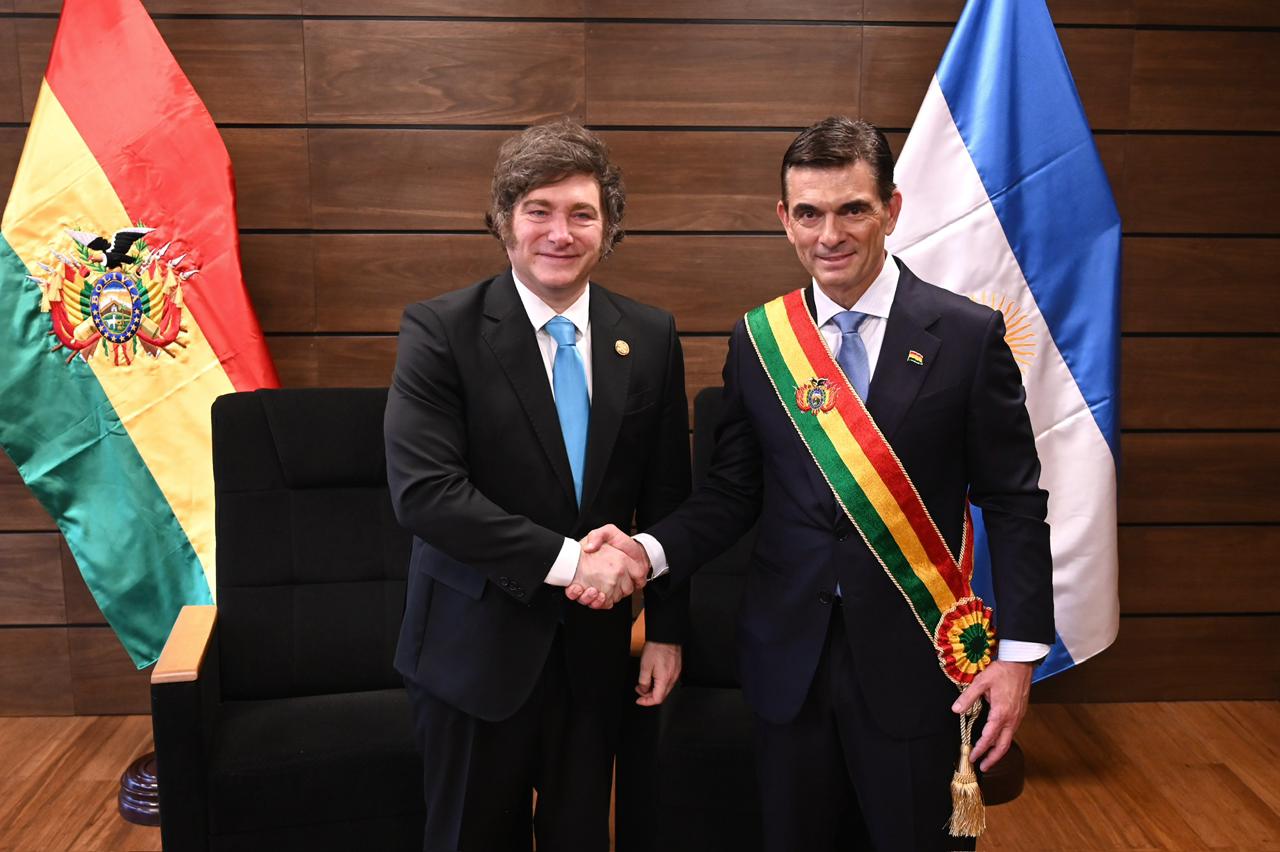
After two weeks of the blockades, Paz flew ten tons of chicken from Santa Cruz to La Paz on a plane borrowed from Argentine President Javier Milei; the following week 70 cisterns of gas were successfully brought down from El Alto. Peruvian, Chilean and Brazilian governments have also offered to fly in ‘humanitarian aid’ – food, fuel, medicine – to La Paz, Santa Cruz and especially Beni, whose governor has declared a humanitarian emergency. (Such largesse has not been forthcoming for Cuba, suffering under US blockade.) On 20 May, Paz announced he would not resign, nor engage in dialogue with demonstrators until they demobilize, claiming that ‘blockades equal death’. He instead promised a cabinet reshuffle, volunteered to cut his salary and that of his ministers, and proposed an ‘Economic and Social Council’ with which to socialize – through monthly meetings – the reforms he plans to implement, incorporating ‘all sectors’ into his government.
Meanwhile, on 25 May, Paz’s cousin, Minister of Public Works Mauricio Zamora, headed a ‘humanitarian mission’ led by the military and police – ostensibly designed to open the road between La Paz and Oruro to let oxygen, medicine and food through. During the operation Víctor Cruz Quispe, a twenty-four-year-old father of two, and Aymara community member from a small town south of La Paz, was shot and killed. The government initially denied the death had occurred; later, police issued a report saying it was likely due to friendly fire. Demonstrators occupied the centre of La Paz, descending in column after column from El Alto, and up through the zona sur from Río Abajo and Chasquipampa in their tens of thousands, reiterating the call for Paz to resign, and demanding justice for Cruz Quispe’s widow and children. They surrounded the Palacio Quemado, though didn’t attempt to storm it.
In response, police conducted raids on the residences and hostels of social movement leaders, especially in El Alto, despite Vice-President Lara’s request that they be called off. The freeing of prisoners and the lifting of arrest warrants has become another principal demand of protesters; nearly 500 are currently being detained according to the CSUTCB leadership. The media reports that at least four protesters have died, one in clashes, along with eight others who died because the roadblocks prevented them from receiving medical attention. At least fourteen police have been injured in the confrontations; we do not have a clear picture of how many demonstrators have been injured.
Paz has insisted that he is not planning to privatize state enterprises or impose structural adjustment in exchange for IMF loans. But this has fallen on deaf ears. So far, co-operative miners from Oruro, Potosí and La Paz are the only group to call off the mobilization. When representatives from the highland Quechua-Aymara migrants’ association in the Yungas met with Paz on 26 May, the rank-and-file called an assembly, rejecting their authority, and imposed a blockade.
*
For the Paz administration, this mobilization has stark precedents. In 2003 and 2005, two consecutive presidents were brought down when, after decades of neoliberal restructuring, popular insurrections immobilized the country. Then as now, the leading protagonists were the FEJUVE-El Alto neighbourhood associations, the COB, and especially the CSUTCB. In 2003 the chief demands were the resignation of President Sánchez de Lozada; abrogation of a law criminalizing social protest; a halt to the proposed export of Bolivian gas through Chile; repeal of the 1996 Hydrocarbons Law to facilitate re-nationalization; no participation in the Free Trade of the Americas Agreement; and a constituent assembly. Responding with militarization and state terror, leaving 67 dead, Sánchez de Lozada then fled to the US, leaving vice-president Carlos Mesa as interim president. ‘If I don’t follow through, you can kick me out’, Mesa promised. In 2005, the popular sectors did just that – through insurrection.
Evo Morales came to power in the aftermath of these uprisings. Leader of the Movimiento al Socialismo (MAS), an alliance of unions and social movements formed in 1997, Morales was the first president in Bolivia’s history to identify as indigenous. He won 54 per cent of the vote in 2006 – the first time any candidate had achieved an absolute majority – on promises to nationalize Bolivian gas and prevent Washington-backed coca eradication. His tenure brought unprecedented political stability and economic prosperity until 2014–15, when the collapse of gas export prices led to an economic downturn. After losing a referendum in 2016 on a constitutional amendment that would have allowed him to stand for a fourth term, Morales ran anyway, considerably eroding his legitimacy. He won with 47 per cent of the vote, but that was not enough for the Organization of American States (OAS), the US or the anti-MAS bloc, initially led by the middle class in La Paz and other cities, later by the far right in the eastern lowlands. In 2019, a coup based on fake claims of electoral fraud forced Morales into exile and brought to power a far-right government led by President Jeanine Añez – a previously unknown senator from Beni, who until recently was in jail, awaiting trial for sanctioning massacres of dozens of unarmed, mostly indigenous demonstrators at Senkata in El Alto and Sacaba in Cochabamba in 2019, carried out under a State of Exception.
Morales’s influence has waned since 2019, now extending little beyond the Chapare and the coca growers’ trade union federation in the tropical lowlands of Cochabamba. But the 2020 election saw another MAS victory, bringing Morales’s former finance minister Luis Arce to power and enabling Morales to return to Bolivia. Relations quickly deteriorated, however, dividing the party between arcistas and evistas, with disastrous results. Morales ejected Arce from the party in 2023, while Arce tried using the constitution to prevent Morales from returning to power. An arrest warrant for Morales on charges of alleged rape and human trafficking saw him retreat to the tropics of Cochabamba, where he is guarded by supporters. Bolivia’s economic travails continued under Arce, intensified by a pandemic-induced recession. There was another coup attempt in 2024, allegedly orchestrated by Arce himself in a desperate attempt to bolster popular support – a rumour enthusiastically promoted by Morales and his supporters. The furore further eroded MAS’s legitimacy, which, after two decades in power, went on to lose every one of its senate seats in the 2025 election. The ‘little war’ between Morales and Arce paved the way for a presidential run-off between the centre-right, represented by the Paz-Lara ticket, and the far right, led by the pro-Trump and pro-IMF former president Jorge ‘Tuto’ Quiroga. In the wake of Paz’s victory, Arce was arrested on corruption charges.
*
Broad sectors of the urban population have lined up behind Paz, as have the eastern regions which saw massive counter-mobilizations in 2003–2005. As in 2019, civic committees in La Paz, Cochabamba, Oruro, Chuquisaca, Tarija and Potosí, led by the local Chambers of Commerce, as well as real estate and construction interests, mayors, city councillors and local businesspeople, are on the march. Class, ethnic and demographic gulfs separate these counter-demonstrators from the millions of peasants and workers leading the siege. There is often a racist edge to these mobilizations, in part because of the leadership of Santa Cruz, where anti-indigenous racism is central to the regionalist (‘camba’) identity of entrepreneurial economic leadership, ‘development’ and ‘progress’. The 1781 siege of La Paz, led by Aymara leader Tupac Katari, continues to haunt the imaginations of property-holding and even working-class citizens, who regard themselves as defending the nation from what they see as the violent, irrational hordes of the indigenous peasantry.
The Paz administration and the corporate media have attempted to stigmatize the uprising by associating it with Morales, and allege that they are being funded by narco-traffic and terrorists. Isolated incidents of violence have also been amplified to discredit the movement. On 18 May, anti-government protesters removed wooden doors and rows of chairs from an office building to build barricades in the streets below the Plaza Murillo. Footage circulated on social media; talking heads, in line with the official script, emphasized vandalism and violence. Two men who beat a police officer were arrested, sentenced and jailed. The following night, in the prosperous zona sur of La Paz, baseless rumours circulated that ‘Indians’ from Río Abajo and Chaskipampa were coming to loot and steal (rape and murder were implicit). The same rumours circulated in 2019 and 2003. But then as now, the exceptions prove the rule: the mobilizations are highly disciplined and tightly controlled. The occupation of the capital on 25 May took place with few incidents; the same was true of the women-led ‘empty pots’ march – designed to dramatize the dire economic conditions – the following day.
Calls for Paz to impose a State of Exception have come from Quiroga, Paz’s opponent in the 2025 election, and Stello Cochamanidis, head of the Santa Cruz Civic Committee, who has demanded a ‘firm hand’ in ending the rebellion, which the new commander of the armed forces duly promised. These are boosted by the corporate media. On 26 May, the lower house abrogated law 1341, passed in 2020 to set limits on the executive’s State of Exception decrees and the army’s use of lethal force. At a meeting of his Economic and Social Council – at which all relevant social movement leaders were absent – Paz warned he would impose ‘constitutional order’ through force if the blockade did not end. On 3 June, the Minister of Defence and Minister of Education resigned without explanation, amid speculation that the US was trying to force a declaration of martial law. On 8 June, following approval by the Plurinational Assembly, Paz signed legislation that prepares the ground for a State of Exception, which would suspend constitutional rights and empower the military to clear the blockades; demonstrators say they will respond with civil disobedience and resistance to defend the future of their children and grandchildren. They are prepared to die if necessary.
There are signs of escalation. On 7 June, a joint military-police operation on Saturday to unblock the roads in San Julián, Santa Cruz, employed members of the fascist Cochabamba Youth Union on motorbikes; one policeman received a bullet wound to the head (most likely by friendly fire), six were injured, along with thirty civilians. The police were ultimately forced to retreat. That same day, national union leaders from the mining, manufacturing, construction and education sectors were kidnapped in El Alto by masked agents in civilian clothes and taken to the anti-narcotics police headquarters. On 10 June, Vicente Salazar, head of the CSUTCB’s Tupac Katari Confederation, was apprehended in the city centre of La Paz; his whereabouts could not be immediately verified.
*
While the insurrections of two decades ago occurred during the first wave of the pink tide, today strong headwinds are blowing from the far right. A statement issued by Argentina’s Foreign Ministry, signed by Chile, Paraguay, Guatemala, Costa Rica, El Salvador, Ecuador and Peru, condemned efforts to destabilize ‘the democratic order’ – which is to say, militarized neoliberalism under US leadership. On 21 May, the Shield of the Americas, the new military coalition convened by Trump, also issued a rebuke of the protesters. Paz also has the support of the World Bank, the IMF and the OAS (reprising the role it played in abetting the 2019 coup). Deputy Secretary of State Christopher Landau has condemned the mobilization as an ‘ongoing coup d’état’, while Marco Rubio has insisted that ‘we will not allow criminals and drug traffickers to overthrow democratically elected leaders in our hemisphere’. On 4 June, after a call with Paz, Rubio announced that the US was ramping up emergency assistance to help with food and medical shortages. Pete Hegseth’s message to demonstrators: ‘We’re watching you.’
The US has returned to Bolivia with a vengeance. The DEA and CIA are back in Morales’s home region of the Chapare, having been expelled in 2008–9. In March, with Paz’s blessing, the US captured the Uruguayan narco-trafficker Sebastián Marset in Santa Cruz and extradited him to the US. Yet the relation of the administration to narcotics is murky, to say the least. In late November, Laura Rojas, a former congressional deputy and close associate of Paz’s, flew into Santa Cruz from Los Angeles in a private jet with 32 suitcases containing cash. Confiscated by customs, the cases subsequently ‘disappeared’ from a warehouse subcontracted to store them. The warehouse is linked to a major narcotics bust (Rojas is currently awaiting trial). Protesters allege that US and Bolivian governments’ attempts to link them to drug money are part of the cover-up of the nexus between the government, the DEA and narco-traffickers. Stranger things have happened.
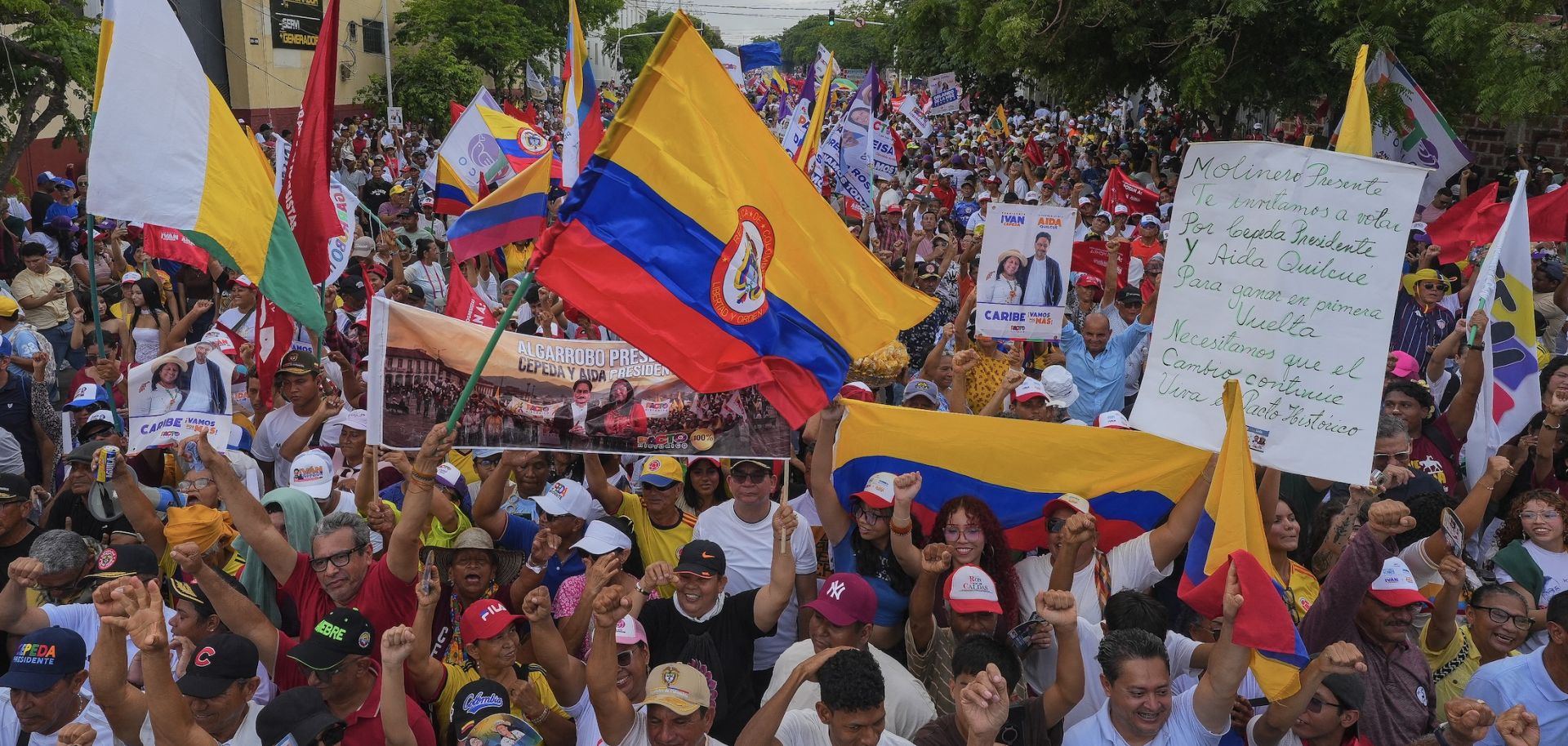
An outlier is Colombia. President Gustavo Petro has voiced his support for the rights of demonstrators, referring to the protests as ‘a popular insurrection’ and insisting they were defending ‘Latin American dignity’. Paz’s government claimed Petro’s comments amounted to an ‘attack on democracy’ and expelled the Colombian ambassador. Yet Petro is soon to leave office, and his putative successor, Iván Cepeda, recently finished second in the first round of the general election, behind the far-right mafia lawyer and populist, Abelardo de la Espriella. Sadly, a similar show of solidarity has not been forthcoming from Brazil, where Lula da Silva has stuck to the official line by calling for an end to blockades and for negotiations (meanwhile offering to hand over Brazil’s rare earth minerals to Trump in alliance with one of Brazil’s most reactionary governors). Mexico has long defended national sovereignty, including Cuba’s, but is facing threats to its own – most recently Trump’s extradition of two governors in the ruling Morena party.
Yet time appears to be running out for Paz. Some of his support in the urban middle class has begun to erode; ditto on the far right. Two politicians from Paz’s Christian Democratic Party went on hunger strike on 28 May, demanding Paz find a solution; on the same day he failed to show up for a meeting with the Santa Cruz Civic Committee, which demands a ‘National Salvation Plan’. Morales has called for elections in 90 days – a proposal deemed ‘seditious’ by José Luis Lupo, the Minister of the Presidency. Others demand constitutional succession, along the lines of 2003 and 2005. Vice-President Lara would become interim president, and, presumably, call new elections. Quiroga and his rival on the centre-right, Samuel Doria Medina, would be the likely winners in that scenario. Paz surely remembers Lozada’s ignominious departure to the US in 2003; leaders such as Severo Marca of the peasant confederation CSUTCB have issued warnings to Paz to resign while there’s still time to avoid a similar fate.
In the previous uprisings, Morales and MAS helped broker the accords that led to constitutional succession, calculating – correctly – that Morales’s turn would come next. But with MAS widely unpopular, even among many of the demonstrators, and arrest warrants out for Morales, this is unlikely to be an option now. Other mediating institutions – namely, the Catholic Church, the Ombudsman’s Office and the Permanent Human Rights Assembly – have been either missing in action or ineffective. Discredited by the events of 2019, they are husks of what they were in 2003–2005. Vice-President Lara has attempted to play a mediating role, inviting Paz to a meeting with representatives from the Plurinational Assembly on 9 June, but was stood up, and denounced by other members of the government as ‘seditious’ for his contact with movement leaders.
A path out of the impasse remains unclear. Monday saw the largest march since the uprising began, with peasants from northern Potosí, Oruro and Cochabamba descending on La Paz from El Alto along with tens of thousands of others to the sound of pututus (bulls’ horns). What is certain, in the words of the demonstrators, is ‘fusil, metralla, el pueblo no se calla!’: ‘Rifle, machine gun, the people will not be silenced!’
Read on: Forrest Hylton, ‘The Landslide in Bolivia’, NLR 37.
This article was originally published by New Left Review; please consider supporting the original publication, and read the original version at the link above.