Saturday, June 20, 2026

Trump, the Democrats and the Courage To End a Failed War


Trump owns this failed war, but if the Democrats help torpedo the MOU and war resumes, then they will co-own the next war.

by | Jun 19, 2026

Reprinted with permission from Trita Parsi’s Substack.

I have spent years fighting against Trump’s push toward war with Iran, and I have the scars to prove it. When Trump withdrew from the JCPOA in 2018, I warned that it would eventually bring us to this moment. Ever since, I have consistently argued against the confrontational path he set the United States on. That record speaks for itself, which is why I can say what follows without any throat-clearing.

Given the circumstances, President Trump’s decision to strike a deal with Tehran and bring this costly, unnecessary war to an end is the right one. It deserves support, not partisan second-guessing. As Rob Malley – a key member of Barack Obama’s team that negotiated the nuclear deal and later Joe Biden’s lead negotiator with Iran – noted on X, comparing Trump’s memorandum of understanding to Obama’s JCPOA misses the point. What matters is not how the agreement stacks up against past diplomatic achievements, but how it compares to the alternatives before us. And on that score, Malley argued, the MOU is “far preferable to any of the alternatives on offer. Period.”

I would go further. To examine the Memorandum of Understanding and ask “Was the war worth it?” is nonsensical.

Of course it wasn’t. How could it have been? The premise itself is deeply flawed: that a failed war of choice would somehow strengthen Washington’s hand at the negotiating table and produce more favorable terms. History offers little support for such a proposition.

The question is also flawed in another, more consequential way. It implies that a war should not be brought to an end until it has produced better terms – even when the war itself is failing.

Taken seriously, that logic leads to a dangerous conclusion: that a failed war must continue until the battlefield fortunes somehow improve and a more favorable outcome becomes attainable. Perhaps that day will come. Perhaps it never will. In the meantime, the costs – in lives, treasure, regional stability, and strategic credibility – are treated as secondary considerations.

This is how endless wars are born.

Wars become interminable when leaders convince themselves that ending them without victory is politically more costly than continuing them without hope. Once that trap is sprung, every setback becomes an argument for one more deployment, one more escalation, one more year. The objective shifts from achieving a realistic political outcome to avoiding the admission that the original objectives were unattainable.

American history offers more than a few examples. Presidents inherit wars they did not start, recognize they cannot be won on the promised terms, yet lack the political space to end them. So they postpone the reckoning. They kick the can down the road, handing the burden to their successor, who does the same. The result is a cycle of strategic drift in which the costs accumulate while the prospects for success steadily recede.

When victory is nowhere in sight, prolonging a conflict in the hope that reality will eventually conform to political rhetoric is not resolve. It is denial.

Remember Afghanistan. For years, American officials lied to the public that victory was just around the corner—six months away, perhaps a year at most. Yet the Afghanistan Papers later revealed that these officials privately understood that victory was nowhere in sight. They knew the war was adrift, but feared the political consequences of admitting it.

So the war continued. By the time the United States finally withdrew, nearly two decades had passed, and more than $2 trillion had been spent.

And what was the end result? After twenty years of war, thousands of American and allied lives lost, and hundreds of thousands of Afghan casualties, the United States arrived back where it had begun: it had replaced the Taliban with the Taliban.

That is the curse of endless war. The refusal to accept an unfavorable reality today merely guarantees a higher bill tomorrow.

Some credit must be given to Trump for breaking this pattern, even as he should be blamed for having started this war in the first place. Political leaders should be judged not only for the mistakes they make, but also for whether they have the courage to correct them.

Trump could have followed the well-worn path of his predecessors. He could have prolonged the conflict, spent more money, sacrificed more lives, destabilized more economies, and further depleted American power – all while insisting that victory remained just over the horizon. Recall the countless times he declared that the war had been won.

Indeed, the political costs of continuing the war would likely have been lower than the costs he is paying today for ending it. In American politics, there is often greater punishment for acknowledging failure than for perpetuating it.

That perverse incentive has trapped presidents for decades. In his testimony on the Vietnam War before the Senate Foreign Relations Committee in 1966, George Kennan stated the following: “There is more respect to be won in the opinion of the world by a resolute and courageous liquidation of unsound policies than by the most stubborn pursuit of extravagant or unpromising objectives.”

The criticism coming from some Democrats is particularly disappointing because it echoes the same bad-faith tactics Republicans deployed against the JCPOA in 2015. To be sure, Trump has invited some of this treatment. He spent years attacking Obama’s agreement with a barrage of misleading arguments and exaggerated claims.

But that does not make it wise for Democrats to return the favor.

Trump currently owns this failed war, but if the Democrats help torpedo the MOU and war resumes, then they will co-own the next war. Trump’s disaster will become theirs as well.

This isn’t rocket science. Several Democratic lawmakers have managed to criticize the war, hold Trump accountable for it, yet avoid attack lines that could sabotage the MOU. Their criticisms are primarily over Trump having started this war in the first place, rather than the terms for ending it.

Rather than attacking the terms of the MOU, Democrats should pressure the administration to protect it from those who are determined to see it fail. The main external threat is the Israeli government and Benjamin Netanyahu’s obsession with sabotaging any opportunity for Iran and the United States to bury the hatchet.

Instead of relying solely on angry phone calls and public rebukes of Netanyahu, supporters of ending the war should press Trump to act now: suspend military aid to Israel and curtail military and intelligence cooperation. Such measures would limit Israel’s ability to reignite the conflict and dispel any notion in Tel Aviv that Washington will automatically follow Israel into another war. If Israeli leaders understand that the United States will not be drawn into a future conflict on their behalf, their incentive to start one in the first place will be significantly reduced.

The task now is not to reward Trump politically, nor to excuse the recklessness that produced this war. It is to prevent the war from returning. Democrats can condemn the decision to start it without sabotaging the agreement that ends it. They can hold Trump accountable without helping Netanyahu drag the United States back into conflict. The choice before them is not between opposing Trump and supporting peace. It is between learning from America’s endless wars and repeating them.

Trita Parsi is the Executive VP of the Quincy Institute for Responsible Statecraft and an award-winning author. Washingtonian Magazine has named him one of the 25 most influential voices on foreign policy. Noam Chomsky calls him “one of the most distinguished scholars on Iran”

Visit Trita Paris’s Substack and subscribe.


Hey, POTUS, The Point of the War Was What Again?


by | Jun 17, 2026 | Antiwar.com


Thanks heavens. The bombs, missiles, planes and guns of every size, shape and lethality have gone silent in the middle east. What could have imminently and rapidly mushroomed into a full bore Demolition Derby among the Persian Gulf oilfields, petroleum and LNG processing plants, helium and sulfur extraction operations, loading terminals, desalinization facilities and the vast range of civilian infrastructure which support them has thus been (temporarily) averted.

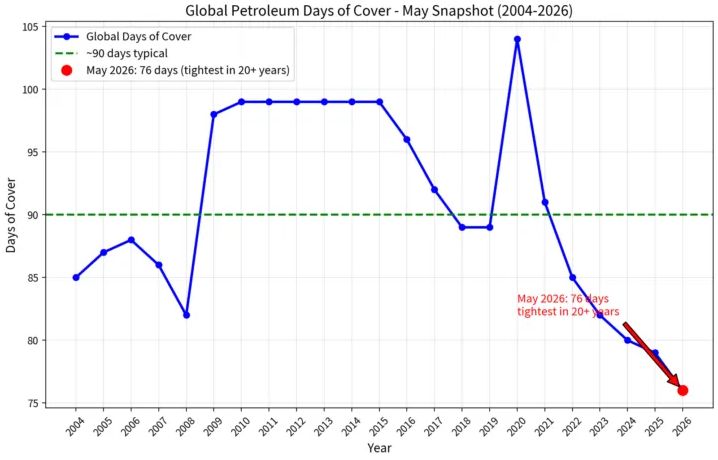
Indeed, had the 76-day shutdown of the world’s energy and commodities mother lode been prolonged much longer it would have also brought unspeakable worldwide economic disruption and carnage. So you can at least give the Donald this much: When push came-to-shove, he blinked. And just in the nick of time, as the global oil stocks graph below strongly suggests.

Currently, stocks are at a record low of 76 days of worldwide use. That’s damn near the bottom of the barrel – the point where working inventories give way to disruption and breakdown of the intricate and opaque supply chains through which 108 mb/d of crude oil, refined products, petro-chemical feedstock, LPGs and commodity by-products like sulfur, helium, needle coke and countless more pass through the arteries of global commerce.
As usual, however, the Donald has seen fit – obviously in conjunction with the Roman-style “games” put on for his 80th birthday – to triumphantly describe Sunday’s announcement as the equivalent of “peace in our time”. But it is no such thing. It’s more the opposite – a google calendar invite to meet and attempt yet again to negotiate the long-standing issues that stood on February 27th.

Well, at least some of them. And the “some” part is crucial to grasping the absolute insanity of the February 28 military attack on Iran in the first place.

Self-evidently, the reason for the attack is not that Iran was days, weeks or months away from a nuke: Even the Donald’s own former DNI, Tulsi Gabbard, had recently affirmed in Congressional testimony that the long-standing assessment of the US intelligence agencies that Iran had ceased all research and activities designed to weaponize HEUs was still the case, and with a high degree of confidence.

Likewise, the January 2026 street uprisings throughout Iran, which had been the catalyst for war that Netanyahu had peddled to the SUCKER he finally found in the Oval Office, has long since become a moot point. Not only has no uprising occurred upon the Donald’s explicit invitation of February 28th, but the “deal” actually says the opposite.

For instance, here is the predicate for war offered by Trump on February 28th:

Finally, to the great proud people of Iran, I say tonight that the hour of your freedom is at hand… When we are finished, take over your government… No president was willing to do what I am willing to do tonight.

America is backing you with overwhelming strength and devastating force. Now is the time to seize control of your destiny and to unleash the prosperous and glorious future that is close within your reach.”

If that wasn’t a clarion call to regime change, the word has no meaning. Accordingly, Item #3 of the MOU sticks out like a sore thumb. Contrary to the promised liberation from the tyranny of the mullahs, Iranian dissidents and patriots are self-evidently scheduled for the George HW Bush treatment.

That is to say, for complete and total abandonment similar to that which was notoriously accorded to the Iraqi Shiite uprising at the end of the first Gulf War. After being spurred into action by CIA operatives and Voice of America propaganda, the Iraqi Shiites were abandoned to be brutally liquidated by a vengeful Saddam – even as Washington conveniently became amnesiac about the guns and money it had promised to provide.

Here again, therefore, there will be no further Washington instigated regime change activities but, instead, full respect for Iran’s own sovereignty and benighted form of internal governance. To be sure, that is a good thing: Washington should never ever pretend to be the hall monitor for the 193 sovereign states of the planet in the first place.

Still, what the hell was the reason for going to war on February 28th when there was no bomb and, self-evidently, no prospect of a regime change uprising, as MOU item #3 makes clear as a bell?

Then again, this so-called betrayal actually represents a silver lining. Owing to his stumbling, bumbling handling of the entire matter, the Donald by inadvertence or otherwise has put the CIA, NED, the USIA and the rest of the Deep State operations out of business when it comes to the Regime Change file in Iran. And that’s hopefully a strong precedent for the future.

3. The US commitment to non-interference in Iran’s internal affairs and respect for the sovereignty of the Islamic Republic of Iran.

Next we needs go back to the reasons why the Donald shit-canned the JCPOA way back in April 2018 at the instigation of the neocon/Bibi Fifth Column in Washington. One of the latter’s red hot claims was that the JCPOA did nothing about the alleged Iranian network of proxies and terrorist states around the middle east, especially Hezbollah, the Houthis and the former regime of Assad in Syria.

You might well have expected, therefore, that high on the list of items that the parties would be obligated to discuss and resolve pursuant to the Meeting Invite would be the matter of Iran reining in its purportedly terrorist allies.

Alas, we appear to have another case of mistaken identities. The only “allies” tasked with new obligations by the MOU are not the axis of resistance associates of Iran, but the Gulf States allies of the US!

That’s right. The former are apparently to be assessed upwards of $300 billion to rebuild the massive damage caused by US/ Israeli missiles and bombs on the Iranian side of the Persian Gulf.

#7: The necessity for the US and its allies to present reconstruction plans for Iran amounting to at least $300 billion.

Again, this item constitutes yet another silver lining – even if it is ass-backwards with respect to the ostensible reasons for the war in the first place. To wit, the Bibi/Donnie War was actually such a severe existential threat to the economic prosperity of the Sunni states ringing the Persian Gulf that they have actually agreed to hoover-up $300 billion to get the Donald to call off the dogs of war in their own backyard.

Alas, awhile back Crown Prince Mohammed bin Salman (MBS) was understandably vexed by the Donald’s boast about the basis on which his principle Gulf state ally was cooperating. But now, it appears, he is expected to plant a great big wet one upon the Donald ample posterior in the form of diverting the massive funding needed for MBS’ grand ambition for Vision 2030 for Saudi Arabia into what VP Vance is already fatuously describing as “investment” in his rival across the Gulf.

“He [MBS] didn’t think this was going to happen… he didn’t think he’d be kissing my ass… He really didn’t. He thought he’d be just another American president that was a loser… but now he has to be nice to me.”

To be sure, the Wall Street pea-shuffler pretending to be the US Secretary of the Treasury will likely come up with some financial engineering scheme to sweeten the financial castor oil being shoved down the throats of the Washington’s once and former Persian Gulf allies. That is, some abuse of the Overseas Private Investment Corporation’s guarantee authority designed to hold these “allies” harmless for losses.

The point is, the Donald backed himself into the Mother of all Corners. So he is now being forced to swallow an inverted Versailles treaty obligation: To wit, he claims to have won the stupidest war every waged by Washington – and there is plenty of competition for that honor – but will now be paying massive reparations to the loser!

There is not a snowball’s chance in the hot place, of course, that he could ever get Iranian Reparations payments funded on Capitol Hill. So what is being cooked up at this very moment is some cockamamie “Persian Gulf Investment Authority” that will be fronted by the Persian Gulf allies, but, as usual, ultimately down deep in the plumbing there will be recourse to the hard-pressed taxpayers of Flyover America.

Then again, not a word is said in the MOU about the other Bibi Bugaboo that became a talking point against the JCPOA. Back in 2015 when Bibi came to the US Congress and denounced the agreement, among many complaints was his instance that the deal failed because it did not eliminate Iran’s missiles.

Well, for crying out loud. That was was risibly rich because Israel had upwards of 100 nukes – none of which had ever been declared, inspected by the IAEA or sanctioned by the UN or any other body. Yet Iran was now officially giving up any prospect of having even one bomb for deterrence purposes – even as the neocon/Bibi Fifth Column demanded that it strip itself of missile defenses, as well, thereby even further exposing itself to the kind intentions of Bibi Netanyahu, who had made a 30 year career in Israeli politics centered on demonizing the “far enemy” in Tehran.

So rather than finally stripping Iran of even its missile defense—another ostensible aim of the war – the MOU is completely silent.

Of course, the deal does include an Iranian pledge not to seek a nuclear bomb – but that surely gives gilding the lily a wholly new definition.

Iran was already committed to “no nukes” as a signatory of the nuclear non-proliferation treaty; had re-committed to that status in the 2015 JCPOA; and has maintained an internal policy of not seeking nuclear weapons since at least 2003. The latter, in fact, was confirmed in the 2007 NIE and reinforced by the 2015 IAEA findings in conjunction with the implementation of the JCPOA and subsequent US intelligence agency findings.

So what the MOU does, at the end of the day, is essentially establish at 60 day cease fire window in which an attempt is to be made to put the Humpty-Dumpty of the JCPOA back together again. In Part 2 we will amplify why the prospects of success on that front lie somewhere between slim and none.

But here it is will to consider what the JCPOA actually did and why the Donald’s reckless shit-canning of the deal in May 2018 probably was one of the greatest mistakes of American foreign policy in the entire history of the nation.

So to begin, the Joint Comprehensive Plan of Action (JCPOA), finalized on July 14, 2015, represented one of the most technically detailed and intrusive non-proliferation agreements in history. Negotiated between Iran and the P5+1 (United States, United Kingdom, France, Russia, China, and Germany, plus the European Union), it aimed to sharply extend the theoretical breakout time to a nuclear weapon – well beyond the physics and manufacturing hurdles that existed in their own right.

The deal achieved this through layered restrictions on enrichment capacity, elimination of the plutonium pathway entirely, and an unprecedented verification regime.

Needless to say, the negotiations were protracted. Secret U.S.-Iran talks began in 2013 in Oman, followed by the interim Joint Plan of Action in November 2013. Intensive multilateral negotiations produced a framework in April 2015 and the final 159-page agreement (including five detailed annexes and appendices) on July 14, 2015.

Thus, from the ramp-up of serious talks to finalization, the process spanned roughly 18 to 22 months of complex bargaining over technical, legal, and political details. The document itself is exceptionally long for an international accord – often described as the longest multilateral agreement since World War II – because its annexes contain highly specific implementation schedules, technical specifications, monitoring protocols, and dispute-resolution mechanisms.

Enrichment Capacity Reductions: The JCPOA imposed strict, time-bound limits on Iran’s uranium enrichment program to prevent rapid accumulation of weapons-usable material. To this end, Iran was required to reduce its operating centrifuges dramatically. At Natanz, it could operate no more than 5,060 first-generation IR-1 centrifuges in 30 cascades for the first 10 years.

The total number of installed old and slow first generation IR-1 machines was capped at 6,104 (including those at Fordow). All excess centrifuges – more than 13,000 – had to be dismantled and placed under continuous IAEA monitoring in storage.

Iran was also prohibited from producing additional IR-1 centrifuges for 10 years and from installing or testing any advanced centrifuges at all (IR-2m, IR-4, IR-6, IR-8) that would increase enrichment capacity beyond specified limits during the early years.

Enrichment level and location: For 15 years, uranium enrichment was capped at 3.67 percent U-235 (low-enriched uranium suitable for civilian power reactors but far below weapons-grade approximately 90 percent). Enrichment activities were confined exclusively to the Natanz Fuel Enrichment Plant.

By contrast, the Fordow facility was converted into a nuclear, physics, and technology research center with no uranium enrichment permitted for 15 years; only 1,044 IR-1 centrifuges could remain installed there, mostly for stable isotope production in cooperation with Russia, and most cascades stayed idle.

These measures collectively slashed Iran’s enrichment capacity by roughly two-thirds and prevented rapid scaling with more efficient advanced machines.

Elimination of the Plutonium Route: A major achievement of the JCPOA was closing Iran’s potential plutonium pathway to a bomb. The Arak heavy-water research reactor (IR-40) was originally designed to produce significant quantities of weapons-grade plutonium in its spent fuel.

Under the JCPOA, however, the original reactor core was removed and rendered inoperable (filled with concrete). Iran agreed to redesign and rebuild the reactor with international assistance (primarily from China and others) so that it would produce far less plutonium – comparable to a modern light-water research reactor. All spent fuel from Arak had to be shipped out of Iran for the reactor’s lifetime.

Iran also committed not to build any new heavy-water reactors or a reprocessing facility capable of separating plutonium for at least 15 years. These steps effectively eliminated Arak as a viable source of weapons-usable plutonium.

Inspection and Surveillance Regime: The JCPOA established the most robust IAEA verification system ever applied to a state with an advanced nuclear program. Key elements included implementation of Iran’s Additional Protocol to its safeguards agreement, allowing broader access and information.

There was continuous IAEA monitoring at declared nuclear sites (Natanz, Fordow, Arak, Esfahan, etc.), including real-time camera surveillance, seals, and sensors on centrifuges, uranium flows, and storage. Daily IAEA access upon request to enrichment facilities was provided, along with monitoring of centrifuge production, assembly, and storage facilities.

A mechanism also existed for IAEA access to undeclared sites suspected of nuclear-related activities. If Iran objected, a 24-day process involving the Joint Commission could compel access. Verification of uranium mines, mills, and ore concentrate production was included, as well as long-term presence of IAEA inspectors and enhanced reporting requirements.

In all, the JCPOA regime provided “anytime, anywhere access” in practice for most practical purposes and created multiple layers of detection for covert activities

IAEA-Verified Compliance: On Implementation Day (January 16, 2016), the IAEA certified that Iran had completed all required initial steps. Crucially, Iran had reduced its stockpile of enriched uranium from roughly 7,000 to 10,000 kg (various enrichment levels) to under 300 kg of uranium enriched to no more than 3.67 percent – a reduction of well over 90 percent.

It also converted or shipped out nearly all of its stockpile of 20 percent enriched uranium (previously about 400 kilograms, used for medical isotope production in the Tehran Research Reactor),while a small remainder was fabricated into fuel or diluted.

As indicated, the IAEA also confirmed that Iran disabled the core at Fordow and removed associated infrastructure, and disabled the Arak reactor core and had begin redesign work. It also confirmed that Iran had dismantled and stored excess centrifuges under IAEA seal. Subsequent IAEA quarterly reports (2016 through early 2018) repeatedly confirmed Iran’s compliance with all of these nuclear-related commitments.

As it happened, Iran enriched uranium stockpile remained well below the 300 kg cap, and that material that was enriched stayed at or below 3.67 percent. No prohibited activities were detected at declared sites. The IAEA also verified the physical removal and disabling of key equipment at Fordow and Arak.

In short, the JCPOA’s intricate provisions – centrifuge caps and modernization bans, enrichment-level and location restrictions, plutonium pathway elimination via Arak redesign, and an exceptionally intrusive IAEA verification system – created multiple overlapping barriers. Even a modern day Houdini could not have escaped its barriers to a nuke, which the Iranians weren’t pursuing in any event.

At the end of the day, the whole case against the JCPOA was a crock – another Big Lie by Netanyahu that the Donald embraced lock, stock and barrel. And now he’s trying to put it back together under circumstances that are not remotely suitable for purpose, as we will essay in Part 2.

David Stockman was a two-term Congressman from Michigan. He was also the Director of the Office of Management and Budget under President Ronald Reagan. After leaving the White House, Stockman had a 20-year career on Wall Street. He’s the author of three books, The Triumph of Politics: Why the Reagan Revolution Failed, The Great Deformation: The Corruption of Capitalism in America, TRUMPED! A Nation on the Brink of Ruin… And How to Bring It Back, and the recently released Great Money Bubble: Protect Yourself From The Coming Inflation Storm. He also is founder of David Stockman’s Contra Corner and David Stockman’s Bubble Finance Trader.


The US-Israel Wars on Iran: Follow the Money

by | Jun 18, 2026

Like most of America’s wars in West Asia, the current joint U.S.-Israel attack on the Islamic Republic of Iran is about securing control over the region’s energy resources and preserving oil currency policies; practices that have fueled its expansive economy since the end of the Second World War.

Ultimately, this conflict, which has sent shockwaves through the global economy, boils down to who will reign in West Asia, control the world’s energy lifeline, and dictate the rules of global finance.

Beneath the veneer of geopolitical diplomacy and rhetoric about global order, the true catalyst for U.S. wars in the Persian Gulf – from the 1990 invasion of Kuwait to the current Iran war – has always been monetary supremacy, “money.” They have been rooted in oil revenue, debt leverage, and the staggering economic stakes of global energy and currency dominance.

Washington’s hardline stance, economic strangulation and military interventions  have been designed to enforce compliance. Countries, like Iran, that resist U.S. hegemony face severe financial and military pressures, because their defiance challenges America’s regional security architecture and unipolar dominance over the global financial system.

Since the 1970s, the “petrodollar system” has been the invisible engine of American prosperity and power.  However, the economic scaffolding that has buoyed its global hegemony is fraying, as geopolitical shifts and de-dollarization trends gradually erode the U.S. dollar’s absolute grip on global energy markets.

To make sense of how we reached this point, it is important to consider how the U.S. dollar achieved its global dominance and shaped our current economic reality.

In June 1974, the United States and Saudi Arabia signed a landmark economic and military cooperation agreement, establishing what has come to be known as the “petrodollar system.”

This consequential bargain was born in an era of political and economic uncertainty – inflation, Vietnam War and the 1973 Arab oil embargo. With the U.S. economy in a nosedive, then-President Richard Nixon, anxious to maintain the global demand for dollars, persuaded the Saudi government to finance America’s debt with its petroleum wealth.  He convinced them to price their oil exclusively in U.S. dollars and to invest their surplus oil profits in U.S. Treasury bonds.  In exchange, Washington agreed to provide the Saudis with weapons and protection.  By 1975, all Organization of Petroleum Exporting Countries were pricing their oil in dollars.

The Saudi policy of pricing crude exclusively in U.S. dollars compelled all purchasing nations to convert their native currencies before making purchases.  Increased international demand for the dollar made it the world’s singular reserve currency and preferred medium of exchange.  To meet the increased need, Washington simply fired up the printing presses.

Over the years, Washington’s staunch support of the repressive Saudi regime has been driven by a strategic imperative: to ensure that its client state remains committed to the 1974 bargain.

This favorable pricing and trading arrangement has allowed Washington to entail massive deficits, to borrow and spend with abandon without triggering financial collapse. It has financed America’s numerous military adventures and provided the tools to wield economic sanctions and enforce its foreign policy.

Although a web of motives have fueled Washington’s interventions in West Asia, punishing currency dissenters was prominent in its past wars in Iraq and Libya.

In Iraq, for example, President Saddam Hussein’s fate was sealed when in 1999, he switched to trading Iraqi oil in euros; and officially converted his $10 billion reserve fund, held at the UN Oil-for-Food program, to euros in 2001.  President George W. Bush’s invasion in March 2003 not only quashed Iraq’s euro threat, it sent a clear warning to other countries considering an alternative oil transaction currency.

Under U.S. occupation, the country’s oil exports were quickly reverted to the dollar norm.  Additionally, UN Security Council Resolution 1483, drafted by the Bush administration and passed with U.S. pressure in May 2003, allowed the United States to control Iraq’s oil revenue, which they continue to do today.

The U.S.-led intervention and overthrow in 2011 of Colonel Muammar Qaddafi can be viewed through the same prism.  For decades, a number of African countries, led by Qaddafi, had been attempting to establish a pan-African currency based on Libya’s gold-backed dinar (estimated at around 143 tons of gold and a similar amount of silver) to reduce the continent’s dependence on the U.S. dollar, the euro and French franc in future oil sales.

Qaddafi’s life, along with his plan for a unified African currency, ended violently when NATO forces, led by the U.S., France and Britain, invaded Libya. It is worth noting that within weeks and in the midst of fighting, the poorly-organized anti-Qaddafi forces had created a Central Bank of Benghazi as the new monetary authority, replacing Libya’s state-owned bank.  The invasion also solidified France’s primacy in the post-Qaddafi oil sector.

Countries have grown weary with America’s dominance of the world economy, and with its use of military force to punish currency dissenters.  Consequently, dependence on the dollar as the global reserve currency has begun to weaken.

The intensity of U.S. rancor toward Iran is directly related to its efforts, along with Russia, to break free from the petrodollar monopoly.  To survive decades of punishing U.S.-Western economic sanctions, Tehran, has had to pioneer non-dollar trade alternatives.

For example, in 2003, Iran shifted its foreign-held assets and reserve funds out of dollars.  By 2008, it formalized the total elimination of the dollar from its crude transactions; and in 2012, began conducting its energy deals with China in renminbi (yuan).

When the U.S. and Israel launched the Iran war in February 2026, Tehran, as it said it would do if attacked, blocked the Strait of Hormuz to vessels going to and from ports of the U.S., Israel and their allies. And in mid-March, Iran formalized a non-dollar transit system in the strait.

Under the transit system, secure passage is guaranteed and permits granted to commercial vessels and oil tankers of primarily “friendly” nations that agree to pay transit fees in Chinese yuan (the petroyuan) or stable coins; and requires all ships traversing through the strait settle their cargo transactions in yuan.

America’s historical economic dominance has provided leverage to project unparalleled geopolitical and coercive power; an undisputed advantage it is now fighting fiercely to protect.

Ultimately, the escalating conflict in West Asia is a high-stakes stress test for the petrodollar, with Washington battling to maintain currency dominance, and adversaries attempting to actively bypass or dismantle it.

The international community is slowly shifting to a multi-currency world.  Ironically, the current war, as well as Washington’s over-employed sanctions regime against Iran, Russia and China, have catalyzed and hastened the erosion.

A weakened U.S. currency sets the stage for short and long-term consequences for the country.  International confidence in U.S. markets as an economic safe haven has begun to fracture. The historical belief that America is a well-governed country with stable legal, economic and financial institutions explains why central banks have allocated approximately 57 percent of global reserves to U.S. dollars.

Whenever it ends, the Iran war will have major implications for the U.S.-centered economic order.  The long-term outlook points to a weaker currency, as war costs – estimated at $12 billion a week – escalate and the national debt ($39+trillion) grows.  A natural consequence of this dynamic is increasing austerity domestically and a lessening of American geopolitical influence globally.

The United States could achieve significant economic benefits by cooperating with the international community to progressively overhaul global monetary structures.  Such a promethean transition, however, would require Washington policymakers to forego their imperious myths, exceptionalist ideologies and subservience to Zionist interests that have been foundational to America’s weaponization of the world financial system.

© 2026, M. Reza Behnam, Ph.D.

Dr. Behnam is a political scientist who specializes in comparative politics with a focus on West Asia.


How Stable Is the China-North Korea Alliance?


by | Jun 18, 2026 | Antiwar.com

For more than 7 decades, leaders of the People’s Republic of China (PRC) and the Democratic Republic of Korea (DPRK) have emphasized that their countries maintain an exceptionally close political, economic, and security relationship.  Mao Zedong even stated during the Korean War that the bilateral relationship was “as close as lips and teeth.” Numerous PRC officials have repeated that phrase throughout the years since then.  (A variation describes the alliance as close as “teeth and gums,” a formulation that is essentially the same).  The summit meeting between PRC President Xi Jinping and North Korean leader Kim Jong-un held in mid-June sought to reemphasize both the continuing importance and the compatibility of PRC-DPRK ties.

There is an indisputably crucial history of very close relations between Beijing and Pyongyang.  In late 1950, PRC forces intervened in the war between communist North Korea and anti-communist South Korea (whose government was massively supported with military personnel and weaponry from the United States and other Western countries).  The armistice that ended the fighting in 1953 left the Korean Peninsula split between two intensely hostile countries, with the United States and the PRC firmly backing their respective clients throughout the remainder of the Cold War.

Despite that history, the current connection between the two communist states is decidedly more nuanced, ambiguous, and even contentious than the lips and teeth cliché would imply.  Beijing’s ambivalence about its small, more radical, client has especially been building since Pyongyang began pursuing a nuclear weapons program in the 1990s and started conducting underground nuclear tests in the early 2000s.  PRC civilian and military officials believe that North Korea’s actions contribute to the worrisome level of political and military tensions plaguing Northeast Asia and could even trigger a catastrophic war.

Chinese policymakers have had ample reasons for concern.  In 1994, Bill Clinton’s administration was so alarmed by Pyongyang’s pursuit of a nuclear arsenal that U.S. officials seriously contemplated launching preemptive aircraft and missile strikes on North Korean installations.  A peace initiative that former president Jimmy Carter initiated helped avert that tragedy, but tensions regarding the nuclear issue on the Korean Peninsula escalated again as the years passed.  The DPRK’s decision to conduct nuclear tests greatly added to worries in both the United States and China.

Beijing watched with mounting uneasiness the DPRK’s obvious intention to barge into the exclusive global club of nuclear weapons powers.  PRC officials attempted to reassure their Korean clients that China would continue to firmly protect the DPRK’s security.  The PRC’s underlying message was that a North Korean nuclear weapons program, therefore, was both unnecessary and provocative.  Nevertheless, for all the talk about fraternal Leninist solidarity and the image of “lips and teeth,” Beijing’s discontent with Pyongyang became increasingly serious and obvious.  That trend was especially apparent when North Korea ignored its patron’s advice. The DPRK withdrew from the Nuclear Nonproliferation Treaty in 2003 and then conducted a series of underground nuclear tests over the next 14 years.  Pyongyang’s pursuit of a larger, more sophisticated capability with respect to medium-and long-range ballistic missiles also agitated Chinese leaders.  Nevertheless, despite Beijing’s sometimes caustic criticism, North Korea has managed to build a modest nuclear arsenal that Western analysts now estimate to number approximately 50 warheads.

My numerous conversations with PRC diplomats in the Foreign Ministry as well as China’s embassy in Washington, D.C. during the 1990s and early 2000s confirmed my impression about the extent of Beijing’s mounting annoyance with North Korea.  Despite their efforts to conceal such frustration, it became obvious to me that many mid-level PRC diplomats privately regarded the DPRK as an embarrassment to China.  They seemed to view the Pyongyang regime as an obsolete client that was needlessly complicating the PRC’s ambitions to play a leading economic, diplomatic, and security role in world affairs.

More recently, Xi’s government also seems uneasy about the extent of Pyongyang’s nuclear ambitions as well as some of the DPRK’s other freelancing geostrategic initiatives.  For example, Pyongyang has assisted Vladimir Putin’s government to wage its bloody war in Ukraine.  Indeed, North Korean troops are now direct participants in that meat grinder conflict.  Pyongyang’s involvement complicates Beijing’s multifaceted efforts to facilitate an end to the fighting and gain plaudits around the world for its role as peacemaker.

The United States has missed multiple opportunities over the decades to help wean the DPRK off its excessive security dependence on the PRC – and do so without unduly antagonizing China.  For example, when the Cold War ended, both Beijing and Moscow promptly fulfilled their earlier offers to establish diplomatic relations with South Korea.  Washington, however, found reasons to renege on a similar implied offer to extend diplomatic recognition to the DPRK.

Despite some initial promising symbolic gestures during President Trump’s first administration, U.S. leaders still have made no substantive moves to normalize relations with Pyongyang.  That is a serious mistake.  Washington should give the DPRK economic and diplomatic alternatives to a continued extensive reliance on Beijing.  Kim Jong Un appears to want greater policy choices, as indicated by his recent intense courtship of Moscow.

Exchanging ambassadors, lifting some trade sanctions, offering to pull U.S. troops back from their current positions near the Demilitarized Zone, and tolerating the DPRK’s emergence as a nuclear power, would be relatively low-cost, low-risk ways of easing tensions on the Korean Peninsula.  Such concessions also would reduce Pyongyang’s intense reliance on Beijing’s security shield and pervasive patronage.  Moreover, they would constitute peaceful steps that would be very difficult for PRC leaders to criticize.  Indeed, Trump administration officials could contend that the approach is consistent with the president’s apparent overall willingness to treat China as a benign peer power.

Dr. Ted Galen Carpenter is a senior fellow at the Randolph Bourne Institute and the Libertarian Institute. He is also a contributing editor to National Security Journal and The American Conservative. He also served in various senior policy positions during a 37-year career at the Cato Institute. Dr. Carpenter is the author of 13 books and more than 1,600 articles on defense, foreign policy and civil liberties issues. His latest book is Unreliable Watchdog: The News Media and U.S. Foreign Policy (2022).

The World Government That Wasn’t

In 1961 Washington and Moscow agreed to abolish war. Then the men who meant it died.

by | Jun 19, 2026 |

Reprinted from The Realist Review.

There are certain episodes in Cold War history that modern conservatives are expected to treat as either sinister fantasy or liberal delusion. The McCloy–Zorin Accords of 1961 occupy a curious place. Explain the concept today and half of the audience assumes you are describing a proto-globalist fever dream hatched in Manhattan conference rooms full of Scandinavian furniture and earnest men in rimless spectacles.

Yet for a brief moment — and this is the part that ought to unsettle both the utopians and the cynics — the United States and the Soviet Union formally agreed that the ultimate goal of international politics should be the abolition of war itself.

Not metaphorically. Literally.

The “Joint Statement of Agreed Principles for Disarmament Negotiations,” better known as the McCloy–Zorin Accords, was negotiated between American statesman John J. McCloy and Soviet diplomat Valerian Zorin in September 1961 and endorsed unanimously by the United Nations General Assembly in December 1961. It envisioned phased and verified general disarmament under international control, including the eventual elimination of national military establishments and the creation of a United Nations peace force.

This was not drafted by Woodstock pacifists smoking hashish in Vermont. McCloy was the very model of the American establishment insider: Wall Street lawyer, banker, Assistant Secretary of War, and one of the founding grandees of the postwar Atlantic order. Zorin, meanwhile, was a hard Soviet apparatchik who had spent decades navigating the darker corridors of Kremlin diplomacy.

And yet there they were, at the height of the Berlin Crisis and only a year before the Cuban Missile Crisis, jointly sketching a roadmap toward “general and complete disarmament.”

The irony is that the men closest to this project were not starry-eyed internationalists in the modern sense. They were realists in the older and more serious tradition. They had lived through industrial slaughter on a civilizational scale. Twenty-seven million Russians had died in World War Two. They understood that thermonuclear war was not a talking point but an extinction event. The generation that built the United Nations had watched Europe commit suicide twice in thirty years and concluded, however imperfectly, that sovereign states armed to the teeth and gripped by ideological hysteria might not indefinitely coexist.

Dag Hammarskjöld, the Swedish Secretary-General of the UN, became the moral and administrative face of this ambition. Today he is remembered, if at all, as the Nordic bureaucrat whose name adorns the plaza outside the UN building by the East River in New York and the library inside that skyscraper. In his own time he was treated almost as a secular pope. The press followed him obsessively. In the newsreels, he emerged from turboprop airliners with a mysterious Swedish smile. A new conflict, a new day for Dag. For a few years from the mid-fifties to very early sixties, the UN became a repository for a tired planet’s hopes. Diplomats regarded him with awe, irritation, or both. He believed the UN could become not merely a debating chamber but an actual mechanism for preventing great-power war.

This is the part modern conservatives are supposed to laugh at.

And yet before laughing too hard, it is worth observing that Hammarskjöld’s world, unlike ours, still possessed statesmen capable of fearing war more than they feared bad headlines.

The McCloy–Zorin framework emerged at the same time as the Berlin confrontation of 1961. Nikita Khrushchev wanted NATO forces out of West Berlin. Washington refused. Khrushchev declared they would be forced out, and brandished nuclear threats. In public, Kennedy responded by talking tough: Berlin would be defended militarily. The city was framed as a great testing place of Western courage. “Any dangerous spot is tenable if men—brave men—will make it so. We do not want to fight—but we have fought before,” he told American prime-time TV audiences from a sweltering Oval Office on 25 July 1961.

Behind the scenes, however, Kennedy was far more open to compromise, leading top secret discussions with his cabinet about transforming Berlin into a kind of internationally supervised city under UN protection — blue helmets replacing the tripwire forces of the Cold War blocs, perhaps even moving UN headquarters from New York to that city. According to a memo from 5 September 1961 in the diplomatic archives of the State Department (FRUS): “The President asked the State Department to consider the following elements of an eventual negotiation on Berlin… a move of some UN functions, or the whole Headquarters of the UN, to West Berlin, with appropriate guarantees to make West Berlin really a Free City.”

When one of his officials, Adlai Stevenson, objected to moving the United Nations out of New York City, Kennedy snapped, “I don’t think enough of the UN not to be able to trade it for a nuclear war.”

The concept sounds fantastical now because contemporary diplomacy imagines nothing except its own next communiqué.

The broader principle was simple enough: if neutral international supervision could defuse Berlin, perhaps similar arrangements could reduce tensions elsewhere. If the blue helmets could make Soviet-American conflict moot in its most neuralgic area of tension, Berlin and central Europe, maybe it could work in many other places, and the superpowers could eventually stand down their forces. From there would emerge the wider concept of phased disarmament backed by international verification and collective security mechanisms. Eventually, only the UN would have an army. No nation state would have an army, only police forces. The extraordinary UN document, A/4879, agreed by the USSR and USA on 20 September 1961, signed by Messrs McCloy and Zorin, lays out the long term goal in black and white:

“The program for general and complete disarmament shall ensure that States will have at their disposal only those non-nuclear armaments, forces, facilities, and establishments as are agreed to be necessary to maintain internal order and protect the personal security of citizens; and that States shall support and provide agreed manpower for a United Nations peace force.”

Of course, almost none of this happened. Hammarskjöld died in a plane crash in the small hours of 18 September 1961 while attempting to negotiate peace in the Congo, two days before McCloy and Zorin set their names to the text — so that the man most identified with the dream of a UN that could hold the peace never read the document that assumed one.

His death remains controversial, with continuing allegations of foul play and longstanding suspicions involving mercenaries, mining interests, Western intelligence, and colonial networks. Various UN inquiries have examined unresolved evidence and incomplete archival disclosures, particularly from British and American sources.

Then, two years later, Kennedy was murdered in Dallas. A notorious handbill circulating in the city, published by right wing groups, accused Kennedy of selling out the sovereignty of the United States to the “communist-controlled United Nations.”

Yet the grand design did not vanish entirely. Even as “general and complete disarmament” passed beyond reach, fragments of it survived. Kennedy had been genuinely taken with Hammarskjöld and his vision of a world at peace, and he was not about to let so convenient a martyrdom go unused. On 25 September 1961 — a week after the crash, and five days after McCloy had signed the Joint Statement — the President rose before the General Assembly and bound the dead Secretary-General to his own disarmament programme: “So let us here resolve that Dag Hammarskjold did not live, or die, in vain…as we build an international capacity to keep peace, let us join in dismantling the national capacity to wage war.”

He continued to pursue arms control after Hammarskjöld’s death, and something of the original ambition survived in the doing. The 1963 Partial Nuclear Test Ban Treaty grew out of the same atmosphere of post-Cuban terror and reluctant cooperation; the Non-Proliferation Treaty and the long architecture of strategic arms control followed. But the dream had been quietly redefined. The goal was no longer to abolish war, only to manage the apocalypse — to make the destruction survivable, or at least postponable.

That, in the end, is what became of McCloy–Zorin. It did not fail so much as shrink. The universal ambition collapsed into technocratic containment, as such ambitions usually do. We did not transcend power politics; instead we installed hotlines and verification protocols so that Washington and Moscow could threaten one another more responsibly. Perhaps that was the only realistic outcome.

And it is surely right to be wary of the alternative. The twentieth century offered evidence enough that universal ideologies, administered by self-anointed experts, tend to end in coercion, bureaucracy, and eventually blood. No sane person wants a superstate policing the planet from a tower on the East River.

But realism cuts both ways, and this is the part the cynics miss. The accords were not the fever-dream of pacifists. They were the last serious attempt by rival empires to imagine a totally new security order beyond permanent confrontation — and even at their most utopian they rested on a hard premise: that modern war had simply become too destructive to remain an ordinary instrument of policy. The men who drafted them feared annihilation more than they feared looking naive.

Set that against what followed. The post-Cold War triumphalists promised that liberal hegemony, NATO expansion, financial globalization, and humanitarian intervention would deliver permanent peace. What they delivered was forever wars, color revolutions, mass migration, collapsing social trust — and, once again, a nuclear confrontation in Eastern Europe. Today Western elites discuss war between nuclear powers in the bored tones of men who have never seen one, while proving unable to close a border to asylum seekers, or balance a budget. One suspects McCloy and Zorin, those hard old operators from Washington and Moscow, would have found our governing class not reckless so much as unserious — which, in the nuclear age, is the more frightening condition.

For the great irony is that the “New World Order” so feared by conspiracy-minded conservatives never arrived at all. No world government was ever built. What came instead was something far smaller and far shabbier: not a superstate but a drifting western order — managerial, directionless, conducted under ever-thinner moral slogans, with the occasional proxy war or managed student revolution to lend it the appearance of purpose.

And so the thing worth mourning is not the universal peace that was never going to come. It is the seriousness that died with the men who briefly believed in it: the capacity, now almost wholly lost, to look at a century of industrial slaughter and conclude that history itself had become too lethal to be left to run its course.

Pelle Neroth Taylor is a British-Swedish journalist and historian based in Sweden. He is writing a book on the death of Dag Hammarskjöld at Ndola in 1961.

Highly contagious bird flu found in Australia for the first time

20.06.2026, dpa


Photo: Richard Wainwright/AAP/dpa

By Rebekah Lyell, dpa

The highly contagious H5N1 bird flu virus has been detected in mainland Australia for the first time, authorities said on Saturday.

Agriculture Minister Julie Collins said a brown skua, a type of migratory seabird, found on a remote beach south of Perth in Western Australia had tested positive for the disease.

The positive result means the virus, which has infected millions of birds worldwide, had now spread to every continent.

"This is the highly pathogenic strain of concern that has been circulating globally, and this is its first detection on mainland Australia," Collins said.

There was no evidence of any mass mortalities nor any evidence of infection in any poultry, she said.

Samples from another sick bird from the same region had been tested and had returned a suspected positive result for the avian influenza. The samples had now been sent for confirmatory testing.

Prime Minister Anthony Albanese said the case was concerning, but the country was well prepared to respond.

"This is something that has happened through migratory birds, and has happened by definition around the world, and this is why we are preparing for this," he said.

Collins pointed to a A$100 million (US$70 million) government investment to prepare for a potential avian influenza outbreak.

"We have looked at what has happened overseas we have learnt from that, which is why we have invested early."

The H5 variant of avian flu was found on the sub-Antarctic remote Australian territory of Heard Island last year. The disease was detected on the island, about 4,000 kilometres south-west of Perth, after an unusually high number of elephant seals died there.

S.Africa anti-migrant hate loses team African support at World Cup

Nairobi (AFP) – In a Kenyan sports bar, several football fans cheered South Africa's opponents in their latest match at the World Cup -- reflecting a wave of anger at the country's recent xenophobic violence.


Issued on: 19/06/2026 - RFI

South Africa has seen a wave of anti-migrant protests this year 
© EMMANUEL CROSET / AFP/File

"Everything is political in football. We're against what South Africa is standing for," said Shahim, a 37-year-old Kenyan woman, clenching her fists in joy every time the South African team missed an opportunity against the Czech Republic on Thursday night.

"We want (South Africans) to react against what is happening in their country... But nothing happens," she added.

South Africa has been gripped for months by protests demanding the departure of undocumented immigrants.

The marches have never exceeded a few thousand people, but they have been accompanied by a torrent of xenophobic hatred online and received significant media attention.

That has flipped the usual script during the World Cup, when African nations traditionally support each other.

"We support all the other African teams. This is to teach them that there are consequences," said Shahim's friend, Fatma, a 34-year-old farmer.

"When you have a superiority complex, you suffer alone," she added.

South Africa says it has repatriated 2,745 foreigners following President Cyril Ramaphosa's promise to crack down on illegal immigration.

Ghana and Nigeria have repatriated several hundred of their citizens, and some 600 Mozambicans returned home after violence in the southern city of Mossel Bay that left at least two dead.

It has shocked many across the continent and turned football fans against the Bafana Bafana, as the South African team is known.

There was joy when the team lost to Mexico last week. A popular social media meme showed a map of the African continent covered with the Mexican flag, excluding South Africa.

"The whole continent seems to have become Afro-Mexican," quipped Wode Maya, a popular vlogger in Ghana, asking his fans to reply in Spanish.

Even a spokesperson for the Confederation of African Football, Ibrahim Sannie Daara, joined in, posting on X: "You cannot mistreat Africa and still expect Africa's full blessing on the world stage," though he later moderated his remarks and called on all Africans to wear the South African jersey.
'Unacceptable'

The atmosphere remained light-hearted in the Nairobi bar visited by AFP for the Czech Republic match -- which ended in a draw -- where a few South Africans were present.

Edwin, a 50-year-old Kenyan communications professional, said he was determined to support all African teams: "You can't judge a whole country because of a minority."


The squad has received a torrent of 'online harassment and abuse' 
© Alfredo ESTRELLA / AFP

He recalled even harsher times in east Africa, when dictator Idi Amin Dada expelled tens of thousands of Ugandans of Indo-Pakistani origin in 1972.

But others were less forgiving.

"It is not because you don't have jobs that you can attack Africans," said Richie, a Tanzanian consultant visiting Nairobi, recalling his country's support for black South Africans during the apartheid era.

"Unless they change, we will do it over and over," he added.

The South African Football Association issued a statement on Wednesday denouncing the "online harassment and abusive messages" directed at its players, which it said was "unacceptable".

At a press conference on Thursday, Bafana Bafana captain Ronwen Williams admitted "it does hurt".

"You want to focus on doing your job, which is being a footballer, but then you get involved in politics and you don't want to get into that space," he said.

© 2026 AFP

The tape and the illegal ketchup: FIFA's sponsor protection rules

20.06.2026, dpa


Photo: Tom Weller/dpa

FIFA makes a big effort to protect its sponsors which can lead to bizarre measures. Tape is an important tool but some of the measures are deemed counterproductive.

By Tom Bachmann and David Joram, dpa

Austria coach Ralf Rangnick was highly amused by a small PR coup while Jamal Musiala will probably have to carry a roll of tape with him for the next few weeks.

The Germany star’s headphones are not made by a World Cup sponsor which means that he had to cover the clearly visible logo with tape in official tournament areas.

The zeal with which world governing body FIFA protects the exclusivity of its sponsors at the World Cup is causing more than just surprise. It is also prompting companies that are not among the official sponsors to come up with clever ideas.

What the sponsors pay

Being an official FIFA or World Cup sponsor is not cheap.

Florian Pfeffel, professor for sports management at the university of applied sciences in Bad Homburg, says that official FIFA partners pay $50-100 million per years and World Cup sponsors $20-30 million. There are also regional sponsors that only appear in certain areas.

To protect exclusivity, there is strict trademark protection for terms such as “World Cup 2026,” as well as logos, mascots, and even the World Cup trophy.

Around the stadiums and at official fanfests, no competing products from non-sponsors may be sold. Stadiums have also been renamed in a neutral way for the World Cup.

“FIFA follows a clean-site principle, under which stadiums must ensure that the venue and surrounding grounds are free from potentially competing third-party naming rights,” economist Markus Voeth from Hohenheim university says.

Please cover it up: Musiala’s headphones and ketchup containers

FIFA was not particularly lenient when it came to Musiala’s headphones.

“You naturally think: that’s terribly petty. And it is,” says Pfeffel. “On the other hand, you also have to understand the rights holders and FIFA. These partners pay substantial sums for these rights, and FIFA must ensure that there are no free riders who benefit from the reach without paying for those rights.”

Tape apparently ranks among FIFA’s most important tools when it comes to sponsor protection.

In Foxborough, the naming sponsor has its logo on every single seat, which means that tape was needed for more than 60,000 seats. In Santa Clara, the manufacturers’ names on ketchup and mayonnaise containers were covered with black tape.

For advertising executive Robert Zitzmann, managing director of Jung von Matt Sports, such action is counterproductive: “It’s an invitation to pay attention, because otherwise we would never concern ourselves with the ketchup bottle or with Musiala’s headphones that are now being taped over.”

Levi’s trick

Naming rights sponsorships for stadiums are commonplace in the United States, but they are prohibited during the World Cup. Jeans brand Levi’s had its logo covered with white tarps in such a way that the outline of the logo remained clearly recognizable.

“A good marketing stunt,” says Pfeffel, but he also notes: “FIFA will probably keep this in mind for future tenders and add a few more clauses so that something like this may no longer be legally possible.”

Rangnick did not miss the trick either, saying: “I had to laugh a bit when I saw outside that the Levi’s logo had been covered. Of course, now nobody can tell what it’s actually called underneath.”

For advertiser Zitzmann, the campaign offers “an outstanding cost-benefit ratio.” After all, an advertising campaign generating similar attention would have been far more elaborate and expensive.

“All sports fans and sports media in the US know that it’s the Mercedes-Benz Arena, Levi’s Stadium, or MetLife Stadium. And with that brand awareness capital, these companies can get people talking by creatively and actively playing with the ban on visibility.”

The problem in Atlanta

Atlanta’s futuristic stadium is named after car manufacturer Mercedes-Benz, which reportedly pays $10 million per year for the naming rights through 2042. The company’s logo is displayed prominently on the arena’s roof.

FIFA obviously wanted it removed but was told by the the stadium operators: We can do that, but then we’ll have a structural problem.

Each of the eight roof sections weighs 500 tons. The issue of structural integrity ultimately convinced FIFA and Atlanta is thus the only stadium where the naming sponsor’s logo did not have to be concealed. Inside the stadium, however, around 2,000 Mercedes logos were covered.

The tricks of the others

Those who are not official FIFA sponsors find ways to sneak into the tournament’s attention span anyway. Companies deliberately buy TV advertising slots during halftime or during the hydration breaks newly introduced by FIFA.

At World Cup host locations, FIFA’s restrictions are countered with wordplay. The term “World Cup” may not be used, so slogans such as “Atlanta welcomes the world” were invented, or people refer to the “summer of soccer.” Completely permissible — and everyone knows what is meant.


Iran to lodge complaint with FIFA over World Cup travel restrictions

The Iranian World Cup team will lodge a complaint with world football association FIFA over the unfair travel restrictions imposed on them during the North American tournament, Iran's football federation said Thursday.


Issued on: 19/06/2026 
By: FRANCE 24

Iran's Mohammad Mohebbi scores their second goal against New Zealand on June 15, 2026. © Matthew Childs, Reuters


Iran's World Cup team will lodge a complaint with FIFA saying they are being subjected to travel restrictions during the tournament in North America, the Iranian football federation spokesman said on Thursday.

"Despite having submitted its preparation schedule for the tournament well in advance, Iran's national football team has once again encountered restrictions imposed by the organisers, affecting the implementation of its technical staff's plans," the spokesman said.

Iran wanted to fly from their base camp in Tijuana, Mexico, to the United States two days before their next match, against Belgium in Los Angeles on Sunday.

But the Iranian federation said its request was turned down.

"Given that the game will be played at 12pm local time in Los Angeles, the Football Federation of Iran requested that the team be allowed to travel to Los Angeles two days before the match," the spokesman said.

"The aim was to provide sufficient time for players to adapt to the match conditions, complete their final training session, and finalise preparations.

"Despite the technical reasons presented by the federation, the request was once again denied."

The Iranians were also angry that they had to leave Los Angeles the night of their first game of the World Cup, a 2-2 draw against New Zealand.

The US administration has pushed back against the Iranian claims.

Andrew Giuliani, the executive director of the White House FIFA Task Force, said on Monday that Iran had been informed in advance that they would be allowed to come into the United States only on the day before the game.

"The team will be allowed to come in, match day minus one, so the day before the match," Giuliani told CBS News.

"They'll be asked to leave the day that the match wraps up, so the evening of the match. And they'll be able to do that again in Los Angeles."

He added that the procedure would be the same for Iran's final group game against Egypt in Seattle on June 26.

(FRANCE 24 with AFP)

Germany's IKEA stores affected as workers go on strike

19.06.2026, dpa


Photo: Bernd Wüstneck/dpa


Thousands of retail workers across Germany have once again walked out in the current round of collective bargaining. 

The focus of Friday's action, called by the Verdi trade union, was the furniture retailer IKEA. Verdi stated that 31 furniture stores were "involved in industrial action to varying degrees".

The union said more than 8,000 retail workers took part in the strikes. A spokeswoman said there had been noticeable disruptions to operations, including impacts at the checkouts. In some branches, Kitchen design appointments also had to be cancelled.

IKEA told dpa that "We are currently seeing only a minor impact from the strikes in our furniture stores. All 54 branches are open". 

Steven Haarke, the collective bargaining director for the German Retail Association, said: "Business is continuing as usual. Verdi must understand that the strikes will not achieve their aim." Confrontation, he said, is the wrong tactic.

Verdi is demanding a 7% pay rise, amounting to at least €225 over a twelve-month period. Employers have most recently offered a 2% increase in the retail sector from November onwards in several federal states and a further 1.5% increase from August 2027 over a two-year period. Verdi rejected this.

The union says around 5.2 million people work in the retail sector in Germany. 

The previous collective bargaining negotiations dragged on for more than a year. In the end, retail workers secured a total pay rise of around 14% for the years 2023 to 2025.