Wednesday, June 24, 2026

THAAD Missile Defense System: A Comprehensive Review

File photo of a Terminal High Altitude Area Defense (THAAD) system. Photo Credit: The U.S. Army Ralph Scott/Missile Defense Agency/U.S. Department of Defense, Wikipedia Commons

June 24, 2026 
The Congressional Research Service (CRS)
By Andrew Feickert


The Terminal High Altitude Area Defense (THAAD) system is a key element of U.S. ballistic missile defense (BMD). THAAD employs interceptor missiles, using “hit-to-kill” technology. Reportedly, THAAD is capable of engaging targets at ranges of 150–200 kilometers (km). THAAD covers the BMD middle tier and defends a larger area than the Patriot Air and Missile Defense System. It complements the Patriot, the Navy’s AEGIS Missile Defense System, and the Ground-based Midcourse Defense (GMD) System.

A THAAD battery consists of approximately 90 soldiers, 6 truck mounted launchers, 48 interceptors (8 per launcher), 1 Army/Navy Transportable Radar Surveillance and Control Mode 2 (AN/TPY-2) radar, and a Tactical Fire Control/Communications component. THAAD provides Combatant Commanders a rapidly deployable capability against short-range (up to 1,000 km), medium-range (1,000–3,000 km), and limited intermediate-range (3,000–5,000 km) ballistic missile threats inside or outside the atmosphere during their final (terminal) phase of flight. THAAD was developed by Lockheed Martin Corporation, headquartered in Bethesda, MD, and is being manufactured in Troy, AL. The Missile Defense Agency (MDA) is responsible for the development of THAAD. According to the MDA,

MDA is responsible for the sustainment of the THAAD missile defense unique and development items, while the U.S. Army is responsible for the operations and sustainment of the common items. MDA funding provides sustainment for all fielded THAAD batteries, ensures THAAD assets are properly maintained, and crews are trained to meet Combatant Commanders’ needs.

The Army provides soldiers for THAAD units and the ability to field and operate THAAD batteries can be affected by recruiting and retention shortages, as well as the availability of qualified critical technical military occupational specialties.

The Army currently has eight THAAD batteries. The first THAAD battery (A Battery, 4th Air Defense Artillery Regiment, 11th Air Defense Artillery Brigade) was activated in May 2008 at Fort Bliss, TX. According to 2019’s Army Air and Missile Defense 2028, three THAAD batteries are based at Fort Bliss; two batteries are based at Fort Cavazos, TX; one battery is based in South Korea; and one is based in Guam. It is not known to CRS where the eighth THAAD battery is planned to be stationed.

Brief History of the THAAD Program

According to the Center for Strategic and International Studies (CSIS) Missile Defense Project, the Army began developing THAAD in 1992. In December 1995, the Army attempted its first THAAD intercept test, which was unsuccessful. Five successive test flights—taking place from 1996 to 1999—also failed. The Army redesigned THAAD and relaxed requirements for intercepting targets at lower altitudes. Between 2006 and 2019, the Army and the MDA conducted 18 THAAD intercept tests. Fourteen of the tests were successful, and four were cancelled prior to launch due to target malfunctions.

THAAD Program Activities

The FY2021 National Defense Authorization Act (NDAA) (P.L. 116-283) authorized and funded the procurement of an eighth THAAD battery. On April 21, 2022, Lockheed Martin received a contract totaling $74 million to produce the THAAD battery for the MDA, which was planned to be fielded by 2025. According to the MDA, as of January 2024, the eighth THAAD battery was in production. According to Lockheed Martin, they delivered the minimum engagement package of the eighth THAAD battery to the U.S. government in June 2025.

THAAD Overseas Deployments

THAAD has been deployed on several occasions in response to potential ballistic missile threats. According to an April 2013 Federal Register notice, “The U.S. Secretary of Defense directed the Army to deploy a THAAD battery immediately to Guam on an emergency basis in response to potential North Korean missile launch activity.”

The Guam-based THAAD unit is designated as Task Force Talon, Echo Battery, 3rd Air Defense Artillery of the Army’s 38th Air Defense Artillery Brigade.
South Korea

On July 7, 2016, the U.S. and South Korean governments decided to deploy a THAAD battery to U.S. Forces Korea as a defensive measure designed to ensure the security of South Korea and to protect alliance military forces from North Korea’s use of weapons of mass destruction and conventional ballistic missile threats. The THAAD battery is stationed at a South Korean military base in Seongju, about 130 miles south of Seoul.

2023 Middle East Deployment

On October 21, 2023, the Secretary of Defense directed the deployment of a THAAD battery, as well as additional Patriot battalions, to locations throughout the region to increase force protection for U.S. forces, bolster regional deterrence efforts, and assist in the defense of Israel.

United States Deploys THAAD to Israel

On October 13, 2024, the Department of Defense, currently using a secondary Department of War designation under Executive Order 14347, announced,

The deployment of a Terminal High-Altitude Area Defense (THAAD) battery and associated crew of U.S. military personnel to Israel to help bolster Israel’s air defenses following Iran’s unprecedented attacks against Israel on April 13 and again on October 1 [2024].
THAAD Use During the June 2025 Iranian Conflict

From June 13 to 24, 2025, the United States and Israel were involved in combat operations against Iran intended to destroy key Iranian military and nuclear facilities. In retaliation, Iran launched a series of regional missile strikes largely directed at Israel. According to one study, THAAD interceptors accounted for almost half of all U.S. and Israeli interceptors used to protect Israel against Iranian medium-range ballistic missiles. The study estimated that 92 THAAD interceptors were used during the conflict out of an estimated supply of 632 interceptors. The study also suggested that it could take three to eight years to replenish the THAAD interceptor stockpile, with each THAAD interceptor valued at approximately $12.7 million.

THAAD and Operation Epic Fury

On February 26, 2026, the United States, in conjunction with Israel, launched Operation Epic Fury to “dismantle the Iranian regime’s security apparatus, prioritizing locations that pose an imminent threat.” As a result of Iranian retaliation, THAAD has played a role in regional air and missile defense. While information on THAAD-specific intercept rates is unknown, reportedly, “the THAAD system, alongside Patriot and other defenses, contributed to a high interception rate of over 90% against Iranian missiles and drones, particularly in the United Arab Emirates (UAE).” Reportedly, it has been alleged that some THAAD AN/TPY-2 radars were damaged and/or destroyed by Iran, thereby degrading THAAD’s effectiveness. Another reported concern was that the usage rate of THAAD interceptors during Operation Fury further depleted limited interceptor stocks. Reportedly, six THAAD launchers from U.S. Forces, Korea that were deployed to the Middle East to support Operation Epic Fury in March 2026 returned to their bases in South Korea in June 2026.

THAAD to Transfer from MDA to the Army

On March 17, 2026, it was reported that the Army is working with MDA on a plan to transfer THAAD to Army control by FY2027. Reportedly, “bringing THAAD into the Army’s portfolio would place it alongside systems such as Patriot and the Integrated Air and Missile Defense Battle Command System, potentially simplifying integration and oversight.” It was also suggested that the Army assuming control of THAAD “could also saddle it with significant long-term costs at a time when the service is trying to shift resources toward new capabilities.”

Estimated THAAD Procurement and Operations and Support Costs

According to a September 2025 American Enterprise Institute (AEI) working paper titled “Build Your Own Golden Dome: A Framework for Understanding Costs, Choices, and Tradeoffs,” incremental costs for a THAAD battery were estimated as $2.73 billion to procure a single THAAD battery, including 192 interceptors, and $32.5 million annually for each THAAD battery for Operations and Sustainment (O&S).
Potential Congressional Oversight Considerations

Adequacy of Current THAAD Force Structure

With the 2024 THAAD deployment to Israel, at least half of the Army’s eight THAAD batteries were, at that time, deployed on operations. Additional THAAD units were likely deployed in early 2026 in support of Operation Epic Fury, with reports suggesting THAAD elements stationed in Korea were deployed to the Middle East to support Operation Epic Fury. It is also possible that additional THAAD units might be required to support the Trump Administration’s Golden Dome homeland missile defense initiative. Given these considerations, Congress might decide to examine the adequacy of Army THAAD force structure. Such an examination might include an assessment to determine the practicality of creating THAAD units in the Army National Guard to meet potential Golden Dome requirements for additional THAAD units.

THAAD Transfer from MDA to the Army

Congress might decide to examine the MDA’s and the Army’s plans to transfer THAAD to Army control. Such an examination could include current and future Army resource and budgetary requirements and how these requirements could affect other ongoing Army modernization efforts. In addition, such an examination could discuss timelines associated with transfer of control and what Army organizational changes could be required to accommodate the Army’s assumption of responsibility for THAAD.


About the author: Andrew Feickert, Specialist in Military Ground Forces

Source: This article was published by the Congressional Research Service (CRS).


About CRS
The Congressional Research Service (CRS) works exclusively for the United States Congress, providing policy and legal analysis to committees and Members of both the House and Senate, regardless of party affiliation. As a legislative branch agency within the Library of Congress, CRS has been a valued and respected resource on Capitol Hill for nearly a century.
View all posts by CRS →


SpaceX’s wild ride is just getting started


Published:

NEW YORK -- SpaceX’s stock extended its wild ride on Tuesday, briefly falling below its first-day opening price before rebounding on an otherwise weak day for the tech sector – sharpening Wall Street’s focus on the shifting balance between buyers and sellers of the volatile shares.

Shares of Elon Musk’s rockets-and-AI firm have surged as much as 67 per cent since they started trading on June 12 and fallen 35 per cent from there. But those swings don’t likely represent a fundamental shift in investors’ views on SpaceX’s prospects and valuation, analysts said, given the flood of information that preceded its record US$75 billion IPO and the silence that has followed.

That will change in coming days. SpaceX’s addition to major indexes and the start of research coverage by major investment banks is likely to fuel more buying, while the expiration of share lockups could drive potential selling, analysts said.

Options-market activity has grown more defensive, with more investors betting on potential share declines after an initial bout of euphoric buying of SpaceX. Often, automatic sell orders cluster around specific milestones, with some identifying the June 12 opening price of $150 and the $135 IPO price as potential pain points.

Tuesday was another up-and-down day for the stock. Shares were lately up five per cent at $162.80, after earlier trading as low as $147.11 amid a broader Nasdaq selloff.

“If these levels hold, it will be viewed optimistically as a ‘test’, but if they break, it could mark a sentiment shift for the more high-flying areas of the market,” Bespoke Investment Group said in a note on Tuesday.

SpaceX’s selloff in recent days has been accompanied by the biggest tech pullback in several weeks, with Nvidia dropping back below $5 trillion in market value on Tuesday and hundreds of billions of dollars being knocked off the Nasdaq composite index.

Red-letter days for SpaceX

A series of SpaceX events will drive trading in coming days and weeks.

Investors said some of the developments are likely to be bullish, such as index additions, but that it’s impossible to say how any of them will affect trading given the many factors that drive securities pricing, particularly in a hot market such as for AI-related shares.

  • SpaceX is expected to be added to Russell indexes as part of FTSE Russell’s regular index reconstitution on Friday. That could result in $2.68 billion in inflows from passive investors
  • June 29: Scheduled 13th flight of SpaceX Starship
  • July 6: Expected addition to the Nasdaq 100 index
  • July 7: End of quiet period that limits publication of research by investment banks involved in the IPO
  • SpaceX’s inclusion in ETFs like the Invesco QQQ Trust and iShares Russell 1000 ETF, which are tied to the Nasdaq and Russell indices

The addition to those ETFs has been anticipated by the market, said Todd Rosenbluth, head of research and editorial at TMX VettaFi, an ETF market analysis firm.

“However, these ETFs will still be buyers on the day of inclusion, providing some demand for the stock,” he said, as index funds, unlike active managers or individual investors, cannot trade far in advance.

Options bets go both ways

Investors’ initial rush to get exposure to SpaceX through bullish options bets has given way to more two-way action in that market, as some traders brace for the stock to slip below its IPO price in the coming months.


“The options activity has gotten more balanced. It’s not as completely euphoric as it was day one,” said Steve Sosnick, chief strategist at Interactive Brokers.

Options data show traders ascribing an about 40% probability to the stock trading below $130 by mid-September, according to Susquehanna Financial Group strategist Christopher Jacobson.

While in aggregate SpaceX options still show a slight bullish bias, contracts expiring July through September with strike prices ranging from $125 to $190 show nearly two puts for each open call, according to LSEG data, pointing to defensive positioning. Calls convey the right to buy shares at a fixed price in the future and puts offer the right to sell them.

“I don’t think this is unusual given the performance of hot IPOs in the immediate term post offering and the need for hedges surrounding unlock periods,” said Ophir Gottlieb, chief executive of Capital Market Laboratories, who has been invested in SpaceX since a funding round in 2022.

While most newly public companies impose broad restrictions on insider ​sales for roughly six months after listing, SpaceX has created exceptions for some participants ​and plans a phased release of restricted shares tied partly to company performance and stock-price targets. Some shareholders could begin selling stock shortly after SpaceX reports its first quarterly earnings , provided specified conditions are met.

(Reporting by Saqib Iqbal Ahmed and Lewis Krauskopf in New York; Writing by Colin Barr)


SpaceX sheds $600 billion in three days as it taps the bond market for the first time


By Quirino Mealha
Published on

SpaceX shares have fallen for a third straight session, sinking to their lowest level since the firm's market debut and wiping out most of the spectacular gains made after its IPO, just as it launches its first-ever bond sale.

SpaceX shares closed at $154.63 on Monday, down around 16% on the day. That leaves them within touching distance of the $150 at which the shares first changed hands when public trading opened, the level set once underwriters finished building the order book, though still some way above the $135 price at which the IPO itself was struck.

The slide has erased more than $600 billion (€524.2bn) in market value over three trading days, dragging the company down from a peak that had lifted it past Amazon and, fleetingly, Microsoft, in terms of market capitalisation.

Its valuation now sits just above $2 trillion (€1.74tn), below Taiwan Semiconductor Manufacturing Company (TSMC), making it the seventh most valuable company in the world.

The retreat unwinds a remarkable opening run.

After the open at around $150 on 12 June, shares climbed to almost $226 by 16 June, a gain of roughly two-thirds before the company had published a single set of results as a public firm.

Currently, SpaceX is trading over 30% lower than the intraday high of around $226 and only 3% higher than the opening price.

That rally always rested on a thin pool of freely traded shares and lofty expectations for its AI ambitions, leaving it exposed to a sharp reversal once sentiment turned.

Tapping debt to fund the AI push

The latest leg down on Monday coincided with SpaceX's first move into the corporate debt market.

The company announced an inaugural offering of senior unsecured notes, with people familiar with the plans reportedly putting the target at around $20 billion (€17.4bn).

The proceeds are earmarked chiefly to repay a bridge loan taken on during its merger with Elon Musk's AI venture xAI earlier this year, with the remainder going to general corporate purposes.

The debut bond sale follows the investment-grade credit ratings awarded last Friday by all three major agencies, Moody's at Baa1, Fitch at BBB+ and S&P Global at BBB, which open the door to cheaper borrowing and a wider pool of institutional lenders.

In documents tied to the offering, SpaceX also disclosed a cash position of roughly $100.8 billion (€88bn) as of 19 June, much of it raised in the IPO, alongside $29.1 billion (€25.4bn) of long-term debt.

That mix of vast cash reserves and fresh borrowing so soon after a record flotation has unsettled some investors, who see the rapid fundraising as a sign of heavy spending ahead as SpaceX scales its AI and data centre plans.

Opting for debt rather than new shares does, however, spare existing shareholders further dilution, preserving their economic stake while the company funds its expansion.


World Nuclear News


IAEA produces global mapping tool of used nuclear fuel


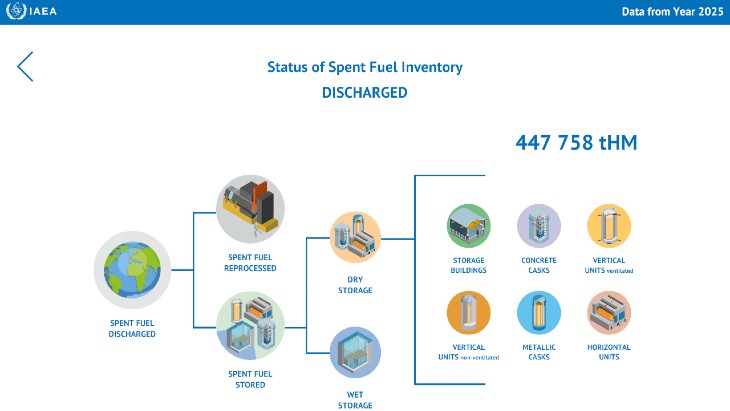
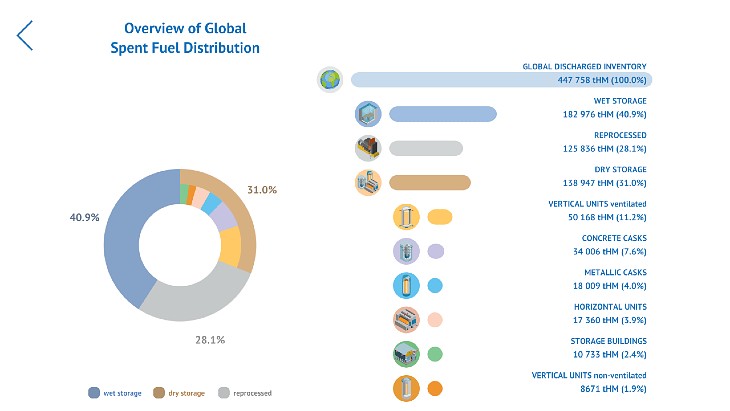
The global total of used nuclear fuel produced by nuclear power plants is about 448,000 tonnes of heavy metal, with three quarters in storage and one quarter reprocessed, according to the International Atomic Energy Agency's first interactive tool showing how much used nuclear fuel the world has - and where it is stored - by country.
 
(Image: IAEA)

The agency says that 41% of used nuclear fuel is in wet storage, "mainly the pools that cool … [it] after it leaves the reactor and other centralised pools. Another 31% is in dry storage which are the casks, buildings, and modular systems used for keeping spent fuel under dry conditions".

The figures for the interactive map - which allows people to look by country, by region and by storage type - comes from the Contracting Parties to the Joint Convention, which is "the principal international legal instrument to address the safety of spent fuel and radioactive waste management on a global scale". It is the second edition of the International Atomic Energy Agency's (IAEA) Global Spent Nuclear Fuel Inventory.

The data was submitted under the 2025 reporting cycle and the IAEA says it was supplemented by other publicly available information. The first edition, in 2019, did not include the interactive tool.

It reports that about 126,000 tonnes of heavy metal - the standard unit for the uranium and other heavy elements in power reactor fuel - has been reprocessed, which can allow its usable materials to be made into new fuel, reducing waste and the amount of natural uranium needed.

Amparo Gonzalez Espartero, Technical Lead in the IAEA Division of Nuclear Fuel Cycle and Waste Technology, said: "By displaying information on worldwide spent fuel inventories in a structured manner, including reprocessed and stored spent fuel in different storage systems, the tool benefits technical analysis, and facilitates informed discussions on long-term spent fuel management strategies among countries and interested stakeholders."

You can find the IAEA's Global Spent Nuclear Fuel Inventory here.


Major component milestone for Indian reactor


Nuclear Power Corporation of India Ltd says the successful unloading of the first End Shield is a major milestone for the Kaiga 5 and 6 construction project.

(Image: NPCIL)

Manufactured by L&T Heavy Engineering, the manufacturing arm of Larsen & Toubro, at its Hazira facility, the component weighs 107 tonnes and is about 9.3 metres across with a thickness of nearly a metre. "The complex unloading operation was executed flawlessly through meticulous planning and seamless coordination using a 500-tonne crane, 70-tonne crane and 10-tonne chain pulley block," Nuclear Power Corporation of India Ltd said.

The End Shield is the first major piece of equipment of the reactor core, NPCIL said. It provides structural support to coolant channel assemblies, facilitates on-power refuelling and forms an integral part of the calandria vault enclosure.


(Image: NPCIL)

Kaiga units 5 and 6 are Indian-designed 700 MW pressurised heavy water reactors, ten of which NPCIL is planning to build in "fleet mode". Excavation works for the units began in May 2022. A ceremony to mark the first pouring of concrete - which marks the point at which a project becomes a nuclear power unit under construction - was held earlier this year. The aim is for the first new unit at the Kaiga nuclear power plant to achieve criticality in five years.

Larsen & Toubro has already manufactured and dispatched four of the eight steam generators for the units.

Flushing work under way for Changjiang unit 4


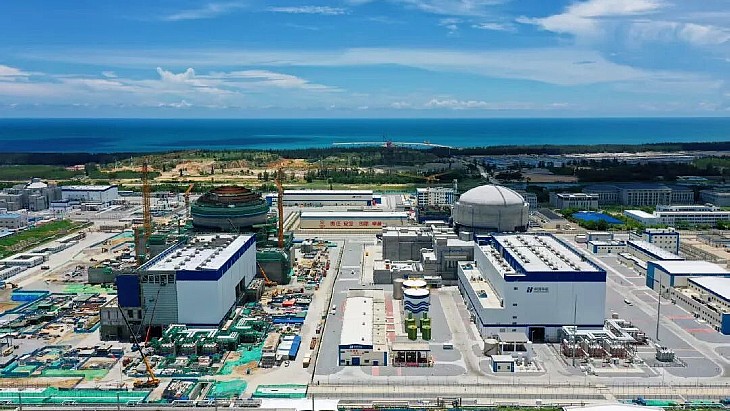
Nuclear loop flushing work has begun at the Changjiang nuclear power plant's fourth unit in China's Hainan province, China National Nuclear Corporation has announced.
 
Units 3 and 4 are Hualong One reactors under construction (Image: CNNC)

The flushing process is a key stage before cold and hot testing during the commissioning steps taken for a new nuclear power unit.

It involves the core pipelines and equipment, including the reactor coolant system, residual heat removal system and the safety systems. The flushing removes debris from inside pipelines, verifies flow capacity, and checks leak tightness and that everything has been installed correctly.

China National Nuclear Corporation said: "It is a crucial preliminary process for maintaining nuclear safety and ensuring the long-term stable operation of the unit.

"This flushing task has a tight schedule, frequent cross-operations of multiple systems, and stringent cleanliness acceptance standards. The Hainan Changjiang Nuclear Power Project Department, in collaboration with the owner, supervisor, general contractor, and other construction units, refined specialised construction plans and optimised on-site work procedures … preemptive hazard identification and mitigation were conducted to ensure the smooth, safe, and standardised implementation of flushing operations."

Two Hualong One reactors are being constructed in the second phase of the Changjiang plant. First concrete was poured for the base slab of unit 3's nuclear island in March 2021, with that of unit 4 being poured in the December of that year. Changjiang Phase II - units 3 and 4 - represents a total estimated investment of CNY40 billion (USD5.9 billion), according to China Huaneng, which holds a 51% share in the project. The outer dome was installed on unit 4 in April. The construction period is expected to be 60 months. Both units are scheduled to be fully operational in early 2027.

The Changjiang nuclear site is already home to two operating CNP-600 pressurised water reactors (PWRs) - Changjiang 1 and 2 - which entered commercial operation in 2015 and 2016, respectively. In 2021, CNNC also began construction of a demonstration ACP100 small modular reactor at the site. The multi-purpose 125 MWe PWR - also referred to as the Linglong One - is designed for electricity production, heating, steam production or seawater desalination. It is currently undergoing pre-commissioning tests.

The island province of Hainan is China's southernmost point. Energy policies published in 2019 by Hainan Province Development and Reform Commission specify that nuclear power will become the primary source of electricity for the island, which has a population of close to 10 million.

Cold hydraulic tests under way at Turkey's Akkuyu 1


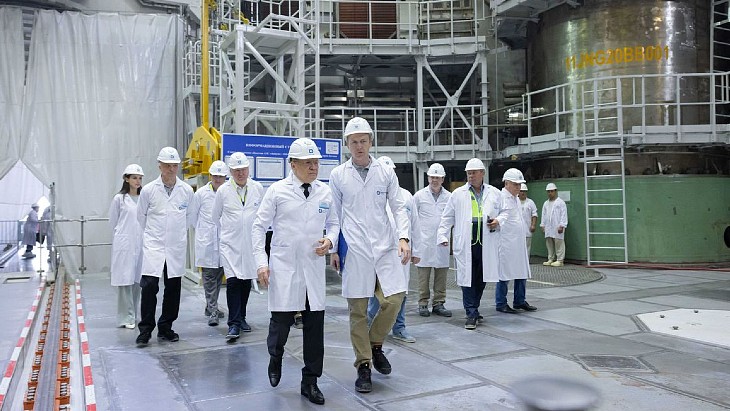
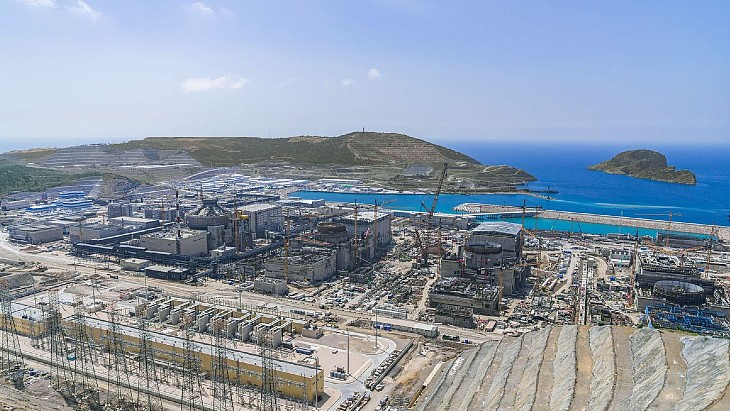
Construction of Turkey's first new nuclear power unit has been completed and cold-hot testing - a key part of the commissioning process - has begun, Rosatom has said.
 
(Image: Rosatom)

Alexei Likhachev, director general of Russia's state nuclear corporation, visited the site on Monday (see picture above) to review the progress of commissioning work. The visit came the week after the successful loading of dummy fuel assemblies into the reactor.

He said: "We are celebrating the completion of construction work. Cold hydraulic tests of the reactor began last night, and this work will be completed within a few weeks. Just a few weeks remain until the start-up operations begin, and based on the results of all the work completed, an inspection will be conducted and adjustments will be made for the final stage. Unit 1 has a staff of 1,930 people, more than 40% of whom are Turkish citizens. We are proud that these are graduates of our universities, who are now undergoing training and practical experience on Russian simulators and nuclear power plants."

The cold hydraulic tests confirm the "the tightness and strength of the reactor system components, perform circulation flushing of the primary and secondary circuits, establish water chemistry, and check the thermal-hydraulic, strength, vibration, and dynamic characteristics of the reactor system and primary circuit equipment for compliance with design values".

This will be followed by the hot tests to confirm that equipment and systems are ready for operating conditions, including checking the operation of the four main circulation pumps at temperatures of at least 260 degrees Celsius. Both cold and hot tests take place before the loading of nuclear fuel in the commissioning process.

Background

Akkuyu, in the southern Mersin province, is Turkey's first nuclear power plant. Rosatom is building four VVER-1200 reactors, under a so-called BOO (build-own-operate) model. According to the terms of the 2010 Intergovernmental Agreement between the Russian Federation and the Republic of Turkey, the aim was for the commissioning of the first power unit of the nuclear power plant to take place within seven years from receipt of all permits for the construction of the unit.

The licence for the construction of the first unit was issued in 2018, with construction work beginning that year. The first steam generators were shipped to the site - for unit 1 - in August 2020. Nuclear fuel was delivered to the site in April 2023. The aim is for unit 1 to begin supplying Turkey's energy system during 2026.

When the 4,800 MWe plant is completed, it is expected to meet about 10% of Turkey's electricity needs.


Work is taking place on all four units - first concrete for unit 4 (right) was poured in August 2023 (Image: Akkuyu Nuclear)

Turkey has plans for a second nuclear power plant, at Sinop, and has also been in talks with China about plans for a third plant, in the Thrace region in the country's north-west.

The country is also developing plans for small modular reactors, with the aim of adding 5 GWe of capacity by 2050 - which would mean the equivalent of at least 16 individual SMRs.


Canada aims to grow nuclear and uranium capacity, at home and abroad


World Nuclear News
The first-ever national nuclear strategy released by the Canadian government outlines a vision of new nuclear builds, as well as expanded uranium production, and a strengthened supply chain, as the nation works towards its ambition to become an "energy superpower".
 
(Image: Tim Hodgson/X)

The Nuclear Energy Strategy for Canada was unveiled by Minister of Energy and Natural Resources Tim Hodgson, and sets out how Canada intends to strengthen energy affordability, security and sustainability at home and abroad by leveraging its existing strengths, according to Natural Resources Canada (NRCan). These strengths include CANDU reactor technology, world-class uranium deposits, a top-tier Canadian nuclear workforce and supply chain, proven refurbishment expertise, medical isotopes and other nuclear innovations. And - with 38 countries to date endorsing the Declaration to Triple Nuclear Energy by 2050 - the global nuclear renaissance creates time-limited opportunities that Canada is well-positioned to capture, the strategy notes.

Referencing Canadian CANDU reactor technology - with 26 reactors in operation around the world, including 17 in Canada - as well as Canada's status as the world’s second-largest producer of uranium, Canadian federal support for nuclear new-build projects, and its track record of nuclear refurbishments, the strategy is structured around four pillars:

  • Enabling new builds across Canada

  • Being a global supplier and exporter of choice

  • Expanding uranium production and nuclear fuel opportunities and supporting world-class long-term nuclear waste management

  • Developing new Canadian nuclear innovations (including fission and fusion)

Key objectives under the new-build plans include enabling the construction of up to ten new large-scale reactors within Canada, with two under construction by 2035 and five more planned or under development by 2040; at least one nuclear deployment (including small modular reactors, SMRs) operational or under construction outside Ontario by 2035; and a Canadian microreactor to be demonstrated by 2035 and deployed to remote communities in the late 2030s.

The government will aim to centralise federal support for nuclear buildouts and intellectual property management. A draft Policy on Federal Financing of New Nuclear Power Projects will be released by April 2027, by the Departments of Finance and Natural Resources Canada, outlining preconditions for federal support and a range of financing instruments, including green bonds, Canada Infrastructure Bank participation, and loan guarantees. It will also aim to Increase Indigenous equity participation in nuclear energy generation projects, alongside broader economic and leadership opportunities for Indigenous communities.

The regulatory framework for nuclear projects will be streamlined, with a target of completing federal regulatory review within two years, to ensure projects are reviewed efficiently, and federal funding will prioritise a fleet-based approach to reduce regulatory burden, construction risk, and supply chain costs, the strategy notes.

Key export objectives include a unified "Team Canada approach", and securing the success of existing international CANDU projects, beginning with Romania's plans for new build and refurbishment programmes. The strategy targets winning at least four new international markets for CANDU technology by 2040, and engaging six to ten new nuclear entrant countries over a 15-year horizon; establishing a Nuclear Export Strategy providing end-to-end lifecycle support; and positioning the Canadian supply chain "beyond CANDU" to take part in SMR and large light-water reactor projects globally, with an objective of capturing "significant Canadian supply chain participation" in at least five international non-CANDU large reactor and SMR projects by 2040.

Uranium expansion

Geopolitical volatility has exposed fragility in nuclear fuel supply chains at every stage, the strategy notes, with nuclear fuel supply chains bifurcating with certain markets - it cites the USA and Europe in particular - "moving away from a hostile aggressor in favour of reliable actors" while also needing to ensure alternative supplies. "Canada is uniquely positioned to address this evolving demand, particularly in the upstream uranium stages, but there is also a compelling case for expanding downstream capabilities selectively," it notes.

To this end, the strategy sets an objective to strengthen and secure fuel supply chains for all reactors in Canada by 2032, with a doubling of Canadian uranium exports over the 10 years to 2035, supported by new mine production entering service by 2035. Canadian policies on uranium mining investment will be reviewed and updated as necessary by 2027. 

Canada currently has no requirements for uranium enrichment services - the CANDU fleet uses unenriched fuel - but with the deployment of SMRs and, possibly, light-water reactors, Canada will have a "modest need" for enriched uranium in future, the strategy says. It envisages meeting this need primarily through alliances and contracts, but does not rule out the possibility of developing domestic enrichment: "The longer-term question of whether Canada should develop domestic enrichment capability remains under assessment. The case would strengthen if the domestic non-CANDU fleet expands considerably, but in the meantime, forming deliberate partnerships with trusted allies - with Canada as the top supplier of uranium - will ensure our fuel security."

A Nuclear Fuels Table of industry, provincial and territorial governments, and Indigenous groups, will be the primary forum for tracking supply chain analysis. And at the other end of the fuel cycle, the third pillar includes an objective to advance responsible waste management solutions by continuing to support waste management projects such as the Deep Geological Repository project for used nuclear fuel.

Innovation

The fourth pillar of the strategy sets out objectives to strengthen Canadian innovation to sustain Canada's status as a Tier One nuclear nation. These objectives include aims to more than double annual private-sector nuclear R&D investment by 2032 and establish Canada as a leader in the global fusion fuel cycle market, and the development and demonstration of a Canadian-controlled Generation IV microreactor technology before 2035. Also included is an expansion of research reactor capacity by the early 2030s, alongside a formal assessment of the case for a large-scale research reactor replacement; and development of a Radioisotope Strategy to grow Canada's share of the global medical isotope market by at least 10%. 

Complementing an independent review of Canada's national nuclear innovation ecosystem, which will consider deployment of smaller research reactors "in regions developing in-jurisdiction expertise to support their deployment ambitions", the Government intends to "leverage the Pan-Canadian Multipurpose Research Reactor Alliance to support consideration of the case for a large-scale research reactor to replace the National Research Universal (NRU) reactor". The closure of the NRU in 2018 "removed a cornerstone capability" and replacement of this infrastructure "is a strategic priority, not simply a scientific one", the strategy notes.

Powering up

"We are moving at speeds not seen in generations to get big things done and leveraging pre-existing strengths to become a modern energy superpower," Hodgson said as he launched the strategy. 

On social media platform X, he went on to say the new strategy "is more than an energy plan. It is an industrial strategy, a pillar of our energy security, and an instrument of our foreign policy. It means high-quality jobs, a road to a clean grid, and diversifying our trading partners around the world". 

Cameco - which as well as being one of the largest global producers of uranium, is now a co-owner, with Canadian investment firm Brookfield, of Westinghouse - welcomed the new strategy, and its recognition that "Canada offers multiple nuclear reactor technologies including the Cameco-owned AP1000". 

"The strategy is also clear that Canada has an important role to play in delivering secure, reliable nuclear fuel to allied partners facing geopolitical realities impacting national and energy security. With our tier-one uranium assets, world-class fuel services, and strategic investments across the nuclear fuel and reactor cycle, Cameco is fundamental to Canada's nuclear energy strategy," the company said on X.

Fred Dermarkar is President and CEO of Atomic Energy of Canada Ltd - Canada's nuclear Crown corporation, which owns the intellectual property for the CANDU reactor technology on behalf of the Canadian government. (CANDU is for CANada Deuterium Uranium reactor). "This is a pivotal moment for Canada," he said. "Nuclear energy will play a critical role in meeting growing energy demand while advancing economic growth, energy security, and climate objectives. The Nuclear Energy Strategy provides an important national framework to help turn that opportunity into action."

AtkinsRéalis is the sole licensee for the CANDU technology and is developing the Monark reactor: the Government of Canada last year announced it would lend the company up to CAD304 million (USD212 million) over four years to support the development. AtkinsRéalis Ian Edwards said the Nuclear Energy Strategy "reflects the ambition and vision Canada's nuclear industry deserves," adding: "I look forward to continuing to work together to advance Canada's nuclear advantage at home and abroad."

The Nuclear Energy Strategy for Canada is available on NRCan's website.

Agreement secures management of Canadian low-level legacy waste


A new long-term agreement between Atomic Energy of Canada Limited and the Municipality of Port Hope extends Canada's responsibility to safely manage eligible historic low-level radioactive waste in Port Hope for up to 100 years after the Port Hope Long-Term Waste Management Facility closes.

The Long Term Waste Management facility at Port Hope (Image: AECL)

The project is part of the Port Hope Area Initiative (PHAI), the Canadian federal government's commitment to develop and implement a safe, long-term solution for the management of low-level historic wastes in the Ontario municipalities of Port Hope and Clarington. 

By the early 1930s, Port Hope had become the centre for radium refining in Canada, and the waste is mostly soil that was contaminated with residue ore from those historic activities. Waste was stored at various planned sites as well as deposited at unplanned locations within the town. At the time, residual soil and surplus building materials from the plant site were routinely reused. This was in line with the knowledge and practices of that time, but meant that some parks, ravines, and even residential properties were backfilled or even constructed using contaminated materials.


The Port Hope Project involves the construction of a long-term waste management facility and supporting infrastructure for the safe, long-term management of some 1.2 million cubic metres of historic low-level radioactive waste, cleanup of the waste from various sites in Port Hope and its transportation to the facility, and long-term maintenance and monitoring. The engineered, above-ground facility is managed by Canadian Nuclear Laboratories (CNL). 

Under the original 2001 agreement that established the PHAI, the government's responsibility would have ended 20 years after the closure of the waste facility. 

The new agreement extends the federal responsibility to safely manage eligible historic low-level radioactive waste in Port Hope for up to 100 years after the Port Hope Long-Term Waste Management Facility closes, aiming to provide long-term certainty for residents, property owners, and the municipality, according to Atomic Energy of Canada Ltd (AECL). 

"As the Port Hope Area Initiative has progressed - particularly on private properties - it has become clear that it is not always practical or beneficial to remove all of the eligible waste from every location," AECL said. "Now, property owners have more choice and flexibility. If they choose to leave eligible low-level radioactive waste undisturbed beneath existing features such as mature trees or landscaping, they can address the radiological material later, if needed."

Under the new agreement, once the PHAI project is complete, a designated access point will remain open at the Port Hope facility with disposal capacity to ensure it can safely accept any low-level radioactive waste encountered during future renovations, repairs, or infrastructure projects. As part of this agreement, the Municipality of Port Hope will receive funding of CAD8 million (USD5.65 million) to support future excavation, restoration, and transportation costs.

"This historic agreement reflects a strong and collaborative partnership between the Municipality of Port Hope and Atomic Energy of Canada Limited, grounded in a shared commitment to safety, flexibility, and long-term environmental stewardship. By introducing a practical, property-owner-focused approach, the agreement not only enhances choice for residents but also supports a more efficient completion of the PHAI project," the Municipality of Port Hope said.

AECL is Canada's federal Crown corporation for nuclear science and technology. Its remit includes fulfilling the Government of Canada's radioactive waste and decommissioning responsibilities.

 SCI-FI-TEK 75YRS IN THE MAKING


Fusion supply chain spend up, but challenges remain


The Fusion Industry Association has reported that supply chain spending by the fusion industry rose 25% to USD538 million in 2025, but ensuring access to specialist materials and fuel systems remains a continuing concern.
 
(Image: FIA report)

The figure, in the The Fusion Industry Supply Chain 2026 report, is based on interviews with 25 fusion companies and 67 fusion suppliers. It suggests that progress is being made to overcome the "chicken-and-egg" problem of fusion companies needing to ensure future supply chain capacity, but also having to ensure that suppliers have confidence in their plans to make investments.

According to the report, more than two-thirds of fusion companies have seen established suppliers "pivoting to fusion". It reports that 75% of suppliers had made investments to expand their fusion capacity during 2025 but says "there is still work to do, as 69% continue to report a lack of long-term visibility of fusion needs, making planning and investment difficult".

The main supply chain bottlenecks identified are power systems and power components (48%), heat management technologies (44%), and vacuum vessels and pumps (both 32%). Meanwhile 48% of fusion companies named fusion fuel cycle systems as a major future concern. Forty per cent of the companies also have future concerns about the need for commercial-scale access to materials which can withstand extreme conditions.

Andrew Holland, CEO of the Fusion Industry Association (FIA), said: "Our fourth annual report sees considerable progress in the relationship between fusion developers and their supply chain. We see signs of the chicken-and-egg gridlock raised in previous reports easing, as supplier relationships improve and new and existing suppliers invest in scaling up capacity to meet the sector's growing needs.

"In large part, the winner of this race to fusion will not be the country that gets there first, but the one with the strongest, most integrated supply chain. Building that capability and capacity will need a truly collaborative effort between policymakers, investors, the supply chain and fusion companies."

The recommendations set out in the report by the FIA include: Governments and investors should nurture specialist fusion suppliers with a focus on key bottleneck areas such as precision engineering, high-spec materials and components, and fuel-cycle technologies; Strengthen supplier-developer communication through regular industry forums, events, and matchmaking initiatives; De-risk supplier investment through demand visibility with fusion developers providing “clearer demand signals through long-term agreements, forward purchasing, and early supplier engagement; Accelerate standardisation and pre-competitive collaboration with shared standards, specifications, and testing protocols; Expand access to shared infrastructure and test facilities such as national labs; Close the supply chain funding gap which causes a “mismatch between funding for fusion developers and their suppliers”; Streamline regulation and enable global supply chains - governments worldwide should pursue harmonised regulatory frameworks, targeted tariff exemptions, and support for cross-border collaboration; Accelerate the development of fusion fuel systems supply chains infrastructure.

The Fusion Industry Association is a US-headquartered international non-profit independent trade association for the private nuclear fusion industry. It was founded in 2018. The report was launched at The Fusion Supply Chain Trade Show in New Mexico in the USA.