Tuesday, June 30, 2026


EU ends tax loophole exploited by SHEIN, Temu, and Aliexpress
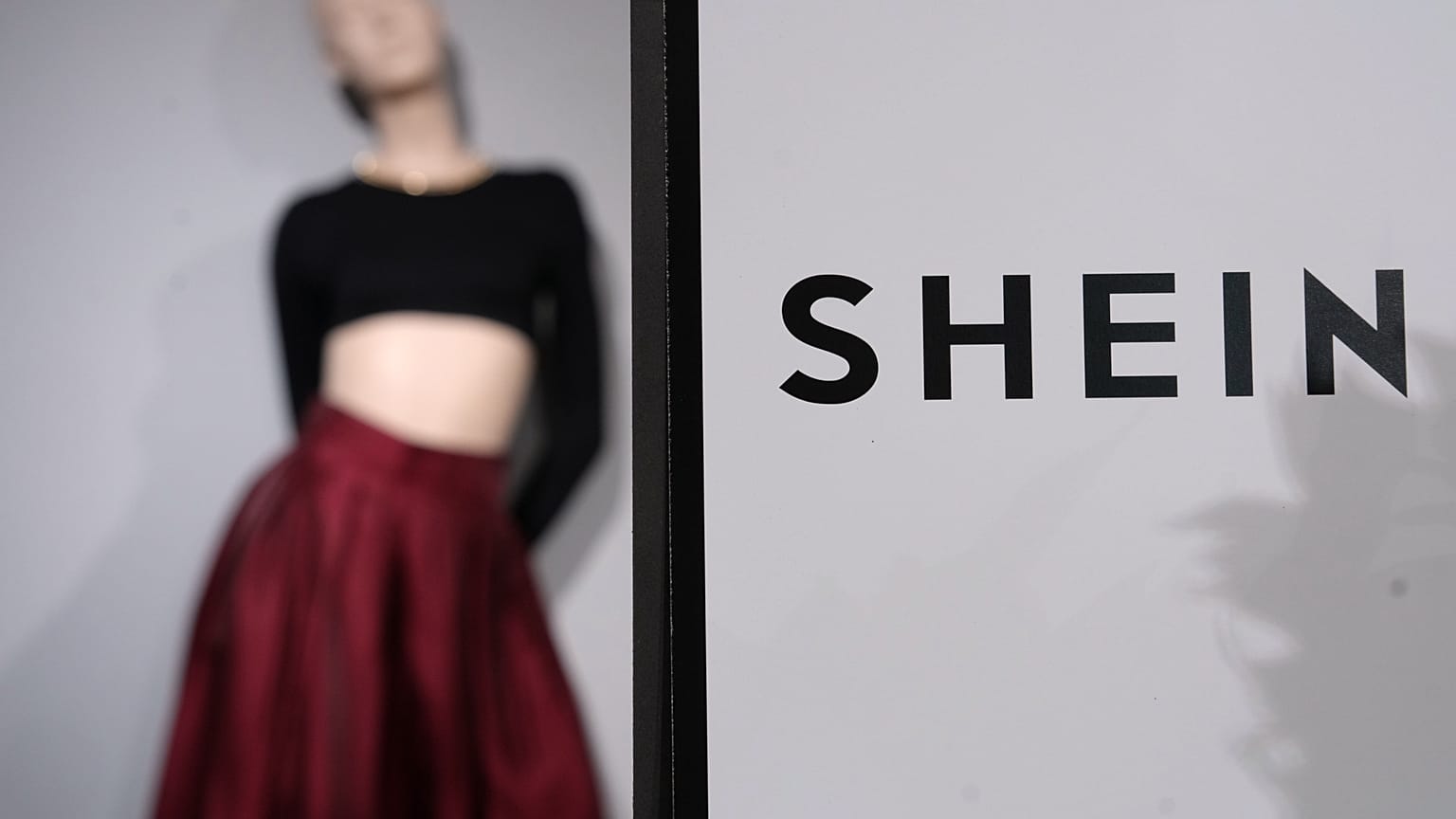
Clothes by Chinese company Shein are seen in the BHV (Bazar de l'Hotel de Ville) department store,
Copyright Copyright 2025 The Associated Press. All rights reserved.

By Leticia Batista Cabanas
Published on

The European Union is imposing a new tax on small imports, which will heavily impact Chinese giants like SHEIN, Temu, and AliExpress. What does this mean for European consumers, product quality, and brands?

On July 1, a flat €3 customs duty on low-value e-commerce imports will come into effect. Until now, goods imported into the EU worth under €150 were exempt from customs duties.

This temporary measure means small parcels entering the bloc, largely through online shopping platforms, will face a fixed customs charge. It addresses what the European Council describes as "unfair competition" for European retailers, as well as concerns over unsafe products, fraud and the environmental impact of vast volumes of cheap imports.

The Council also clarifies that this customs duty is separate from the proposed "handling fee" (expected to be €2) currently being negotiated under the EU's broader customs reform and long-term budget plans, another blow to the Chinese e-commerce sector.

"The urgency was so big that there was deep political consensus", Dirk Gotink, a Dutch MEP for the EPP, told Euronews. But the measure was slow to arrive, "because countries were slow to accept that, to do something about the tsunami of non-compliant [fast fashion] products, you need to integrate European customs."

A juicy tax loophole

The EU receives over two billion e-commerce packages worth under €150 annually. This overwhelms customs infrastructure and allows up to 65 per cent of parcels to enter with misdeclared values or unverified safety profiles. The unprecedented volume hampers border inspections and demands regulatory action.

"I think only 0.006 per cent of parcels get checked by customs. The number of products coming into Europe means not all of them can be tested", estimated Laura Clays, spokesperson for consumer organisation Testachats. "Too many non-compliant products can enter the market."

For years, companies like SHEIN operated in a zero-tariff environment by routing individual orders directly from China. This was possible under the "de minimis" loophole, a customs policy allowing low-value shipments (under €150 in the EU) to enter free of customs duties.

Firms used the loophole to avoid up to 12 per cent in import duties, keeping shipping and production costs artificially low while avoiding European oversight. The system also channelled billions in untaxed retail revenue into Chinese logistics.

SHEIN, for instance, used this model to generate over €30 billion in global revenue while bypassing levies on European imports. By avoiding up to 12 per cent in customs duties, foreign platforms could also undercut European retailers, who face higher structural costs (30 to 50 per cent per garment).

Gotink describes it as "tax avoidance on an industrial scale, basically."

Safety and environmental issues

"Fast fashion has destroyed the second-hand market in Europe and caused huge unfair competition for European clothing brands. The taxpayer pays a high price for this trade: fast fashion can contain chemical substances that shouldn't be in Europe, like PFAS", shared Gotink.

Independent assessments by European consumer groups, including Testachats, found that "around 70 per cent of the products did not comply or did not fully comply with all EU safety requirements", said Clays.

A Greenpeace Germany investigation also found that 32 per cent of tested apparel contained illegal concentrations of hazardous substances, including heavy metals, formaldehyde and PFAS "forever chemicals" in jackets at levels up to 3,300 times the legal European threshold.

Safety checks on toys and children's clothing also uncovered serious non-compliance. Certain items had dangerous shapes and loose components that posed a high choking risk.

"International e-commerce offers lots of opportunities for consumers. But any product entering the EU market must comply with safety, consumer protection and environmental standards. That is our goal: to ensure products entering Europe meet the same standards as those made in the EU", said Clays.

The hyper-production of ultra-fast fashion goods also generates a major environmental toll. Flying billions of individually packaged items directly from Chinese factories to consumers greatly increases aviation emissions compared with bulk maritime shipping.

What the EU wants to do

"What the EU and especially member states need to do is invest massively in their ability to control the products that are coming into the European market", said Gotink.

The €3 customs duty applies according to the item's type.

The fee is determined by the specific Harmonised System commodity code of each product. For example, if a package contains a textile item, footwear and a tech product, it will face a €9 charge because three different codes are triggered. If a package contains multiple items of the same type, the €3 charge applies only once.

The measure applies to non-EU sellers registered under the Import One-Stop Shop VAT system, which accounts for 93 per cent of all e-commerce imports into the EU. Enforcement relies on digital sales logs transmitted directly to authorities.

Another change is that, under previous rules, consumers were legally considered the "importer" when ordering a non-EU package. If a dress from SHEIN or a toy from Temu contained illegal chemicals or posed a choking hazard, the consumer technically bore the legal liability. The platforms acted merely as "intermediaries" with no responsibility for the product itself.

As of March 26, the new EU Customs Code Reform removes this shield by legally reclassifying digital marketplaces as "deemed importers". As recognised importers, they are liable under EU product safety laws, including the General Product Safety Regulation. This makes them legally responsible for safety certifications and chemical testing, while exposing them to severe financial penalties or market bans for non-compliance.

The new duty will remain in force until a broader permanent system for low-value imports, agreed in November 2025 as part of wider customs reforms, takes effect. In 2028, the permanent EU Customs Data Hub will go live, removing the €150 threshold entirely and taxing every item dynamically from the first cent.

Rise of fast-fashion consumption

For consumers: more expensive, less dangerous

Under the new rules, European shoppers will face higher prices and longer waiting times.

A typical low-cost online order worth €20 could easily exceed €30 once the new fees are added. For example, if a customer buys a €10 summer dress and a €10 pair of sunglasses, the order triggers two separate €3 category duties, adding €6 to the bill. Add the planned €2 handling fee and the final checkout price reaches €28, a 40 per cent increase on a basket of cheap goods.

Customs agents must digitally screen every package, and border checkpoints are likely to face backlogs. Shoppers used to receiving air-freighted packages from Asian warehouses within a week may have to wait while customs agents verify product category codes.

This benefits consumers in the long run. "If it makes sure more non-compliant products are rejected, or that producers and sellers increase compliance with European laws before listing products online, then it's a good thing", said Clays.

The changes also provide stronger safety protections. Because platforms are now legally classified as importers, the risk of unknowingly buying dangerous goods, such as children's clothing containing toxic chemicals or cheap toys with choking hazards, should fall. The rules also remove surprise cash-on-delivery charges, as all duties must be paid upfront at checkout.

For companies: a fairer playing field

Once the levy takes effect, marketplace apps such as SHEIN, Temu and AliExpress must either absorb these multi-billion-euro compliance costs or risk losing price-sensitive shoppers through price rises.

To survive, they may be forced to restructure their business models by moving away from direct-to-consumer air mail and investing in large EU-based warehouses. Analysts estimate this shift to local distribution hubs could erase up to 40 per cent of profit margins, while penalties for non-compliance could reach 6 per cent of annual import values.

The policy will also affect China's trade strategy. Cross-border e-commerce exports reached 2.75 trillion yuan (about €350 billion) in 2025, and these online platforms are major drivers of the economy.

For European businesses, however, the new rules level the playing field by removing the artificial price advantage enjoyed by non-EU sellers.

Traditional high street and online retailers can regain competitiveness as the 2.3 billion untaxed parcels entering the bloc each year are brought into standard taxation regimes.

Domestic fast-fashion brands such as Zara and H&M can better exploit their European supply chains, restocking stores faster than overseas rivals facing border friction. Brands emphasising durability and compliance with EU sustainability standards are also likely to become more attractive to consumers.

"The fast fashion sector, as it works now, is simply unsustainable as an economic model. I hope we will be able to stop the non-compliant and overly cheap trade flows, where consumer goods are used once and then thrown away", added Gotink.


 

Over 1 million migrants apply for Spain's mass regularisation, PM Pedro Sánchez says


By Christina Thykjaer & Gavin Blackburn
Published on

Sánchez has long argued that immigrants are needed to sustain the economy, the welfare state and pensions amid Spain's ageing population and depopulation in rural regions.

More than 1 million undocumented migrants in Spain have sought legal status under a scheme that has defied a wider European crackdown on irregular immigration, the government said on Tuesday, the final day for submissions.

The vast scheme was predicted to benefit around 500,000 people, mostly from Latin America, when the left-wing government launched it in April.

"The more than one million applications submitted...show how necessary this recognition of rights and responsibilities was," Socialist Prime Minister Pedro Sánchez said at an event in Madrid.

Sánchez has become a standard bearer of more open immigration policies as his European neighbours, including some Socialist peers, toughen measures in response to pressure from ascendant far-right parties.

He has long argued that immigrants are needed to sustain the economy, the welfare state and pensions amid Spain's ageing population and depopulation in rural regions.

Spain's Prime Minister Pedro Sánchez arrives for the EU summit in Brussels, 18 June, 2026 AP Photo

The number of applications submitted does not necessarily indicate how many migrants will secure their legal status.

Applicants must prove they have a clean criminal record and spent at least five consecutive months in Spain before 1 January.

The authorities have three months to process their paperwork and decide whether to issue a work and residence permit only valid in Spain.

"When we condemn a person to invisibility, I think we make our country a worse country. We all lose," Sánchez explained, saying his government aimed to "offer an opportunity and future" to migrants.

"We want the world to view Spain as a country that respects, protects and upholds human rights."

Economic boost

For Juana Hernandez, a 59-year-old Cuban who has lived in Spain for two and a half years and whose application was recently approved, the plan "is a huge opportunity."

She told the AFP news agency she had paid a lawyer roughly €200 to handle the administrative formalities "to be on the safe side," as well as receiving help from a migrant aid association.

Although she was "a little worried" at the start, the English degree holder now aims to work at Madrid airport.

A land of emigrants for centuries, Spain is a key entry point into the European Union for tens of thousands of undocumented asylum seekers and migrants, alongside Italy and Greece.

Migrants queue outside Barcelona City Hall to obtain paperwork needed to apply for Spain's immigration amnesty, 20 April, 2026 Copyright 2026 The Associated Press. All rights reserved.

Many come via a long and perilous Atlantic route from West Africa to the Canary Islands, although numbers dropped last year after peaking in 2024.

Since April, streams of men, women and children have queued in the streets to obtain documents and attend appointments for their regularisation, in addition to online applicants.

Although fears arose of a saturation of the services handling the scheme, Mohamed, a Moroccan who lives in the northern region of Cantabria, felt the administrative journey was "relatively easy."

The 23-year-old jobseeker, who declined to give his surname, has been in Spain irregularly for about four years and hopes "to be able to work legally, to pay contributions."

Gaining legal status will also spare him from unscrupulous employers who "take advantage" of irregular migrants "by paying low salaries, without any rights or...don't pay at all," he told AFP.

Migrants queue outside Barcelona City Hall to obtain paperwork needed to apply for Spain's immigration amnesty, 29 April, 2026 AP Photo

Sánchez, who has presided over one of the world's fastest-growing developed economies in the last few years, has touted the benefits of immigration for sectors such as construction that need to boost their workforce.

Spanish business leaders have welcomed the regularisation drive but the conservative and far-right opposition are furious about a policy they claim will encourage more irregular immigration.

While accepting "tensions" and "challenges" linked to immigration and integration, Sánchez on Tuesday accused the right of "fuelling fear (and) stirring up xenophobic discourse that does not solve any problem."


UK watchdog moves to break Apple and Google's grip on app payments

FILE - FILE - In this 6 December 2020 file photo, the logo of Apple is illuminated at a store in the city center of Munich, Germany.
Copyright AP Photo/Matthias Schrader, File

By Una Hajdari
Published on

Buy an app subscription today and there is a good chance Apple or Google is taking a cut. The CMA wants developers to be free to point customers elsewhere to pay and is asking the tech giants to justify any fees they charge for the privilege.

The UK's competition regulator has opened a consultation that could force Apple and Google to loosen their grip on how UK customers pay for apps.

The move is designed to bring down prices and spur innovation in the country's tech sector.

The Competition and Markets Authority (CMA) said on Tuesday it was consulting on new conduct requirements for the two companies under the UK's digital markets competition regime, targeting restrictions that currently stop app developers from directing customers towards cheaper payment options outside Apple and Google's own platforms.

The CMA designated Apple and Google's mobile platforms as holding an "effective duopoly" last October, citing the 90-100% of UK mobile devices running on their platforms.

What is 'steering'?

The practice, known as steering, is basically about letting developers tell customers there is a cheaper way to pay, one that skips the mandatory fees baked into Apple's App Store or Google's Play Store.

Right now, Apple bans it outright in the UK, while Google only allows it in a limited way.

Scrap those restrictions, the CMA said, and developers would finally be free to point users elsewhere to pay.

But Apple and Google could still charge for allowing that, so the regulator is also drawing up principles to make sure any new steering fees are fair.

Under its proposed framework, the CMA said it would expect those fees to come in lower than existing app store charges, with the savings either landing in customers' pockets or ploughed back into developers' businesses.

Google changes its terms

The consultation comes days after Google announced new global terms for its Play Store which include allowing developers to steer users towards completing transactions outside the store, subject to certain conditions.

Google has also altered the fees it charges developers, including those who use steering. The CMA said it would assess the impact of these changes during the next phase of its work on mobile platforms.

Under the Digital Markets, Competition and Consumers Act, the CMA must consult before imposing any new conduct requirement.

App store terms, including steering practices, remain under regulatory scrutiny in several other jurisdictions, including the EU, the US and Japan.


Starmer sets out to strengthen UK and European defence with cash for drones and AI systems

British Prime Minister Keir Starmer announces the UK defence plan, 30 June 2026.
Copyright PA Wire/PA Images

By Angela Skujins
Published on

The outgoing UK prime minister has finally unveiled a long-awaited Defence Investment Plan that aims to revive an “underfunded” sector. It emphasises the growing use of of unmanned aerial vehicles in repelling foreign aggression.

British Prime Minister Keir Starmer has at last presented his government's Defence Investment Plan, a spending programme that aims to ensure Britain’s military future by raising defence investments to £80 billion (€92.8 billion) a year by 2029.

Building and buying stealth fighter jets, submarines and warheads are all on the menu, with £5 billion (€5.8 million) allocated solely for the development of drones, a move Starmer hailed as “the largest ever UK investment in this technology”.

“We will build an army that is ten times more lethal, with attack drones flying alongside our Apache helicopters, a new fleet of surveillance drones collecting intelligence and finding targets and a surge in low-cost one-way attack drones which have proved so effective in Ukraine,” he said at a press conference on Tuesday.

The new spending will emphasise autonomous vehicles, such as a “hybrid” Royal Navy vessels utilising artificial intelligence and smaller autonomous aircraft flying alongside RAF Typhoon combat planes that are “invisible” to radar systems.

Drones will also be tested at the “Uncrewed Systems Centre” — a 50,632 square metre facility touted as Europe’s largest drone testing facility.

The Russia factor

Starmer used his speech to directly point the finger at Russia, a country identified by various intelligence services as preparing to mount an attack on a NATO ally by 2030.

He reiterated that if Russia continues its full-scale invasion of Ukraine, and pushes past the war-torn country’s border, Europe may be in the Kremlin’s line of sight.

“If Russia were to win in Ukraine, Putin would not stop there but turn his gaze to other allies, bringing even greater instability to our continent, even greater impacts on our security and the cost of living and an even greater need to mobilise yet more resources for our defence,” Starmer said.

In April, the UK's then-Defence Secretary John Healey warned that three Russian submarines had conducted a clandestine operation over pipelines and cables in waters just north of the UK, mirroring similar cable-cutting incidents across Europe, particularly in the Baltic Sea. Britain and Norway are already developing frigates to hunt Russian submarines that enter European waters.

In a stunning turn of events, Healey resigned two weeks before the defence plan was announced by Starmer over concerns that not enough money was being allocated to support the country’s security and meet the new NATO commitment of 3.5 percent of GDP to be spent annually on defence by 2035.

In his resignation letter, Healey wrote that the original defence sum in the blueprint fell “well short” of what is required “at this dangerous time”.

The prime minister reiterated on Tuesday his view the investment plan is sufficient to support both Britain and Europe more broadly.

“(We are) maintaining our role in guaranteeing British and European security and leaving our country in a much better and much stronger state than we found it,” he said.

But speaking in Parliament on Tuesday after the plan was unveiled, Healey repeated that the spending programme does not go far enough, warning that the UK needs "to develop a clear, credible funding plan" before it faces a Russian attack.

Britain in Europe

Starmer said the plan aims to bolster European defence decision-making and will have input from the Europeans, such as the development of “deep precision strike weapons” in partnership with Germany.

The plan comes as the US is signalling it will review its defence posture within Europe, prompting allies to step up to the plate.

Euronews asked the Ministry of Defence whether the EU will have any involvement with the plan through the development or testing of capabilities. In response, a spokesperson pointed to comments Starmer had made earlier in the day without providing specifics.

The UK's new plan is being made public just before the 2026 NATO summit in Ankara on 7-8 July. NATO Secretary General Mark Rutte said that the first day of the summit will be an opportunity for the alliance’s 32 members to sign “massive amounts of new contracts, MOUs (and) letters of intent” to meet defence spending goals.

France's National Assembly approves assisted dying bill after Senate rejection

View of the National Assembly in Paris.
Copyright AP Photo/Aurelien Morissard

By Marta Iraola Iribarren
Published on

The French National Assembly has passed the assisted dying bill — a law that has sparked controversy across the country — following the Senate's rejection.

The French National Assembly has approved the proposal for an assisted dying bill by 295 votes in favour and 232 against after the Senate’s rejection in January.

“This vote is the culmination of several years of work and of a thorough public debate, conducted with seriousness, respect and dignity,” Yaël Braun-Pivet, president of the National Assembly, said in a post on X following the vote.

The bill has been controversial in France, sparking debate on how to regulate end-of-life assistance.

It has undergone several amendments since its first proposal. Critics are divided, with some arguing it has been watered down in the process, while others still consider it too permissive.

However, the members of the Assembly in charge of the law noted that the final text "has reached a point of balance”.

According to the rapporteur, Philippe Vigier, the bill establishes new rights for patients, while guaranteeing the freedom of professionals to abstain and it builds in safeguards for everyone — patients, professionals and relatives.

What will this law mean?

The proposed law creates a right to aided dying for adults with grave incurable illnesses in an advanced or terminal phase.

One key change in the final text is that psychological suffering alone has been excluded from access to assisted dying.

Only patients who are physically unable to administer the substance themselves would be allowed to have a doctor or nurse do it for them.

Patients must be over 18 and be French citizens or residents in the country.

A team of medical professionals would need to confirm that the patient has a grave and incurable illness "at an advanced or terminal stage,” with constant suffering from intolerable and untreatable pain, and is seeking lethal medication of their own free will.

The proposed law would also create a conscience clause for healthcare professionals who do not wish to participate in this procedure and would then require them to refer the patient to other healthcare professionals.

Long road to approval

President Emmanuel Macron promised in 2022 to bring forward end-of-life legislation.

First officially proposed in 2024, it was approved by the National Assembly in May 2025.

However, on 28 January, the Senate rejected the bill by 181 votes against and 122 in favour.

After the disagreement between the chambers, a joint committee made up of seven senators and seven deputies met to find a balance but failed to reach a compromise, sending the bill back to the National Assembly.

Now that the text has been once again approved, it will return to the Senate again, and if the two chambers still fail to reach an agreement, the National Assembly can have the final word.


Prosecutors conduct Europe-wide raids over alleged misuse of funds by defunct far-right EU group

French far-right National Rally president Jordan Bardella, Monday, Oct. 6, 2025 at the European Parliament in Strasbourg, eastern France.
Copyright AP Photo/Pascal Bastien

By Emma De Ruiter
Published on

Raids were underway in France, Spain, Italy and Belgium as part of a probe into the alleged misuse of European parliament funds by the former far-right Identity and Democracy (ID) group.

The European Public Prosecutor's Office (EPPO) said on Tuesday they were conducting raids in four countries to probe alleged misappropriation of EU funds by the former far-right Identity and Democracy (ID) group in the European parliament.

The EPPO said the searches were "part of an ongoing investigation into the use of EU funds by a former political group of the European Parliament between 2019 and 2024."

The ID group was formally disbanded after elections in 2024 and was succeeded by a new grouping Patriots for Europe. It contained MEPs from a range of Eurosceptic parties including France's National Rally (RN), Italy's League (Lega) and the Alternative for Germany (AfD).

Jordan Bardella, RN president and head of the Patriots group, posted on X on Tuesday evening that "searches have been underway at the offices and private homes of communications service providers who have worked with us" since the morning.

The EU's prosecutor announced formal investigations in July last year after media quoted a parliamentary report as saying said ID was suspected of improperly spending €4.3 million between 2019 and 2024.

Bardella at the time said the probe represented "a new harassment operation by the European Parliament".

The RN is eyeing its best chance yet of winning the presidency in France next year, with polls suggesting it will have a commanding lead in the first round of voting.

But three-time RN presidential candidate Marine Le Pen may have to quit the race, and let Bardella run instead, if a Paris court next week upholds a five-year ban from office in a separate case of alleged fake jobs in EU parliament from 2004 to 2016.


France's National Rally targeted as part of Europe-wide raids over alleged far-right embezzlement


France's National Rally was on Tuesday targeted as part of Europe-wide raids following suspicions of the misappropriation of European funds by the now-defunct Identity and Democracy (ID) group of MEPs, the European Public Prosecutor’s Office (EPPO) said, onfirming a report in French daily Le Monde.


Issued on: 30/06/2026 -
By: FRANCE 24


Jordan Bardella (right), leader of the National Rally (RN), a far-right French party, Member of the European Parliament and chair of the ‘Patriots for Europe ’, takes part in a joint press conference with the leader of the main right-wing opposition party, Law and Justice (PiS), at the party’s headquarters in Warsaw on 19 June 2026. © Wojtek Radwanski, AFP

Searches are currently under way “in France and other European countries” following suspicions of the misappropriation of European funds by the now-defunct Identity and Democracy (ID) group of MEPs, of which France's far-right National Rally (RN) was a member, the European Public Prosecutor’s Office (EPPO) said on Tuesday, confirming a report in French daily Le Monde.

The EPPO said it was "carrying out investigative measures in France and other European countries as part of an ongoing investigation into the use of EU funds by a former political group of the European Parliament between 2019 and 2024."

The ID group contained MEPs from a range of Eurosceptic parties including France's RN, Italy's League and the Alternative for Germany.

"Since early this morning, searches have been underway at the offices and private homes of communications service providers who have worked with us," RN president Jordan Bardella said on X.

The EU's prosecutor announced formal investigations in July last year after media quoted a parliamentary report as saying said ID was suspected of improperly spending 4.3 million euros ($5 million) between 2019 and 2024.

ID was formally disbanded after elections in 2024 and was succeeded by the Patriots for Europe group. Bardella, who heads the Patriots group, last year said the probe represented a "new harassment operation by the European Parliament".

The RN is eyeing its best chance yet of winning the presidency in France next year, with polls suggesting it will have a commanding lead in the first round of voting.

But three-time RN presidential candidate Marine Le Pen may have to quit the race, and let Bardella run instead, if a Paris court next week upholds a five-year ban from running for public office in a separate case related to an alleged fake jobs scam in the EU parliament from 2004 to 2016.

(FRANCE 24 with AFP)
US Supreme Court Rules Police Need Warrants For Cellphone Location Data


June 30, 2026
Oregon Capital Chronicle
By Jonathan Shorman

(Oregon Capital Chronicle) — The U.S. Supreme Court ruled Monday that law enforcement searches for the location history of cellphones near crime scenes are covered by the Fourth Amendment, requiring warrants to obtain the data.

But the high court left unsettled when searches for the information are reasonable — likely meaning the justices will eventually weigh in again on the privacy rights of Americans in the electronic era.

In a 6-3 decision, the Supreme Court ruled that police officers conducted a search for the purposes of the Fourth Amendment when they obtained cellphone location history data during an investigation into a bank robbery in Virginia. The amendment protects against unreasonable searches and seizures by the government.


“An individual has a reasonable expectation of privacy in records about his cell phone’s location, and police intrude on that constitutionally protected interest when they demand the information — even though for only a limited time, and from a third-party tech company,” Justice Elena Kagan wrote in the majority opinion.

Kagan was joined by Chief Justice John Roberts and Justices Sonia Sotomayor, Brett Kavanaugh and Kentanji Brown Jackson. Justice Neil Gorsuch concurred in the judgment but did not join the majority opinion.

Justice Samuel Alito dissented, joined by Justices Clarence Thomas and Amy Coney Barrett.
States ask warrants be upheld

Over the past two decades, geofence warrants have become a major tool of law enforcement. At a basic level, they allow police to identify phones within a geographic area for a certain period of time. The data can be tremendously valuable to investigators, offering a way to develop suspects in crimes where their identities aren’t otherwise known.

Civil liberties advocates warned that geofence warrants ensnare people in digital dragnets, handing the government data on anyone who happens to be in the wrong place at the wrong time. They argued that accessing data on anyone within a certain area — the geofence — amounts to a general warrant prohibited by the Constitution.

A broad bipartisan coalition of states urged the justices to uphold the warrants. Thirty-one states and the District of Columbia filed a brief with the court arguing that geofence warrants can be more precise than many traditional investigative methods when supported by probable cause and appropriately tailored. In the brief, they urged the justices not to prohibit geofence warrants altogether.

Geofence warrants can generate critical leads when the perpetrators of crimes are otherwise unknown, they wrote. When suspects are unknown but the suspected wrongdoing is linked to a specific place and time, location data provides one of the narrowest available tools for finding leads, the brief argues.
Credit union robbery in Virginia

The case centered on a 2019 robbery of a federal credit union in Midlothian, Virginia. Okello Chatrie was convicted of armed robbery after surveillance footage showed the robber using a cellphone. A detective then obtained a geofence warrant directed at Google for devices within 150 meters of the credit union within an hour of the robbery.

Google initially provided anonymized data in response to the warrant. The detective then requested and received additional location data on nine users. Finally, the detective received de-anonymized information on three users, without obtaining an additional warrant.

While Google has since changed the way it stores location history data to limit geofence warrants, other apps and tech firms collect the data. Lawyers for Chatrie argued that geofence warrants open the door to the authorities requesting information on everyone at a sensitive location — perhaps an abortion clinic or a political convention — at a particular time.

The records serve as a “personal journal of a user’s movements,” Kagan wrote. Location history resembles other private materials like emails, documents, photos and calendars that, even if stored on Google’s servers, users reasonably view as their own, she wrote. Users, in turn, expect the data to be shielded from the “inquisitive eyes” of the government, Kagan wrote.

‘Reasonable’ question unanswered

But Kagan and the court’s majority didn’t wade into whether the search of Chatrie was reasonable under the Fourth Amendment. While the warrant in the case was an uncommon, multi-step warrant, Kagan wrote, the lower appeals court found that a search did not occur, so it did not decide whether the warrant was reasonable.

“We are, as we have said many times before, ‘a court of review, not of first view,’” Kagan wrote. “It is therefore now up to the Court of Appeals to decide whether, at each step of the search process, the warrant satisfied the Fourth Amendment’s requirements of particularity and probable cause.”

In his dissent, Alito wrote that the Supreme Court’s decision “further destabilizes” longstanding jurisprudence on the Fourth Amendment. He accused the majority of issuing an advisory opinion by not addressing whether the search of Chatrie’s data was reasonable.

“Indeed, by refusing to review the one question that could have at least theoretically given Chatrie some hope of relief, the Court carefully set the stage for its planned performance: striking a pose as a great champion of privacy in the digital age. I cannot support this irresponsible escapade,” Alito wrote.


About Oregon Capital Chronicle

The Oregon Capital Chronicle, founded in 2021, is a professional, nonprofit news organization. We focus on deep and useful reporting on Oregon state government, politics and policy. Staffed by experienced journalists, the Capital Chronicle helps readers understand how those in government are using — or abusing — their power, what’s happening to taxpayer dollars, and how citizens can stake a bigger role in big decisions.

View all posts by Oregon Capital Chronicle →
NASA’s New Horizons Research Team Extends Key Observations Of Interstellar Material Slowing The Solar Wind


June 30, 2026 
By Eurasia Review

A new Southwest Research Institute (SwRI) study based on data from NASA’s New Horizons spacecraft has uncovered fascinating insights into why the solar wind gradually slows as it moves toward the edge of the solar system and the boundary with interstellar space.

New Horizons is currently roughly 66 AU from the Sun. One AU, the distance from the Earth to the Sun, is roughly 93 million miles. The researchers, led by SwRI’s Dr. Heather Elliott, studied how the solar wind’s speed, measured by the Solar Wind Around Pluto (SWAP) instrument on New Horizons, changed between 21 and 58 AU compared to measurements taken nearer the Sun.

“As the solar wind travels away from the Sun at supersonic speeds, roughly 1 million miles per hour, eventually it encounters incoming interstellar neutral gas particles entering the heliosphere,” Elliott said. “These neutral interstellar atoms become ionized via charge exchange with solar wind ions, adding mass to the solar wind by picking up interstellar material that slows the solar wind down.”

Previously, New Horizons and Voyager 2 measurements between 30 and 43 AU indicated the solar wind was 5 to 10% slower than at 1 AU near Earth. Now, New Horizons researchers found at 58 AU that the solar wind is 13 to 15% slower than the wind at 1 AU. This gradual slowdown aligns with previous models of how interstellar material enters the heliosphere and affects the solar wind. It also demonstrates how the Sun’s influence decreases over long distances.


This gradual decrease in speed pales in comparison with the sharp drop in speed expected when New Horizons eventually reaches the heliosphere’s Termination Shock (TS), which is where solar particles rapidly drop in speed to less than the local plasma (solar wind and interstellar pickup ions combined) speed of sound. The termination shock is a stark indication that the incoming interstellar material heavily affects the properties of the solar wind as it nears the outer boundary of the heliosphere. Voyager 2 measured a sharp 46% drop in speed at the termination shock at a distance of 84 AU.

“Eventually, the solar wind reaches the outer boundaries of the heliosphere — the sphere of influence where the solar wind affects the space environment — where it interacts with incoming interstellar material. The shape and properties of these heliospheric boundaries control the amount of Galactic Cosmic Rays (GCRs) that can enter our solar system and reach Earth,” Elliott said. “Therefore, the data from New Horizons combined with observations from other missions, such as IBEX, IMAP and Voyager will enhance our understanding of the edge of the solar system.”

This is important for astronauts working outside of Earth’s protective atmosphere on the Moon, and eventually on humanity’s journey to Mars, because GCRs pose one of the most severe risks to long-term space travel. They can increase cancer risk in travelers and negatively impact technology.


“This new data could be highly beneficial in predicting the outer boundaries of the heliosphere and solar system and ultimately the amount of GCR radiation exposure of astronauts, satellites and spacecraft to harmful cosmic radiation, especially as we look toward more ambitious deeper-space exploration,” Elliott said.

These findings also provide insights into astrospheres, the protective heliosphere-like bubbles generated by other stars in the galaxy. Astrospheres share many similarities with the Sun’s heliosphere and could help us understand how other stars interact with the interstellar material surrounding their systems.

“Studying the heliosphere is like solving a cosmic puzzle,” said Elliott. “Not only do we learn more about how the Sun’s influence ends, but we also gain a deeper understanding of the boundary between our solar system and interstellar space — a critical step toward planning future interstellar travel.”

“NASA’s New Horizons continues to be the only spacecraft in the Sun’s outer heliosphere and yielding important new insights to build on what the venerable Voyager probes discovered,” said SwRI Associate Vice President Dr. Alan Stern, the Principal Investigator of the New Horizons mission. “Our studies of the heliosphere, like this one, are virtually continuous and provide crucial new datasets to better understand the Sun’s outer heliosphere and its termination region far beyond Pluto’s orbit.”

The Johns Hopkins Applied Physics Laboratory in Laurel, Maryland, designed, built and operates the New Horizons spacecraft and leads the mission for NASA’s Science Mission Directorate. The Marshall Space Flight Center (MSFC) Planetary Management Office in Huntsville, Alabama provides NASA oversight for New Horizons. Southwest Research Institute, based in San Antonio, directs the mission via Principal Investigator Dr. Alan Stern, who leads the science team, payload operations and science planning. New Horizons is part of the New Frontiers Program managed by NASA’s MSFC.

SwRI built, calibrated and operates the New Horizons solar wind instrument Solar Wind Around Pluto (SWAP). This research is part of the NASA Solar wind with Hydrogen Ion charge Exchange and Large-Scale Dynamics Heliophysics Drive Center (SHIELD) led by Boston University, which models the outer boundaries of the heliosphere to understand how Galactic Cosmic Rays enter our heliosphere.
Clean Energy Investments Can Lead To Good Union Jobs – OpEd


June 30, 2026 
By Algernon Austin

At the AFL-CIO convention in early June, union leaders spoke of how the Biden administration’s 2021 Infrastructure Investment and Jobs Act (IIJA, also known as the Bipartisan Infrastructure Law) and its 2022 Inflation Reduction Act (IRA) contributed to the creation of good union jobs in clean energy production. As discussed in CEPR’s Majority Agenda, US infrastructure is in a poor state. Our energy infrastructure receives only a D+ grade. The Biden administration directed$1 trillion to clean energy, and those investments have produced positive results for workers, US energy production, and the climate.

“Energy jobs grew every year of the Biden administration” and “[c]lean energy investments powered job growth in the sector,” the Roosevelt Institute reports. The Institute adds,

The lion’s share of energy job growth (72 percent) after the passage of IIJA and IRA was in clean energy, representing over 450,000 net new jobs in clean energy. Jobs in clean energy now represent nearly 44 percent of all US energy jobs.

Roosevelt also pointed specifically to strong growth in construction and manufacturing jobs related to clean energy.


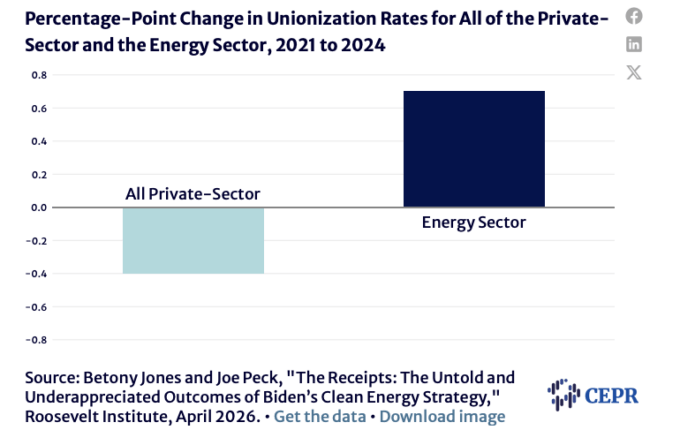
The Biden legislation encouraged the linking of project funding to labor and community benefits agreements. This policy appears to have worked to support the growth of union jobs in the energy sector. Figure 1 shows that while the overall private-sector unionization rate declined over the Biden administration, the unionization rate increased in the energy sector.

Figure 1


Much of the world is moving toward a clean energy future, but the Trump administration wants to take the United States back to the dirty energy past. One such step was the administration’s cancelling of wind energy projects. John L. Downey, the president of the International Union of Operating Engineers, who celebrated the growth of energy jobs at the AFL-CIO convention, issued a statement on December 23, 2025 in response to Trump’s actions:

The International Union of Operating Engineers denounces the Trump Administration’s decision to issue stop work orders on five large scale energy projects and immediately laying off thousands of American workers right before Christmas.

As working families struggle with a nationwide affordability crisis, the Administration’s decision adds insult to injury to thousands of construction workers who will be getting pink slips instead of holiday bonuses this week. This shortsighted decision, cloaked under a “national security” label, to halt construction on previously vetted and approved projects will only increase energy prices for ratepayers and hand America’s energy future to foreign competitors.

American workers are employed in this industry. Taking more wind power off the board creates uncertainty in the renewable construction business, and uncertainty creates job loss. We need to stay at the forefront of energy dominance, not scaling back the American workforce AND America’s power generation capacity.

He condemned the making of the members of his union “collateral damage in a political vendetta against one particular industry.”

While the Trump administration continues to waste taxpayer dollars by paying companies not to build wind projects, after a legal battle, there are signs that wind energy production developed by state governments might resume in the United States. As the Trump administration’s anti-clean-energy — and anti-good-jobs — stance continues, one hopes that unions and others will keep fighting for a clean energy future.

This first appeared on CEPR.


About Algernon Austin
Algernon Austin is the Director for Race and Economic Justice at the Center for Economic and Policy Research. Algernon Austin has conducted research and writing on issues of race and racial inequality for over 20 years. His primary focus has been on the intersection of race and the economy. Austin was the first Director of the Economic Policy Institute’s Program on Race, Ethnicity, and the Economy where he focused on the labor market condition of America’s workers of color. He has also done work on racial wealth inequality for the Center for Global Policy Solutions and for the Dēmos think tank. At the Thurgood Marshall Institute, the think tank of the NAACP Legal Defense and Educational Fund, Inc., he worked on issues related to race, the economy, and civil rights.
View all posts by Algernon Austin →
US-Israel Rift Has Been Brewing For Some Time – OpEd

June 30, 2026 
Arab News
By Yossi Mekelberg

There is perhaps nowhere further removed from the horrors of war unfolding across the Middle East than the tranquility of Lake Geneva, its surrounding mountains and the city itself, where negotiations between the US and Iran have been proceeding at a painfully slow pace in an effort to reach a deal that could end the conflict. Yet, alongside these talks, another development has emerged that could significantly influence their outcome and reshape the political and security architecture of the Middle East in both the short and long term: the growing rift between the US administration and the Israeli government.

This divide reflects a genuine divergence of interests over whether the war should continue or end. It also mirrors a gradual shift in American attitudes away from unquestioning support for Israel. Equally, it is a product of the personalities of the leaders of both governments: leaders who tend to be tactical, transactional and self-serving rather than strategic.

There has long been an element of predictability to this growing tension, as it has been brewing for some time. At the outset of the latest round of hostilities with Iran, both countries operated on the assumption that the campaign would be short, lasting days or at most weeks, and would fatally weaken the Iranian regime. This, in turn, was expected to eliminate Iran’s nuclear program, its long-range ballistic missile capabilities and its support of a network of regional allies and proxies. Needless to say, these assumptions were unrealistic from the outset.

More importantly, there was no Plan B when Plan A failed. While Israel never appeared to regard the possible closure of the Strait of Hormuz or Iranian attacks against neighboring Gulf states as decisive factors in either launching or ending the war, these should have been critical considerations for American policymakers when deciding whether to join the campaign or how to conduct it.

The absence of an alternative strategy beyond the best-case scenario of a rapid and total victory exposed a striking lack of strategic thinking. Little consideration was given to the consequences for the global economy if one of the world’s most important maritime arteries were to be disrupted. The desperate manner in which Washington is conducting negotiations with Tehran derives directly from this strategic failure.

Yet the current crisis between the US and Israel over the latter’s conduct in Lebanon, which is seen in America as obstructing progress in the negotiations, is only the immediate manifestation of a broader political and societal reassessment of the “special relationship” that has been gathering pace for years.

For Prime Minister Benjamin Netanyahu, particularly since Oct. 7, 2023, a perpetual state of war has become both a political objective and a governing strategy. It enables him to remain in office while delaying any state commission of inquiry into the failures surrounding the Hamas attacks. An endless war, in which tactical successes are repeatedly portrayed as strategic breakthroughs or steps toward “absolute victory,” serves primarily to keep a failed government in power.

This approach stands in sharp contrast to President Donald Trump’s political instincts. Trump is impatient, seeks immediate results and appears to place little value on enduring alliances or long-term strategic partnerships. At the outset of the conflict, Trump and those around him embraced the idea that a swift military victory could permanently resolve the Iranian challenge. Once the economic, political and diplomatic costs became apparent, however, the administration shifted toward limiting the damage as quickly as possible, with relatively little regard for the long-term consequences.

The US withdrawal from the Joint Comprehensive Plan of Action in 2018 followed a similar logic. Influenced in large part by Netanyahu, Trump also sought to dismantle one of Barack Obama’s signature foreign policy achievements. The result was that Iran, no longer constrained by the agreement, accelerated significant aspects of its nuclear program.

More recent understandings between Washington and Tehran may have reduced immediate tensions but they also contain the seeds of future instability and an Iranian attempt at hegemony. Despite suffering extensive military losses, the Iranian leadership has survived and may emerge believing that it is the US and Israel, not Tehran, that will ultimately be forced to make concessions.

Netanyahu should perhaps have drawn lessons from the way Trump has treated other foreign leaders. His administration has repeatedly demonstrated how quickly long-standing relationships can be discarded once they cease to serve immediate political interests. Personal loyalty matters only so long as it remains useful, while criticism is often delivered in deliberately harsh, public terms to exert political pressure.

When Vice President J.D. Vance reportedly remarked that “you can’t just kill your way out” of problems and argued that the US was effectively the only friend Israel has left — suggesting that Trump remained the only major world leader still openly sympathetic toward Israel — he was articulating an uncomfortable reality. Yet it was successive US administrations, including the current one, that helped create this situation. In Iran, Washington aligned itself closely with Israeli military objectives rather than pursuing durable political settlements through negotiations.

None of this, however, absolves the Israeli government of responsibility for the manner in which it has conducted its wars, often with little regard for civilian lives. Hence, Netanyahu’s approach to conflict over the past several years has left Israel increasingly isolated internationally. Now, growing tensions with Washington risk undermining Israel’s own long-term security and prosperity.

Since its founding, Israel has been the largest cumulative recipient of US foreign assistance, receiving well over $300 billion (adjusted for inflation) in economic and military aid. Nearly 70 percent of Israel’s imported weaponry originates in America. Moreover, Washington remains Israel’s principal diplomatic defender in international institutions, particularly at the UN Security Council.

American administrations come and go but broader shifts within US public opinion appear increasingly significant. Israel’s reputation as a like-minded democracy committed to liberal values and human rights has weakened, particularly among younger and more progressive Americans. At the same time, the “America First” wing of the Republican Party has become increasingly skeptical of foreign interventions and long-term overseas commitments.

With the midterm elections approaching and the political costs of another unpopular conflict mounting, Netanyahu and, to some extent, Israel itself risk becoming collateral damage as Washington seeks both a quick agreement with Iran and a recalibration of its regional priorities.

Equally, this moment may mark the beginning of a different phase in US-Israeli relations, one in which Washington seeks not only to protect Israel but also to prevent Israeli policies from damaging its own interests and destabilizing the region, which ultimately harms Israel itself.

• Yossi Mekelberg is a professor of international relations and an associate fellow of the MENA Program at Chatham House.