How Russia is Upending the West’s Attempt to Control Technology With Intellectual Property
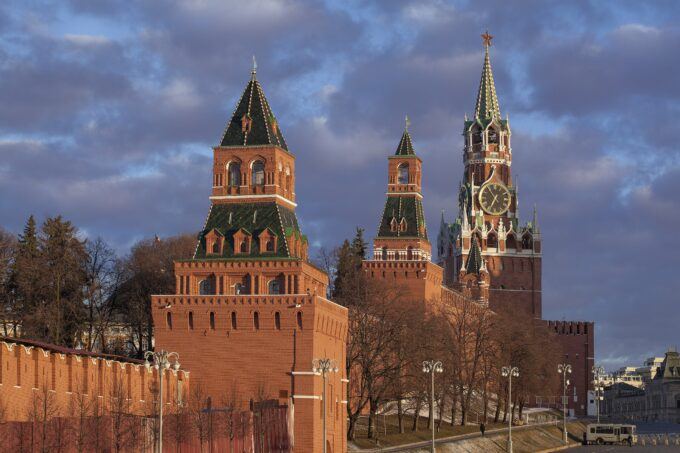
Spasskaya Tower, the Kremlin. Photo: Крылов Иван. CC BY-SA 4.0
Taking an invention and claiming it as yours is called intellectual property, based on practices followed by US and European businesses. But what happens when your neighbor argues that inventions can’t be owned, and that intellectual property is no longer applicable based on the rules and regulations you have established?
In March 2026, Russian officials announced plans to develop a state-managed system for the “temporary administration” of the intellectual property of foreign companies from “unfriendly countries” that left Russia after the 2022 Ukraine invasion. The move drew immediate concerns in policy and legal circles and is one of Moscow’s latest challenges to the Western-led system of patents, copyrights, and trademarks that has developed over centuries.
What Led to the Development of Intellectual Property
Before the modern IP system, creators could be protected through reputation, guild membership, secrecy, patronage, or state-granted monopolies. Early precursors to today’s framework took place in Venice, including printing monopolies in 1469, and reflected efforts to control the value of reproduced knowledge. Another milestone was the Venetian Patent Statute of 1474, which granted inventors time-limited exclusive rights over new creations. The European Enlightenment later helped spread the notion across the region that inventions and ideas could be legally ownable property, laying the foundations for modern IP law to develop in different states.
While powerful Western firms and states have the greatest stake in maintaining the existing system, given the advantages it ensures for key industries, that wasn’t always the case. From the late 18th century to the early 20th century, the US often relied on weak foreign IP enforcement, copying European industrial and scientific innovations, which “propelled the United States forward and quickly transformed it into one of the world’s leading industrial powers,” according to author Christopher Klein. British writer and journalist Charles Dickens, among others, meanwhile, complained about the widespread reprinting of books without royalties.
Jane K. and Peder Sather Professor of History at UC Berkeley, Carla A. Hesse, noted in an essay that US attitudes toward IP shifted from an “objectivist-utilitarian” emphasis on shared knowledge to a “universalist-natural-rights” view that prioritized exclusive rights over the country’s growing number of inventions. This was also seen in Germany, where firms became known for reverse-engineering machine tools and improving foreign chemical products. The country later became a strong advocate of patent protection.
When these economies caught up technologically, incentives converged to help drive the creation of international IP rules. The 1883 Paris Convention for the Protection of Industrial Property and the 1886 Berne Convention for the Protection of Literary and Artistic Works were milestones in establishing the modern global IP system.
The Russian challenge to the notion of IP goes back more than a century, with the Russian Empire only partially engaging with emerging global IP regimes before its 1917 Revolution. While adopting patent and trademark laws on paper, it applied them unevenly and with minimal enforcement, while focusing on state control over strategic industries and foreign technology transfers. Later, the Soviet Union joined some international agreements, including the Universal Copyright Convention (1952) and Patent Cooperation Treaty (1970), while avoiding others such as the Berne Convention.
Hesse and economist Ha-Joon Chang have noted that since the 1970s, the US and Western Europe have increasingly used trade sanctions and agreements to pressure developing nations to adopt their preferred IP standards. Institutions like the World Trade Organization (WTO) and the Agreement on Trade-Related Aspects of Intellectual Property Rights (TRIPS) have helped export Western-style IP rules, transforming intellectual property into a tool of economic governance that helped leverage technological progress.
Following the Soviet collapse, Russia moved its IP regime closer to Western standards in the 2000s and early 2010s, driven by WTO accession requirements and pressure and incentives from Western governments and corporations. Access to investment, markets, technology, and the global economy convinced Moscow that cooperation would be more constructive for national development.
China, of course, has been a principal target of claims about IP violations for Western companies. Beijing eased some tensions during the 2010s by improving its enforcement regime on intellectual property, and increasingly over recent decades, has focused on protecting the country’s expanding IP portfolio.
Ukraine
Hopes for further entanglement and collaboration with the Western IP regime were dashed after Ukraine entered the regional discussion. In the face of sanctions, Moscow increasingly explored legal avenues to limit the reach of foreign IP rights, citing national security concerns. It continued expanding its legal options over the next few years, including amending legislation in 2021 to allow the government certain use of patented inventions, utility models, and industrial designs without the rights holder’s consent.
The most significant changes followed Russia’s 2022 invasion of Ukraine. Wartime measures introduced by Moscow against countries that had imposed additional sanctions on Russia allowed the use of patents and industrial designs from the sanctioning country without compensation, expanded parallel imports without the patentee’s consent, restricted royalty payments, and widened the state’s ability to authorize the use of protected technologies.
Russia’s decision to alter global IP rules caused shockwaves across the West, with The Conversation stating “The suspension of intellectual property rights as an economic weapon in the context of a conflict is unprecedented, at least in recent decades,” But in their book Against Intellectual Monopoly, Michele Boldrin and David K. Levine argue that instead of a competitive market for innovations, patents have become a trading tool for powerful firms and countries in an oligopolistic patent market. From this perspective, challenging patent monopolies is essential to reducing dependence on foreign technology and increasing domestic innovative capabilities.
Russian courts have therefore shown greater willingness to entertain challenges to follow-on patents, arguing that secondary patents should not indefinitely delay generic competition once core inventions have entered the public domain. Russian officials and legal scholars attending the 2026 St. Petersburg International Economic Forum, meanwhile, reinforced previous arguments that intellectual property rights are not absolute protections but economic privileges, subject to national development and competition objectives.
For many Russian firms, the risks of violating Western IP rights have also changed. Sanctions, market exits, and technology transfer restrictions have already cut many off from Western suppliers, reducing disincentives to continue using foreign technologies without authorization, particularly when supported by state policy.
While the 2026 state-managed system shows efforts to formalize the reassignment of IP, Moscow has stopped short of abandoning IP law altogether. Instead, it has sought to selectively weaken protections while preserving access to international trade and technology, and continues to use IP law to protect Russian inventions and companies abroad.
Post-Sanctions Developments
Some of the earliest signs of Russia’s new approach to IP drew attention for its impact on a variety of products and industries. Western brands such as Peppa Pig ended up in courtroom disputes over trademark control. The company that owns the rights to the popular children’s series had taken a Russian entrepreneur to court for drawing his own versions of Peppa Pig. Meanwhile, former McDonald’s franchises were taken over and rebranded by a local licensee, and there were media reports about microchips being stripped from imported home appliances to repair military equipment.
More consequential changes emerged at the industrial level. Parallel imports through third countries to bypass Western restrictions are being facilitated through close integration with China and its Eurasian Economic Union partners. Defense and dual-use technologies previously supplied by Western suppliers have been maintained, substituted, or replicated domestically. Western military equipment captured in Ukraine has been reverse-engineered, alongside civilian aerospace systems.
Foreign-owned automobile factories were meanwhile sold, frozen, or transferred to Russian operators before restarting under domestic branding. Russia’s car production fell from about 1.5 million vehicles in 2021 to roughly 600,000 before making a partial recovery in 2024, with sales of 756,000 vehicles, according to The Moscow Times. Several major facilities were later restarted under simplified production chains with increased reliance on imported components and Chinese supply chains, alongside output rebranding at former foreign-owned plants, such as Toyota.
Russia invited Chinese brands to fill the production gap, with their contribution rising from under 10 percent of automobile sales in Russia before the Ukraine war to more than 50 percent by 2023–2024. A large share of industrial capacity and investment has been redirected toward defense production and import substitution, making it difficult to determine the effects of Russia’s industrial and IP policies on the automobile sector.
The withdrawal of Western companies also exposed the dependency of modern economies on software and digital service networks. Reduced access to system updates, predictive maintenance, cloud services, and technical support created disruptions across the Russian industry and infrastructure.
Siemens, for example, suspended support for rail and industrial systems, while General Electric scaled back remote service and monitoring for gas and thermal turbines. SAP halted software used in factories, logistics, and energy, while Microsoft, Adobe, and other firms restricted services to software and cloud services for both businesses and consumers alike.
These measures have forced Russia to adapt to keep critical industrial systems operational. To support parts of its machine-tool sector previously dependent on Western hardware, Russian operators have relied on spare parts stockpiles, gray-market imports, and partial domestic substitution. For software, some equipment has operated offline using legacy software and local maintenance capabilities to replace vendor-linked support and update services.
At the consumer level, Russian authorities also signaled greater tolerance for software and media piracy, with Russian media emphasizing that domestic consumers had been exploited for profit by Western brands. Underlying this was the belief that dependence on foreign IP sends licensing revenues abroad and slows the development of domestic technological capabilities, as well as cultural sovereignty.
Impact on the Pharmaceutical Industry
Some of Russia’s most significant developments have occurred in the pharmaceutical sector, where tensions over IP predated the war. Seeking greater pharmaceutical security, Russia used state procurement programs and localization requirements to favor domestic producers, with courts increasingly willing to limit foreign patent protections. In 2017, Russian courts approved the production of certain patented medicines, including for HIV treatments, to the consternation of Western drug companies, who don’t conform to the idea of free medicine.
Peter Drahos and John Braithwaite, in Information Feudalism, show how Brazil previously resisted pressure from the US government and pharmaceutical companies by threatening compulsory licensing for HIV/AIDS drugs in the 1990s and early 2000s, helping make treatment and prevention far more affordable. This approach was widely supported by medical scientists, AIDS activists, and international health organizations, according to the National Library of Medicine. In contrast, Russia lacked a comparable network. Western health organizations were viewed with greater suspicion in Moscow, limiting international support for efforts to expand access to affordable medicines. Russian health networks also faced greater isolation following the 2022 invasion, as Western sanctions and supply chains contributed to a more fragmented environment for international health cooperation.
As these pressures strained access to dozens of essential medicines, Russian authorities increasingly treated pharmaceutical patents as flexible when weighed against public health and public policy goals. Domestic firms expanded efforts to develop copies of complex medicines that would have faced major legal obstacles in other jurisdictions.
This has resulted in numerous high-profile disputes. In 2025, Russian biotech company BIOCAD received approval for its own version of Darzalex, the $10 billion-a-year cancer drug developed by Johnson & Johnson subsidiary Janssen. Boston-based Vertex has also accused the Russians of infringing patents linked to its cystic fibrosis treatment, Alyftrek. Danish drugmaker Novo Nordisk has challenged Russian patents relating to semaglutide products, while Britain’s AstraZeneca also has multiple disputes with Russian manufacturers over the manufacture of cancer and diabetes medicines.
Russian courts continue to be a major battleground for IP disputes. According to The Pharma Letter, both foreign drugmakers and Russia’s Federal Antimonopoly Service (FAS) have lost a series of cases involving generic products launched before the expiry of patents on the original drugs. Meanwhile, pharmaceutical trade tensions between Washington and the EU have weakened collective Western efforts to defend pharmaceutical IP abroad.
Between Fragmentation and Reform
Russia’s challenge to IP protections was extensive even before the war, with Russia’s Intellectual Property Rights Court accused of using unlicensed software by a former judge in 2018.
Moscow’s IP strategy is not yet systematically applied to the state. While Russia’s executive and legislative branches have steadily expanded mechanisms to weaken foreign IP protections, parts of the judiciary have been more cautious. Hostile states, including Russia, still seek foreign investment, technology transfer, and access to global markets, and even while challenging Western IP rights, Moscow continues to rely on similar protections for its own inventions and companies abroad.
Western companies have also avoided treating the rupture as permanent. Although many suspended or exited Russian operations, most maintained trademark and other IP registrations in anticipation of a possible return. Allowing these rights to lapse would risk losing control in one of Eurasia’s largest markets and potentially set precedents elsewhere, particularly in China. As a result, many firms continue to do business in Russia, driven not only by financial considerations but also to ensure IP protection.
Russia is not alone in challenging aspects of the current IP system. India and South Africa spearheaded an international effort during the COVID-19 pandemic seeking temporary waivers on IP protections to ensure greater access to vaccines, sparking wider discussions on greater flexibility under current rules during emergencies.
A related issue is the patenting of preexisting traditional knowledge. In 1995, researchers at the University of Mississippi’s Medical Center received a US patent for turmeric’s wound-healing properties, until India challenged it by providing evidence that the practice had long been part of traditional medicine. The patent was revoked in 1997, but showed how long-established, socially beneficial knowledge can be appropriated through patent systems.
Russia’s efforts to challenge the Western-dominated IP model have seen mixed results, with some success in sectors such as pharmaceuticals but limited progress in advanced semiconductors and high-end industrial technologies. At the same time, Moscow’s continued reliance on IP mechanisms to protect its own assets highlights their central role in global innovation, technology transfer, and international trade.
As history shows, the appropriation and adaptation of foreign technologies and knowledge have often contributed to rapid industrial catch-up and advancement, including in many countries that are now among the strongest defenders of IP protection.
This article was produced by Economy for All, a project of the Independent Media Institute.