Sunday, July 05, 2026


Ocean Surface Temperatures Are Setting New Records Again
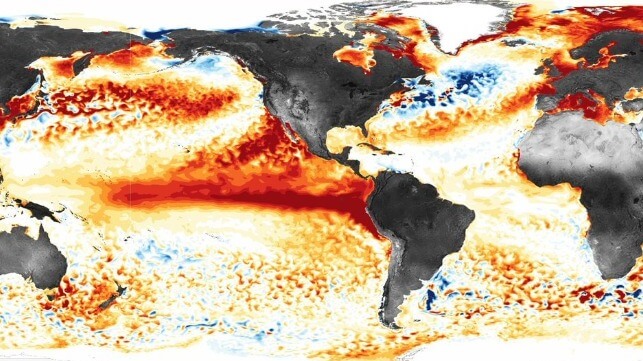
Copernicus Marine Service

Published Jul 2, 2026 11:07 PM by The Maritime Executive

Amidst a record-setting summer heat wave in Europe, the EU-sponsored Copernicus Marine Service has released a familiar message: a new record global sea surface temperature, making 2026 the third year in the last four that this threshold has been passed.

The incremental difference is small, about 0.1 degrees C over the previous records for the date of June 21, and it was expected. With El Nino conditions arriving in the Pacific, and high heat events observed in other ocean basins, the average was predicted to rise - and more daily records are expected in the weeks to come.
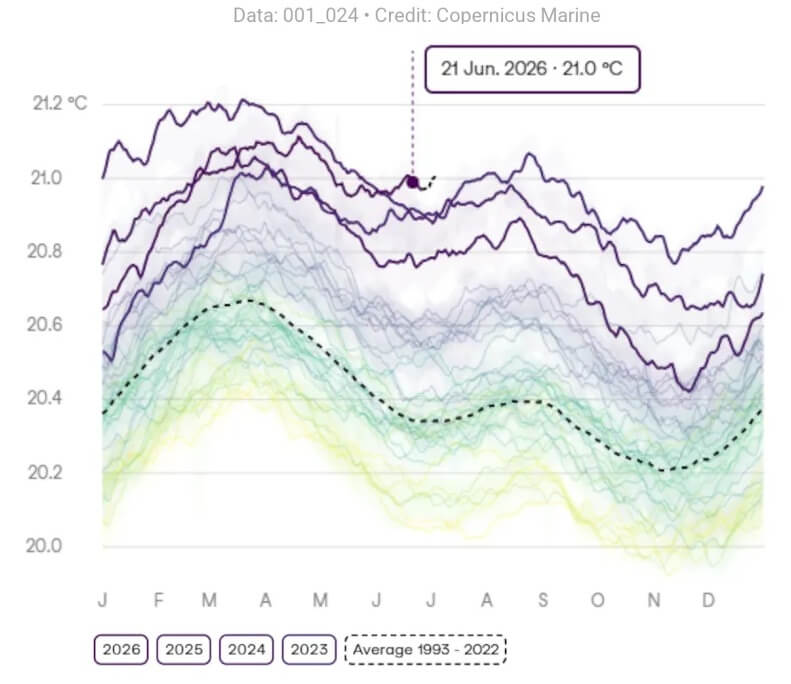
The new daily record was confirmed by a sister institution, the European Centre for Medium-Range Weather Forecasts (ECMWF).

“With ocean temperatures at these levels and El Niño on the horizon, we are likely to see more temperature records fall in the coming months. That Copernicus Marine data reaches the same conclusion through independent methods speaks to the strength of European science — and to why open, robust data matters now more than ever,” said Carlo Buontempo, Copernicus Climate Change Service Director at ECMWF.

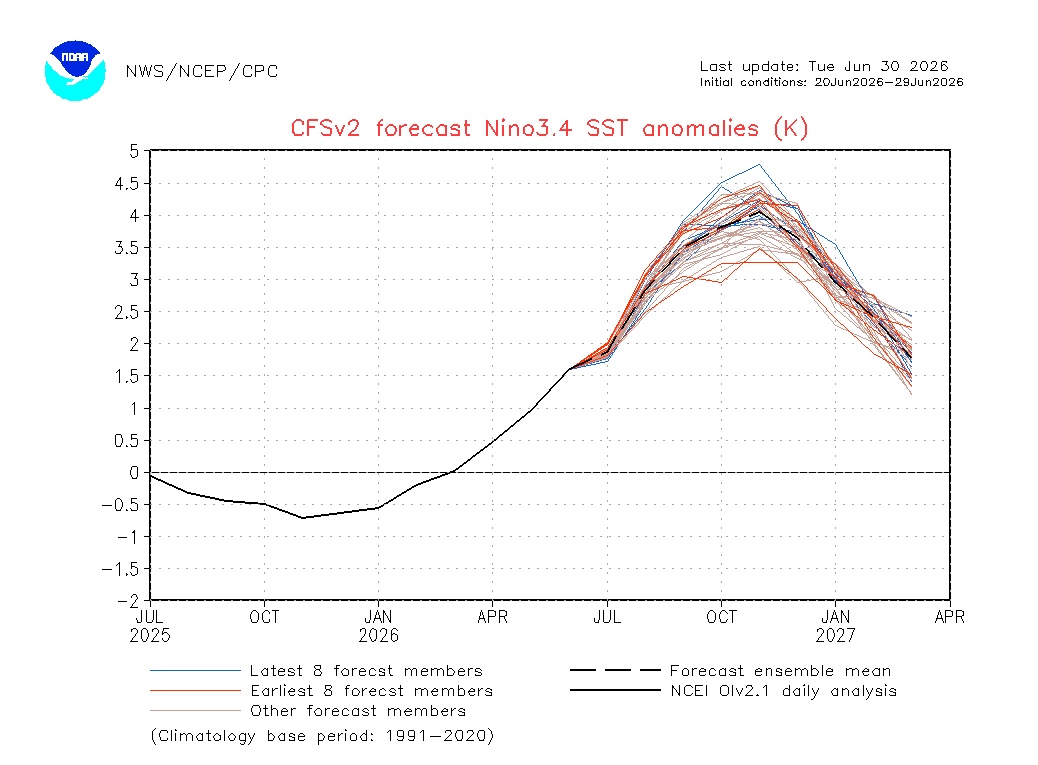
El Nino events cause surface temperatures to soar in the equatorial Eastern Pacific, affecting weather patterns around the world. Increased average global air temperature and more extreme weather events (droughts, storms and heat waves) typically accompany El Nino years. Climate scientists expect 2027 to bring record global temperatures, driven by El Nino conditions - and the effects could be unique this time, given the size of this year's event.

"This El Niño is unusually large for this early in the year, and it is occurring in a warmer climate that is fundamentally different than past decades," climate scientist Kim Cobb told CNN.  

Sea surface temperatures are an important part of the picture for weather, but the rest of the ocean is getting warmer too. Last year, deep ocean waters from 0-2,000 meters of depth set a new record for heat content, a joint Chinese-U.S. research team wrote in Advances in Atmospheric Sciences.

In a related paper in Nature Climate Change penned by many of the same authors, researchers suggested that this work depends on the integrity of a global network of sensors, created by many nations but underpinned by U.S. research investments. Any reductions in this international partnership, known as the Global Ocean Observing System - for example, the Trump administration's early removal of a $370 million deep ocean monitoring megaproject - will reduce future data quality on ocean heat content. This will have an outsize impact on climate research, experts in the field say. 

"Ocean heat content is the most robust indicator of climate change we have - not just of what is happening in the ocean, but of the entire climate system," French oceanographer Sabrina Speich told The Guardian. "Lose them, and you lose your ability to track not just ocean warming but the climate system as a whole."


Record ocean temperatures push climate into uncharted waters
Record ocean temperatures push climate into uncharted waters
Ocean temperatures are beyond breaking all time high records as the Climate Crisis enters a new phase. / bne IntelliNewsFacebook
By IntelliNews July 3, 2026

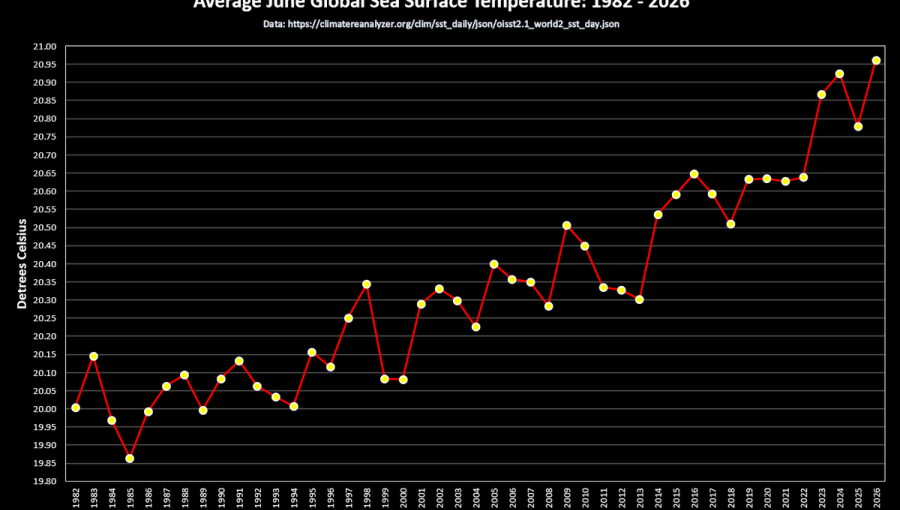
The world's oceans reached their highest average June surface temperatures on record this year, underscoring growing concern among scientists that the planet is entering a new phase of climate instability in which extreme weather events become both more frequent and more severe.

According to the EU's Copernicus Climate Change Service (C3S) and Copernicus Marine Service (CMEMS), global sea-surface temperatures exceeded the previous June records set in both 2023 and 2024. On June 21, average sea-surface temperatures reached between 20.86°C and 21.0°C, the highest ever recorded for this time of year.

The record comes as Europe recovers from an exceptional early-summer heatwave that shattered temperature records across much of the continent, while forecasters warn that the emergence of a potentially powerful El Niño later this year could intensify global weather extremes even further.

Although the oceans cover more than 70% of the Earth's surface, they absorb more than 90% of the excess heat trapped by greenhouse gases. Rising sea temperatures therefore provide one of the clearest measures of long-term global warming, but they also act as a powerful amplifier of extreme weather by transferring heat and moisture into the atmosphere.

"Current conditions could indicate the beginning of a new phase, leading, once more, to uncharted territory," said Carlo Buontempo, director of the Copernicus Climate Change Service. "With ocean temperatures at these levels and El Niño on the horizon, we are likely to see more temperature records fall in the coming months."

The Mediterranean Sea  heatwave is so severe, climatogists complained they ran out of colors to paint the extreme on maps.  Sea surface temps peaked at 8°C above normal.  Perhaps more impressive is how expansive the area of 6°C  anomalies are. Much of the water is 29-32°C.

“The Sea is now record hot for early July beating - you guessed it - the old record set last year. This is obviously a consequence of the most severe heatwave in Europe history last week. And this weekend another intense heatwave is due to arrive,” Jeff Berardelli a climatologist said in a social media post.

Scientists stress that the current warming reflects two forces acting simultaneously. Long-term climate change has steadily increased baseline ocean temperatures over recent decades, while the re-emergence of El Niño—a natural warming of the tropical Pacific that occurs every two to seven years—is now adding another layer of heat to an already warmer planet.

The consequences extend far beyond hotter beaches. Warmer oceans provide additional energy for tropical cyclones, increase evaporation that can fuel heavier rainfall and flooding, accelerate sea-level rise through thermal expansion and place increasing stress on marine ecosystems, particularly coral reefs already suffering repeated bleaching events.

Marine heatwaves have become increasingly widespread. Copernicus estimates that around 82% of the world's oceans experienced marine heatwave conditions during the first half of this year, with parts of the Mediterranean recording sea-surface temperature anomalies of as much as 6°C above the long-term average.

The timing is especially concerning because global sea temperatures typically continue rising through July and August. Forecasts suggest El Niño will strengthen through the second half of the year, potentially reaching levels not seen for decades. If that occurs, meteorologists warn that already elevated ocean temperatures could help drive another year of record-breaking global heat, alongside greater risks of droughts, floods and powerful storms.

For climate scientists, the latest milestone reinforces a broader trend. The world's oceans have now spent much of the past three years at or near record temperatures, suggesting that what once appeared exceptional is rapidly becoming the new baseline. The question is no longer whether the oceans are warming, but how quickly societies can adapt to the increasingly volatile climate system that follows.
 

Summer Cruise Boom Supports B.C. Businesses and Tourism Operators

Vancouver cruise ships

Published Jul 3, 2026 8:49 PM by The Maritime Executive

[By Vancouver Fraser Port Authority]


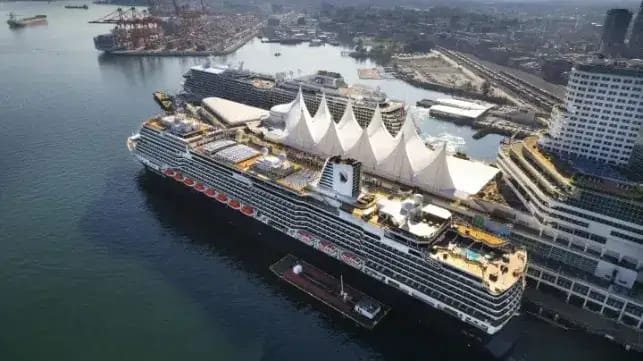
B.C. businesses and tourism operators are set for a welcome boost in coming months, with July and August on track to be the busiest months ever for the Canada Place cruise terminal.

A record-breaking 290,000 passengers are expected to pass through Canada Place in July—the most ever for a single month—with similar passenger numbers also anticipated in August.

The strong cruise volumes will provide a significant boost for the local economy with new passenger survey data revealing cruise visitors spend an average of more than $1,100 each locally on hotels, restaurants, shopping, tours and local attractions, and more.
 
“The Canada Place cruise terminal at the Port of Vancouver continues to demonstrate its importance as a vital driver for Canadian tourism year-over-year,” said Chance McKee, Senior Account Representative at the Vancouver Fraser Port Authority.

“We are seeing these strong cruise volumes translate into ongoing meaningful benefits for local and regional businesses and communities. The continued success of Vancouver’s cruise sector reflects strong collaboration and shared local commitment to ensuring Vancouver remains one of the best and most sustainably managed cruise ports in North America.”

Vancouver is also increasingly becoming an added destination on many cruise passengers' travel itineraries, with more than three-quarters of travellers spending time locally before or after their cruise (up from 70% in 2023), according to the 2025 Cruise Passenger Survey by the Pacific Rim Cruise Association. The same survey found average local spending per cruise passenger had grown to $1,144.

The growing popularity of the Alaska cruise market has helped Vancouver cruise to thrive in recent years, with upwards of 1.2 million passenger visits and 300-plus ship calls a year the new post-pandemic normal for Canada Place. In 2026, there will be an estimated 1.4 million passenger visits and 360 cruise ship calls—a 30% increase in passenger volumes compared to 2019.

The Port of Vancouver is a full-service homeport where cruise lines base their ships for the Alaska season, with passengers embarking and disembarking, and ships re-stocking between sailings. Each cruise ship visit to the Canada Place cruise terminal injects about $3 million into the local economy as cruise lines, such as Carnival Corp.’s brands Holland America Line, Princess Cruises and Seabourn Cruise Line, look to local goods and services providers to keep their operations running smoothly.

“As we reach the heart of summer cruise season, we’re once again reminded what makes sailing from Vancouver so special,” said Beth Bodensteiner, president of Holland America Line. “We’re proud to introduce guests to the wonders of Alaska, Hawaii, the South Pacific, Asia and beyond, all from Canada Place—while also supporting local businesses and Vancouver’s vibrant tourism economy. And we look forward to celebrating our milestone 80th year visiting Alaska with our partners at Port of Vancouver next year.”

“Vancouver plays an important role in Seabourn’s Alaska season, and we’re pleased to have Seabourn Encore sailing from this beautiful city for the first time this year,” said Mark Tamis, president of Seabourn. “As one of the more spacious luxury small-ship vessels in our fleet, she allows us to give more guests immersive Alaska experiences in both popular destinations and towns, as well as in lesser-known ports and hideaways, connecting them more closely to the region’s landscapes and communities, and supporting local businesses.”

“Princess Cruises will deliver its largest Alaska season ever in 2026, with seven ships visiting Vancouver, including our newest ship, Star Princess,” said Gus Antorcha, president of Princess Cruises. “Whether guests begin or end their journey in Vancouver, they’ll have access to unforgettable Alaska experiences – from breathtaking glacier viewing to our immersive North to Alaska program – designed to connect guests more deeply with the region’s natural beauty, rich culture and iconic wildlife.”

Strong cruise volumes and ongoing FIFA World Cup 2026 festivities mean those planning to visit downtown Vancouver and Canada Place should plan for increased crowds and traffic.
 

The products and services herein described in this press release are not endorsed by The Maritime Executive.


Rijkswaterstaat Program for Zero-Emission Emergency Response Towing Vessel

Damen Shipyards Group
ijkswaterstaat launches development programme for zero-emission ERTV 1.

Published Jul 4, 2026 5:32 PM by The Maritime Executive

[By: Damen Shipyards Group]

Rijkswaterstaat has launched the research and development phase of the Power2Tow project. Under this innovation partnership, three consortia will simultaneously develop new solutions for near zero-emission Emergency Response Towing Vessels (ERTVs) and the associated charging infrastructure at sea and onshore. To mark the start of this project, Director-General Martin Wijnen signed cooperation agreements with the three consortia on 30 June.

A key feature of Power2Tow is that Rijkswaterstaat is entering the research and development phase alongside the consortia. Within the innovation partnership, all three consortia have been awarded the contract and will receive a compensation to further develop and refine their proposed innovative solutions. This approach provides scope for different technological approaches and innovative ideas. In doing so, the consortia are developing solutions for the vessels, the offshore and onshore charging infrastructure, and the operational deployment of the complete system.

During the research and development phase, the proposals will be further developed, tested and evaluated. Ultimately, one consortium will be selected to deliver the project for Rijkswaterstaat. This will allow the contract for construction and operation to be awarded directly, without the need for a further procurement procedure. Each consortium comprises a partnership of various companies and/or organizations, each bringing its own specialist expertise.

The consortia selected for the research and development phase are:

  • Kustkracht: Kotug International B.V., IHC Defence B.V. and Bluewater Energy Services B.V.
  • Multraship Ocean Towage B.V., Damen Shipbuilding & Cooperation B.V. and Stillstrom A/S
  • Smit Terminals Europe B.V. & Smit Salvage B.V.

Safety and sustainability in the North Sea
Through Power2Tow, Rijkswaterstaat is developing a future-proof emergency towing capability in the North Sea. The project includes the development of three electric ERTVs, capable of charging offshore using wind energy, to help protect the offshore wind farms from collisions involving vessels in distress. The development of offshore and land-based charging infrastructure, together with the provision of services for a period of 25 years, also forms part of Power2Tow. The vessels will operate on electric power wherever possible, while sustainable e-methanol will be used for emergency towing operations. This represents an important step towards the further decarbonisation of the maritime sector.

Part of the Rijksrederij Fleet Renewal programme
Power2Tow forms part of the Fleet Renewal Programme for the Rijksrederij (Netherlands Government Shipping Company). Through this programme, Rijkswaterstaat is working to ensure the timely and sustainable renewal of the national fleet. In addition, Power2Tow contributes to the maritime sector agenda, "No guts, no Hollands glorie!" under which the strategic interests of the maritime manufacturing industry are given greater consideration in government procurement processes. The Power2Tow project is being delivered in collaboration with the Ministry of Infrastructure and Water Management, the Ministry of Economic Affairs and Climate Policy, the Netherlands Coastguard and the interdepartmental Maritime Manufacturing Industry Coordination Office (Rijksregiebureau Maritieme Maakindustrie).

The products and services herein described in this press release are not endorsed by The Maritime Executive.


Investment Firm KKR Sells Ocean Yield to A.P. Moller Holding

gas carriers
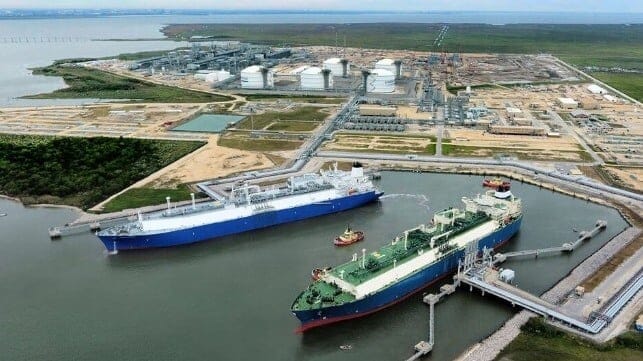
Ocean Yield has nearly half its fleet in LNG, including a deal for gas carriers to be chartered to Cheniere Energy (Cheniere Energy file photo)

Published Jul 2, 2026 5:38 PM by The Maritime Executive

The investment arm of the Maersk family, A.P. Moller Holding, is expanding its large portfolio of maritime investments, reporting it has agreed to buy Norway’s Ocean Yield, a large shipowner-lessor. According to A.P. Moller, the acquisition will strengthen its maritime portfolio and build on its experience in the segments of the maritime industry.

Headquartered in Oslo, Norway, Ocean Yield holds interests in over 70 vessels across several core shipping sectors, including gas carriers, container ships, LNG carriers, crude, product and chemical tankers, and dry bulk carriers. The acquisition expands A.P. Moller’s exposure in the LNG sector, where Ocean Yield currently has nearly half its investment, or a total of 30 vessels.

Ocean Yield is continuing to grow its exposure in the energy sector, reporting that it recently extended a deal with NYK to add four additional LNG carriers in a joint venture. That will bring the total of this JV to eight vessels, all of which will operate under charter to Cheniere Energy. Similarly, it recently took delivery of new vessels which are chartered to Qatar Energy.

The other large segments of Ocean Yield’s fleet include 12 crude oil tankers and 10 containerships. It also has dry bulk carriers and other vessels.

“Since 2021, we have strengthened Ocean Yield as a globally diversified maritime leasing platform with long-duration, high-quality contracted cash flows and a modern fleet positioned for the energy transition,” said Andreas Røde, CEO of Ocean Yield.

Established in 2012, Ocean Yield was acquired by the well-known investment firm KKR (Kohlberg Kravis Roberts & Co.) in 2021. KKR highlights that it has significantly scaled and diversified Ocean Yield’s platform with more than $3 billion invested, strengthened its long-term contracted revenue base, and supported its transition toward a more modern and sustainable fleet. KKR will continue to hold its joint investment with Ocean Yield in CapeOmega Gas Transportation, which owns 10 of the LNG carriers.

A.P. Moller Holding, established in 2013 by the Maersk family as an investment vehicle, is the parent company of the A.P. Moller Group. It has a broad range of holdings in the maritime sector, including, in addition to Maersk, investments in Svitzer tugs, DOF offshore, Noble Drilling, Maersk Tankers, Maersk Offshore Wind, and other non-shipping investments.
 

Port of Galveston Opens New Berth with 1st Cargo Vessel Call

Galveston, Texas

Published Jul 4, 2026 6:11 PM by The Maritime Executive

[By Port of Galveston]


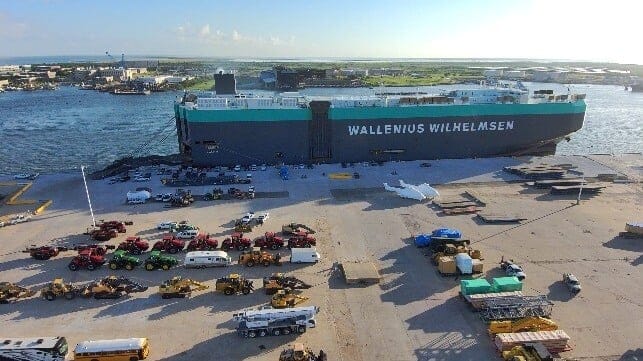
The Port of Galveston’s new cargo berth officially opened for business July 2 with a Wallenius Wilhelmsen cargo carrier delivering roll-on/roll-off cargo at the West Port Cargo Complex.

The 656-foot-long MS Toledo offloaded hundreds of pieces of heavy construction equipment from Brazil and the Far East to be transported by truck to destinations in Texas and Middle America. Then union workers loaded heavy construction and farm equipment bound for Brazil and Australia.

The 1,410-foot-long berth at Pier 39-40 is part of the port’s $106 million cargo facility expansion project begun in 2024 and completed in 2026. Work to repair and expand the cargo area also included enclosing two outdated slips, filling one slip, repaving and repairing cargo handling areas, and demolishing a decommissioned grain elevator.

The project, which will add almost 30 acres to the previously 60-acre facility, was funded with port operating revenues and a $36 million Texas Department of Transportation (TxDOT) grant. A future phase will include filling the second slip to add another 6 acres.

Galveston Wharves Port Director and CEO Rodger Rees, said, “This is the first time in decades that the port has made a significant investment in its cargo business. Driven by cargo tenant demand, the expansion paves the way for major cargo growth to generate hundreds of new jobs and tremendous economic growth for the region. Additional land also allows us to consider other types of cargo not previously handled.”

Rees credited the Galveston Wharves Board of Trustees for its commitment to the major project and the Texas Legislature and TxDOT for jumpstarting the project with critical funding. He added that the port’s growing cruise business generated the revenues to fund the cargo area improvements.

TxDOT Maritime Division Director Geir-Eilif Kalhagen added, “This $36 million state investment added capacity and will help the Port of Galveston operate more efficiently as demand continues to grow. When the state partners with seaports on projects like this, we’re not just improving infrastructure, but strengthening the supply chain, supporting job growth, and ensuring Texas remains competitive nationally and globally.”

Located on Galveston Harbor, one of the nation’s busiest cargo waterways, the port moves 3 million tons of general and breakbulk cargos, including roll-on/roll-off (ro-ro) and giant wind turbine pieces a year. Cargo handling at public and private facilities on the harbor generates almost 20,000 jobs and a $6.5 billion economic impact statewide.

The products and services herein described in this press release are not endorsed by The Maritime Executive.


Bureau Veritas Signs Cooperation Agreement with Shenzhen Port Group

Bureau Veritas Marine & Offshore
Signing ceremony

Published Jul 4, 2026 5:24 PM by The Maritime Executive

[By: Bureau Veritas Marine & Offshore]

On June 29, Shenzhen Port Group and Bureau Veritas Marine & Offshore (BV) signed a strategic cooperation agreement in Shenzhen, China. The two parties engaged in in-depth discussions on strengthening collaboration across key sectors and jointly advancing the development of green shipping corridors.

Under the agreement, both parties will leverage their respective strengths and resources to deepen collaboration focused on the development of green shipping corridors and related businesses. Through resource sharing and complementary capabilities they will jointly develop green shipping projects to deliver replicable and scalable outcomes.

Bureau Veritas will provide professional technical support to Shenzhen Port Group and industry players at large, helping them navigate evolving maritime regulatory policies and translate emerging international rules into practical, implementable measures to align domestic and global industry standards. Backed by its comprehensive global business footprint, BV offers end-to-end testing, inspection and certification services covering the entire green fuel industrial chain, spanning renewable energy production to bunkering infrastructure for marine fuels. It has also built extensive hands-on experience in numerous domestic green fuel projects.

Alex Gregg-Smith, President, Bureau Veritas Marine & Offshore, said: "Global decarbonization of the shipping industry requires concerted efforts and in-depth collaboration across the entire industrial value chain. As a world-class port conglomerate, Shenzhen Port Group boasts strengths that are highly complementary to Bureau Veritas’s expertise in technical services and standard-setting. Deepening our partnership is of great significance for the green transition of the shipping sector. We hope this collaboration will serve as a catalyst to align domestic and international standards and jointly develop viable pathways for low-carbon maritime trade.”

Hu Zhaoyang, Secretary of the Party Committee and Chairman of the Board at Shenzhen Port Group, stated: “Bureau Veritas Marine & Offshore is a globally recognized authoritative body in the maritime sector, with a wealth of decarbonization solutions and practical experience for the global shipping industry. Its vision aligns perfectly with Shenzhen Port Group’s green development strategy. Building on this agreement, we will further expand all-round cooperation across relevant fields, and maximize the combined value of Shenzhen Port Group’s diverse industrial application scenarios and BV’s authoritative technical certification capabilities to achieve mutual benefit through complementary strengths."

The products and services herein described in this press release are not endorsed by The Maritime Executive.


Report: Russian Shadow Fleet Vessels Play a Role in Drone Incursions in EU

A Russian Orlan-10 medium range surveillance drone on a man-portable launcher (Mike1979 / CC BY SA 4.0)

Published Jul 2, 2026 8:57 PM by The Maritime Executive

Russia's intelligence agencies have used shadow fleet tankers to launch spy drones over Western Europe since at least 2024, but European governments have yet to field an effective response, concluded researchers at IISS in a new report. 

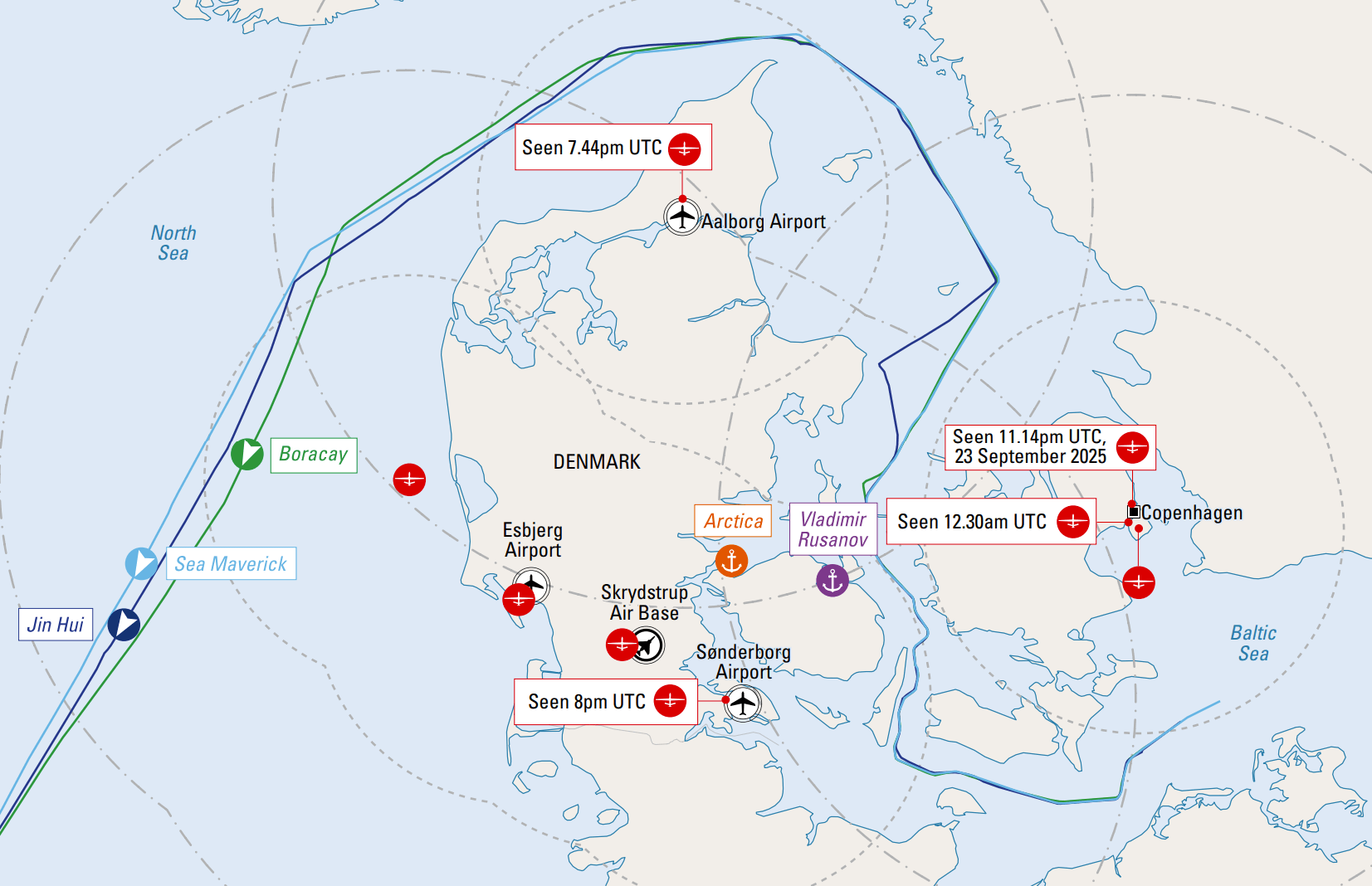
The three-person research team behind the report found that out of 144 documented incidents, a large subset were likely launched from the decks of Russia-linked vessels, based on patterns of AIS and satellite-based radar ship tracking. Other reporters have previously suggested that Russia uses sanctions-busting tankers to launch drone sorties, notably the disruptive UAV intrusions at Copenhagen's airport in 2025. French forces stopped and boarded the tanker Pushpa/Boracay shortly after this notorious series of drone incursions into Danish airspace; two deck officers from Boracay were taken in custody, and the interdiction by French commandos sent a strong message. (The Kremlin denied any knowledge of the vessel.)

The complex drone incursion suspected to be linked to the Boracay and other Russian vessels, Sept. 23-24, 2025 (IISS)

But IISS' report is a more comprehensive analysis, and it extends beyond anecdotal reports. The think tank described the campaign as a success for Moscow and a "strategic failure" for European air defenses, which were designed to deal with missiles, fighters and bombers. The absence of a response also suggests a failure of coordination and attribution, the report found. 

Save for one incident involving the Russian spy ship Zhigulevsk, "[no governments] have, to date, publicly attributed a UAV sighting to Russia or gone as far as to describe a coordinated Russian UAV campaign over Western and Northern Europe," the authors noted. "One reason, European officials have suggested to us as part of our research, is that the relevant governments focused on the national response rather than connecting the dots across Europe."

By carrying out these incursions, Russia likely fulfilled several intelligence objectives, the team said. First, Russia was able to assess how quickly and effectively European militaries and civilian decisionmakers could respond to a drone incursion, useful information for planning covert attacks. Second, it could evaluate the defenses of important sites: half of the documented incursions occurred at military installations, including highly sensitive nuclear-weapons sites. Third, it caused confusion and disruption in countries that support Ukraine. And fourth, it established a routine pattern of airspace violations, habituating Europe to the presence of Russian drones. (Germany's Federal Criminal Police Office puts the number of drone incursion incidents at 1,072 events in 2025 alone). 

It also revealed a vulnerability, the researchers said: Russia had to use drones to gather information because it had no better options. If it had better satellite imaging capabilities, or more intelligence agents on the ground, it would likely have used them, IISS suggested. 

The trouble going forward, the report concludes, is that the EU does not have a comprehensive way to counter the incursions. It has a drone response policy now, the European Drone Defence Initiative (EDDI), but this framework does not provide a way to counter shipboard launch platforms. 

"As long as Russian-linked vessels and the shadow fleet can loiter in international waters or European EEZs and launch UAVs with effective impunity, the campaign’s primary enabling mechanism remains intact. The Zhigulevsk incident demonstrated that attribution is possible. The question is whether European governments are prepared to act on it," the authors concluded.


Testing Begins for First Wing-Sail Installed on a Car Carrier

wind-assisted propulsion installed on car carrier
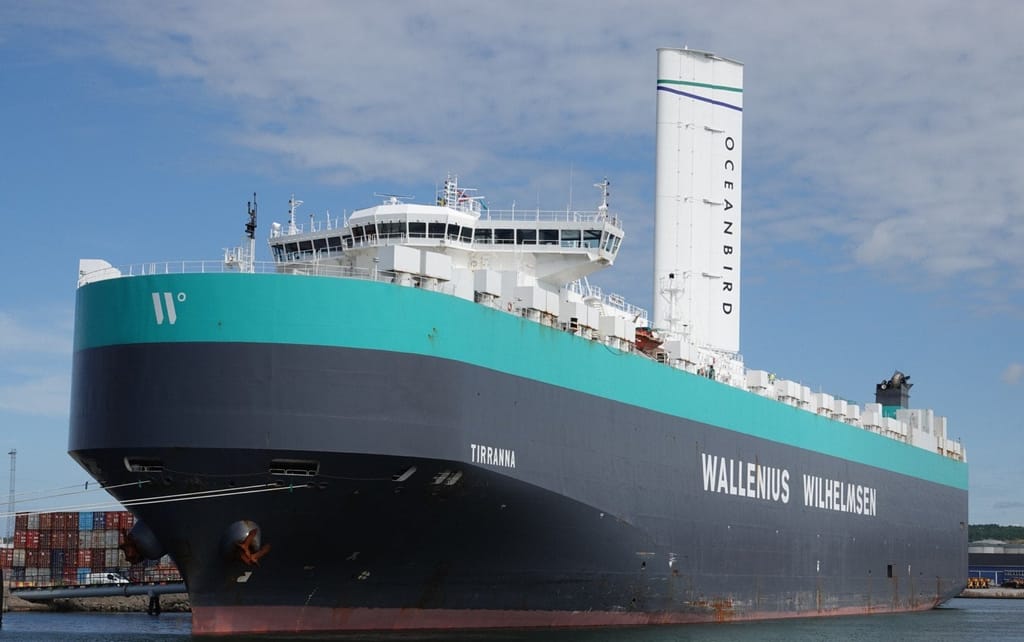
Car carrier Tirranna became the first in its class fitted for wind-assisted propulsion as Oceanbird deployed its first prototype on an in-service vessel (Oceanbird)

Published Jul 2, 2026 6:09 PM by The Maritime Executive

Oceanbird, a joint venture started by Alfa Laval and Wallenius Lines in December 2021, reached a key milestone as its prototype for a vessel received class certificates and completed its installation, extending wind-assisted propulsion for the first time to the car carrier segment.

The installation took place between June 21 and 24 at the Damen Shipyard in Rotterdam aboard Wallenius’ Tirranna. The vessel, which is 30,000 dwt and has a capacity to transport 7,620 cars, departed the yard on June 24. The harbor acceptance test and sea acceptance test have been completed as of July 1.

“This is a pivotal moment for us, and it is just the beginning,” said Oceanbird CEO, Amrit Bhullar. “We are very excited to see Wing560 perform at sea so we can prove the value of our efforts. This installation is the next step in our journey to create wind propulsion systems.” 

The effort was launched as part of Wallenius’ vision to incorporate wind-propulsion to its global fleet, achieving up to 50 percent of its propulsion power. The company has also shared designs for a wind-powered car carrier and for how the rigid sail could be incorporated to other sectors of shipping.

As Oceanbird’s first onboard prototype, the sail will provide critical information to learn how the technology performs in practice. The installation is about two years after the company first announced the plan and a year after it demonstrated a sail on land.

The installation stands 46 meters (approximately 150 feet) tall and is 14 meters (46 feet) wide to contribute the surface area needed to provide thrust to such a large vessel. They report the prototype is designed to deliver around 10 percent energy efficiency gains. It also has sensors and control systems to gather data and make it a testbed to validate performance.

The installation is part of the EU-funded Orcelle Horizon project. It aims to develop a new generation of large RoRo vessels that get 50 percent of their power from wind,

Wallenius is calling this installation an important step in the commercialization of wind propulsion for its global fleet.

Oceanbird reports that a team will sail with?Tirranna?to collect performance data, monitor usage, and evaluate the wing’s efficiency under real operating conditions under a limited period.

The company says it is planning the next installation for the spring of 2027. The undisclosed vessel will receive two of its Wing 560s to expand the testing in operating conditions.


Panama Ship Registry Returns to Paris MoU “White List”

Panama flag on stern of a ship
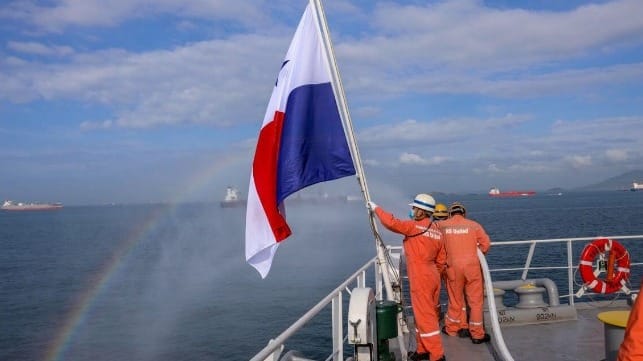
The Panama Ship Registry has returned to the Paris MoU White List due to an effort to ensure quality of the ships in the registry (Panama Maritime Authority)

Published Jul 2, 2026 6:49 PM by The Maritime Executive

Officials in Panama are highlighting the successful return of its ship registry to the Paris MoU White List after having been on the Grey List for the past several years. They are highlighting it as a confirmation of their efforts to maintain the highest standards for Panama-registered vessels.

It is a critical development for the flag and registry, which is the largest by the number of ships. It has been under pressure from competitors and criticized for substandard vessels and harboring shadow fleet tankers. The administration has made a concerted effort with the support of the government to purge the registry and enhance its administration.

The annual listing setting the standards for flags is effective as of July 1 and is based on three years of data reviewed by the Paris MoU. Flag state performance is evaluated using a rolling three-year average based on inspections and detention conducted at ports within the organization.

Panama highlights that there were 5,7312 inspections of ships under its flag between 2023 and 2025. It reports the data shows a total of 338 detentions during that period, or a rate of 5.9 percent, well below the Paris MoU standard of 7 percent to be on the White List.

Ships on the White List are recognized for operating under the highest standards. It is also reflected in their inspection routines

The Panama authorities highlight a sustained strategy to strengthen safety standards, enhance compliance with international conventions, and reinforce oversight of the Panamanian merchant fleet. The return to the White list, they report, reflects a series of initiatives over the past several years to improve performance on inspections while also raising the overall quality of the registry.

Among the steps they highlight is a strengthening of its preventative inspection program and an introduction of more rigorous mechanisms to identify and monitor vessels with a history of deficiencies during inspections. It also adopted enhanced methodologies for flag state inspections.

Other efforts included reinforcing a precheck process to ensure that only vessels meeting international standards are admitted to the Panama Ship Registry. It has also enhanced the removal process for violators and increased the number of flag cancellations.

The Panama flag, however, has been under pressure in 2026 due to the political and commercial disputes between Panama and China. China recently denied it was targeting ships with the Panama flag as a retaliation for Panama’s cancelling CK Hutchison’s operations in the port of Balboa and Cristobal. The number of Panamanian-flagged ships detained in China jumped dramatically, while China says this was due to the ships being involved in fishing boat accidents.


Venezuelan Port Remains Shuttered as Quake Response Continues

Amphib USS Fort Lauderdale arrives in La Guaira, June 28 (USMC)

Published Jul 2, 2026 11:22 PM by The Maritime Executive

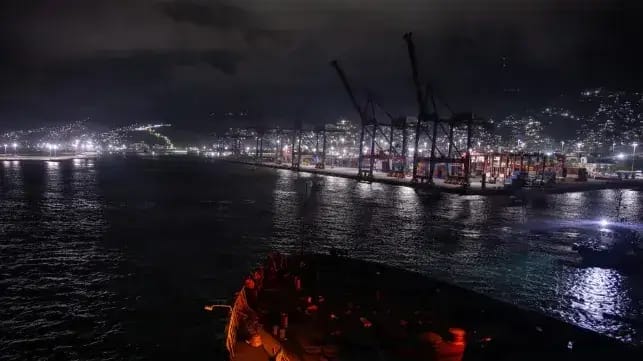
The massive quakes that destroyed thousands of buildings across Venezuela's central coastline have also disrupted the normal functioning of the port of La Guaira, prompting container lines to suspend or alter service until recovery operations are complete. 

The harbor is accessible, according to the U.S. military. The amphib USS Fort Lauderdale has been allowed to enter the port and moor alongside in order to speed up delivery of humanitarian goods and services. An emergency supply vessel from the Mexican Navy is also expected soon. However, commercial port operations are shut down for the present, according to Maersk. 

"Commercial operations at the Port of La Guaira have not yet been authorized to resume. As a result, import and export shipments through this terminal remain suspended until further notice," the number-two container line said in a statement.

Bookings to La Guaira from other ports in the Americas are suspended for now, but Maersk will still accept new bookings from overseas, which will arrive later and allow more time for the port's reactivation. Maersk is still running operations elsewhere in Venezuela, and is accepting returns of empties at its Puerto Cabello location instead of La Guaira. 

CMA CGM reports that structural damage has rendered the La Guaira Container Terminal inoperable for the time being, citing reports from state-owned port operator Bolipuertos. 

Instead of commercial activity, the quayside has been pressed into service as a temporary disaster-response hub. A temporary field hospital has been set up by charity Samaritan's Purse, and aid distribution operations are in process as well. 

The port also serves another essential role. The quake's official death toll stands at about 1,700 people, but tens of thousands remain missing, and independent assessments suggest that the true number is much higher. To handle the influx of remains, responders have set up a temporary morgue on the quayside at La Guaira, where forensic specialists are working to identify the deceased. A nearby area has been set aside for family members to await news of their loved ones, according to EuroNews. 


Fire Crews Battling Large Scrap Metal Fire on Bulker in Gdansk

scrap metal fire on bulker
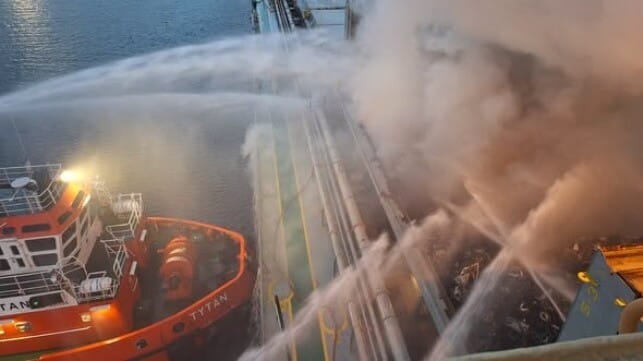
Fireboats were aiding the fight against the scrap metal fire on a bulker (KM PSP Gda?sk)

Published Jul 3, 2026 12:43 PM by The Maritime Executive

A large, smoky fire was reported aboard a bulker loading in the Port of Gdansk, Poland, on Thursday evening. There was a large ongoing response involving fireboats and crews onshore while residents complained of smoke blanketing the city.

The Panama-flagged bulker Sion Star (237,152 dwt) was loading scrap metal at the terminal when the fire was reported on Thursday evening, July 2. Crews said it was a difficult, stubborn fire because of the depth of the cargo holds and the densely packed nature of the cargo.

At its peak, the fire departments reported that around 100 firefighters and 27 fire engines were being deployed. Pictures showed fireboats alongside spraying foam on the fire. They were also cooling the ship’s fuel tanks as a precaution. They were also using a thermal camera to locate the center of the fire.

The decision was made to begin offloading some of the scrap metal to get to the center of the fire. The fire department reported by late morning on Friday that it had reached the fire, and it was not spreading.  A commander from the State Fire Service said they were not sure if the source of the fire was oily scrap metal or other flammable materials aboard the ship.

By Friday afternoon, crews reported the fire had been extinguished. The offloading of material, however, was continuing.