Rijkswaterstaat Program for Zero-Emission Emergency Response Towing Vessel
[By: Damen Shipyards Group]
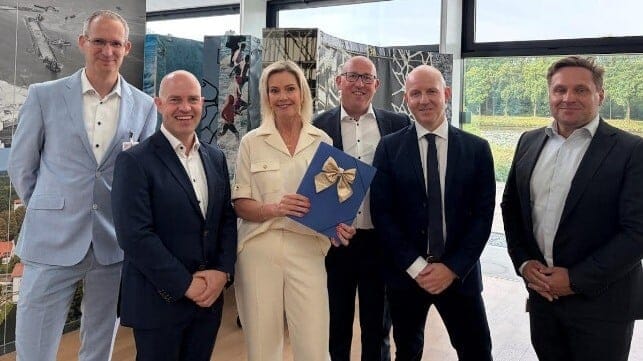
Rijkswaterstaat has launched the research and development phase of the Power2Tow project. Under this innovation partnership, three consortia will simultaneously develop new solutions for near zero-emission Emergency Response Towing Vessels (ERTVs) and the associated charging infrastructure at sea and onshore. To mark the start of this project, Director-General Martin Wijnen signed cooperation agreements with the three consortia on 30 June.
A key feature of Power2Tow is that Rijkswaterstaat is entering the research and development phase alongside the consortia. Within the innovation partnership, all three consortia have been awarded the contract and will receive a compensation to further develop and refine their proposed innovative solutions. This approach provides scope for different technological approaches and innovative ideas. In doing so, the consortia are developing solutions for the vessels, the offshore and onshore charging infrastructure, and the operational deployment of the complete system.
During the research and development phase, the proposals will be further developed, tested and evaluated. Ultimately, one consortium will be selected to deliver the project for Rijkswaterstaat. This will allow the contract for construction and operation to be awarded directly, without the need for a further procurement procedure. Each consortium comprises a partnership of various companies and/or organizations, each bringing its own specialist expertise.
The consortia selected for the research and development phase are:
- Kustkracht: Kotug International B.V., IHC Defence B.V. and Bluewater Energy Services B.V.
- Multraship Ocean Towage B.V., Damen Shipbuilding & Cooperation B.V. and Stillstrom A/S
- Smit Terminals Europe B.V. & Smit Salvage B.V.
Safety and sustainability in the North Sea
Through Power2Tow, Rijkswaterstaat is developing a future-proof emergency towing capability in the North Sea. The project includes the development of three electric ERTVs, capable of charging offshore using wind energy, to help protect the offshore wind farms from collisions involving vessels in distress. The development of offshore and land-based charging infrastructure, together with the provision of services for a period of 25 years, also forms part of Power2Tow. The vessels will operate on electric power wherever possible, while sustainable e-methanol will be used for emergency towing operations. This represents an important step towards the further decarbonisation of the maritime sector.
Part of the Rijksrederij Fleet Renewal programme
Power2Tow forms part of the Fleet Renewal Programme for the Rijksrederij (Netherlands Government Shipping Company). Through this programme, Rijkswaterstaat is working to ensure the timely and sustainable renewal of the national fleet. In addition, Power2Tow contributes to the maritime sector agenda, "No guts, no Hollands glorie!" under which the strategic interests of the maritime manufacturing industry are given greater consideration in government procurement processes. The Power2Tow project is being delivered in collaboration with the Ministry of Infrastructure and Water Management, the Ministry of Economic Affairs and Climate Policy, the Netherlands Coastguard and the interdepartmental Maritime Manufacturing Industry Coordination Office (Rijksregiebureau Maritieme Maakindustrie).
The products and services herein described in this press release are not endorsed by The Maritime Executive.
Investment Firm KKR Sells Ocean Yield to A.P. Moller Holding
The investment arm of the Maersk family, A.P. Moller Holding, is expanding its large portfolio of maritime investments, reporting it has agreed to buy Norway’s Ocean Yield, a large shipowner-lessor. According to A.P. Moller, the acquisition will strengthen its maritime portfolio and build on its experience in the segments of the maritime industry.
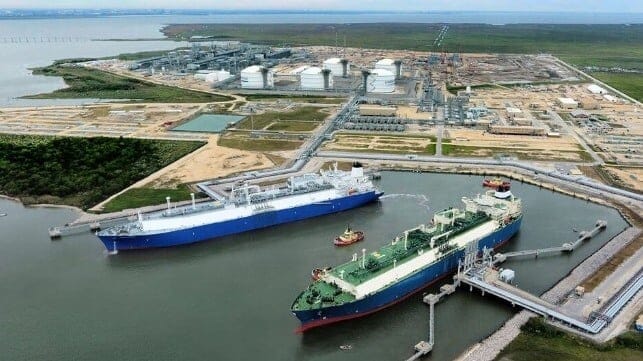
Headquartered in Oslo, Norway, Ocean Yield holds interests in over 70 vessels across several core shipping sectors, including gas carriers, container ships, LNG carriers, crude, product and chemical tankers, and dry bulk carriers. The acquisition expands A.P. Moller’s exposure in the LNG sector, where Ocean Yield currently has nearly half its investment, or a total of 30 vessels.
Ocean Yield is continuing to grow its exposure in the energy sector, reporting that it recently extended a deal with NYK to add four additional LNG carriers in a joint venture. That will bring the total of this JV to eight vessels, all of which will operate under charter to Cheniere Energy. Similarly, it recently took delivery of new vessels which are chartered to Qatar Energy.
The other large segments of Ocean Yield’s fleet include 12 crude oil tankers and 10 containerships. It also has dry bulk carriers and other vessels.
“Since 2021, we have strengthened Ocean Yield as a globally diversified maritime leasing platform with long-duration, high-quality contracted cash flows and a modern fleet positioned for the energy transition,” said Andreas Røde, CEO of Ocean Yield.
Established in 2012, Ocean Yield was acquired by the well-known investment firm KKR (Kohlberg Kravis Roberts & Co.) in 2021. KKR highlights that it has significantly scaled and diversified Ocean Yield’s platform with more than $3 billion invested, strengthened its long-term contracted revenue base, and supported its transition toward a more modern and sustainable fleet. KKR will continue to hold its joint investment with Ocean Yield in CapeOmega Gas Transportation, which owns 10 of the LNG carriers.
A.P. Moller Holding, established in 2013 by the Maersk family as an investment vehicle, is the parent company of the A.P. Moller Group. It has a broad range of holdings in the maritime sector, including, in addition to Maersk, investments in Svitzer tugs, DOF offshore, Noble Drilling, Maersk Tankers, Maersk Offshore Wind, and other non-shipping investments.

No comments:
Post a Comment