Monday, July 06, 2026

AI drones made in Germany see duty on Ukraine's front line


DW
07/03/2026

The German defense company Helsing is supplying combat drones to Ukraine and will soon provide them to the German army. How effective are they on the front line? DW joined a Ukrainian combat mission to find out.

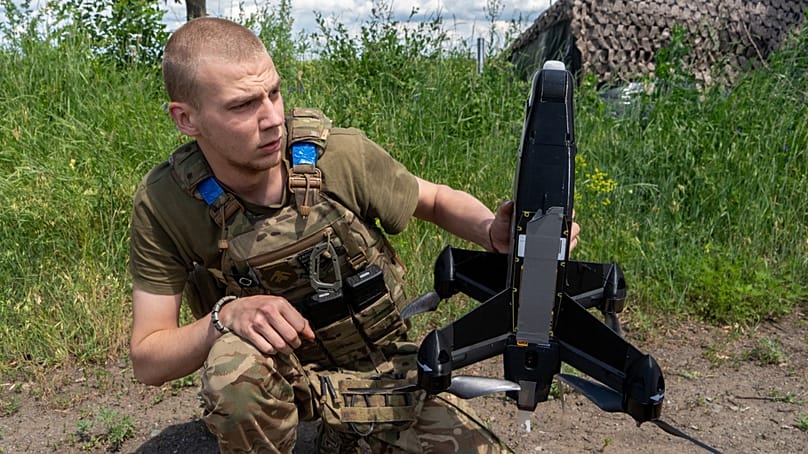
Ukrainian soldiers tested the HX-2 combat drone near Pokrovsk in March
Image: Hanna Sokolova-Stekh/DW

In a forested strip, two Ukrainian soldiers — a technician and an electrician — attach wings to a large black box. The kit is an HX-2 combat drone from the German manufacturer Helsing, equipped with artificial intelligence.

The billion-dollar startup from Bavaria is supplying thousands of these kits to the Ukrainian military, funded by the German government. Germany's armed forces have also recently awarded Helsing a multimillion-euro contract.

At the beginning of the year, critical reports about the drones appeared in Western media, including German outlets. They cited Ukrainian soldiers who reportedly identified technical issues during test deployments in 2025. According to a report by the newspaper Die Welt, many drones were not flight-ready or crashed shortly after takeoff. The hit rate was also said to be low. Its report quoted Ukrainian soldiers fighting at the front in eastern Ukraine.

The manufacturer, however, refuted these reports. "Members of the Ukrainian armed forces are testing the HX-2 drone together with Helsing staff at the front," a spokesperson told DW in late January. The first results of the tests, it said, were "encouraging."

How Ukraine's drone pilots help hold front near Pokrovsk  08:41


Combat deployment near Pokrovsk

The soldiers setting up the HX-2 drone repeatedly glance up at a detector mounted on a tree. It tracks Russian drones flying over their position.

Inside a shelter, two other soldiers — a pilot and a navigator — prepare to launch the German drone. They switch on their laptops and monitors, and also arrange a string of lights meant to create a bit of atmosphere. The crew is operating in the front-line section in Ukraine’s eastern Donbas coal region , where the Russian army is advancing.

"Our task is to destroy their logistics routes," says the pilot and commander, who goes by the call sign Black.

Helsing initially delivered its earlier, simpler HF-1 model, developed with a Ukrainian manufacturer. At the time, the order covered 4,000 drones. In early 2025, the German company announced delivery of an additional 6,000 drones of the new HX-2 model.

Black's crew, currently operating the HX-2, had first used Helsing’s first drone, the HF-1. The HX-2 is described as fast and agile. "It gives us a major advantage in the air — for the enemy it is harder to shoot down," says Black.

Target acquisition is carried out using artificial intelligence. "Normally we fly toward the target that reconnaissance drone pilots show us. However, the HX-2 system can independently identify targets. That said, it still can't tell if a target has already been destroyed or not," says Black.

Once the pilot confirms the target selected by the artificial intelligence, the drone continues its flight autonomously. According to commander Black, the HX-2 — like most drones — is vulnerable to electronic warfare.
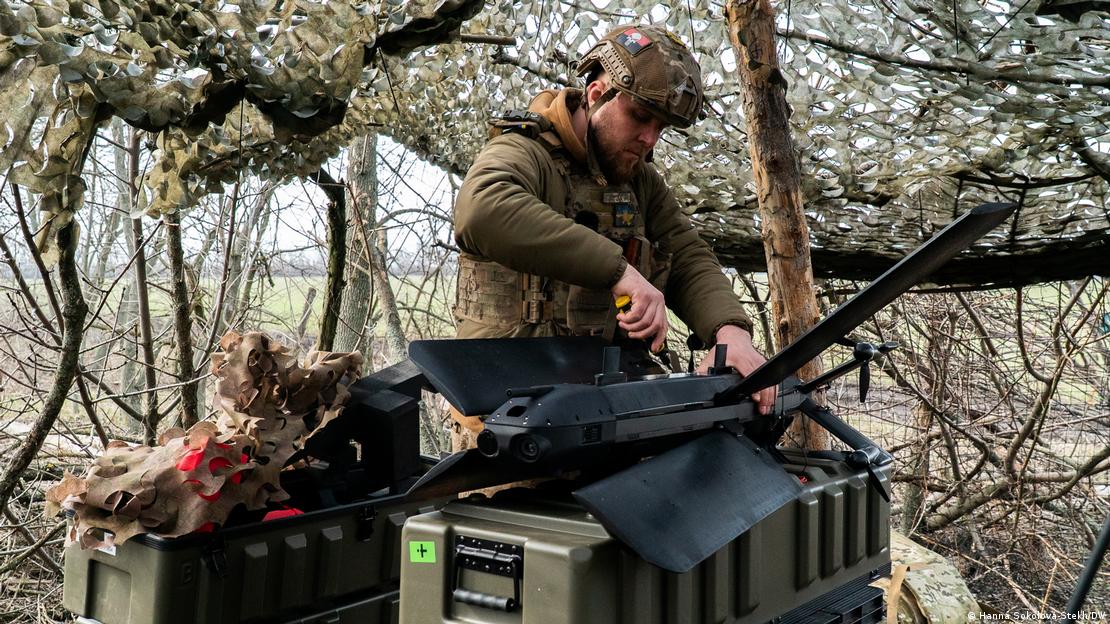
Technicians initially had a problem connecting the drone with the ground station
Image: Hanna Sokolova-Stekh/DW

The Ukrainian military personnel DW spoke with have identified several shortcomings with the drones that they do not want to make public. "Representatives of the manufacturer will come soon to look into it. We have a support chat with them," the commander says.

In response to a DW request, Helsing said the HX-2 drones have so far "not flown in sufficient numbers at the front to allow a fundamental assessment of performance under wartime conditions." The company added they are currently being adapted to front-line conditions, particularly to constantly changing electronic warfare measures used by the opposing side.

Helsing did not respond to DW’s request at the end of April regarding the current hit rate of the HX-2.

Problems arise during launch

The crew carefully selected the day for the HX-2 flight, taking into account wind speed, precipitation and cloud cover. The weather is clear. The drone is supposed to fly several dozen kilometers into the Russian-occupied part of the Donetsk region.

A few hours later, the HX-2 crew finally receives the launch order. The drone, however, doesn't launch from the catapult. The motor fails to start, the electrician reports over radio.

Together with the technician, he tries again and it finally takes off. It originally had a problem connecting with the ground station, something which occasionally occurs with this type of drone, explains Oleksandr Karpyuk, the unit's senior sergeant.

Putin admits Ukraine's drones are hurting Russia's economy   19:19


A hit in better weather

Despite the favorable weather forecast, the sky is now overcast again and the drone pilot is having difficulties with navigation. The test has to be aborted.

On the next deployment, when the DW reporter was no longer present, the crew successfully struck a truck. The drone operation was recorded by a reconnaissance drone and the military personnel show the video. They attribute the success to better weather conditions than during the previous mission.

Karpyuk reported that the earlier HF-1 model also delivered poor results at first, but the manufacturer responded to feedback and improved the product. As a result, the HF-1 has hit more than 50% of targets in the Pokrovsk front-line area.

When asked whether he would continue working with this drone, Karpyuk answers yes. In his view, the Russians currently have no comparable model to the HX-2. He cites the Russian "kamikaze drone" Lancet as an example.

"In the Lancet, the motor is at the rear — it's a pusher motor. The wings, also mounted at the rear, control the drone. Only Helsing has equipped its drones with four forward-facing motors. Why? Because it gives them maneuverability and speed," says Karpyuk.

This article was originally published in Ukrainian.


Hanna Sokolova-Stekh DW correspondent in Ukraine

Roman Goncharenko Writer and senior editor with a focus on European security, Russia and the war in Ukraine.


NATO's drone problem: Can European industry close the gap?
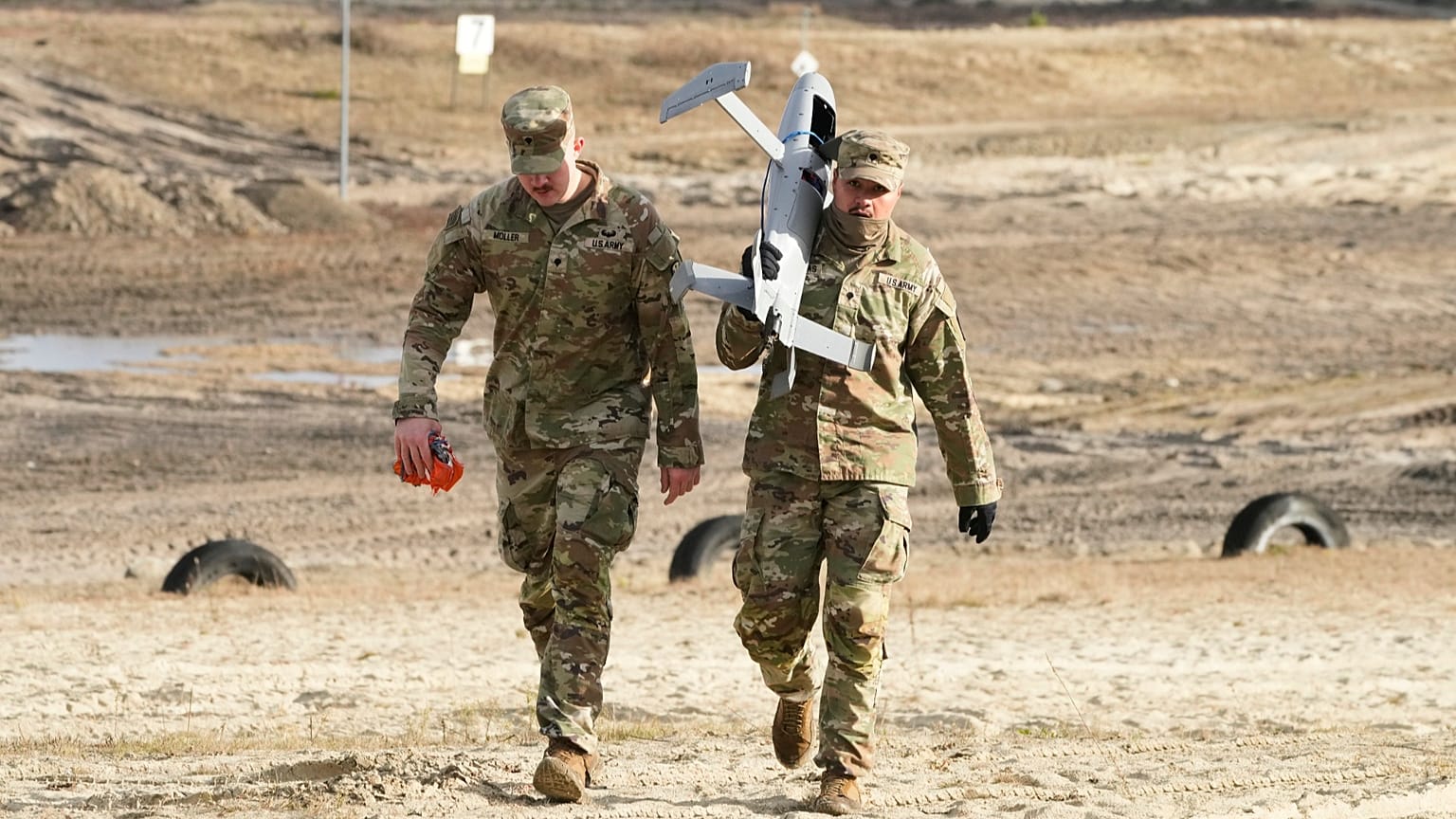
The American Merops drone system, deployed by Poland and Romania to defend Russian drones, is tested in Nowa Deba, Poland, Tuesday, Nov. 18, 2025.
Copyright AP Photo/Czarek Sokolowski

By Johanna Urbancik
Published on

At NATO AIRCOM's Industry Day in Ramstein, Euronews had exclusive access, speaking to military leaders and defence companies about the race to develop cheaper, faster and more effective ways to counter drones.

To find a more cost-effective solution and strengthen collaboration, NATO is turning to industry for ways to counter unmanned systems. Earlier this week, the second AIRCOM Industry Day took place at Germany's Ramstein Air Base, bringing together representatives from European arms manufacturers and the military.

A drone crashing into a house in Romania, another violating Lithuanian airspace, and Munich Airport suspending operations for several hours following a suspected sighting: unmanned systems, and how to counter them, have become an increasingly acute threat for NATO.

If a drone is detected violating NATO airspace, the operation known as "Eastern Sentry" is triggered, which involves the deployment of several fighter jets to either track the drone or, if necessary, neutralise it. This, however, is deemed a costly intervention: drones are relatively cheap, with some being produced for less than €100,000. A single NATO fighter jet scramble against a drone can cost tens of thousands of euros per hour, though, with a typical two-jet interception costing more than €85,000 before any missiles are fired.

In his opening remarks, Lieutenant General Guillaume Thomas, Deputy Commander of the Allied Air Command, emphasised that drone warfare is confronting NATO with "collective challenges," pointing out the masse that Russia is using in its war against Ukraine. For him, the solution is to stay ahead of three key curves: cost, production and innovation. Achieving that requires close cooperation between industry and the armed forces.
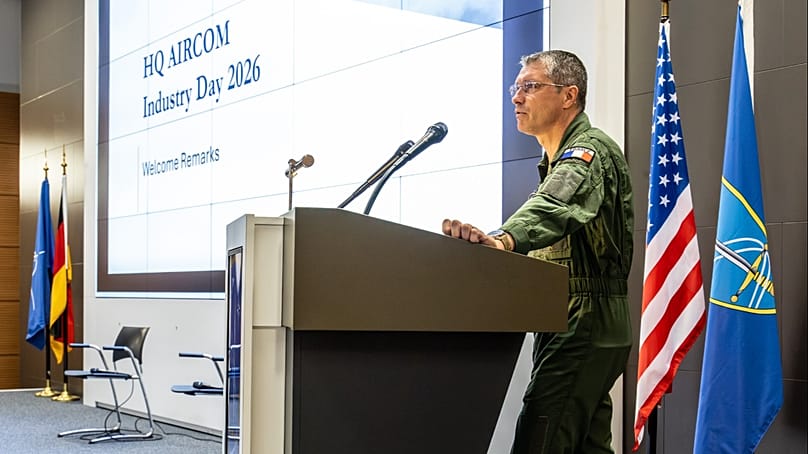

Lieutenant General Guillaume Thomas, Deputy Commander, NATO Allied Air Command (AIRCOM) provided by NAT

Working with Ukraine a 'requirement'

According to senior policy fellow at the European Council on Foreign Relations, Dr. Ulrike Franke, one of the event's keynote speakers, drones "have brought mass to the battlefield," which forces the alliance to focus on mass and cost, not using expensive equipment to take down cheap drones and work with Ukrainians. The latter, she called a "requirement" in countering drone threats.

Senior Lieutenant Oleksandr Vorobiov, call sign "Zhan" and deputy chief of air defence of Ukraine's 3rd Army Corps, said Ukraine's biggest shortcoming is reliable radar detection. He explained that intermittent radar tracking has prevented the development of fully autonomous interceptor drones, as existing radar systems often lose track of small drones for several seconds.

"The one thing that really stopped us [in Ukraine] from making it fully autonomous. The radars we mostly use in Ukraine were not designed to detect this type of drone. They're weather radars, jet radars, basically any type of radar except ones designed for these drones. That means the target sometimes disappears from the radar picture. If the drone still can't see the target and the radar loses track of it for ten seconds, then the drone needs to be operated manually for that time. That's the biggest gap: reliable detection of these kinds of targets. Maybe Europe has that capability, maybe the US has it, I don't know," he told Euronews.
A Ukrainian serviceman of Khartia brigade launches an interceptor drone in Kharkiv region, Ukraine, Friday, June 26, 2026. AP Photo/Andrii Marienko

Connecting military needs with industrial innovation

The aim of this year's industry day "is about innovation in technologies overall," Lieutenant Colonel Steffen Bott, the event's project manager told Euronews. He emphasised that during these industry days, the military's role "remains unchanged."

"Neither we as the military nor NATO itself enter into contractual relationships with defence companies. However, one of the main drivers behind the current focus on counter-UAS is that the military has identified specific operational requirements. To carry out these operations effectively, it has become clear that technologies in the counter-UAS field are evolving extremely quickly. Start-ups, alongside established defence companies, are driving much of this innovation. At the same time, military requirements, particularly in light of the war in Ukraine, are evolving rapidly. Those requirements may not change completely, but they adapt much faster than the procurement and acquisition processes designed to meet them," he explained.

Reflecting that focus on rapidly evolving counter-drone technologies, around 35 companies exhibited their latest systems at the event, including Matra BAe Dynamics Alenia (MBDA), Alta Ares, Hensoldt and Aselsan, to name a few. The systems and counter measures ranged from radars to interceptor drones and missiles, such as MBDA's specialised counter-drone missile. A representative told Euronews that the missile was developed to counter mass drone attacks, "such as those we have seen in Ukraine and the Middle East, typically involving Shahed or Geran drones, in a cost-efficient and effective way."
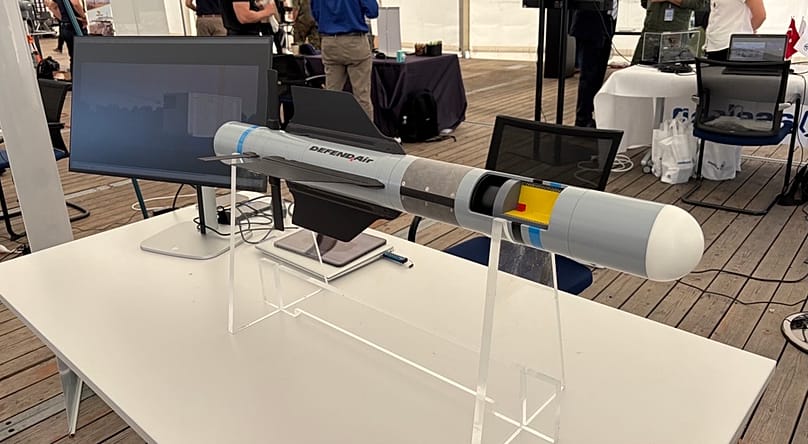
MBDA-interceptor missile mock up at NATO's Industry Day, 30/06/2026 Johanna Urbancik/ Euronews

The missile is being integrated into Rheinmetall's Skyranger 30 air defence system, the first of which are earmarked for Germany's brigade in Lithuania, with deliveries expected between 2027 and 2028. Each Skyranger 30 carries nine missiles, allowing a six-vehicle battery to field 54 ready-to-fire interceptors. Smaller Class 1 drones, such as quadcopters, are engaged by the system's 30 mm cannon, while the "Defend Air-missile is intended for larger threats, including Shahed-type drones, the company representative said.

Learnings from Russia's full-scale invasion of Ukraine

Walking through the exhibition tent, one thing quickly stood out: the absence of Ukrainian companies. The event was reserved for firms from NATO member countries, Euronews has been told. Still, Ukraine was an ever present topic for both the alliance and the companies, with many of them highlighting the collaboration with Ukraine.

Turkey's defence giant Aselsan told Euronews that the key learning from Russia's war against Ukraine is reliability. "The system has to be reliable. When the target comes towards you, you have just a few seconds to decide and act. The system should use artificial intelligence to shorten the decision-making time," he said.

A representative from the French defence company Alta Ares that develops AI-powered software and systems for intelligence, surveillance and reconnaissance (ISR) and counter-drone (counter-UAS) operations, told Euronews, that they "don't really see Ukraine as a lab". The French company has presented two different types of interceptors on NATO Aircom's industry day: the x-block, designed for short and mid-range interception, so with a maximum range of 15 kilometers and one is for longer range, which can go up to 40 kilometers from launching site.

"Our two co-founders were in Ukraine at the beginning of the war. And they worked closely with Ukrainian units in order to understand the needs, to understand clearly how the battlefield is evolving. They wanted to give them solutions adapted to their needs, so they worked on AI solutions in order to be integrated on the drones," the representative explained.

With more than 30 competitors exhibiting their products, competition is never far away. "If you adpot the Ukrainian way of thinking, we are only partners because we potentially need solutions like this in Europe," he told Euronews. "There's not enough on offer. There will be too much demand," he added, pointing out that Alta Ares has recently signed an Memorandum of Understanding (MOU) with the German drone company Quantum Systems.

Senior Lieutenant Oleksandr Vorobiov agreed saying it's "good they are there," as without, there's a lack of knowledge about the modern battlefield. Vorobiov added that he can't say if these efforts are enough, but the mindset, that European companies go to Ukraine and are present on the battlefield is good, albeit a little late.


Unmanned Arms Race: The Integration Of Drone Warfare In The South Caucasus – Analysis

A FlyEye reconnaissance drone. Photo Credit: VoidWanderer, Wikipedia Commons


July 6, 2026 
Geopolitical Monitor
By Turan Darishov


Key Takeaways

Drones Transformed Regional Warfare — The 2020 Nagorno-Karabakh War marked the first major conflict where drones played a decisive role. Azerbaijan’s use of Turkish and Israeli UAVs demonstrated their effectiveness against conventional forces, setting a precedent for modern drone warfare.

Azerbaijan Leads, Armenia Catches Up, Georgia Lags — Azerbaijan is the clear frontrunner with domestic production, dedicated Unmanned Systems Troops, and diversified procurement. Armenia is rapidly modernizing its drone capabilities after its 2020 defeat. Georgia is falling significantly behind despite limited local initiatives.

Ongoing Military Modernization — All three South Caucasus states are investing more in unmanned systems (aerial and ground), reflecting lessons from Ukraine and the 2020 war. Azerbaijan and Armenia have substantially increased defense spending, while Georgia’s efforts remain modest.


Analysis

The military use of unmanned aerial vehicles dates back decades, with early reconnaissance drones already appearing during the Vietnam War and later conflicts. However, drones only began being used widely during the war in Afghanistan, where the United States relied heavily on UAVs for surveillance, reconnaissance, intelligence gathering, and targeted strikes against enemy targets. The conflict demonstrated the value of persistent aerial monitoring and precision remote strikes, gradually normalizing the use of unmanned systems in modern warfare. In Afghanistan, drones were also increasingly used for logistics support, infrastructure monitoring, and broader military coordination, further expanding their battlefield role.

The use of drones leaped even further during the 2020 Nagorno-Karabakh War between Azerbaijan and Armenia, which became the first major interstate conflict where unmanned systems played a central battlefield role. Azerbaijan’s extensive use of Turkish Bayraktar TB-2 drones, Israeli loitering munitions, and reconnaissance UAVs demonstrated how deadly drones can be against armored vehicles, artillery systems, and air defenses. This conflict sealed UAVs as a vital part of the modern battlefield rather than supplementary assets.


In the Ukraine war, both sides increasingly relied on drones for reconnaissance, artillery adjustment, long-range strikes, logistics disruption, and direct attacks against armored vehicles and personnel. The conflict eventually accelerated the rapid evolution of FPV drones, loitering munitions, naval drones, and AI-assisted systems. The scale of drone usage and the unprecedented damage inflicted by relatively cheap unmanned systems fundamentally changed global military discussions about the future of warfare itself.
Regional Insecurity and Unmanned Systems in the South Caucasus

The South Caucasus occupies a particularly important place in the evolution of modern drone warfare. The 2020 Nagorno-Karabakh War became the first conflict where unmanned systems were systematically integrated to overwhelm and defeat a capable conventional force.


Although the region has not witnessed large-scale armed conflict since Azerbaijan’s 2023 operation in Nagorno-Karabakh, the South Caucasus still retains a noticeable degree of geopolitical instability. More than 20% of Georgia’s territory remains occupied by Russia following the 2008 war, while relations between the two countries continue to be tense. Armenia’s relations with Russia have also become increasingly strained in recent years as Prime Minister Nikol Pashinyan gradually expanded cooperation with the European Union and the United States. In addition, the Iran war introduced another layer of regional tension, with Azerbaijan briefly becoming involved after an alleged Iranian drone hit an Azerbaijani airport in Nakhchivan. Even though direct military confrontation remains unlikely in the near future, these security concerns continue to encourage South Caucasus states to modernize their armed forces and further explore the military potential of unmanned systems.

Azerbaijan: Drone Pioneer and Expanding Military Hegemon

Azerbaijan remains the most advanced and institutionally developed drone operator in the South Caucasus. The country continues actively expanding its unmanned warfare capabilities through both procurement and domestic development efforts. In recent years, Azerbaijan adopted several new drone systems into service, including domestically produced UAVs such as the “İti Qovan.” Azerbaijan’s leading defense producer “Azersilah” is also actively involved in UAV design and production efforts. Alongside local production initiatives, Azerbaijan continues operating a diverse fleet of Turkish and Israeli unmanned systems, including Bayraktar TB-2 and Akıncı drones, while also showing interest in acquiring additional advanced UAV platforms in the future. The country also established dedicated training and maintenance facilities for Akıncı drones. The military cooperation framework established with Türkiye under the 2021 Shusha Declaration further strengthened cooperation in defense technologies, training, and military-industrial development.


Azerbaijan also increasingly seeks to deepen cooperation with Turkish defense companies beyond simple procurement by exploring possibilities for joint drone production and broader defense-industrial collaboration with Baykar. In recent years, both sides signed cooperation agreements and memorandums regarding technology exchange, industrial cooperation, and potential localized production of Baykar systems in Azerbaijan, signaling Baku’s long-term interest in developing more sustainable domestic unmanned systems production.

One of the most important developments, which received little international attention, was the formal establishment of dedicated Unmanned Systems Troops within the Azerbaijani Armed Forces. The experience of Ukraine demonstrated that such an institutionalization of unmanned forces allows for better coordination and battlefield results. The commander of the newly established forces, Colonel Adam Huseynov, is known to have received high-level military decorations following the 2020 Nagorno-Karabakh War. Although Azerbaijani authorities have not officially clarified the exact location of the Unmanned Systems Troops within the broader military structure, the sequence of units presented during the 2025 military parade suggests that the new forces are likely integrated into the Azerbaijani Air Force structure.

Azerbaijan’s expanding drone capabilities are also supported by steadily increasing military expenditure. The country’s defense budget grew from approximately $2.24 billion in 2020 to a planned $5.1 billion in 2026, reflecting Baku’s continued emphasis on military modernization and technological development.

Armenia: Adapting to the Lessons of Defeat

Armenia’s approach to drone warfare and unmanned systems modernization is heavily shaped by the lessons of its military defeat during the 2020 Nagorno-Karabakh War, where Azerbaijani drones inflicted devastating damage on Armenian units and exposed major weaknesses in Armenia’s armed force structure. Since then, Yerevan has accelerated military modernization efforts with a strong emphasis on unmanned systems. This shift was clearly visible during the 28 May 2026 military parade, where Armenia showcased a wide variety of modern UAVs and unmanned systems ranging from small reconnaissance drones to larger strike-capable platforms. Among the systems displayed were reconnaissance and attack drones such as the UL350 and Storm-320. Armenia also showcased Chinese-made CH-4 strike drones equipped with precision-guided munitions, Iranian AD-08 Majid short-range air defense systems, and domestically produced drones such as the AW5R and Krunk-25.

One of the most interesting developments was Armenia’s demonstration of ground-based robots known as “Gail” (“wolf”). Similar unmanned ground systems have increasingly attracted attention following their use in Ukraine, where they were employed for logistics, reconnaissance, casualty evacuation, and even direct combat support missions. However, effective use of such systems requires strong communications infrastructure, coordination capabilities, maintenance networks, and institutional adaptation — areas where Armenia still faces important challenges. Nevertheless, the decision to integrate UGVs into military modernization efforts demonstrates Armenia’s growing awareness of broader unmanned warfare trends extending beyond aerial drones alone.


Another major post-2020 development was the establishment of the Unmanned Aerial Vehicle Directorate within the Armenian Armed Forces in 2024. The creation of a specialized UAV command structure demonstrates that Armenia increasingly views unmanned warfare as a strategically crucial military sphere. Armenian officials have repeatedly referenced the lessons of Ukraine as highly important for Armenia’s future military development, while simultaneously continuing active drone-related cooperation
 with a variety of foreign partners.

Armenia’s military procurement strategy also underwent significant diversification following 2020. While Russia previously dominated Armenian arms imports, Yerevan increasingly expanded defense cooperation with countries such as India, France, China, Iran, and the United States, while still maintaining certain Russian military ties. The purchase of Chinese strike drones and American-made V-BAT reconnaissance UAV’s reflects Armenia’s broader attempt to avoid overdependence on a single supplier.

Armenia’s military modernization is also reflected in rapidly increasing defense expenditure. The country’s military budget increased from approximately $634 million in 2020 to around $1.44 billion in 2026, demonstrating the importance Yerevan places on rebuilding and modernizing its armed forces following the 2020 war.

Georgia: Falling Behind in Drone Warfare


Compared to Azerbaijan and Armenia, Georgia appears significantly less advanced in the integration of unmanned systems within its armed forces and is increasingly falling behind in this field. The country’s arguably only significant drone-related project is the cooperation between the Georgian defense company Delta and the Polish firm WB Technologies under the Delta WB initiative. The partnership focuses on local production of systems such as the FlyEye reconnaissance drone and the Warmate loitering munition. Georgian authorities announced plans for serial production of these systems in summer 2023, and the initiative initially attracted considerable attention as a potential step toward strengthening Georgia’s domestic military-industrial capabilities.

However, despite the ambitious plans, there have been no follow-up announcements regarding successful large-scale production or operational deployment. Unlike Azerbaijan and Armenia, Georgia also has not established dedicated unmanned systems forces or specialized drone branches within its military structure. The relatively modest scale of Georgia’s recent military parade raises further questions regarding the current pace of military modernization. During the 26 May 2026 Independence Day Parade, Georgia showcased very limited military equipment and did not publicly demonstrate drone systems, in contrast to Armenia and Azerbaijan where unmanned systems occupied a visible place in military presentations.

Recently, professor and political analyst Lasha Dzebisashvili sharply criticized the government for insufficient military funding, procurement problems, and the lack of meaningful development of domestic military production capabilities. Georgia’s prolonged political instability and polarization may also partially explain the weak pace of military reform and modernization in recent years. This situation is particularly important given Georgia’s geopolitical environment, where Abkhazia and South Ossetia remain occupied by Russia following the 2008 war, creating a long-term security challenge for the Georgian state.

Georgia’s military spending reflects a similarly cautious trajectory. While the defense budget increased from approximately $288 million in 2020 to around $662 million in 2026, military expenditure as a percentage of GDP declined during the same period. This differs noticeably from Armenia and Azerbaijan, both of which significantly expanded military spending and modernization efforts following the 2020 Nagorno-Karabakh War.

Looking Ahead


The South Caucasus remains one of the regions where the importance of unmanned systems is most visible. The experience of the Nagorno-Karabakh wars, followed by the lessons emerging from Ukraine, demonstrated to regional actors that drones are a crucial weapon in 21st century warfare. As a result, all three South Caucasus states show at least some level of interest in developing unmanned warfare capabilities, although the scale of implementation varies significantly.

Azerbaijan currently stands out as the clear regional leader in drone warfare integration due to its domestic production, diversified procurement, and creation of dedicated unmanned systems structures. Armenia, largely motivated by the lessons of defeat in 2020, is rapidly attempting to modernize and diversify its military capabilities with increased emphasis on drones. Georgia, despite possessing some domestic production initiatives, lags significantly in practical adaptation. Overall, it appears that drone adaptation will remain one of the most important military modernization trends in the South Caucasus in the coming years.


This article was published by Geopolitical Monitor.com

About Geopolitical Monitor
Geopoliticalmonitor.com is an open-source intelligence collection and forecasting service, providing research, analysis and up to date coverage on situations and events that have a substantive impact on political, military and economic affairs.
View all posts by Geopolitical Monitor →


Summit host Turkey eyes major weapons deals with NATO allies

Issued on: 05/07/2026 - RFI
Play - 05:33 
INTERNATIONAL REPORT


Next week's NATO Summit in Ankara is expected to showcase Turkish President Recep Tayyip Erdogan’s rising influence within the alliance, as he aims to use the gathering to overcome resistance to crucial arms deals and highlight the rapid growth of Turkey’s defence industry.

Ankara is preparing for the upcoming NATO summit, which it views as a showcase for Turkey's defence industry. © Efekan Akyuz / Reuters

Boasting NATO’s second-largest army and sharing borders with flashpoints from Ukraine to the Middle East, Turkey is at the heart of the alliance’s future amid doubts about the United States' commitment to European defence.

“It is a paradigm shift,” says international relations professor Huseyin Bagci of Ankara’s Middle East Technical University.

With European and North American leaders attending the summit, on 7 and 8 July, Bagci predicts Erdogan will use the opportunity to cement Turkey’s pivotal role.

“The NATO summit will be a good instrument for Erdogan to show Turkish domestic politics, as well as international politics, that he is one of the medium-power leaders in the world with whom you have to deal."

Defence deals

Major arms deals are expected to make headlines at the summit. US President Donald Trump – attending out of what he calls respect for Erdogan – is not likely to come empty-handed.

"The administration is eager to deliver something to Erdogan," says Aaron Stein, president of the Foreign Policy Research Institute, a US-based think tank.

Trump and Erdogan are expected to sign a $700 million deal for the sale of around 80 GE F-110 fighter jet engines. The sale would be a major breakthrough for Ankara in its ambitious Fifth Generation fighter jet project.

“The Kaan fighter jet, Turkey's domestic fighter, is powered at least in the first iteration by the F-110. And so getting these engines would be important for the development of that fighter,” explained Stein.

Ankara is investing billions of euros into the Kaan jet, but without enough engines critics have mockingly called it the world’s priciest glider. Congressional roadblocks, fuelled by influential Israeli and Greek lobbies, have stalled the engine deal, but Trump has vowed to use executive power to push it through.

“Turkey has become a domestic political football in the United States, kicked around,” says Stein. “The administration wants to push forward on these agreements and is willing to use leverage to do it."

Ankara is also looking to the NATO summit for a breakthrough in its goal to secure the French-Italian SAMP-T anti-missile system. Until now Paris has blocked the sale, but French media has hinted that an agreement could be within reach.

“That would open maybe a new chapter in European-Turkish relations,” says International relations expert Zaur Gasimov of Istanbul’s Turkish German University.

“That would bring key European members of NATO – France, Italy – closer to Turkey. And would maybe forge a new core group within NATO."
Exclusion from SAFE

Ankara is using the summit to spotlight Turkey’s booming defence industry, showcasing its cutting-edge weaponry and highly coveted drones, used in conflicts from Ukraine to Africa.

“Turkey has quite a developed field of drone production, which is of paramount importance in modern types of warfare,” explains Gasimov. “So all that makes Turkey a very, very special member of NATO from the point of view of European leaders."

However, Turkish arms sales to Europe face a major hurdle: exclusion from the EU’s €150 billion Safety and Assistance for Europe (SAFE) arms procurement programme. EU members Greece and Cyprus continue to block Turkey’s participation in SAFE due to unresolved disputes in the Mediterranean and Aegean Seas.

Bagci predicts Erdogan will use his meeting with European leaders to try to break this deadlock.

“SAFE is the grand strategic decision of the European Union, so it cannot be stopped or prevented by such a small country like the southern Republic of Cyprus or Greece. The Greeks and the southern Republic of Cyprus, they have to stop or shut up and not prevent [Turkey’s participation in] SAFE," he says.

Turkey is the only country that recognises the Turkish Cypriot administration in Northern Cyprus, refusing to recognise the Republic of Cyprus as the sole sovereign administrator of the island, as international law does.

By: Dorian Jones

Turkey steps up arrests ahead of NATO summit

DW with AFP, dpa
July 5, 2026

Journalists, academics and members of left-wing groups have reportedly been detained during police raids in several Turkish provinces. Turkey's capital Ankara is set to host a major NATO summit this week.

Supporters of the leftist HKP staged an anti-NATO rally in Ankara on Sunda
y
Image: Riza Ozel/AP Photo/picture alliance

Turkish police have arrested several journalists, rights activists, academics and members of leftist groups, according to media and unions in Turkey on Sunday.

The raids across several provinces come as the Turkish government, led by President Recep Tayyip Erdogan, steps up security operations in the run-up to a NATO summit taking place in Ankara on Tuesday and Wednesday.

Turkish authorities have imposed a strict ban on public gatherings in Ankara ahead of the summit.

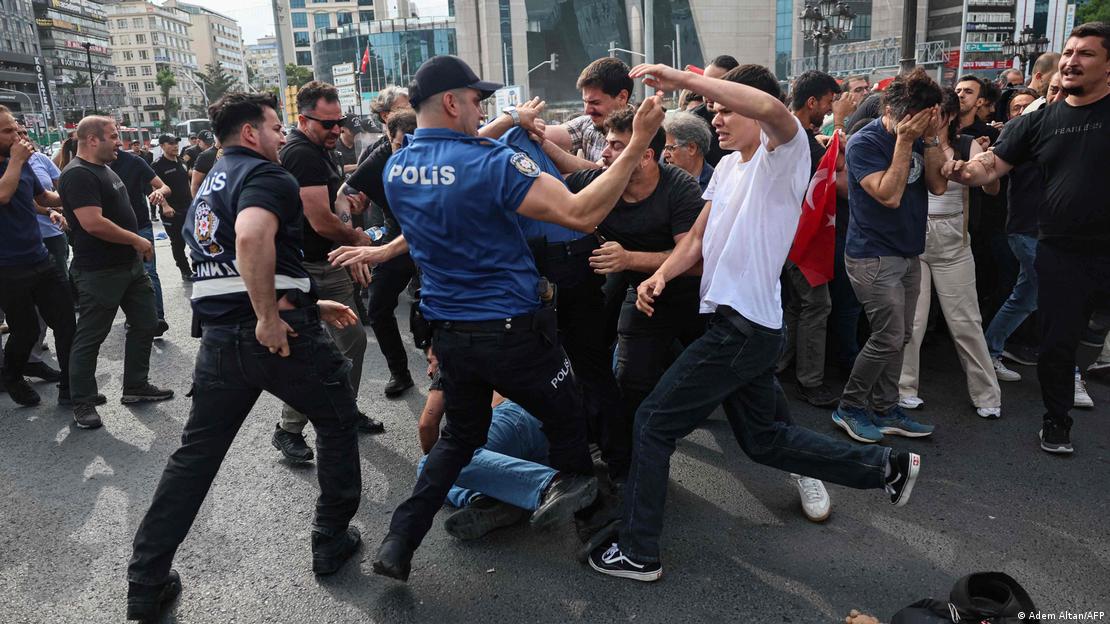
Despite that ban, left-wing protesters demonstrated against NATO in Ankara on Sunday.

Police clashed with demonstrators and made some arrests during an Ankara protest on SundayImage: Adem Altan/AFP


What do we know about the police raids in Turkey?


Opposition broadcaster Halk TV and the Cumhuriyet newspaper reported that police operations in Ankara, Istanbul and other provinces had targeted dozens of left-wing and socialist political parties, labor unions and civil society groups.

The chairwoman of the Istanbul chapter of the Association of Contemporary Lawyers (CHD) was arrested and her apartment was searched, the organization said, adding that several of her clients were also arrested.

The editor-in-chief of the T24 online newspaper, Buse Sotuglu, and Ceren Erdogdu, a reporter for Oda TV, were both arrested at their homes, their respective employers said.

No reasons for their detentions were given, but lawyer Erman Ozturk said he presumed the arrests were related to the upcoming NATO summit.

Ozturk told the AFP news agency that the police raids were seemingly trying to "intimidate democrats, leftists, and the press."

State news agency Anadolu said police had arrested 39 suspects in raids across the country which targeted the youth wing of the banned leftist organization THKP/C-DEV YOL.

Police also detained 28 suspects in the western Kocaeli province who have alleged ties to the "Islamic State" and left-wing militant groups, according to Anadolu, with police seizing ammunition and banned digital materials.

Groups denounce police crackdown

While authorities say the raids are part of counterterrorism investigations, government critics say the police crackdown is designed to prevent protests and silence dissent ahead of the summit in Ankara this week. More than 30 leaders of NATO member states, including US President Donald Trump and German Chancellor Friedrich Merz, are set to attend.

Turkey's representative for Reporters Without Borders (RSF), Erol Onderoglu, condemned the "blind, arbitrary, and haphazard operations" which endangered "the reputation and safety of journalists."

The Turkish Journalists' Association (TGC) also denounced the arrests, saying it was "unacceptable for journalists to be placed under pressure and attempted to be silenced through the threat of detention."

The TGC demanded the release of all those detained, warning that the raids were a violation of press freedoms and just the latest attempt to silence opposition dissent ahead of the NATO summit in Ankara.

Over 200 people, including lawyers, academics, civil society representatives and students, were arrested in late June, human rights activists say, as part of the crackdown by Turkish authorities in the run-up to the NATO meeting.


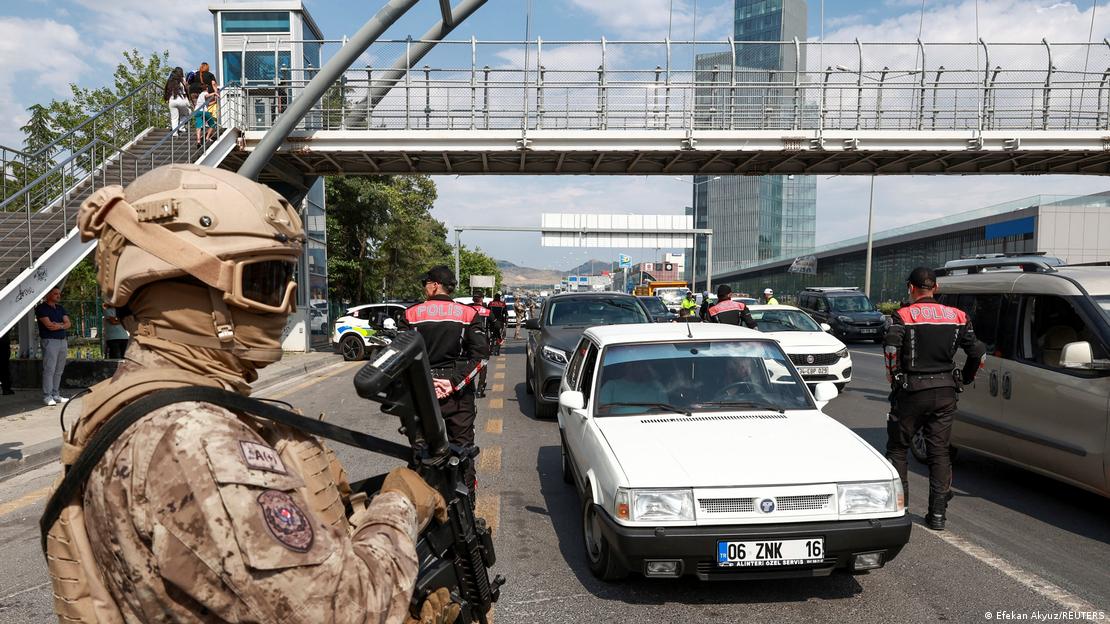
Security in the Turkish capital has been beefed up ahead of the summit

Image: Efekan Akyuz/REUTERS

Edited by: Wesley Dockery


Karl Sexton Writer and editor focused on international current affairs


Turkey’s judicial squeeze tightens on Istanbul mayor Imamoglu with triple hearing marathon

Turkey’s judicial squeeze tightens on Istanbul mayor Imamoglu with triple hearing marathon
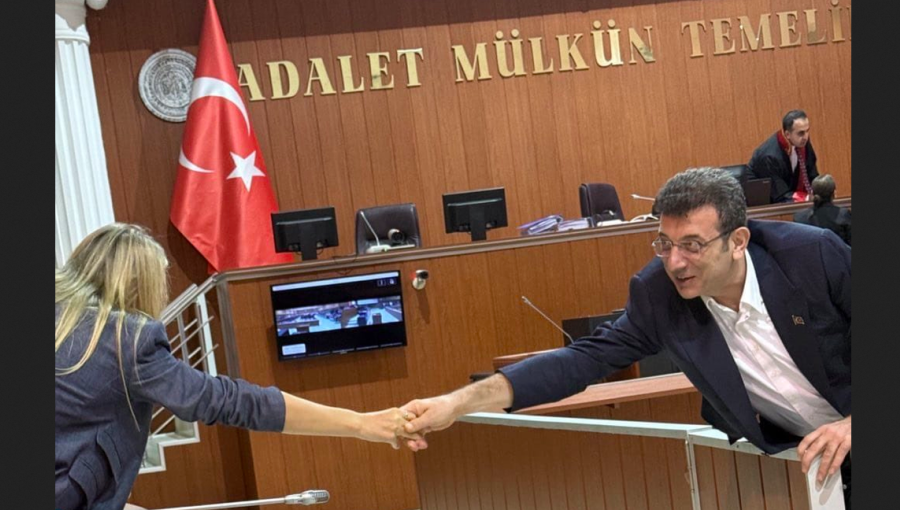
Ekrem Imamoglu (right) and his wife Dilek Imamoglu (left) at a courtroom in the Silivri prison / @imamoglu_int. / bne IntelliNewsFacebook
By bne IntelliNews July 6, 2026

The ongoing legal campaign against Ekrem Imamoglu, the jailed mayor of Istanbul and presumptive opposition presidential candidate, reached an unprecedented logistical and judicial peak on July 6. In a single day, the most prominent political rival to President Recep Tayyip Erdogan was scheduled to defend himself across three separate criminal proceedings.

The extraordinary scheduling posed a spotlight on the mounting legal pressure, which is seen as an overt attempt to permanently disqualify Imamoglu from public life ahead of the upcoming elections. The mayor has more than a dozen ongoing trials.

Corruption, espionage, forgery

The Republican People’s Party (CHP) figure, who has been held in pre-trial arrest since March 2025, faced an array of charges spanning from administrative malpractice to national security threats. The three distinct cases heard on July 6 included the main Istanbul Metropolitan Municipality (IBB) case along with the political espionage and diploma forgery cases.

The main IBB case is a massive, 414-defendant trial concerning allegations of corruption, graft and embezzlement during Imamoglu’s tenure at the IBB. The hearings are being conducted at the infamous Silivri prison complex, where Imamoglu is also held.

In the espionage case, Imamoglu is being prosecuted alongside journalist Merdan Yanardag, his political adviser Necati Ozkan and businessman Huseyin Gun. The case was based on Gun’s alleged statement during his questioning by prosecutors.

At the first hearing, Gun declined that he was a spy and he had conducted espionage activities with the three other defendants. Nevertheless, the trial continues. Imamoglu has a court ruling for being jailed pending trial from the IBB case while the other three defendants are kept in prison for the espionage case in question.

The diploma forgery case is another trial regarding allegations of "forgery of official documents" following the abrupt annulment of Imamoglu’s undergraduate business degree by Istanbul University in March 2025. A university diploma is a credential legally required to run for the Turkish presidency.

"A lawlessness triathlon"

The logistical bottleneck of managing three trials simultaneously follows a period of escalating friction between the defense and the state judiciary. Just days prior, on July 2, courtroom proceedings descended into chaos when Imamoglu and his legal team fiercely protested a newly imposed judicial deadline aiming to wrap up the first stage of the main trial by July 9.

Defense lawyers argued that compressing the timeline made a robust defense impossible for a case encompassing over 400 co-defendants. The ensuing argument led to the presiding judge ordering gendarmerie officers to forcibly remove Imamoglu, his counsel and observing opposition MPs from the courtroom.

On July 6, Imamoglu attended the espionage hearing at 10:30 and he left after 15 minutes to attend the diploma hearing.

During his statement at the diploma hearing, he described the day as “a lawlessness triathlon”.


Turkey jails comedian who called Erdogan “dictator” pending trial

HUMOUR IS SUBVERSIVE 

GEORGE ORWELL


Turkey jails comedian who called Erdogan “dictator” pending trial
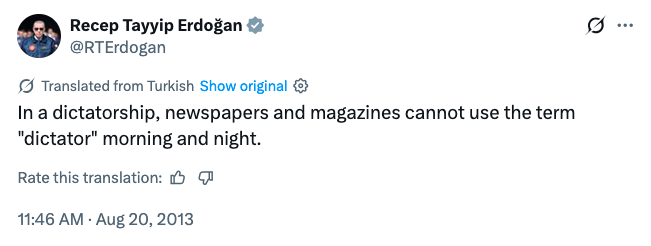
The Goktas incident re-confirmed that it is forbidden to “use the term dictator” in Turkey / Screenshot of a 2013 tweet by Recep Tayyip Erdogan (@RTErdogan). / bne IntelliNewsFacebook
By bne IntelliNews July 5, 2026

A criminal court (sulh ceza) at the Caglayan courthouse in the European side of Istanbul on July 3 jailed popular stand-up comedian Deniz Goktas pending trial, according to local media reports.

As reported by IntelliNews on June 26, Goktas described Turkey’s president, Recep Tayyip Erdogan, as having transitioned from a "shy dictator" to one who is "at peace with himself" during his performance.

It is no joke

Following the hearing, Goktas was transferred to the Karatepe prison in the Corlu town of Tekirdag province, the western neighbour of Istanbul. It is a high-security prison, known as “well-type” since prisoners are kept alone in five square-metre cells and they have no access to direct sunlight.

The prisons in question were designed for those who were convicted for being a member of a terrorist organisation. Some special prisoners are also kept in these facilities for the sake of educating them. 

On July 5, Gurkan Turkoglu, a prisoner who spent 266 days on hunger strike to demand to be transferred to a non-well-type prison, died.

The court ruling follows the widespread social media success of Goktas’ latest stand-up special, Ölü Deniz (Dead Sea). The performance, which has so far garnered more than 11mn views after being uploaded on YouTube on June 24, features a biting, satirical critique of Turkey’s current political landscape and societal pressures.

Well-planned political act

Legal proceedings were initiated after segments of the show were circulated on social media, prompting calls for censorship by the government’s media and trolls. As reported by IntelliNews on June 28, portions of the special posted on X (formerly Twitter) had been blocked from access in Turkey by a court order under the pretext of "national security".

On June 29, the Istanbul chief public prosecutor’s office announced that it had launched a prosecution against Goktas. In response, Goktas wrote on X that he was abroad for a vacation and he would be back. It was obvious that he would be jailed.

On July 2, Turkish police forces detained Goktas at Istanbul Airport during a passport control check upon his return to Turkey from a trip abroad.

The Goktas incident is not a mistake by the comedian or a slip of the tongue. It is rather a very well-planned and well-executed political act to remind people of the situation in Turkey. He was very well aware that he would end up in jail when he uploaded his video on YouTube.

Erdogan’s opinion on dictator discussion

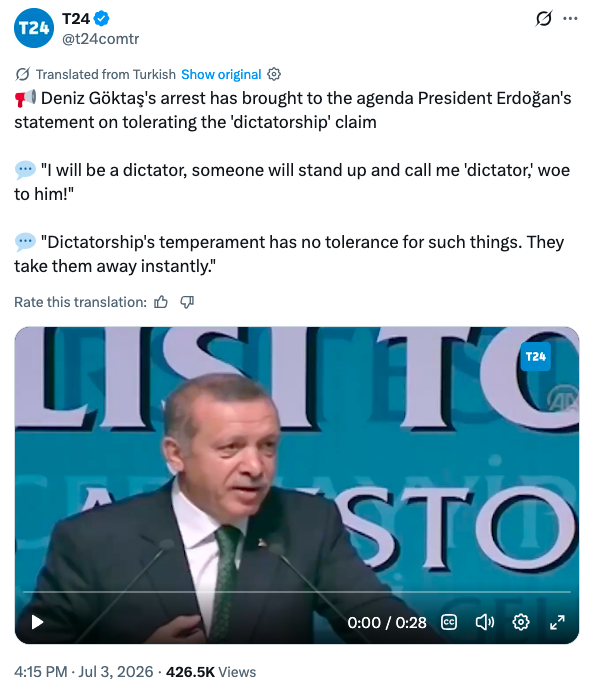
Tweet: President Recep Tayyip Erdogan (@RTErdogan) wrote in August 2013 during the widespread Gezi protests in Turkey: “Where there is a dictatorship, newspapers and magazines can not use the term dictator day and night.”

Screenshot: Back in 2013, Erdogan talking on a separate occasion on the dictator matter: “If I were a dictator and someone stood up and called me a 'dictator,' woe betide them! The nature of dictatorship does not tolerate such things. They would be taken away in an instant.”

The dictator discussion in Turkey is not new. It dates back to the countrywide Gezi protests that were held against Erdogan across the summer of 2013. Goktas is also pointing at a transition in the matter.

Back then, Erdogan’s argument was that no one would be allowed to call him a dictator if he was a dictator. His tweets and videos on the matter have been re-circulated with the Goktas incident.

Backed by the West, and the East

Tweet: Not free, not fair but competitive. The destiny of any attempt to legitimize Turkey’s government unfortunately is to fall into a fallacy. Where competitiveness is concerned, two of Erdogan’s rivals in presidential elections, namely Selahattin Demirtas and Ekrem Imamoglu, are currently in jail.

In recent weeks, access to the social media accounts of numerous LGBT+ organisations and activists has been blocked while more than 200 people have been detained ahead of next week's Nato leaders' summit in the capital Ankara, the BBC noted on July 3 while reporting the Goktas incident.

During July 7-8, all of the heads of state of Nato members will be in Ankara.

The Erdogan government is also backed by non-Nato actors in the league of states such as Russia, China and Iran.

Thanks to the global consensus in question on the continuation of the Erdogan government in Turkey, the lack of legitimacy at home makes no sense.

Planned Parenthood Can Access Medicaid Funds Again as Congress Lets Ban Expire

Reproductive healthcare advocates vowed to keep up the fight as conservative activists pressure Congress to make the funding ban permanent.


Medicaid recipient Emily Gabriella protests outside the US Supreme Court as oral arguments are delivered in the case of Medina v. Planned Parenthood South Atlantic on April 2, 2025 in Washington DC.
(Photo by Kayla Bartkowski/Getty Images)

Olivia Rosane
Jul 05, 2026
COMMON DREAMS

Planned Parenthood and other reproductive health clinics regained access to Medicaid funding on Saturday after a provision in the One Big Beautiful Bill Act defunding the organizations expired.

The provision depriving Planned Parenthood was touted as a major victory for the anti-abortion movement when the bill was signed on July 4, 2025, but, due to Senate rules, the defunding only lasted for one year, and Congress failed to renew it before their summer recess.

While this means that Planned Parenthood, Health Imperatives in Massachusetts, and Maine Family Planning can once again bill Medicaid for non-abortion related healthcare, it doesn’t reverse the damage caused by a year-long lack of access to funds totaling more than $800 million per year for Planned Parenthood alone.

“Tens of thousands of patients have been denied access to services like cancer screenings and birth control and STI testing and treatment. These are things that just can’t be undone,” Nora Walsh-DeVries, vice president of political and legislative affairs at Planned Parenthood Action Fund, told The Hill.

“Patients have totally borne the cost of this politically motivated attack on care.”

In a report published July 1, Planned Parenthood and Planned Parenthood Action Fund said that the defunding had led to the closure of almost 30 health centers, two-thirds of which were in rural areas, or locations that had a shortage of medical services or healthcare professionals. In addition, all of the closed centers were in “contraceptive deserts.” Overall, the number of Medicaid visits to the organization decreased by 25% compared with the year before.

“By deliberately targeting Planned Parenthood, President [Donald] Trump and his allies in Congress worsened a public health crisis, making it harder for people to get the essential and lifesaving care they needed at their trusted provider,” Alexis McGill Johnson, president and CEO of Planned Parenthood Federation of America and Planned Parenthood Action Fund, said in a statement.

Olivia Pennington, a spokesperson for Maine Family Planning, told NPR, “It’s been devastating to see this defund and to see the impacts that it’s had across the nation.”

As Walsh-DeVries further told The Hill, “I think it’s just really clear that patients have totally borne the cost of this politically motivated attack on care.”

Despite the restoration of funding, uncertainty lingers. Walsh-DeVries said that it wasn’t clear how clinics could obtain the restored funds, and states can now block Medicaid funds to Planned Parenthood on their own, thanks to a Supreme Court ruling last year. To date, 13 states have blocked or tried to block funds.

What’s more, conservative and anti-abortion advocates have expressed outrage at Congress’ failure to extend the funding ban, and are determined to pressure it do so via a reconciliation bill.

“This failure must be corrected immediately. President Trump and Congress must act as fast as possible to restore and extend the defunding of Planned Parenthood and every organization that commits abortion,” Lila Rose, founder and president of anti-abortion group Live Action, said in a statement.

However, 65% of Americans oppose congressional efforts to defund Planned Parenthood, according to polling by the organization, and it is unclear if Republicans as a whole have the political will to renew the ban ahead of the midterm elections. Planned Parenthood Action Fund is currently mobilizing to unseat House republicans who voted for the ban last year.

“We have to really continue to do the work that we’re doing to make this as politically toxic as possible,” Walsh-DeVries told Politico.

McGill Johnson affirmed: “Anti-abortion lawmakers are trying to make ‘defund’ permanent because Planned Parenthood health centers provide abortion care where it’s legal. They are willing to sacrifice the lives and health of people across the country if it gets them closer to their goal of banning abortion everywhere and shutting down Planned Parenthood.”

She continued: “We’re in a fight for survival—not just for Planned Parenthood health centers, but for everyone to get high-quality, affordable healthcare from their trusted provider. And know this: Planned Parenthood will never stop fighting to ensure everyone can get the care they need.”


Trump Campaigns on Anti-Communism as Left Opponents Are Indicted

Monday 6 July 2026, by Dan La Botz


President Donald Trump in two different speeches celebrating Independence Day called upon Americans to celebrate July 4 by revering the nation’s history and rallying against “godless” communism. His speech was a clear response to the recent election to Congress of three members of the Democratic Socialists of America (DSA) who ran as Democrats. He has made clear that he will characterize both the DSA members, other progressives, and the Democratic Party as “evil” communists, as he strives to reelect a Republican majority to Congress in November. [1]

At the same time, Trump’s Justice Department has indicted and convicted several leftist activists—opponents of ICE or supporters of Palestine— on felony charges resulting in them being sentenced to years and even decades in prison. The combination of the new anti-communist rhetoric and the increased repression of the left, under the guise that the government is fighting a domestic terrorist organization called antifa, suggest that we may be entering a new anti-communist era of repression such as those of the 1920s and 1950s. If so, the entire left will be in danger. And of course, it suggests we may be witnessing another step from authoritarianism to neofascism.

In his speeches, Trump stated more than once that the United States “is the greatest civilization in human history.” And communism, he said, “is the greatest threat to our country,” a greater threat than the two world wars and the September 11, 2001 terrorist attack on New York and Washington, D.C.

There is now a resurgence of the communist menace in our land, including from newcomers to our country who embrace ideas totally opposed to our way of life and our great success…Communism is a mortal threat to American liberty.

Trump didn’t mention DSA, the left group actually winning elections but said instead that the problem was the Communist Party, “made up of illegal immigrants, criminals and everybody that doesn’t want to work.” In response, CPUSA Co-chair Rossana Cambron said, “MAGA [Trump’s Make America Great Again movement] is going to lose the midterms, and Trump’s getting desperate.”

Trump alleged that the Democratic Party had become Communist. “They are becoming a Communist party – not social democrats. They are core communists.”

There have been two previous Red Scares in the United States, one in the 1920s and the other in the 1950s. The first Red Scare was a result of the Russian Revolution of 1917 that brought the Communists to power, a wave of industrial strikes, and in 1919 a series of anarchist bombings. Attorney General A. Mitchell Palmer organized raids that led to the arrest of 3,000 people and the deportation of hundreds. The movement was devastating to the Industrial Workers of the World, the Socialist Party, and the newly formed Communist Party.

The second Red Scare in the 1950 was driven in large part by Republican Senator Joseph McCarthy who made claims of widespread Communist Party spies’ penetration of the U.S. State Department. McCarthy, who was chairman of the Senate Permanent Subcommittee on Investigations launched highly publicized investigations into alleged Communist infiltration of federal agencies, universities, and the U.S. Army. Some 500 people were called to testify and another several hundred before the House Un-American Activities Committee. Many people called before these committees lost their jobs or were evicted from their homes and were blacklisted. The Communist Party was virtually outlawed and CP leaders were imprisoned.

The previous two Red Scares strengthened right-wingers in both the Democratic and Republican Parties and drove many leftists underground or out of the movement. While we don’t know what Trump’s Red Scare will do, it has to be seen as a serious threat to the left, to the unions, and to the social movements.

5 July 2026

Footnotes

[1] Image By Democratic Socialists of America.


Hungarian government unveils major wind power expansion plan after decade-long pause

Hungarian government unveils major wind power expansion plan after decade-long pause
Fidesz restricted the spread of windfarms in a 2016 regulation. / bne IntelliNewsFacebook
By bne IntelliNews July 6, 2026

Hungary's government has unveiled an ambitious plan to boost the share of wind power for the first time in a decade, with Economy and Energy Minister István Kapitány describing the programme as a key step towards greater energy independence, business online VG writes. The government has also rolled out the first RRF-financed tenders to modernise Hungary’s ageing energy grid.

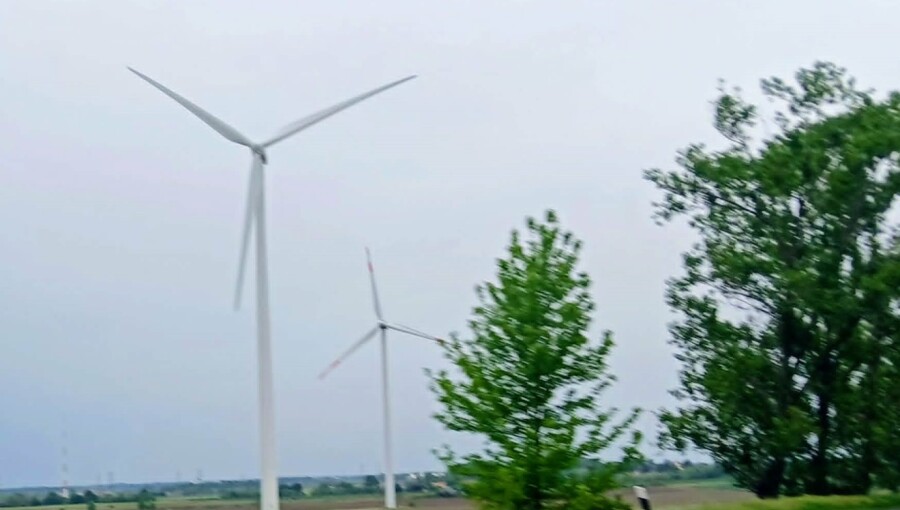
The government aims to increase Hungary's installed wind generation capacity more than tenfold by 2030, from the current 330 MW to around 4 GW. The new project in wind farms would complement solar power and would improve the stability of the electricity system.

The measure would reverse nearly a decade of stagnation in new wind projects, as Fidesz adopted restrictive rules in 2016 that effectively made it impossible for investors to start new projects. Parliament introduced a rule prohibiting wind turbines within a 12-kilometre radius of populated areas, leaving virtually no suitable locations for new projects. The government eased regulations in 2024 to encourage wind power expansion, hoping to secure much-needed RRF funds. The new rules reduced the minimum distance between wind turbines and residential areas to 700 metres, in line with European standards, but no new permits were issued.

Kapitany said the programme to expand wind power and upgrade the grid is designed to create a more balanced electricity system and remove bottlenecks.

While Hungary has become one of Europe's fastest-growing solar markets in recent years, the country's renewable generation is heavily concentrated in photovoltaic capacity, creating growing challenges for grid operators during periods of high solar output. The planned network upgrades, Kapitany said, are designed to create a more balanced electricity system, remove bottlenecks, and allow more renewable capacity to be connected to the grid.

The government plans to launch its first tender for at least 700 MW of new wind capacity by August 31. Draft tender conditions are expected to be released for public consultation in mid-July. By 2030, authorities intend to auction 4 GW of new wind projects, a volume the minister said is broadly comparable to the nominal generating capacity of four reactor units at the Paks nuclear power plant.

The wider investment programme is expected to mobilise around €2.5bn, including €1.5bn for modernising Hungary's electricity transmission and distribution networks.

The government argues that large-scale grid investments are now essential to accommodate further growth in renewable generation, as the rapid deployment of solar panels has exposed significant weaknesses in the country's electricity network.

Last week, summer electricity consumption broke records during an unprecedented heatwave, and the grid was operating near full capacity. Production at the Paks nuclear power plant had to be scaled back by 35-40%, and government officials asked households to reduce consumption during peak hours to maintain system stability, which was under immense load.

The grid upgrades will be financed through the EU Recovery and Resilience Facility (RRF), after the government pledged to meet the required super milestones to unlock frozen funds, following years of disputes between Brussels and the Orbán government.

The Energy Ministry has also launched a public consultation on a package of legislative amendments intended to fulfil Hungary's energy reform commitments under the RRF.

The proposals include mandatory dynamic electricity tariffs offered by larger suppliers, a legal framework for independent electricity aggregators, streamlined permitting procedures for renewable projects, simplified approval processes in designated priority areas, and greater transparency in network charges. Authorities that fail to meet permitting deadlines would face financial penalties under the proposal.

Separately, the government has opened applications for more than HUF500bn (€1.25bn) in energy-related funding, designed to support the integration of renewable energy sources into the power system. Households can apply for HUF27bn in funding to install smart electricity meters, and the second scheme covers HUF480bn for grid upgrades. Kapitany said the funding would help address what he described as years of underinvestment in the electricity system.

The installation of smart meters in households could effectively open the door to dynamic electricity tariffs, allowing retail electricity prices to vary with wholesale market conditions and the time of consumption. Consumers would be encouraged to reduce electricity consumption during peak hours and shift energy-intensive activities to periods when solar and wind generation is abundant.

This would reduce pressure on the grid, lower balancing costs, and, at the same time, reduce the need for imports, analysts said. Smart meters could also address wide volatilities in wholesale electricity prices. During supply peaks, prices often turn negative, while in the evening hours, when solar production fades, prices can spike sharply.