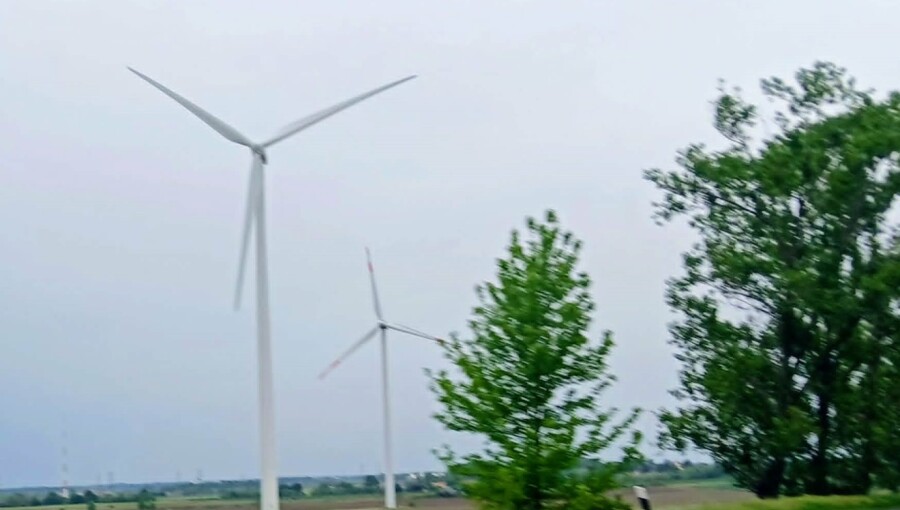
Hungary's government has unveiled an ambitious plan to boost the share of wind power for the first time in a decade, with Economy and Energy Minister István Kapitány describing the programme as a key step towards greater energy independence, business online VG writes. The government has also rolled out the first RRF-financed tenders to modernise Hungary’s ageing energy grid.
The government aims to increase Hungary's installed wind generation capacity more than tenfold by 2030, from the current 330 MW to around 4 GW. The new project in wind farms would complement solar power and would improve the stability of the electricity system.
The measure would reverse nearly a decade of stagnation in new wind projects, as Fidesz adopted restrictive rules in 2016 that effectively made it impossible for investors to start new projects. Parliament introduced a rule prohibiting wind turbines within a 12-kilometre radius of populated areas, leaving virtually no suitable locations for new projects. The government eased regulations in 2024 to encourage wind power expansion, hoping to secure much-needed RRF funds. The new rules reduced the minimum distance between wind turbines and residential areas to 700 metres, in line with European standards, but no new permits were issued.
Kapitany said the programme to expand wind power and upgrade the grid is designed to create a more balanced electricity system and remove bottlenecks.
While Hungary has become one of Europe's fastest-growing solar markets in recent years, the country's renewable generation is heavily concentrated in photovoltaic capacity, creating growing challenges for grid operators during periods of high solar output. The planned network upgrades, Kapitany said, are designed to create a more balanced electricity system, remove bottlenecks, and allow more renewable capacity to be connected to the grid.
The government plans to launch its first tender for at least 700 MW of new wind capacity by August 31. Draft tender conditions are expected to be released for public consultation in mid-July. By 2030, authorities intend to auction 4 GW of new wind projects, a volume the minister said is broadly comparable to the nominal generating capacity of four reactor units at the Paks nuclear power plant.
The wider investment programme is expected to mobilise around €2.5bn, including €1.5bn for modernising Hungary's electricity transmission and distribution networks.
The government argues that large-scale grid investments are now essential to accommodate further growth in renewable generation, as the rapid deployment of solar panels has exposed significant weaknesses in the country's electricity network.
Last week, summer electricity consumption broke records during an unprecedented heatwave, and the grid was operating near full capacity. Production at the Paks nuclear power plant had to be scaled back by 35-40%, and government officials asked households to reduce consumption during peak hours to maintain system stability, which was under immense load.
The grid upgrades will be financed through the EU Recovery and Resilience Facility (RRF), after the government pledged to meet the required super milestones to unlock frozen funds, following years of disputes between Brussels and the Orbán government.
The Energy Ministry has also launched a public consultation on a package of legislative amendments intended to fulfil Hungary's energy reform commitments under the RRF.
The proposals include mandatory dynamic electricity tariffs offered by larger suppliers, a legal framework for independent electricity aggregators, streamlined permitting procedures for renewable projects, simplified approval processes in designated priority areas, and greater transparency in network charges. Authorities that fail to meet permitting deadlines would face financial penalties under the proposal.
Separately, the government has opened applications for more than HUF500bn (€1.25bn) in energy-related funding, designed to support the integration of renewable energy sources into the power system. Households can apply for HUF27bn in funding to install smart electricity meters, and the second scheme covers HUF480bn for grid upgrades. Kapitany said the funding would help address what he described as years of underinvestment in the electricity system.
The installation of smart meters in households could effectively open the door to dynamic electricity tariffs, allowing retail electricity prices to vary with wholesale market conditions and the time of consumption. Consumers would be encouraged to reduce electricity consumption during peak hours and shift energy-intensive activities to periods when solar and wind generation is abundant.
This would reduce pressure on the grid, lower balancing costs, and, at the same time, reduce the need for imports, analysts said. Smart meters could also address wide volatilities in wholesale electricity prices. During supply peaks, prices often turn negative, while in the evening hours, when solar production fades, prices can spike sharply.

No comments:
Post a Comment