It’s possible that I shall make an ass of myself. But in that case one can always get out of it with a little dialectic. I have, of course, so worded my proposition as to be right either way (K.Marx, Letter to F.Engels on the Indian Mutiny)
Monday, July 06, 2026
400,000-year-old intact cave found in Israel sheds light on pre-Neanderthal era
A prehistoric cave found near Foreidis in northern Israel is offering a rare glimpse into a little-known phase of human evolution. Sealed for hundreds of thousands of years, the site preserves tools, animal remains and evidence of prolonged occupation.
Archaeologists seldom encounter a site that has remained virtually untouched by natural and human interference for hundreds of thousands of years.
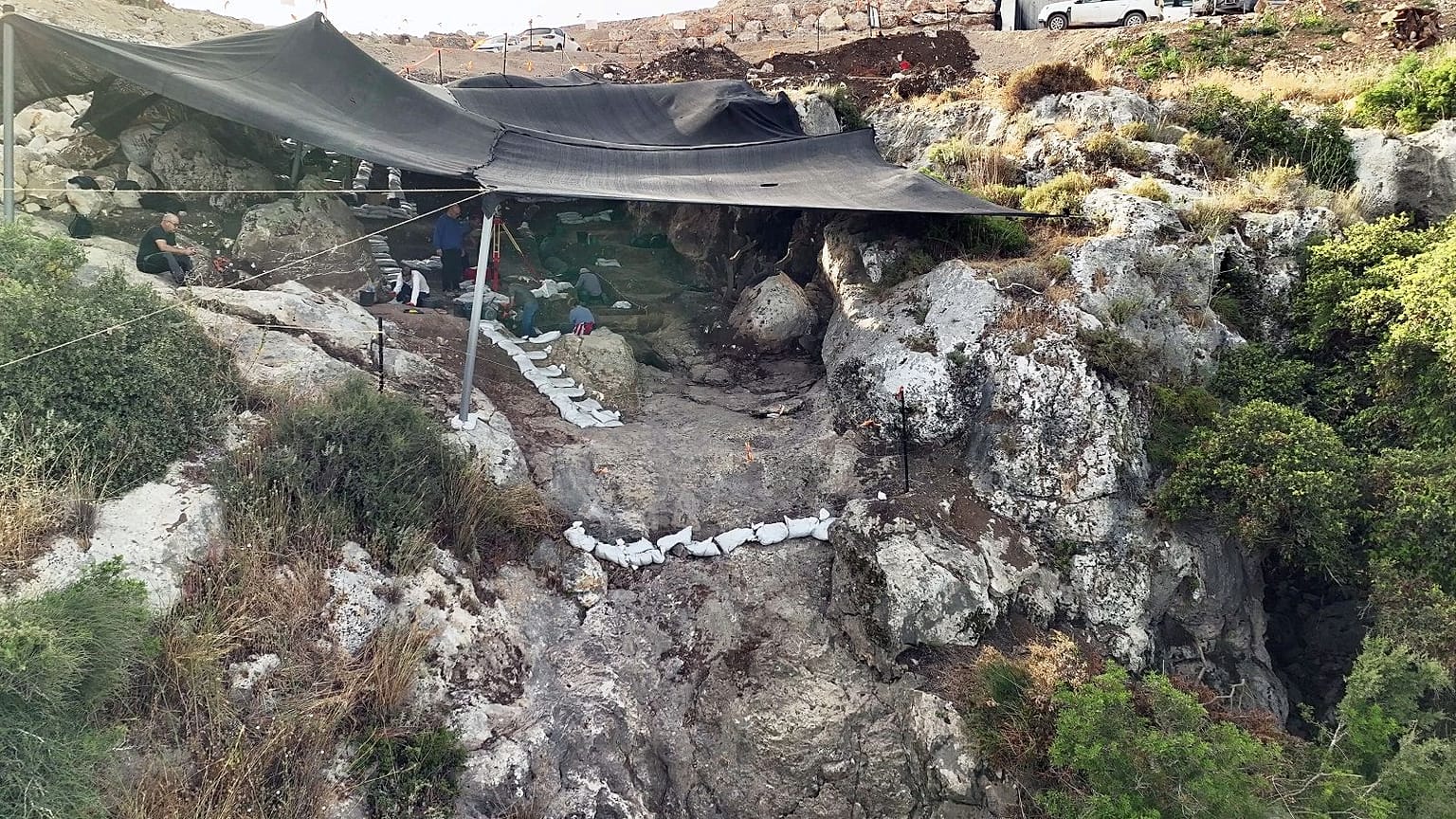
That is precisely what has been found in a cave on the outskirts of Foreidis, near the Zichron Yaakov junction, where researchers from the Israel Antiquities Authority and the University of Haifa are excavating a site dated to between 400,000 and 250,000 years ago.
The excavation is led (source in Spanish) by archaeologist Kobi Vardi and Amit Gabay, together with Professor Ron Schimmelmitz. The team describe the site as one of the most significant discoveries of recent decades for understanding a stage in human evolution for which very little evidence has been preserved.
The cave is associated with the so‑called Acheulo-Yabrudian culture, a technological tradition characteristic of the Levant during the late Lower Palaeolithic. According to the researchers, its exceptional state of preservation makes it a genuine “time capsule” capable of yielding information that is difficult to obtain at other sites in the region.
Inside the Foreidis cave during excavation Emil Aljam - Israel Antiquities Authority
A decisive moment in the history of our species
The period to which the site belongs predates the spread of Neanderthals and anatomically modern humans. Specialists view it as a time of profound change in ways of living, relating to one another and adapting to the environment.
According to Schimmelmitz, during these millennia behaviours began to emerge that would later become commonplace among human populations. These include the formation of larger groups, the long-term occupation of specific places and a more complex social organisation.
The evidence recovered also points to an intensive use of fire and to relatively long stays in caves, something usually associated with greater cooperation between individuals and the systematic transmission of knowledge within communities.
The researchers believe that these changes laid some of the cultural and technological foundations that would later characterise Neanderthals and Homo sapiens.
Tools, animals and a landscape rich in resources
Among the finds already documented are numerous flint tools produced using techniques that were advanced for the time. Archaeologists have identified small hand axes, scrapers and cutting blades made with great precision.
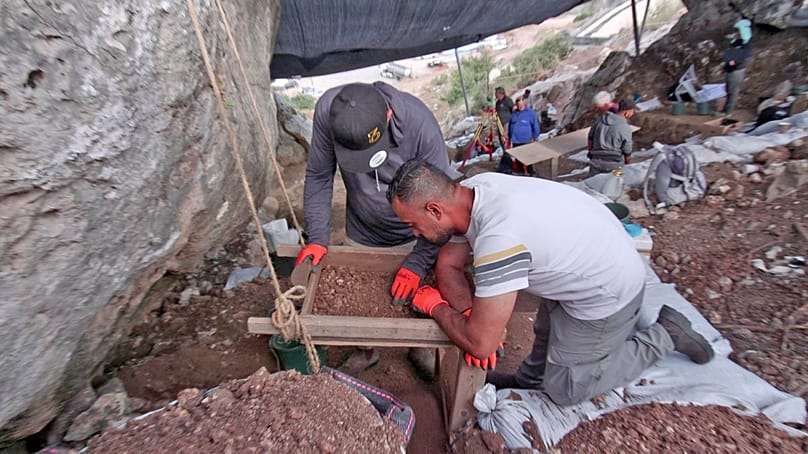
From right to left: researchers Prof Ron Schimmelmitz of the University of Haifa, Dr Kobi Vardi and Amit Gabay of the Israel Antiquities Authority. Emil Aljam - Israel Antiquities Authoritiy
The excavation has also brought to light animal bones from species such as horses, deer and wild asses. Alongside them were traces indicating the presence of water in the surrounding area, a resource that would have made the site particularly attractive to groups of hunter-gatherers.
Vardi compares the scientific importance of the discovery to that of the renowned Nahal Me'arot site (source in Spanish), designated a UNESCO World Heritage Site and also crucial for the study of prehistory in the Levant.
The Israel Antiquities Authority and the University of Haifa plan to develop an extensive research programme to reconstruct in greater detail how these human groups lived, how they exploited the resources available to them and how their technologies evolved.
Once the studies have been completed, the institutions involved hope to prepare the site for public visits, with the aim of bringing these discoveries closer both to local residents and to students and visitors interested in human evolution.
ISRAEL
Monsters Playing Victims: Danny Danon’s Twisted War on the Truth
Whether Israelis will ever comprehend the irreparable damage inflicted upon their country’s reputation by their UN Ambassador, Danny Danon, is a moot point. The damage Israel has done to itself through its barbaric practices in occupied Palestine is simply impossible to overcome.
Danon, however, utilizes a peculiar approach to defending Israel within international institutions: he relies on bullying, intimidation, and an overt attempt to silence anyone who dares to challenge the official Israeli narrative – particularly women leaders. Yet, what makes his behavior most outrageous is his deployment of these abrasive tactics to suppress an issue that demands the utmost sensitivity: the systemic use of sexual violence and human rights abuses against Palestinians.
The confrontation took place during a UN General Assembly session convened to mark the International Day for the Elimination of Sexual Violence in Conflict. Senior UN officials were presenting harrowing findings documenting sexual violence against Palestinian detainees.
True to form, Danon refused to engage with the substance of the reports. For Israeli diplomacy, the enemy is never merely the armed adversary; it is the judge, the independent human rights observer, and the UN investigator whose sole mandate is to document violations of international law.
The immediate target of Danon’s wrath was Pramila Patten, the UN Secretary-General’s Special Representative on Sexual Violence in Conflict. Instead of reflecting on the grim findings, Danon demanded Patten’s resignation. He accused her and the broader international community of harboring an “obsession” with targeting Israel.
When Vanessa Frazier, the Secretary-General’s Special Representative for Children and Armed Conflict, attempted to intervene on a point of order per established protocol, Danon unleashed a vitriolic verbal assault. Refusing to yield, he shouted over her, ordering her to “be quiet” and drowning out the chamber with his outbursts. “Shame on you. You are part of this obsession,” Danon bellowed.
While such unruly behavior should have resulted in Danon’s immediate removal from the chamber, the diplomatic asymmetry of the UN prevailed. It was Frazier who found herself trying to de-escalate, politely clarifying that her procedural request was “not personal.” Danon shot back with typical defiance: “You will not be allowed to bully us.”
Herein lies the supreme irony of Israel’s diplomatic relationship with the UN and international law. Israel stands as one of the most egregious, serial violators of international law in modern history – a decades-long pattern of behavior left unpunished by Western vetoes, which ultimately emboldened it to carry out an ongoing genocide in Gaza. Yet, Israeli officials persistently claim the mantle of the ultimate victim, alleging they are the targets of antisemitism, unfair bias, and now, “bullying” by the very institutions they defy.
But the mountain of evidence cannot be shouted away. According to an extensive report issued by Patten’s office, there are verified patterns of systemic abuse, sexual degradation, and psychological torture weaponized against Palestinian men, women, and children in Israeli detention camps like Sde Teiman.
The weight of this evidence reached such an undeniable threshold that the UN Secretary-General’s office formally added Israel to the global ‘List of Shame’ – the blacklist of states committing grave violations against children in armed conflict.
None of this exposure is enough to convince Danon or the broader Israeli political establishment that Israel does not possess a sovereign right to violate international law. In their view, merely pointing out these crimes constitutes an act of aggression.
This systemic denial extends to every facet of the conflict. A comprehensive UN investigation recently concluded that Israel has deliberately targeted Palestinian children in Gaza as a core component of its military campaign. The numbers are staggering: Between October 7, 2023, and October 7, 2025, an estimated 20,179 Palestinian children were killed – about 30 percent of all Palestinian deaths.
“The evidence shows that Palestinian children have been deliberately targeted and killed by the Israeli security forces,” stated commission chair Srinivasan Muralidhar, noting that Israeli authorities have systematically continued to commit the crime of genocide.
While these findings provide another layer of ironclad legal proof regarding genocidal intent, the true significance of the report lies in its exposure of the rationale behind targeting youth. Typically, the disproportionate slaughter of children and women is dismissed by Western apologists as “collateral damage”. The UN inquiry shattered this defense, offering a far more consequential conclusion: the targeting of Gaza’s children is part of a calculated strategy to destroy the biological continuity and future existence of the Palestinian people in Gaza.
As Muralidhar bluntly summarized: “By targeting children, Israel is attacking the very capacity of the Palestinian people to exist.”
It remains a profound disappointment that the International Criminal Court and the International Court of Justice – often swift to indict war crimes committed elsewhere – continue to move at a glacial pace regarding Israel. Tragically, the catastrophe continues unabated because there is still no meaningful international mechanism willing to enforce sanctions or employ genuine pressure to halt it.
This is precisely why Danny Danon wants the world to be quiet. His outbursts are not merely directed at UN diplomats; they are directed at global civil society, ordinary citizens, and anyone refusing to look away. Israel demands absolute silence while Palestinians are starved, raped, and murdered. According to its twisted logic, committing these atrocities is an inherent right, and objecting to them is an act of malice.
If this logic is allowed to prevail, it becomes the blueprint for every future aggressor who wishes to kill, rape, and starve a population for geopolitical gain. Palestinians and Lebanese are already forced to inhabit this dystopian reality. Our collective responsibility is clear: we must refuse to be quiet. We must speak out, ensuring our voices drown out the shouts of Danon and his peers, so that murder and systemic violence are never normalized as tools of military necessity.
Dr. Ramzy Baroud is a journalist, author and the Editor of The Palestine Chronicle. He is the author of six books. His forthcoming book, ‘Before the Flood,’ will be published by Seven Stories Press. His other books include ‘Our Vision for Liberation’, ‘My Father was a Freedom Fighter’ and ‘The Last Earth’. Baroud is a Non-resident Senior Research Fellow at the Center for Islam and Global Affairs (CIGA). His website is www.ramzybaroud.net
Tibetan Activist Dies After Self-Immolation Outside UN Headquarters
Lobga Rangzen in an undated photo. (Lobga Rangzen via Facebook)
Tragic Self-Immolation Protest — Tibetan activist Lobsang Palden (Lobga Rangzen) died after setting himself on fire outside UN headquarters in New York, in protest against Chinese policies in Tibet and the new Ethnic Unity and Progress Law.
Symbol of Tibetan Resistance — The act is part of a long history of self-immolations (157 inside Tibet since 2009) by Tibetans protesting cultural erasure, forced assimilation, and Beijing’s repression. It has sparked widespread memorial prayers and vigils in Tibetan communities worldwide.
Calls for Global Awareness — Tibetan leaders and activists hope the incident will draw international attention to the Tibetan cause and China’s policies, while Beijing dismissed the event and asserted Tibet as an inalienable part of China.
A Tibetan activist died Thursday after setting himself on fire outside the United Nations headquarters in New York.
Lobsang Palden, popularly known as Lobga Rangzen, a longtime Tibetan activist based in New York, died at Bellevue Hospital after succumbing to his injuries, Jamphel Choesang, president of the Regional Tibetan Youth Congress of New York and New Jersey, told Radio Free Asia.
The self-immolation comes one day after China’s new ethnic unity law went into effect, with critics warning that the law brings accelerated forced assimilation and cultural erasure of Tibetans and Uyghurs. It also brings fears of Beijing’s increasing transnational repression and its ability to stifle dissident voices overseas.
“The unfolding genocide inside Tibet and the enforcement of the draconian ‘Ethnic Unity and Progress Law’ on July 1 are what drove Lobga Rangzen to this tragic decision,” Penpa Tsering, head of the Central Tibetan Administration said in a released statement on Friday.
Rangzen was a well-known Tibetan activist who participated in demonstrations and campaigns calling for Tibetan freedom and raising awareness of human rights issues under Chinese rule.
Before the incident, Rangzen posted a Facebook video where he spoke about the situation in Tibet and the importance of efforts to preserve Tibetan language and culture. He also criticized Chinese government policies in Tibet, which he described as an “erasure” of Tibetan identity, and urged Tibetans in exile to increase their efforts in their struggle.
In a subsequent Facebook livestream post, Rangzen propped the camera on the sidewalk and walked a few steps to a traffic median across from the U.N. building and placed a large Tibetan flag on a traffic post. Moments later, he set himself on fire. In the video, cars were seen driving past on First Avenue, honking their horns. Rangzen fell to the ground. Two men in security uniforms reached him a minute and 10 seconds later with fire extinguishers.
Penpa Tsering said that from 2009 to around 2022, roughly 157 Tibetans have self-immolated inside Tibet, referring to this act as “offering of the body” for the Tibetan cause.
Thupten Choenyi, a friend of Lobga Rangzen, told Radio Free Asia: “About 15 minutes before he set himself on fire, I had a video call with him on WhatsApp. It was around 5:30 P.M. Unlike our previous conversations, he spoke very quietly and sounded deeply disappointed. He told me, ‘I think China will never listen to us.’”
“He was smoking during the call, and I told him not to smoke. He replied that he doesn’t drink, but he does smoke. He was also sipping from a Coke bottle, and his T-shirt was wet. I asked him where he was, and he said he was in front of the United Nations.”
“Then he suddenly asked, ‘Can I take a screenshot of our video call?’ I said yes, and he sent it to me immediately. A short time later, he set himself on fire. He also called a few of his close friends before carrying out the act. I am very sad right now.”
Penpa Tsering, attending the International Tibetan Youth Conference in Dharamsala, India, said that Rangzen had always carried the Tibetan cause and devoted his time to it in New York. He said that wherever it happens, inside or outside Tibet, those who give their lives for the Tibetan cause must be remembered. He announced that the Kashag (cabinet of the Central Tibetan Administration) had met that morning to organize a day of memorial prayers.
Sonam Tso, who was among more than 100 participants at the conference, told RFA, “It is heartbreaking to hear of his death, yet I hope it will help more people around the world learn about Tibet and the Tibetan cause.”
Tibetans gathered outside the United Nations headquarters for a candlelight vigil and prayers following Rangzen’s death Thursday evening.
As news of the passing of Rangzen spread, Tibetan communities including groups in Dharamsala, Australia, Taiwan and elsewhere in the United States have begun holding prayer gatherings in his remembrance.
Responding to the immolation at a daily Beijing news conference on Friday, Chinese foreign ministry spokesperson Guo Jiakun said Tibet has been an inalienable part of the country’s territory since ancient times and Beijing believes “relevant countries will handle the matter in accordance with domestic laws.”
About RFA Radio Free Asia’s mission is to provide accurate and timely news and information to Asian countries whose governments prohibit access to a free press. Content used with the permission of Radio Free Asia, 2025 M St. NW, Suite 300, Washington DC 20036. View all posts by RFA →
EU investigation confirms spy network at Hungarian diplomatic mission in Brussels
An internal European Commission investigation has confirmed that a Hungarian intelligence network operated at Hungary’s Permanent Representation to the EU in Brussels in the mid-2010s, according to a document seen by Politico.
The April-dated report, prepared under EU anti-fraud commissioner Piotr Serafin, concludes that Hungarian intelligence officers were deployed to the mission between 2013 and 2016, with activity becoming more visible from 2015. It says the network focused on approaching EU officials, primarily Hungarian nationals working in EU institutions, to obtain internal information on policy work relevant to the Hungarian government.
The findings broadly confirm earlier investigative reporting by Direkt36, which alleged that intelligence officers working under diplomatic cover attempted to influence EU decision-making and gather internal Commission information.
Direkt36 in an article in late 2025 reported that the Prime Minister's Office grew increasingly interested in inside information about EU decisions that could affect Hungary's interests as disputes deepened between the government and the European Commission over media freedom, rule of law, and judicial independence.
Hungarian operatives reportedly reviewed the backgrounds of Hungarian nationals working at EU bodies and attempted to recruit some of them through intelligence officers operating under diplomatic cover.
The investigation found that the intelligence activity initially operated discreetly but later became more overt, to the point where its presence became known within Hungarian circles in Brussels, ultimately reducing its effectiveness. According to the report, the operation ended in 2016.
While the report confirms the existence of the network and its targeting of EU officials, it says it was not possible to establish individual responsibility beyond the intelligence officers involved, citing limited investigative tools available to the Commission and stating that no major security breach could be formally identified.
The document also notes that the activities went beyond standard diplomatic functions, including efforts to contact Hungarian EU staff and gather information on issues of particular interest to Budapest.
The Hungarian Permanent Representation did not respond to Politico’s request for comment.
The case has previously triggered political controversy in Brussels, including calls from members of the European Parliament for an investigation into Hungarian Commissioner Oliver Varhelyi, who led the mission during part of the period in question and has denied any knowledge of intelligence activity.
The Commission opened its internal review following media reports last year, which alleged that Hungarian intelligence operated in Brussels under diplomatic cover and attempted to recruit EU officials.
Russia Is Losing Its War Against Ukraine – Analysis
Ukraine’s Strategic Neutralization Working — Ukraine has shifted to a smart, drone-heavy strategy focused on degrading Russian logistics, energy infrastructure, and command systems rather than large territorial offensives. This has allowed Ukraine to strike deep inside Russia and inflict disproportionate damage.
Russia Facing Multiple Crises — Russia is suffering heavy casualties (up to 1,500/day), recruitment desperation (using prisoners, migrants, disabled), collapsing refining capacity, fuel shortages, economic strain (defense spending at 40% of budget), declining public support, and growing elite/military blogger dissent.
Putin’s Regime in Increasing Trouble — Putin is increasingly isolated and detached, cancelling major public events out of fear. His options are limited: escalation risks domestic instability, while continuing the war leads to further degradation. Time is not on Russia’s side, and the convergence of military, economic, and political pressures is pushing toward a potential turning point.
Analysis
Russia is losing its war against Ukraine, and a decisive turning point is approaching. This conclusion draws on Russian military sources, internal documents, polling data, and frontline reporting to build a comprehensive picture of Vladimir Putin’s regime in crisis. The convergence of five mutually reinforcing dynamics—military defeat, economic and financial collapse, public discontent, dissent among Russian nationalists and military bloggers, and elite fears of a coup and assassinations—contribute to Russia losing its war against Ukraine.
Ukraine’s Strategic Plan
Rather than pursuing the kind of large-scale territorial offensive that failed in Summer 2023, Ukraine has adopted what former Defence Minister Andriy Zagorodnyuk calls “strategic neutralization.” The approach does not aim primarily at recapturing territory through direct military confrontation, but at systematically degrading Russia’s capacity and will to fight. Ukraine disrupts Russian logistics, destroys supply lines, and strikes high-value targets deep inside Russian territory. This strategy is underpinned by what Zagorodnyuk terms a “Revolution in Military Affairs”—Ukraine’s rapid and largely private-sector-driven innovation in drone technology, precision strikes, and battlefield coordination.
The results have been remarkable. By May 2026, Ukraine was for the first time launching more drones and missiles into Russia than Russia was firing into Ukraine. In the first half of 2026 alone, Ukraine struck approximately 800,000 Russian targets.
Ukrainian Commander-in-Chief Oleksandr Syrskyy described the strategy as maintaining the initiative by exhausting Russia while building Ukrainian reserves, striking where Russia is weakest, and steadily liberating occupied territory. Ukraine established a Deep Strike Command Center in January 2026 to coordinate attacks, and medium-range drones have effectively replaced the U.S.-supplied HIMARS systems as the primary tool for striking Russian logistics and troop concentrations.
Ukraine will acquire ballistic missiles by autumn 2026—the hardest category of weapon to intercept—just as Russian air defences are approaching near-total degradation. Political, military and security HQs in Moscow and St. Petersburg will be high value targets for Ukrainian ballistic missiles.
Russian Military Degradation
Russia’s battlefield position has deteriorated sharply. Russia seized only 0.4 percent of Ukrainian territory in all of 2024, barely 0.2 percent more by mid-2025, and just 164 square kilometres in the first quarter of 2026—compared to 1,151 square kilometres in the same period the year before. Since Winter 2025–2026, Ukraine has liberated 400 square kilometres of occupied territory.
Meanwhile, Russian casualties are staggering: the Defence Ministry recorded 36,000 Russian casualties in March 2026 alone, with 90 percent caused by Ukrainian drones, exceeding Russia’s monthly volunteer recruitment figures. In April, Russia was losing approximately 1,500 soldiers per day.
Russia is increasingly filling these losses from the margins of Russian society – alcoholics, drug addicts, and men with severe physical disabilities. Video footage of these recruits waiting at deployment centres has circulated widely on Russian social media. Russia’s pre-war prisoner population of 465,000 has fallen to 282,000, with the remainder deterred by news of very high death rates. Migrants from Africa and Central Asia lured with false promises of employment are forcibly conscripted and sent to the front. Students are being pressured to enlist, and businesses are being levied for recruits. Russia’s recruitment plan for 2026—409,000 soldiers—is being fulfilled at only 60–75 percent.
The quality of the army reflects its composition. Russian soldiers are sent on “meat assaults” without body armour, artillery support, or adequate supplies. Officers steal from their soldiers’ bank accounts and demand bribes to avoid suicide missions. Blocking units composed of convicts shoot soldiers who retreat.
A Russian deserter described his officers’ culture as defined by “fear, corruption and indifference.” Desertion doubled in 2024–2025 to 70,000. Internal documents hacked by Ukraine’s foreign intelligence service show that Russia’s General Staff privately acknowledges the army cannot achieve Putin’s stated goal of occupying all of Ukraine. Russian security analyst Vasily Kashin has conceded that the goal of “liquidating the anti-Russian regime” in Ukraine is “fundamentally unattainable” and that Russia “lacks the capacity to sustainably control and manage” additional occupied territories.
Economic Crisis
Russia’s financial position is equally dire. Defence spending has reached 40 percent of the federal budget—a record $146.4 billion—and total defence outlays since 2022 are estimated at $522 billion. Russia’s economic reserves are nearly exhausted, according to the Minister of Economic Development.
In the first quarter of 2026, government revenues were $11.7 trillion against outlays of $17.6 trillion. Business profits fell 33 percent year-on-year. Nearly half of small businesses are operating at a loss. Large numbers of Russians are withdrawing savings at a 30-year record pace, with central bank officials floating the possibility of deposit confiscation.
Ukrainian drone strikes on energy infrastructure have compounded fiscal pressure. In May 2026, strikes rendered inoperable refineries in Kstovo, Ryazan, Taman, Yaroslavl, Perm, Kirishi, Samara, Primorsk, and Tuapse—among Russia’s most critical refining capacity. The Tuapse refinery, which handles 12 million tonnes annually, has been attacked repeatedly; 28 of its 47 storage tanks have been damaged or destroyed.
The resulting fuel shortages have sparked a regional state of emergency in Krasnodar Krai and contributed to a major fuel crisis in Crimea and Russian-occupied southeastern Ukraine. The fuel crisis has also spread to the rest of Russia, including Moscow, undermining public confidence in Putin and the government. Energy rich Russia is importing oil from Kazakhstan.
Oil export revenues have halved relative to the previous year despite higher global oil prices, as Ukrainian strikes and Western sanctions take simultaneous effect. Ukrainian strikes against Russian energy installations have prevented it from higher oil prices brought on by the US-Israeli war against Iran.
Public Discontent and Elite Fractures
Russia’s public mood has shifted. The Levada Centre reported in April 2026 that 64 percent of Russians believe it is time to negotiate an end to the war, with only 24 percent supporting continued military action. Nevertheless, many of these Russians continue to refuse to countenance returning occupied territory to Ukraine.
VTsIOM (Russian Public Opinion Research Center) found only 29.5 percent of Russians named Putin as a politician they trust. Meanwhile nearly two thirds of Russians expressed a negative view of developments in the country. State television—once the primary instrument of Kremlin propaganda and public mobilization—has seen its audience share as a news source fall from 60 percent to 47 percent since 2022.
Among Russian military bloggers and Russian nationalists, criticism is intensifying. Prominent blogger Ilya Remeslo has publicly called Putin “not a legitimate president” who “must resign and be brought to trial as a war criminal.” He predicts a “palace coup” or “revolution” producing “profound changes” in late 2026 or early 2027. These views are becoming increasingly typical for military bloggers and nationalists.
Russian elites are increasingly divided between those who favour ending the war and those who insist on pressing forward, with the hawks now “persuading, defending and fighting back” rather than dominating the debate—a significant reversal.
Putin Detached From Reality
Against this backdrop, Putin is increasingly portrayed—including by Russians—as detached from reality and politically vulnerable. His approval ratings are declining; VTsIOM has ceased publishing weekly figures since late April 2026. Putin is mockingly referred to as “grandpa in the bunker” in Russian discourse because he lives in bunkers and never uses mobile phones or the Internet.
Ukraine’s attacks on Moscow and St. Petersburg—including strikes timed to embarrass Putin at the St. Petersburg International Economic Forum in June 2026—have exposed the hollowness of his strongman image. Putin cancelled a public military parade on 9May 9 “Victory Day” for the first time since 2008, citing the risk of Ukrainian attacks. Parades on Russia Day and Navy Day have also been cancelled.
The structural weaknesses embedded in Russia’s corrupt, hyper-centralized system cannot be resolved by escalation or full mobilization, which would destroy the regime’s unwritten social contract with the Russian population.
Time is decisively not on Putin’s side, and the growing crisis is increasingly becoming a threat to his regime. This is reflected in Putin’s paranoia. Ukraine’s campaign of “strategic neutralization” has made Crimea into an isolated island and is turning Russia’s size, which had been an advantage in the past against foreign invasions, into a disadvantage as it is impossible to provide air defence for every oil and gas installation, each military factor and military and air bases.
Putin’s options are limited. Escalation, through mobilisation, would be highly unpopular and threaten political instability – without bringing benefits on the battlefield. Ukrainian Defence Minister Mykhaylo Fedorov said Ukrainian forces would respond by increasing their monthly kill rate from 35,000 to 50, 000. President Volodymyr Zelenskyy is counting on Putin being forced to deescalate and return to the negotiating table without his hitherto maximalist demands.
Irrespective of what decision Putin makes, different crises are coming together that ae contributing to Russia losing its war against Ukraine.
About Dr. Taras Kuzio
Taras Kuzio is a professor of political science at the National University of Kyiv Mohyla Academy. He is co-author of The Four Roots of Russia’s War Against Ukraine (Cambridge University Press, 2026); co-editor of Russia and Modern Fascism: New Perspectives on the Kremlin’s War Against Ukraine (Columbia University Press, 2025); Crimea: Where Russia’s War Started and Where Ukraine Will Win (Jamestown Foundation, 2024), and Russian Nationalism and the Russian-Ukrainian War (Routledge, 2022). He can be found on X/Twitter @TarasKuzio View all posts by Dr. Taras Kuzio →
Ukraine strikes oil infrastructure sites near Saint Petersburg, Zelenskyy says
It comes after Moscow launched a massive drone and missile barrage at Kyiv earlier this week, killing at least 30 people and hitting more than 20 sites across the city.
Ukrainian forces carried out strikes on oil infrastructure sites near the Russian city of Saint Petersburg on Friday evening, Ukrainian President Volodymyr Zelenskyy announced.
In a post on X, Zelenskyy said Ukraine hit "port oil infrastructure that generates revenue for Russia's war".
"There were also successful strikes on Kronstadt – an important military target. The distance from Ukraine's state border is more than 850 kilometers," he added.
Alexander Drozdenko, the governor of Russia's Leningrad Oblast, had earlier reported that "several dozen" Ukrainian drones had been intercepted over the region, with debris falling on the port of Vysotsk.
Russian forces launched their own attacks on Ukraine's Poltava region on Saturday morning, targeting Naftogaz Group gas production facilities, according to Sergii Koretskyi, the company's CEO.
"A fire broke out at the site and operations at the facility have been suspended," Koretskyi wrote on Facebook. "It is not yet possible to assess the extent of the damage".
Russian strikes also hit the city of Sumy, where three people, including a child, were killed, according to Ukraine's Emergency Service.
Authorities said 27 people were injured, including seven children. Emergency crews rescued five people from damaged buildings.
In the Odesa region, a Russian strike injured two people and set ablaze a warehouse used to store food products, authorities said.
In the Kherson region, Russian attacks struck the grounds of a poultry farm, sparking a large fire in one of the facility's production buildings, officials said.
It comes after Moscow launched a massive drone and missile barrage at Kyiv earlier this week, killing at least 30 people and hitting more than 20 sites across the capital.
Kyiv's mayor described the strike as Moscow's "most massive attack" on the city.
Ukraine's air force said the attack included 570 air attack assets, including four Zircon missiles, 24 Iskander ballistic missiles, and 496 Shahed-type drones.
Kyiv has been repeatedly targeting Russia's energy industry in recent months as it looks to ramp up pressure on President Vladimir Putin and the Russian economy.
The attacks have sparked a fuel crisis across the country as well as in Russian-occupied areas, with limited petrol supply.
Ukraine denies claims of Kostyantynivka capture
Also on Saturday, Kyiv's army spokesman Andriy Kovalyov dismissed Russian claims the eastern stronghold of Kostyantynivka had been seized, saying the situation was "difficult" but that troops were defending the town.
Zelenskyy called the Russian claim a "lie", a day after Russia's President Vladimir Putin appeared in military uniform on television thanking his forces for seizing the town.
"Ukrainian defenders continue to hold their positions along the designated defensive lines. The situation remains difficult but is under the control of the Ukrainian Defense Forces," Kovalyov said.
He acknowledged that Russian troops have tried to seize the town and had infiltrated it in small groups.
"There have been instances of small infantry groups (1–3 personnel) infiltrating deep into the battle formations of Ukrainian forces. Counter-sabotage operations by the Defense Forces are ongoing in the town. Occupying forces are being detected and eliminated," Kovalyov added.
He said Russian carried out "11 assault attempts" on Friday but said they "failed to achieve any success".
"The enemy has resorted to the dissemination of blatant disinformation and fake claims by its highest-ranking officials," he said.


.jpg)