Sunday, July 12, 2026


Congo Ebola deaths rise to 600, as new cases are suspected in a previously unaffected province

Health workers interact at the Evangelical Medical Center, in Bunia, eastern Congo, Friday, July 3, 2026, where Ebola clinical trials are scheduled to take place.
Copyright AP Photo/Dirole Lotsima Dieudonne

By Marta Iraola Iribarren with AP
Published on

Previously unaffected Congo regions report suspected Ebola cases as oubtbreak keeps spreading faster than the response, while healthcare workers are walking off their jobs amid payment delays.

New suspected cases of Ebola have been reported in parts of Congo that were previously unaffected, the government said, as the death toll in the country's latest Ebola outbreak reached 600. The total number of confirmed cases across the country has now reached 1,759

The Congolese government's latest report said two new cases were suspected in Kisangani, in Tshopo province, in the north-central part of the country, which borders Ituri province, where the outbreak started and where cases had not previously been recorded.

One of the two suspected cases was linked to the Nia-Nia health zone in Ituri, while the other case “has no apparent geographical connection to known outbreaks,” according to the report.

The virus continues to spread, fuelled by population movements and insecurity, while some treatment centres are at near-full capacity, according to Anne Ancia, WHO’s representative in Congo.

Healthcare workers protest salary delays

Moreover, some healthcare workers in Ituri say they haven’t been paid since the outbreak was declared.

“Since the Ebola virus disease outbreak was declared, we've been demanding payment for our work,” Biensi Kano, a member of the epidemiological surveillance committee in Ituri’s capital, Bunia, told AP.

The non-payment of benefits “exposes us and our families to significant socio-economic difficulties and seriously undermines our living conditions,” said Kano.

Healthcare staff also alleged they were working with limited equipment and were being treated unfairly by authorities as well as response teams.

Congo’s government did not immediately respond to a request for comment about the situation. Officials in Ituri, however, said they’ve met with the workers and their concerns are being addressed.

“The fact that Bunia airport is closed is hampering the very implementation of the response, particularly certain aspects of the flow of funds. This is one of the reasons that may account for the delay in payment,” Akilimali Pierre, incident manager at Congo’s National Institute of Public Health, told AP.

Health workers face other challenges as well, including attacks from angry residents and scepticism about the virus.

The Congolese authorities declared the Ebola outbreak on 15 May, after the disease had been transmitted for weeks without official detection, according to the World Health Organization (WHO).

The latest outbreak is caused by the rare Bundibugyo virus, which has no approved vaccine or treatment. Last week, researchers launched a highly anticipated clinical trial in the hope of finding a treatment for the virus.


Ebola outbreak in DR Congo leaves hundreds dead and children orphaned

Issued on: 10/07/2026 - FRANCE24


Health officials say DR Congo is facing its fastest-growing Ebola outbreak ever, with nearly 1,800 confirmed cases and at least 600 deaths. In the epicentre of the crisis, children who have lost their parents to the virus are left to rebuild their lives while communities struggle to contain the disease.





 

Italy's poorest region relies on Cuban doctors despite US pressure to cut ties

Cuban doctor Daysi Luperon Loforte helps lift up a patient hospitalized in Polistena.
Copyright AP Photo/Valeria Ferraro

By Marta Iraola Iribarren with AP
Published on

Calabria is opposed to the US push to end Cuba's medical missions in the region, saying the region can't afford to lose the doctors.

Italy’s southern Calabria region is the rare place in Europe where Cuba sends medical professionals under a long-running programme that the United States wants to stamp out.

Cuba has more doctors per person than almost any country on Earth — around 9.5 physicians per 1,000 people according to WHO data, nearly three times the OECD average — and its community-based prevention model is studied by health systems worldwide.

The country has sent its doctors to developing nations such as Gambia and Venezuela for decades, particularly due to their skills in providing care with scarce resources.

Over 200 are working in remote hospitals across Calabria, Italy’s poorest region, where shortages of homegrown healthcare workers had forced some hospital departments to close.

“It was a disaster. I was keeping the emergency room open all by myself,” the chief physician of Polistena hospital, Francesco Moschella, told The Associated Press, recalling the days before the Cubans arrived in January 2023.

Their presence triggered a visit from United States officials amid criticism from Washington, which calls the programme a moneymaker for the socialist government that the Trump administration has isolated and sanctioned.

Calabria’s president has refused to shut down the programme. Even if Cuba’s socialism doesn’t fit with his political views, he says the region depends on the doctors.

Countries under US pressure

United States Secretary of State Marco Rubio has accused the Cuban missions of being a “form of human trafficking” — a reference to Cuba's government keeping most doctors' salaries and allegedly confiscating some passports.

The US head of mission to Cuba, Mike Hammer, flew to Calabria in February alongside the American consul-general in Naples.

“I had some pressures also during the Biden administration. But pressure grew under Trump,” Occhiuto said. He told Hammer his government is working on incentives to lure Calabrian doctors home.

“But at the same time, I have also reiterated to the US Ambassador Hammer that I needed to keep hospitals open and that I intend to keep the Cuban doctors who are currently in Italy in their posts,” Occhiuto said.

Italy is not the only country under US pressure to stop collaborating with Cuba. In March, Jamaica ended its 50-year medical cooperation agreement with the country, affecting nearly 300 healthcare workers. In the same month, Honduras expelled more than 150 Cuban medical staff.

Calabria’s strained healthcare system

Despite growing tourism and a strong farming economy, wages in Calabria are about 30% lower than the Italian average, and the unemployment rate is double the national rate.

The region ranks last in Italy in public healthcare access, according to the health ministry.

During the COVID-19 pandemic, Cuba sent doctors to several areas of Italy and Calabria continued employing them after the health emergency ended.

“For a first-world country, Europe, we had a completely different idea. We didn’t think that the shortage of doctors was so serious,” said Zoila Yakelin Arevalo Cruz, an emergency medicine specialist who left Cuba in 2023.

The emergency room where she works in Polistena sees 30,000 patients annually, and six Cuban doctors make up half its staff.

“In this hospital there were lines that lasted up to eight or 12 hours. Now, thanks to our work, in less than an hour a doctor visits you.”

The region pays Cuban doctors directly

Calabria signed individual contracts with the doctors and makes deposits in their Italian bank accounts rather than paying the Cuban government agency that runs the medical missions.

Cuban doctors told the AP they still send as much as half their salaries back to their government.

“We are all aware of the economic situation Cuba is going through. It’s a contribution that we make voluntarily because Cuba trained us, educated us and made us doctors,” Arevalo Cruz said.

Daisy Luperon Loforte, Cuban cardiologist, echoed that sentiment: “We do not consider ourselves modern-day slaves at all, as somebody called it. We love our country, we give an economic contribution and we are happy to do so.”

Occhiuto confirmed that 63 Cuban doctors, some of them previously involved in Cuba’s international medical mission, recently applied to work in its healthcare system independently.


Who is Count Binface – the alien space warrior standing against Brexit champion Nigel Farage?

Who is Count Binface – the space warrior standing against Nigel Farage?
Copyright AP Photo


By David Mouriquand
Published on


In a week when the race to become Britain’s next prime minister is effectively a one-horse race, there seems to be more suspense in another contest pitting Brexit champion Nigel Farage against a comedian going viral online. Is this a joke too far for Brits and their famous sense of humour?

It’s easy to look across the Atlantic and despair at the state of American politics under Donald Trump, but the Old Continent has its fair share of shenanigans.

Brexit champion, prominent Eurosceptic, fervent Trump supporter and leader of right-wing populist party Reform UK Nigel Farage has regularly made headlines for his antics, the most recent being his resignation as an MP to trigger a by-election in his Clacton constituency.

Farage claimed an “establishment stitch-up" after facing scrutiny over an unregistered £5 million donation from a cryptocurrency tycoon and gifts from a convicted criminal.

Many have seen this move on his part as a way to dodge the investigation by the Parliamentary Standards Commissioner and distract from the serious allegations regarding Farage's funders.

Still, by standing in the resulting by-election, Farage will attempt to win his seat back.

Nigel Farage announcing his resignation - 7 July 2026 AP Photo


Major political parties have all refused to field candidates in the by-election dubbed by Farage as a “people versus the establishment” fight.

Outgoing British Prime Minister Keir Starmer said the move was a “desperate stunt,” Green leader Zack Polanski branded it a “circus”, while Conservative leader Kemi Badenoch described the race as "fake" and accused Farage of having a “hissy fit”.

As for Chancellor Rachel Reeves, she said: "It is a farce and a desperate distraction, and the people of Clacton deserve better. But if he wants to spend the summer arguing with a bin, I won’t stop him."

A bin?

Yes. You read correctly. The refusal from the other parties to field candidates has resulted in boosted odds for a joke candidate who is considered Farage’s main – and currently only - opponent in the by-election.

His name? Count Binface.

He looks like this:

Count Binface AP Photo

So, instead of facing the “establishment”, Farage will face off against a man with a rubbish bin on his face.

While this may seem incongruous or downright absurd, it isn’t unheard of. The UK have a long and proud tradition of novelty candidates, with the likes of Screaming Lord Sutch, Captain Beany, Lord Toby Jug or Howling Laud Hope as notable eccentrics who have run as parody candidates in elections as a form of satire or protest. Plus, the British have always shone when it comes to embracing silliness and leaning into self-deprication – as exemplified by some strange outfits and props over the years.

And now, the hopes of a nation hang on the Darth Vader-shaped shoulders of Count Binface, who is going viral online and amassing followers.


Chat Control 1.0 passed the European Parliament — through the back door

FILE - This July 10, 2019, photo shows an Associated Press reporter holding a phone showing the Instagram app icon in San Francisco.
Copyright Jenny Kane/AP

By Egle Markeviciute, EU Tech Loop with Euronews
Published on

A loophole in parliamentary procedure allowed MEPs to extend mass scanning of private communications until 2026 — without a direct vote on the substance of the law.

Chat Control 1.0 — a temporary derogation from ePrivacy rules designed to detect online child sexual abuse — was adopted by the European Parliament on Thursday.

The regulation will remain in effect until 3 April 2028, providing a substantial buffer while lawmakers negotiate an agreement on the updated framework, Chat Control 2.0.

How the file resurfaced

In March, MEPs rejected extending Chat Control 1.0 after subsequent talks failed.

In late June, the European Parliament President Roberta Metsola reopened the file, sending it to the Council, warning that the expired rules left a dangerous gap in online child protection.

The Council then sent the file back to Parliament at the beginning of the vacation season, where it was difficult to secure the necessary majority to dismiss it again.

What happened at the Parliament

At the EP, a simple majority initially supported rejecting the position with 314 MEPs voting in favor, 276 against, and 17 abstentions.

As there was no absolute majority (currently equal to 360 MEPs) to reject the amended EP position (276 MEPs voted in favor, 286 against, 30 abstentions), the second reading was closed, and the amended package has now been sent to the Council for approval within 3 months.

The amended EP position adopts a positive, yet rather cosmetic amendment proposed by the liberal RENEW group that would “exclude communications to which end-to-end encryption is, has been, or will be applied” from the scope of the law.

While some MEPs have called this "a glimmer of hope," and it was likely one of the contributing factors why the whole text was not rejected in the second hearing, it is not clear how extensive the list of such communication channels could be.

Since this amendment may run counter to the very idea of mass scanning of private communications, the Council is likely to reject these amendments.

The previous Council positions on Chat Control 2.0 have also included minor statements about protecting privacy and end-to-end encryption, but no technical debate about how aligning the goals of Chat Control and end-to-end encryption is possible in practice.

While social media is buzzing with criticism of both proposals, the conversation at the member state level about the files is scarce.

At the member state level, the files for both Chat Control proposals are normally led by representatives from the Ministries of the Interior.

Currently, only a small number of countries are engaged in an active debate on the matter, evaluating the proposal not only from a law enforcement perspective but also through the lens of data protection, private communication and cybersecurity.

Big-tent opposition

Both proposals for the mass scanning of European private communications have ignited widespread opposition, spanning left-wing, liberal and right-wing politicians, privacy advocates such as former MEP Patrick Breyer, cybersecurity specialists and even human rights advocates with extensive experience in freedom of expression and information issues outside the EU.

The recently re-elected ALDE Party President and German MEP, Svenja Hahn, was openly critical of the parliamentary vote in her comment for EUTechLoop:

“It’s a disgrace that the Chat Control instrument has passed in the European Parliament. It opens the door for mass surveillance of all private communication of our European citizens instead of the targeted fight against child sexual abuse as proposed by the Parliament."

"The surveillance of private chats pushed by EU-states is a threat for our freedom and democracy. We need to continue fighting against Chat Control.”

The President of the Open Dialogue Foundation, Lyudmyla Kozlovska commented for EUTechLoop that the vote on Chat Control 1.0 should be viewed in a broader context of erosion of privacy in the EU:

“That vote should trouble anyone who cares about how democracy in the EU works, not just about privacy. It’s the same approach to normalising the erosion of privacy that we’ve seen before — first with financial privacy, then travellers’ data, now our communications: a sweeping power justified by an urgent-sounding purpose, then quietly normalised."

"And the result? Financial, security and cybersecurity laws are now heavily weaponised by adversaries of the EU against its own citizens and entities, for transnational repression."

"The real fight for encryption and the privacy of communication is in September, over Chat Control 2.0. Between now and then, the resistance has to be strong enough that no procedural trick can carry it.”

This story was originally published on EU Tech Loop and has been shared on Euronews as part of a syndication agreement.


News outlets seek sanctions against OpenAI in copyright battle

FILE - A view of copies of international newspapers reporting U.S. President-elect Donald Trump election win, in central Rome, Thursday, Nov. 7, 2024.
Copyright AP Photo

By Una Hajdari with AP
Published on

OpenAI has been "hiding and destroying evidence" of how it trained ChatGPT on copyrighted news content, US media organisations allege as legal costs in the landmark copyright battle top $28 million.

Media organisations including the New York Times and the Daily News are asking a federal judge to impose sanctions on OpenAI, escalating a legal fight over artificial intelligence and copyright that could reshape the future of a struggling news industry.

The newspapers allege the ChatGPT maker is concealing evidence central to what could be a landmark copyright infringement trial over how OpenAI and its business partner, Microsoft, built their AI systems using millions of news articles.

At stake is whether AI chatbots are unfairly competing as an information source, draining web traffic without doing the journalistic work involved in gathering the news.

A filing on Thursday in a Manhattan federal court alleges OpenAI "chose obstruction" over releasing datasets and ChatGPT logs that could show how the AI system used copyrighted news content.

The plaintiffs are asking the judge to penalise the company for "discovery misconduct" that could distort evidence, saying a recent deposition of an OpenAI employee contradicts the company's earlier claims.

New York Daily News attorney Steven Lieberman said OpenAI had been "making misrepresentations" for two years about its ability to search for copyrighted content in its AI training datasets and logs.

"This motion asks the court to punish OpenAI for hiding and destroying evidence showing how ChatGPT was trained on stolen journalism," said Lieberman, who represents the Daily News and seven of its sister papers.

The New York Times sued OpenAI and Microsoft in late 2023, about a year after ChatGPT's debut sparked a commercial AI boom and began changing the way people search for information online.

The threat to news publications became more acute in 2024, when Google introduced AI-generated summaries at the top of search results, cutting off the advertising revenue generated when readers click through to an original source.

The Times has since been joined by other news organisations, including Daily News and Chicago Tribune parent MediaNews Group, digital media publisher Ziff Davis and the nonprofit Center for Investigative Reporting.

OpenAI and other tech companies have argued that training their AI systems on digitised books, online articles and other web content is protected by the "fair use" doctrine of US copyright law — a theory being tested in dozens of lawsuits as visual artists, novelists, music labels and other creative industries take AI companies to court, with mixed results.

In the largest copyright settlement so far, OpenAI rival Anthropic agreed to pay book authors $1.5 billion (€1.35bn) for training its Claude chatbot on their works without authorisation.

The Times's arguments differ from those brought by book authors.

In its original lawsuit and an amended complaint filed last month, it focused on the unfair competition of companies that seek to profit from its journalism without permission or payment to build rival products.

The Times has already spent more than $28 million (€25m) fighting AI companies in court, according to regulatory filings disclosing its litigation costs — including a separate lawsuit filed last year against AI company Perplexity.

Among the sanctions sought on Thursday are attorney fees to cover the cost of securing what the newspapers call "improperly withheld" evidence.

The escalating legal costs come as a growing number of media organisations have signed licensing deals with OpenAI and other AI companies, including Google and Meta, that pay outlets a fee to train AI systems on their news feeds or archives.


EU demands Facebook and Instagram dismantle 'addictive' design features


By Una Hajdari
Published on

The European Commission has taken aim at infinite scroll and autoplay on Instagram and Facebook, finding that Meta failed to adequately mitigate the risks its platforms pose to users' mental health, including children.

The European Commission has preliminarily found Meta in breach of the Digital Services Act (DSA) over the addictive design of Instagram and Facebook, opening the door to a fine worth billions of euros.

Friday's finding centres on features including infinite scroll, autoplay, push notifications and highly personalised recommendation algorithms — tools regulators say shift users into "autopilot mode" and fuel compulsive use.

"Protecting the physical and mental health of Europeans must be a priority for social media platforms," Henna Virkkunen, the Commission's Executive Vice-President for Tech Sovereignty, Security and Democracy, said in a press release.

"The Digital Services Act provides a clear framework to hold platforms accountable for the addictive design and effects of their services. We are fully committed to enforcing our legislation in Europe," the statement continued.

The Commission's investigation, launched in May 2024, found that Meta failed to adequately assess the risks its platforms pose to the physical and mental wellbeing of users — particularly minors and vulnerable adults.

Investigators found the company had disregarded data on how much time teenagers spend on Instagram and Facebook at night, and how the optimisation of formats such as reels and stories could lead to excessive or compulsive use.

Meta's existing safeguards were also found wanting. The Commission said time management tools, including those activated by default for teenagers, can easily be ignored and do not meaningfully reduce usage.

Parental controls, meanwhile, were found to be effective only for parents with sufficient technical expertise and time to navigate them, an assumption regulators said undermined their value.

Further design changes are needed

The Commission has called on Meta to make structural design changes to both platforms, which include disabling features such as autoplay and infinite scroll by default, introducing effective screen-time breaks and adjusting its recommendation systems to make them less engagement-driven.

The preliminary findings do not prejudge a final outcome. Meta now has the right to examine the Commission's investigation files and respond in writing before any non-compliance decision is issued.

If the findings are ultimately confirmed, Meta faces a fine capped at 6% of its total worldwide annual turnover — a figure that could run to more than $12 billion (€11bn) based on the company's 2025 revenue of just under $201 billion.

It is the latest in a series of DSA actions against major platforms.

The first two fines under the law were a hefty €120 million fine issued against Elon Musk's X in December, and an ever greater €200 million fine against Chinese e-commerce giant Temu in May.

The investigation also runs alongside a separate probe into Meta's age assurance measures for under-13s, for which preliminary findings were adopted in April.


Germany puts the squeeze on Lime and Bolt with tougher e-scooter liability rules

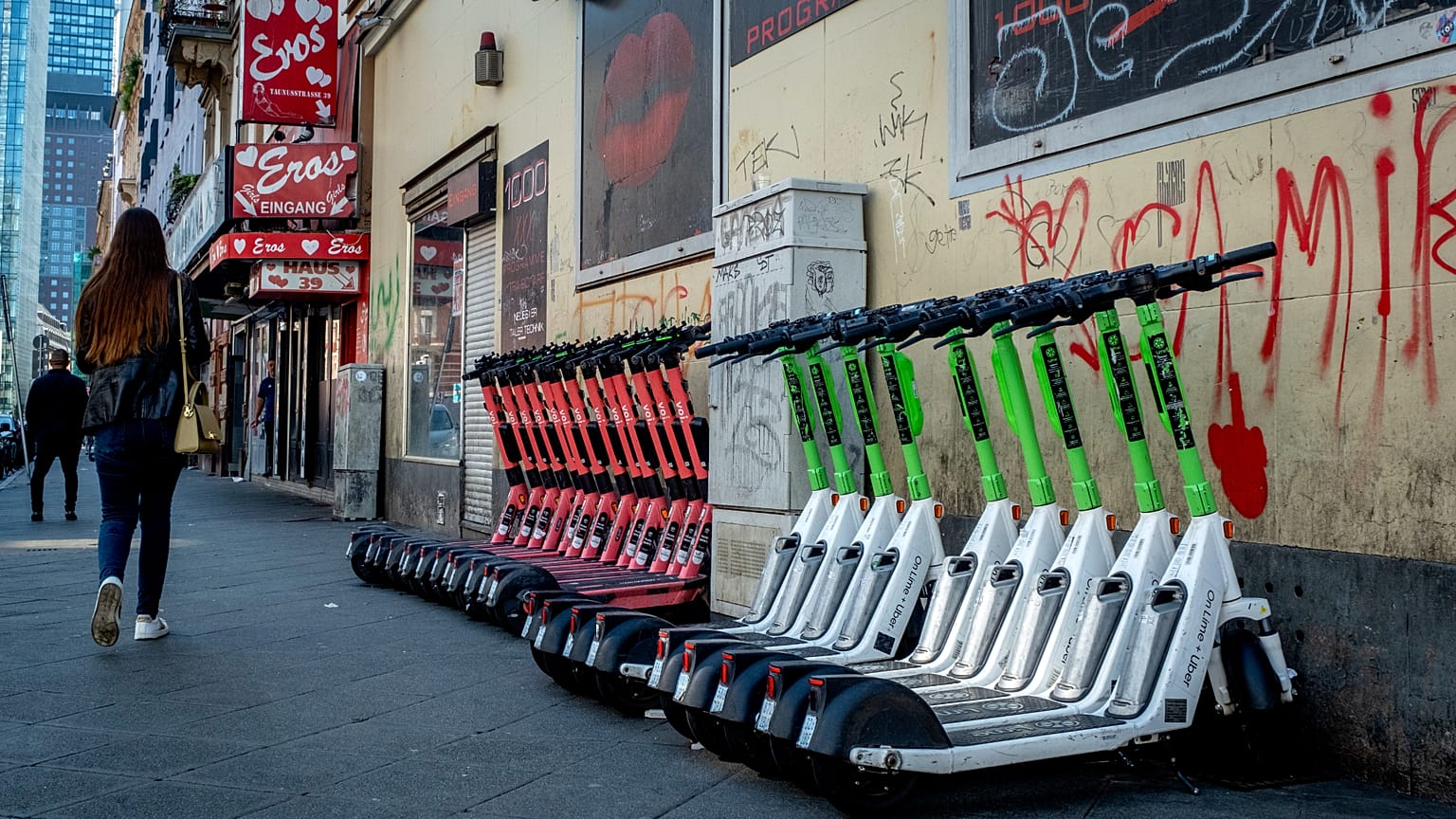
E-scooters are lined up in the red light district in Frankfurt, Germany, Friday, June 7, 2024.
Copyright AP Photo/Michael Probst

By Roselyne Min
Published on

Rental scooters represented around one-fifth of insured e-scooters in 2023 but accounted for roughly 40% of claims.

Germany is moving to close a legal loophole that has left e-scooter accident victims unable to claim compensation by making rental companies such as Lime and Bolt directly liable for accidents involving their vehicles

The bill would also cover accidents caused by scooters left blocking pavements. Under the new rules, operators face strict liability as owners regardless of fault, while riders will be presumed at fault unless they can prove otherwise.

Meanwhile under the current rules, victims of scooter accidents must prove the rider was at fault — a standard that is often impossible to meet when the rider cannot be identified. The new law would make it significantly easier to claim compensation

“The economic benefits of these services are largely enjoyed by fleet operators as vehicle holders,” the German Federal Ministry for Justice and Consumer Protection said in its justification for the bill.

“It therefore appears logical that whoever benefits from an activity should also bear the risk it creates,” it added.

It would apply to e-scooters and some self-balancing vehicles, but not e-bikes.

The German government argues that the current rules no longer reflect the rapid growth of e-scooters on German streets.

Rising concerns about e-scooter accidents across Europe

The number of insured e-scooters increased more than fivefold, from 180,000 in 2020 to 990,000 in 2023, according to the German Insurance Association.

Third-party damage claims rose from 1,150 in 2020 to 5,000 in 2024. Rental scooters represented around one-fifth of insured e-scooters in 2023 but accounted for roughly 40% of those claims, according to the German Insurance Association.

Beyond collisions and pavement obstructions, authorities have also warned that the lithium-ion batteries used in e-scooters can cause serious fires when damaged, faulty or charged incorrectly.

Safety and public-space concerns have led several European cities to remove shared e-scooters.

Paris ended rental services in 2023 after a public vote, while Madrid withdrew operators’ licences in 2024 over failures to control riding and parking.

Prague removed shared e-scooters from its streets in January 2026, and Brussels plans to follow in January 2027.


Volkswagen unveils four-year plan but lacks backing for overhaul with up to 100,000 job cuts


By Doloresz Katanich
Published on

Volkswagen's proposed restructuring plan failed to win backing from the labour bloc on the company's supervisory board on Thursday, leaving uncertainty over additional job cuts and factory closures. The carmaker nevertheless laid out plans to reduce production capacity and simplify its model range.

Volkswagen's labour representatives on the supervisory board blocked a sweeping restructuring plan at a meeting on Thursday, Reuters reported on Friday, citing company sources.

This comes as Europe's largest carmaker wrestles with falling profits, rising costs and competition. Volkswagen said on Friday that its global vehicle deliveries fell 8.6% year on year in the second quarter, a steeper decline than in the previous quarter.

The company's share price was down by 0.6% around noon in Europe. The focus, however, remained on the restructuring proposals that divided the supervisory board.

As the board met at Volkswagen’s headquarters in Wolfsburg on Thursday, IG Metall, one of Germany’s largest trade unions, organised coordinated protests across the country to stop a plan that reportedly includes up to 100,000 job cuts worldwide — more than 15% of its workforce — and closing four plants in Germany: Volkswagen factories in Hanover, Emden and Zwickau, as well as Audi's Neckarsulm plant.

According to Reuters, citing unnamed company sources, these measures were rejected by the supervisory board on Thursday, which includes labour representatives and representatives of the state of Lower Saxony. The committee voted against management's proposed restructuring by 12 to seven, after opposition from labour representatives.

Volkswagen ⁠made no mention of possible job cuts or plant closures late on Thursday. Instead, after the meeting, Volkswagen unveiled its strategy through to 2030, including plans to halve the number of models it offers and reduce the number of vehicle variants by as much as 75% in an effort to cut costs and complexity, measures that did not require the approval of the supervisory board.

Volkswagen said it would reduce annual production capacity to around 9 million vehicles to respond to “sharply intensified competition”. That compares with capacity of around 12 million vehicles before the Covid-19 pandemic and about 10 million today.

Other measures include tailoring products and technology more closely to regional markets, aligning production capacity to match demand, and simplifying the group’s corporate structure and investment portfolio.

Volkswagen chief executive Oliver Blume said in a video statement that “the global situation has deteriorated over the past 12 months”, pointing to geopolitical tensions, tariffs, high costs, increasing regulation and intensifying global competition.

He also said Volkswagen needed to “get rid of excess capacity”, leaving open the possibility of factory closures in the longer term. Blume added that “digitalisation, artificial intelligence and shared services will help increase productivity and speed”.

Arno Antlitz, Volkswagen Group’s chief financial officer, said the cost reductions already agreed were “not sufficient in the current economic and geopolitical environment”.

He said the company planned to improve vehicle cost structures, “significantly reduce overhead costs”, increase plant efficiency and accelerate technology development and decision-making.

Volkswagen employs about 657,000 people worldwide, but the company has not said how the planned reduction in production capacity would affect its workforce. According to Reuters, Volkswagen's works council has demanded clarification on management's cost-cutting plans by the end of Friday.

The group has repeatedly argued that deeper restructuring is necessary after its net profit fell 28% to €1.56bn while revenue declined 2.5% year on year to €75.7bn in the quarter to March 2026.

“The next few years will decide who will play a decisive role in the automotive industry in the future,” Blume said.


Volkswagen boss prefers 'smarter solutions' over factory closures

12.07.2026, 


Photo: Johannes Neudecker/dpa


Volkswagen Group chief executive Oliver Blume said he believed the carmaker could avoid factory closures as it presses ahead with efforts to cut costs.

"There are smarter solutions than closing plants," Blume told the Bild am Sonntag newspaper in an interview published on Sunday.

A cost-cutting programme at Volkswagen's German production sites was already delivering results, he said.

"We were able to reduce our factory costs in Germany by an average of 20% last year alone. That's significant progress."

Blume's comments came after a meeting of the supervisory board on Thursday, where he reportedly failed to secure approval for a more far-reaching cost-cutting package.

According to a report in the Süddeutsche Zeitung newspaper, which cites sources within the group, representatives of the workforce and the German state of Lower Saxony voted against the package.

Details of the rejected package have so far emerged only through media reports. 

According to Manager Magazin, up to 100,000 jobs could be cut worldwide - twice as many as previously planned. 

Bild reported that the figure could even be as high as 120,000. 

Four of the Group's plants in Germany are also under threat of closure including a factory operated by VW's Audi subsidiary.