
A functional unemployment insurance system for today’s economy would cover more workers, including part-time, gig, and temporary workers, and would provide benefits that actually allow families to survive while searching for new work.
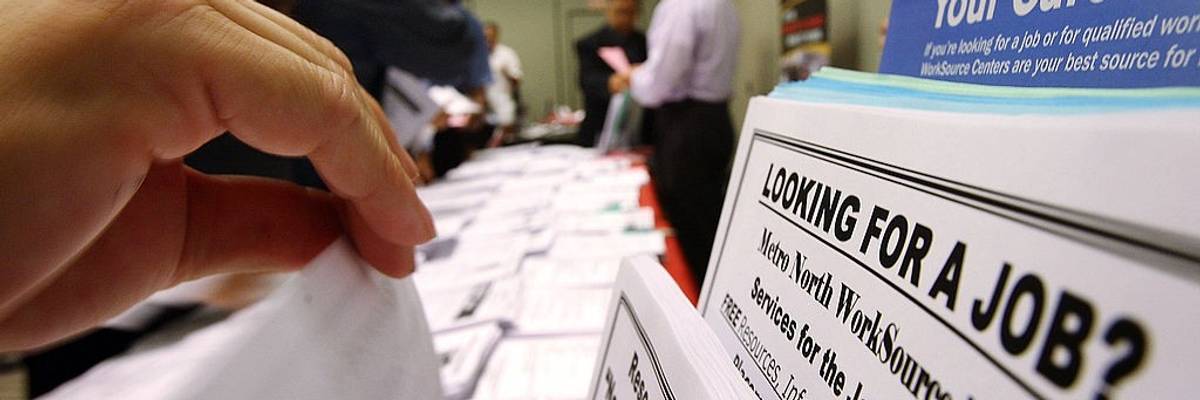
Job seekers look over job opening fliers at the WorkSource exhibit, a collaborative effort by governmental agencies to offer jobs and job training resources at the Greater Los Angeles Career Expo at the Pasadena Convention Center on May 14, 2009 in Pasadena, California.
(Photo by David McNew/Getty Images)
Rebecca Dixon
Jun 25, 2026
Common Dreams
For millions of workers, the conversation about artificial intelligence and the future of work is no longer theoretical. It is already showing up in layoffs, hiring freezes, shrinking departments, and growing anxiety about whether the paycheck families rely on today will still exist tomorrow.
But the most important question is not simply which jobs AI will eliminate. It is whether workers will have any real support when those jobs disappear.
While policymakers, executives, and economists debate which industries will thrive and which occupations will disappear in the age of AI, working Americans are focused on more immediate concerns: paying rent, affording groceries, covering childcare, and figuring out how they would support their families if their income suddenly vanished.
Workers are right to worry, because the system meant to help them through job loss is already failing to meet this moment.
While we may not be able to control every change AI will bring, we can decide whether workers will face those changes alone.
America’s unemployment insurance system was built for a different era entirely, one in which AI was nonexistent. It was built for an era that assumed stable full-time employment, long-term employer relationships, and relatively predictable layoffs. Today’s economy looks nothing like that.
Millions of workers now move between part-time jobs, contract work, temporary positions, caregiving responsibilities, and periods outside the workforce entirely. But unemployment insurance rules still exclude many of those workers from receiving help when they need it most.
Today, only about 1 in 4 unemployed workers receive unemployment benefits nationwide. In some states, fewer than 13% received support at all. And even when workers do qualify, benefits are often too low and too short-lived to keep families financially stable while they search for new work.
The result of this broken system is families scrambling to avoid financial free fall: draining savings accounts, falling behind on rent, or taking the first low-paying jobs they can find because they can’t afford to wait for something better.
That disconnect is already visible. While the number of unemployed workers has climbed sharply over the past year, unemployment claims have remained relatively flat—not because people are unaffected, but because so many workers are locked out of a system that no longer reflects the realities of modern work.
The first wave of AI disruption is already here. As adoption of these technologies increases, more workers will cycle between jobs, more families will navigate periods of unemployment, and more people will be forced to rebuild after losing work through no fault of their own.
And those burdens will not fall equally. Women—especially Black women, who are disproportionately represented in clerical and administrative jobs—are among the workers most vulnerable to displacement. Workers of color already face persistently higher unemployment rates because of structural inequities in the labor market. Yet when they lose work, they are significantly less likely to receive unemployment benefits and the economic stability those benefits are supposed to provide.
That reality is colliding with an already fragile economy. Data from the New York Federal Reserve shows that college graduates are now experiencing recession-level rates of unemployment. Over the last year, unemployment among young college graduates averaged 5.5%—the highest sustained level outside the brief peak of the Covid-19 pandemic since the aftermath of the Great Recession.
These are graduates who were told that if they worked hard, earned a degree, and applied themselves, they would find stability and opportunity. Instead, many are entering a labor market defined by uncertainty and shrinking opportunities, all while facing a weakening safety net.
That is why modernizing our unemployment systems must be part of the AI conversation.
A functional unemployment insurance system for today’s economy would cover more workers, including part-time, gig, and temporary workers. It would provide benefits that actually allow families to survive while searching for new work. It would make it easier, not harder, for eligible workers to receive support. And it would actually be prepared to withstand economic downturns.
Unemployment insurance should be understood for what it truly is: economic infrastructure.
Just as roads and bridges help goods move through the economy, unemployment insurance helps people move through economic change without falling into crisis. A strong UI system gives people the stability to search for good jobs instead of being pushed into the first low-wage position available. It stabilizes families, communities, and local businesses during periods of disruption.
The age of stable employment is fading. More workers will inevitably face periods of transition, disruption, and job loss in the years ahead.
While we may not be able to control every change AI will bring, we can decide whether workers will face those changes alone. Modernizing unemployment insurance is not simply a matter of compassion. It is a matter of economic readiness.
Our work is licensed under Creative Commons (CC BY-NC-ND 3.0). Feel free to republish and share widely.
Rebecca Dixon
Rebecca Dixon is the president and CEO of the National Employment Law Project.
Full Bio >
For millions of workers, the conversation about artificial intelligence and the future of work is no longer theoretical. It is already showing up in layoffs, hiring freezes, shrinking departments, and growing anxiety about whether the paycheck families rely on today will still exist tomorrow.
But the most important question is not simply which jobs AI will eliminate. It is whether workers will have any real support when those jobs disappear.
While policymakers, executives, and economists debate which industries will thrive and which occupations will disappear in the age of AI, working Americans are focused on more immediate concerns: paying rent, affording groceries, covering childcare, and figuring out how they would support their families if their income suddenly vanished.
Workers are right to worry, because the system meant to help them through job loss is already failing to meet this moment.
While we may not be able to control every change AI will bring, we can decide whether workers will face those changes alone.
America’s unemployment insurance system was built for a different era entirely, one in which AI was nonexistent. It was built for an era that assumed stable full-time employment, long-term employer relationships, and relatively predictable layoffs. Today’s economy looks nothing like that.
Millions of workers now move between part-time jobs, contract work, temporary positions, caregiving responsibilities, and periods outside the workforce entirely. But unemployment insurance rules still exclude many of those workers from receiving help when they need it most.
Today, only about 1 in 4 unemployed workers receive unemployment benefits nationwide. In some states, fewer than 13% received support at all. And even when workers do qualify, benefits are often too low and too short-lived to keep families financially stable while they search for new work.
The result of this broken system is families scrambling to avoid financial free fall: draining savings accounts, falling behind on rent, or taking the first low-paying jobs they can find because they can’t afford to wait for something better.
That disconnect is already visible. While the number of unemployed workers has climbed sharply over the past year, unemployment claims have remained relatively flat—not because people are unaffected, but because so many workers are locked out of a system that no longer reflects the realities of modern work.
The first wave of AI disruption is already here. As adoption of these technologies increases, more workers will cycle between jobs, more families will navigate periods of unemployment, and more people will be forced to rebuild after losing work through no fault of their own.
And those burdens will not fall equally. Women—especially Black women, who are disproportionately represented in clerical and administrative jobs—are among the workers most vulnerable to displacement. Workers of color already face persistently higher unemployment rates because of structural inequities in the labor market. Yet when they lose work, they are significantly less likely to receive unemployment benefits and the economic stability those benefits are supposed to provide.
That reality is colliding with an already fragile economy. Data from the New York Federal Reserve shows that college graduates are now experiencing recession-level rates of unemployment. Over the last year, unemployment among young college graduates averaged 5.5%—the highest sustained level outside the brief peak of the Covid-19 pandemic since the aftermath of the Great Recession.
These are graduates who were told that if they worked hard, earned a degree, and applied themselves, they would find stability and opportunity. Instead, many are entering a labor market defined by uncertainty and shrinking opportunities, all while facing a weakening safety net.
That is why modernizing our unemployment systems must be part of the AI conversation.
A functional unemployment insurance system for today’s economy would cover more workers, including part-time, gig, and temporary workers. It would provide benefits that actually allow families to survive while searching for new work. It would make it easier, not harder, for eligible workers to receive support. And it would actually be prepared to withstand economic downturns.
Unemployment insurance should be understood for what it truly is: economic infrastructure.
Just as roads and bridges help goods move through the economy, unemployment insurance helps people move through economic change without falling into crisis. A strong UI system gives people the stability to search for good jobs instead of being pushed into the first low-wage position available. It stabilizes families, communities, and local businesses during periods of disruption.
The age of stable employment is fading. More workers will inevitably face periods of transition, disruption, and job loss in the years ahead.
While we may not be able to control every change AI will bring, we can decide whether workers will face those changes alone. Modernizing unemployment insurance is not simply a matter of compassion. It is a matter of economic readiness.
Our work is licensed under Creative Commons (CC BY-NC-ND 3.0). Feel free to republish and share widely.
Rebecca Dixon
Rebecca Dixon is the president and CEO of the National Employment Law Project.
Full Bio >
Fearing Mass Job Loss, Working-Class US Voters Believe Government Must Act to Prevent Economic Disaster
The findings of a new poll could bolster the case made by many progressive politicians about the need to vigorously regulate the AI industry.
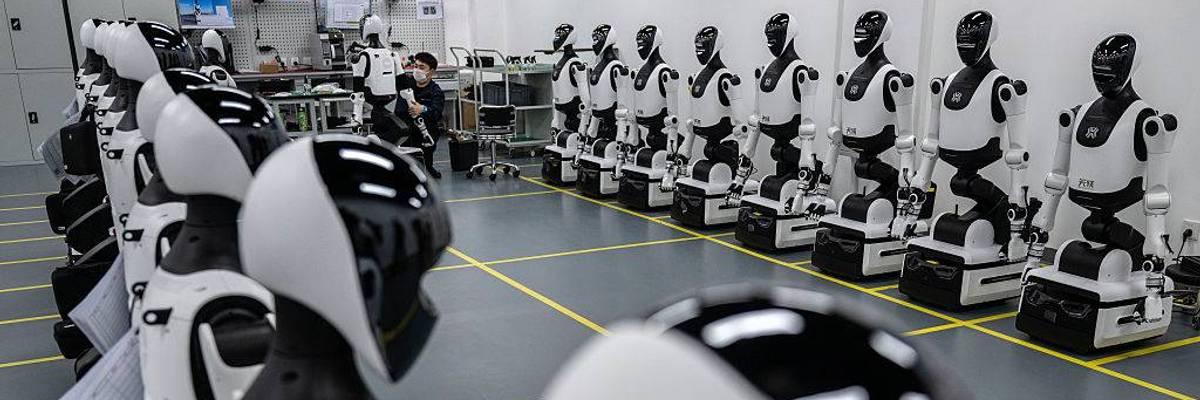
Humanoid robots are seen lined up as an engineer works on a robot in the production facility of X-Humanoid on March 20, 2026 in Beijing, China.
(Photo by Kevin Frayer/Getty Images)
Brad Reed
Jun 23, 2026
COMMON DREAMS
A poll commissioned by Working Families Power reveals deep anxiety among US workers about the impacts of artificial intelligence, as well as support for the government intervening to prevent potential mass unemployment.
The survey of just over 2,500 working-class American voters, conducted by Justice Research Group, finds that 73% said they were worried that AI would lead to job losses in the US, while 62% said they were concerned that AI would personally affect them or people close to them.
Workers expect that AI will negatively impact a broad number of industries, with majorities saying it will hurt truckers and delivery drivers; retail and service workers; writers, designers, and other creative workers; and office and administrative workers, according to the poll. Pluralities, meanwhile, expect AI to hurt teachers, education workers, and healthcare support workers.
With so many workers fearing massive jobs losses due to AI, they also support major government interventions to alleviate the harms caused by the technology.
Overall, 84% of those surveyed support free training or education for all workers displaced by AI, while 79% support rules to force companies to share AI productivity gains with their workers in the former of higher pay, stronger benefits, and shorter hours.
Even the least popular policy idea presented in the poll—taxing large companies that replace workers with AI and using the money to create a worker unemployment fund—received 69% support among US workers.
The poll’s findings could bolster the case made by many progressive politicians about the need to vigorously regulate the AI industry to prevent it from hurting working-class Americans.
Sen. Bernie Sanders (I-Vt.) and Rep. Alexandria Ocasio-Cortez (D-NY) earlier this year introduced a bill that would impose a nationwide moratorium on AI data center construction “until strong national safeguards are in place to protect workers, consumers, and communities, defend privacy and civil rights, and ensure these technologies do not harm our environment.”
Sen. Elizabeth Warren (D-Mass.) and Rep. Greg Casar (D-Texas) last month proposed a tax on the use of AI to pay for jobs programs for affected workers.

The findings of a new poll could bolster the case made by many progressive politicians about the need to vigorously regulate the AI industry.
Humanoid robots are seen lined up as an engineer works on a robot in the production facility of X-Humanoid on March 20, 2026 in Beijing, China.
(Photo by Kevin Frayer/Getty Images)
Brad Reed
Jun 23, 2026
COMMON DREAMS
A poll commissioned by Working Families Power reveals deep anxiety among US workers about the impacts of artificial intelligence, as well as support for the government intervening to prevent potential mass unemployment.
The survey of just over 2,500 working-class American voters, conducted by Justice Research Group, finds that 73% said they were worried that AI would lead to job losses in the US, while 62% said they were concerned that AI would personally affect them or people close to them.
Workers expect that AI will negatively impact a broad number of industries, with majorities saying it will hurt truckers and delivery drivers; retail and service workers; writers, designers, and other creative workers; and office and administrative workers, according to the poll. Pluralities, meanwhile, expect AI to hurt teachers, education workers, and healthcare support workers.
With so many workers fearing massive jobs losses due to AI, they also support major government interventions to alleviate the harms caused by the technology.
Overall, 84% of those surveyed support free training or education for all workers displaced by AI, while 79% support rules to force companies to share AI productivity gains with their workers in the former of higher pay, stronger benefits, and shorter hours.
Even the least popular policy idea presented in the poll—taxing large companies that replace workers with AI and using the money to create a worker unemployment fund—received 69% support among US workers.
The poll’s findings could bolster the case made by many progressive politicians about the need to vigorously regulate the AI industry to prevent it from hurting working-class Americans.
Sen. Bernie Sanders (I-Vt.) and Rep. Alexandria Ocasio-Cortez (D-NY) earlier this year introduced a bill that would impose a nationwide moratorium on AI data center construction “until strong national safeguards are in place to protect workers, consumers, and communities, defend privacy and civil rights, and ensure these technologies do not harm our environment.”
Sen. Elizabeth Warren (D-Mass.) and Rep. Greg Casar (D-Texas) last month proposed a tax on the use of AI to pay for jobs programs for affected workers.


No comments:
Post a Comment