Revolutions 250 Years Ago and Today

“What, to the American slave, is your 4th of July? I answer: a day that reveals to him, more than all other days in the year, the gross injustice and cruelty to which he is the constant victim. To him, your celebration is a sham; your boasted liberty, an unholy license; your national greatness, swelling vanity; your sounds of rejoicing are empty and heartless; your denunciations of tyrants, brass fronted impudence; your shouts of liberty and equality, hollow mockery; your prayers and hymns, your sermons and thanksgivings, with all your religious parade, and solemnity, are, to him, mere bombast, fraud, deception, impiety, and hypocrisy— a thin veil to cover up crimes.”
–speech by Frederick Douglas, July 5, 1852, Rochester, NY
“[The 1775-1787 US revolution] led to the expansion of European American settlement across the continent in the decades afterwards, a process which nearly wiped out the Indigenous peoples who have lived here for many thousands of years. Estimates are that 90% or more were killed either by disease or violent military action to force the survivors onto reservations so that the Europeans could take the land and the resources underneath it.
“Like so much else about this country, this 250th anniversary of the beginnings of what became the United States is a decidedly mixed bag.
“On balance, though, I see value to connecting the political uprising against the Trumpfascists with the uprising by revolutionary European Americans 250 years ago. Not by coincidence, the success of this revolution was followed by the French Revolution, the Haitian Revolution, the Bolivar-led South American Revolution and eventually, in the USA, the Civil War that led to the end of the legal enslavement of African people. It led to the success of the women’s suffrage movement over 100 years ago, the rise of industrial unionism, the Black Freedom movement in the 60’s which forced an end to Jim Crow segregation, anti-colonial revolutions throughout the world, the rise of Indigenous resistance and societal leadership, the LGBTQ+ movement, an environmental protection movement and more.”
–Revolution?, a March 22, 2025 Future Hope column
Is it right to connect what happened 250-plus years ago with what is happening right now, in 2026, as a broad cross-section of US society resists the Trumpfascist efforts to impose repressive dictatorial rule? Yes, there are many similarities. Indeed, the US pro-democracy forces, if successful, will have much more immediate impacts worldwide.
The world is seeing that we in the USA are alive and well and rapidly becoming a mass movement that has the potential to bring about major, internationally-welcomed, desperately-needed changes in the USA at this turning point moment for human societies and all life forms on earth.
Some who are participating in this movement do not see themselves as “revolutionaries.” More accurate for them would be something like, “patriots” or “democracy lovers.” And some are involved primarily because of the personal and family impacts of Trump regime policies which have made their lives materially more difficult.
But IMHO, the word “revolutionary” best describes what this pro-democracy movement is developing into, in part because it has been building for many years–it is not a “flash in the pan”–and in part because the Trumpists are so destructive in their efforts to turn the clock back to the 1950’s or even further that many millions of us have risen up in a whole variety of ways.
The changes needed are clearly systemic, not some reforms here and there that have little effect on who runs the country today: the “billionaire class”, the “Epstein class,” the “corporate elite,” the “ruling class,” etc.
It’s very simple, actually. What this revolutionary movement is about is the creation of a US government and society truly “of the people, by the people and for the people.” In such a society we would be about racial and gender justice and equal rights; for the right to organize and unionize on the job; against militarism and for a justice-based peace; for detoxification and protection of our natural environment and a rapid shift from dirty and dangerous fossil fuels and nukes to clean, renewable energy sources; for immigrant rights, reproductive rights and an end to mass incarceration; for a Green New Deal; for quality medical care for all no matter what their age; for a true living wage for work done; for tuition-free public higher education and student debt cancellation; for substantive taxes on the billionaires and multi-multi-millionaires and major cuts in the US military budget with conversion of war industry production to peaceful purposes; and more.
Love, that’s the word. We need a government and society which makes love for the earth and its peoples central. That is what this 250th anniversary of the USA has to be about for those of us in the pro-democracy movement. Not should be about, but has to be about. This is our time!
Ted Glick has been a progressive activist and organizer since 1968. He is the author of two books, Burglar for Peace and 21st Century Revolution, published in 2020 and 2021 and both available at https://pmpress.org . More info can be found at https://tedglick.com

Congress Is Preparing To Surrender American Sovereignty on the Eve of America’s 250th Anniversary
Reprinted with permission from The Kucinich Report.
The United States Congress, on the very eve of the 250th anniversary of our Declaration of Independence from Great Britain, is preparing to formally diminish American independence and sovereignty through a proposed merger and long-term integration of executive functions throughout the government, coordinated by the Department of Defense.
Treacherous provisions in the 2027 National Defense Authorization Act (NDAA) mandate that the U.S. State Department, the U.S. Commerce Department, and the heads of other relevant Federal departments and agencies cooperate with their Israeli counterparts for the purpose of consolidating U.S. and Israeli military activities in order to align efforts and avoid duplication.
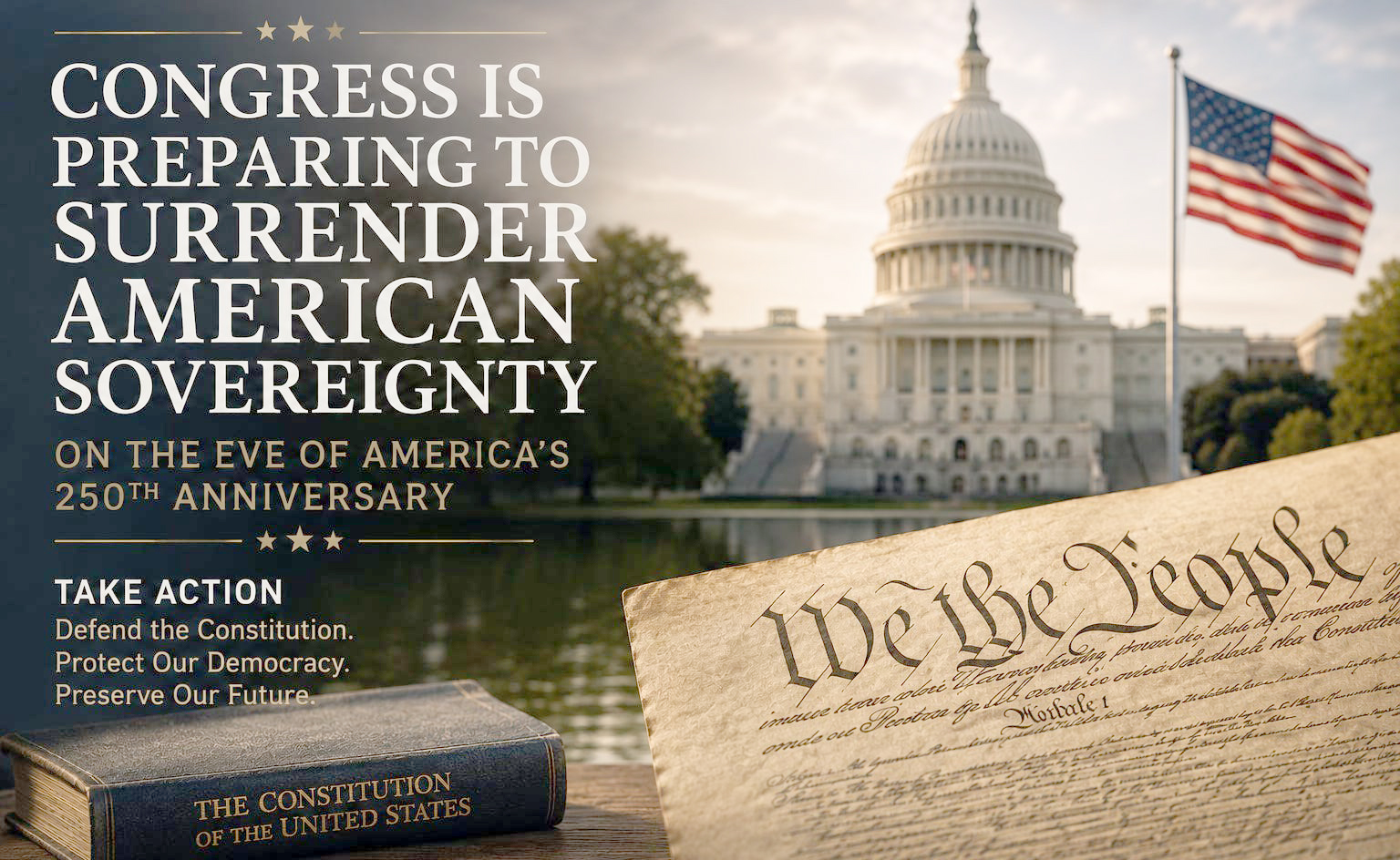
The greatest threat to American sovereignty rarely arrives wearing the uniform of a foreign army. It often arrives through the complacency, expediency, or poor judgment of elected officials who fail to recognize the long-term consequences of the powers they surrender.
Whether motivated by political convenience, misplaced loyalty, or simple inattention, such actions can erode constitutional self-government just as surely as deliberate acts of betrayal.
No foreign nation, regardless of whether it is Israel, Britain, Canada, France, or Japan, should be integrated into permanent executive, military, technological, intelligence, and research structures in a manner that diminishes American sovereignty and democratic accountability.
The Pentagon’s Defense Intelligence Agency (DIA) recently identified Israel as a counterintelligence threat.
Under ordinary circumstances, such a finding would prompt heightened scrutiny, caution, and congressional oversight. Instead, Congress has continued advancing provisions in the 2027 National Defense Authorization Act (NDAA) that would deepen military, technological, and strategic integration between the United States and Israel.
The legislation specifies Israel-U.S. coordination with America’s Defense Advanced Research Projects Agency (DARPA), the Missile Defense Agency, including the Golden Dome initiative, the United States Space Command, directed energy programs, artificial intelligence, biotechnology, and other critical technologies that will shape the future distribution of power.
Of all the areas mentioned, artificial intelligence and biotechnology may have the greatest long term implications. These technologies will shape privacy, surveillance, predictive policing, digital identity systems, biosecurity, human enhancement technologies, and information control.
The Founders could never have imagined artificial intelligence, autonomous systems, or biotechnology directed by algorithms. Yet they understood a timeless truth: power must remain accountable to the people. The danger of our age is not merely that authority may concentrate in governments, corporations, or military institutions. It is that decisions of profound consequence may increasingly be delegated to technological systems that operate beyond the understanding and oversight of those whom the Constitution entrusts with governing.
The highly structured Israel-U.S. merger is included in the $1.5 trillion NDAA, in Section 219, formerly Section 224, in the House version and Section 1217 in the Senate version. It puts in place policies which will bind future Administrations.
Democracy depends on elected officials being able to alter policy. Permanent structures can make that increasingly difficult. Democracies function because citizens can change policy through elections. When military, intelligence, and technological institutions become permanently integrated across governments and bureaucracies, decision making can drift beyond the reach of voters.
The issue is not cooperation with perceived allies. The issue is whether future Americans retain the practical ability to change course through democratic means. The democratic question, regardless of the technology involved, is simple: Who governs these technologies, and for what purpose?
Will decisions remain accountable to elected representatives and the American people, or will authority increasingly reside within security agencies, military institutions, and specialized technical bureaucracies beyond meaningful democratic oversight?
The U.S.-Israel military-executive merger provisions in the NDAA advance military influence across civilian government and create precisely the conditions the Constitution was designed to prevent.
Our Declaration of Independence condemned King George III for having rendered the military independent of and superior to the Civil power and for having combined with others to subject us to a jurisdiction foreign to our constitution, and unacknowledged by our laws.
The concern is not just military and executive integration with any foreign nation. It is the gradual expansion of military institutions into civilian domains including technology, biotechnology, commerce, communications, and artificial intelligence and the effect on our Republic and our freedom.
As national security priorities become embedded throughout government, civilian decision making becomes subordinate to military logic. Policies that should be determined through democratic debate become the province of security institutions, technical experts, and permanent bureaucracies.
The Founders repeatedly warned against permanent ‘s because they understood the motivations of leaders of other countries may be inconsistent with American ideals or interests. The Founders structured the government of the United States so that future Administrations would not be locked into foreign alliances which became vexatious.
If cooperation evolves into integration, future administrations will have less freedom to pursue independent diplomatic, military, technological, and economic policies. Decisions made in the name of efficiency today may limit the choices available to Americans tomorrow.
Congress is constitutionally responsible for oversight of the executive branch.
A key question is whether the military and executive merger provisions in the 2027 NDAA create new arrangements that are sufficiently transparent and reviewable by Congress. If significant military, intelligence, technological, or strategic decisions become embedded within joint frameworks, legislators may find themselves attempting to oversee systems that have acquired their own institutional momentum.
Ironclad collaborative provisions uniting Israel and the United States in the 2027 NDAA are being advanced on the basis of current political relationships and short-term strategic considerations rather than a careful assessment of their long -term institutional consequences. Congress has devoted remarkably little attention to how such an arrangement could affect American sovereignty, constitutional accountability, civilian control of the government of the United States, and the ability of future generations to alter policy through democratic means.
The question before Congress is not whether Israel is a friend today. The question is whether the permanent integration of military, technological, intelligence, research, and governmental functions with any foreign nation serves the long-term interests of the United States.
The Declaration of Independence and our constitutional system has been entrusted to our care. Aliances between nations may change. Governments change. Political leaders come and go, friendships change. Yet the structures established by law can endure for generations.
The Constitution was designed to preserve the sovereignty of the American Republic through democratic accountability, separation of powers, and civilian control of government. Any arrangement that permanently embeds foreign influence within executive, military, intelligence, technological, or research institutions will not stand once it receives the highest degree of constitutional scrutiny.
Congress has already struggled to reclaim its constitutionally based war powers. The military establishment has steadily accumulated influence across multiple domains of public policy. These provisions move further in that direction by embedding foreign military and security priorities. throughout the machinery of government.
Members of Congress swear an oath to support and defend the Constitution of the United States. That oath is a sacred trust and does not abide treachery. Any measure that diminishes American sovereignty, weakens constitutional self-government, or places the powers of this Republic in alignment with a foreign authority violates both the spirit of that oath and the duty owed to every American citizen.
As America approaches the 250th anniversary of our Independence, Congress is poised to bind future generations through strategic commitments made to a foreign power today. These provisions reflect a profound failure of constitutional judgment. They elevate short term political and military considerations above the enduring duty to preserve the sovereignty, independence, and freedom of action of the United States.
The Founders warned repeatedly against arrangements that would entangle future generations in obligations they neither chose nor approved. Yet Congress now stands on the threshold of embracing precisely such an arrangement, limiting the freedom of future American leaders to chart an independent course in diplomacy, technology, security, and national defense.
Whether driven by political expediency, misplaced loyalties, institutional inertia, or a failure to grasp the long-term consequences of their actions, the result is the same: a diminished capacity for self-government and a dangerous departure from the constitutional principles that have safeguarded American independence for two and a half centuries.
On the eve of America 250th year, every citizen must decide whether independence is merely a memory to celebrate or a responsibility to defend.
TAKE ACTION
The merger is timed to be voted on the week of June 29, just before the Fourth of July.
Let us truly celebrate our independence by staying independent. Please help spread the word and forward this article.
Find your member of Congress:
It is urgent that you call your congressional representative today at 202-224-3121 and tell them to Strip Section 219 (House) or Section 1217 (Senate) from the 2027 NDAA.
Congressmen Tom Massie (R-KY) and Ro Khanna (D-CA) will offer an amendment in the House to remove Section 219. Please tell your U.S. Representative: Support the Massie-Khanna Amendment to the NDAA.
Optional telephone script for the House of Representatives:
My name is ______ and I am a constituent. I am calling to urge Representative ______ to support the Massie-Khanna Amendment and to remove Section 219 from the NDAA. Congress should defend American sovereignty, uphold the Constitution, and reject any measure that integrates the executive and military functions of the United States with those of a foreign government. Please pass my message to the Representative. Thank you.

No comments:
Post a Comment