‘We Intend to Win’: California Billionaire Tax Officially Certified for November Ballot
“The fact that the ultra-wealthy and billionaire-backed politicians like Gov. Newsom nearly succeeded in killing it is the single best argument for why we need to tax billionaires in the first place.”
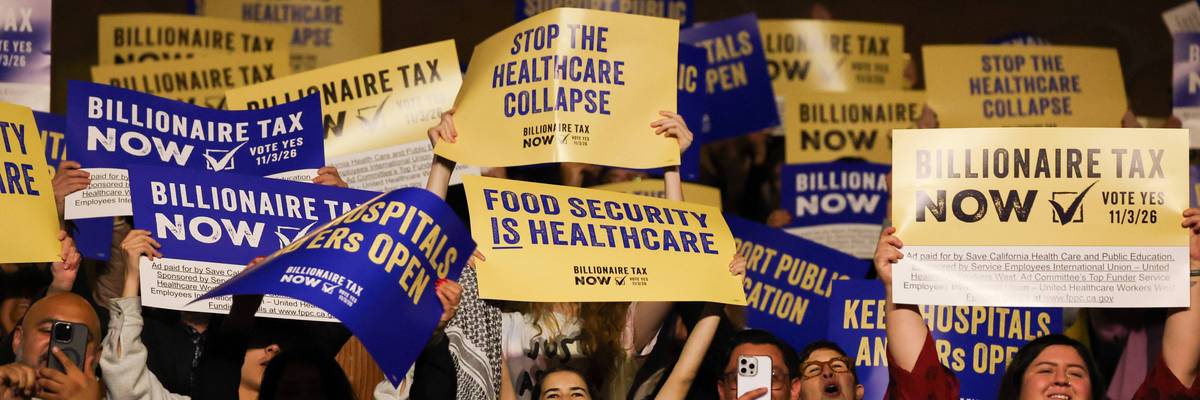
Attendees cheer during an event supporting the California Billionaire Tax Act in Los Angeles on February 18, 2026.
(Photo by Patrick T. Fallon/AFP via Getty Images)
Jake Johnson
Jun 26, 2026
COMMON DREAMS
Organizers said late Thursday that a proposed one-time wealth tax on California billionaires has been certified to appear on state ballots in November, advancing despite efforts by Democratic Gov. Gavin Newsom and billionaire-funded groups to tank the measure ahead of the June 25 deadline.
“Today we’re making it clear that we aren’t backing down–the billionaire tax will be on the ballot this November, and we intend to win,” said Debru Carthan, a radiologic technologist and spokesperson for Billionaire Tax Now, the healthcare union-led coalition leading the ballot initiative.
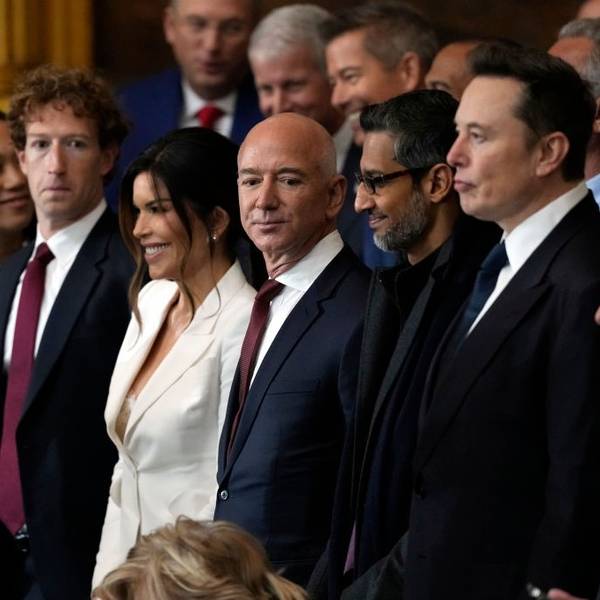
Real Fight With Oligarchy Begins as Billionaires Tax Qualifies for Ballot in California
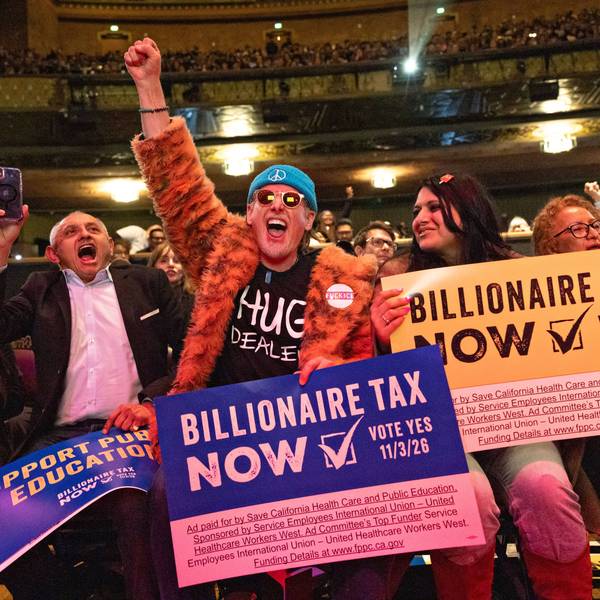
If approved by California voters, the proposal would tax billionaires’ wealth at a rate of 5%, raising an estimated $100 billion to shore up the state’s healthcare system amid devastating federal cuts to Medicaid. Revenue from the tax would also be used for food aid and education, according to the initiative’s text.
Last week, organizers offered to withdraw their proposal if Newsom agreed to push a 2% tax on billionaire wealth in California’s Legislature. Newsom, who is widely seen as a 2028 presidential hopeful, rejected the compromise and privately told a major Democratic donor that he was confident the billionaire tax would not appear on California’s ballot in November.
Organizers emphasized Thursday that despite Newsom’s opposition and fearmongering from billionaires and other opponents, the proposed tax is popular among California voters, who are facing an affordability crisis as the wealthiest see their fortunes soar. From 2023 to 2025, the wealth of California billionaires surged by 144%, according to a recent paper co-authored by leading economists.
“Voters consistently support the billionaire tax by large, double-digit margins, and the growing campaign has brought on thousands of volunteers,” organizers said in a statement. “Supporters of the measure submitted over 1.6 million signatures, more than double the number needed to secure a spot on the general election ballot.”
To succeed, proponents of the billionaire tax must secure enough votes to pass their initiative while also defeating separate ballot measures that would effectively cancel out the wealth levy. One of the competing initiatives was pushed by a group bankrolled by Google co-founder Sergey Brin, who has spent tens of millions of dollars trying to defeat the billionaire tax and who left California in late 2025 to avoid the potential levy.
The competing ballot measures—the Retirement and Personal Savings Protection Act of 2026 and the Improving Transparency, Effectiveness, and Efficiency in California Government Act of 2026—are titled in ways that could lead some voters to support both the wealth tax and proposals that would counteract it.
Igor Volsky, director of the Tax the Greedy Billionaires campaign, said in a statement that “when billionaires can erase democratic initiatives that threaten their fortunes, they have too much power.”
“The fact that the ultra-wealthy and billionaire-backed politicians like Gov. Newsom nearly succeeded in killing it is the single best argument for why we need to tax billionaires in the first place,” Volsky added.
US Rep. Ro Khanna (D-Calif.), a vocal supporter of the proposed billionaire wealth tax, said Thursday that “this issue couldn’t be more simple.”
“There are 250 billionaires in a state of 40 million people,” said Khanna. “What we’re saying is, tax these 250 billionaires so that millions of Californians can have healthcare.”
“The fact that the ultra-wealthy and billionaire-backed politicians like Gov. Newsom nearly succeeded in killing it is the single best argument for why we need to tax billionaires in the first place.”
Attendees cheer during an event supporting the California Billionaire Tax Act in Los Angeles on February 18, 2026.
(Photo by Patrick T. Fallon/AFP via Getty Images)
Jake Johnson
Jun 26, 2026
COMMON DREAMS
Organizers said late Thursday that a proposed one-time wealth tax on California billionaires has been certified to appear on state ballots in November, advancing despite efforts by Democratic Gov. Gavin Newsom and billionaire-funded groups to tank the measure ahead of the June 25 deadline.
“Today we’re making it clear that we aren’t backing down–the billionaire tax will be on the ballot this November, and we intend to win,” said Debru Carthan, a radiologic technologist and spokesperson for Billionaire Tax Now, the healthcare union-led coalition leading the ballot initiative.
Real Fight With Oligarchy Begins as Billionaires Tax Qualifies for Ballot in California
If approved by California voters, the proposal would tax billionaires’ wealth at a rate of 5%, raising an estimated $100 billion to shore up the state’s healthcare system amid devastating federal cuts to Medicaid. Revenue from the tax would also be used for food aid and education, according to the initiative’s text.
Last week, organizers offered to withdraw their proposal if Newsom agreed to push a 2% tax on billionaire wealth in California’s Legislature. Newsom, who is widely seen as a 2028 presidential hopeful, rejected the compromise and privately told a major Democratic donor that he was confident the billionaire tax would not appear on California’s ballot in November.
Organizers emphasized Thursday that despite Newsom’s opposition and fearmongering from billionaires and other opponents, the proposed tax is popular among California voters, who are facing an affordability crisis as the wealthiest see their fortunes soar. From 2023 to 2025, the wealth of California billionaires surged by 144%, according to a recent paper co-authored by leading economists.
“Voters consistently support the billionaire tax by large, double-digit margins, and the growing campaign has brought on thousands of volunteers,” organizers said in a statement. “Supporters of the measure submitted over 1.6 million signatures, more than double the number needed to secure a spot on the general election ballot.”
To succeed, proponents of the billionaire tax must secure enough votes to pass their initiative while also defeating separate ballot measures that would effectively cancel out the wealth levy. One of the competing initiatives was pushed by a group bankrolled by Google co-founder Sergey Brin, who has spent tens of millions of dollars trying to defeat the billionaire tax and who left California in late 2025 to avoid the potential levy.
The competing ballot measures—the Retirement and Personal Savings Protection Act of 2026 and the Improving Transparency, Effectiveness, and Efficiency in California Government Act of 2026—are titled in ways that could lead some voters to support both the wealth tax and proposals that would counteract it.
Igor Volsky, director of the Tax the Greedy Billionaires campaign, said in a statement that “when billionaires can erase democratic initiatives that threaten their fortunes, they have too much power.”
“The fact that the ultra-wealthy and billionaire-backed politicians like Gov. Newsom nearly succeeded in killing it is the single best argument for why we need to tax billionaires in the first place,” Volsky added.
US Rep. Ro Khanna (D-Calif.), a vocal supporter of the proposed billionaire wealth tax, said Thursday that “this issue couldn’t be more simple.”
“There are 250 billionaires in a state of 40 million people,” said Khanna. “What we’re saying is, tax these 250 billionaires so that millions of Californians can have healthcare.”
“The misdirect here is that Newsom is opposing a WEALTH tax on billionaires in his own state and insisting he supports a new national INCOME tax on billionaires. But billionaires make money off non-income sources.”
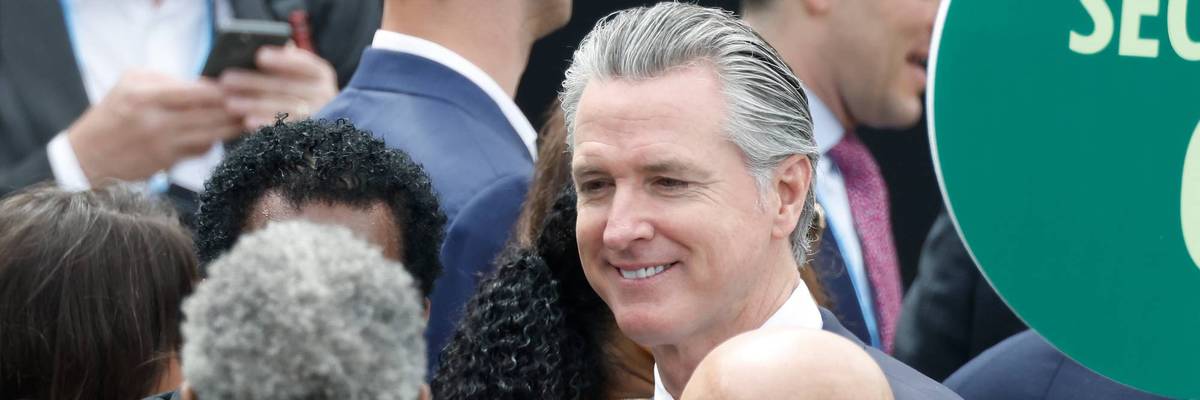
California Gov. Gavin Newsom (D) attends the dedication ceremony for the opening of the Barack Obama Presidential Center, in John Lewis Plaza, on June 18, 2026 in Chicago, Illinois.
(Photo by Taylor Hill/Getty Images)
Stephen Prager
Jun 26, 2026
COMMON DREAMS
Critics say that Democratic California Gov. Gavin Newsom is trying to trick voters with his new plan for a national billionaire income tax, while simultaneously opposing a tax on billionaire wealth in his own state.
Along with a coterie of wealthy donors, Newsom has long stressed that he is adamantly opposed to the statewide plan to institute a one-time 5% tax on the total wealth of those in the state with more than $1 billion to fund healthcare, education, and food assistance programs, which has been spearheaded by the Service Employees International Union-United Healthcare Workers West (SEIU-UHW).
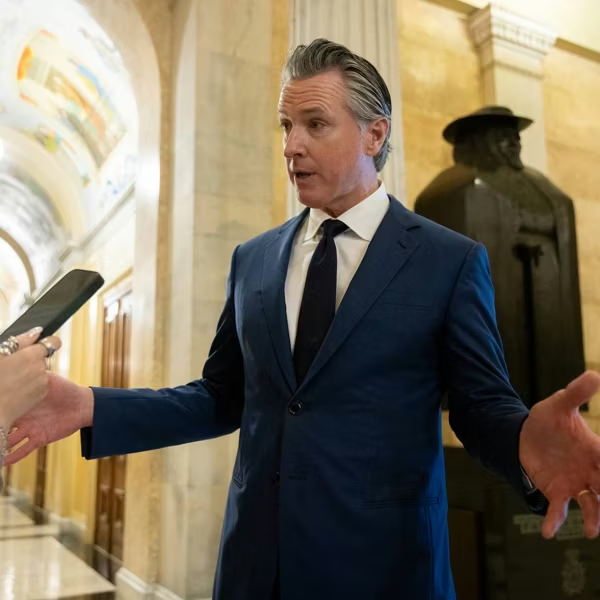
‘The World Is Watching’: Top Economist Rips Newsom for Working to Tank Billionaire Wealth Tax
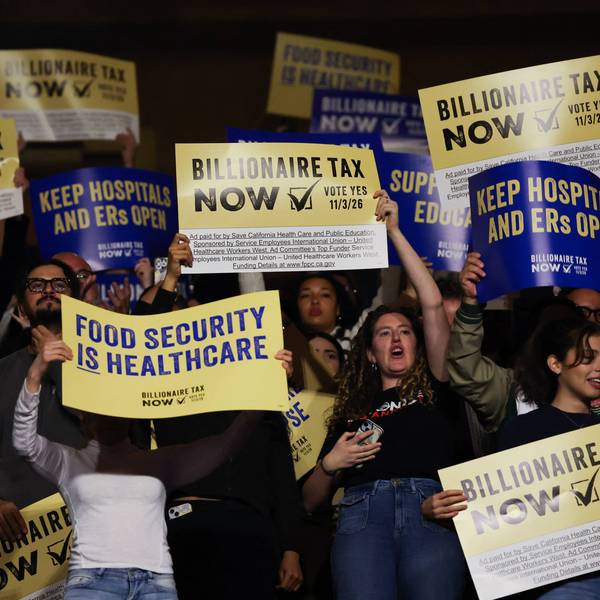
Failing ‘Moral Test,’ Newsom Rejects Compromise 2% Wealth Tax on California Billionaires
But a day after the measure was certified to appear on voters’ ballots, Newsom—who is expected to run for president in 2028 and face an electorate that is angrier than ever about the outsized wealth and power of the billionaire class—unveiled a new national proposal that, at least on the surface, seems to hit many of the same populist notes as the one in California.
“Last night, it became certain that a wealth tax would be placed on the November ballot in California. I’m voting no,” he explained in a Substack post, in which he rehashed many of his previous objections—including the factually dubious idea that a wealth tax would supposedly lead to mass capital flight from the state. He also said the plan to spend most of the revenue on healthcare neglects other needs like housing, childcare, and public safety.
As an alternative, he proposed what he referred to as “a national billionaires’ tax. A true minimum tax on billionaires and those with a net worth of over $100 million.”
When counting unrealized wealth gains as income, America’s richest billionaires actually pay lower effective tax rates than the average American. A 2025 paper from the National Bureau of Economic Research (NBER) estimated that the richest 400 Americans paid about 24% of total income in taxes from 2018-20, compared with 30% for the public as a whole.
“That system is the result of decades of loopholes written by lobbyists and upheld by politicians who knew exactly who they worked for,” Newsom said. “The wealthy have their own private tax code full of loopholes and exemptions that most people have never heard of, and they’re counting on politicians in Washington to maintain it and keep quiet.”
Referencing an idea from the Obama era, Newsom described his plan as “a modern Buffett Rule—that ensures the people at the very top pay at least the tax rate their own workers pay.”
While he did not elaborate on what rate he’d plan to charge the wealthiest Americans, the original 2012 Buffett Rule would have required that millionaires pay a minimum effective tax rate of 30% of their adjusted gross income (AGI), which includes things like capital gains and other sources of income that are normally taxed at lower rates.
While Newsom had borrowed the “billionaire tax” branding of California’s popular proposal, critics pointed out that he was proposing something vastly weaker.
“Read his Substack post carefully,” implored Lever editor-in-chief David Sirota in a social media post. “He’s talking about income taxes and closing a few loopholes, but not a national version of the WEALTH tax on the ballot in California.”
“The misdirect here is that Newsom is opposing a WEALTH tax on billionaires in his own state and insisting he supports a new national INCOME tax on billionaires,” Sirota said. “But billionaires make money off non-income sources.”
Gabriel Zucman, a French economist who has championed the wealth tax measure in California, has said this critical distinction between wealth and income is the reason why a wealth tax in California is needed to begin with.
“California’s billionaires now hold $2.3 trillion in wealth—equivalent to roughly half of California’s [gross domestic product] and about 10% of US GDP,” he said. “One might assume that such immense wealth translates into equally enormous tax payments. It doesn’t.”
Citing a NBER working paper from last month, Zucman pointed out that “California’s [top four] billionaires pay only 0.07% of their wealth each year in California income tax” while billionaires as a whole represent “barely 0.2% of the state’s total tax revenue,” meaning that they “contribute a negligible amount to the state that made them rich.”
He noted that Google co-founders Sergey Brin and Larry Page—who have publicly opposed the billionaire’s tax and, in Brin’s case, spent tens of millions of dollars trying to stop it—reported no taxable income in 2019, 2020, and 2023 because all of their wealth was held in company stock. Since they didn’t sell any stock during those years, they had no capital gains and therefore owed no income tax.
In the meantime, Zucman noted, “their fortunes have increased by more than $400 billion” since 2019.
Rep. Ro Khanna (D-Calif.)—another potential 2028 presidential candidate who introduced his own federal billionaire wealth tax legislation in March with Sen. Bernie Sanders (I-Vt.)—has vocally questioned Newsom’s opposition to the ballot measure in California.
“Why would you want to side with 250 billionaires over the working class in California?” he asked earlier this week on a podcast hosted by Sirota. “The only reason, in my view, to not be taxing them is because you care about these 250 people’s contributions to the political system.”
Sirota speculated that Newsom’s motivation behind co-opting and watering down the “billionaire tax” concept was much the same.
He said, “This is Newsom thinking he can fool everyone and going to bat for billionaire donors who could fund his presidential campaign.”
‘The World Is Watching’: Top Economist Rips Newsom for Working to Tank Billionaire Wealth Tax
“You have chosen to protect California’s billionaires at the expense of Californians’ health,” said Gabriel Zucman.
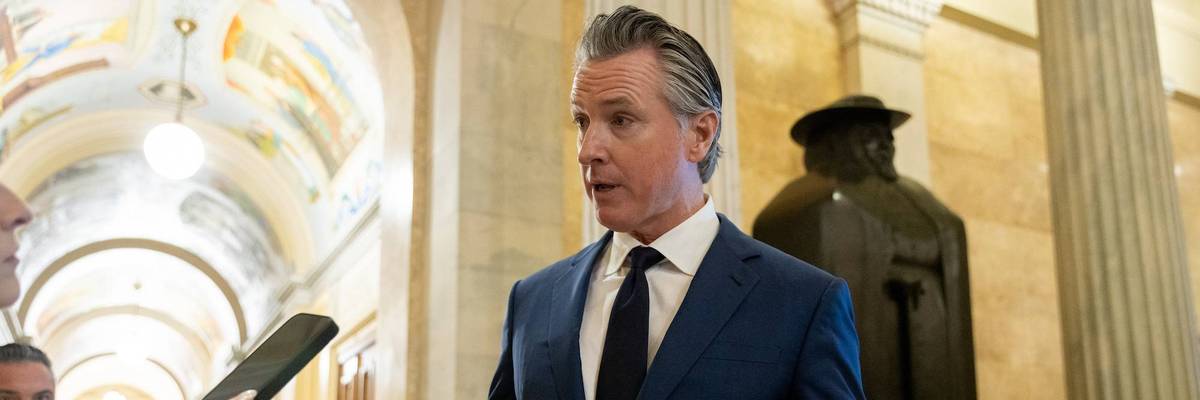
California Gov. Gavin Newsom speaks to reporters inside the US Capitol in Washington, DC on May 20, 2026.
(Photo by Nathan Posner/Anadolu via Getty Images)
Jake Johnson
Jun 22, 2026
COMMON DREAMS
A world-renowned economist and expert on wealth inequality castigated California Gov. Gavin Newsom on Monday for working to kill a proposed tax on billionaire fortunes in the Golden State, warning that the Democratic leader and likely 2028 candidate appears bent on handing President Donald Trump “an unexpected ideological and political victory.”
Gabriel Zucman, a research professor of economics at the University of California, Berkeley, pointed to a recent Bloomberg story detailing Newsom’s “last-ditch pressure campaign” to prevent a healthcare union-led initiative from appearing on California voters’ ballots in November. Last week, organizers announced that they had collected the number of signatures required to get the initiative—a one-time, 5% tax on the wealth of California billionaires—on the ballot ahead of the June 25 deadline.
In a lengthy thread posted to X on Monday, Zucman wrote that he is “shocked” by Newsom’s “efforts to defend Peter Thiel and Mark Zuckerberg at the expense of Californians’ health,” referring to two of the state’s most prominent billionaires. Thiel has donated millions to an industry group looking to defeat the ballot initiative, which would use revenue from the wealth tax to offset the impacts of federal Medicaid cuts approved last year by Trump and congressional Republicans.
“Yet you are now devoting all your energy to preventing this ballot initiative from taking place and denying Californians the opportunity to express their democratic will this November,” Zucman wrote. “You have chosen to protect California’s billionaires at the expense of Californians’ health.”
By stridently opposing the proposed billionaire tax in California, the economist warned, Newsom is lending credence to “familiar conservative arguments against taxing great fortunes: the threat of capital flight, tax avoidance, harm to growth, etc.”
“Instead of reinforcing these arguments, you could have chosen to challenge them. Take the risk of tax flight, a classic objection. It is effectively nonexistent,” Zucman wrote. “Beyond the ideological victory you risk handing Trump, you may also be giving him a political victory.”
Politically, Zucman warned Newsom that his opposition to the proposed wealth tax—which has proven extremely popular among likely Democratic voters—risks giving Trump and his right-wing allies a political victory by blunting momentum for a wealth tax not only in California, but beyond as well.
“If the ‘Yes’ prevails, California’s tax could quickly inspire similar efforts in other states,” Zucman argued. “Ultimately, that process could pave the way for a federal tax on extreme wealth. This is precisely what happened more than a century ago with the progressive income tax.”
“The world is watching,” the economist added. “In the struggle between democracy and oligarchy, one must choose a side. I hope you will choose ours.”
Zucman has been outspoken in support of the proposed wealth tax in California, writing in The New York Times’ op-ed pages last month alongside fellow economist Emmanuel Saez that the proposed levy would “be tiny relative to billionaires’ recent wealth gains.”
“In the past three years alone, the total wealth of California’s billionaires grew by a staggering 144%, to over $2 trillion,” the economists wrote. “Critics of the ballot measure have voiced concerns that even a small number of billionaires leaving the state would lead to lower state tax revenues overall. Their math doesn’t add up. California’s billionaires currently pay such a low tax rate that even if all of them left the state, it would take 25 years for the loss of their tax payments under the current set of rules to surpass the amount the state would raise if the one-time tax succeeds this fall.”
“Defending 200 billionaires at the expense of the millions of Californians who will lose healthcare absent the passage of a billionaire tax is not a tenable position for the governor or the state of California.”
Last week, organizers of the wealth tax initiative offered to withdraw its proposal if Newsom threw his support behind legislation imposing a 2% tax on California’s billionaires—a compromise plan that the governor swiftly rejected.
“The governor supports making the wealthiest Americans pay their fair share, but this poorly designed state-only measure will defund teachers, schools, clinics, and public safety,” said Newsom spokesperson Tara Gallegos. “Changing the tax rate doesn’t change this measure’s fundamental flaws that harm working Californians.”
Suzanne Jimenez, chief of staff for the Service Employees International Union-United Healthcare Workers West—the union leading the ballot initiative—hit back, accusing Newsom’s office of “engaging in Trump-like misinformation tactics, which is sad and indefensible.”
“The billionaire tax explicitly funds clinics, hospitals, schools, teachers, and food assistance to the tune of billions,” Jimenez said in an emailed statement. “All objective reports have shown that the wealth tax raises billions to fund healthcare, education, and food assistance—and the revenue that will be raised far surpasses any potential income tax erosion—in no small part because billionaires pay very little relative income tax.”
“Defending 200 billionaires at the expense of the millions of Californians who will lose healthcare absent the passage of a billionaire tax is not a tenable position for the governor or the state of California,” Jimenez added.
“You have chosen to protect California’s billionaires at the expense of Californians’ health,” said Gabriel Zucman.
California Gov. Gavin Newsom speaks to reporters inside the US Capitol in Washington, DC on May 20, 2026.
(Photo by Nathan Posner/Anadolu via Getty Images)
Jake Johnson
Jun 22, 2026
COMMON DREAMS
A world-renowned economist and expert on wealth inequality castigated California Gov. Gavin Newsom on Monday for working to kill a proposed tax on billionaire fortunes in the Golden State, warning that the Democratic leader and likely 2028 candidate appears bent on handing President Donald Trump “an unexpected ideological and political victory.”
Gabriel Zucman, a research professor of economics at the University of California, Berkeley, pointed to a recent Bloomberg story detailing Newsom’s “last-ditch pressure campaign” to prevent a healthcare union-led initiative from appearing on California voters’ ballots in November. Last week, organizers announced that they had collected the number of signatures required to get the initiative—a one-time, 5% tax on the wealth of California billionaires—on the ballot ahead of the June 25 deadline.
In a lengthy thread posted to X on Monday, Zucman wrote that he is “shocked” by Newsom’s “efforts to defend Peter Thiel and Mark Zuckerberg at the expense of Californians’ health,” referring to two of the state’s most prominent billionaires. Thiel has donated millions to an industry group looking to defeat the ballot initiative, which would use revenue from the wealth tax to offset the impacts of federal Medicaid cuts approved last year by Trump and congressional Republicans.
“Yet you are now devoting all your energy to preventing this ballot initiative from taking place and denying Californians the opportunity to express their democratic will this November,” Zucman wrote. “You have chosen to protect California’s billionaires at the expense of Californians’ health.”
By stridently opposing the proposed billionaire tax in California, the economist warned, Newsom is lending credence to “familiar conservative arguments against taxing great fortunes: the threat of capital flight, tax avoidance, harm to growth, etc.”
“Instead of reinforcing these arguments, you could have chosen to challenge them. Take the risk of tax flight, a classic objection. It is effectively nonexistent,” Zucman wrote. “Beyond the ideological victory you risk handing Trump, you may also be giving him a political victory.”
Politically, Zucman warned Newsom that his opposition to the proposed wealth tax—which has proven extremely popular among likely Democratic voters—risks giving Trump and his right-wing allies a political victory by blunting momentum for a wealth tax not only in California, but beyond as well.
“If the ‘Yes’ prevails, California’s tax could quickly inspire similar efforts in other states,” Zucman argued. “Ultimately, that process could pave the way for a federal tax on extreme wealth. This is precisely what happened more than a century ago with the progressive income tax.”
“The world is watching,” the economist added. “In the struggle between democracy and oligarchy, one must choose a side. I hope you will choose ours.”
Zucman has been outspoken in support of the proposed wealth tax in California, writing in The New York Times’ op-ed pages last month alongside fellow economist Emmanuel Saez that the proposed levy would “be tiny relative to billionaires’ recent wealth gains.”
“In the past three years alone, the total wealth of California’s billionaires grew by a staggering 144%, to over $2 trillion,” the economists wrote. “Critics of the ballot measure have voiced concerns that even a small number of billionaires leaving the state would lead to lower state tax revenues overall. Their math doesn’t add up. California’s billionaires currently pay such a low tax rate that even if all of them left the state, it would take 25 years for the loss of their tax payments under the current set of rules to surpass the amount the state would raise if the one-time tax succeeds this fall.”
“Defending 200 billionaires at the expense of the millions of Californians who will lose healthcare absent the passage of a billionaire tax is not a tenable position for the governor or the state of California.”
Last week, organizers of the wealth tax initiative offered to withdraw its proposal if Newsom threw his support behind legislation imposing a 2% tax on California’s billionaires—a compromise plan that the governor swiftly rejected.
“The governor supports making the wealthiest Americans pay their fair share, but this poorly designed state-only measure will defund teachers, schools, clinics, and public safety,” said Newsom spokesperson Tara Gallegos. “Changing the tax rate doesn’t change this measure’s fundamental flaws that harm working Californians.”
Suzanne Jimenez, chief of staff for the Service Employees International Union-United Healthcare Workers West—the union leading the ballot initiative—hit back, accusing Newsom’s office of “engaging in Trump-like misinformation tactics, which is sad and indefensible.”
“The billionaire tax explicitly funds clinics, hospitals, schools, teachers, and food assistance to the tune of billions,” Jimenez said in an emailed statement. “All objective reports have shown that the wealth tax raises billions to fund healthcare, education, and food assistance—and the revenue that will be raised far surpasses any potential income tax erosion—in no small part because billionaires pay very little relative income tax.”
“Defending 200 billionaires at the expense of the millions of Californians who will lose healthcare absent the passage of a billionaire tax is not a tenable position for the governor or the state of California,” Jimenez added.


No comments:
Post a Comment