France, Germany reach deal on arms maker KNDS, opening door to stock market
France and Germany announced Monday a deal for the joint governance of Amsterdam-headquartered arms maker KNDS, paving the way for a blockbuster share offering as they seek to boost faltering European defence cooperation.
Issued on: 22/06/2026 - RFI

The deal envisages Paris and Berlin holding equal stakes in the maker of tanks and other military gear, at a time when the continent is contending with a hostile Russia and worsening US ties.
KNDS has a portfolio ranging from Leopard 2 and Leclerc tanks to artillery and armoured vehicles, and is a key supplier to European militaries.
The announcement comes just weeks after the collapse of the Franco-German FCAS project to build a next-generation fighter jet, which dealt a severe setback to efforts to strengthen Europe-wide defence initiatives.
The KNDS deal "reflects the shared determination of France and Germany to strengthen Europe's industrial and defence capabilities, to support their armed forces, and to reinforce European sovereignty in an enduring fashion," according to a joint statement issued by the French presidency.
The German government also said the deal would bolster Europe's defence capabilities.
"The government aims in particular to strengthen bilateral and European armaments cooperation. Cooperation with France plays a key role in this regard," it said in a statement.

KNDS, created in 2015 through a merger of French and German companies, is currently half-owned by the French government via a holding company, with the rest of the shares owned by the Wegmann family of Germany.
The German owners are seeking to sell their stake and have been negotiating with the German government.
After much internal wrangling, Berlin announced in May that it would seek to acquire a 40-percent holding when the company goes public.
In Monday's announcement Berlin and Paris said they were aiming to become shareholders in KNDS, with equal stakes.
Merz and Macron agree to scrap FCAS joint fighter jet programme
KNDS chief executive Jean-Paul Alary said the agreement "confirms the strategic importance of KNDS for Europe's defence capability, industrial base and technological sovereignty".
The deal would allow KNDS to move forward with a dual stock market listing in Paris and Frankfurt, in one of Europe's most hotly anticipated IPOs of the year.
The company has previously voiced frustration at alleged foot-dragging by the German government, which reports say has threatened to delay a listing that could value the company at 15 to 20 billion euros ($17 to $23 billion).
Tight timeline
KNDS is a key player in a joint Franco-German project to develop a new battle tank, dubbed the Main Ground Combat System (MGCS) initiative.
The agreement Monday and subsequent IPO boosts the chances that this delayed programme might go ahead, after the FCAS failure fuelled fears it might also be scrapped.
But the timeline is tight if KNDS wants to launch its IPO in July as hoped, according to a confidential German defence ministry document outlining the latest details of the deal, circulated to lawmakers and seen by French news agency AFP.
'Under destruction': Europe's future security in question at Munich conference
The ministry said parliament's budget committee would have to approve Berlin's stake acquisition when it meets on Wednesday for the IPO to proceed next month.
The committee has to sign off on any substantial defence procurements.
The ministry acknowledged the "tight schedule" and also noted that "agreement with the Wegmann family on the purchase contract must be reached".
Multiple regulatory approvals for the IPO are also needed and there is a risk they might not be ready in time, it said.
(with AFP)
Rheinmetall sinks as Germany axes mega-warship project after spending €2.3bn
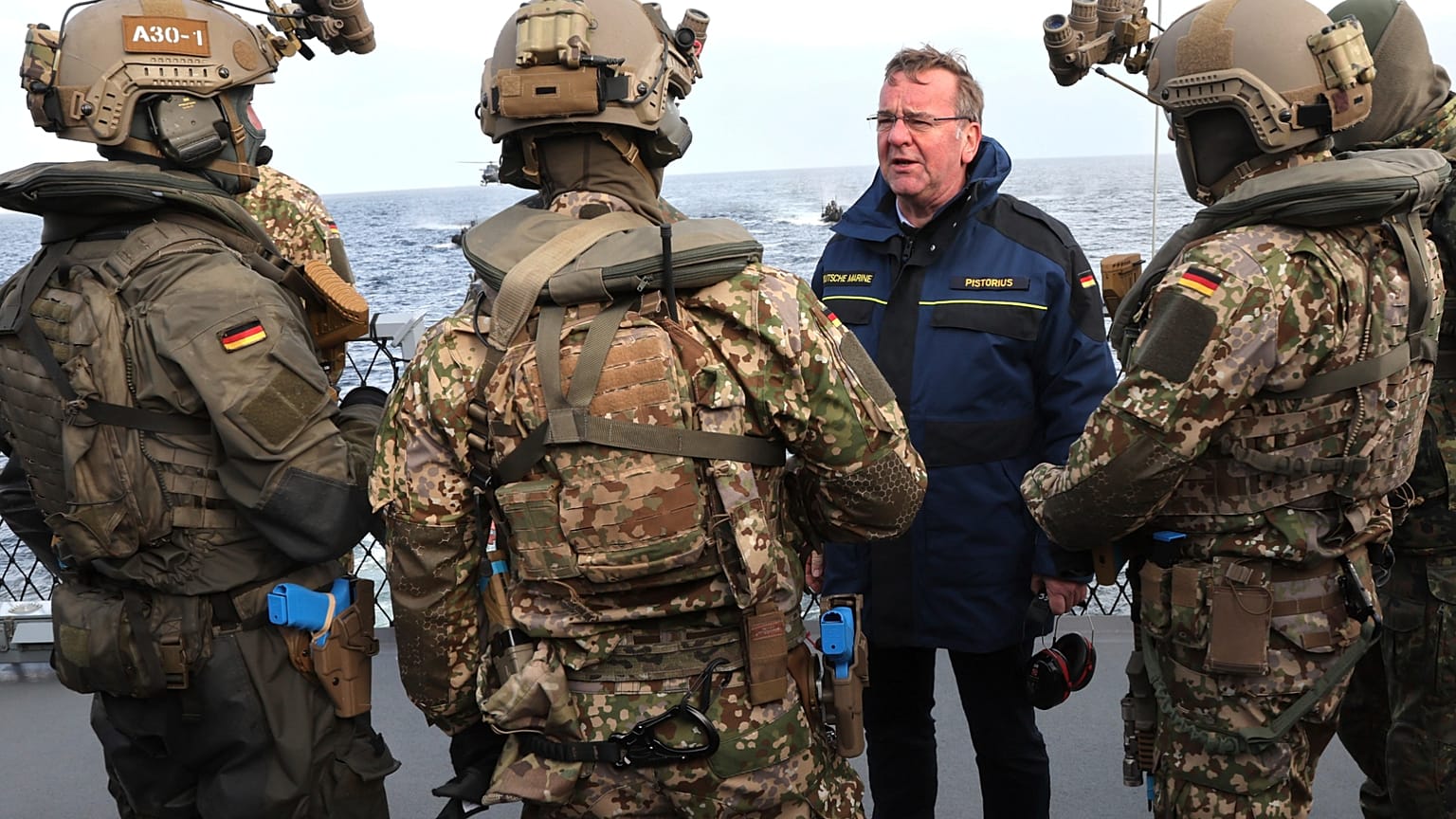
Rheinmetall shares fell sharply after Berlin scrapped its F126 frigate programme, a project that has already cost taxpayers around €2.3bn.
Rheinmetall shares fell as much as 13% after the German government scrapped plans for a major warship order from the firm, which would have been the biggest warship commission since the Second World War.
The news magazine "Der Spiegel" reported on Tuesday that the multi-billion-euro project to build six of the world’s largest frigates, the F126, had been cancelled.
The ministry in Berlin said the decision was a response to significant delays, foreseeable cost increases and other risks. However, cancelling the contract could prove costly for taxpayers.
At the same time, Defence Minister Boris Pistorius wants to procure eight smaller frigates instead. To that end, Berlin awarded new contracts to defence contractor TKMS, whose shares rose about 10% in early trading on Wednesday.
According to the newspaper, the warship project was first launched by Ursula von der Leyen (CDU) when she was defence minister. In 2020, her successor, Boris Pistorius (SPD) ordered the super-frigate F-126 in the Netherlands from the Damen shipyard.
However, because of delays and other problems, German shipbuilder Lürssen Naval Vessels – since taken over by Rheinmetall in March 2026– was put in charge of the project.
In March 2026, Berlin approved the procurement of four TKMS-built MEKO A-200 frigates, estimated to cost about €1bn each, according to FT reporting, amid mounting concerns over delays to the six-vessel F126 programme.
More than €2bn already invested in the project
According to reporting by Die Welt, citing the German Defence Ministry, the F126 programme had already incurred around €2.3bn in costs before its cancellation. These costs include design work, software development, construction activities and payments to contractors.
The ministry says that continuing the programme would have pushed total costs above €18bn, compared with an original programme value of roughly €10bn for six frigates.
Instead of the F126 frigates, which were most recently scheduled for delivery in 2029, a total of eight smaller MEKO A-200-class frigates are now expected to be ordered from TKMS, extending the original order for four vessels placed in March.
The warships now being considered, at around 120 metres in length and with a displacement of 4,200 tonnes, are much smaller than the F126, which was designed to be 166 metres long with a displacement of 10,500 tonnes. Originally, six warships were to be procured; now there could be eight.
The navy's top brass has reportedly backed the defence minister's decision to revise the frigate plans.
Will the Bundeswehr be deployed in the Strait of Hormuz?
Most recently, Germany, the United Kingdom and France have discussed whether and how they could take part in clearing mines in the Strait of Hormuz, so that this vital global shipping lane can once again be used without hindrance after the Iran war.
How important the German navy could become in future is also evident from the fact that the frigate "Fulda" and the support vessel "Mosel" were dispatched towards the Middle East weeks ago. On board are around 140 Bundeswehr soldiers. Off the Iranian coast, the German navy would receive support, among others, from the French aircraft carrier "Charles de Gaulle".
In the event of a lasting ceasefire, 57% of respondents in the ZDF Politbarometer poll said they were in favour of deploying the Bundeswehr in the Strait of Hormuz, while 38% opposed such a mission.
 |
| LA REVUE GAUCHE - Left Comment: Search results for permanent arms economy |

No comments:
Post a Comment