Revealed: How Britain Weaponised Terrorism Laws Against Activists

In August 2024, Palestine Action activists raided an Israeli arms factory in Bristol, causing property damage and a clash with security. Though convicted only of criminal damage (and one of grievous bodily harm without intent), four now risk sentencing under the UK’s Counter-Terrorism and Sentencing Act, which allows judges to apply a “terrorism connection” to non-terrorist offences. Unlike standard prisoners, they would serve full terms and face decades of terrorist status, without a jury ever finding them guilty of terrorism.
Four activists could be sentenced as terrorists next month despite not being convicted of terrorism offences.
Charlotte Head, Samuel Corner, Leona Kamio, and Fatema Rajwani are among several Palestine Action activists accused of raiding an Israeli weapons factory in Bristol in 2024.
They were found guilty of criminal damage earlier this month at Woolwich Crown Court, with Corner also convicted of grievous bodily harm without intent.
Two others, Zoe Rogers and Jordan Devlin, were found not guilty despite telling the court that they were proud of their actions.
During the trial, a jury was asked to decide whether the defendants were guilty of criminal charges but not allowed to know there was also a “terrorism connection”.
The 12-panel jury was also not permitted to hear why the defendants chose to target the Israeli arms firm, stripping the action of all context – namely the genocide in Gaza.
It is now up to the presiding judge to decide whether to sentence the activists with a “terrorism connection” – and, if he does, the ramifications will be enormous.
Unlike most prisoners in the UK who serve around 40 percent of their sentences, they would have to serve their full terms unless they can convince a parole board that they have “reformed” after serving at least two-thirds of it.
Once released, they could be treated as terrorists for decades.
And this could all happen without a jury ever finding them guilty of any terrorist offence, marking the first case where activists risk prosecution under terrorism provisions.
How did we get here?
‘Terrorism connection’
The Terrorism Act (2000) defined an action as “terrorism” if it:
a. Involves serious violence against a person
b. Involves serious damage to property
c. Endangers a person’s life, other than that of the person committing the action
d. Creates a serious risk to the health or safety of the public or a section of the public, or
e. Is designed seriously to interfere with or seriously to disrupt an electronic system
And it:
a. Is designed to influence the government or an international governmental organisation or to intimidate the public or a section of the public, and
b. Is made for the purpose of advancing a political, religious, racial, or ideological cause
When debating the act, home secretary Jack Straw reassured parliament that those definitions “will not catch the vast majority of so-called domestic activist groups which exist in the country today”.
That included groups like Greenpeace which were engaged in direct action campaigns on issues ranging from militarism to the environment.
Home Office minister Charles Clake added that the new proscription powers would only be used “when absolutely necessary”.
To this end, it was broadly understood that the act was not intended to allow for the designation of activism as terrorism on the basis of property damage that did not pose a threat to life or safety.
In 2021, the Counter-Terrorism and Sentencing Act allowed prosecutors to attach a “terrorism connection” to a criminal case at a much lower bar than before.
It allowed non-terrorist offences which carried over two years of imprisonment to be sentenced with a “terrorism connection” without those charges being heard by a jury.
One of the few dissenting voices to this amendment was Lord Marks, who noted how sentencing individuals on the “basis of a decision taken by a judge alone, without hearing any evidence… would cut across the principle of our criminal law”.
He added: “No one should be convicted of an offence except upon admissible evidence, open to challenge in a trial and, if in the Crown Court, heard by a jury”.
The Filton incident
On 6 August 2024, activists from Palestine Action raided an Elbit Systems facility in Filton, Bristol.
Inside the factory, they clashed with security guards – one of whom allegedly hit an activist with a sledgehammer – and destroyed property including military drones.
Some of the activists were rounded up at the scene and detained under ordinary criminal provisions, but after 36 hours they were re-arrested under section 5 of the Terrorism Act.
Section 5 “establishes the offence of the preparation of an act of terrorism or assistance to another to commit an act of terrorism”. Anyone found guilty is liable to life imprisonment.
So extreme was this police response that a group of UN special rapporteurs sounded the alarm.
In a letter sent to the UK government, they observed how “UK police have exercised significant powers under counter-terrorism legislation despite the absence of credible connection between the activists’ conduct to terrorism as properly defined”.
The Filton activists were not ultimately charged under the Terrorism Act. But the Crown Prosecution Service (CPS) later announced it would submit to the court that the first case being tried against the Filton activists had a “terrorism connection” under the Counter-Terrorism and Sentencing Act.
This marked the first time that such provisions had been used against activists – and seemed to prepare the groundwork for the proscription of Palestine Action as a whole.
Proscribing Palestine Action
Documents seen by Declassified reveal how the UK government was considering the proscription of Palestine Action before the action in Filton.
A Counter Terrorism Policing (CTP) report dated 27 June 2024, some five weeks before the incident, discusses a meeting with the CPS about “the resource implications for CTP” if Palestine Action were “declared as a terrorist group”.
The report contained a CTP threat matrix which identified four categories of “activism”. They ranged from “lawful activism” to “terrorism” as defined under the Terrorism Act.
In the view of the activists’ lawyers, this timeline suggested the “terrorist connection” was added to the Filton action to build a legal justification for proscribing the group as a whole.
“The material decision making agencies appreciated that in order for Palestine Action to be proscribed as a terrorist entity, rather than high level aggravated activism, there would need to be ‘terrorist’ organisation”, the lawyers argued during an abuse of process hearing last year.
They added that those agencies required concrete instances of “terrorism” in order to proscribe, with the first Filton hearing being “charged in a way that enabled Palestine Action to meet the definition of a terrorist organisation”.
Indeed, former home secretary Yvette Cooper used the “terrorism connection” issue when justifying her decision to proscribe Palestine Action in parliament last June.
Two months later, she also wrote in the Observer that charges against Palestine Action activists included a “terrorism connection” when seeking to explain her decision to proscribe.
That article was published despite internal advice that it risked prejudicing the criminal proceedings against the Filton activists, suggesting proscription was the key priority.
Serious property damage
While the “terrorism connection” to the Filton case was used to justify proscription, it remains unclear how the authorities have determined when protest-related criminal damage crosses the line into terrorism.
Palestine Action has engaged in hundreds of direct action campaigns since it was founded in 2020. But at the time of proscription, the authorities only referred to three incidents which allegedly met the threshold for “terrorism”.
What made them different?
Last year, the Attorney General’s Office (AGO) was asked under the Freedom of Information (FOI) act to provide “policy documents, guidance notes, circulars, or legal guidance issued to prosecutors” regarding when to apply a “terrorism connection” to criminal offences.
Internal guidance was also requested in relation to “the treatment of protest-related cases in which a terrorism connection may be considered”.
The AGO responded by refusing to confirm or deny whether the information was held.
“Any documents that may or may not be held in relation to the application or proposed application of a ‘terrorism connection’ under the Sentencing Code to protest-related or criminal damage-related prosecutions would relate to the Attorney General’s function as a Law Officer and chief legal adviser to the Government”, it said.
When asked for the same information, the CPS said it “does not hold any internal CPS policy documents, guidance notes, circulars, or legal guidance within the specific scope of your request”.
Taken together, it would seem that the British authorities have drawn an invisible line whereupon protest-related criminal damage crosses a legal threshold into “terrorism” – but the public is not allowed to know where it is.
£1 million
Despite the absence of public information on how a “terrorism connection” is applied, internal documents and ministerial statements suggest that high-profile protest actions causing £1m in damage or more could leave activists liable to being sentenced as terrorists.
And this line appears to have been drawn with pro-Palestine activists in mind.
In March 2025, when the Joint Terrorism Analysis Centre (JTAC), housed within MI5, recommended that Palestine Action be proscribed, its report focussed exclusively on three incidents which allegedly caused damage “in excess of £1m” as evidence of “terrorism”.
One of those three incidents was Filton, described in the JTAC report as “6 August 2024 Terrorist Attack” with “estimated damage… to be in excess of GBP 1 million”.
Another related to an action against French arms firm Thales in Glasgow in 2022 which was seemingly not assessed as terrorism until after Filton.
In 2023, a year after the Thales action, a private briefing for a British minister noted: “Palestine Action does not meet the threshold for proscription as they do not commit, participate in, prepare for, promote, encourage, or otherwise be concerned with acts of terrorism”.
In 2025, a Scottish counter-terrorism board observed that Palestine Action “has been focused on protest activity which has not been close to meeting the statutory definition of terrorism”.
What emerges from this timeline is that the authorities may have developed a new way of interpreting the threshold for “terrorism” – based on the “serious damage to property” limb of the Terrorism Act – and retroactively applied it to the Thales case.
That the authorities may have modified their interpretation of what constitutes “terrorism” raises serious concerns in and of itself, particularly given there has been no parliamentary or public consultation on the matter.
If any reinterpretation of the threshold for “terrorism” occurred after the Filton incident, this would raise concerns about ex post facto modifications of how the law is administered.
In other words, in light of the absence of any legal precedent, it would not have been possible for the defendants to know that the incident could be treated as terrorism at the time that it took place.
Moreover, it raises the prospect that private arms companies targeted by Palestine Action could be incentivised to inflate damage costs in order to aggravate punishment for activists, potentially offering a deterrent effect against future protest activity at their sites.
In the Thales case, which was later used to justify proscription, damage costs were estimated at around £190,000, with the company claiming “revenue lost due to the site closure” was £941,000.
In another instance, damage costs relating to a Palestine Action campaign at a factory in Runcorn, Chester, were revised down from £4m to £225,000-£345,000 – amounting to a reduction of over 90 percent.
Moreover, there appears to be no framework for ensuring the arms companies provide accurate damage reports before a “terrorism connection” is applied.
Violence
In addition to emphasising actions which caused “in excess of £1m damage”, the JTAC report made allegations about Palestine Action’s use of “violence”.
While conceding that Palestine Action was “highly unlikely” to advocate for violence, it claimed with regard to Filton that “some of the attackers attended the incident with the intent or willingness to conduct serious violence against persons in support of their political cause”.
Cooper repeated these claims in parliament when she said members of Palestine Action had demonstrated “a willingness to use violence”.
Security minister Dan Jarvis also said Palestine Action members “have used violence against people” and been “charged with a series of serious offences, including violent disorder, grievous bodily harm with intent and aggravated burglary”.
The same claims were emphasised by senior Conservative party officials, with shadow foreign secretary Priti Patel declaring Palestine Action had “a long history of violence”.
While used to strengthen the public justification for proscription, it remains unclear what if any bearing the issue of violence had on the decision to apply a “terrorism connection” to the first Filton defendants or to proscribe Palestine Action as a whole.
Furthermore, since the CPS applied for a “terrorism connection” to be added to the first Filton case, all of the defendants have been cleared by two juries of any violent intent.
While the Filton incident was used to publicly justify proscription, the verdict in that case, with the defendants cleared of violent intent, has undermined the public rationale for proscription.
And now, four Filton defendants could be sentenced as terrorists despite Palestine Action not being proscribed at the time of the incident and the High Court subsequently finding the ban unlawful, pending an appeal.
The sentencing hearing will take place on 12 June at Woolwich Crown Court. Three days later, the Court of Appeal will hand down its judgment on the legality of the Palestine Action ban.
The Crown Prosecution Service, Attorney General’s Office, and Counter Terrorism Policing were approached for comment.
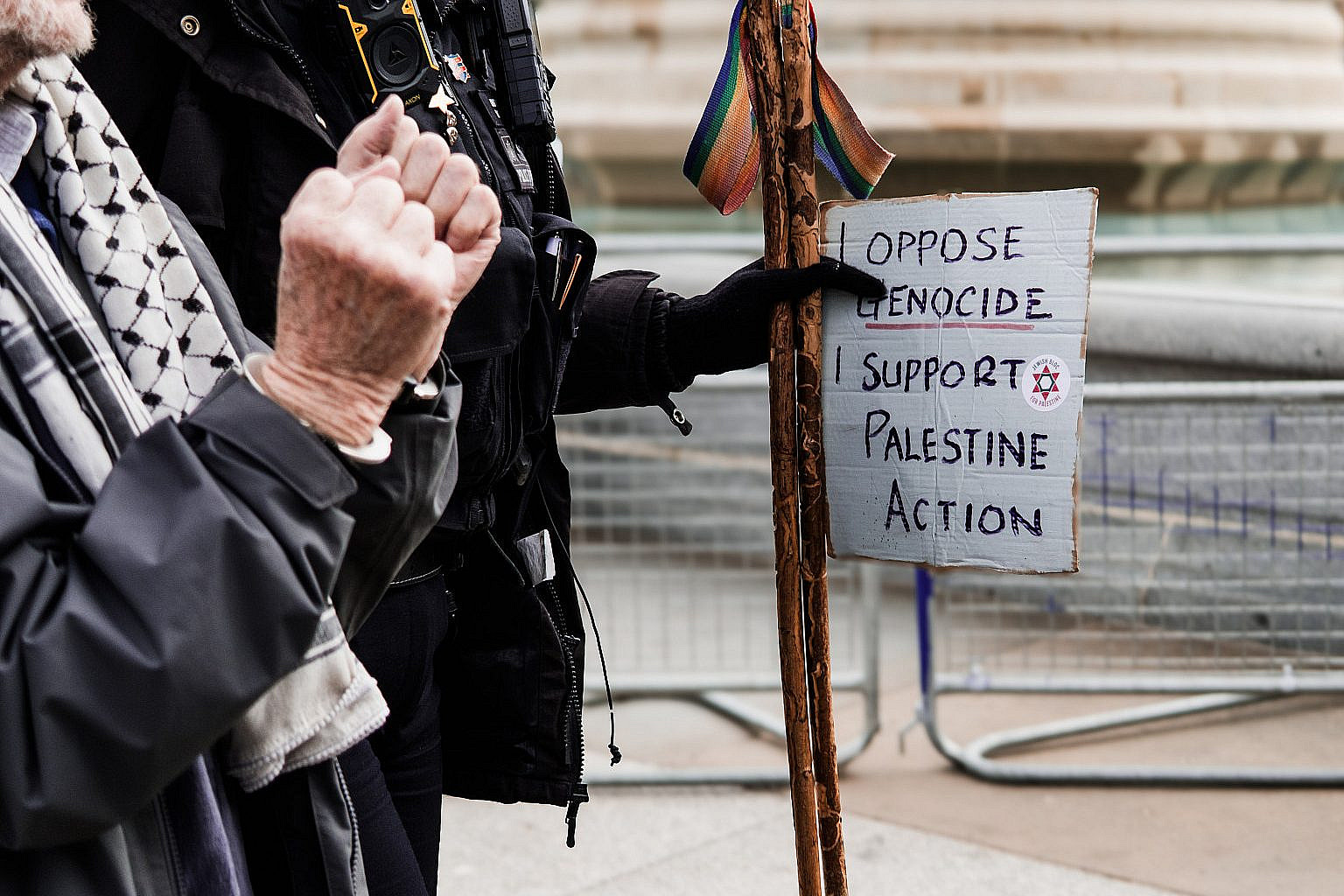
It was virtually inevitable that, once the British government decided to actively support Israel’s mass slaughter of civilians in Gaza, an unprecedented, authoritarian crackdown on dissent back home would follow. That climate of official repression culminated this week with the Court of Appeal — the UK’s second highest court — upholding the government’s proscription last year of Palestine Action as a terrorist organization.
The need to crush opposition to the British state’s complicity in Israeli atrocities in Gaza — which a consensus of international legal, scholarly, and human rights experts has determined amounts to a genocide — has led to many firsts in British legal history. But the proscription of Palestine Action is perhaps the most foundational, and the most dangerous.
It is the first time that a direct action group, whose form of civil disobedience is damaging property rather than using violence against people, has been declared a terrorist organization, on a par with Al-Qaeda and the Islamic State group. Under this new interpretation of the law, the Suffragette movement — which fought to gain women the vote in Britain over a century ago, and whose members are uniformly extolled as role models by the very politicians who support Palestine Action’s proscription — would undoubtedly have been declared a terrorist organization.
It is sometimes forgotten, often willfully, that the Suffragettes operated underground cells that organized hundreds of bombings and arson attacks in pursuit of their goals, killing four people and wounding at least 24. Palestine Action, by contrast, has explicitly eschewed this kind of life-endangering violence while being far more transparent about its activities. It has restricted its actions to property damage, chiefly targeting the Israeli company Elbit Systems’ weapons factories in the UK that make drones used in Gaza.
The group admits that it causes damage to property but argues its attacks are warranted by a higher duty to international law, which places an obligation on third parties to prevent atrocities and genocide rather than collude in such crimes. And given how deeply enmeshed the British state is in Israel’s atrocities in Gaza, this duty is particularly acute.
The UK sells arms to Israel. It allows Israeli arms manufacturers such as Elbit to operate factories in the UK that build killer drones (one of which was used to kill seven World Central Kitchen aid workers in Gaza in April 2024, including three British citizens). British planes transport U.S. and German weapons to Israel. And the UK has been carrying out endless surveillance flights over Gaza to supply Israel with intelligence used in its obliteration of the enclave.

That is not all. Britain has provided Israel with diplomatic cover for its crimes, including at the UN Security Council. Israeli generals and politicians suspected of war crimes in Gaza are welcomed in the UK. And as foreign secretary in the previous government, David Cameron threatened to pull funding from the International Criminal Court (ICC) — in violation of Britain’s legal obligations under the Rome Statute — over the court’s decision to issue an arrest warrant for Israeli Prime Minister Benjamin Netanyahu.
British collusion in Israeli crimes is the reason Palestine Action was originally founded six years ago, and it stepped up its attacks, particularly on Elbit factories, when Israel began its current onslaught on Gaza in October 2023. Its actions were designed not only to interrupt the supply of weapons to Israel but to provoke a debate in Britain about why the government should stop actively aiding these crimes against the Palestinian people.
Instead, the British state has worked strenuously — through the establishment media, the police, and the courts — to redirect popular attention away from its own criminal actions under international law. The goal has been to keep the public fixated on the faux-illegality of opposing genocide rather than the British security state’s all-too-real criminal collusion in that genocide.
Among other things, this has extended to endless condemnations by politicians and the media of peaceful mass demonstrations against the genocide as “hate marches” and “antisemitic” — despite the protests including a large contingent of demonstrators who make their Jewishness explicit.
Architecture of repression
In proscribing Palestine Action, Keir Starmer’s Labour government has brought out of the shadows a legal architecture of repression — mostly squirreled away in recent amendments to counter-terrorism laws — that seems to have been prepared for just such a moment as this. The police and courts appear only too willing to conspire in vaguely worded legal formulations, creating a dragnet in which the government can ensnare as a terrorist anyone who challenges the legitimacy or legality of its foreign policy.
That has been most obvious in the now routine sight of police officers hauling away thousands of British citizens — many of them retired lawyers, doctors, vicars, and army veterans — for the crime of holding up a placard that reads: “I oppose genocide. I support Palestine Action.” Under Britain’s draconian Terrorism Act, anyone expressing an opinion, even inadvertently, that might “encourage support” for a proscribed organization can be arrested and potentially faces a jail term of up to 14 years.
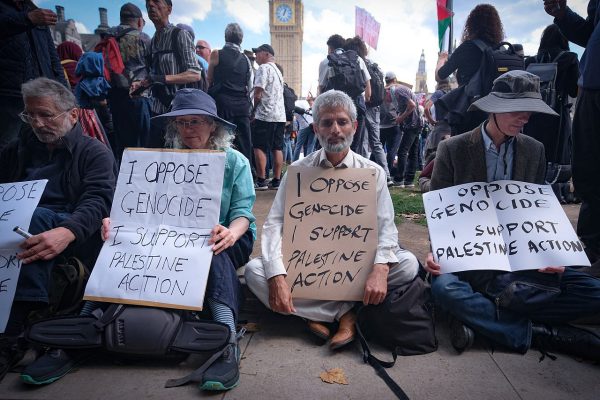
Waves of highly visible defiance, often taking place in the square adjacent to Britain’s parliament, have been deeply discomfiting to Starmer’s government — as well as to him personally, given his credentials as a former leading human rights lawyer. Starmer once argued before the ICC that a sustained Serbian attack on the Croatian city of Vukovar was a genocide, yet he has repeatedly rejected the same label for Israel’s destruction of Gaza, which is many orders of magnitude worse.
Earlier this year, it briefly looked as if the placard protests might have won Palestine Action a reprieve. The High Court ruled in February that the government’s proscription last July was “unlawful,” on the basis of its disproportionate chilling effect on free speech and the right to protest. However, the police were allowed to carry on arresting people for holding the placards, thereby giving no practical remedy to the chilling effect that had supposedly concerned the High Court.
With the Court of Appeal now overturning that lackluster decision, the High Court’s ruling against proscription looks more like misdirection — a piece of cynical, legal theatre. The February ruling is better understood as the British judiciary creating the impression that it had carefully weighed the balance between protecting long-cherished, basic rights of free speech and assembly, on the one hand, and supposed “national security concerns” — that is, Israel’s right to commit atrocities — on the other.
In truth, however, there was no real likelihood that Britain’s highest judges, pillars of the establishment, would agree to place limits on the UK’s participation in the genocide. That would set the British state on a collision course with Washington, which has been fully on board with the genocide under both the Biden and Trump presidencies.
Faced with widespread condemnation from human rights groups, international legal organizations, and prominent sections of the British public, the Starmer government desperately needed to breathe life into its improbable claim at the High Court and Court of Appeal that Palestine Action should be treated as equivalent to Al-Qaeda or the Islamic State group — no simple task. But help came in the form of a high-profile court case against some of the two dozen Palestine Action activists awaiting trial.
The problem for the government was that they had all been arrested for involvement in damaging property related to the genocide — from Elbit factories to two Royal Air Force war planes — before the group was declared a terrorist organization. Though they were not charged retroactively with terrorism offences (the prosecution understood there was little chance of persuading a jury to convict them of such charges), they were held in pre-trial detention three times longer than the normal maximum and in particularly harsh, restrictive conditions. In effect, they were already treated as if they were terrorists.
This led to a prolonged hunger strike by several of the detainees. Notably, the strike received almost no coverage from the UK media, presumably out of fear it might draw attention to their mistreatment and the reasons why they were ready to risk their health and potentially their lives.
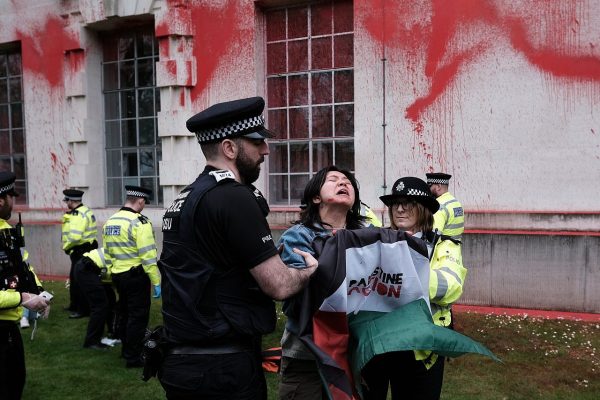
No normal trial
The trial of the six Palestine Action activists started in November 2025, running in parallel to the deliberations of the High Court and Court of Appeal on whether the government was justified in declaring the group a terrorist organization. The government used the trial to bolster its case for proscription, and in the process prejudiced the proceedings against the six accused before they had even begun.
Yvette Cooper, who, in her previous role as home secretary, proscribed Palestine Action almost a year ago, argued at the time that the trial would prove the group was engaged in terrorist activities, even though the prosecution never pressed any terrorist charges against the defendants. Meanwhile, rumors began circulating in the British media — reportedly planted by a PR firm working for Elbit Systems — suggesting that Palestine Action was secretly funded by Iran. No evidence for this claim was ever forthcoming.
The six defendants in the so-called Filton trial, named after the suburb of Bristol where Elbit’s drone factory — which they broke into on Aug. 6, 2024 — is located, were accused of three charges: aggravated burglary, violent disorder, and criminal damage.
Crucially, one of them, Samuel Corner, was also accused of grievous bodily harm with intent: After police arrived at the scene to arrest the activists, Corner struck one of them in the back with a sledgehammer the activists had been using to smash up Elbit’s drone production line, causing a small fracture in the policewoman’s vertebra.
When the media did cover the case, which was rare, it was to focus almost exclusively on the injury to the policewoman, framed in such a way as to suggest that her back had been “shattered.” (In fact, the fracture was so small it was not evident in an X-ray and missed on a first MRI scan; the recommended treatment was six weeks of mild rest and over-the-counter pain killers.)
The police were also allowed to release a highly selective video of edited scenes of confrontation between the activists, Elbit security guards, and police — another abuse of legal process in the case designed to whip up the public mood against the “Filton 6.”
It was clear that this was no normal trial. The government was determined to secure convictions that would prove the six activists had engaged in intentional and planned violence against people, and thereby stand up its proscription of Palestine Action. The job of the presiding judge, Jeremy Johnson, was to make sure the jury arrived at the right verdict. He was certainly the man for the task.

Johnson made it to the bench after years serving as the most favored barrister of the “secret state,” representing the intelligence services, the Defense Ministry, and the police. His working environment of choice as a lawyer had been behind-closed-doors prosecutions held out of view of the public or proper legal scrutiny.
During the trial, Johnson oversaw an extraordinary number of legal manipulations that helped the government. The defendants were denied the right to refer to their motives in attacking the Elbit factory (the terms “genocide” and “ethnic cleansing” were barred from the proceedings). The type and use of the weapons damaged in the attack was concealed from the jury. The defense was given no opportunity to cross-examine Elbit staff. Video evidence was introduced by the police that had been in the sole custody of Elbit for a year after the attack.
But most egregiously of all, Johnson ruled that the jury must not be informed of its right to acquit on the basis of conscience. Under a principle known as jury equity, established in British law hundreds of years ago, juries are allowed to defy a direction from a judge that a defendant has no legal defense. In fact, Johnson actively encouraged the jury to think they had no such right.
The lead defense barrister, Rajiv Menon KC, used his closing speech to defy the judge and alert the jury to this right. Johnson responded — in another legal first — by instituting contempt of court proceedings against Menon, which would ultimately be overruled by the Court of Appeal on procedural grounds amid mounting disquiet from the legal profession.
Weaponizing justice
Despite these many legal manipulations, Johnson was unable to secure the convictions sought by the government. In February, the jury acquitted the defendants of the most serious charges of aggravated burglary and violent disorder, and could not reach a verdict on the less serious one of criminal damage, or on Corner’s charge of grievous bodily harm.
The jury’s inability to reach a decision on criminal damage left the way open for the prosecution to initiate a second trial of four of the activists (the “Filton 4”): Charlotte Head, Samuel Corner, Leona Kamio, and Fatema Rajwani. Those proceedings ended last month, with the jury finding the four guilty of criminal damage and Corner of grievous bodily harm over the injury sustained by the policewoman. Disappointingly for the government, however, the jury refused to convict Corner of inflicting such harm intentionally, as the prosecution had wanted.
The jury were presumably influenced by the evidence: Testimony and video footage showed that Corner had been blinded by pepper spray moments before the tussle, and that he had been trying to protect a fellow female activist who, the footage showed, was being viciously assaulted when Corner was sprayed.
Notably, this had been the messiest of all the Palestine Action attacks — in large part, as the two trials showed, because Elbit security guards had decided not to withdraw and wait for the police to arrive but to launch a sustained attack on the activists, beating them and grabbing their sledgehammers to use against them. One of the defendants, Jordan Devlin, acquitted in the first trial, was shown to have been so badly beaten by the guards that it was difficult to understand why the Elbit staff themselves had not been charged.
In short, as Yvette Cooper, the former home secretary, had suggested, this was the government’s best shot at propping up its narrative that Palestine Action used violence and should be treated as a terrorist organization. But neither the criminal damage nor the GBH without intent convictions helped in this regard. Another solution was needed.
Before the verdict, Judge Johnson had stated that, should the Filton 4 be convicted of criminal damage, he would — in yet another legal first — use his powers of sentencing to add in a “terrorism connection.” He was able to do so under a highly controversial 2021 Counter-Terrorism and Sentencing Act that allows judges to “upgrade” criminal offences to terrorism offences during sentencing. Yet Johnson withheld that information from the jury and issued a gag order, meaning no one could make it public.
It was not hard to work out why the judge did not want the jury to know his intentions. Its members would have been highly unlikely to convict the Filton 4 of criminal damage had they known the judge would treat that verdict as effectively a license to convict the activists of terrorism.
This may explain, in part, why a trial for criminal damage by activists to another weapons factory, this one in Wolverhampton, saw four defendants walk free this week after the jury could not reach a verdict. Unlike the Filton case, the judge allowed the jury to hear the defendants’ reasons for attacking the site, operated by U.S. aerospace firm Moog. The four are likely to face a retrial.
The anticipated underhand maneuver in the Filton trial provoked an application from a civil liberties group, Defend Our Juries, backed by thousands of legal professionals, for Judge Johnson to recuse himself from the sentencing hearing. He refused to do so.
The same group of legal professionals submitted a petition demanding that the Judicial Conduct Investigations Office investigate the judge’s “manifest bias and discrimination” during the trial. Discussing the petition, David Whyte, professor of law at Queen Mary University of London, observed that Johnson had acted with exceptional “cruelty and vindictiveness,” noting the highly irregular length of the activists pre-trial detention when even the prosecution had not requested remand.

During the Filton 4’s sentencing, Johnson made good on his promise to add a “terrorism connection,” increasing the activists’ jail sentences to between five and eight years. Additionally, they will be ineligible for normal parole, held in harsher conditions in prison, and face years of punitive restrictions after their release.
Judge Johnson’s official reasoning for adding the “terrorism connection” was that the four activists had tried to “influence the government” with their act of criminal damage to a factory making killer drones. That was clearly music to the ears of an embattled government struggling to sell its complicity in a genocide to the British public. It finally provided a rationale to treat as terrorism any practical attempt by groups such as Palestine Action to stop the supply of arms to Israel’s genocidal military.
As Huda Ammori, the co-founder of Palestine Action, observed this week: “The legal system is being weaponized to attack our movement.”
A dark precedent
But Judge Johnson’s terrorism upgrade sets a much larger and darker precedent too. It effectively gives the British government the power to declare any disruptive civil disobedience group a terrorist organization, even if the government is unable to secure a terrorism conviction through a jury trial.
And all of this is happening as the UK government, in another unprecedented step, presses ahead with plans to scrap juries in many trials — leaving judges like Johnson exclusively in charge of deciding the fate of defendants. It is a recipe for more political show trials like that of the Filton 4.
As Amnesty International warned after this week’s Court of Appeal decision upholding proscription: “The banning of Palestine Action as a terrorist organization is a grave misuse of counter-terrorism powers with serious consequences for human rights. It is a huge overreach to treat direct action protest as terrorism.” It added that the decision “leaves the door wide open for governments to suppress other protest movements in the future.”
Undoubtedly, the Starmer government will be selective about how it uses this new suppressive power. For example, while followers of the far-right provocateur Tommy Robinson have been regularly found to break the law — not least in the recent race riots in the cities of Southampton and Belfast that included arson attacks on homes and injuries to police officers — it appears unlikely that those committing these kinds of crimes will be sentenced as terrorists, even though they are clearly seeking to “influence the government” to crack down harder on immigration.
Similarly, the government seems determined to make sure more than 2,000 British citizens who have recently served in Israel’s genocidal army face no consequences — including the son of Ephraim Mirvis, Britain’s Orthodox chief rabbi. These soldiers are not even being investigated, let alone arrested or charged with terrorism offences. Indeed, the British security state appears to have no problem with the gravest violations of international law — refusing to prosecute them entirely — precisely because it is already violating such laws itself through its deep complicity in Israel’s genocide.
The authoritarianism of Starmer’s government should be terrifying in itself. But it is likely to soon lead to an even more dangerous place: His deeply unpopular Labour Party risks being ousted at the next general election by the far-right Reform Party, led by Nigel Farage.
Starmer’s abuses of Britain’s terrorism laws have paved the way for Farage and Reform to unleash a whirlwind of repression. And be sure: Like Starmer, they will frame the crackdown on the most fundamental of civil liberties as vital to protecting “national security” from the threat of “terrorism.”


No comments:
Post a Comment