“The $1.1 trillion that governments are pouring into fossil fuel subsidies this year is not a safety net, it is a ransom payment.”
Jessica Corbett
Jul 01, 2026
COMMON DREAMS
With the US and Iranian governments engaged in 60 days of peace talks, the United Nations’ latest projections about the illegal war’s impact on fossil fuel subsidies this week triggered new demands for taxing the windfall profits of climate-wrecking Big Oil.
The United Nations Development Program (UNDP) on Monday released “Military Escalation in the Middle East: Cushioning the Global Shock,” a report detailing how governments have navigated the “most severe oil supply shock in history,” caused by Iran limiting traffic through the Strait of Hormuz in response to the Trump administration and Israel’s unlawful assault.
As fossil fuel prices have soared worldwide, the report states, “governments have moved quickly to cushion households and firms from higher energy prices through fuel subsidies, tax cuts, price caps, strategic stock releases, emergency procurement, export restrictions, demand-management measures, and fuel switching.”
“While energy subsidies had fallen by roughly half in 2024 as energy markets stabilized, the downward trajectory has sharply reversed,” the document notes. “We estimate that global fossil fuel subsidies are currently on track to reach $1.1 trillion in 2026 and could reach as high as $1.43 trillion in a severe scenario where the average oil price reaches $110/barrel... This represents an estimated $410-$740 billion increase from 2025.”
UNDP Administrator Alexander De Croo said in a statement that “the global spillover of the Middle East conflict is profound and potentially long-lasting. Developing countries, many already struggling with debt, have temporarily managed to protect people from the worst of the energy shock.”
“These countries are doing everything they can, but there is a hidden cost,” he stressed. “To deal with today’s crisis, governments are postponing tomorrow’s investments. Money that should be building schools, hospitals, and clean energy systems is being used simply to keep economies afloat. Without international support, these countries won’t escape the shock. They are absorbing it at the expense of future growth.”
“No country should have to sacrifice its future development to manage a crisis it did not create,” De Croo argued. “First, we must unlock multilateral liquidity in ways that are easy to access for low- and middle-income countries. Second, we must accelerate investment in renewable energy. Every clean energy investment reduces exposure to future shocks. The crisis has made one thing clear: Energy security and the energy transition are no longer separate agendas. They are one and the same.”
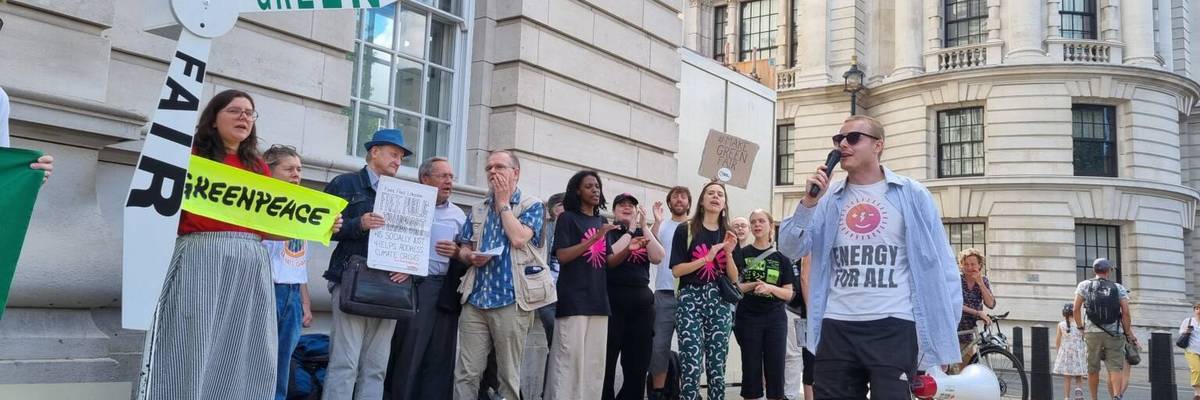
In addition to reiterating calls for a just transition to clean energy, the advocacy group 350.org has repeatedly advocated for a windfall profits tax targeting oil and gas giants cashing in on the conflict in the Middle East. Executive director Anne Jellema pushed for such policies again on Wednesday, noting the new UNDP numbers.
“The $1.1 trillion that governments are pouring into fossil fuel subsidies this year is not a safety net, it is a ransom payment,” Jellema declared. “Every dollar spent shielding the fossil fuel industry from the consequences of its own price volatility is a dollar not spent on the clean energy systems that can bring costs down for good.”
“We need a phaseout to end public subsidies for fossil fuel companies, and a permanent windfall tax on fossil fuel profits,” she continued. “Not a one-off levy, but a permanent, legislated mechanism that redirects the extraordinary profits of an industry driving this crisis into the just transition every country needs. That means affordable clean energy, retrofitted homes, and funding to protect people from the extreme weather unleashed by fossil pollution.”
In the United States, where President Donald Trump’s war has cost Americans tens of billions of dollars at the pump, Sen. Sheldon Whitehouse (D-RI) and Rep. Ro Khanna (D-Calif.) reintroduced the Big Oil Windfall Profits Tax Act in March, just weeks into the war.
Backing the bill, Food & Water Watch managing director of policy and litigation Mitch Jones said at the time that “historical evidence could not be any clearer: Big Oil will undoubtedly leverage the current crisis in the Middle East to maximize profit margins, pinching American families and enriching their executives and Wall Street speculators.”
“This demands a policy response—namely, a windfall profits tax... which would recover much of these egregious, opportunistic gains and return them to everyday Americans,” Jones added. “Fossil fuel companies must be held accountable for the profiteering they are orchestrating as we speak.”

No comments:
Post a Comment