State legislatures are scrambling to combat abuses associated with the rising AI-driven surveillance of workers.
By Michael Arria ,
July 9, 2026
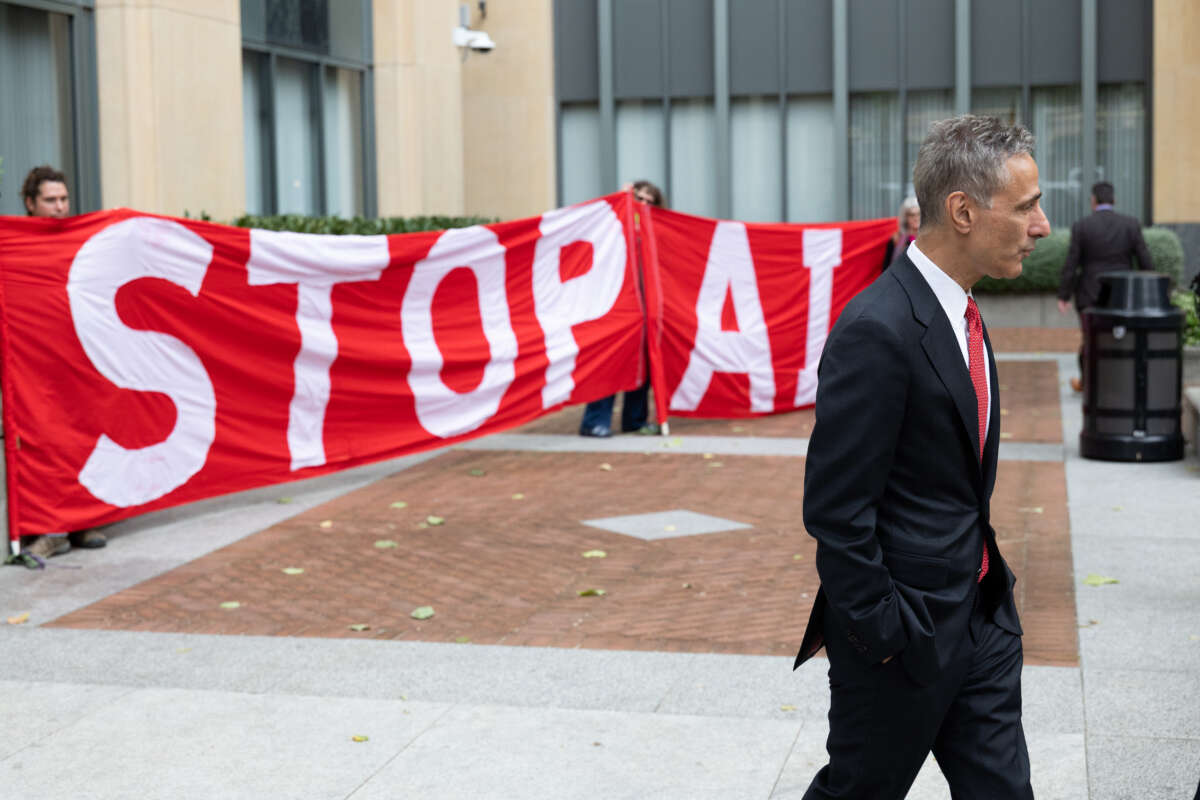
OpenAI's attorney William Savitt walks to a press conference outside the courthouse at the Ronald V. Dellums Federal Building on May 5, 2026, in Oakland, California.Benjamin Fanjoy / Getty Images
In March, The Lever reported that the U.S. Department of Agriculture had hired the infamous software company Palantir to implement its controversial return-to-office directive, warning that the contract could bring surveillance technology — commonly referred to as “Bossware” — to the federal workforce.
Days later, those suspicions were confirmed. A published disclosure reveals that the company will “design, configure, deploy, and manage a secure, user-friendly tool to track USDA employees’ return to the office.”
“AI has supercharged surveillance,” Jay Stanley, senior policy analyst with the ACLU Speech, Privacy, and Technology Project, told Truthout. “People can be monitored as they never have in the past and companies are rushing to exploit that.”
AI Has Supercharged Workplace Surveillance
Labor advocates have been warning about the threat of workplace spying for years, as many companies have long-established policies of tracking mouse movement and keystroke frequency to maximize productivity. In some cases, the tactics are much more extreme than computer monitoring. In a 2015 Harper’s Magazine investigation, Esther Kaplan revealed that UPS workers were speeding, leaving the bulkhead doors on their trucks open, and misdelivering packages in an attempt to meet quotas enforced through workplace monitoring.
Related Story
In March, The Lever reported that the U.S. Department of Agriculture had hired the infamous software company Palantir to implement its controversial return-to-office directive, warning that the contract could bring surveillance technology — commonly referred to as “Bossware” — to the federal workforce.
Days later, those suspicions were confirmed. A published disclosure reveals that the company will “design, configure, deploy, and manage a secure, user-friendly tool to track USDA employees’ return to the office.”
“AI has supercharged surveillance,” Jay Stanley, senior policy analyst with the ACLU Speech, Privacy, and Technology Project, told Truthout. “People can be monitored as they never have in the past and companies are rushing to exploit that.”
AI Has Supercharged Workplace Surveillance
Labor advocates have been warning about the threat of workplace spying for years, as many companies have long-established policies of tracking mouse movement and keystroke frequency to maximize productivity. In some cases, the tactics are much more extreme than computer monitoring. In a 2015 Harper’s Magazine investigation, Esther Kaplan revealed that UPS workers were speeding, leaving the bulkhead doors on their trucks open, and misdelivering packages in an attempt to meet quotas enforced through workplace monitoring.
Related Story

Worker Surveillance Is on the Rise, and Has Its Roots in Centuries of Racism
High-tech corporate monitoring of workers today stems from the legacy of tracking enslaved workers in the 18th century. By Esperanza Fonseca , Truthout June 8, 2020
Kaplan quotes a consultant who pushed the technology that UPS adopted: “The important thing is where the power lies,” they told attendees at a conference. “Drivers might not be happy being measured, but in the end they will yield.”
That same year, The Atlantic ran a piece by law professor Frank Pasquale on workplace surveillance titled “The Other Big Brother,” in which he called for legislation to prevent the spread of such spying.
“States and the federal government need to step up their monitoring of employer violations of privacy,” he wrote. “Until they start drawing red lines, the push by bosses to monitor every aspect of workers’ lives — online and off, at work or home — will only gather momentum.”
Over the past decade, such surveillance has only increased, particularly during the COVID-19 pandemic, when many companies sought to keep tabs on their workers amid office closures. A 2022 investigation by The New York Times found that 8 out of the 10 largest private U.S. employers track the productivity of their workers.
“The real question is which companies are going to use it and when, and which companies are going to become irrelevant?” Tommy Weir, CEO of Enaible, a company that uses AI to track worker “productivity scores,” told the paper.
However, the legislative resistance that Pasquale referenced has also materialized, as labor advocates and progressive lawmakers pushed bills regulating electronic workplace monitoring across multiple states.
In a recent interview with Semafor, AFL-CIO President Liz Shuler highlighted the importance of state legislatures in the battle to regulate AI. “We think that’s really where the game is, because there’s not much happening at the federal level with the tech bros in charge of the White House,” she explained.
State Legislatures’ Efforts to Regulate AI
This summer, Maine’s LD 61 — “An Act to Regulate Employer Surveillance to Protect Workers” — will kick in. The new law prohibits employers from conducting workplace surveillance without prior notice, surveilling employees’ homes and vehicles, and installing data‑collection or tracking apps on personal phones or laptops.
The Maine bill builds on existing workplace surveillance laws that have been established in New York, Connecticut, and Delaware, but as the management-side law firm Fisher Phillips notes in an explainer to employers, the laws in those states focus primarily on notice requirements while the Maine bill “reflects a broader privacy-focused approach that not only mandates disclosure but also limits certain monitoring practices outright.”
A number of bills connected to electronic monitoring are currently active in California’s legislature, including SB 947, or the No Robo Bosses Act of 2026, which was introduced by Democratic State Sen. Jerry McNerney, co-founder of the state’s Artificial Intelligence Caucus. The bill would prohibit companies from relying exclusively on automated decision-making systems to terminate or discipline workers. It would also block employers from using automated decision-making systems to run predictive behavior analysis on its workers.
“Right now, there are absolutely no restrictions on how employers can use artificial intelligence to arbitrarily discipline and fire their workers … We need stronger guardrails to make sure there is human review and oversight of any decision made by a machine that impacts a worker’s job and paycheck.”
SB 947 is effectively a reboot of SB 7, which was also introduced by McNerney. That bill cleared the House and Senate but was ultimately vetoed by California governor and presidential hopeful Gavin Newsom, who claimed that it was too broad. McNerney says the new version of the bill addresses Newsom’s concerns.
The effort is backed by the California Federation of Labor Unions, an affiliate of the AFL-CIO.
“Right now, there are absolutely no restrictions on how employers can use artificial intelligence to arbitrarily discipline and fire their workers. Employers are devastating workers’ livelihoods and taking no responsibility for the callous decisions of this unchecked technology,” said the group’s president, Lorena Gonzalez, in a statement. “This is unacceptable. We need stronger guardrails to make sure there is human review and oversight of any decision made by a machine that impacts a worker’s job and paycheck.”
State lawmakers have also introduced bills like AB 1331, which would prohibit employers from using surveilling workers during off-duty hours, and AB 1898, which would require companies to inform workers in writing when AI tools are being used to make employment-related decisions.
In Massachusetts, the AFL-CIO has gotten behind the FAIR Act, short for “Fostering Artificial Intelligence Responsibility.” The proposed legislation, which was reported out of committee and is currently stuck in the committee on House Ways and Means, follows the same path as the Maine bill, as it would block companies from relying solely on automated decision-making systems to make employment decisions, as well as restrict the collection of employee data. It would also allow workers to refuse directives from AI systems if they believe those directives would have a negative impact on their work.
“Working people aren’t buying Big Tech’s promise of a shiny AI future that will solve all of our problems. While technological advances can improve our lives in many ways, we need real guardrails around the use of AI and other technology on the job so that working people aren’t left in the dust,” Chrissy Lynch, president of the Massachusetts AFL-CIO and co-chair of the AFL-CIO State Federations AI Taskforce, told Truthout. “The FAIR Act prioritizes data privacy and human autonomy so we can capitalize on the beneficial aspects of this technology without compromising fundamental worker rights.”
“Working people aren’t buying Big Tech’s promise of a shiny AI future that will solve all of our problems.”
In January 2026, Illinois’s HB 3773 took effect. The bill, which was signed into law by Gov. JB Pritzker during the summer of 2024, amends the state’s Human Rights Act to directly regulate AI and prohibits companies from using it any manner that might enable illegal discrimination against an employee. It also requires workers and applicants to be informed if the company uses AI technology to make employment decisions. In 2021, New York Gov. Kathy Hochul signed a similar bill into law, requiring private employers to inform workers of any potential electronic surveillance.
While many state governments have successfully passed commonsense worker protections, a deeper regulation of AI has proved politically fraught.
A clear example of this challenge can be found in Colorado, where the state legislature passed the first comprehensive bill governing AI in 2024. After it was signed into law by Gov. Jared Polis, a two-year battle ensued, as the local tech industry lobbied for the legislation to be watered down.
In the end, the legislation’s opponents prevailed. The bill was supposed to require companies to disclose how they use AI technology to make decisions about things like hiring and loan approvals but, under the revised version, they only have to reveal whether or not they use AI to make such decisions.
“These black boxes are deciding who gets hired, who gets housing, who gets to go to their dream school,” Democratic State Rep. Javier Mabrey told The Colorado Sun. “I find it incredibly alarming that it took six months to get to this bill — a bill that does nowhere near enough to protect the people of Colorado when AI is making decisions that could make or break our lives.”
One-third of the sampled workplace monitoring platforms track the worker’s precise location, on some occasions when the employee is clocked out.
Similar political fights will inevitably take shape across multiple states, but the situation is also becoming more dire. A recent investigation of nine widely used workplace monitoring platforms found that all of them share worker data with third-party companies, including Google, Microsoft, and Meta. It also revealed that one-third of the sampled workplace monitoring platforms track the worker’s precise location, on some occasions when the employee is clocked out.
“Our findings show workplace monitoring platforms are repeating the same failures we’ve seen in consumer surveillance — often with even fewer protections for the people harmed,” said Stephanie Nguyen, senior fellow at Columbia Law School’s Center for Law and the Economy, one of the authors of the report, in a statement. “Policymakers, lawmakers and regulators need to put hard limits on what can be collected, how long it can be kept, and who it can be shared with.”
Jay Stanley told Truthout that such regulations are simply commonsense protocols that everyone should support.
“These are just basic rules and I think everyone should agree they’re fair,” he told Truthout. “Don’t turn workplaces into hellish atmospheres of pervasive surveillance.”
This article is licensed under Creative Commons (CC BY-NC-ND 4.0), and you are free to share and republish under the terms of the license.

Michael Arria
Michael Arria is the U.S. correspondent for Mondoweiss. Follow him on Twitter: @michaelarria.


No comments:
Post a Comment