Is It the End for Communism in India?
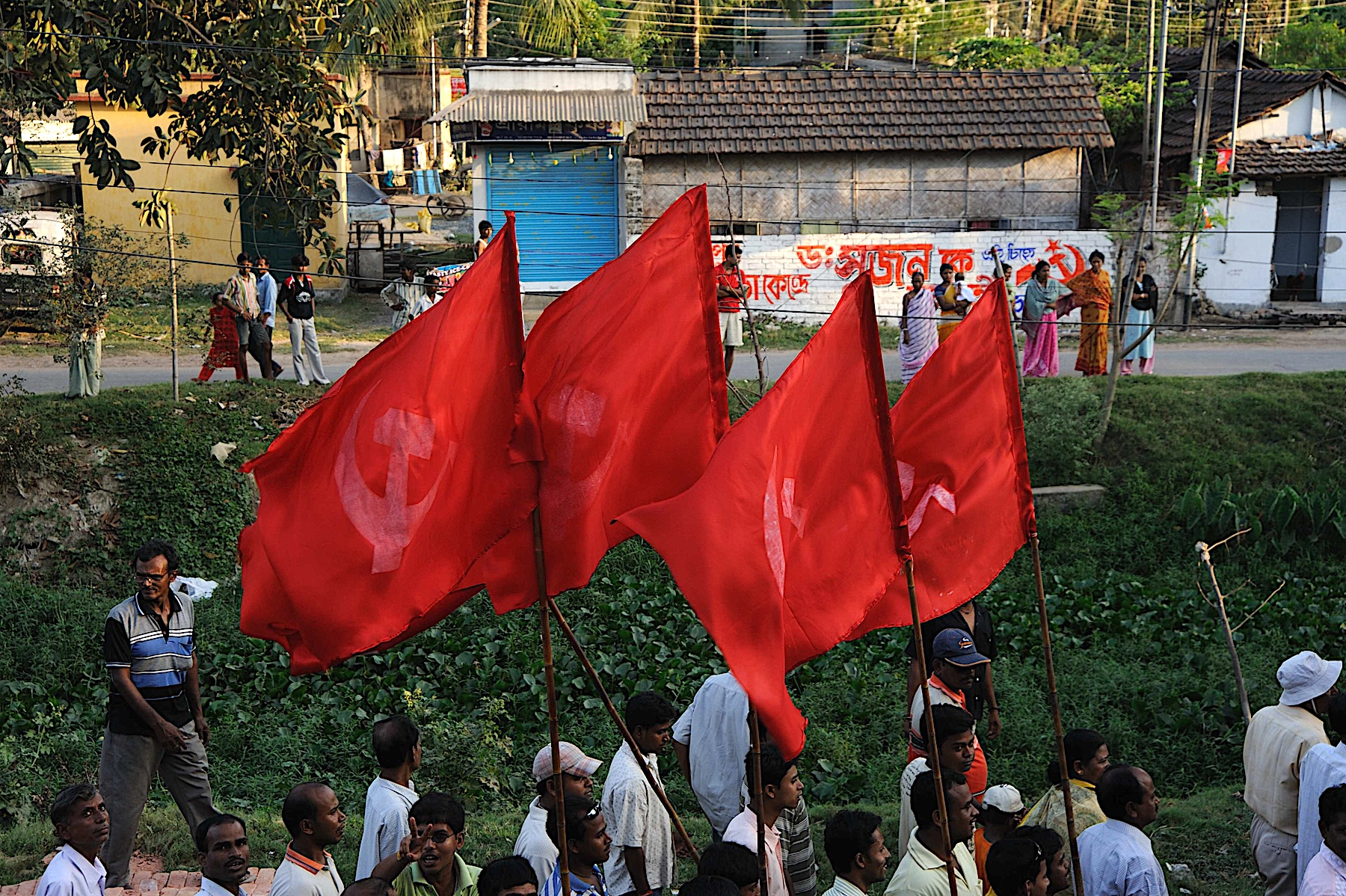
The defeat in the southern state of Kerala of the Communist Party of India (Marxist), or CPI (M), in recent elections means the Left, a major force in Indian politics for decades, is now out of power across the country for the first time since 1977, with no Indian state governed by a single communist party.
This marks a turning point for the Indian Left. It is in danger of slipping further from mainstream relevance, despite its legacy in land reforms and peasant movements, labour rights, trade union movements, public healthcare, education and the empowerment of marginalised communities.
In Kerala, for instance, in May 2021, the Left Democratic Front, led by the CPI(M), claimed extreme poverty had been eradicated, making it the first state in the country to achieve that feat (some economists and social activists questioned the claim, the methodology and the data.) Anyone subsisting on less than $3 per day is considered living in extreme poverty, according to the World Bank.
The communist legacy remains urgently relevant in a country suffering from deepening inequality, chronic unemployment and mounting rural distress that results in hundreds of farmer and agricultural labourer suicides every year — problems that 12 years of a Hindu nationalist government led by Prime Minister Narendra Modi have failed to alleviate.
Mohammed Salim is a leading communist politician who served four terms as a lawmaker — twice in Lok Sabha, India’s lower house of Parliament; once in the the West Bengal Legislative Assembly and once in the Rajya Sabha, India’s upper house of Parliament. He was a minister in the government of West Bengal holding multiple portfolios, including minister of technical education and training, youth welfare, minority development and self-employment.
Currently CPI (M)’s secretary for the eastern state of West Bengal, Salim said his party was down but not out. As a social movement, the Left had its “golden era” in the periods when it was actually out of power, he told Consortium News in an interview.
“Definitely, it is a debacle as far as the CPI (M) movement in India is concerned,” said Salim of the electoral loss on April 9.
“But even in the sixties and early seventies, when there was no communist party in government, there was a much more active Left movement and farmer and worker and student-led movement, particularly when Vietnam was being bombed. The youth flocked together under the leadership of the Left, which led to the formation of governments in Kerala, Bengal and Tripura.”
“It is not only when we are in government that the Left movement is relevant,” he added.
Why It Happened
With Marxist ideas usually secular and atheist, one of the biggest challenges communism has faced in India is that Indian society is deeply religious and caste-ridden, with identity politics around both becoming increasingly dominant since the 1980s and 1990s.
“The Left globally circumvents cultural problems and equates all of culture with conservatism,” Ajay Gudavarthy, an associate professor at the Centre for Political Studies at the Jawaharlal Nehru University, told Consortium News.
“But culture is such a part of the world of people; myths, mythologies and memory. The Left could have reinterpreted them, but gradually their politics became so middle-class, Bhadralok-centric.” (Bhadralok means upper-caste Hindus in Bengal).
“There was no mass reach,” Gudavarthy said. “Is the Left prepared to give a progressive interpretation of myths and mythologies?”
On the subject of identity politics, Salim, now CPI (M)’s secretary for the eastern state of West Bengal, said “more division on regional identity, caste, sub-caste and religion has cost the Left movement because unless the people get united, they cannot resist.” He added:
“Instead of giving rise to the labour movement, the kisan (farmer) movement, the student movement, the major energy of the CPI (M) in the eighties and nineties went into checking the divisive forces and fighting against communalism, casteism and regionalism and identity politics.”
Over the years, communists’ ability to shape policy has also weakened as Indian politics has increasingly been shaped by economic liberalisation and privatisation on one side — and Hindu majoritarianism and nationalism on the other.
Neoliberalism in India has been distinctive in that it has coincided with the expansion of welfare programmes and social rights, from employment guarantees and education to food security schemes. More recently, BJP governments have continued this trend through free food-grain distribution and direct benefit transfers.
Communist parties have often argued that welfare should not be treated as election-time handouts, but as stable, guaranteed public rights delivered through the state.
Last year, the World Bank reported 270 million Indians had moved out of extreme poverty.
Gudavarthy, at Jawaharlal Nehru University, described the model that prioritises immediate relief through cash transfers, over bigger structural change, as “transactional welfarism.”
He said the Left’s “structural position — that this is not sustainable — is right, but they also have to understand the experiential reality. In the experiential reality, people are feeling a sense of relief, inclusion and mobility. The Left does not know how to handle this.”
After land reforms, Gudavarthy said, the Left didn’t really develop new strategies even as the agrarian crisis pushed more people into unorganised and migrant work, and, still rooted mainly in factory-based trade unions, it struggled to build a sustained base among informal workers moving from city to city in search of work.
As for the growth of inequities and the continued lack of Left resonance, Gudavarthy said,
“There is something paradoxical and an anomaly the Left could not really solve. It requires deeper study. It is not merely economics that explains political behaviour. You see such a pro-corporate, ruthlessly neo-liberal BJP at the height of its success. How does one square up?”
Kshama Sawant, the Indian-American socialist politician who is running for the U.S. Congress after having been elected to the Seattle city council, called it “a cautionary tale that we have seen play out in India and also in other nations where you have communist parties in name who have ended up joining the neoliberal agenda of the ruling class.”
Sawant told Consortium News: “You can’t just have the party being called communist if they are not actually fighting against the violence of the neoliberal system, against the greed of the capitalist class and not fighting for working class people. That is the downfall that you have seen of the Communist parties in India.”
Sawant, who was born and educated in India and moved to the U.S. after university, said no political party in India fights for workers’ interests. She said:
“In India, you have a multitude of parties, but none of those parties represent the working class. So it’s not about how many parties you have. The key question is, do you have at least one party that represents the working class? And when the answer to that is no, you will see events like you’ve seen in Indian elections where you have the downfall of supposedly Communist Party parties that are supposed to be standing up for the working class.
There are lots of rank and file members who strongly agree with everything I’m saying. But if the leadership of those parties had actually fought for the working class and fought against the BJP, I have no doubt that they would have had completely different results, not just in West Bengal but in multiple states. […]
The more time passes where you don’t have an alternative to Hindu fundamentalism and the billionaire-backed BJP politics … the more the population gets indoctrinated [with] support from the media, the more attacks there are against ordinary people, attacks against dissent.”
Indian communist parties have never had a national profile and have only contested elections in a few states. With the rise of caste and religious identity politics, the BJP is popular in the Hindi-speaking belt where people vote for the Hindu majority agenda, which they often see as more important than their class or economic interests.
An Influential History
One could say that communism in India has been a story of contrasts.
On the one hand, it has driven major social reforms and governed effectively in some states. On the other hand, it has been marked by internal splits, economic stagnation and episodes of revolutionary violence in other parts of the country.
Communists first came to power in Kerala in 1957 under the leadership of E. M. S. Namboodiripad, an upper-caste Brahmin and Marxist thinker, forming the world’s first democratically elected communist government.
The government did not last long and was dismissed in 1959 when Prime Minister Jawaharlal Nehru’s Congress-led Centre imposed President’s Rule under Article 356 of the Constitution, following widespread political agitation by opposition parties, including the Congress and sections of Kerala’s significant Christian population through the Church, which criticised its education and land reform policies and accused it of authoritarianism.
The Left later returned to power in the state in the 1960s and again in the 1980s, becoming a dominant force in Kerala’s coalition politics.
The 1959 dismissal was a major early and controversial use of Article 356 against a democratically elected state government, and, after that, the provision was invoked more than 100 times across India, often in politically contested circumstances. After its repeated abuse for political reasons, especially by Nehru’s daughter, Prime Minister Indira Gandhi, in the 1970s, the Supreme Court put limits on its use.
The era of long-term, steady communist rule really started in West Bengal in 1977, when the Left Front, led by the CPI(M), won the state elections and remained in power for 34 years until 2011.
The Left became dominant in Tripura, a smaller eastern state with strong tribal and ethnic identities, by providing security and stability during years of insurgency while also expanding development like electrification and infrastructure in rural and tribal areas. Manik Sarkar, the former chief minister, often described as India’s “poorest CM” because of his very modest personal assets. But the Left lost ground to the Hindu nationalist Bharatiya Janata Party (BJP), which ended the CPI(M)’s 25 years in power by winning the 2018 state election.
Fighting British Rule
Communism in India got its start in the early 1900s, shaped by both the global rise of socialist ideas and the fight against British rule.
The CPI was formed in 1925 in Kanpur (then Cawnpore), a city in the state of Uttar Pradesh once called the Manchester of the East because of its booming textile industry.
During the independence movement, communists had an uneasy relationship with the Indian National Congress (INC), seeing Congress as too moderate and too compromising with the British, while they supported a more radical, class-based struggle rather than constitutional methods like laws, elections and negotiations. But they still worked alongside Congress and through separate groups to organise farmers, workers and labourers, in the process raising questions of class, exploitation and economic inequality.
When the communist government first came to power in Kerala in 1957, it introduced land reforms, giving land to tenants and reducing the power of feudal landlords, improved education, and expanded welfare programs and public health. These later helped Kerala achieve high literacy rates and better healthcare.
In West Bengal, which became known for its long communist rule, sharecroppers were given security over the land they worked, village-level governance was strengthened and rural education was expanded. Gradually, however, the decline of industry, labour strikes and political violence eroded its base.
Factionalism within the communist movement weakened it, including splits into the Communist Party of India (CPI), the Communist Party of India (Marxist), the erstwhile Communist Party of India (Marxist-Leninist), the Communist Party of India (Marxist-Leninist) Liberation, and a six-decade long Maoist insurgency begun by the Naxalite–Maoist movement and most recently led by the banned Communist Party of India (Maoist). In March the Indian home minister declared victory over the 59-year insurgency.
Salim said that over the past few decades, those divisions had gradually narrowed, with Left parties increasingly coming together, especially now, in opposition to the Hindu right.
“With international developments, national developments and the challenges that we face, it is not a small thing that the communist parties, especially the CPI and CPI (M), have been coming together since the 1980s, more than 45 years,” said Salim. “Nowhere in the world are two political parties fighting together, be it electorally or protesting in the streets.”
“It is no small matter that, despite their different approaches to organisation and views on the revolutionary path, the Left parties have come together to face this fascistic strain and the current onslaught from the right,” he said.
‘Fear of the Organised Left’
Inspired by Maoist ideas, the Maoist or Naxalite movement revealed another divide within India’s communist movement: between those who supported parliamentary democracy and those who believed violent revolution was necessary.
The movement began in 1967 as a peasant uprising in the village of Naxalbari in northern West Bengal, where poor farmers and tribal communities revolted against landlords over land rights and exploitation.
Over time, the movement under the Communist Party of India (Maoist), a designated terrorist organisation, grew into one of India’s longest-running armed insurgencies, concentrated in the tribal areas of central and eastern India.
While the Naxalite movement became deeply embedded in the national consciousness, constantly highlighting the State’s neglect of the poorest and most marginalised communities, and the exploitation of their resource-rich homelands by large corporations, it also claimed tens of thousands of lives, including civilians, insurgents, and security personnel.
When the Congress Party led the government at the Centre, former Prime Minister Manmohan Singh called it the biggest internal security threat facing India.
The BJP government under Modi, claims to have crushed it by adopting a ruthless zero-tolerance policy, killing hundreds of militants, securing the surrender of thousands and declaring India to be “Naxal free.”
Salim said the root causes which gave way to such a violent struggle — poverty, neglect and exploitation — remain unaddressed, but the Naxal movement had always been “adventurism” that was never going to succeed and had been “fatal” for the organized Left movement.
“The rightist establishment and state power always prefer anarchism over the organised Left,” said Salim. “They fear the organised Left. When you had the farmers’ protest that left a mark and Modi had to bow to the pressure.”
Diminished Influence in Parliament
CPI (Communist Party of India) and CPI (M) regularly participate in elections, but their influence in Parliament has diminished.
At its peak, the Left Front won 251 of 294 seats in the West Bengal Assembly election in 1987.
In 2004, the Left held a combined 61 in the Lok Sabha — with CPI(M) holding 43 seats — while in the current Lok Sabha, three communist parties hold eight of 543 seats.
In the Rajya Sabha, the upper house, where the 245 members are chosen not directly by the public but by elected members in state legislatures, the number is five.
And on Campus
Even though having been elected only in parts of the country, communist and Left groups are among the most active in student politics in many colleges and universities, organising protests on issues ranging from labour rights and inequality to exploitation of resources and environmental degradation, to women’s safety and communalism and caste atrocities.
Since the BJP came to power in 2014, the government, its right wing ecosystem and much of the pro establishment media has increasingly portrayed the Left as dangerous and subversive, coining the term “urban naxals” and using it to target those who question or criticise the government.
At the same time, campuses such as Jawaharlal Nehru University in Delhi, once vibrant centres of left-wing politics and political debate, have been subdued through crackdowns on free speech and administrations aligned with the right. As spaces for independent thought, protest, dissent and debate have shrunk, right-wing student groups have grown louder and more powerful.
“It is true the campus always used to be the centre for the Left and progressive movement, but after (economic) liberalisation, this has also changed,” said Salim. “Private campuses have flourished where campus politics is not allowed, and secondly, in government-funded universities, there is hardly any democratic space anymore.”
When asked why communist influence in student politics seldom carried into mainstream politics, Salim said it was a challenge.
“Most of them move on to careers and livelihoods instead of organising workers and peasants,” he said. “Retaining them, that will be our task.”
Today, communism in India is at a crossroads.
Its past achievements remain significant, but its future relevance is uncertain.

No comments:
Post a Comment