Critics say the indictments against 15 people aim to intimidate and silence dissent against the Trump administration.
By Ibrahim Hirsi ,
July 1, 2026
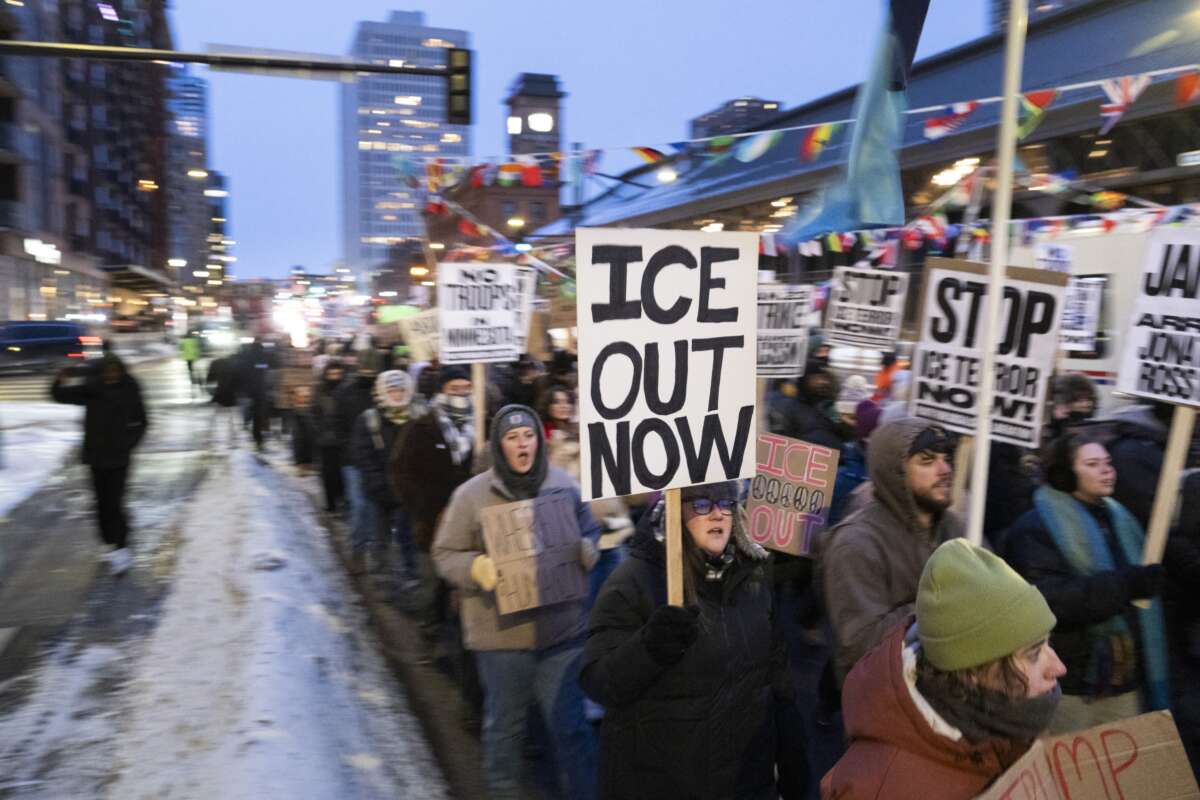
Demonstrators march during the nationwide "Stop ICE Terror" rally through downtown Minneapolis, Minnesota, on January 20, 2026.ROBERTO SCHMIDT / AFP via Getty Images
Minnesota activists and scholars are decrying the recent federal indictment of 15 people who took part in demonstrations against the Trump administration’s aggressive immigration crackdown in the Twin Cities metro region earlier this year.
The indictment accuses the protesters of surveilling federal agents, disrupting Immigration and Customs Enforcement (ICE) operations, and training people on how to delay or prevent arrests, among other allegations. It also alleges that the defendants are members of antifa-linked groups like the Black Cat Worker’s Collective, which prosecutors describe as an organization committed to “militant class struggle” and “revolution.” According to the indictment, “militant class struggle” includes activities such as “digital campaigning, community organizing, and physical confrontation.”
The defendants include a college professor, a union carpenter, a health care worker, a special education teacher, union members, and community organizers.
Civil rights attorney and activist Nekima Levy Armstrong told Truthout that the defendants are being targeted for exercising their constitutional rights to protest and assemble. She called the charges “farcical” and part of “a familiar pattern where the federal government is hell-bent on punishing protesters and those who speak out against the authoritarianism and fascism of the Trump administration.”
The defendants include a college professor, a union carpenter, a health care worker, a special education teacher, union members, and community organizers.
Armstrong herself faces a separate federal charge stemming from an anti-ICE protest inside a church during a Sunday service in January. The Department of Justice, which called the protest a violation of religious freedom, has charged her and more than three dozen others for allegedly carrying out a “coordinated takeover-style attack” on Cities Church in St. Paul, Minnesota. However, video clips of the event appear to show activists peacefully chanting “Justice for Renee Good” and “ICE Out” as they protested what they viewed as a glaring contradiction: One of the church’s pastors, David Easterwood, was both preaching the Gospel and allegedly serving as acting director of a local ICE field office.
Others who were charged along with Armstrong include local journalist Georgia Fort and former CNN journalist Don Lemon, both of whom were at the church covering the protest.
But in recent weeks, federal prosecutors have dismissed or reduced dozens of charges against indicted protesters. At least 15 cases have been dropped entirely, while others — including that of Isabel “Isa” Lopez — have been downgraded from felonies to misdemeanors. Last week, attorneys for Armstrong and 32 other co-defendants asked a federal judge to dismiss charges tied to the church demonstration, arguing that the indictment does not “allege a single fact that any defendant used physical force against another person, issued a threat of violence to anyone, or fully blocked ingress to or egress from the church, as is required by the charged statutes.”
David Schultz, a political science professor at Hamline University in Minnesota, told Truthout that the charges against the 15 anti-ICE protesters reflect what he sees as a broader campaign against Donald Trump’s political opponents. The charges, Schultz said in an email, resemble the Trump administration’s allegations against prominent national leaders, including Minnesota Gov. Tim Walz and former FBI Director James Comey.
“The pattern is to use the machinery of government to intimidate individuals, even when the legal basis for the investigations appears weak or nonexistent … The objective is often less about obtaining convictions than about intimidation and harassment.”
“The pattern is to use the machinery of government to intimidate individuals, even when the legal basis for the investigations appears weak or nonexistent,” Schultz said. “The objective is often less about obtaining convictions than about intimidation and harassment.”
JaNaé Bates Imari, executive director of Faith in Minnesota, a faith-based political grassroots organizing group, echoed Schultz’s sentiment, noting that the indictment was indeed aimed at intimidating protesters whose only crime was peacefully confronting immigration agents who, in the nation’s largest crackdown, pursued immigrants and refugees — including naturalized citizens and permanent residents — across the city.
The defendants, Imari told Truthout, have been criminalized for “blowing whistles and showing up when their neighbors are being kidnapped, and for writing down license plates of people who are doing the kidnapping.”
Imari’s Faith in Minnesota is one of 50 organizations — including religious, labor, and other groups — that issued a statement condemning the indictment of the protesters. “When self-serving politicians are losing, they lie, lash out and attempt political repression,” the statement reads in part. “They will do whatever it takes to seize and hold power, including trying to silence our voices and keep us from voting.”
Similar organizations, affiliate groups, and individual supporters have already taken steps to defend the indicted protesters in various ways. People have turned out in large numbers at defendants’ court appearances to show solidarity. Legal organizations, including the Minnesota chapter of the National Lawyers Guild, have provided legal representation. Thousands of individuals have so far raised over $342,000 in legal funds.
People have turned out in large numbers at defendants’ court appearances to show solidarity. Thousands of individuals have so far raised over $342,000 in legal funds.
The cases in Minnesota come amid a broader national pattern of ICE protest prosecutions. Recently, federal judges sentenced eight activists for participating in an anti-ICE noise demonstration in Texas. Prosecutors claimed that the protesters had links to antifa, which the Trump administration labeled as a domestic terrorist group. One of them, Benjamin Song, who was convicted of firing shots and injuring a police officer during the protest, received a 100-year prison sentence. Song argued that he acted to prevent police brutality and pointed out in a statement that while he opposed fascism, he was not a member of an antifa group because antifa is not an actual organization. The others received sentences ranging from 30 to 70 years.
In Minnesota, the indictment of the 15 anti-ICE protesters mainly revolves around digital communications and planning related to organizing demonstrations; it does not accuse the defendants of causing physical harm to agents. “Peaceful protest is protected by the First Amendment, and discussions about how to organize and conduct those protests are likewise protected,” Schultz said. “Those activities generally fall squarely within the rights of free speech and assembly.”
Whatever the case, Minnesotans continue to exercise their rights to protest and assemble despite the federal government’s crackdown on protesters in the state and across the country.
This became clear, Armstrong said, at the initial court appearance for the defendants. Supporters filled the largest courtroom in St. Paul to capacity, she said, with many more waiting outside. “So, it just shows that people are resilient, that people see what is going on in these attempts to silence our voices and to intimidate us,” Armstrong added. “They are refusing to capitulate to Donald Trump, even knowing that there may be consequences at the hands of this president and his administration.”
This is not the first time that a U.S. government — local, state, or federal — has used its power to pursue dissent. In recent years, pro-Palestinian and Black Lives Matter protesters on college campuses and in the streets have faced harsh punishment at the hands of law enforcement and the courts, reflecting a pattern seen throughout U.S. history.
“Historically, conspiracy charges have frequently been used against progressive organizations and movements in the United States,” Schultz said. “Labor unions, socialists, and members of the Communist Party were all, at various times, prosecuted under conspiracy theories in efforts to suppress their political activities. Over time, the courts repeatedly recognized that much of this conduct constituted protected speech and protected political association under the First Amendment.”
This article is licensed under Creative Commons (CC BY-NC-ND 4.0), and you are free to share and republish under the terms of the license.
Minnesota activists and scholars are decrying the recent federal indictment of 15 people who took part in demonstrations against the Trump administration’s aggressive immigration crackdown in the Twin Cities metro region earlier this year.
The indictment accuses the protesters of surveilling federal agents, disrupting Immigration and Customs Enforcement (ICE) operations, and training people on how to delay or prevent arrests, among other allegations. It also alleges that the defendants are members of antifa-linked groups like the Black Cat Worker’s Collective, which prosecutors describe as an organization committed to “militant class struggle” and “revolution.” According to the indictment, “militant class struggle” includes activities such as “digital campaigning, community organizing, and physical confrontation.”
The defendants include a college professor, a union carpenter, a health care worker, a special education teacher, union members, and community organizers.
Civil rights attorney and activist Nekima Levy Armstrong told Truthout that the defendants are being targeted for exercising their constitutional rights to protest and assemble. She called the charges “farcical” and part of “a familiar pattern where the federal government is hell-bent on punishing protesters and those who speak out against the authoritarianism and fascism of the Trump administration.”
The defendants include a college professor, a union carpenter, a health care worker, a special education teacher, union members, and community organizers.
Armstrong herself faces a separate federal charge stemming from an anti-ICE protest inside a church during a Sunday service in January. The Department of Justice, which called the protest a violation of religious freedom, has charged her and more than three dozen others for allegedly carrying out a “coordinated takeover-style attack” on Cities Church in St. Paul, Minnesota. However, video clips of the event appear to show activists peacefully chanting “Justice for Renee Good” and “ICE Out” as they protested what they viewed as a glaring contradiction: One of the church’s pastors, David Easterwood, was both preaching the Gospel and allegedly serving as acting director of a local ICE field office.
Others who were charged along with Armstrong include local journalist Georgia Fort and former CNN journalist Don Lemon, both of whom were at the church covering the protest.
But in recent weeks, federal prosecutors have dismissed or reduced dozens of charges against indicted protesters. At least 15 cases have been dropped entirely, while others — including that of Isabel “Isa” Lopez — have been downgraded from felonies to misdemeanors. Last week, attorneys for Armstrong and 32 other co-defendants asked a federal judge to dismiss charges tied to the church demonstration, arguing that the indictment does not “allege a single fact that any defendant used physical force against another person, issued a threat of violence to anyone, or fully blocked ingress to or egress from the church, as is required by the charged statutes.”
David Schultz, a political science professor at Hamline University in Minnesota, told Truthout that the charges against the 15 anti-ICE protesters reflect what he sees as a broader campaign against Donald Trump’s political opponents. The charges, Schultz said in an email, resemble the Trump administration’s allegations against prominent national leaders, including Minnesota Gov. Tim Walz and former FBI Director James Comey.
“The pattern is to use the machinery of government to intimidate individuals, even when the legal basis for the investigations appears weak or nonexistent … The objective is often less about obtaining convictions than about intimidation and harassment.”
“The pattern is to use the machinery of government to intimidate individuals, even when the legal basis for the investigations appears weak or nonexistent,” Schultz said. “The objective is often less about obtaining convictions than about intimidation and harassment.”
JaNaé Bates Imari, executive director of Faith in Minnesota, a faith-based political grassroots organizing group, echoed Schultz’s sentiment, noting that the indictment was indeed aimed at intimidating protesters whose only crime was peacefully confronting immigration agents who, in the nation’s largest crackdown, pursued immigrants and refugees — including naturalized citizens and permanent residents — across the city.
The defendants, Imari told Truthout, have been criminalized for “blowing whistles and showing up when their neighbors are being kidnapped, and for writing down license plates of people who are doing the kidnapping.”
Imari’s Faith in Minnesota is one of 50 organizations — including religious, labor, and other groups — that issued a statement condemning the indictment of the protesters. “When self-serving politicians are losing, they lie, lash out and attempt political repression,” the statement reads in part. “They will do whatever it takes to seize and hold power, including trying to silence our voices and keep us from voting.”
Similar organizations, affiliate groups, and individual supporters have already taken steps to defend the indicted protesters in various ways. People have turned out in large numbers at defendants’ court appearances to show solidarity. Legal organizations, including the Minnesota chapter of the National Lawyers Guild, have provided legal representation. Thousands of individuals have so far raised over $342,000 in legal funds.
People have turned out in large numbers at defendants’ court appearances to show solidarity. Thousands of individuals have so far raised over $342,000 in legal funds.
The cases in Minnesota come amid a broader national pattern of ICE protest prosecutions. Recently, federal judges sentenced eight activists for participating in an anti-ICE noise demonstration in Texas. Prosecutors claimed that the protesters had links to antifa, which the Trump administration labeled as a domestic terrorist group. One of them, Benjamin Song, who was convicted of firing shots and injuring a police officer during the protest, received a 100-year prison sentence. Song argued that he acted to prevent police brutality and pointed out in a statement that while he opposed fascism, he was not a member of an antifa group because antifa is not an actual organization. The others received sentences ranging from 30 to 70 years.
In Minnesota, the indictment of the 15 anti-ICE protesters mainly revolves around digital communications and planning related to organizing demonstrations; it does not accuse the defendants of causing physical harm to agents. “Peaceful protest is protected by the First Amendment, and discussions about how to organize and conduct those protests are likewise protected,” Schultz said. “Those activities generally fall squarely within the rights of free speech and assembly.”
Whatever the case, Minnesotans continue to exercise their rights to protest and assemble despite the federal government’s crackdown on protesters in the state and across the country.
This became clear, Armstrong said, at the initial court appearance for the defendants. Supporters filled the largest courtroom in St. Paul to capacity, she said, with many more waiting outside. “So, it just shows that people are resilient, that people see what is going on in these attempts to silence our voices and to intimidate us,” Armstrong added. “They are refusing to capitulate to Donald Trump, even knowing that there may be consequences at the hands of this president and his administration.”
This is not the first time that a U.S. government — local, state, or federal — has used its power to pursue dissent. In recent years, pro-Palestinian and Black Lives Matter protesters on college campuses and in the streets have faced harsh punishment at the hands of law enforcement and the courts, reflecting a pattern seen throughout U.S. history.
“Historically, conspiracy charges have frequently been used against progressive organizations and movements in the United States,” Schultz said. “Labor unions, socialists, and members of the Communist Party were all, at various times, prosecuted under conspiracy theories in efforts to suppress their political activities. Over time, the courts repeatedly recognized that much of this conduct constituted protected speech and protected political association under the First Amendment.”
This article is licensed under Creative Commons (CC BY-NC-ND 4.0), and you are free to share and republish under the terms of the license.
Ibrahim Hirsi
Ibrahim Hirsi is a Minneapolis-based journalist and historian covering immigration, politics, and racial justice. His work has appeared in The Nation, Dissent, MinnPost, and elsewhere.

No comments:
Post a Comment