Trump Drops Hormuz Protection Fee Saying Gulf States Will Invest in US
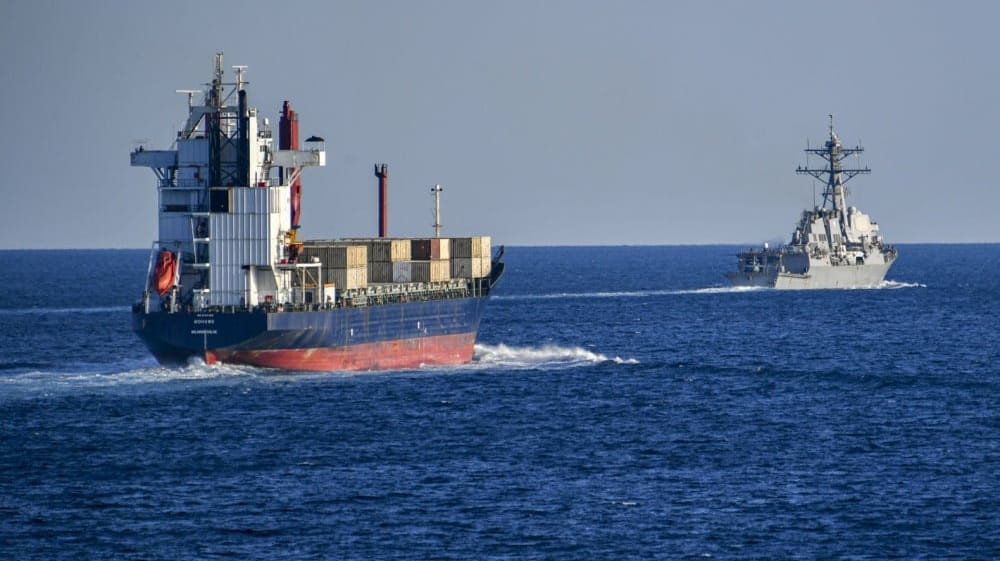
The United States is resuming its blockade of shipping related to Iran today, July 14, but in a reversal of course, Donald Trump now says the Gulf States will pay for protection by investing in the United States. While still asserting “it’s not fair” that the United States is protecting the Strait for the entire world, he announced after calls from Gulf States that he would replace the 20 percent “reimbursement fee” with investment deals.
Trump appeared to surprise everyone on Monday when he announced in a social media posting, and to the media in the Oval Office, that the U.S. would require a 20 percent reimbursement fee as compensation for providing security. He announced the U.S. would become the “Guardian of the Hormuz Strait.”
His comments were immediately met with commendation, and questions about a reversal of position after Trump, as well as Secretary of State Marco Rubio and Treasury Secretary Scott Bessent, in the past, said fees were wrong. When pressed by the media about how the fees would work and who would pay, Trump responded that the Gulf States are rich.
The global shipping community also openly rejected the proposed fees, citing international law. Hapag-Lloyd made a public statement calling the fees “fundamentally wrong,” while shipping groups ranging from BIMCO to the European Community of Shipowners’ Association and others also rejected the idea in statements to CNBC.
The International Maritime Organization has also repeatedly rejected fees. Even the Iranians used it as a propoganda tools. Iranian Foreign Minister Abbas Araghchi said 20 percent was too much and that Iran would be fair with its fees.
The Omani government, a strong ally of the United States, also issued a formal statement. “The Sultanate of Oman continues its transparent and neutral cooperation with all parties to restore freedom of navigation in the Strait, fully in line with international law,” they wrote, calling on all parties to respect international law.
“Based on highly productive conversations with Middle East leadership, I have decided to replace the 20 percent United States Reimbursement Fee with Trade and Investment Deals that the various Gulf States will be making into the United States. Those investments will be MASSIVE but, at the same time, extraordinarily good for them, and their future,” Trump wrote today on social media.
Trump continues to assert, “Oil is flowing like never before.” He wrote that the Strait is open to all shipping except Iran. He says ships were moving through the Strait.
Data, however, continues to show a strong decline in transits. Kpler said there were just 10 verified crossings on July 13, “marking a further slowdown.” It reported crossings were down by six versus a day earlier and that 9 of the 10 crossings were on the Iranian route.
Windward AI reported that only five vessels made the crossing overnight. It was up by two from the day before, but it said one of the five was a tanker loaded with Iranian oil repositioning deeper into the Gulf.
Other tankers appeared to be rushing to make their exit before the U.S. blockade resumes. TankerTrackers.com spotted one tanker carrying Iranian oil moving at between 14 and 16 knots.
Global oil markets also remained jittery after Iran attacked three more oil and gas tankers overnight. The price of oil is up more than 11 percent in the past five days, with the benchmark briefly exceeding $80 a barrel on Tuesday. Traders continue to watch as the fluid situation continues to evolve.
Iran Piles on Pressure and Targets Tanker off Omani LNG Terminal
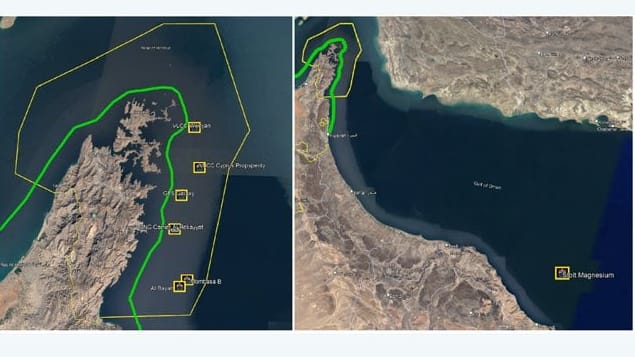
Oman has been sent a new signal by the IRGC, following drone attacks on ground targets in the Musandam, Batinah, and Al Wusta governorates on July 12. It followed the attacks on tankers in Omani territorial waters using the southern route through the Strait of Hormuz which began on July 6.
The new attack was carried out late on July 13 on the Liberian-flagged chemical product tanker Stolt Magnesium (27,600 dwt), 40 nautical miles northeast of Qalhat, the Omani LNG terminal near Sur. There were no injuries aboard the tanker, nor any rupture of tanks, but the crew subsequently was fighting an engine room fire.
The attack was far from the Omani Coastal route in the Strait of Hormuz, on which the IRGC has concentrated its attacks in recent days. Last night's other attacks, the Liberian-flagged crude oil tankers Al Bahyah (299,425 dwt) and Mombasa B (299,392 dwt), were near the Strait of Hormuz. The attack on the Stolt tanker is raising concerns, and perhaps threatening, that LNG tankers loading at the Qalhat terminal could be vulnerable to attack in the near future.
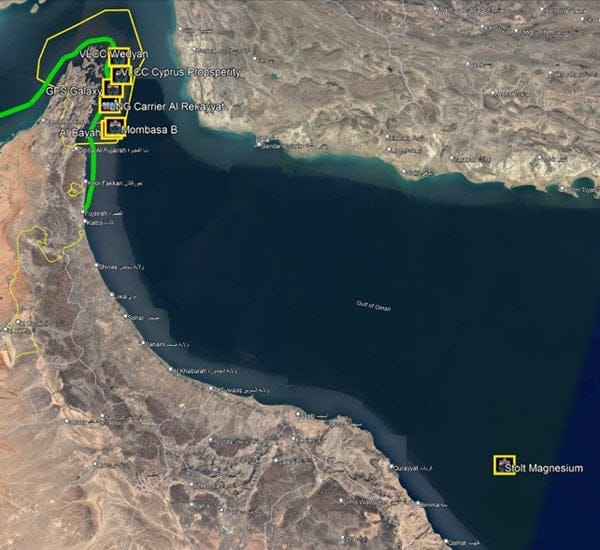
The pattern of IRGC attacks July 6-13 in the Strait (top left) and the attack late on July 13 (right)
(Google Earth/CJRC)
The Omani authorities have not announced what ground targets were attacked on July 12, but The Maritime Executive understands that the targets included coastal radar sites in Musandam covering the Strait of Hormuz, logistic stores at an airbase in central Oman, and bunkering facilities in Duqm. There have been no reported casualties, and Omani authorities appear keen to downplay the attacks, with no mention of the incidents either in newspapers or on social media. The pattern of events suggests that, notwithstanding the attacks, Oman is keen to continue its dialogue with Iran, with whom it believes it is making progress towards a long-term solution. In an interview with Le Monde on July 12, Sayyid Badr Al Busaidi, the Omani Foreign Minister, said that “complex talks have begun to shape a lasting framework guaranteeing freedom of navigation in the Strait of Hormuz.”
Nonetheless, it appears that Iran is upset and is attempting to pressure Oman into dropping its insistence that a final solution to the Hormuz transit issue should be compliant with international law and UNCLOS, and should not involve paying passage fees. Donald Trump’s announcement that he proposes to charge 20 percent of the value of cargoes transiting through the Strait has enabled Oman to restate its principles – a solution within UNCLOS and without passage fees – that applies equally to both Iranian and American attempts to disturb the status quo.
It is apparent that Trump’s 20 percent levy was announced without pre-consultation with Oman, through whose territorial waters ships transiting the Strait must pass. Moreover, the Musandam Peninsula is dependent in daily life on coastal traffic travelling through the Strait to reach settlements otherwise unreachable by road. The Trump pronouncement is evidently unworkable from a practical perspective, but its most long-lasting impact may be to upset countries whose sovereign rights are implicitly ignored by his proposal. While Iran is threatening logistic and bunkering facilities in Oman, which all nations make good use of now that such facilities within the Gulf are no longer available, President Trump’s proposal is also a good cause to withdraw those facilities.
Iran Attacks Two Emirati Tankers Off Oman, Killing One Crewmember
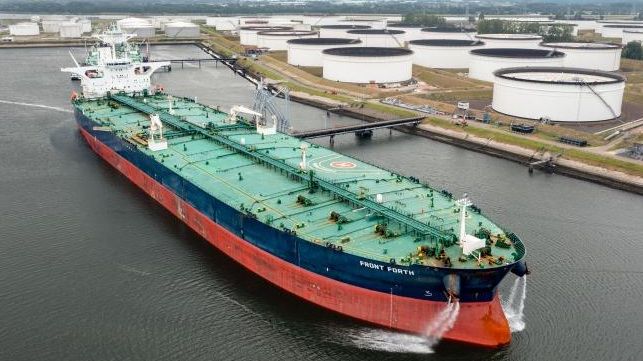
The UAE's defense ministry says that two tankers connected to its oil industry were attacked by Iran while transiting the Strait of Hormuz - the latest targets in Tehran's campaign to wrest control of all shipping through the waterway.
According to the UAE Ministry of Defense, the tanker "Mombasa" (likely the VLCC Mombasa B, IMO 9739501) and "Bahia" (likely the VLCC Al Bahyah, IMO 9937799, but also reported as the similarly-named LNG carrier Al Bahiya) were each hit by an Iranian cruise missile while transiting the southern Strait of Hormuz route through Omani waters. Eight crewmembers aboard the ships were injured, including four who sustained serious injuries. One of Mombasa B's crewmembers, an Indian national, was killed in the attack.
Fires broke out on both vessels following the strikes, but the blazes have been successfully brought under control, the ministry said.
"The Ministry of Defense condemns this brazen attack, which constitutes a serious violation and a clear breach of international law," the ministry said. "The state reserves its full right to respond to this escalation and to take all necessary measures to protect its territories, people, and residents."
Following Iran's renewed hostilities with the United States and the reimposition of the U.S. blockade of Iranian shipping, Tehran has declared the closure of the strait to all traffic. The Omani route - which has U.S. overwatch, and is where the two Emirati tankers were operating - has been in Iran's crosshairs, as the Islamic Revolutionary Guard Corps views its existence as a direct challenge to Iranian control of the strait.
The UAE has been one of the biggest and best-publicized users of the Omani lane, operating tankers as shuttles to move oil out of the Arabian Gulf to an anchorage off Khor Fakkan, in the Gulf of Oman. At this location, the oil is transferred onto other ships for onward shipment to the final destination. Mombasa B and Al Bahyah were both engaged in this trade in June and early July, but have been operating dark since last week, according to their AIS records.
Top image: Mombasa B, 2024 (VesselFinder / Rush2112)
Kuwait Reports Attack on Offshore Oil Platform as US and Iran Trade Fire
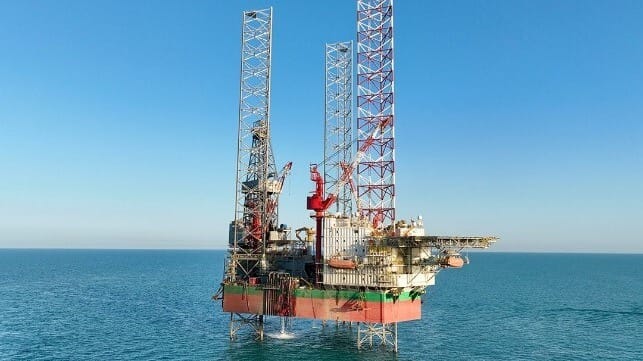
Kuwait's ministry of defense has reported a drone attack on an offshore drilling platform operated by the state-owned Kuwait Petroleum Company near Shuwaikh Port, causing substantial damage to the rig and injuring one worker. In a statement, the ministry called the strike a "criminal" act.
The platform strike - a likely but unconfirmed operation by Iranian forces - is among the first attacks on energy infrastructure in the GCC states since the ceasefire began. The recent Iranian missile and drone volleys have focused on U.S. military bases and the nations that host them, without the damage to oil and gas facilities seen in the first round of intense hostilities in March and April.
Dozens of targets around the region were hit over the weekend. After Iran struck and damaged a container ship in the Strait of Hormuz on Saturday, Iranian and American forces traded fire on July 11-12 - the most intense exchange since the beginning of the ceasefire agreement last month, with extensive damage reported on both sides.
In addition to the Kuwaiti platform strike, Iranian attacks or attempted attacks have been reported in Oman, Qatar, Bahrain and Jordan. Open-source intelligence researchers have spotted apparent impact sites via Sentinel-2 low-resolution satellite imaging, notably at Prince Hassan Air Base in Jordan, one of the staging points for long range U.S. Navy-operated surveillance flights near Iran. The extent of any damage at the air base remains unconfirmed, but satellite imaging shows clear visual changes in the vicinity of one large hangar and a nearby apron.
U.S. strikes hit 140 Iranian targets overnight Saturday, according to U.S. Central Command. Targets included Iranian missile and drone launch sites, naval units, ammunition storage sites, communications systems and coastal surveillance locations.
Additional follow-up strikes on Sunday night included more attacks on air-defense systems, coastal radars, and small boats. For the first time ever reported, the U.S. military used "one-way attack sea drones" in combat, Central Command said.
Satellite imaging also appears to show impact damage on the site of Iran's Bushehr nuclear power plant complex, though the timing of the damage is unclear; satellite data suggests a physical event occurred sometime between July 7-12, and caused damage to a building located several hundred yards from the main reactor. Residents in the Bushehr region reported strikes and air defense activity overnight July 11-12.
In a statement carried by state media, the Atomic Energy Organization of Iran dismissed reports of an attack on the Bushehr nuclear site, claiming that "the plant remains fully operational, secure, and stable, with all systems running continuously and without any disruption."
Bushehr is undergoing a planned expansion with the addition of two more Russian-built reactors. The project has been delayed by the conflict, which prompted state atomic agency Rosatom to withdraw its advisors and workers in March, but Rosatom director Rosatom Director General Alexei Likhachev has said that both Russia and Iran remain committed to completing the reactors. An attack on an Iranian nuclear site - if confirmed - would mark a major escalation.
Oman Makes Most Unequivocal Statement Yet on Hormuz Transits
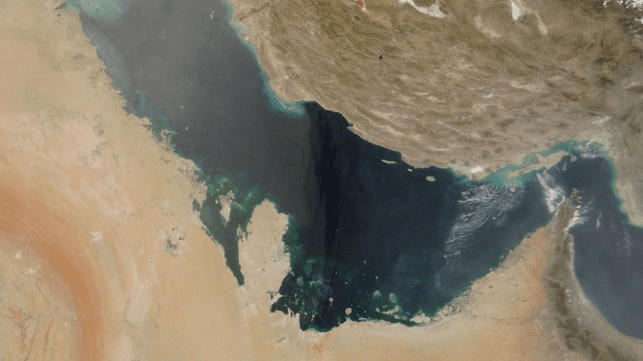
Oman has made its most unequivocal statement yet on its attitude to free passage navigation in the Strait of Hormuz.
Emerging from Council Meeting 137 on July 9 at the International Maritime Organization headquarters in London, the statement said that 'The Sultanate of Oman reiterates that the right of transit passage through straits used for international navigation is guaranteed under international law. Oman remains fully committed to these legal principles and does not support the imposition of transit fees on vessels passing through the Strait of Hormuz'. Earlier the IMO Secretary General had issued his own statement condemning the 'reckless attacks' on 'commercial ships and innocent seafarers' in the Strait in recent days.
There has been some misunderstanding caused by Oman's attempts to achieve a consensus with Iran over navigation in the Strait, developed in routine conversations between the respective foreign ministries, but also by direct talks in Muscat on May 24 and June 29. In these discussions, Oman tabled proposals to review charges raised for provision of lighthouses, channel markings, traffic control and emergency response, known as Navigation Dues, as are customarily charged elsewhere, for example by Trinity House in UK and Irish waters, but rejected the concept of passage fees. In these discussions, Iran held out for controlling navigation on both northern and southern sides of the Strait, for vetting permissions to transit, and for charging passage fees. Misunderstandings were reinforced by the well-established Iranian custom of releasing their own views on how discussions have gone, and not an agreed version of events.
Oman's Foreign Minister Sayyid Badr Al Busaidi set the record straight with an interview on July 1 with Monte Carlo Doualiya, France's Arabic language radio station. He outlined Oman's position:
· Any bilateral understanding between Iran and Oman must fall within international law and UNCLOS.
· Oman is "not in favor of imposing transit fees. That is prohibited under international law and we are committed to those rules."
· Oman is considering with Iran how environmental protection, navigational services and emergency response can be improved in the Strait, drawing on the models in operation covering the Strait of Malacca and Singapore. Proposed future arrangements would be discussed and agreed with the international maritime community.
· Responsibility for mine clearance in the Strait rests with Iran, who should approach others for support if it was unable to fulfill its commitment to clearance of the Strait under the 14 Point MoU signed with the United States.
Sayyid Badr's statement made it clear that while the scope and fee scale for services provided and charged for as Navigation Dues had been discussed between Iran and Oman, charging tolls for passage, in effect creating a reconstruction fund, would be unacceptable to the Sultanate.
Following the series of attacks on ships in Omani territorial waters, Oman's patience appears to have snapped, and the statement made at the IMO today is noticeably tauter and more direct, driven by Iran's duplicitous behavior and by the attacks on ships and sailors in recent days in Omani territorial waters. The attacks on Saudi and Qatari ships in Omani territorial waters caused considerable outrage.
It remains to be seen if Iran reacts to Oman's tougher position by coming back to the negotiating table. If Oman were to abandon the neutral stance it has taken so far, in the hope of drawing Iran into fruitful discussions, then the confrontation in the Strait could take on a different character. Qatar had tried the same approach, trying to tempt Iran into consensus-building discussions, but now appears also to have given up on the Iranians, in the wake of the attack on the Nakilat-owned and Marshall Islands-flagged LNG tanker Al Rekayyat (IMO 9397339) which had loaded at Ras Laffan.

No comments:
Post a Comment