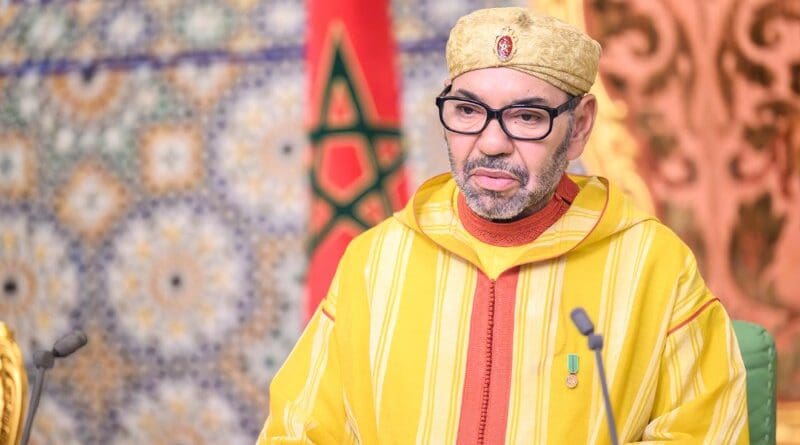
His Majesty King Mohammed VI of Morocco reacts to the Security Council resolution and extends a hand to the Algerian President
November 2, 2025
By Dr. Mohamed Chtatou
“By the grace of the Lord and with His help, after fifty years of sacrifices, we are opening a new and victorious chapter in the process of consecrating the Moroccan identity of the Sahara, intended to definitively close the case of this artificial conflict through a consensual solution based on the Autonomy Initiative.” — Address by His Majesty King Mohammed VI on October 31, 2025
Introduction
For several decades, the question of the Moroccan Sahara has been one of the major issues in the foreign policy of the Kingdom of Morocco, as well as a matter of stability and national identity. It is part of a historical and legal framework that goes beyond the simple logic of territorial claims: it touches the very heart of national sovereignty, territorial unity, and the collective memory of Morocco. From the moment of independence in 1956, the Kingdom affirmed its desire to reintegrate the southern territories, which had remained under Spanish rule since the late 19th century.
This claim was always based on the continuity of the Makhzen’s political and religious authority over the Saharan tribes, attested to by acts of allegiance (bay’a) and official historical documents. The advisory opinion of the International Court of Justice (ICJ) of October 16, 1975, confirmed the existence of ties of allegiance between the Sultan of Morocco and the tribes of Western Sahara, rejecting the terra nullius thesis (ICJ, 1975). This opinion was one of the cornerstones of the Green March, a symbol of Moroccan pacifism and popular support for a just national cause. Since then, Moroccan diplomacy has consistently combined historical legitimacy, political realism, and international commitment, resulting in increasing recognition of Moroccan sovereignty over the Sahara.
Today, through the explicit recognition of several world powers and the opening of more than 30 consulates in Laayoune and Dakhla, the Moroccan identity of the Sahara has become an irreversible geopolitical reality. This article aims to analyze the foundations and manifestations of this recognition along three lines:
– (I) the historical and identity-based foundations of Moroccan sovereignty,
– (II) the diplomatic strategy that has led to international consolidation, and
– (III) the growing recognition of the Moroccan identity of the Sahara in the economic, political, and cultural spheres.
I. The Historical and Identity-Based Foundations of the Moroccan Identity of the Sahara
1. The Historical Continuity of Moroccan Authority
The political identity of the Moroccan Sahara is deeply rooted in the historical structure of the Kingdom. Since the Almoravid, Almohad, and Saadian dynasties, the Saharan territories have constituted a natural extension of Morocco. The caravan routes linking Sijilmassa, Smara, and Timbuktu bear witness to this long-standing integration. According to historians, the Saharan region was never a political vacuum, but rather an area of spiritual and economic exchange under the protection of the Makhzen.
The bonds of allegiance (bay’a) were the legal and symbolic foundation of this unity: Saharan tribes swore oaths of loyalty to the Sultan in exchange for the Makhzen’s religious and political protection. The ICJ recognized these bonds as “legal relations of allegiance between the Sultan of Morocco and certain tribes living in the territory of Western Sahara” (ICJ, 1975, §162). This recognition, while not conferring exclusive sovereignty before decolonization, invalidated the thesis of a legal vacuum upon which Spanish colonization was based.
Moroccan documents, such as an 1886 dahir appointing a representative of the Sultan in the Smara region, or letters addressed to tribal chiefs, confirm Morocco’s administrative presence in the Sahara. These archives demonstrate that the Makhzen’s authority extended well beyond the borders of the Souss region, reaching the southern Atlantic shores.
2. The Cultural and Religious Foundations of National Unity
Beyond historical evidence, the Moroccan identity of the Sahara is also expressed in the religious and cultural coherence that unites the north and south of the Kingdom. The Saharan tribes belong to the same Maliki school of law, share the same Hassaniya Arabic language, and the same loyalty to the Commander of the Faithful (Amîr al-Mu’minin). The 2011 Moroccan Constitution, in its Article 41, enshrines the monarchy as the guarantor of the faith and religious unity of the country. This spiritual dimension is essential, because it links the temporal authority of the sovereign to the religious legitimacy shared across the Sahara.
Historians remind us that Morocco has always been a multicultural state where linguistic diversity (Arabic, Amazigh, Hassaniya) coexists under a unified political system. Article 5 of the 2011 Constitution stipulates:
“Arabic remains the official language of the State.
The State works to protect and develop the Arabic language, as well as to promote its use.
Similarly, Amazigh constitutes an official language of the State, as a common heritage of all Moroccans without exception.
An organic law defines the process for implementing the official status of this language, as well as the modalities for its integration into education and priority areas of public life, in order to enable it to eventually fulfill its function as an official language.
The State works to preserve Hassaniya, as an integral part of the unified Moroccan cultural identity, as well as to protect the cultural expressions and dialects spoken in Morocco.” Similarly, it ensures the coherence of national linguistic and cultural policy and the learning and mastery of the most widely used foreign languages in the world, as tools for communication, integration, and interaction with the knowledge society, and for openness to different cultures and contemporary civilizations.
A National Council for Moroccan Languages and Culture is established, tasked in particular with the protection and development of the Arabic and Amazigh languages and the various Moroccan cultural expressions, which constitute an authentic heritage and a source of contemporary inspiration. It brings together all the institutions concerned in these areas. An organic law defines its responsibilities, composition, and operating procedures.’’
This constitutional recognition reinforces the place of the Sahara in Moroccan identity: Hassani culture is not peripheral; it is constitutive of the nation.
II. From the Green March to Morocco’s Proactive Diplomacy
1. The Green March: A Founding Moment in Regained Sovereignty
On November 6, 1975, King Hassan II launched the Green March, bringing together 350,000 volunteers who marched peacefully toward the Sahara to demand the return of the Southern Provinces. This historic moment symbolized the convergence of historical legitimacy and popular mobilization. The King affirmed that there was no other objective than to recover our territories, peacefully, without violence, with faith in God and in the justice of our cause (Hassan II, 1975).
Shortly thereafter, the Madrid Agreement (November 14, 1975) ended Spanish colonial administration. Spain transferred the administration of the territory to Morocco and Mauritania, in accordance with the right to self-determination and territorial integrity (UN, 1975). Contrary to a colonial vision, Morocco chose the path of pacifism and legal legitimacy, supported by the ICJ advisory opinion.
The Green March thus embodied an act of national faith, rooted in a diplomacy of non-violence and the rule of law. It marked the shift from a historical claim to a symbolic and legal reconquest of the territory.
2. The Autonomy Proposal: A Diplomacy of Realism
Faced with the impasse in negotiations under the auspices of the UN, Morocco proposed a broad autonomy initiative in 2007. This plan grants the Saharan provinces significant local executive, legislative, and judicial powers under Moroccan sovereignty. The UN, in its resolution 1754 (2007), described this proposal as “serious and credible.”
This approach illustrates Moroccan pragmatism: rather than maintaining the status quo or engaging in confrontation, it seeks to reconcile national sovereignty with internal self-determination. The proposed autonomy “transforms a regional conflict into an opportunity for democratic and decentralized governance.”
Furthermore, the 2011 Constitution reinforces this approach by enshrining advanced regionalization (Title IX, “Regions and Territorial Communities”), granting regions, including those in the South, a role in development planning. Thus, Morocco has integrated the principles of subsidiarity and local political participation into its internal legal framework.
3. Royal Diplomacy and the African Roots
Since King Mohammed VI ascended the throne, Moroccan diplomacy has reoriented itself towards Africa, resting on three pillars: development, cooperation, and historical legitimacy. Morocco’s return to the African Union (2017) marked a major diplomatic victory: it transformed the Western Sahara issue from a source of division into a lever for integration.
Today, more than 30 African, Arab, and Latin American countries have opened consulates in Dakhla and Laayoune—an explicit diplomatic recognition. This dynamic reflects a tacit recognition of Moroccan sovereignty by states that value stability and economic cooperation.
III. Growing International Recognition: From Diplomacy to Geoeconomics
1. Support from Major Powers
On December 3, 2020, US President Donald Trump issued an official proclamation recognizing Morocco’s sovereignty over the Sahara (U.S. Proclamation, 2020). This decision, confirmed by the subsequent administration, marks a major geopolitical milestone: a permanent member of the Security Council endorses Morocco’s position.
Other powers have followed suit:
• In March 2022, Spain described Morocco’s autonomy proposal as “the most serious, realistic, and credible basis” for resolving the conflict.
• Germany, the United Arab Emirates, Senegal, Jordan, and Qatar have expressed their clear support for Morocco’s sovereignty.
This support reflects a strategic convergence between regional stability, the fight against terrorism, and Morocco’s diplomacy of moderation.
2. The Sahara, an Engine of Development and African Integration
The Moroccan Sahara is today a hub for integrated development. The Southern Provinces Development Program (2015–2030), with a budget of 77 billion dirhams, aims to transform the region into an African economic hub (CESE, 2021). The Atlantic port of Dakhla, the Tarfaya wind farms, and the trade corridors to Mauritania and Senegal embody this vision of a Morocco firmly rooted in its African environment.
This policy is part of the New Development Model (NDM), which considers the Sahara as a lever for national and continental growth. The Moroccan identity of the Sahara is now expressed in economic dynamism as much as in political legitimacy.
3. Cultural and Institutional Recognition
Moroccan unity has also been strengthened by the institutional recognition of Saharan cultures. Article 5 of the 2011 Constitution recognizes the Hassani language and culture as an integral part of the national heritage. The royal address of November 6, 2021, reaffirms this dimension:
“The Moroccan identity of the Sahara is a truth as immutable as the Atlas Mountains and as clear as the desert sun” (H.M. the King Mohammed VI, 2021).
The educational institutions of Laayoune and Dakhla, as well as the programs of IRCAM, play a central role in preserving Hassani heritage.
Conclusion
The Moroccan identity of the Sahara is now an undeniable historical, legal, and political truth. The historical foundations of Moroccan sovereignty—bay’a (oath of allegiance), administrative presence, and cultural unity—have been consolidated by decades of diplomatic action based on law, pragmatism, and cooperation. Morocco has succeeded in transforming a decolonization issue into a project of national and continental integration, linking the Sahara to its major development initiatives. International recognition, illustrated by the opening of consulates and the support of major powers, confirms a geopolitical reality that is now irreversible. In a regional context marked by instability, Morocco offers a vision based on stability, legitimacy, and shared prosperity.
As H.M. King Mohammed VI stated: “The Sahara is Moroccan, and Morocco will remain in its Sahara until the end of time” (Royal Address, November 6, 2022).
The Moroccan Sahara is therefore no longer merely a territorial issue: it has become a symbol of national unity, a driver of regional development, and a key to the Kingdom’s African projection.
You can follow Professor Mohamed Chtatou on X: @Ayurinu
Appendices:ROYAL DECREE OF HIS MAJESTY ABDELAZIZ BEN EL HASSAN
“Praise be to God alone! May God bless our lord Muhammad and his family! (Seal of His Majesty Abdelaziz Ben el Hassan, God is his protector and master.) To our esteemed servant, Caid Harmmadi Ech-Chbani. May God guide you! And to you, divine greetings and mercy!” After this preamble, We have charged Our servants: Caid Brahim Ben M’barek Ech-Chtouki Et-Tecni and Caid Mohamed Ben el Bellal Boussaïdi, with the care of the coasts of Our fortunate subjects from Tarfaya to Ras Bogador, and with protecting them from anything that might be created there by land and sea. We inform you so that you may be vigilant. Greetings! ‘’
The 1st of Muharram 1319 (corresponding to April 20, 1901).
Cf. https://mjcc.gov.ma/wp-content/uploads/2024/02/40.pdf TEXT OF A LETTER FROM MA EL AININ
(Here is the text of a reply addressed by Ma el Aïnin – may God perpetuate his life! – to Sultan Moulay Abdelaziz.)
“Praise be to God alone!” May God bless our master Muhammad, his family, and his companions! In the shadow of God over the universe, to the soul of the Muslims’ actions, and to the Commander of the Faithful. May God strengthen your reign and grant you the same victory as that given to the best of divine emissaries! And to you be the greetings and mercy of God, for as long as the cosmos, its movements, and its rests, endure! It has come to the attention of the Commander of the Faithful that our son, sent to the Ouled Dlim, has now returned. He has brought us the good news so desired by Your Majesty, namely, the severing of all relations with the Christians, where—by divine power and will!—no repercussions remain, and there is no harm, indeed, by divine will, there will be no harm except what you decide in the correct manner and the sound path. Among other things, he wrote to us this: “We inform you that the instructions you gave to your son El Wali concerning the Christians, and in particular the Spaniards, will be carried out according to your wishes, after we have resolved to establish relations with them involving receiving their weapons and ceding this territory to them. We have definitively abandoned this plan, to your satisfaction, and we will never carry it out, especially after your disapproval and objection. Friendly greetings! As for the French, they said they had little dealings with them. They say they have not engaged in any discussions with them concerning a sale, a purchase, territory, or anything else. It is hoped that everyone will act only according to your will and approval. We pray to God that He will receive you only with what you fully desire, with a long life full of good health and a happy end. Greetings with our affection!’’
2 Ramadan 1321 (corresponding to November 22, 1903).
Cf. https://mjcc.gov.ma/wp-content/uploads/2024/02/40.pdfDAHIR OF H.M. ABDELAZIZ BEN EL HASSAN
“Praise be to God alone! May God bless our lord and master Muhammad, his family, and his companions! (Seal of H.M. Abdelaziz Ben el Hassan Ben Muhammad.) To our esteemed servants, to the people of El Mouissat and the Ait Mohamed Lahssen, and to half of Yaggout, of the Tekna tribe. May God guide you! And to you, divine greetings and mercy! After this preamble, we have entrusted your administration to your brother, our esteemed servant, the caid Muhammad al-Amin Ben Ali al-Tekni al-Hassani, and have charged him with taking care of your affairs. For this, we command you to listen to and obey what we have invested him with the power to recommend and prohibit within the scope of our Sharifian service. May God grant you mutual happiness and guide you to what pleases Him! Greetings!’’
21 Rajab 1314 (corresponding to December 25, 1896).
Cf. https://mjcc.gov.ma/wp-content/uploads/2024/02/40.pdfDAHIR OF H.M. ABDELAZIZ BEN EL HASSAN
“Praise be to God alone! May God bless our lord Muhammad and his family! (Seal of H.M. Abdelaziz Ben el Hassan Ben Muhammad, may God be his protector.) To our esteemed servants Ouled Moussa, Laabobat, and Ouled Ali of the Tidrarin of the Sahara. May God guide you! And to you, divine greetings and mercy! After this preamble, we have entrusted your administration to our esteemed servant, the caid Muhammad el Amine Ben Ali At-Tecni, and have charged him with taking care of your affairs. Therefore, we command you to listen to and obey what we have entrusted to you with the power to recommend and prohibit within the sphere of our Sharifian service. May God grant you mutual happiness and guide you to what pleases Him! Peace be upon you!’’
The 3rd of Ramadan, the year 1316 (corresponding to January 15, 1899).
Cf. https://mjcc.gov.ma/wp-content/uploads/2024/02/40.pdf DAHIR OF H.M. ABDELAZIZ BEN EL HASSAN
“Praise be to God alone! May God bless our master Muhammad, his family, and his companions!” (Seal of His Majesty Abdelaziz Ben el Hassan.) To our esteemed servants, the Chtouka and their allies, the Mejjat, the Fouigat, one-third of the Ait Lahssen, one-third of the Zergat and their allies among the Toubalt, as well as their allies from the Meir, of the Tekna tribe, may God guide you! And to you, greetings and divine mercy! After this preamble, We have entrusted your administration to your brother, our esteemed servant, the caïd Brahim Ben M’Barek Ech-Chtouki, and charged him with taking care of your affairs. Therefore, we command you to listen to and obey what We have invested him with the power to recommend and prohibit within the scope of our Sharifian service. May God grant you mutual happiness and guide you all to what pleases Him. Peace!’’
20 Kaada 1313 (corresponding to May 3, 1896).
Cf. https://mjcc.gov.ma/wp-content/uploads/2024/02/40.pdfDAHIR OF H.M. ABDELAZIZ BEN EL HASSAN
“Praise be to God alone! May God bless our lord and master Muhammad and his family! (Seal of H.M. Abdelaziz Ben el Hassan Ben Muhammad, of whom God is the protector and master.) To Our esteemed servants (members of the Mnassir tribe [of the Azerguiyine confederation]). May God guide you on the right path! And to you, divine greetings and mercy! After this preamble, We have entrusted your administration to your brother, Our esteemed servant, the caid Brahim Ben M’Barek Ech-Chtouki Er-Rouifi, and have charged him with taking care of your affairs and all your comings and goings. Therefore, we command you to adhere to its recommendations and prohibitions within the scope of our Sharifian service. May God grant you mutual happiness! Greetings!’’
23 Rabi’ al-Awwal 1317 (corresponding to August 1, 1899).
Cf. https://mjcc.gov.ma/wp-content/uploads/2024/02/40.pdf
Sultan Moulay ABDELHAFID (Reign 21 August 1908 – 13 August)DAHIR OF H.M. ABDELHAFID BEN EL HASSAN
‘’Praise be to God alone! May God bless our master Muhammad and his family! (Seal of H.M. Abdelhafid Ben el Hassan.) To our esteemed servants, all the tribes of the Ait Hasine and the Ait Ikkou, Ouled Tidrarin, Yaggout, Mouissat, who are Ait Lahssen, tribes of Tekna Oued Noun. May God guide you! And to you, divine greetings and mercy! After this preamble, We have entrusted your administration to our esteemed servant, Caid Mohamed el Amine, and charged him with taking care of your affairs. We command you to listen to him, obey him, and adhere to his recommendations and prohibitions in all that we have invested him with our service and our Sharifian orders. May God grant you mutual happiness and guide you all towards what pleases Him! Peace!’’
Sha’ban 1325 (corresponding to September 10, 1907).
Cf. https://mjcc.gov.ma/wp-content/uploads/2024/02/40.pdfDAHIR OF H.M. ABDELHAFID BEN EL HASSAN
‘’Praise be to God alone! May God bless our lord and master Mohamed and his family! (Seal of H.M. Abdelhafid Ben el Hassan.) To our esteemed servants, Ait Moussa ou Ali, Yaggout, Ouled Driss, Rguibat, and Ouled Tidrarin. May God guide you (on the right path)! And to you, greetings and mercy. And to you be greetings and mercy from God, the Most High! After this preamble, We have entrusted your administration to Our esteemed servant, the Caid Brahim el Khail Ben el Habib Ben Birouk el Ouadnouni, and charged him with taking care of your affairs. Therefore, We command you to listen to and obey the recommendations and prohibitions We have entrusted to him within the scope of Our Sharifian service. May God grant you mutual happiness! And guide you all to what pleases Him! Peace!’’
14 Rabi’ al-Thani 1327 (corresponding to May 5, 1909).
Cf. https://mjcc.gov.ma/wp-content/uploads/2024/02/40.pdf

Dr. Mohamed Chtatou
Dr. Mohamed Chtatou is a Professor of education science at the university in Rabat. He is currently a political analyst with Moroccan, Gulf, French, Italian and British media on politics and culture in the Middle East, Islam and Islamism as well as terrorism. He is, also, a specialist on political Islam in the MENA region with interest in the roots of terrorism and religious extremism.