Thursday 19 March 2026, by IIRE Manila
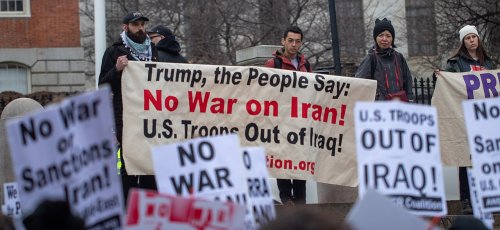
The global order is currently grappling with a catastrophic escalation in the Middle East. Initiated without provocation by coordinated US-Israeli attacks on Iranian strategic targets on February 28, 2026, the conflict has rapidly evolved into a multi-front war.
In response, Iran retaliated by targeting US military bases in the region. With the death of Iran’s Supreme Leader and the subsequent blockade of the Strait of Hormuz, the Philippines finds itself in the crossfire of global war machines, a system it did not build but is now forced to fuel with the lives and livelihoods of its citizens.
The Human Costs
The immediate cost of this aggression is measured in blood. In only ten days, the conflict has descended into horrors that violate the core tenets of international humanitarian law. On the first day of the campaign, a guided missile struck the Shajareh Tayyebeh girls’ primary school in Hormozgan province. UN experts and Iranian authorities have confirmed the deaths of at least 165 schoolgirls, aged 7 to 12, who were killed when the roof collapsed mid-lesson. These same strikes claimed the lives of Iran’s highest leadership, including Supreme Leader Ayatollah Ali Khamenei, his immediate family (wife, daughter-in-law, and granddaughter), and several high-ranking officials.
Beyond this massacre, verified reports indicate that over 1,675 people have been killed in Iran alone, while retaliatory strikes have claimed lives across the Gulf, including the confirmed death of a Filipino caregiver in Israel, while another Filipino crewman has gone missing after the United Arab Emirates (UAE)-registered salvage tugboat Mussafah 2 was struck by two Iranian missiles in the Strait of Hormuz. This violence treats workers, women, and children as mere collateral in a struggle for regional dominance. It is a stark reminder that aggression and violence can never bring democracy or peace; instead, they dig mass graves for the people and inflict huge losses on poor nations. While ordinary citizens suffer, the wealth of corporations investing in weaponry and armament complexes continues to grow, fueled by the rising demand for destruction.
Iranian Resistance Hijacked
For decades, the Iranian people have been engaged in an organic, grueling national struggle against the structural tyranny of the Ayatollahs—a movement rooted in the desire for secularism, economic dignity, and the restoration of stolen civic liberties.
However, this internal evolution is repeatedly “hijacked” by the aggression of the US-Israel alliance. When the primary tool of regime change shifts from supporting the voices of the Iranian streets to the deployment of flying bombs and targeted assassinations, it inadvertently hands the Islamic Republic its most potent survival manual.
By transforming a domestic crisis of legitimacy into a defensive war against foreign invaders, the regime is able to pivot from oppressor to protector. It weaponizes the deep-seated Iranian memory of foreign meddling, stretching from the 1953 Coup to the “Holy Defense” of the Iran-Iraq War (1980s), to consolidate power. In this atmosphere of high-alert militarism, the nuanced demands of the Iranian youth are silenced under the roar of flying jet fighters and bombs. Every explosion from the outside becomes a justification for more gallows on the inside; the regime frames every protester not as a citizen seeking rights, but as a Zionist asset or a Western agent.
Ultimately, this cycle of external aggression does not liberate the Iranian people; it entrenches their captors. It creates a siege mentality that allows the clerical leadership to bypass accountability for economic collapse and social repression by pointing toward foreign threats. By attempting to dismantle the regime through force, the alliance effectively hijacked the very organic movement that was already doing the hard work of eroding the Ayatollahs’ foundation from within.
Accounting by dollars
The current crisis in the Middle East is more than a tragedy of human life; it is a violent recalibration of the global economy and another impact of the lawless global order championed by US President Trump and Israel’s Netanyahu. We are watching a staggering $10.35 billion in military capital and $3.2 trillion in market value vanish into death machines, diverted from human progress toward systematic destruction.
Research noted that the United States-Israeli war on Iran is estimated to have cost Washington $3.7 billion so far in its first 100 hours alone, or nearly $900 million a day, driven largely by the huge expenditure of munitions, which has started as a $779 million opening salvo that spiked into soaring daily expenditures.
This isn’t just fuel and salaries; it’s the high cost of attrition. The US has already seen $2.55 billion in hardware erased from the ledger, including a $1.1 billion early warning system in Qatar and several F-15E Strike Eagles. As nations bleed, the military-industrial complex finds its grim profit, with contractors surging as governments race to replace the $4 billion in munitions spent in a single week.
Global Economy Choked
The global economy is reeling from a massive supply-side shock following the closure of the Strait of Hormuz, a move that has effectively severed the world’s primary energy artery. As the blockade of the world’s most vital maritime chokepoint enters its second week, the economic fallout is outpacing the 1973 oil embargo in both speed and scale.
The statistics are staggering. Brent crude has vaulted from the $70 range to nearly $120 per barrel, triggering a $3.2 trillion hemorrhage in global equities within the first 96 hours. In energy-dependent hubs like Tokyo and Seoul, market indices have cratered by as much as 8% as the reality of an energy famine sets in. With 20% of the world’s liquefied natural gas (LNG) now stranded, spot market prices have surged by 300%, threatening everything from European home heating to the global production of nitrogen-based fertilizers.
In the Philippines
For the Philippines, this geopolitical crisis is not a distant headline, it is a direct, systemic threat to the national interest. By March 2026, the country has entered a high-stakes economic emergency. Relying on imports for roughly 98% of its crude oil, much of which originates in the Middle East, the Philippines is currently witnessing the highest single-week price jump in its history.
With diesel, kerosene, and gasoline prices projected to surge by as much as ₱24, ₱38, and ₱22.80 per liter respectively this week, oil companies are reportedly staggering price hikes to prevent an immediate collapse of the domestic transport sector. Week after the war, kerosene per liter is at P78.90, diesel worth ₱55 and gasoline at P61 per liter. These increases surely effect prices of commodities and essentials for people’s sustenance. However, the economy faces a “double whammy” as the Philippine Peso nears the ₱60-to-$1 threshold. This currency depreciation forces the nation to deplete dollar reserves to cover ballooning import bills, which in turn further weakens the Peso and drives up the cost of subsequent fuel shipments. It seriously impacts on the country’s foreign debt (35% from the external source) which is based on US currency - which means the dollar value appreciation is an automatic increase of its foreign debt. For commuters and operators alike, this creates a punishing inflationary cycle. Furthermore, proposed fare hikes aimed at easing the burden on operators effectively shift these costs onto the most vulnerable sectors, forcing daily wage earners to shoulder a disproportionate financial strain for an essential service. It should be noted that the proposal for a nationwide P200 across-the-board wage increase, intended to help workers recover from COVID-19 pandemic losses, remains in the sidelines in both houses of Congress.
Beyond the pump, the crisis jeopardizes projected 2026 $36.5 billion Overseas Filipino Workers (OFWs) remittances, a lifeline provided by over 2.4 million stationed in the Gulf. As hostilities escalate between the U.S., Israel, and Iran, not less than 2.4 million OFWs face potential displacement or repatriation, threatening the primary pillar of Philippine consumption. Furthermore, the nation’s structural dependence on a labor-export economy and the reliance on remittances, which accounted for $6.48 billion (18%) from the Middle East in 2025, is now a critical liability.
In response to what many are calling a perfect storm, the Philippine government has officially triggered a State of Economic Alert. Emergency measures now in effect include: a mandatory four-day work week for executive offices; strict energy conservation rules, including the “24-degree rule” for public sector air conditioning; and legislative moves to grant the President emergency powers to suspend fuel excise taxes if Dubai crude remains above $80.
The immediate reality for the average Filipino is a rapid, painful spike in the cost of basic goods, electricity, and transport. National inflation is now tracking toward a “doomsday” forecast of 7.5%, while global GDP growth projections for 2026 have already been slashed from 3.2% to 2.2%. If the blockade persists beyond a month, exposed Asian economies could see up to 2% of their total growth evaporate.
The domestic agriculture sector, already “dying” from decades of neglect, under-investment, and trade liberalization, faces imminent collapse if the crisis is prolonged. Relying on the capitalist development orientation that enriches only the few and the bigger nations, allowing vast natural resources to be exploited and the Philippines to be used as a pawn in global power competitions, leads down a road to perdition.
The crisis in the lives of the people of Mindanao and the Bangsamoro Autonomous Region in Muslim Mindanao (BARMM) in the Philippines has particularly forced them into a compounding struggle, requiring them to shoulder a massive economic burden while still in the fragile stages of recovery from a relentless series of climate disasters. The final quarter of 2025 saw a convergence of catastrophic events, beginning with Typhoon Tino (Kalmaegi) in November and the massive Super Typhoon Uwan (Fung-Wong), which together inflicted over ₱5.16 billion in agricultural damages and left the Mindanao River Basin under record-breaking floodwaters. This environmental onslaught persisted into the start of 2026 with Tropical Storm Ada in January, which saturated the soil across Caraga, followed in February by Typhoon Basyang, which brought 100-year rainfall (according to experts) to Northern Mindanao, killing 12 people and dealing an additional ₱1.48 billion in losses to Surigao del Sur alone.
Consequently, the 7.5% inflation forecast and the projected ₱24 per liter fuel spike will not land on a stable economy, but on a population whose agricultural yields were already slashed, where workers are struggling with low wages, and living conditions are precarious. For Mindanao’s farmers and across the country, the fuel famine or scarcity of fuel would make irrigation and mechanization unaffordable, and prices of farm inputs will certainly increase, making the already hard lives even more difficult, while fisherfolk are increasingly grounded as the cost of a single fishing trip now exceeds their potential catch. Policies that liberalized agricultural imports while failing to invest in rural infrastructure and land reform have steadily declined the resilience of Philippine agriculture, and it leaves the farmers dangerously exposed to global market shocks.
Amidst the escalating turmoil, the BARMM government is in a high-stakes race to safeguard over 250,000 Bangsamoro OFWs currently in the Middle East, many of whom are located in high-alert zones like Dubai and Kuwait. The Office of the Chief Minister (OCM) and the Ministry of Labor have activated emergency protocols to provide logistical and financial lifelines to families who have lost contact with relatives in these volatile areas, coordinating with the national Department of Migrant Workers (DMW) and Department of Foreign Affairs (DFA). As of March 8, DMW reported 1,979 official repatriation requests from the region, including 633 in Kuwait, 312 in Bahrain, 285 in Abu Dhabi, 231 in Dubai, 173 in Qatar, and 90 in Saudi Arabia.
However, these figures raise a haunting question: out of more than 2 million OFWs in the region, why have only a fraction requested to return? This suggests a desperate calculation, that many workers may prefer the physical dangers of a conflict zone over the economic uncertainty and lack of opportunity awaiting them back home.
The vacuum of systemic neglect
On the other hand, this economic strangulation and the perceived regime change by bombs could be viewed as systemic neglect, creating a dangerous vacuum that threatens the Mindanao peace process. Disgruntled armed groups and fragmented remnants of local extremist networks may find new grounds in a narrative of abandonment, neglect, and exclusion.
What the Crisis Calls For?
Caught in the crossfire of the U.S.-China rivalry, the Philippines faces an existential security threat due to the posturing of the rival USA and China competing for their interests in the trade route since the Philippines is a U.S. military host and a Chinese economic partner. This geopolitical tension necessitates an independent foreign policy and a shift in priorities. The government must move beyond extractive economics, instead prioritizing national industrialization and an ecological transition that safeguards domestic production and sovereignty over strategic trade routes.
The current crisis calls for a tangible comprehensive political, economic, and social transition program with extreme urgency. The existing elitist political setup, characterized by dynasties and domestic tyrants who plunder the environment and government coffers, is incapable of protecting the people. There is an urgent need to advance concrete democratic programs—moving from mere procedural reforms to a total system change of the political and socioeconomic systems and apparatus.
This crisis must compel social movements to find creative ways of articulating our political and economic visions and connect to the mass populations. It is an opportunity to center public discourse on sustainable development and ecological alternatives. This can substantiate more sweeping reform campaigns, including the repeal of the oil deregulation law, trade liberalization, and the Mining Act, for example, while dismantling political dynasties and the institutionalized systems that permit environmental plunder and bureaucratic neglect.
Solidarity on what grounds?
This crisis demands a response that goes beyond one country’s waters. This calls for radical people-to-people solidarity that transcends national borders. The struggle of the Filipino farmer against fuel hikes is the same struggle faced by Iranian women and Palestinian children against bombardment, and the American worker whose taxes are diverted to the military-industrial complex.
We need a radical, direct alliance between the working classes and social movements of both occupied and imperialist nations, bypassing the corporate and financial intermediaries that traditionally dictate the terms of trade. By asserting that workers and movements of occupied and imperialist countries must directly establish economic exchange and solidarity, we reject the extractive logic of global capital in favor of horizontal cooperation.
In this model, the exchange of products, modeled on the historical efficacy of barter trade and deep-seated consumer-producer solidarity, can be improvised today as a resilient alternative to volatile global markets. Let us transform the act of consumption into a political commitment to producers’ sovereignty; this solidarity functions as a grassroots tool for mutual aid, prioritizing communal well-being and collective autonomy over the accumulation of profit. Alternative trade should be strengthened.
True solidarity requires clarity of our socio-economic and political goals. We must refuse the temptation of sectarianism and the urge for movements to outmaneuver each other for temporary political leverage. Instead, we must build a unified front based on:
• An Anti-War Solidarity from Below by uniting the democratic and productive forces and the poor of both “occupied” and “aggressor” nations against the elites who profit from war and oppression.
• Recognizing that people, nature, and the poor must be the center of our transition, not the bottom line of armament corporations and capitalist interests.
• Integrating the fight against foreign and imperialist interference with the struggle against domestic tyrants.
Finally, the time calls to move beyond critique and toward concrete proposals for democratic governance, climate justice, food sovereignty, ecological transformation, and strengthened solidarity from below. We do not start from zero; for decades, social movements, Indigenous peoples, and activists have pioneered alternatives to profit-driven, elitist models, grounding their work in ecology and human necessity. Central to this mission is the cultivation of a collective working-class consciousness, empowering the people to spearhead the transition toward a more equitable political order.


