Sunday, May 10, 2026

Death toll in China fireworks factory blast rises to 37

08.05.2026, DPA


The death toll from an explosion at a fireworks factory in central China earlier this week has risen to 37, while one person remains missing, state broadcaster CCTV reported on Friday.

A further 51 people were being treated in hospital, including five with serious injuries, according to the report.

The blast occurred on Monday in the city of Liuyang in Hunan province, an area known as China's fireworks manufacturing hub.

Authorities said search operations at the site had largely been completed, with more than 1,500 emergency personnel deployed.

Police have summoned eight people over suspected negligence linked to the accident, CCTV reported. The cause of the explosion remains under investigation.

China produces much of the world's traded fireworks, but the industry has long been plagued by deadly industrial accidents. In June 2025, nine people were killed in an explosion at another fireworks factory in Hunan province.

Nepal issues record number of climbing permits for Mount Everest

09.05.2026, DPA


Photo: Narendra Shahi Thakuri/dpa

Nepal has issued a record number of permits for the ascent of Mount Everest this spring, officials said on Friday, raising fears of heavy traffic on the world's highest mountain.

As of May 8, Nepal has issued 492 permits for Everest alone, bringing in more than $7.1 million in revenue, according to Department of Tourism (DoT) data. The previous record had been set in 2023, when 478 permits to summit Everest were issued. Last year Nepalese authorities issued 468 permits.

Overall, 1,134 mountaineering permits were issued for 30 peaks for the coming season, bringing in record revenue of over $8.3 million.

"Despite the Gen Z protests and the Israel-Iran war, a record number of climbers number have taken permits this season. This is truly historic," DoT spokesperson Himal Gautam told dpa. 

In September, the Himalayan country was rocked by serious unrest after a ban on social media platforms drove tens of thousands of mostly young protesters onto the streets, denouncing widespread corruption and nepotism. At least 76 people were killed in the so-called Gen Z protests.

According to reports in Nepali media, a reason for the record number of permits issued is that China has closed the ascent to Everest from the Tibetan side of the mountain. Official figures in Nepal show that the largest number of applications this year are from China, followed by the US and India.

The increase in climbers is expected to boost Nepal’s economy, but some fear traffic jams on Everest due to delayed summit preparations. 

In the past, congestion at the summit has left climbers stranded for hours in the so-called death zone with low oxygen concentration, contributing to deaths that some climbers and experts say were avoidable.

Compared to previous years, this spring the first summit has been delayed nearly two weeks due to unstable ice conditions, bad weather, logistical hurdles and a dispute over the use of drones. 

Gautam, however, said that the season was going as scheduled. 

The Everest climbing season typically sees summit attempts concentrated within a few days or weeks in May when weather conditions are most stable. After May, warming temperatures accelerate melting of the Khumbu Glacier, forcing expeditions to wrap up.

Study finds that malaria vaccinations reduced child mortality by 13%

08.05.2026, DPA


Photo: Kay Nietfeld/dpa


A malaria vaccination programme in three African countries has reduced the mortality rate among young children by 13%, according to an analysis published on Friday. 

However, vaccination coverage for the first three doses was only between 71-83% of all eligible children, according to the World Health Organization (WHO). 

"Our results highlight the urgent need to accelerate the deployment of malaria vaccines in areas where malaria continues to be a leading cause of child mortality," write the study authors.

Furthermore, the effectiveness could potentially be increased if the fourth dose were administered more frequently at around two years of age. According to data presented in the medical journal The Lancet, vaccination coverage for this dose was just under 40%.

The actual incidence of malaria-related mortality is difficult to measure directly, according to the research team, led by Victor Mwapasa of the Kamuzu University of Health Sciences in Blantyre (Malawi) and Kwaku Poku Asante of the London School of Hygiene & Tropical Medicine in London. 

The study region comprised 66 areas in Ghana, 46 areas in Kenya and 46 areas in Malawi, making a total of 158 individual areas. 

These areas were randomly assigned to the study group, in which the malaria vaccine RTS,S/AS01E was part of the standard vaccination programme for young children, and a control group, in which this was not the case. 

The malaria vaccinations were administered – with the consent of parents – to children in Ghana and Kenya at 6, 7, 9 and 24 months of age, and to children in Malawi at 5, 6, 7 and 22 months of age.

AFFORDABILITY

Haribo sees record sales as shoppers shift from chocolate to gummies

04.05.2026, DPA


Photo: Fredrik von Erichsen/dpa


German gummy bear maker Haribo said it achieved a record sales volume last year, driven in part by new product launches and shifting consumer preferences.

“Our worldwide sales increased by 4.5%,” Herwig Vennekens, chief commercial officer of the Haribo Group, told the German business daily Handelsblatt in interview published on Monday.

The confectionary company, headquartered in the western town of Grafschaft, said new products accounted for about a quarter of that growth.

“By 2025, we succeeded in further expanding our market share and attracting new customers across all age groups — particularly among 20- to 39-year-olds,” a company spokesman said in a follow-up statement. 

Recent sour-flavoured launches, including Haribo Pico-Balla Sauer and the worm-shaped Haribo Super Wummis, contributed to the gains, he said.

Vennekens said gummies are increasingly replacing chocolate in seasonal purchases such as Christmas and Easter.

"Fruit gummies are increasingly finding their way into Christmas stockings and Easter baskets instead of chocolate," Vennekens told the Handelsblatt, pointing to a shift in consumer behaviour as chocolate has become significantly more expensive due to high cocoa prices.

Haribo products are sold in nearly 200 countries worldwide, according to the company. They are produced at 16 sites across 11 countries, and the company employs around 8,500 people.

New details on freeing of whale stranded off Germany coast

10.05.2026, DPA


Photo: Christoph Reichwein/dpa


New information emerged on Sunday about the operation to tow a humpback whale from Germany’s Baltic coast a week ago.

Hamburg law firm Cronemeyer Haisch said in a statement it was representing the company behind the barge used in the operation, the Robin Hood.

A private initiative had organized the rescue of the whale on the Baltic coast and its transport in a water-filled cargo vessel towards the North Sea. 

The release was initiated on Friday, May 1, the law firm said, "on the instructions of the private initiative."

The statement said that the whale had bumped against the barge during transport, and had "sustained scratches".

The barrier net had been removed, leaving the barge open to the sea, but a first attempt to release the whale was unsuccessful and was abandoned at nightfall.

A second attempt took place the following day, which succeeded.

"It took another breath, then swam past the ships half-submerged and then dived away," the statement said, adding that the shipping company and the crew had done everything possible to ensure that the whale was released unharmed and as quickly as possible.

The release took place around 70 kilometres off Skagen in northern Denmark. Animal welfare organizations had all assessed the mammal’s long-term chances of survival as very low.

The German state of Mecklenburg-Western Pomerania recently expressed dissatisfaction at the lack of information regarding the whale’s location and condition.

It was reportedly agreed with the initiative that a GPS transmitter would be attached to the whale and that tracking data would be transmitted. This has apparently not yet been complied with.

Berlin: Fighting the city's young far-right scene
DW
10/05/2026

A recent police raid on Germany's neo-Nazi scene has revealed how alarmingly young some of its members are. But those targeted by this hatred are fighting back.


Young, male, far-right extremist: Rally by the group 'Deutsche Jugend Voran' (German Youth Forward) in Berlin
Image: Stefan Boness/Ipon/picture alliance


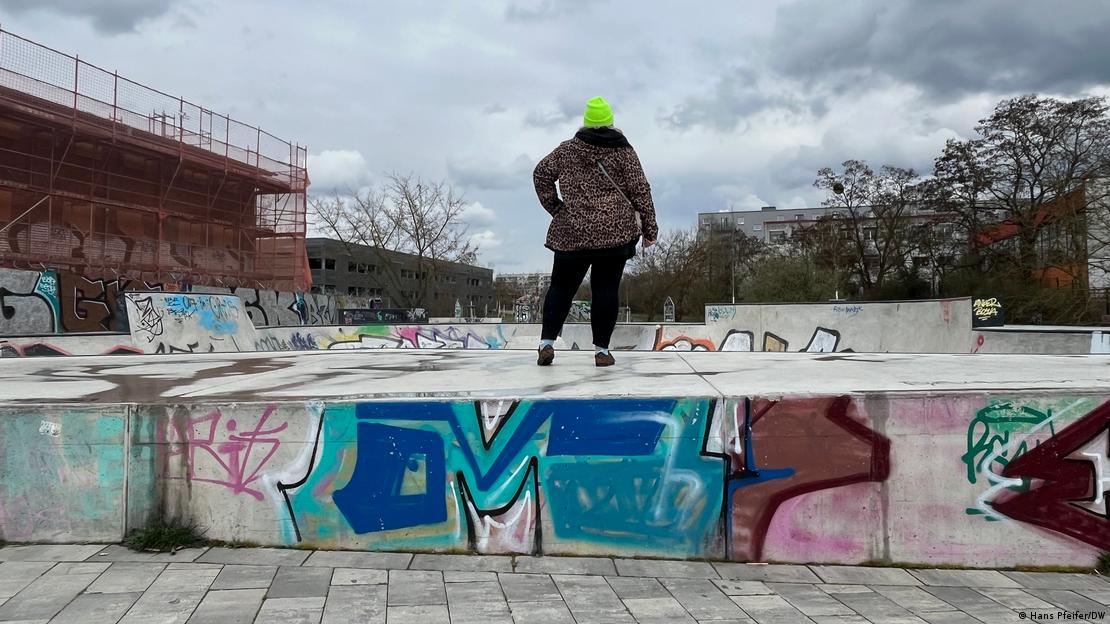
Anne isn't afraid. But she is cautious. That's because she has chosen to take a stand against right-wing and racist violence in the German capital, Berlin, and as a result has found herself facing hostility from right-wing extremists — which is why DW is not using her real name.

The 30-year-old keeps track of the far-right scene in the Berlin district of Marzahn-Hellersdorf, documenting right-wing violence, propaganda, and everyday racism. "You have neo-Nazis here who want to assert their dominance on the streets, who want to project symbols of their control of the streets, who use stickers or graffiti to show: 'We are here and this is our neighborhood,'" Anne told DW during a tour of the district.

Across Berlin's various neighborhoods, there are young people like Anne who document right-wing and racist incidents, to make the extent of the threat visible. And they want to give a voice to those affected. "There are people who are threatened because they have pink hair," Anne explained, "or because they wear a jacket from a supposedly left-wing brand. We've had several neo-Nazi-motivated robberies here."
Anne is actively engaged in combating right-wing extremism in Berlin's Marzahn-Hellersdorf district
Image: Hans Pfeifer/DW


Europe's largest prefab housing estate


Marzahn-Hellersdorf is a world of its own in the German capital. A huge district on the city's eastern edge, it is full of contrasts: It is home to Europe's largest prefabricated housing estate, built up quickly in the aftermath of World War II, now a socially deprived area where one in four children is categorized as living in poverty. At the same time, the district is rich in nature and green spaces — and attractive to families: Marzahn-Hellersdorf is also home to Germany's largest single-family and multi-family housing developments.

It takes just 20 minutes to travel by subway from Hellersdorf to Alexanderplatz, the square in the heart of eastern Berlin with its massive TV tower — the city's most conspicuous tourist attraction. But for many people, the glittering city center feels far away: "There are many young people who never leave the district," says Anne. "It's also a stark reality that a neighborhood like this can mean your whole life."

For years, young neo-Nazis have been trying to gain a foothold in Berlin — especially in Marzahn-Hellersdorf. At the forefront are two of the groups that were the targets of police raids in Germany this week: Deutsche Jugend Voran ("German Youth Forward") and Jung und Stark ("Young and Strong"). Both of these have become adept at using social media to spread their hatred toward queer people, immigrants, or political opponents. But here in Marzahn-Hellersdorf, they also make their presence known on the streets — as with a violent attack during the LGBTQ community's Christopher Street Day celebrations. The police reported at the time that two of the neo-Nazis were under the age of 14.

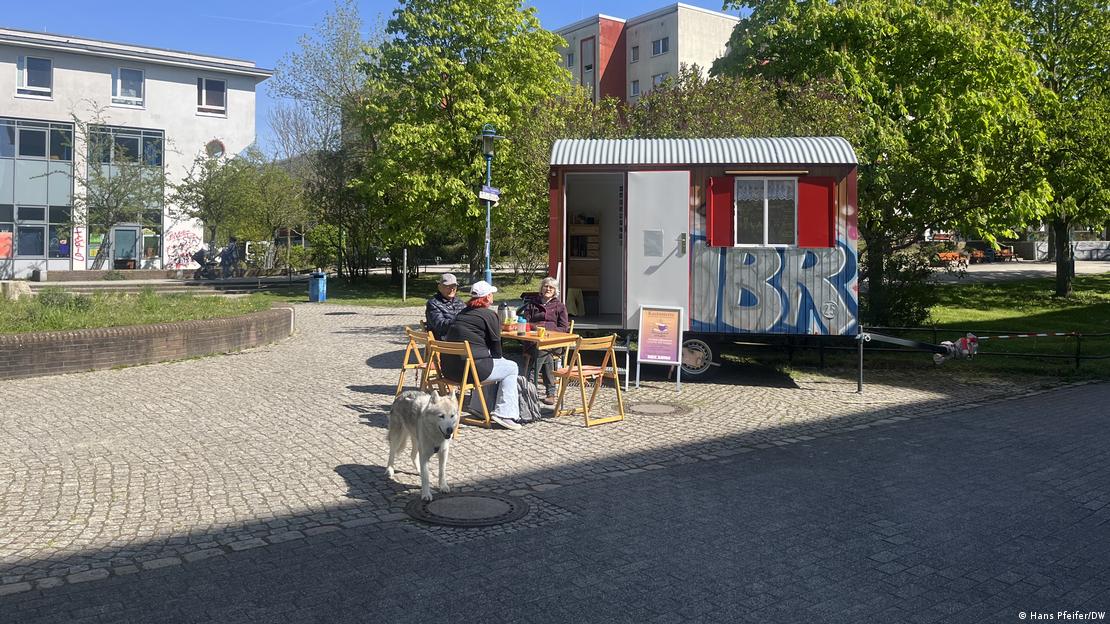
Once a week, the Cafe on Wheels in Hellersdorf serves as a quiet focal point to invite conversation and counter racism and xenophobia
Image: Hans Pfeifer/DW


Nazi stickers and far-right symbolism

This xenophobia isn't always immediately visible in the neighborhood: Many streets are beautifully kept, with plenty of flowers and trees. Everything is neat, quiet, and clean. But the far-right undercurrent is still part of everyday life. During DW's tour, a man on a bicycle rode past and called out, "Heil Hitler."

In Germany, this statement, along with the Nazi salute and several other Nazi paroles are banned in public.

A few hundred meters further down a busy street, a sticker affixed to a lamppost read the racist slogan "Germany for the Germans," next to the logo of a small neo-Nazi party.

Anne gathers the stories of those affected by hate and violence: "People have called me and said: 'I'm hiding right now — I just ran away from a group of ten teenagers!'" Young people have been brutally beaten up. "This is immense, escalating violence that people can feel. And you think twice about how you dress if you're young and anti-Nazi."

Gordon Lemm, deputy district mayor of Marzahn-Hellersdorf, has also observed the spread of violence and hate. A member of the center-left Social Democratic Party, Lemm grew up in this neighborhood. For some time now, he says, queer people in particular have been targeted: "Unlike in other Berlin neighborhoods, there aren't any queer cafes here that are a normal part of the cityscape," he told DW. "We have fewer safe spaces here in the neighborhood. I'm hearing that queer young people are becoming less and less willing to be visibly queer."

Lemm has noticed a growing backlash against liberal values among young people. "According to their ideas, women are supposed to return to traditional roles, and men are supposed to be the breadwinners," he says. This backlash is also fueled by growing social insecurity. "I sense a certain coldness in my neighborhood. People keep to themselves and don't want to stand out. They don't want to be approached or looked at strangely. There's a kind of protective wall that many try to project through their appearance: Hair cut as short as possible and clothing that conveys a certain strength outwardly, because they don't want to be seen as victims. I'm seeing this become more pronounced again in Marzahn-Hellersdorf."


Everyday racism against migrants

People like Farzaneh are the first to feel this. Like Anne, she is 30 and lives in Hellersdorf. Farzaneh wears a loose headscarf. Her family is from Afghanistan, but she herself was born in Iran, and they have lived in Hellersdorf for many years. She met Anne when she reported the everyday racism to the online registry Berliner Register, where users can report racist incidents they experienced in Berlin.

"In my family's building, my mother was insulted by an older woman: Every time she saw my mother, she would say some insult." Farzaneh herself laughs off the hostility she faces in her daily life: The stares she encounters at the supermarket, on the subway, on the street. That's how racism starts for her. But she fights back. "I'm not weak just because I'm a woman. I can protect myself."

And despite everything, she loves Berlin: "When I was in South Tyrol for a while recently, I missed multicultural Berlin." She enjoys living in Germany and, after many years — having graduated from high school and college — now wants to become a naturalized citizen. "The good thing about Germany is: You can at least report incidents to the [Federal] anti-discrimination office. That doesn't exist in Iran. At least here, you can defend yourself."

Barbara Jungnickel also wants to stand up for herself. Once a week, she opens her converted construction trailer in the heart of Hellersdorf, which she calls her "Cafe on Wheels," where she invites neighbors over for coffee and cookies. Jungnickel is a community educator for the local Protestant church.

She wants to start dialogues with anyone she can. "I don't steer the conversations in any particular direction," she tells DW, "I don't want to."

She launched her cafe project in 2013, when a shelter for refugees opened in the neighborhood. "Right-wingers came from all over Germany to march through the streets here and shout, 'No to the shelter.' And we as a church community, were shocked to see how many neighbors simply ran after them and shouted along with them."

The cafe might be a modest starting point from which to counter xenophobia, but it is proof that every single person can make a difference. Barbara Jungnickel, Anne, Farzaneh, and Deputy Mayor Gordon Lemm — they all refuse to cede the city to an aggressive minority. They are fighting back against what has become a worrying trend in Germany.

This article was translated from German.


Hans Pfeifer DW reporter specializing in right-wing extremism


Australian far-right party wins first lower house seat

Natalie Muller 
DW with Reuters, AFP, ABC
May 9, 2026

The far-right populist One Nation party has won its first seat in Australia's House of Representatives.


https://p.dw.com/p/5DWS1


One Nation candidate David Farley unseated the incumbent Liberal Party
Image: Hilary Wardaugh/AFP


Australia's far-right One Nation party won a key by-election on Saturday in a rural seat that had been held by traditional conservatives for more than half a century.

Preliminary results showed its candidate, David Farley, was on track to win 59.1%, defeating the incumbent center-right Liberal Party by a wide margin.

It marks the first time One Nation has won a lower house seat in the federal parliament.

Farley, a former agribusiness executive, was the clear favorite heading into the contest for Farrer, a large agricultural electorate some 550 ​kilometers (340 miles) south of Sydney.

"We're like a mason with a chisel and a hammer, and we're carving the letters into the Australian democracy," Farley told cheering supporters.

"One Nation is at the end of its beginning — we are going through the ceiling," he said, pledging to bring down the cost of living.


Farley (C) said the election win is the 'biggest achievement' of his career
Image: Hilary Wardaugh/AFP


Why was a by-election held?

The seat was left vacant when former Liberal leader Sussan Ley resigned in February as her party slumped in the polls behind One Nation.

Farley's main rival, popular independent Michelle Milthorpe, was trailing in second place with around 40%, while the Liberal candidate Raissa Butkowski had around 11%, according to the ABC.

The ruling Labor Party did not contest the seat, which is considered unwinnable for a left-leaning candidate.

The One Nation win does not affect the parliamentary majority of Labor, which still holds 94 of 150 seats in the lower house.
What is One Nation?

One Nation was founded nearly 30 years ago by Pauline Hanson, who has long advocated for cuts to immigration. She is one of four senators from One Nation in the upper house.

Hanson was widely condemned after she wore a burqa in parliament last year as part of her push to ban the face coverings
 [FILE: November 2025]Image: Mick Tsikas/IMAGO

Hanson said the result was "a win for Farrer but a bigger win for the nation."

Liberal leader Angus Taylor said the outcome of the by-election brought some "hard lessons" for his party, which has been battling for second place with One Nation in national polls.

The result in Farrer comes amid a surge of support for far-right parties globally. Britain's ruling Labour Party this week suffered a significant loss of seats at council elections.

Meanwhile in Germany, the far-right Alternative for Germany (AfD) is polling at 41% ahead of elections in the eastern state of Saxony-Anhalt that could potentially see it win an absolute majority in a regional parliament for the first time.

Edited by: Karl Sexton
French far-right leaders court Israel, Germany envoys ahead of presidential poll

Paris (AFP) – France's far-right leaders have met the ambassadors of Germany and Israel in recent months as their party, once deemed antisemitic, seeks to court foreign envoys in the run-up to next year's presidential elections.


Issued on: 10/05/2026 - RFI

Either Marine Le Pen, or her lieutenant Jordan Bardella, will run for president next year. © Bertrand GUAY / AFP/File

Marine Le Pen's anti-immigration National Rally (RN) party is eyeing its best chance yet at taking power, with President Emmanuel Macron stepping down after hitting the two-term limit.

Le Pen hopes to run for president for a fourth time in 2027, after twice making it to the runoffs against Macron in the last two votes.

But if an appeals court in July bars the 57-year-old from public office over an alleged fake jobs scam in European Parliament, her lieutenant Jordan Bardella, 30, is expected to run in her place.

France is home to western Europe's largest Jewish population, at around half a million people.

Le Pen has long sought to make the party she inherited from her father Jean-Marie more palatable, including by distancing it from the antisemitic legacy of a man convicted for Holocaust denial.

As polls suggest she or Bardella could well lead in the first round of the election, the strategy seems to have paid off.

Bardella, who is RN party leader after taking over from Le Pen, in February met the German ambassador, his party and a participant said.

The embassy did not confirm the meeting.

But a diplomatic source told AFP it was "the responsibility of a foreign mission to maintain contacts with all the political forces in the host country concerned".

Germany has long been among Israel's staunchest allies, something Berlin has grounded in the country's responsibility for the Holocaust.

"Yes, they met in February," a member of Bardella's team said, seeking to present it as a routine meeting.

He "meets many ambassadors as part of his duties as head of the RN party and as leader of a group in the European Parliament," the person said.

Bardella is head of the Patriots for Europe group, the EU legislature's third-largest bloc that was co-founded in 2024 by former Hungarian prime minister Viktor Orban.


'Areas of convergence'


The participant said the discussion between Bardella and the German ambassador made it possible to identify "areas of convergence" on several issues in France and neighbouring Germany.

They focused in particular on "budgetary discipline" in both leading EU member states.

The episode follows Le Pen last month meeting the Israeli ambassador for the first time.

The embassy confirmed the meeting, with a diplomatic source adding that the ambassador "received all political parties" except from the hard-left France Unbowed (LFI).

LFI has criticised Israel over the war in Gaza, and its leader Jean-Luc Melenchon – also a candidate next year – has been accused of making antisemitic comments.

Before the meeting with the Israeli envoy, Le Pen had the previous day been seen meeting the Lebanese ambassador, who thanked her for her solidarity as his country sought a lasting ceasefire with neighbouring Israel.

Both Le Pen and Bardella also met the US ambassador late last year.

US ambassador Charles Kushner in December on X posted a picture of himself with them, saying he appreciated the chance to learn from them "about the RN's economic and social agenda and their views on what lies ahead for France".


Brazil judge suspends law that reduces Bolsonaro's jail term

Mahima Kapoor 
DW with AFP, Reuters
May 9, 2026

Brazil's top court prohibited the implementation of legislation that would drastically cut former President Jair Bolsonaro's prison term.

The Supreme Court of Brazil on Saturday suspended the implementation of a law that would reduce the prison sentence of former far-right President Jair Bolsonaro, pending the outcome of legal challenges against it.

Bolsonaro is currently serving a 27-year sentence for plotting a coup after losing the 2022 election. The law in question could potentially have freed him in 2028.

Justice Alexandre de Moraes ordered the suspension until the Supreme Court holds a full hearing on appeals challenging the law's constitutionality, the ruling said.
What is the law?

The new law applies to all those convicted of plotting coups, including Bolsonaro. It aims to reduce the waiting period for sentence reductions and significantly cut jail time.

Passed in December, the law was vetoed by leftist President Luiz Inacio Lula da Silva a month later. However, in April, lawmakers led by Bolsonaro's allies overturned the presidential veto, and the bill was enacted on Friday.

The legislation requires defense attorneys to file requests with the Supreme Court to have sentences recalculated on a case-by-case basis.

Moraes' ruling suspends the review of such cases until the full Supreme Court meets to decide on the law's constitutionality.

Two Brazilian political parties and the press association ABI separately challenged the bill this week.

Bolsonaro's lawyers are yet to formally request a recalculation of his sentence. But on Friday, they filed a motion for criminal review with the Supreme Court seeking to overturn the conviction.

Edited by: Roshni Majumdar
Mahima Kapoor Digital journalist based in New Delhi@MahimaKapoor12
Eurovision 2026: Politics collide with a blockbuster show

DW 
May 9, 2026

Controversy over Israel's participation and boycotts unprecedented in scale are already weighing on the Eurovision Song Contest before it even kicks off in Vienna.


The Eurovision Song Contest returns to Vienna for the first time since 2015I
mage: Max Herbst/APA-Images/picture alliance


The 2026 Eurovision Song Contest in Vienna hasn't even started yet — and yet it has been at the center of heated debates for months. At issue isn't so much the spectacular pop shows themselves as the political tensions that, despite the competition's long-standing claim that it is apolitical, are becoming increasingly difficult to ignore.

The last time the Austrian capital hosted the Eurovision Song Contest was in 2015. This year, on the occasion of its 70th anniversary, the contest returns from May 12-16 to a city that stands for culture and diversity. Expectations are high, as the contest aims to bring people together and send a message of openness. The motto is "United By Music – (In) The Heart Of Europe"

But this is precisely what is becoming an increasingly difficult challenge with each passing year, as political crises in some participating countries are also growing.
Israel is the target of protests

As in previous years, Israel is once again the focus of considerable attention. Amid the ongoing conflict in Gaza, activists and some members of the creative community are once again calling for the country to be excluded or boycotted.

Most recently, more than 1,100 artists signed an open letter with a clear message: No Eurovision Song Contest as long as Israel is participating. Supporters of the "No Music for Genocide" initiative include international stars such as Peter Gabriel, Massive Attack, Roger Waters, Macklemore and Brian Eno.

On the other side, an open letter by the pro-Israel initiative "Creative Community for Peace" has also been signed by around 1,100 members of the entertainment industry, including Helen Mirren, Amy Schumer and Gene Simmons. It advocates for Israel's participation: "We are shocked and disappointed that some members of the entertainment industry are calling for Israel to be excluded from the competition due to its response to the largest massacre of Jews since the Holocaust," the letter states.

The Vienna police are expecting disruptive protests and attempts to block the event, especially on the final day. They announced that a demonstration with around 3,000 expected participants from pro-Palestinian groups has been registered for May 16. However, further actions are to be expected. Demonstrators are also likely to arrive from abroad.

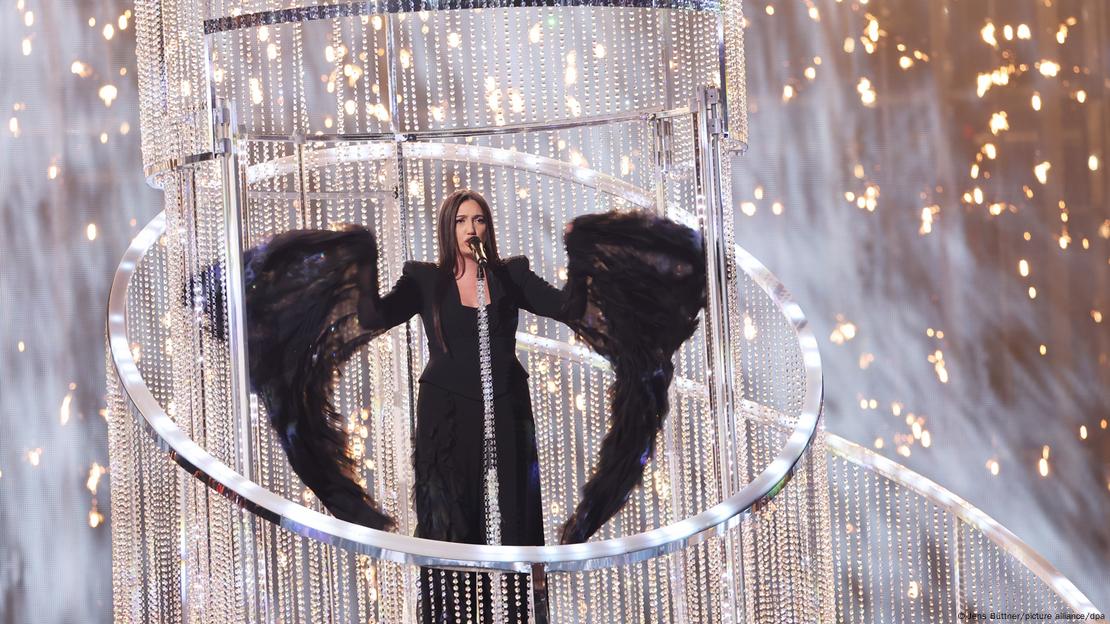
In 2025, Israel's Yuval Raphael came in second
Image: Jens Büttner/picture alliance/dpa

However, Israel, who is sending singer Noam Bettan to Vienna with the seemingly ordinary heartbreak pop song "Michelle," will not be barred from participating, in a decision that aligns with the European Broadcasting Union's (EBU) long-standing position: The competition is an association of broadcasters, not of governments. As a result, Israel remains part of the Eurovision Song Contest.
Even a 'Big Five' country is boycotting the Eurovision Song Contest

This has led some countries to react strongly: Ireland, the Netherlands, Slovenia and Iceland — all Eurovision veterans — are boycotting the contest. Spain has also joined the boycott, meaning that one of the so-called "Big Five" countries (which are the contest's biggest financial backers) will not be participating this year. This has never happened before.

Some countries will not be broadcasting the Eurovision Song Contest on TV. The world's biggest music event, which most recently drew nearly 170 million viewers worldwide, will have a smaller audience this year.

Criticism of Romania's entry


In addition to geopolitical issues, the song submitted by Romania has also sparked debate. One legal professor is quoted in The Guardian as saying that Alexandra Capitanescu's song "Choke Me" demonstrates "an alarming disregard for young women's health and well-being." One of the lines Capitanescu sings is: "All I need is your love, I want it to choke me." Following accusations that the song glorifies violence toward women, the singer explained on Reddit that "Choke Me" is a metaphor — for the pressure and inner fears one imposes on oneself; the title and chorus are not to be taken literally.

The commotion surrounding the song has died down somewhat now — the first rehearsals are over, and the show begins in a few days. But these reactions are a reminder of how delicate the situation has become. What might once have been dismissed as a flamboyant performance is now being scrutinized and interpreted in detail.


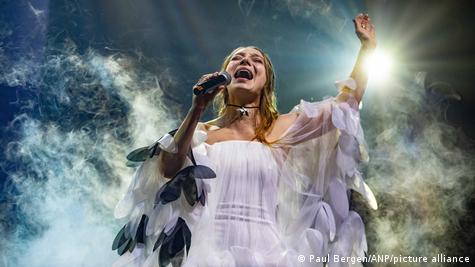
Leleka is competing for Ukraine
Image: Paul Bergen/ANP/picture alliance


Ukraine's German connection

Ukrainian singer Viktoria Leleka is competing with a song written in Berlin, hoping to win over the hearts of Eurovision fans with a blend of ethno-pop and musical theater. In an interview with German broadcaster ARD, she spoke about how much she loves Germany and the language, and how important it is to her to give a voice to her homeland and its diverse culture at a time of Russian aggression against her country.

Ukraine is one of the most successful countries in the contest and is almost always among the finalists. Most recently, the Kalush Orchestra won the 2022 contest with "Stefania."

Amid political tensions, Leleka's entry "Ridnym" is being watched with particular interest. The song describes an inner transformation, coping with fear and the power to find hope even in hopeless situations.

Favorites and trends

Musically, it's shaping up to be a typical ESC year: Big emotions, dramatic stage designs and lots of danceable, upbeat electro-pop.

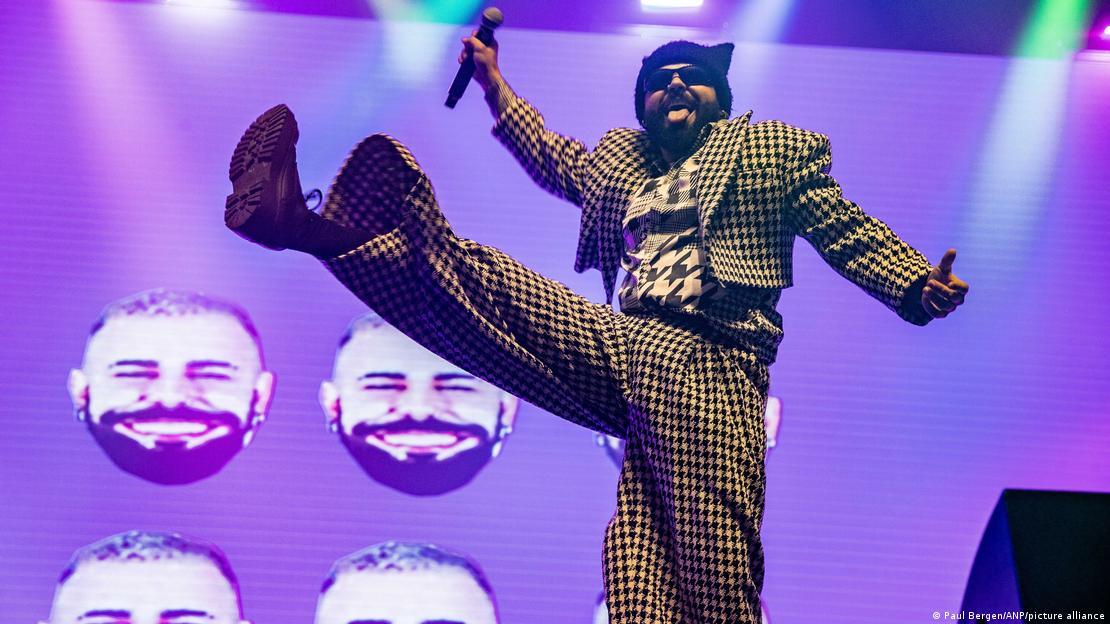
Greece's entry is rapidly climbing the betting odds — whether it can hold its ground will be revealed on Tuesday, May 12, during the first semifinal, when Akylas performs the song live.

Finland will also be competing in the first semifinal with the pop-classical duo Linda Lampenius x Pete Parkkonen, both of whom also have a good chance of winning.

For host country Austria and Big Five member Germany, however, the prospects are not so good — both are traditionally guaranteed a spot in the final and don't have the opportunity to perform in the semifinal shows. For both countries, it's all or nothing in the grand final on Saturday, May 16.


Meme-worthy: Greek singer Akylas
Image: Paul Bergen/ANP/picture alliance

Eurovision Song Contest Asia — a new spin-off


While Europe focuses on Vienna, attention is also turning to the Asian continent. The first Eurovision Song Contest Asia is set to take place on November 14 in the Thai capital, Bangkok. Ten countries, including the Philippines, South Korea and Vietnam, have already confirmed their participation.

An attempt to establish the contest in the US has failed. The American Song Contest 2022 remains a one-time event.

This article was originally written in German.

Silke Wünsch Reporter and editor at DW's culture

Eurovision hopes 70th anniversary celebration outshines Israel controversy


The Eurovision song contest turns 70 this year, but the celebration threatens to be overshadowed by the competition’s biggest ever boycott over the continued inclusion of Israel.

ANALYSIS
Issued on: 08/05/2026 - 
FRANCE24
By: Joanna YORK

A light show at the official opening of the stage at the Wiener Stadthalle prior to the 70th Eurovision Song Contest, in Vienna, Austria on April 28, 2026. © Joe Klamath, AFP


The 2026 edition of the Eurovision Song Contest is celebrating two notable milestones – not only is it the event’s 70th birthday, but it also features the lowest number of competing countries in two decades.

Among the delegations gathered in Vienna for the grand final on Saturday, May 16, five competition regulars will be absent, with Iceland, Ireland, the Netherlands, Slovenia and Spain all boycotting the event over the inclusion of Israel.

Officials from Spain’s national broadcaster RTVE said in April that it would not participate as the contest’s stated mission of neutrality had become “impossible to maintain”.

"No one raised an eyebrow when Russia was required to leave international competitions and not participate in Eurovision after the invasion [of Ukraine],” Prime Minister Pedro Sanchez, an outspoken critic of Israel’s policies in Gaza, added in May.

"We cannot allow double standards, not even in culture."

“It certainly is a rather challenging situation for the organisers of the contest this year,” said Dean Vuletic, historian and author of ‘Postwar Europe and the Eurovision Song Contest’.

“This should really have been a huge party, but in the end, we're seeing fewer participants than ever since 2003.”
‘Under the spotlight’

Eurovision describes itself as a non-political event and performances that contain political messages are not allowed under the competition rules.

But critics say the organisation’s continued inclusion of Israel – which has been accused of committing war crimes including genocide in Gaza – is a political gesture in itself.

“It puts the organisers under the spotlight, and makes people ask what they are doing and how they are thinking,” said Christina Oberg, a professor at Sweden’s Linnaeus University and author of several studies on geopolitical tensions and Eurovision.

Opposition to Israel’s inclusion began in 2024, with the competition falling six months after Prime Minister Benjamin Netanyahu launched extensive ground operations in Gaza in response to the October 7 Hamas attacks in Israel.

By May 2025 – as ground operations and aid blockades in Gaza continued – calls for Israel to be excluded from the competition grew. They have reached a fever pitch this year, amid new Israeli military operations in Iran and Lebanon.

But anger against the Eurovision organisers may be misplaced, said Vuletic. “The European Broadcasting Union (EBU) is not a political organisation. It's a technical association of National Public Service broadcasters, and it doesn't have a political mandate to act.”

The decision to exclude Russia from the Eurovision since 2022 over its full-scale invasion of Ukraine was straightforward, as all members of the EBU had shown a united front in imposing international sanctions on Moscow.

Ukraine's Kalush Orchestra won the Grand Final of the Eurovision Song Contest in Turin, Italy, on May 14, 2022. © Luca Bruno, AP


“But when it comes to Israel, Europe is divided over how it should respond to Israel's military actions,” Vuletic added. “For the European Broadcasting Union to make a decision against Israel, it needs a majority of its members to support such a decision, and we're simply not seeing that.”
‘Playing politics’

This year, Israel will be represented by Noam Bettan with a song called "Michelle" that was co-written by last year's entrant, Yuval Raphael, and features a chorus in French.

In 2025, Austria won the competition overall, but Raphael, who is a survivor of the October 7 Hamas attack, won the public vote for Israel in the grand final, sparking accusations that the competition was rigged.

In response, Eurovision organisers in November announced a series of reforms to the voting system, such as capping the number of votes per voter at 10.

But, regardless of what happens on stage, Oberg expects a similar dynamic this year, with a strong result for Israel in the public vote tempered by a low score from the competition judges. “Which side is playing politics is difficult to say,” she said.

I
sraeli singer Yuval Raphael arrives at the Eurovision opening ceremony as protesters wave Palestinian flags in Basel, Switzerland, on May 11, 2025. © Fabrice Coffrini, AFP


Spain’s boycott of the competition is significant as it is one of the “big five” countries – along with France, Germany, Italy and the UK – whose public broadcasting services make the largest financial contribution to the production of the competition and, as such, are guaranteed a place in the final.

Should more of the big five join the boycott, it could destabilise the competition financially. It could also raise broader questions about “where we are with the initial idea that led to the Eurovision, to bring collaboration and peace to Europe after the Second World War”, Oberg said.

Although she added that some countries may find it easier to quit than others. “It would never happen in Sweden because Eurovision is such a big deal for us.”

In fact, given the competition's politically chequered history, it seems unlikely that this year’s boycotts will dent the competition's reputation too badly.

As far back as 1969, Austria boycotted the Madrid final to show its opposition to dictator Francisco Franco. More recently, Moscow hosted the competition in 2009, in a seeming endorsement of Russian President Vladimir Putin’s regime.

“Eurovision has been through many political crises, and it has weathered them all,” said Vuletic, who believes the politics of Eurovision adds to its overall appeal.

“One of the reasons why the contest is so engaging because we like to see how it reflects political issues,” he added. “It is a contest between countries, so it reflects international relations alongside expressing cultural diversity.”

Fans seem to agree. Tickets for this year’s nine final events in Vienna sold out in record time with spots for the grand final snapped up in just 14 minutes.

“To see every single show sell out so quickly is a powerful reminder of what the Eurovision Song Contest represents - joy, togetherness and shared experience at a time when that feels more important than ever”, said Eurovision’s director, Martin Green.