It’s possible that I shall make an ass of myself. But in that case one can always get out of it with a little dialectic. I have, of course, so worded my proposition as to be right either way (K.Marx, Letter to F.Engels on the Indian Mutiny)
Sunday, May 17, 2026
'This is so sad': MS NOW panel pounces as Trump lets China insult US
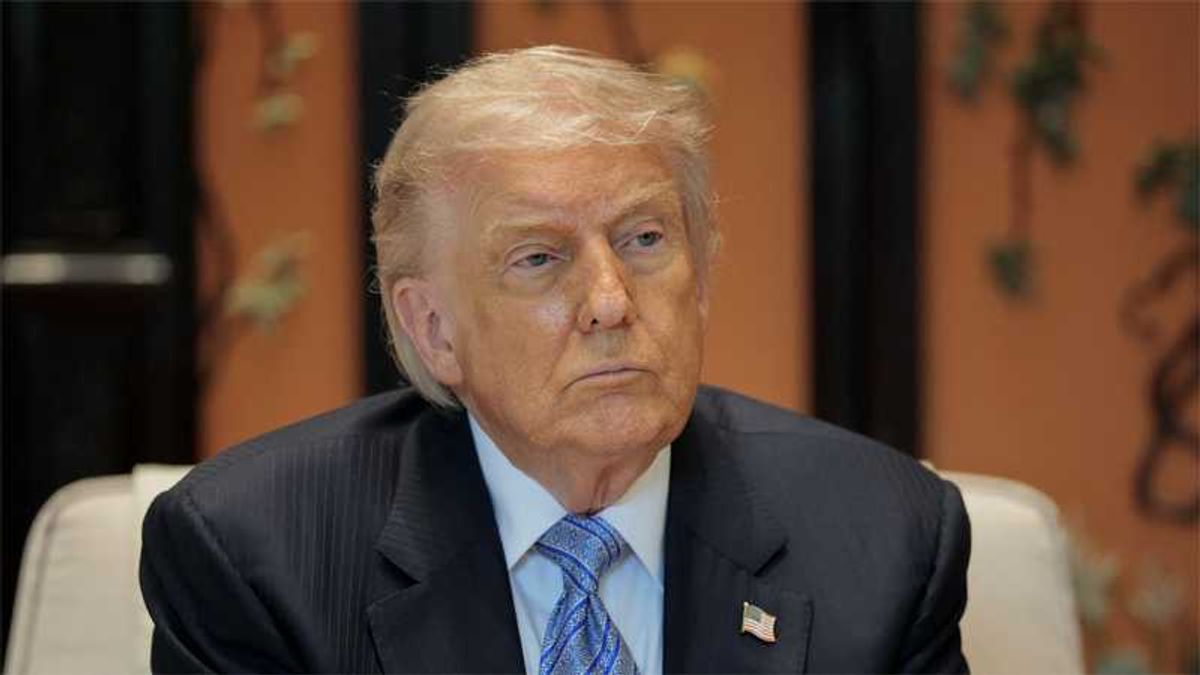
U.S. President Donald Trump looks on during a meeting with Chinese President Xi Jinping (not pictured) on the sidelines of their visit to the Zhongnanhai Garden in Beijing, China, May 15, 2026. REUTERS/Evan Vucci/Pool
On Friday morning, longtime political analyst John Heilemann pointed to Trump’s admission that the Chinese leader talked about the US as a “declining nation,” without pushback, was a particularly humiliating effort by the American president to ingratiate himself to Xi.
Pointing to Trump posting on Truth Social, “When President Xi very elegantly referred to the United States as perhaps being a declining nation, he was referring to the tremendous damage we suffered during the four years of Sleepy Joe Biden and the Biden Administration, and on that score, he was 100% correct,” Heilemann admitted he was stunned that Trump would admit that in public thinking it would help him make the case for his presidency.
“So basically, this is Xi Jinping saying, hey, let's not get into war. But the implication was decline, that the U.S. was in decline and Trump's response to that was so sad,” he exclaimed to agreement from the panel. “I mean, not just the fact that he's blaming Joe Biden, but let's read the first sentence of it where he says something like yesterday, when Xi Jinping, so elegantly, I have it here: ‘When President Xi very elegantly referred to the United States as perhaps being a declining nation,’ that's all you need.”
“It's like — that's just — it's an amazing thing to write,’ he elaborated. “It's a wonder — one of the more incredible Trump sentences ever. ... Because I can't ever say anything critical of Xi Jinping. Never does. Right?“
“You didn't have to to pin the tail on the donkey and say, the United States is the declining power for it to be very clear that in the optics and dynamics and on any metric that Trump understands, let alone the rest of the world: which of those two countries is the declining country? “ he added. “And Xi Jinping didn't need to say it directly. It's pretty clear to everyone where they stand in terms of relative power.”
Taiwan says it is a ‘sovereign’ nation with US ‘security commitment’ after Trump’s warning
Taiwan on Saturday maintained it is a "sovereign and independent" nation and that US arms sales were part of Washington's security commitment to the island. The foreign ministry statement came a day after President Donald Trump warned Taiwan against declaring formal independence following his meeting with Chinese President Xi Jinping during a state visit to China.
Taiwan on Saturday said it is thankful for US President Donald Trump's long-standing support for peace and stability across the Taiwan Strait and asserted it was a "sovereign and independent" nation.
The statement was issued a day after Trump, following his visit to China, warned the democratic island against declaring formal independence.
Taiwan "is a sovereign and independent democratic nation, and is not subordinate to the People's Republic of China", Taiwan's foreign ministry said in a statement.
The ministry also insisted that US arms sales were part of Washington's security commitment to Taiwan, after Trump flagged that he was considering the issue.
"Regarding Taiwan-US arms sales, this is not only a US security commitment to Taiwan clearly stipulated in the Taiwan Relations Act, but also a form of joint deterrence against regional threats," the ministry said.
Speaking to reporters in Taipei on Saturday, Taiwan Deputy Foreign Minister Chen Ming-chi also asserted that US arms sales are confirmed under the Taiwan Relations Act.
"Taiwan-US arms sales have always been a cornerstone of regional peace and stability," he said.
In December, the Trump administration approved a record $11 billion arms sale package for Taiwan. Reuters has reported a second one, worth around $14 billion, still awaits Trump's approval.
Chen declined to comment on the second package because it has yet to be made public, saying Taiwan will continue to communicate with and understand the situation from the US side.
Taiwan's statements came a day after Trump wrapped up a visit to Beijing where Chinese President Xi Jinping had pressed him not to support the self-ruling island, which China claims is part of its territory.
"I'm not looking to have somebody go independent. And, you know, we're supposed to travel 9,500 miles to fight a war. I'm not looking for that," he told Fox News host Brett Baier.
"I want them to cool down. I want China to cool down," Trump said.
"We're not looking to have wars, and if you kept it the way it is, I think China's going to be OK with that."
The US recognises only Beijing and does not support formal independence by Taiwan, but historically has also stopped short of explicitly saying it opposes independence.
Under US law, the US is required to provide weapons to Taiwan for its defence, but it has been ambiguous on whether US forces would come to the island's aid.
Xi had begun the summit with a warning on Taiwan, whose President Lai Ching-te considers the island already independent, making a declaration unnecessary.
Xi had told Trump that missteps on the sensitive issue could push their two countries into "conflict".
(FRANCE 24 with AFP and Reuters)
The U.S. Leans Toward War, China Toward Trade – OpEd
We are not going to tire of repeating it, violence always destroys, especially the one who initiates it. That is why states, when they use their monopoly of violence to impose “laws” and “regulations”, what they achieve is that their countries are backward.
Thus, while the federal state of the United States has chosen to close its borders with more customs tariffs and various military interventions, the Chinese, although communist and authoritarian, has acted more wisely by opting for freer trade. And the results are indisputable.
On an ironic note, Trump’s best ally, another supporter of state interventions, the president of Argentina, “betrays” him behind his back and increases his trade with China.
Gabriel Cohen publishes in Visual Capitalist the following graph and article that leaves no room for doubt. Compare (in blue) the trading partner countries of the United States and in red those of China, in the year 2000 vs 2025:
Key points
In 2000, only 33 countries traded more with China than with the United States.
By 2025, China had become the top goods trading partner for most countries in the world.
Only a handful of African countries continue to trade more with the United States than with China.
Twenty-five years ago, the United States was the world’s dominant trading power. Today, China has surpassed it as the top goods partner for most countries globally.
This map compares whether countries traded more with the U.S. or China in 2000 and 2025, based on total bilateral imports and exports using data from the IMF’s Trade Statistics Directorate.
China’s rise was fueled by its emergence as a global manufacturing hub and growing demand for raw materials such as oil, copper, iron ore and soybeans.
The United States entered the 21st century with a good tone of support. After the end of the Cold War, liberal democracy and open markets were expanding throughout the former Soviet bloc, while global trade was mainly focused on the U.S. consumer market.
In 2000, only 33 countries traded more with China than the United States. Many of these countries were Chinese neighbors such as Kazakhstan, Mongolia, Myanmar, and Vietnam. Others were states with strained or no relations with Washington, including Cuba, Iran, Libya and North Korea.
For her part, Tasmin Lockwood, also in Visual Capitalist, shows another graph that visualizes those countries most dependent on imports from China.
Ironically, it turns out that technology is China’s biggest export. Cheap commercial products have historically been associated with the “Made in China” seal, but today technology is its biggest export after consolidating itself as a strong manufacturing hub with cheaper labor.
Integrated circuits, which are central to most modern technologies, make up the bulk of exports and highlight China’s critical role in global supply chains; mobile phones and cars follow.
And by the way, the world is critically dependent on China for the processing of critical minerals, which are used in everything from consumer electronics to basic military systems. This reliance has prompted U.S. policymakers to try to strengthen and diversify local capacity.
Is a Chinese invasion of Taiwan imminent?
Issued on: 17/05/2026 - FRANCE24
After nearly a decade since his last visit, US President Donald Trump is meeting Chinese President Xi Jinping in Beijing in a historic summit focused on global trade, technological rivalry and rising tensions over Taiwan, one of the world’s most sensitive flashpoints. 🇹🇼China claims Taiwan as part of its territory while the United States continues to back the island with military support and strong diplomatic ties. Caught in the middle is a resilient democracy that has become one of Asia’s greatest success stories, despite never being formally recognised as a sovereign state by most other countries. 🎥FRANCE 24's Stella Elgersma takes a closer look at the tense triangle between Taiwan, China and the United States: how it came to be, what's really at stake and whether a military confrontation is truly on the horizon.
The optics were the policy. Donald Trump arrived at Beijing Capital International Airport on May 13, accompanied by Elon Musk, Tim Cook, Larry Fink, Jensen Huang and the chief executive of Boeing. The next morning he was received at the Great Hall of the People by Xi Jinping, walked through an honour guard of the People's Liberation Army, and within hours of the opening ceremony agreed a joint position on Iran's nuclear programme and the Strait of Hormuz. Xi reciprocated with the warmest welcome accorded any Western leader since the founding of the People's Republic. The summit ran two days. The aftershocks will run longer.
From outside the room, the visit looked less like a stabilisation exercise than what Bonny Glaser of the German Marshall Fund called, before Trump boarded the plane, the risk of "a tacit or explicit bargain in which Washington appears to concede a sphere of influence to Beijing over Taiwan" in exchange for concessions elsewhere. That formulation, reported by CNBC on May 11, has since become the lens through which the Trump visit is being read across four continents. In Taipei, in Riyadh, in Moscow, in Warsaw, in Brasília and in Astana, the question being asked is not whether Trump struck a grand bargain. It is whether he sold something that was not his to sell.
Begin with the Middle East. The White House readout of May 14 confirmed that Trump and Xi had agreed "Iran can never have a nuclear weapon" and that "the Strait of Hormuz must remain open." Xi, on the same readout, made clear "China's opposition to the militarisation of the Strait and any effort to charge a toll for its use," and expressed interest in purchasing more American oil to reduce Chinese dependence on Hormuz crude. Al Jazeera's analysis on May 15 noted that the Chinese statement, by contrast, omitted any explicit reference to Iranian nuclear weapons, instead calling for "political settlement" and "dialogue and consultation."
For the Gulf monarchies, watching from Riyadh and Abu Dhabi, the spectacle of Washington and Beijing co-announcing the terms on which their region's principal waterway would be reopened, without any Gulf state present in the room, confirmed every suspicion that has been building since the Iran war began on February 28. The American-led security order, the one for which Saudi Arabia and the UAE pay through arms purchases and which the Trump administration has spent fifteen months actively dismantling, is now being negotiated bilaterally with China over their heads.
Iran's interpretation was sharper. Chinese state media circulated Xi's softer language and Iranian officials briefed regional outlets that Beijing had not in fact endorsed the American position. The Soufan Center's May 13 brief observed that China had "defended Iranian sovereignty and security concerns" and "resisted US-backed efforts at the United Nations to pressure Iran over the Strait of Hormuz." Tehran's working assumption is that Xi will pocket whatever trade and rare-earths concessions Trump delivered, and continue to buy Iranian crude at the discounted prices Beijing has paid since March. The Iranian leadership has, in effect, been told it has no patron, only a buyer. The Gulf monarchies have been told the same thing. Neither will forget.
In Moscow, the calculation runs in the opposite direction but reaches the same conclusion. The Conversation, in a May 14 analysis subsequently republished by Asia Times, observed that Vladimir Putin will have watched the Trump-Xi summit nervously. Dennis Wilder, a former US intelligence official quoted by CNBC on May 11, put it plainly: "Russia would be nervous about an overall improvement in US-China relations." Putin's relevance to Beijing has rested on three propositions: that the Sino-Russian partnership is "no limits," that Russia provides China with discounted hydrocarbons and strategic depth against the West, and that Trump and Xi cannot do business directly. Each is now under strain.
Xi did not accept Trump's invitation to pressure Russia on Ukraine, on CSIS's reading, and Beijing will continue to prop up the Russian war economy. But the symbolism of the summit, the warmth of the welcome, and the fact that Putin's own Beijing visit was scheduled to follow Trump's rather than precede it, have signalled to the Kremlin that it is now the junior partner not just of China, but of an emergent China-led arrangement to which Washington has been admitted as an interlocutor rather than excluded as an enemy.
For the post-Soviet states of Central Asia, the implications are immediate. The Kazakh, Uzbek and Kyrgyz governments have spent the past three years balancing China's Belt and Road infrastructure with American security partnership and Russian inertia. The Trump-Xi summit, occurring in the same month as ongoing C5+1 ministerial discussions, suggests that the American leg of that triangle has been quietly redefined. Astana now has to plan for a world in which the United States and China coordinate at the strategic level on questions affecting Central Asian transit corridors, critical minerals and trans-Caspian logistics. The Soufan Center's January reading of the Iran-Russia-China axis, that Western alliance-system analysis no longer fits the region, applies with equal force to the CIS.
In Latin America, the visit lands on already-frayed ground. Caracas, since the US naval blockade of Venezuelan ports earlier this year, has assumed Washington will not negotiate. Brasília and Mexico City, both of which sent senior delegations to the EU-CELAC summit in Santa Marta last November where Trump was conspicuously absent, now read Beijing's diplomatic graduation as confirmation that Latin America's most consequential strategic relationship is no longer with the country to its north. Argentina's Milei government, the only Latin American capital genuinely aligned with Trump, finds itself isolated within the region. The Council on Foreign Relations, in its May 8 preview, noted that Trump's new China policy has been reduced to "not fighting," and that the structural agenda, Taiwan, technology controls, and Beijing's "active support of US adversaries such as Iran and Russia," has been quietly shelved. Latin Americans, watching their Chinese trade lifelines deepen as US engagement thins, have drawn the obvious conclusion.
Eastern Europe is the most exposed. Warsaw, Vilnius, Riga and Tallinn have spent the post-2022 period rebuilding their security architecture on the premise that American commitment to NATO's eastern flank was non-negotiable. The Greenland crisis of January, the Pentagon's withdrawal of 5,000 US troops from Germany on May 1, and now the Beijing summit have compounded into a single message. Polish prime minister Donald Tusk's earlier post on X about "the ongoing disintegration of our alliance" reads, in retrospect, as the first European acknowledgement of what the Trump-Xi visit has made unavoidable. If Washington is now coordinating with Beijing on the terms of Middle Eastern security, the working assumption in Warsaw must be that a similar coordination on the terms of European security is not far behind. The Eastern flank cannot afford to discover otherwise too late.
The Council on Foreign Relations editorial of May 8 captured the deeper problem. "Not fighting" is now the north star of American China policy, which means that the structural issues, China's support for Russia, its position on Iran, its mercantilist trade model, and its designs on Taiwan, have been relegated. What the rest of the world saw in Beijing was not a stabilisation but a transactional alignment between the two powers most able to reshape the international order without the consent of those affected by it. Graham Allison, the Harvard scholar quoted by CNBC on May 14, predicted Trump would emerge with announcements of "an additional $1 trillion of American goods" purchased by China. The world's response is that the bilateral arithmetic of US-China trade is not what matters. What matters is what the rest of the international system was traded for.
That is the diplomatic damage Trump has done. The visit was sold as an act of statesmanship. It has been received, from Riyadh to Warsaw and from Caracas to Astana, as an act of betrayal. The grand bargain may not exist. The suspicion that it does will outlast the summit by years.
36 countries approve creation of special Ukraine tribunal to prosecute Russia
Thirty-four European states – along with Australia and Costa Rica – said Friday they would join a proposed special tribunal for Ukraine. The future legal body would allow Kyiv to prosecute Russia for a "crime of aggression" over its invasion.
Thirty-four European states plus Australia, Costa Rica and the EU said Friday they would join a future special tribunal for Ukraine to prosecute Russia over its invasion of the country.
The Council of Ministers – comprising foreign ministers from the organisation's 46 member states – met and approved a resolution laying the groundwork for the future tribunal, it said in a statement.
It added that 34 of the council's member states plus the European Union as an institution and Costa Rica and Australia had "expressed their intention" to join in the agreement establishing the court.
"The time for Russia to be held to account for its aggression is fast approaching," said Alain Berset, the secretary general of the Council of Europe, which acts as a guardian of human rights and democracy across the continent.
"The special tribunal represents justice and hope. Action now needs to be taken to follow up on this political commitment by securing the tribunal's functioning and funding," he added in the statement.
Members of the France-based rights body include the European Union's 27 countries but also key European states from outside the bloc such as Turkey, Britain and Ukraine.
Russia was expelled from the Council of Europe in 2022, following its invasion of Ukraine.
Kyiv and its supporters want to see justice served for Russia's war, and European foreign ministers endorsed the creation of the judicial body in a meeting last year.
The tribunal, which was initially intended to start work this year, could in theory try senior figures up to Russian President Vladimir Putin.
The International Criminal Court (ICC) in The Hague has already issued arrest warrants for Putin over the abduction of Ukrainian children and four of his top commanders for targeting civilians.
Ukraine launches more than 500 drones at Russia in deadly overnight attack, authorities say
Russian air defences intercepted more than 500 Ukrainian drones in a massive overnight attack that killed three people in the Moscow region, authorities said Sunday. The interceptions took place across Russia's 14 regions, as well as the annexed Crimean peninsula.
A huge wave of more than 500 Ukrainian drones attacked Russia overnight, killing three people in the Moscow region, authorities said on Sunday.
Air defences shot down 556 drones in more than a dozen regions, including Moscow, Russia's defence ministry said, in one of the largest Ukrainian barrages of the ongoing conflict so far.
These interceptions -- far above the few dozen more often reported -- took place across 14 Russian regions, as well as the Crimean peninsula annexed from Ukraine and the Black and Azov seas, the ministry added, with the region around the capital among the worst-hit.
"A woman was killed as a result of a UAV hitting a private house. One more person is trapped under rubble," the Moscow region's Governor Andrey Vorobyov posted on Telegram, adding that the early morning attack also claimed the lives of two men.
"Since 3 o'clock in the morning, air defence forces have been repelling a large-scale UAV attack on the capital region," he said, adding four people were wounded and infrastructure facilities had been targeted.
Ukrainian President Volodymyr Zelensky had vowed on Friday to launch more retaliatory strikes, a day after a Russian attack on Kyiv killed 24 people.
Within Russia's capital, local authorities reported that air defence systems had intercepted more than 80 drones overnight, wounding 12 people.
"Minor damage has been recorded at the sites where debris fell," Mayor Sergei Sobyanin posted on Telegram.
One of the strikes wounded construction workers at a job site near an oil and gas refinery, Sobyanin said.
"Refinery production has not been disrupted. Three residential buildings were damaged," he added.
While the capital region is often subjected to drone attacks, the city of Moscow, around 400 kilometres (250 miles) from the Ukrainian border, is less frequently targeted. 'Entirely justified'
Diplomatic efforts to end the conflict have been at a standstill, with Kyiv unwilling to accept Moscow's maximalist demands for territory in the eastern Donbas region.
While the United States has pushed for both sides to come to the negotiating table, the talks have noticeably stalled since Washington's attention turned to the US-Israeli war on Iran in late February.
After the expiration of a three-day truce on Tuesday to mark the anniversary of victory over Nazi Germany in World War II -- which both sides accused the other of violating -- Moscow and Kyiv have returned to trading attacks.
In response to daily bombardments by the Russian military for more than four years, Ukraine has regularly struck within Russia.
In the wake of Moscow's latest attacks on the Ukrainian capital, Zelensky insisted that Kyiv's strategy of targeting military and energy sites within Russia, so as to strike at Moscow's ability to finance the war effort, was "entirely justified".
Kyiv's allies have accused Russia of mocking diplomatic efforts to end the conflict.
(FRANCE 24 with AFP)
How stray Ukrainian drones pushed Latvia's prime minister to resign
Latvian Prime Minister Evika Silina resigned Thursday after a key party in her coalition withdrew its support for her sacking of the defence minister after Ukrainian drones repeatedly strayed into the country. Silina had blamed defence minister Andris Spruds for the incursions, saying the country's anti-drone systems had not been deployed quickly enough.
Latvia's centre-right Prime Minister Evika Silina resigned Thursday after a key party in her coalition withdrew support in a row over Ukrainian attack drones that strayed into the Baltic nation.
The drones were on an attack mission across the border in Russia, and Ukraine said they crashed into Latvian territory on May 7 after being electronically diverted by the Russian military. One caused a fire at a disused oil storage site in eastern Latvia.
Silina on Sunday sacked her defence minister Andris Spruds over the affair. She said Latvia's anti-drone systems had not been deployed quickly enough to counter the drone intrusions.
Spruds's sacking prompted nine of his allies, fellow members of the left-wing Progressive party, to quit Silina's ruling coalition, alleging she had made him a scapegoat.
Spruds formally resigned on Monday and Salina proposed a military officer as his replacement, but the Progressive party rejected him.
Their withdrawal left her government with just 41 seats in the 100-seat parliament – and opposition parties said they would call a vote of confidence just five months out from legislative elections. Drone intrusions
"I am resigning, but I am not giving up," Silina, who has been prime minister since 2023, said in a televised statement.
Silina's government will stay on as caretaker until a replacement is sworn in. Latvian President Edgars Rinkevics, who is tasked by the constitution to select a leader of the government, will meet all parliamentary parties on Friday.
"We are fully aware of the times we are all living in," she added. "The brutal war waged by Russia in Ukraine has changed the security situation throughout Europe."
Several Russian and Ukrainian drones have crashed in Latvia, Lithuania and Estonia since Russia launched its invasion of Ukraine in 2022. A Ukrainian drone fell in Latvia on March 25.
Ukraine has stepped up attacks on Russian ports and energy facilities in the region in recent months.
The drone intrusions have not caused victims but they have exposed weaknesses in the Latvia's air defence system.
Following talks with Rinkevics at a summit in Bucharest on Wednesday, Ukraine's President Volodymyr Zelensky said he would send experts to Latvia to help with their air defences.
Ukraine would also work with Latvia "to build a multi-layered air defence system against different types of threats", he said.
Rinkevics said a "long-term" air defence accord would be prepared.
Silina came to power at the head of a broad coalition after the resignation of Krisjanis Karins, also from her centre-right Unity party, in August 2023.
In a SKDS/LSM opinion poll last month, Progressives ranked as the second most popular party nationally with 6.9 percent voter approval, ahead of the New Unity alliance – of which Unity is a member – which was sixth with 5.9 percent voter approval.
Opposition Latvia First party topped the poll, with 8.9 percent approval. The poll showed 26.1 percent of voters undecided, with 16.2 percent saying they didn't intend to vote.
(FRANCE 24 with AFP and Reuters)
RAGOZIN: From reform to relapse, Ukraine’s corruption problems resurface
Most of Zelenskiy's inner circle have now been implicated in a series of large corruption schemes, but corruption has been hard baked into political systems across the FSU since the collapse of the USSR. / bne IntelliNews
Charges brought against president Volodymyr Zelenskiy’s former chief of staff, Andriy Yermak, focus on four mansion houses in the luxury estate co-op called Dynasty. These are identified as R1, R2, R3 and R4 by the SAPO (anti-corruption prosecutor’s office) investigation which claims that the suspects laundered UAH460mn (close to €9mn) through this housing project.
The owners of the last three houses are easily identifiable from the released investigation materials - these are members of Zelenskiy’s immediate entourage, including Yermak. As for R1’s owner, the secret recordings leaked from investigators to their press suggested the person’s name is Vova, which is short for Volodymyr.
Anti-corruption prosecutors were careful to point out that the president Zelenskiy is not a subject of the ongoing investigation. But that’s only because presidents are immune from pre-trial investigations according to Ukrainian law. The impeachment procedure requires a two third majority in the parliament which Zelenskiy’s party currently controls.
For anyone focused on Ukraine, the Dynasty co-op immediately reminds of Mezhihyria, the infamous luxury estate of president Victor Yanukovych deposed by the revolutionaries in 2014. The second association is the Ozero (Lake) dacha co-op whose members, led by Vladimir Putin, turned Russia into their private corporation ruled by authoritarian means.
In a recent poll published by KIIS institute in Kyiv, Ukrainians placed corruption above the ongoing Russian aggression as the greatest threat to their country. This may sound irrational if you don’t understand to what extent corruption - Russian, Ukrainian and Western - was the main driving force behind the Russo-Ukrainian conflict.
Ukrainian foreign minister Andriy Sybiha recently said that a day of war costs Ukraine $450mn. Multiplying this figure by the number of days the war has lasted for, one gets the figure of almost $700bn burned in this furnace over four years. A lion’s share of that money was paid by Western taxpayers.
For the last three decades, the struggle against corruption was a slogan of Western liberal world order crusaders trying to impose their values on the post-Soviet space. So how come the idolised poster boy of anti-Russian resistance, Zelenskiy, appears to be mired in the same kind of corruption that keeps driving Putin’s regime in Russia to ever greater escalation? This question warrants a closer look at the history of anti-corruption struggle in the former Soviet Union.
Wild Capitalism’s Helpmate
For Western audiences, corruption in former Soviet countries is mostly perceived as a thing of the past, perhaps even Soviet legacy. But while there was plenty of petty corruption in the USSR - little bribes and gifts people were routinely handing to traffic policemen, doctors or university professors - top-level corruption was not really a Soviet story, with the exception of specific republics, like Uzbekistan. The way ageing Politburo members lived feels, by modern-day standards, ascetic.
When in the late 1980s, Boris Yeltsin attacked them for enjoying better lifestyles, he was focusing on “privileges”, such as chauffeured cars, not on luxury mansion houses or million-dollar kickbacks. He famously boarded a trolleybus to advertise new “non-corrupt” ways he was promoting. It feels ironic now that we know the extent of corruption during the years of Yeltsin’s own rule, unimaginable in Soviet times.
Corruption as we know it today was being conceived in the late 1980s at the level of district committees Komsomol (Youth Communist League), their comically crookish ways brilliantly described in Yury Polyakov’s book District-Level Emergency, popular at the time. This is the environment which produced such personalities as the future oligarch and Putin’s nemesis, Mikhail Khodorkovsky.
But it took the collapse of the Soviet system in 1991 for rampant, large-scale corruption to enter the scene - not just as a helpmate of wild capitalism, but even as a new ideology. The first pro-democracy mayor of Moscow, economist Gavriil Popov, promoted corruption as a necessary lubricant for a poorly regulated capitalist economy and called for legalising kickbacks.
The new business elite in Russia was formed out of businessmen closely connected to the government as well as organised crime. While capturing industries built by generations of Soviet people through fraudulent schemes like “loans for shares”, they were also capturing the Russian state. Despite outward adherence to democracy and universal values, their inherent instincts were predatory and authoritarian.
A good example is Pyotr Aven, minister of foreign trade in the shock therapy government of Yegor Gaidar, later one of Russia’s main oligarchs. Inspired by Reagan and Thatcher adoration club in the West, he promoted the idea of a “Russian Pinochet” - enlightened dictatorship that would resolve Russia’s economic hardships with an iron fist. After a few experiments, notably with Gen. Aleksandr Lebed, Russian reformers eventually produced what then was a suitable figure - Vladimir Putin.
Meanwhile in Ukraine, state capture was conducted by the new “red director” elite composed of former Soviet industrial managers and embodied by the country’s longest-serving president Leonid Kuchma.
Corruption vs Geopolitics
Anti-corruption activism in former Soviet countries came into being as soon as corruption itself. But it was only partly organic and locally rooted. Anti-corruption activism would soon become firmly intertwined with geopolitics.
The organic component is best represented by people like Aleksey Navalny or the presently forgotten 1990s anti-corruption crusader Yuri Boldyrev. The latter’s political trajectory is illustrative of the rift inside the anti-corruption movement.
Boldyrev emerged as a pro-democracy MP in 1990 and then a state auditor in the early days of Yeltsin’s rule. In one episode of his activities at the time, he insisted that the vice-mayor of St Petersburg, Vladimir Putin, should be suspended on suspicion of corruption pertaining to foreign trade. The request was rejected by none other than Aven.
Boldyrev went on to found the liberal Yabloko party but fell out with it in 1995 due to disagreements over the capture of Soviet industries and Russia’s vast mineral resources by oligarchs and foreign corporations. He was specifically opposed to the production sharing agreements between the Russian government and Western oil/gas giants which many thought provided outright robbery of Russian hydrocarbon resources. These disagreements sent Boldyrev on the course towards embracing Russian nationalism and eventually Putinism, despite his earlier attacks on Putin.
Western corporations benefited hugely from Russia’s rampant corruption and the flight of capital in the 1990s. But as their interests began clashing with those of the emerging Russian oligarchy, Western governments began championing anti-corruption causes in Russia, Ukraine and the rest of the former USSR.
The world’s best-known anti-corruption platform funded by Western governments and charities, Transparency International, arrived in Russia in 1999. If you look at Russia headlines around that time in Western media, business news was dominated by squabbles between the Russian governments and its Western corporate partners over the product-sharing agreements as well as the privatisation of Svyazinvest, Russia’s largest telecom holding.
In both cases, Putin’s new government sought to limit Western appetites or kick Western actors out of the scramble for Russian resources altogether. In the early 2000s, the emerging confrontation gradually switched to rival Russian- and Western-backed projects for supplying gas and oil into Europe. This is how the conflict turned geopolitical. Russia wanted to supply its gas to the newly-expanded EU, bypassing transit countries, especially Ukraine. Western corporations were pushing pipeline projects like Nabucco that were aimed at bypassing the Russian pipeline system and delivering directly from countries like Azerbaijan and Turkmenistan.
This is the point when anti-corruption activism and geopolitics grew inseparable, with the former being increasingly weaponised by Western actors against Russia. The anti-corruption agenda dominated the Georgian Revolution of Roses in 2003 and Ukraine’s first Maidan revolution in 2004. But while in Georgia, Mikheil Saakashvili’s new government did achieve a breakthrough in eliminating corruption – he sacked the entire traffic cop force and replaced it with student-hires - the Ukrainian revolution changed exactly nothing in that respect.
With geopolitics dictating the agenda and anti-corruption groups becoming overwhelmingly dependent on Western funding, the struggle against corruption became increasingly selective. Anti-corruption initiatives blasted Russian and perceived “pro-Russian” actors in former Soviet republics while turning a blind eye on shady oligarchs and outright mafiosi who were chummy with the West.
The anti-corruption struggle was so badly mired in geopolitics that by the time Navalny launched his FSK anti-corruption movement, he tried his best to avoid being seen as a Western pawn. He flirted with Russian nationalism and initially even avoided contacts with Western media. The movement he built was genuinely grassroots and organic. But the cause was already so strongly aligned with Western geopolitical interests that it was easy for the Kremlin to brand its flag-bearers as agents of the West.
The escalating conflict with the West gave Putin carte blanche to destroy Navalny’s movement and eventually kill its leader. It allowed him to consolidate the regime and outsource his domestic conflict to the neighbouring country, making him an all-round beneficiary of the continuing war.
Meanwhile, the simplistic dichotomy of corrupt Russia vs non-corrupt West, promoted by Western media, just didn’t square with people’s lived experience. Petty post-Soviet corruption which people encountered in their daily lives was largely eliminated during Putin’s years though digitalised and otherwise improved government services.
Corruption which Navalny opposed had long drifted to the highest echelons of power. It seemed grotesque by Western standards, but was it fundamentally different from the West's own corruption and what role did the West play in it becoming such a dominant phenomenon? While Western media kept drawing a primitive black and white picture, the reality felt like many shades of grey.
Corruption Export
The conflict over Ukraine exposed both the danger of unrestrained corruption on the one hand and the counter-productivity of anti-corruption activism with visible geopolitical strings attached on the other. The anti-corruption agenda was dominant at the beginning of the Euromaidan revolution, but it was soon overtaken by the geopolitical agenda of mafia state actors that were at least as corrupt as the previous regime, only more aggressive and backed by far-right thugs linked to security agencies.
Ukrainian political scientist Mikhail Minakov calls Euromaidan “a revolutionary attempt” which has never evolved into a genuine revolution, as in achieving a fundamental change of the system. The only thing that did change is the country’s geopolitical orientation.
Not only did the Western governments turn a blind eye on the aggressive redistribution of assets in the aftermath of the revolution, but they also embarked on exporting Western political corruption into Ukraine. US president’s son Hunter Biden offered his name and service to launder the reputation of Mykola Zlochevsky, a rich businessman who served as a minister in the government of the deposed president Yanukovych. President Joe Biden later forced through the resignation of Ukraine’s prosecutor-general to cover up this affair.
Biden’s arch-rival, Donald Trump, weaponised this scandal in the presidential elections of 2020, liaising with shady Ukrainian business figures and attempting to coerce the newly elected president Zelenskiy into joining the smear campaign.
That pressure may have played a significant role in Zelenskiy's abrupt U-turn on peace negotiations with Russia at the start of 2021 which coincided with Biden moving into the White House. Having reached a de-facto ceasefire by the time, Zelenskiy suddenly embarked on the Biden administration’s agenda of crossing all of Putin’s red lines - an ill-fated policy that precipitated Russia’s devastating all-out invasion of Ukraine.
That pattern of Western corruption export persists today, four years into the hot phase of the Russo-Ukrainian war. Just look at the other episode in the ongoing investigation of the Zelenskiy entourage. It focuses on the Ukrainian missile producer Fire Point which, as Ukrainian media allege, is linked to Zelenskiy’s key business associate Tymur Mindich. Guess who sits on its board? Former US State Secretary and CIA chief Mike Pompeo. Fire Point also enjoys a special relationship with the Danish government and runs a joint venture in Denmark.
Some commentators are trying to frame the current anti-corruption investigation almost as a triumph of anti-corruption forces in Ukraine. The investigation is being conducted by agencies created on the insistence of Western governments and with their direct involvement. But it’s hard not to notice the highly politicised nature of this affair, with charges and evidence in the form of taped conversations being presented in a strategic manner, with over-the-top dramatic effects aimed at discrediting top level suspects (like emphasising Yermak’s penchant for witchcraft) and leaked through opposition media and MPs.
Will it result in reducing corruption in Ukraine? The country’s post-Maidan history suggests it won’t. Does it serve as a means for achieving specific geopolitical outcomes? You bet.
INTERVIEW A test for Ukraine, a dilemma for Zelensky: What's at stake in the Andriy Yermak corruption probe
The arrest of Ukraine President Volodymyr Zelensky’s former right-hand man Andriy Yermak Thursday in connection to a corruption scandal comes as a major test for both the Ukrainian government and the country's independent anti-corruption agencies. Yermak is accused of laundering 460 million hryvnia (more than $10 million) in dirty money through an elite real estate project outside of Kyiv – and of having used a secret phone to consult an astrologer on key government appointments.
You’d think the fortune teller would have tipped him off. Ukrainian President Volodymyr Zelensky’s former chief of staff Andriy Yermak, who for years made key government appointments, drafted potential peace plans and held back-channel talks with both Washington and Moscow, was taken into pre-trial detention Thursday on money-laundering charges after a three-day hearing in Kyiv.
The 54-year-old lawyer and former film producer stands accused of being involved in laundering more than $10 million in embezzled funds through the construction of lavish private mansions in the village of Kozyn on the capital’s southern outskirts.
The court has set Yermak’s bail at $3.2 million, which he says he doesn’t have. He told reporters outside the court that his lawyer would work with his friends to scrape the funds together.
The anti-corruption operation – dubbed “Midas” – accused Zelensky’s former business partner Tymur Mindich of leading a scheme to siphon off tens of millions of dollars in kickbacks from the country’s state-owned nuclear energy giant Energoatom.
Mindich, who like Yermak maintains his innocence, reportedly fled to Israel last year ahead of a raid on his house. Former deputy prime minister Oleksiy Chernyshov and former energy minister German Galushchenko have both been detained in connection to the probe.
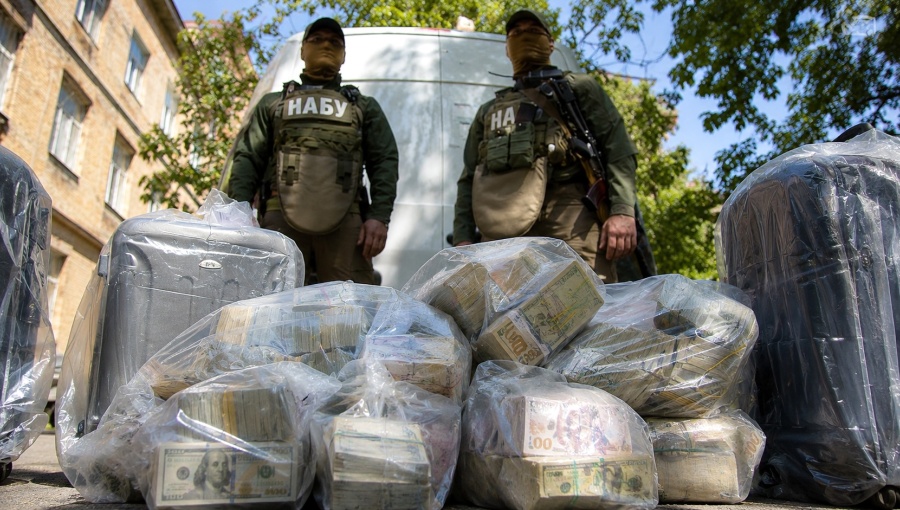
Ukraine’s National Anti-Corruption Bureau (NABU) and the Specialised Anti-Corruption Prosecutor’s Office (SAPU) have said that Zelensky himself is not under suspicion.
But the mention of a “Vova” – a common diminutive of Volodymyr – in a leaked wiretap transcript of a conversation between Mindich and an unidentified woman about the Kozyn construction project has raised questions about just how deep into the president’s circle the corruption has spread. Sitting presidents are immune from prosecution by Ukrainian law enforcement – though they can be impeached if evidence of wrongdoing is found.
To better understand the significance of this sweeping investigation, FRANCE 24 spoke with Andrii Biletskyi, the administrative director of the National University of Kyiv-Mohyla Academy’s Anti-Corruption Research and Education Centre.
FRANCE 24: Just how significant is this latest development in the corruption investigation?
This is the continuation of the “Midas” operation that started last year, and which was one of the reasons why Yermak was fired from the presidential office. And we have different camps, to be honest, because some people were saying that Yermak was on these Midas recordings, and some people were saying to be careful, that he wasn’t there, it was impossible.
There are different views on this Midas operation, because some people are more sceptical about it – they are saying that this is just a political battle during the war. And some people see it as a positive thing, because it means nobody is untouchable and the anti-corruption authorities are doing their work.
Ukraine: Volodymyr Zelensy's former top aide arrested as corruption probe widens
I think it's a test not only for anti-corruption authorities in Ukraine, but also for the government and the country in general. Because the Ukrainian law enforcement system has never seen an official or ex-official of such a high level being prosecuted or being brought to criminal responsibility.
So, it's really a test for anti-corruption authorities to finish this task, or at least to bring this case to court. And for the Ukrainian government, it's a test whether to help Yermak to escape the responsibility – whether or not to interfere or to let the case go and be whatever it's going to be.
But it's really a dilemma for them, because the government needs to understand whether they want to lose their ex-friend, or current friend, Andriy Yermak, and just forget about him. It's really a struggle for them.
But for Ukraine in general, this is a huge case, and we've never seen anything like it.
FRANCE 24: With several close allies of Zelensky under suspicion, what impact is this investigation likely to have on the president’s own support?
Politically speaking, if we're talking about his personal ratings, he is going to be losing support. Not a lot, because he didn't interfere, he didn't comment on the situation, he didn't protect his close ally, or ex-ally. So it’s a manageable situation.
On the other hand, people still rate him because he's a war-time leader, and he is protecting us, he's the higher commander-in-chief, right? So it’s bit into his ratings, but not as much as it could have, for example, in normal times. Because if not for the war, if we had seen such a scandal, it would have been political suicide for him, and we would just be waiting for the opposition to come to power.
FRANCE 24: As someone who’s worked for years in the fight against corruption, how do you see the importance of Ukraine’s anti-corruption authorities being able to undertake an investigation of this magnitude?
For me personally, it's a positive sign. We as Ukrainians, and my colleagues from the anti-corruption centre, we have to talk a lot about how Ukraine is not really corrupt – we have a lot of corruption cases not because we have a lot of corruption, but rather because we have this system in place which can expose this corruption, and which can bring people to responsibility. Because of the fact that we have an independent system, which is not interfered with by political actors, they can do their job properly in a normal way, and they can expose a lot of corruption.
Of course it is [easier] not seeing corruption and not caring about it. When we don't have a lot of corruption scandals in the media, we don't know about them, and we simply don't care. We think of ourselves as good guys, and we think, okay, corruption is at a low level – if it's not being exposed, we have no problem with that.
So it’s really positive. Probably you remember that last year in July, we had huge protests in Ukraine during wartime because the government tried to neglect the procedural independence of the anti-corruption authorities. And a lot of people, a lot of young people, actually came to protest against this decision – and they won, because the government rolled it back.
And it was important for people to see that they did the right thing, so that they could see that they fought for the independence of something valuable. And by this investigation, NABU and SAPO are showing those people that it was the right call.
FRANCE 24: One of the more unexpected details of this three-day hearing has been the allegation that Yermak ran potential government appointments past an astrologer. What kind of reaction has that sparked?
Of course it was quite a surprise to hear that the chief of staff, the head of the presidential office, was consulting an astrologer for governmental appointments. It was really a surprise – I mean, it was ridiculous to hear that he was sending the birthdates of potential candidates.
It not only affects the reputation of Andriy Yermak himself, because he was already seen as this “shadow cardinal” in the office of the president, but it also brings a shadow on the presidential office in general, and the governmental system in general.
Because people have to know whether all the appointments have been going this way or not. It’s also that a bad thing for the public service in general. It was really ridiculous to hear.
This interview has been lightly edited for length and clarity.
Moscow Struggling To Find Extra-Budgetary Funds To Complete Already Announced Icebreakers – OpEd
Moscow often announces that it is going to build more enormous icebreakers to ensure Russia controls the Northern Sea Route, but these are seldom completed on time or even at all, the result of problems with Russian yards and increasingly budgetary stringencies imposed as a result of Putin’s war in Ukraine.
Two tariff arrangements are now under discussion. One would impose tariffs by the ton on cargo carried on the NSR rising now and then falling a few years from now, while the other would impose a single cargo tariff per ton of cargo on all ships using Russian ports. It is unclear whether it would be phased out or not.
Rosatom, the government agency overseeing such projects, says the discussion of imposing such tariffs has been under discussion since 2019, an indication that powerful shipping interests are opposed even though many in the Russian capital want to see the icebreakers completed as a matter of national pride.


_1.jpg)